← Texas Family Law Insiders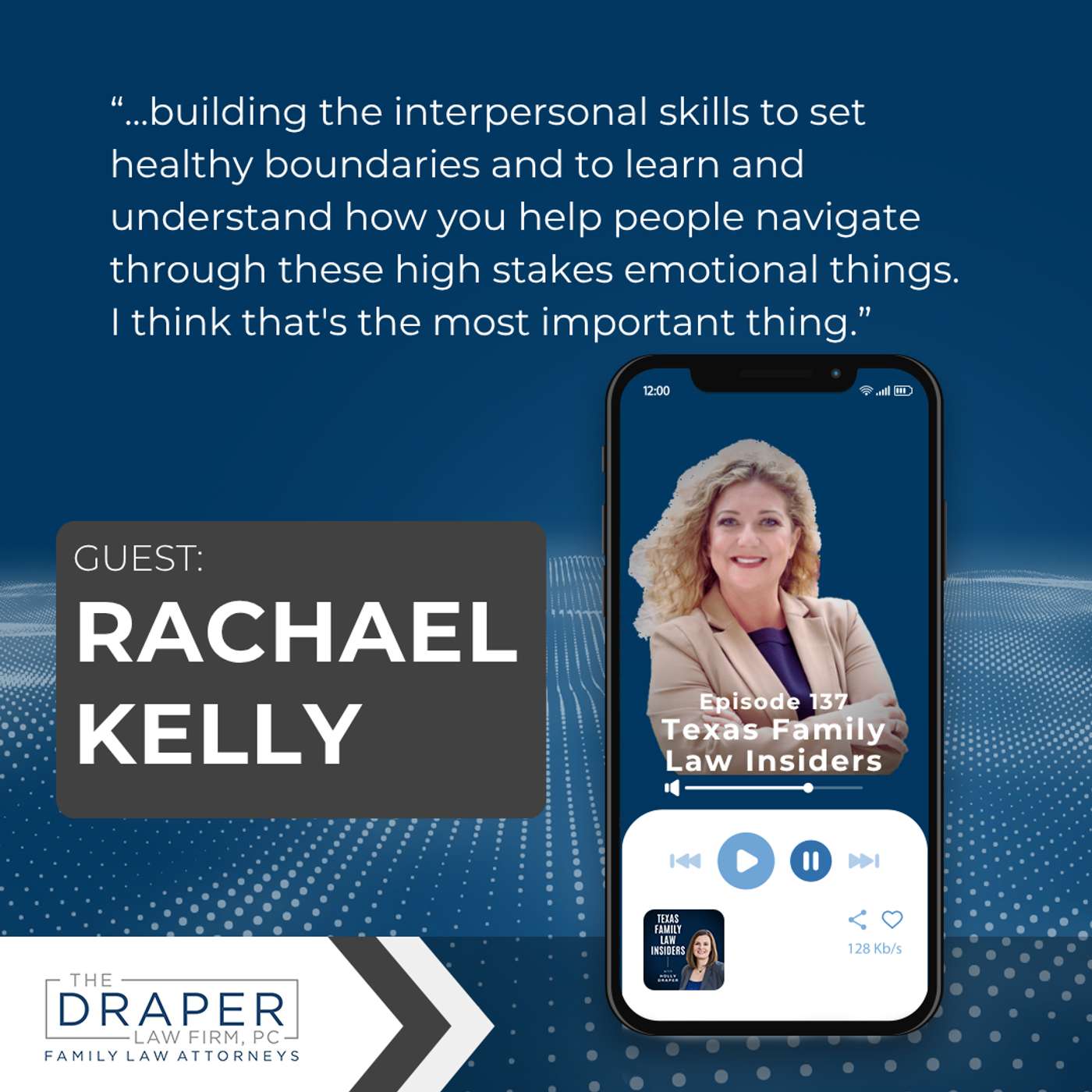
Texas Family Law Insiders
Rachael Kelly l Episode 138: Making Mental Health Connections to Improve Client Outcomes in Litigation and in Life
00:40:30
Loading summary
Transcript58 lines
- [00:00]
A
Part of navigating and helping your client truly is oxygen mask on you first taking care of yourself so that you can show up curious and composed.
- [00:14]
B
You're listening to the Texas Family Law Insiders Podcast, your source for the latest news and trends in family law in the state of Texas. Now here's your host, attorney Holly Draper.
- [00:28]
C
Today, I'm excited to welcome Rachel Kelly to the Texas Family Law Insider podcast. Rachel is the founder of Hive Enterprises, a multidisciplinary platform dedicated to breaking limiting cycles and unleashing human potential to achieve systemic impact. Through Hive Smart, she works with leadership teams navigating growth and complexity. Through Hive Health, she supports individuals during high stakes life transitions. And through Hive Strong, a nonprofit, she helps survivors rebuild their lives. Her work sits at the intersection of business, personal transformation, and systemic change. 100% of her business's consulting profits fuel their philanthropic arm, Hivestrong, which empowers survivors of abuse, violence, and trafficking through safe communities, personalized support, and pathways to independence. Rachel is also the author of From Trauma to Finding youg Way out the End. Thank you so much for joining me today.
- [01:25]
A
Thanks for having me.
- [01:26]
C
So why don't you start by telling us a little bit about yourself?
- [01:29]
A
Yeah, happy to. My background is I kind of worked my way in my early part of my career through large, complex organizations, starting on the front line, through executive roles. And as I worked through those roles and worked and led through numerous crises in the business world, and then combined with my personal life and things I was going through, I just really realized how human beings going through transition, what that looks like, and how it's very universal in different situations. And therefore the ways that you can help people through that is more universal and just saw a lot of gaps and people falling through gaps in systems. And so we really were born to help close those.
- [02:13]
C
So what led you into the nonprofit space, specifically helping survivors?
- [02:18]
A
Yeah. In 2020, while leading a restaurant company as the head of HR, chief people officer through the COVID crisis, which we all know is pretty dramatic, especially in that space, while simultaneously navigating out of my own toxic situation and navigating a divorce with young children, I was really struck with how those two things, like the things that I ended up doing to navigate myself and my family through, were channeled and were the same things that we did and brought forward to help that organization and the human beings navigate through. Because there was just the safety net, wasn't there? And people fall through the cracks so much like survivors do. And I saw in my own experience the benefit of having the systems, the resources, the expertise to navigate certain things that so many other people didn't have and the difference that made in the outcomes and that children pay the price oftentimes. And so after navigating through that, navigating and getting through mine, and then starting to help other people and test different ways, after I spent a couple more years in the business world, I decided I wanted to pull back and take some time and focus on helping other people break those cycles. And that's what led us here. And ultimately Hive Enterprises was born.
- [03:45]
C
And so you're not an attorney, correct?
- [03:47]
A
Correct. No, I'm not, no. We love working with attorneys.
- [03:51]
C
So then what is your background?
- [03:54]
A
Yeah, so my professional background is in operations and HR for global public and private equity backed organizations. Spent many years in restaurant industry. And so my expertise is in business and leadership and navigating human beings and putting systems in place to navigate complex situations. So in this scenario, very much what we do is similar, right? We help people. And the non legal part, we are not attorneys trying to practice law at all. We deeply respect that expertise. And what we do is partner with attorneys and those clients to help the attorneys be able to focus on the legal strategy and we help with the, you know, navigating the mental health support that they need, the financial resources that they need, the other life things that are so critical to somebody navigating through those situations. That's what we focus on.
- [04:54]
C
So you and I have worked a little bit together in that vein and with our firm helping out with clients that come to you. And you said something to me just in an email one day about the importance of having attorneys that are trauma informed or something along those lines. And I thought, you know, that might be a really good topic for a podcast. And so here we are. And you know, I thought we could chat about some issues that will hopefully help family lawyers in dealing with clients who have experienced trauma, whether that is in their relationships, which happens a lot obviously in family law or some other realm of their life that is impacting their family law matter so that we can all provide better service to these clients. So to start with, how do major life transitions such as divorce impact decision making, leadership and overall stability for survivors?
- [05:52]
A
It has a huge, huge impact because situations where family law attorneys become involved are very high stakes and they're very emotional. They affect people's entire lives, their finances, their family, their sense of identity. And that is very destabilizing. It's one of the most destabilizing experiences that a human being can go through. When that happens, human beings are not functioning fully in their executive functioning. They are threatened at that secure, that base security level. So the nervous system starts to get out of whack, and people aren't able to see things clearly. They might be more volatile or emotionally reactive or not thinking things through makes it very hard for human beings when their nervous system is activated that way. No matter, by the way, if you're a CEO of a company attorney, a human being going through this, that is going to impact your ability to think clearly, your prefrontal cortex. So there's ways that you navigate to help people ground and center, and some tools that we help people with as they're getting through that. Because it's really hard to make a strategic decision about things where you're deciding between bad and worse often.
- [07:16]
C
Right?
- [07:17]
A
And it's like, okay, this is. Not everybody is stressed, and this is hurting people. They're very hard situations, especially when you add in trauma. So people being able to think is a really big issue. And that's why we help them focus around the tools that help them to get kind of back online so they can navigate.
- [07:37]
C
So you mentioned trauma. How does trauma from an abusive relationship compound the already destabilizing effects of divorce?
- [07:46]
A
It's significant because when you're going through and coming out of a toxic relationship, that shattering, that destabilization is even more significant. First of all, in 99% of these cases, there's financial control involved. So your level of autonomy empowerment is very low. Right. And you're very afraid of your ability to sustain yourself and your family. So there's a fundamental fear. And so your level of activation is even higher. And when you're in those situations, they're usually not a, oh, this happened. This was a singular incident. So I need to, you know, there's an incident that I'm recovering from. These are years and years of cycles and neural programming that includes this cycle of highs and destabilization and lows. So their nervous system is constantly on high alert, very hypervigilant. So for survivors, when dealing with, like, an attorney in this situation, their reactivity can be really high. And you might see reactions that you're like, whoa. Because they're. They're. They're trying to navigate these neural pathways that have really wired them up to be on edge and paranoid and highly emotional and. And also, I think there's sometimes a need for justice, right? Like the sense of I've been wronged. Like, especially when you go. When you're first going through that awakening and you're realizing, oh my gosh, this happened to me. Like, I'm not crazy, right? Because you've been gaslit and you're like, oh my gosh, I don't believe it. And then you like, oh my God, this happened. And then it's like, this happened to me. You know, fight for me, believe in me. And then there's a journey of going, no, this isn't law and order. You know, the attorney is not your savior, right? You are your savior. And this is about navigating to what your true north is. And like, what is it do you really want at the end of this, what's really important and helping them through that. But it really has a more dramatic impact on their nervous system. And they're very awkward as they're coming out of those cycles and trying to rewire their own brain while navigating these high stakes situations.
- [10:00]
C
So as attorneys, how should we adjust our approach in dealing with someone who is maybe not very rational because of domestic violence or trauma that they've experienced?
- [10:13]
A
Yeah, I think one of the first things is take care of yourself as attorneys. Navigating these, you go through vicarious trauma too. You absorb that energy and so that caring for yourself and grounding of your nervous system and self care and recognizing your own. You guys have cortisol adrenaline going, right? Like you're navigating through that. So a big part of navigating and helping your client truly is oxygen mask on. You first, taking care of yourself so that you can show up curious and composed and holding a, what I call a safe container for people. That's part of it. With the right boundaries as well. Right. Because you've got to have those boundaries with clients. That's first. The second is showing up curious and compassionate. Instead of asking, why is this person behaving this way, ask what is this person experiencing now how do I help them walk that and process through that to get to the other side? Particularly when dealing with some of these legal things that come up and they're hard, right. And you're having to tell them really bad news often. So pausing and asking, what are they experiencing? So I can then help them process through this cognitively knowing what's going on. That limbic system, the lizard brain, I call it. Right. Is really activating my voice is going to get calm, I'm going to take breaths, I'm going to pause, I'm going to ask what they think. I'm going to encourage their autonomy and agency where I can through this and help them find that as they're going through this, that presence and that energy is so important, it literally can change someone's life as they're going through this, that they know you're there for them, you believe in them as a human being and that you're wanting to help them navigate through this the best that is possible.
- [12:28]
C
And something you said earlier about what's the end game versus justice, One thing that I personally and everybody on my team try and focus on is not revenge or fighting, but how can we get you to the other side in the best possible place? And that usually does not involve going to court. Sometimes you have to. There's no choice, there's danger. The other person is so unreasonable that there's no hope. But I think most of the time it's very effective.
- [13:04]
A
Yes, absolutely. And going through the emotional process of getting to that place where you can get to what I call. I call it Bobby Fischer mindset, right? Which is get 10 steps ahead here. What's really important. What are you really trying to get to? What's your true north? What's important? I'm free. My kids are free. We have what we need to start afresh, right? Sometimes it's just we're free and that's it. And that is all that matters. Helping them to really visualize that and then jump ahead so that they're not getting caught in this back and forth and this tit for tat thing, that's really not about the kids. It's about this energy, power dynamic. So I think working with attorneys that are that way, right? And then we often will work together with people because we'll help them process that other energy, right? We're like, okay, well, let's. We might need to do a little sound bath and we get the sound bowls out, right? Or we might do a little ritual that I call and we might be burning some pictures, or we might be, you know, doing some cathartic exercises, or they might need to do sessions with the trauma coach. Or we need to get them into the right trauma therapist to help burn that energy, because that comes from a place of hurt and pain that you can't ignore. But that needs to be a clinical, strategic, well thought out, methodical plan. So there's a space for that energy. But how you help them process it and harness that effectively is the key.
- [14:42]
C
When I think when you recognize that you have a client that is in this type of situation as attorneys, we need to figure out if they have a therapist, if they have a team that can help them process and deal with it. Because even though they call us attorneys and counselors, we are not counselors in the therapy sense of the word. So I think it's really wise for attorneys to encourage people to seek that help. And, you know, as attorneys, we should be networking with the people who can help so that we know who's good and who we can send them to and all those things. Because having that team is really going to help, and it's going to keep their legal fees down when they're not trying to use us as their therapist.
- [15:32]
A
Absolutely right. And then it helps you in your own practice because, you know, there's a training that happens with, like, doing that therapy. Right. Like, there's training we go through as coaches, and we actively work to manage our own energy and boundaries and how we show up so that we can keep showing up for our clients and navigate them the right way. And so knowing, like, hey, this is your space. Right. And people need these things. So building, having the ecosystem that getting people to trust the professionals that can do that work is really, really important for the trajectory of the case and the outcomes. Absolutely. Oftentimes we'll do some of our trauma coaching with our trauma coach will be like helping somebody get ready to go to therapy. They're like, I'm not ready for therapy, because not everybody wants to do that. Right. They can be a little resistant sometimes. So we'll do some coaching, and then that helps them get ready, and then we transition them to a therapist. So super important to get the right help.
- [16:34]
C
We mentioned divorce as one type of transition that people go through, and I know there are others. What types of patterns have you seen showing up across different types of transitions?
- [16:47]
A
You know, interestingly, and I didn't expect this, but the through line is very similar, whether it's somebody going through a divorce, exiting a toxic situation, and what's happening with their brain and how they need to navigate through that is very similar to a CEO who's facing board pressure, team pressure, needs to transform their business, rebuild the team, et cetera. The same change process in their brains happening. So it's an. It's a very interesting pattern that we see between trauma and change management in the workplace. Same thing with professionals who are trying to build their own practice and build the right structures, and they're navigating these transitions. Where there's not perfect answers, stuff goes down that's not ideal. There aren't the right resources. Things are on the line. Your identity, your future, the kid's future, et cetera. The same internal human process is happening. So interestingly, what we do with businesses in terms of helping people to ground, get strategic drive, clarity, showing care and trauma informed compassion and how we're navigating these really difficult things, those are the same patterns. Whether it's a billion dollar organization or it's a woman fighting for her and her kid's life. It's fascinating. But we're all human. So that's truly, that is the pattern that we see across.
- [18:17]
B
This episode of the Texas Family Law Insiders podcast is sponsored by the Draper Law Firm, providing family law appellate representation for non parent custody cases, jurisdiction issues, property division, standing conservatorship, possession and access termination, parental rights and grandparent access. For more information, visit DraperFirm.com or call 469-715-6801.
- [18:44]
C
What are the most common behavioral patterns attorneys might notice?
- [18:51]
A
That's a really good question because the thing about trauma and abuse, it is, does not discriminate. And people can really look like they can present very well and mask very, very well. And then something happens and they behave like in a way you're like, that's kind of strange. Why are they flipping out over this thing all of a sudden for no reason? So you might see like a moment of like emotional volatility and high reactivity in a conversation with, or spinning and ruminating where they just spin out and cannot let go of a certain thing and it spin, spin, spin, spin, spin. And you see their thinking is really clouded or they stop making sense. Or you see somebody starting to shut down where they're just, they're just, they're giving up or they're, they're shutting down or they're just being agreeable. When you see some of those types of behaviors, particularly the emotional volatility part, that's a sign of trauma and there may be additional support that's needed to help that person navigate.
- [19:59]
C
So if we see those patterns, we see someone who's spinning out, we see someone who can't make a decision or who's, what's the right word?
- [20:08]
A
Shut down, paralyzed.
- [20:09]
C
What should we do?
- [20:11]
A
The first is kind of what I was talking about, right? Like the great thing about being trauma informed and those pieces of showing up, you know, asking open questions, checking in, asking how they're, you know, about how they're doing, how they're navigating, creating psychological safety around, hey, it's really important as you're navigating through this that you have your ecosystem of support as you navigate. Sometimes there's a lot of shame involved in how people are thinking and functioning, right? And so creating psychological safety by just talking to them about, hey, here's what goes happens when human beings are going through this kind of journey. And it's important, it will increase the outcomes, it'll make better outcomes for you and your children when you have the right support, which includes, you know, some folks that can help you with the emotional side of this or the mental side of it. It's just going to depend a little bit on the client, right? And their own kind of Persona and how open they are to certain things. But you can create safety by talking about the experience and what it does to human beings, showing openness and calm and helping them to regulate in that moment. Co regulate, almost like you do with your children when they're dysregulated. Take a breath. Would you like a sip of water? Can I get you something? I'm here with you. You're safe with me. Those are grounding statements to co regulate and help them get back into executive functioning. And then offering the right support or creating safety for them to even consider that it's okay to do that. And in fact it's really smart to do that, it will improve their outcomes is the way I would navigate. When you've got clients that are in that space, sometimes you're going to deal with clients that they don't realize that they are in that abusive situation. They're still in the fog. Like they might even be getting divorced. I mean, oftentimes people don't realize until after the divorce. So it's, you know, you've got people that are in different phases of what I call awakening and kind of acceptance of what's been happening where they're at in their own mental health journey. You can always. And also, like, I think in firms like talk to other attorneys and talk to other professionals in this space in your network, right? And go like, hey, I got this client. They're showing up like this. What do you think I should do? How do you think I should approach it? We find that that can be really, really helpful too. Just like, by the way, business leaders would work with HR people. That's exactly what they do with their team. Attorneys can do the same in collaborating and thinking through how best to approach this particular client who seems to be struggling.
- [22:54]
C
So I know a lot of family lawyers kind of make assumptions about people who are victims of domestic violence or maybe have been emotionally and financially abused and think it's very common with somebody who is not in a position to go support themselves and leave but it's not always those people. It can be the attorney or the executive or the, you know, anyone can suffer from this. So why do you think high performing individuals often struggle the most during things like divorce or other periods of personal disruption?
- [23:29]
A
Yeah, it's really hard because high performing individuals, we're used to control and delivering and being able to navigate difficult things and ensure the outcome. And there's also an identity that comes with that too. As an executive, I've experienced it myself being like, this couldn't be happening to me, like how is that possible? I'm not da da da da da and yada yada yada. Right. Like there's a, and there's a part of your identity that's really tied to performance achievement, breakthrough, you know, whatever the professional stuff is. Right. That it's hard to reconcile that those things can be true. I've worked with and we have clients who are tall, white CEO men that are conservative pillars in their community that are being abused by their spouse mentally, physically, financially. It's very hard for them to reconcile that their identity is so strong and it feels like a failure to accept it. And then there's the, what's the fallout going to be in terms of my reputation and my profession? It was very scary to sit on a stage in front of the executives of the entire industry that I had been in and be like, hey look, you know, you guys saw me over here. But this is what was really going on. I don't know if I would have done it if I was going to stay in that industry. I was like, well, I'm leaving. So if they have a problem with that. No, it doesn't matter. Which they didn't. It actually had the opposite effect. But it's hard to reconcile my idea of who I am and what I can do and a situation where I have no control and harm is being done.
- [25:17]
C
So as attorneys, is there anything different we should be doing in dealing with the high functioning executive or whatnot as compared to the stay at home mom who's been really kept down with financial abuse?
- [25:32]
A
Yeah, absolutely. Don't assume, don't assume that they have the ability to break more than the stay at home mom. They are facing different barriers, but they are just as real. The psychological prison bars and patterns exist with them just as much as the stay at home mom. Do they have financial access and means? Sometimes. Sometimes they actually don't or they can't without having to explain a lot of things. And with a high performing executive, they mask really, really well. So the thing with those folks is to plant seeds with them that create that psychological safety. It's often what I do with those folks where I talk about how you can be an executive and these things can be happening and that as a human being going through a certain experience, this is what's normal, this is what the science is. That's why I talk about the science. I'm not an MD trying to practice medicine or law or, you know, it's about actually creating something that's like objective and bringing an objective view to people so that they can grab onto that. Because I'm more likely to grab onto, oh, this is just the science that's going on in my head and if I can learn to harness it, like high performing athletes, high performing attorneys, you know, surgeons, et cetera, that actually can amplify my abilities and it actually can accelerate my performance. So there's a, there's a benefit, you know, to those folks as well. So sometimes talking about that, sending them a certain article to read or a resource to read, getting them to the right person to talk to, that feels safe. Those are the ways that you can help those folks that you may not realize they need it, but they do.
- [27:29]
C
So when should attorneys be recommending additional layers of support to clients who are survivors?
- [27:36]
A
Anytime they don't have it in place and most survivors don't because part of that journey is they've been isolated. Sometimes they have support with family members, you know, and they've gone and they've got, but there's scaffolding that's needed. There can be law enforcement scaffolding that's needed, financial scaffolding, therapy, mental health, sometimes housing, sometimes also childcare and the things that are happening with their children and navigating that, particularly if you've got children who are special needs. So I really recommend that when you're dealing with survivors, is exploring what is their support system, their hive that's around them and seeing does it hit the mind, body, spirit, bank account, you know, those different quadrants and then where there's gaps, then recommending that they get connected to somebody in your ecosystem.
- [28:29]
C
What specific signs can we look for that tell us this person needs more than just a lawyer?
- [28:36]
A
The emotional volatility, for sure that is going to be, you know, a big sign if they are struggling to make decisions and move things forward. A good example would be like discovery or getting ready or even getting the initial information to you to do onboarding. Right. Like you've ever tried to get that stuff from people and you're like, why is this taking weeks for them to onboard? I've seen survivors lose their attorneys because they didn't get them the stuff that they needed. And the attorney's like, I can't practice. I can't fight for you if I don't have the stuff. So those are signs, right? Like, if somebody can't move forward, if somebody starts to describe things that they might not articulate abuse and trauma, but actually are like, I had one client that we were talking with her attorney, and I was like, hey. She was like, is there, you know, how's everything at? Blah, blah, blah. Yeah, it's okay. Like, no, no, no, no. He peed on you. That's not everything. Okay. Right. Like, and your attorney needs to know. That's the dynamic that's going on for a lot of reasons. So, like, sometimes in conversation, they'll say something, not even realizing, like, oh, this is a toxic situation that you're in. Those are all signs. Right? And where somebody's at and recognizing that that's an issue, those are all signs that they need help.
- [29:57]
C
How should attorneys bring up the subject of additional support without making the client feel judged or less than or any of those things?
- [30:06]
A
Yeah. Part of it is in creating that psychological safety in the relationship. So first is as you're building that relationship and showing compassion and openness and helping them to realize that you're, like, in there with them. Right. Like, you're. You're there for them and you want to help them navigate through this. When you have some of that relationship established, that's when you can talk to them and go, okay, there are some areas that are adjacent to this case that could really help you have better outcomes that I've seen or that I've experienced myself. Right. Lots of attorneys have been through divorce. Lots of attorneys have navigated people through really horrific things. So sometimes creating this safety is actually telling some of those stories in a pointed, appropriate way. Right. That helps them realize they're not alone, they're not going to be judged. Right. And that it's okay to get this help. Oftentimes with people, that's how we start, is just share. I just share the stories. And then they're like, oh, oh. And they might not even bite right away. It might be like, the next time that you talk to them, they're like, oh, wait a minute, I really need this. So first is the trust, and building the trust and creating that safety. You share some of the stories and the success stories and talk about how leveraging these other areas of scaffolding is smart strategy and that they deserve it, their children deserve it. That's a really important one. Their kids deserve it. Even if they think, well, I don't need it. Your kids, you know, this is about how we, how we help them navigate this. Right. So those are some of the techniques that we use depending on the person. Now if this is a high powered executive, I probably wouldn't say, hey, you need to go talk to a therapist about your mommy issues. Right. Like you don't do that. Right.
- [32:03]
C
They might need that though, sometimes.
- [32:06]
A
Oh, they need it the most. Absolutely. But you know, it's like, hey, look, I think, you know, it would be helpful to you to talk to somebody who could like really help you strategize and you know it's going to be less expensive or even free. Right. Versus my time, which is going to X amount. Right. That can help you like really think this through and strategize something. Right. It's more performance based with them than a wooing thing. Right. So it just depends on, it depends on the client and you guys know who, you know, who they are and what makes them tick, you know, but. And then just bringing it forward in a way that they can hear.
- [32:44]
C
So we've kind of talked about this a little bit, but let's dive a little bit more into the types of support systems that can be implemented to work together to create better long term outcomes for these people. Maybe start with walking us through the ecosystem of support options.
- [32:58]
A
Yes, absolutely. So there are numerous from a mental health standpoint, which is one of the really important, important pieces. There are ways to get connected with trauma, informed therapists, therapists who will work on a sliding scale and therapists and coaches who will work even pro bono. You know how strong we do it pro bono with survivors. And there are other organizations from a domestic violence. There's the national hotline, there are transitional housing available. There's workforce things that are available. There's several different, like they're fragmented, but they do exist in terms of things that will help people depending on what type of help that they need. Mental health is huge. I think the financial is huge. So. And there are financial counselors in tools out there that will help people who, particularly if you've been financially abused and you're really like insecure about your own knowledge or what you have or even talking about that stuff. There are financial counselors who absolutely will help you navigate through that, help figure out how to navigate debt, figure out housing, which leads me to my next one, which is housing Options, that's another area to help people with. And there's a lot of different things that can be done. Sometimes it's just helping somebody to think through. Sometimes it's getting people together into the right housing together that they can afford. Sometimes it's negotiating for them, or sometimes it's helping them with the contracts and understanding. Right. Because it's truthfully, when people's executive functioning is depressed, they can't read. It's really hard to process that stuff. So there are services, including ours, that will help people just think it through, plan and project, manage, you know, stay on track with the steps that it takes. There are also career. There's everything from training people in new skills to apprenticeships, to helping people with interview and resume prep, to networking and getting people connected with people in the fields from where they are wanting to go or that they work. So there are scaffolding really that is whole human to support people as they're navigating, depending on what they need. Sometimes we see people need law enforcement help. They need somebody to like, show up with them at the police department, asking certain questions with them. That's okay, right? Like, so that help all exists. People are not alone.
- [35:26]
C
So how does Hivestrong fit into that ecosystem?
- [35:30]
A
The way that Hivestrong works is that when a client is referred to us, whether it be somebody we know or an attorney, or they find us online, they come in and do intake with a client care manager and advocate who kind of assesses and figures out with them what's going on, what's the situation, what is it that they need help with. And then they collaborate with our hivestrong team and we basically go, okay, so this person needs. They need some sound healing. They need trauma coaching and a trauma therapist referral. They need an attorney referral. Sometimes they need the consult with the attorney. And we fund that consult because they can't do that otherwise. Right. Without getting known what we do, we're like the connective tissue. It's where are they at? Where are they trying to get to? And then we bring in the team and the resources around that connected to them, and then help them onboard navigate those steps. And then we stay with them for the long term. So oftentimes we'll have clients that will start with those things, then they'll navigate through their divorce. And then when they're ready, we start helping them with their career pieces. And sometimes people apprentice with us, sometimes we help them with their stuff that they're working on and help them get connected to jobs. So. So it's walking. We walk with people along that journey for the long term.
- [36:48]
C
So how can attorneys work together with these various other support systems to help guide clients through litigation?
- [36:57]
A
Yeah, that's a great question. I think one is doing exactly what you're doing. You're doing, right? Is that we all, just those of us who are in this space, connect and go, okay, and test. Right. And validate each other. Like, okay, yeah, like these are safe partners. So some of it is just seeking in your marketplace where you're at. I mean, who are the partners that can help me, both the national and local that I can build networking relationships with and we can establish a referral relationship with. That's really, I think, one of the main ways that you can help that you guys, you know, that attorneys can come together. I think there's also a lot of, you know, as we spend more time in family law, which we're starting to, I think that there are opportunities that are happening, I think, in the community, right. There are different conferences that are talking about how do we make things less adversarial and better for kids as we come through this. Right? Like, they're thinking about how to help people through this, these very difficult things. And so I think there's a broader community piece, that there's some openness, I guess it feels like, for some space for people, for leaders in the community to lead that and say, hey, let's, let's get together around how we can, how we can help our communities. Because at the end of the day, the kids are the ones that really feel this and are impacted and that trauma becomes generational and that's the cycle we really have to break.
- [38:32]
C
So we're just about out of time. But one question I like to ask everyone who comes on the podcast is if you could give one piece of advice to young family lawyers, what would it be?
- [38:43]
A
Care for yourself. I know it sounds silly, right? But like, it's really not. And I know, like going through school, like the law, it's beautiful. The work that you guys do is so beautiful. And it's hard and you have to say objective and it's very right, like, and so respect that. What you're going to be dealing with takes energy. It takes a lot of energy and bandwidth. And so building the interpersonal skills to set healthy boundaries and to learn and understand how you help people navigate through these high stakes emotional things, I think that's the most important thing. Like, I think when something happens, right, we all. Something happens. I don't think people are mal intended. Right, Everybody. You know, people want to do good when you get burned out and you know, like then you lose the capacity to be empathetic. So it's really taking care of yourself and that's okay and really important. So that'd be my piece of advice.
- [39:43]
C
Perfect. So where can our listeners go if they want to learn more about you or Hivestrong?
- [39:48]
A
Yeah, you can always visit us hivestrongempowered.com you can always find me on LinkedIn and Facebook. I'm up there. And Hivesmart is hivesmartllc.com awesome.
- [39:59]
C
Well, thank you so much for joining me today. I really enjoyed it for our listeners. If you enjoyed today's podcast, please take a second and leave us a review and subscribe so you can enjoy future episodes.
- [40:10]
B
The Texas Family Law Insiders podcast is sponsored by the Draper Law Firm. We help people navigate divorce and child custody cases and handle family law and appellate matters. For more information, visit our website at www.draperfirm.
- [40:29]
A
Com.