← TFTC: A Bitcoin Podcast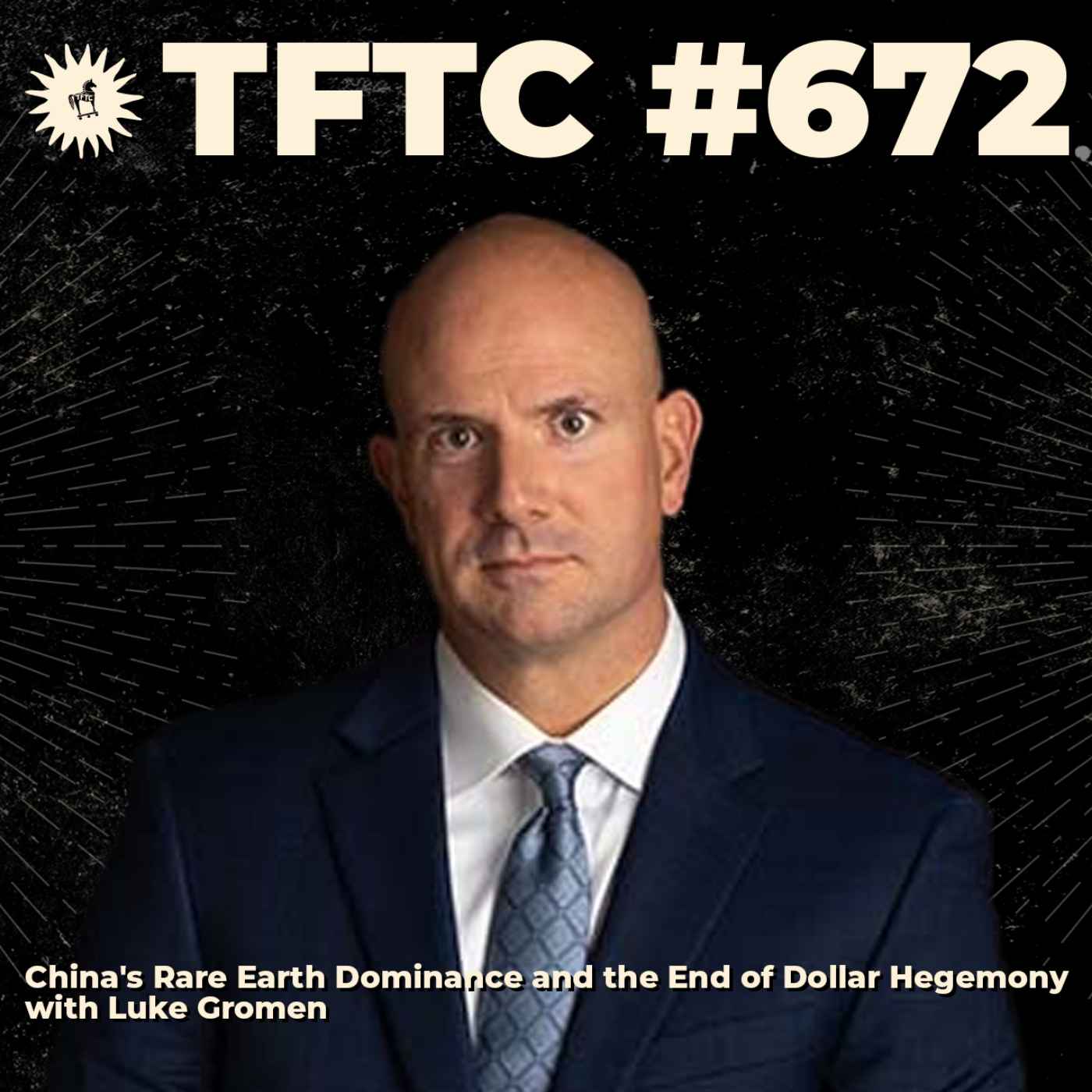
TFTC: A Bitcoin Podcast
#672: China's Rare Earth Dominance and the End of Dollar Hegemony with Luke Gromen
01:07:26
Loading summary
Transcript79 lines
- [00:07]
A
You've had a dynamic where money's become freer than free. If you talk about a Fed just gone nuts, all the central banks going nuts. So it's all acting like safe haven. I believe that in a world where central bankers are tripping over themselves to devalue their currency, Bitcoin wins. In the world of fiat currencies, bitcoin is the Victoria. I mean, that's part of the bull case for Bitcoin. If you're not paying attention, you probably should be. Probably should be.
- [00:37]
B
Look, I have to start by saying I can already tell that the comment section is going to be elated for this catch up because this is the first one where you actually have a mic.
- [00:53]
A
Yeah, I got a lot of feedback on that. And so, yeah, Mrs. Fftt was finally, she's, she took care of me here. So I've got, I've got a very, it's apparently a good one. I wouldn't know if it's a good. Well, it's the same one you got, so it must be good. So, yeah, it's, it's, it's here. So that's, that's good.
- [01:12]
B
It's, it's, this sound quality is impeccable and I think it's important that it's impeccable for this update because as you were just saying, the world is getting crazier and I think we had a stark reminder of how crazy and volatile it can get, at least in markets over the last 96 hours with Trump's Friday true social post that sent markets into a tizzy and then predictable. I recorded on Friday with somebody right after the post went out and I said, okay, we can expect a post on Sunday morning or afternoon, sort of backing off from his statements. And that's exactly what happened. For those who are unaware, Trump came out and said that we're going to put 100% tariffs on China's rare earth metals because they weren't cooperating in negotiations. And then Sunday said, hey, President Xi was, was just not in a good state of mind. We're back into a good spot. What is, what is this geopolitical volatility signal to you?
- [02:21]
A
I think it, it, I think it signals that, that China has a lot more leverage than a lot of the Western commentators are admitting. And maybe this might have been the first time where they finally admitted, like, oh, like reading between the lines, I think China retaliated for the, the, the latest semiconductor, high end semiconductor related sanctions. And basically my view was like, all right, well, we're not going to, you're not going to be allowed to have this stuff. That was the initial read. And it's interesting, Trump came out with what they said, with what he said Friday, right. Which is 100% tariffs and, you know, markets threw a fit and then the Chinese came out and clarified either a Saturday or Saturday, Sunday. I don't remember exactly when it was, but. And it was kind of like the most Chinese statement ever. It was like, you know, this is not a ban. Which, you know, in my experience is, you know, is it a ban or is it not a ban? You know, one of my, one of my best, one of my best sources on China, a friend of mine goes, is it a ban or is it not a ban? Yes, that's the answer. That's, that's how the, that's how the Chinese negotiate. So but when you really read what they said, apparently it's, it's about the weapons. You know, it's a ban on weapons. We're not going to supply rare earths to the US Defense Department to make weapons, to point missiles at us and our friends anymore. And you know, the rest of. And it was interesting because the US Spun it as, hey, they're shutting everybody off. And the Chinese said, no, no, no, no. And so then there was, you know, Trump Tacoed China tacoed or China, China backed or de escalated is spun as mutual de escalation, which it was. And I think there is still not the recognition. There was a moment of recognition in the west of oh my gosh, they can shut down everything. Which, yeah, we've known that all along. If you were honest, you know, if people are honest about the things. And not that it, not that they wouldn't hurt them too. It would. But I think the most important thing is they're done selling weapons to the U.S. defense Department. They're done selling rare earth, selling rare earths into weapons system for the U.S. defense Department, which is enormous and I think still not fully digested, you know, might be being digested by the gold market this morning, which is up 110 bucks as we speak, over $4,100 on the futures. But that's got a lot more to go, in my opinion, to properly digest that message. So I think it's really important in terms of what just transpired because they're basically saying, we're done selling rare earths into Western defense systems. Get your own rare earths.
- [05:20]
B
Yeah, it seems like China feels like it is in a good position. It seems like there's been some coordinating in the background to get to this point where they feel confident to plant these, these flags in the ground and draw these lines in the sand, if you will. And it pertains to the gold market particularly what they've been doing with the Shanghai exchange, putting the gold on warrant and it seems like at a conversation with Vince Lancy on Friday and he made a really good point, is like they're essentially setting up this parallel settlement network that settles in gold. And it seems like the last six, eight months have really been.
- [06:06]
C
Greasing the.
- [06:07]
B
Wheels, getting the slopes ready for that. It's on. And now they can posture geopolitically from a position of strength.
- [06:16]
A
Yeah, I think that's exactly right. And historically if you messed with the monetary side of the rules based global order, the US would send the military over and kick your head in. That's it has a big part of why Saddam was invaded, a big part of, of, of what Gaddafi was doing, as we know from Hillary's emails once upon a time. And the Chinese have been doing this and so they've, they've seen the message which is when we try to change, which they have to because again, they're not doing it because they hate us. They're doing it because they will literally have a late 1990s Southeast Asia crisis where China collapses like, like you saw Southeast Asia do if they don't do this. And so they have understood the order of operations which is if we're going to do this, we need to make it impossible for the US to come over here and kick our heads in. And that's what this is about. And to me, the rare earth card being played in April, May, whenever that was, and we wrote about it at the time is essentially we're done selling rare earths to the US military. That was my interpretation of it. Then this institutionalized it. This is basically, it's now in black and white. And if that's the case, then the window is wide open for the system to be reset. And I think sort of, you know, number 1A on the list of symptoms that you would see as the system is reset in a manner that China, Russia, the brics would like is I think you'll come in and you'll see the price of gold up on every day that ends in Y. And that's what we've been seeing over the last month or so today, no exception. So yeah, I think it's, I think it's a huge deal. You know, I do think that, you know, Trump with his tweets, when he's when he is, when he tweets impulsively or posts impulsively, he usually gives you something that he probably shouldn't either, or that, you know, that is incremental information. So last week, these are very serious people saying, hey, we're hearing she had a stroke. We're hearing she's being deposed. Well, Trump just told you that she had a bad day and made a mistake. So she didn't have a stroke and did not get deposed per the President of the United States and his post. And then the other thing is, we have heard chapter and verse from Trump, Besant, Lutnick over and over about how we have all the leverage. That post just told us, no, we don't. Now again, that's not a surprise per se, but that takes us from denial of the denial stage of grief about who actually has what level, what level of relative leverage into somewhere between anger and bargaining. Right. It's, you know, he threw his fit. Then he's like, well, it'll be, you know, we're not, we don't want to put shine into depression and we don't want to put ourselves in a depression. That's exactly right. We put them both in a depression. So, you know, let's, let's de, escalate. But again, I think it masks like the number one key thing, which is we gotta find our own rare earths for our own weapons systems.
- [09:27]
B
Yeah, it's, it's either that or because I had a, somebody who's very well versed on China's lived over there for 30 years, an American, and I asked him, like, what is the solution to this since the US And China gets to the table. And the US basically acknowledges that China is an equal, apparently from a social perspective, from a cultural perspective, that's what China wants most, just to be viewed as an equal. And I think with the leverage that you just described that China has over us, that may be sort of the necessary pride swallowing that needs to happen to try to figure this out moving forward.
- [10:09]
A
Yeah, I think it ends up being a really good thing for the world if, if, you know, the two big powers stop fighting. And, you know, there's a version of this that can go really well, a version that can go really badly. But I, you know, and again, it's all, it's, it's not to say China won't be hurt by this. China would be hurt by, by that as well. The challenge is that like, we know the treasury market will blow up in five to seven days, trading days, if there's a hard divorce. Whereas China probably would be able to hunker down and be all right for five to seven months. And we know that empirically because we saw it happen in April. Treasury market after Liberation Day went exactly seven trading days and then that led to the first Trump Taco. So it's all about that sort of relative dynamic. We also know from May And June, after 11 days of medium intensity combat, the US chewed through 15% of its high end air defense missiles defending Israel from Iranian drones. And you know, we, we've also heard that, you know, the Chinese can produce 4,000 cruise missile motors a week which compares to 6,000 roughly reportedly tomahawk cruise missiles and inventory total. So they can produce our entire inventory every week and a half in a very automated and very automated fashion. So with rare earths those supplies would be run, you know, would be run down even faster. So there is a, all supply chain bottlenecks are not equal. Right. You can look at, you know, what's our gdp, what's their gdp, whatever those, those metrics are interesting but in the end and things like this, it's all about the marginal metric. Right? Think about this. There was a headline FT yesterday saying the US is, the US Defense Department is out buying a billion dollars worth of critical minerals. People like, wow, that's like four times what we use every year. We're good. But I think that misses a message. 1 billion of critical minerals, 250 million a year of critical minerals of inputs which, the removal of that shuts down a trillion dollar a year. Military, most powerful military in the world. Right. It's like the old poem, you know, for lack of a, for lack. For want of a nail. Right, for want of a nail. And that's the nail in this case is the critical minerals.
- [12:39]
B
Yeah. Well, moving this back to gold with the price going up too, it was. Another interesting thing that Vince Lancy brought up during our conversation on Friday was that there's a lot of people in the Western pundit space, particularly Fintwit, that believes in the dollar milkshake theory that everything will fail up into the dollar and the U.S. treasury market. But this situation in the gold markets, particularly creating this parallel settlement network via Shanghai Gold Exchange and other BRICS nations spinning up their vaults, really throws a wrench in that thesis, which is that can potentially not happen if you have this alternative settlement network that people can leverage. And do you think the price going up, up 110 today? Many people are focusing on China specifically, but I think everybody in the geopolitical landscape is looking at what's happening right now and saying, okay, I got to get some gold, I got to get some silver. There's apparently, apparently a silver shortage going on right now. I don't know how legitimate that is, but at least the narratives out there.
- [13:56]
A
Yeah, I think Brent's milkshake theory is absolutely correct around initially gold going up with the dollar, something I posted a long time ago on X and people familiar with the Fofoa blog and the readings of monetary theorist. Another and friend of another will recall that in the late 1990s, another, another, a friend of another said that when the dollar system is coming to the end of its life, you will see the dollar and gold rise together. That will be the sign that the dollars, because people will be getting squeezed into the dollar at one hand, but they'll also be getting out and going into gold. And so when those two things are rising together, that's the symptom of the end of the dollar system. That was said 30 years ago, almost 25 years ago. And so yes, the milkshake theory will see the dollar squeeze higher. I get it. And gold as well. And gold, once it hits critical tipping point of price. And I don't know where that price is, but you can see hints of it. You know, Albert Marco on X has said, hey, above $3,000 on gold, it starts to create a problem for the dollar. He was right. Dollar went down to 96, says above $5,000 on gold, it creates a problem for the dollar and for the treasury market. He's probably going to be right. And the point here or what he's saying when he says that is ultimately, yes, there is this, you know, we've Talked about this $13 trillion dollar denominated liability out there, right, in terms of foreign borrowed dollar debt, that when the dollar goes up, it squeezes people into that. It forces them to sell treasuries, it forces them to sell us equities to raise the dollars to get that. Well, once the price of gold gets high enough, it starts to fully collateralize their dollar liability on the other side. And suddenly it starts to provide the liquidity. It starts to be the sink. And that is how you circumvent.
- [16:17]
B
The.
- [16:17]
A
Gold, is how you get out of the dollar system. And that's why another or a friend of another said all those years ago, when you see them go up together, that means the dollar is coming to the its end of life. This present form of this dollar system is coming to the end of life. Now, does it mean the Dollar's gonna die. No, I'd be using dollars. And, you know, your. And my grandkids and great grandkids will still be using dollars. It's just gonna buy us a lot less. And certainly in gold terms, de facto, we can see gold, with today's price move, has overtaken Treasuries in global central bank reserves. Right. So there's now more gold in global central bank reserves than there are US Treasuries. How do you sit there and argue and say it's not overtaking the dollar in the system? To me, that's crazy. Now, will people still use dollars? Of course. That's just Gresham's law. Right. And I hear people say, well, it's still dominant, 90% of currency usage. That's dollar dominance. Great. So you're spending. Yeah. You're telling me it's the bad currency, Right. I'll spend dollars all day long because there's a terrible store of value. But if the whole change of structure we've been talking about for years, if you watch all my posts, all my podcasts, everything I ever said, have never said end of dollar reserve status. It's ending. End of the post 71 structure of $ Reserve status, which is $As primary Reserve currency, treasury bond as primary reserve asset. It happened. It's happened. The dollar is still primary reserve currency, but gold is now primary reserve asset as of probably this morning with the $100 move. And I don't think it's ever going back unless, you know, Xi suddenly decides to be, you know, Yeltsin and, you know, sell off his country for pennies on the dollar to American, you know, corporate and Washington interests. And Putin decides to do the same thing because we can't go to war to stop him. The rare earth thing ensures it sup freaks.
- [18:27]
C
This rip at TFTC was brought to you by our good friends at Bitkey. Bitkey makes Bitcoin easy to use and hard to lose. It is a hardware wallet that natively embeds into a two or three multisig. You have one key on the hardware wallet, one key on your mobile device, and block stores a key in the cloud for you. This is an incredible hardware device for your friends and family, or maybe yourself who have bitcoin on exchanges and have for a long time but haven't taken a step to self custody because they're worried about the complications of setting up a private public key pair, securing that seed phrase, setting up a pin, setting up a passphrase. Again, Bitkey makes it easy to Use hard to lose. It's the easiest zero to one step. Your first step to self custody. If you have friends and family on.
- [19:09]
B
The exchanges who haven't moved it off, tell them to pick up a BitKey.
- [19:12]
C
Go to BitKey World. Use the key TFTC20 at checkout for 20% off your order. That's BitKey World code TFTC20SUP, freaks? This RIP is brought to you by good friends at Silent. Silent creates everyday Faraday gear that protects your hardware. We're in Bitcoin. We have a lot of hardware that we need to secure your wallet, emit signals that can leave you vulnerable. You want to pick up silence gear.
- [19:33]
B
Put your hardware in that.
- [19:34]
C
I have a tap signer right here. I got the silent cardholder. Replace my wallet. I was using Ridge wallet because it's secured against RFID signal jacking Silent. The cardholder does the same thing. It's much sleeker, fits in my pocket much easier. I also have the Faraday phone sleeve which you can put a hardware wallet in. We're actually using it for our keys at the house too. There's been a lot of robberies. They have essential Faraday slings, Faraday backpacks. It's a bitcoin company. They're running on a bitcoin standard. They have a Bitcoin Treasury. They accept bitcoin via strike. So go to slnt.com tftc to get 15% off anything or simply just use the code tftc when shopping@slnt.com Patented technology, special operations approved. It has free shipping as well.
- [20:13]
B
So go check it out. I guess. I mean, that begs the question, like, what does the US do in reaction to this? I mean, there was many they were surmising in the beginning of the year. We're calling gold in kind. Back where we were calling gold from vaults internationally into the US Seeing what China was doing and others in preparation. Obviously there was the genius act getting passed here in the United States and the Trump administration and the advisors around the administration are saying this is how we're going to save the treasury market. We're going to take advantage of the fact that the US dollar is the preferred currency globally and try to flood markets with it with this new technology in stablecoins and stablecoin issuer will have to buy Treasuries. But it seems like we've got to also at the same time expedite this reshoring of manufacturing if we want to sort of inoculate ourselves from these external factors.
- [21:12]
A
Yeah. And you know, I think the stablecoin thing can work, but let's call it what it is, right? This is, this is like you know, Operation Iraqi Freedom, right? Well, you know, or you know, the Affordable Care act, right? Or you know, when, when, when you, whenever the government names something you should sort of like assume it's the opposite of what it is and you're usually closer to the truth. And so let's, let's call, let's call the stablecoin gambit for what it is, they should have called it. We can't issue bonds at the long end of the curve, insufficient amounts at prices that don't blow up our debt anymore. So we are issuing and we're refinancing all of our debt in near cash markets. And that's what the stablecoin things about. But of course that doesn't roll off the tongue quite as nicely as the genius act, does it? So but that's what they're doing. They are issuing, they are going to finance, right. And you can see hints of it, right? When you see Besant come, you know, get sworn in and immediately double the pace of treasury buybacks that Yellen was doing, which only started in, was it May of last year, April of last year, he doubles the pace of treasury buybacks immediately relative to what she was doing. And it's all, it is heavily skewed. I just not, I won't say almost always, but it's heavily skewed towards issuing short term paper to replace longer term paper. So he's bringing in duration and then I hear credible rumblings that you know, the plan will eventually be once, if you can get enough, if you can get stable coins big enough. Right. If you can, if this can work, then you will do some form of, of, of what the US did in the 50s, which is make them not make the T bills that go into stablecoins non marketable and say yeah, they're not 4%. All, all stablecoin T bills yield 50 basis points, 30 basis points, whatever. Powell have taken control of the short end of the curve from, or excuse me, Bessant will have taken control of the short end of the curve from Powell completely disintermediated him. But we will, we will be financing massive deficits and the cost of reshoring in near cash markets. Now what would I want to own? If you can, if, if Besson came out and said we are going to reshore and I'm just going to straight print the money to pay it, what would we see? We'd see gold up we'd see bitcoin up, we'd see stocks up. And we might not see the long end of the curve go up because if he's not issuing any bonds at the long end, there's a mindless bid for duration. I don't know if it's 400, 500, $600 billion a year from pensions and liability matching. They have to buy no matter what. And as long as he keeps issuance out there below that number long and can be relatively well behaved, as we've seen, doesn't make me want to own it. They're getting killed on a real basis.
- [24:13]
C
But.
- [24:15]
A
If we saw that, that's how we'd react. If he said that, that's what we'd react. Well, stablecoins to finance large amounts of the deficit. It's just like the kissing cousin of printing cash to pay for the deficit. Why is it happening? Because it has to. That's where we are in this. Like there's no mystery. You go through the history books and these great powers that get into debt and have these big. You start at the long end and you foreigners and then you stay at the long end and you plug domestic. And then when you run out of that, eventually you end up basically printing money to finance your deficits. And we're not quite there yet, but we're, you know, that's what the stablecoin gambit is now. What else can they do? Look, if he can get the price of gold up a lot, you know, at $20,000 an ounce, if they can do things that make the market bid gold to 20,000 and you know, people used to think that was ins. But I gotta tell you, at 100 bucks a day, it's looking less insane. You know, 50 to 100 bucks a day moves on. The upside is looking a lot less insane than it was say six months ago. But if he can get it to $20,000 an ounce, which by the way, would only put it back to 1989, excuse me, it would only put it slightly above the long term average of gold's price relative to the foreign portion of our debt. The gold, the market value of US official gold relative to foreign debt, $20,000 an ounce would deposit roughly $5 trillion into the treasury general account free and clear. It's just straight money creation using gold. It's an accounting entry. Wouldn't have to sell any gold whatever, and then you could buy down a pretty big chunk of debt. He'd go out into the market, say, I'm going to, you know, either he can finance the U.S. you know, the long end needs with that 5 trillion for five years at least, probably more like eight years. Or you could just go in and immediately say, hey, I'm going to buy back $5 trillion worth of the 29 trillion out that's going to take down 20% of the market. So debt to GDP is under 100 right away, assuming a money multiplier, nominal GDP is probably going to run frigging 15, 20% for a couple years. Debt to GDP will be back to 50, 60% in a very short period of time over the backs of the purchasing power of stablecoin holders around the world. So they could, they could do that. But boy, they gotta hurry because, you know, treasure, you know, interest doesn't sleep.
- [26:40]
B
No, it doesn't. And I was telling you I've been watching some of your FFTT videos over the last few days and you're mentioning a book, I forget the name of the book. Author's first name is tobias. Talking about 1931 Germany and the parallels that exist between today and then.
- [27:01]
A
No, that's exactly right. Yeah, yeah, yeah.
- [27:04]
B
And so I think, I think you said it in the video like history doesn't repeat, but it certainly rhymes. And it looks like we have maybe not a playbook, but some history from 100 years ago that we can look at and say, hey, this is what's happening.
- [27:19]
A
Yeah, absolutely. And you know, it's fascinating between that book and the book Raven of Zurich, the memoirs of Felix Somri, which I own, which is, which is great. You know, there's a great passage from like 1912, Somary's writing, a lot of it is his. You know, him, it's his diary. As the world was completely changing, right? Like you came into 1914 with four empires and by 1980, and those four empires had run the world for like 300 years prior. And within four years, three of the four were gone entirely. The fourth was, was wounded. And the British Empire, you know, had lost 6% of its working age men in the war, you know, had lost its power basically at that point was, was a debt vassal of the United States. And so we overtook them as global reserve currency, as global. You know, it was the first step in sort of, you know, becoming the global empire. And but it's fascinating, there's this passage where Somari says Europe, which was full in 1912, full of optimism and pride and power, looked at the Chinese in European capitals with curiosity because they always weighed their money. The silver and the gold, they would weigh it. They didn't go by denomination, they went by weighing it. And they thought the Chinese were five generations behind the Europeans. They thought they were, Somari says, but in reality they were a generation ahead. They had the experience and the historical memory of inflation under Mongol emperors who'd printed a bunch of paper billions and had to suffer through the consequences. And so that's why the Chinese weighed their silver and gold money in 1912. And the Europeans thought they were, you know, they were, they were hillbillies, thought they were behind when they were actually ahead. Now stop me when this all starts to sound familiar, right? Like, how often for the last 15 years have we heard how backwards the Chinese are and how they'll never catch up and this and that. Like, like, here we are. The Chinese have been buying gold hand over fist for 15 plus years. 18 years. And what have the Amer, what is the American, you know, Wall street financiers, power. Washington laughed at them. They're not laughing now, are they? They're not laughing at all. I think something similar is going to happen.
- [29:48]
C
Sup, freaks? This rip was brought to you by our good friends at Obscura. If you've been listening to the show long enough, you know we care deeply about privacy. Particularly as you peruse the web, it is important to be using a vpn and Obscura is our VPN of choice. That is because it is a VPN built by a bitcoiner. For bitcoiners is the first VPN that can't log your activity and outsmarts Internet censorship. Obscura VPN works even in the most restrictive Wi Fi networks where other VPNs simply fail to connect with server locations across America and the globe. Obscura keeps your Internet access unrestricted wherever you are. I've been using it since it launched. I see no problems with speed. I can get on YouTube TV without any problems. It simply works. They can't log. You can pay in bitcoin. Go to obscura.net use the code TFTC25 for 25% off an annual subscription. It's already a good deal. Their annual deal. The TFTC 25 code gets you 25% more off.
- [30:35]
B
Go check it out.
- [30:35]
C
Obscura.net use the code TFTC25. Supraks Healthcare open enrollment has started. It will roll through the end of January. Opt out of traditional health insurance, which doesn't care about you.
- [30:44]
B
It's impersonal. It's expensive.
- [30:46]
C
They deny an increasing amount of claims. Premiums are going up.
- [30:49]
B
You don't have to live this way.
- [30:49]
C
You can opt. I opted out four years ago and joined crowd health. I've been a crowd health member, a very happy crowd health member for four years. I've had two children, a couple of health events in that time period and crowd health has been there. You pay a monthly fee, you contribute to the crowd. We were paying $1,800 on Cobra as.
- [31:04]
B
A family of three.
- [31:04]
C
Now we're paying around $900 a month as a family of five. And that's with crowd health and direct primary care. You can opt out of health insurance. Go to joincrowdhealth.com TFTC you're gonna get $99 a month for the first three months if you use the code TFTC. Join crowdhealth.com TFTC Sup freaks? This was brought to you by good friends at Unchained and they are holding another live event that you should check out. Markets are choppy, layoffs are in the headlines, and rate cuts aren't fixing the core problem. That core problem is that the fiat retirement system is taking on Water. On October 28, Mark Moss and Unchained Jeff Vandru will explain why 401ks were built to serve the system, not you, and how fees and hidden risk create an illusion of wealth. You'll learn why bitcoin security and growth curve make it a powerful long term savings asset and how a Bitcoin IRA can let you roll over an old 401k with tax advantages intact. If you want a retirement plan that prioritizes sovereignty and purchasing power, this is the event. Register now at unchained.com/TFTC unchained.com/TFTC I think.
- [31:57]
B
The only thing you can call it is hubris too.
- [31:59]
A
That's right. That's exactly what it is.
- [32:01]
B
Yeah, like not only from a monetary and economic perspective, but from the military perspective. We've been beating our chests like we're the biggest, strongest military that's ever existed on the planet. China will never be able to catch up. But you threw that stout stat out earlier. They're able to build, what is it, 4,000 tomahawks per week.
- [32:21]
A
That was, well, not tomahawks, but that's from David P. Goldman, who's a very good source on this stuff at Asia Times. He wrote two or three years ago, he said that they can reportedly make 4,000 Cruise missile motors a week.
- [32:34]
B
Cruise missile motors. But that then you look at the advancements that they've had technologically with Automation. I think many people in the United States are looking at the drone technology specifically and saying, oh, that's pretty scary. And you go back to they own the rare earths, which is the raw input of everything we need. And it's. It's very perplexing that we are still beating our chest in this way and not showing a bit of humility, like, okay, we messed up. And it does seem like the Trump administration has recognized holy crap. Or behind in a lot of ways to China. But I think they're focused on energy in AI specifically, which, rightly so, I think they should be. But militarily, things aren't looking relatively good for the US Right now either, as it pertains to China. And it's just like, all right, when are we going to swallow our pride, take the hard medicine, and recognize, like, hey, we need to show these. These Chinese some respect, because you do not want to go to the kinetic warfare route with them. I don't think. Because Andrew's CEO was on a podcast with the 16Z guys last week, and he was saying. I think he referenced this into the. Some of the missiles we supplied Israel earlier this year. Like, we can. If five days worth of depleting missiles in war takes two years to build back that supply. Which is astonishing to me.
- [34:10]
A
Yeah. There's a great quote from US Marine Corps General Barrow. Amateurs study tactics. Professionals study logistics. And we've been more focused on tactics, and they've been arguably more focused on logistics, which we can say because two and a half years ago, the CEO of Raytheon was quoted in the Financial Times saying, you know, we literally can't go to war without Chinese components, and it will be many, many years to try to replace that. They know it. Who let that happen? Why did that decision happen? You start pulling on that thread, I think you're gonna get some really unpleasant conversations. And that gets into politics that, quite frankly, I don't want to be involved in, because I. Yeah, I'll. I'll just leave it at that. But. But the hints have been there. It's. It. You really said the right word, which is hubris. There was. There was a. There's an author, guy named Andrei Martyanov, who was a former Soviet engineer, I believe. I believe he was in the Soviet military when the Soviet Union collapsed. He came here and he advised the US military on all sorts of missile technology, et cetera. And he began writing some books a few years back, the Real Revolution in Military Affairs. And most recently he wrote one a year and a half ago. That was published called America's Final War. And the overall thrust of these books was, number one, there is very much a. There's a very much a science to military. Military sciences, I believe, is a thing. And you know, you can run a calculation of, okay, how much growth, how much steel can you produce? Produce. How much iron ore can you produce, how much copper can you produce? What is your aggregate BTU output of your energy electrical grid, how many engineers are you graduating a year? What's your manpower? All of these things, you know, can be put together into a calculation that it gives you some level of understanding of the ability to prosecute war. It's a measure of power, hard power. And in the first book, he laid out like the Russians were so far ahead of the US in that already that it wasn't even close. And I think people, number one, I don't even think he could get it published in the Western press. So he went with an independent publisher. You can buy it on Amazon to America's credit, right? It's not censored, but you read that, you go, huh, interesting. And then we got a test of that in places like Ukraine, in places like Iran and Israel. And what you find then is what he lays out in America's final war, which is America doesn't have enough of an industrial base to prosecute a major war. And the industrial base and installed capacity it has is all in the wrong things because the nature of war has changed, right? Think about what technology and I do. They allow smaller, less well capitalized participants to do things just as good with just as broad a reach as big capital. You and I are sitting here talking, you know, I was laughing the whole Jimmy Kimmel thing. Like, I was looking at his numbers. Like, I have podcasts that had better numbers. And he was getting. Every night I'm like, what? Like, look at the commercial, the new Apple iPhone commercial, right? What do they have? They have an iPhone in a case with real filmmakers using it to film. This is what technology, high level. And this is what Andrei Martianoff was saying is like, the Americans have all of this sunk cost into these weapons platforms that aren't the right weapons platforms. They're not going to fare well in war. Erik Prince, a former CEO of Blackwater, said it back in February in a speech. He said, if we sailed a carrier, a carrier group over to Taiwan to try to blockade it, we would see it on the news smoking or worse. Because it has changed the nature of warfare has changed. Drones, hypersonic missiles, et cetera. And they've Known this for at least. First time I heard about it was in 2018 at a private conference, which means they've known about this for at least 10 years, at least, and probably more. But the political reality, right, like the Philadelphia shipyards, right, historically a big naval shipyard. There's a bunch of ships being built there or that in theory could be built there that aren't the right things to build anymore. Right. But you're going to go to the senator from, you know, from Pennsylvania and go, we're going to shut down the Philly shipyards and turn it into some sort of missile works or droneworks. Come on. That's not how this country works. And that's the challenge is there's this inertia around the installed base where the incumbent has a disadvantage. And that's what we've been watching.
- [39:21]
B
Yeah, the Philadelphia Navy Yard is the headquarters of anthropology now, which is one of the favorite stores of.
- [39:30]
A
Oh, is that right.
- [39:31]
B
Upper middle class white women in the United States. But it's a far cry from where it was.
- [39:37]
A
That might be the perfect metaphor for why we can't go to war. We used to make destroyers there and now we out cute dresses.
- [39:48]
B
It's cute dresses now. Well, with this in mind, I think there has been a recognition. A lot of people have their thoughts about the sort of Silicon Valley tech elite. But I think if you look at companies like Anduril and there is a big focus on providing startup capital to industrial base focused companies. There was a company named Base that just spun up a factory in the center of Austin in the old Austin, I forget the Austin Times factory, right on Congress Ave. That shut down. Obviously Anduril's focused on drone technology and anti drone technology. There's a sort of metal fabricating startup that's based out of Michigan. So it seems like at least some part of the investment class here in the United States recognizes that we have this weakness in the private markets trying to solve these problems. On that note, if anything, are we doing right right now and where do you think we should be focusing in sort of deploying capital to fix these problems?
- [41:07]
A
What it's just when you. I think those things are the right thing to do and I think we also need to be subsidizing in a major way metallurgy trades. You know, metallurgy degrees, rare earth refining degrees, which doesn't even really exist in America. I'm told 33 different Chinese universities have them. America has zero engineering degrees. Skilled trades should all be being subsidized majorly. In other Words like, you don't pay to go to school. And, you know, you come out and you're going to be making, I don't know, more than a first year, more than a third year Wall street banker, something like that, right? Guaranteed by the US Government because you've got to get the labor there. There's, you know, as an American, why would I go, like, study really hard, not get to drink a bunch of beer when I could go into, you know, finance and come out and trade crypto and more money than someone who's actually helped build stuff? And I say this with being one of those guys that went to college and made the choice in 1993 to drink a bunch of beer and not have to study as hard as the engineering guys and make more money. Like, that's, that's the, that's what the dollar system as structure does, that is 100%. Everybody else makes stuff and then they send the money here and we move the money around and like, that's. That system is at the, it's well beyond the end of its useful life. And I say that because, like, we are doing some things right. But now, again, go back to the first part we talked about. If the Chinese aren't sending rare earth stuff here, that's like, that's the hardest part. That's the hardest part. And it takes a long time to sort of build the infrastructure for that. So, you know, we need to, we need to go to like Manhattan Project speed on that in terms of. Because, you know, it would be a good question for someone to ask Palmer Lucky Dandel, the next time he's doing an interview is, hey, if the Chinese cut off all batteries and all magnets and all rare earth inputs to what you're doing, how many things can you produce a year? And I think he's gonna, I don't think people are gonna like the answer. And I say that because we've seen stories over the last six to nine months of like, hey, we tried to build our own batteries for these drones. Not from Andrew specifically, but from other people in that supply chain in that world. They said we couldn't do it. We had to buy them from China. They weren't as good. And so it's not there. I think there needs to be some reality around, you know, this, right? That, right now I'm still seeing the bargain. Like, well, fine, we'll just do it ourselves. You know, we're America, we'll just do it ourselves. Yes, but no one, everyone's like, we'll just take A year or two. I'm like, so the Chinese did this. You know, China launched, you know, we wrote on Friday, like, China launched China 2025 and 2015. And most of Wall street laughed at them. They're not laughing now. But it took the Chinese, with all of the sort of things that they do that we have a hard time doing, right, centrally planned, some level of, you know, forcing competition, massive subsidies, closed capital account, all the things you have to do to do that. And it took them 10 years. And we're trying to do something orders of magnitude bigger with less engineers, less workforce. And, oh, by the way, an engineering and skilled trades workforce that is a declining option. In other words, it's a decaying asset because we got another six to eight years. And the last generation that was really in engineering and skilled trades, they're going to be aging out every year. So, like, we're on the clock. And so what else can we do? We have recognized the problem and we are taking some steps. We aren't nearly aggressive enough. We need, you know, I will say we are on the right path when I'm seeing stories in the Wall Street Journal about welders making 500, $600,000 a year, coming out of welding school and being able. And you know what? It's going to be inflationary. So inflationary, which means, guess what? The Fed's going to have to put the entire bond market on their books. Great. You know, that's, that's, that's how this has to go. That's what they have to do. And, you know, what's that going to do to the dollar? It's going to get waylaid. Guess what? We offshored this stuff to support the dollar. Why do people think that bringing it back can be done without waylaying the dollar? It's astonishing to me. It's the most, like.
- [45:47]
B
When you put it that way, it's very simple.
- [45:49]
A
It's very simple. It's very simple.
- [45:52]
B
And it's, I mean, as you're describing that, I'm just thinking in my mind of how polarized political landscape in the United States is here domestically. And anything Trump tries to, even if Trump woke up, he was like, all right, Luke, I hear you. We're going to go do it. The amount of backlash you would get. And he calls for the call, calling him like an authoritarian fascist.
- [46:18]
A
That is, that's the challenge, I think, too, right. Because this is like an, this is an orthogonal multidisciplinary problem. And that's, that's, we, you know, the politics of it, right? Like, half of this, you know, without getting into it, like, we can't agree on certain scientific facts. Half the country thinks, you know, you know, Dr. What's his name is. Is a national treasure. And half think he's not. Half, you know, half people, you know, the immigration situation is. There's. There's no. We are so polarized, you know, and if you get, you know, if Trump and the Republicans lose the next election, it's still going to be polarized. It's just going to be in the opposite direction. And so that's the other thing, too, right? Like people say we just need to do. We did in 1940. 1940. You had like, number one, we didn't really have a bunch of foreign engagements. We didn't. A bunch of foreign influence running Washington. We had been basically like, we had just kind of come on the national stage, number one. So we didn't have a bunch of like, hey, you can't take that money away from the war. You're supporting over here to build a factory base, right? There was no such thing. It was all focused here. Number two, you had a huge skilled trade base. And, oh, by the way, 20% of them were unemployed and had been for 10 years. So like, if, if, like, they just needed the rallying cause and we were sort of a very much more unified country. You go, oh, yeah, let's go. We can build this now. It's like apples and zebras. How different all of that is on every angle, politically, domestically. So, you know, again, I think step one is, you know, okay, we admit the problem, but now you got to be realistic, right? It's like, okay, well, I'm 500 pounds and I'm smoking and I have a heart condition. And, you know, people like, well, we're America. We're just gonna go, you know, we're gonna run an Ironman next week. And like, what are you talking about? What are you talking about? Like, the first step is like, get off the couch, stop smoking. Like, walk to the sink, make yourself something healthy, and walk back. And then next week, if you don't die of a heart attack, then you walk to the mailbox and you come back. And I mean, there's just a time aspect to this that, you know, again, if we don't have a time machine, it has. The time aspect has to be paid.
- [48:53]
B
Yeah. Almost feels like there needs to be a propaganda campaign, a good propaganda propaganda campaign to really introduce the concept of low time preference. And I think that's very disconcerting about the Current state of America is that we live in a high velocity trash economy where everything is, what did you do for me yesterday? What are you doing for me today? What's your quarterly financial saying? And basically reacting. And then it gets even more distilled to the 24 hour news cycle.
- [49:27]
A
I thought that what Besson announced about what was a six month reporting versus quarterly, like a lot of people on Wall street, oh, here comes more fraud. And I actually thought that was a really good, that's a really good idea. Like report every six months. Report every, like the amount of effort. Having been on the sell side for 15 years investment research, the amount of effort alone that is wasted on quarterly reporting is like mind boggling. You have like the most brilliant minds in America, like reading the release, getting on the call, asking the comment, hey, good quarter, guys. And like, rather than, hey, here's an idea for raising capital, here's an idea for building a factory. Here's like, it's insane. So I thought like, that's a good, like that's a good little baby down payment. But like, you know, it's like, let's keep that going.
- [50:14]
B
Yeah. Now as somebody sits on the board of a publicly traded company, like the amount of sunk cost or opportunity costs that's spent focusing on quarterly financials, it's like you finish the financials for Q1 and then three weeks later it's like, all right, let's start, let's start getting the books ready for Q2 earnings.
- [50:33]
A
It's not conducive there, right? It's not conducive to like, yeah, because, oh, by the way, as an exec, you know, you go to jail if you sign something that is, that is fraudulent or wrong. And so like your first, like, I need to make sure I don't go to jail. Okay, well, if you're thinking, I don't want, I got to make sure I don't go to jail, you're not thinking about, how do I compete to Chinese, how do I go into this market, how do I do better in Brazil, how do I, like these are the real things you got to focus on. And like we just haven't been for a long time. And it's all, like you said, it's all high time preference society, which is all around the end of the day. It's the currency. Why build a factory? Why plan out building a factory? And how do I allocate that capital when the dollar's moving around like this? And the cost of that capital? You can't, you can't plan a factory, Come on, you've got to have some sort of real, you know, a better currency system.
- [51:30]
B
No, I think you did an incredible service to the world a few weeks ago, really pulling on the debasement trade meme and sharing that chart of equities, real estate and I believe S and P Nasdaq in real estate priced in dollars, gold and bitcoin. And I think if we were able to really distill that message like you did and make it popular and have company execs realize you should be storing your company's profits in these better currencies and bitcoin and gold.
- [52:06]
A
Yeah, I replied to. So, Senator Sanders, Bernie Sanders had something up probably about a month ago. You can find it on my X feed about how, you know, like, I don't know, corporate greed. And something else is, you know, the reason why, you know, since 1971, all of the profits, you know, all of the gains from productivity have accrued to the, to the 1% and not to the bottom 50%. And like, I tagged him out. I'm like, with all due respect, Senator Sanders, in 1963, minimum wage in this country was five silver quarters. It was a $25 minimum wage. $1.25. It's five silver quarters. The melt value at $51 of those five silver quarters today is like eight bucks each. So if minimum wage in real money terms was today what it was in 1963, minimum wage would be five times, eight bucks would be $40. What is national minimum wage actually? Seven and a quarter. You want to know who stole the money, Senator Sanders? It's you and the politicians. You guys change the currency system. You've been there for however many years he's been there. Change the currency system back. Nixon said it was temporary. That's where it all went. You go from having to pay people 40 bucks. You imagine if minimum wage is 40 bucks, what would wealth inequality be? Corporate profit margins would be a lot lower. Sure. But corporate profit dollars would be way higher because we would be running an economy that would be essentially the version of what Henry Ford did initially, right? Which was pay his workers more than the market so that they could buy the Model T's coming off the line. So, like that's, that's the fix? That, like that's the fix if they ultimately, unless you fix the currency, you're not going to really be able to do a whole lot. No.
- [54:07]
B
It's mind boggling how many people don't recognize this at all. I'm looking for a TWEET but there's a guy, Nikita Bear, he, he just joined Twitter or X as some. He's working on their, their product. I don't know exactly what he's doing, but he tweeted out, he's like, oh, why are all these, all these golden bitcoin guys are, are preparing for hyperinflation when AI is extremely deflationary.
- [54:35]
A
I saw that post. I saw that post. And the answer is very simple. I actually think I replied to him and I think I just said, deflation is the midwife of hyperinflation in highly leveraged societies. Read the book 1931. In 1931, Germany didn't hyperinflate again because they'd experienced the hyperinflation of 1922. And so they're like, we're not doing that again. But that was one of their choices. It was either default or hyperinflate. And like, I don't think the US is going to nominally hyper inflate, but like, look, the dollar collapsed 90% against oil in 2001. Between 2001 and 2008, right? Oil went from 15 bucks a barrel to 150 bucks a barrel. That is simply the dollar collapsing 90%. The dollar was worth one tenth as much against oil in eight years. You know, the Chinese, we say, we want to compete. China can make the same or better stuff for us, 85% cheaper than us, including things like, you know, Josh. Josh Crumb. Not Josh Crumb, Josh Wolf testified to Congress three years ago about nuclear power plants. So the Chinese can build a one gig nuke, you know, one gig nuke plan for 85% cheaper than the Americans. A gig's a gig. A gig of electricity is a gig of electricity. It's not like there's some special yuan, you know, gig of electricity that gets them more or less power. It's. They abide by the same physics. So if their gig of electricity costs 85% cheaper than ours, you know what that tells me? Dollars 85% overvalued against the yuan. It's that simple. It's the same. It's this, you know, it's, it's, it's. And that's, that's where we're, that's where this movie's going. Like some version of that. If we want to compete, if we want to break, people say, well, we need to split China. Great. The dollar's got to go down 85%. That's it. Against C1. That's fine, whatever. Good. We'll be able to compete. Working Class is going to get paid. Fed's gonna have to buy a lot of bonds. But that's where this, like some version of that is where this is going. It's just, it's math, it's double entry bookkeeping. It's not like it's not. You know, the only mystery is if we decide to split with China, and as everyone's saying we're going to do, we're going to divorce China and redo this. I don't know if it's 85% down or if it's 40% down or it's 60% down, but it ain't frigging 10% down like we've seen this year. Not even close.
- [57:05]
B
No, no, that's insane. To go back to the Nikita tweets like, tech's been deflationary. I think we've had extreme tech deflation over the course of the last five, six decades specifically. And it's like, yes, TVs are cheaper. What we're doing right now is way cheaper than it would have been 20 years ago. It gets good information out to people. And despite that, the cost of living is rising. And there is just this disconnect between that fact and the ability of people to recognize like, oh, if we paired this with a hard currency, we would actually reap the benefits as a global power and economy if we were able to store our wealth in a hard currency and we can let prices fall, but the purchasing power of our hard money is going up over time as we're being more productive throughout the economy.
- [58:02]
A
It's that simple, right? People are like, oh, well, gold was. Gold wasn't so bad for America. From 1860-19, America had a pretty good friggin run. You had this huge productivity, huge technology, right? Technology is not just electric stuff, right? You had trains, you had planes, you had cars, you had all this technology, you had washing machines, consumer goods, massive deflation. And it was highly, highly productive. And good for America. Good for Americans. We were on a gold standard and some of it a blended gold silver standard. But that's the challenge. People say this tech is deflationary, and it is. But in the presence of a country with 7% fiscal deficits at the peak of the economic cycle and 120% debt to GDP and hollowed out factory base, I've said multiple times, there's nothing more inflationary than an insolvent sovereign that is printing money to keep the nominal value of its sovereign debt high. You know, to keep it, keep it nominally money good. And that's why inflation is where it is. Despite all this inflationary, you know, deflationary tech. Excuse me. It's just they have to keep growing money units because otherwise, you know, the debt implodes. And oh, by the way, the debt imploding is very hyperinflationary because the debt backs the currency. So if the debt, if the backing of the currency goes to zero or is impaired, guess what happens? That's when you really get a hyperinflation of some description as people basically dump currency to just get me something that isn't backed by bonds. So yeah, Bitcoin actually does fix this. A gold standard would actually fix this. And you can make the case. Bitcoin is able to be, you know, all the things in bitcoin start portable and verifiable and et cetera, et cetera, et cetera. Yeah, you need a deflationary currency or else, you know, we're going to kind of continue down this path we're on.
- [59:59]
B
Agreed. In the wrap up, I'll say it like I think the free market, Bitcoin is a creation. The free market is beginning to solve this. But I think even any Americans listening to this, you look at things like Square announced last week where anybody who's running a square point of sale system throughout the United States will be able to automatically convert a portion of their revenues into Bitcoin right away. And when I think about actually solving this problem, what is the walk to the mailbox for the 500 pound smoker with heart problems? It's like, okay, just if you run a small business and you're using square, maybe you start by funneling 5% of your revenues into Bitcoin and building a bitcoin treasury position for your small business. And you see what that does for you over the course of a year, two years, five years, and then you go, huh, this is better money. And you turn the dial up. And eventually when I think about ways in which you solve this problem, it's like, all right, let's not depend on the government officials and central bankers who sort of pushed us down this road to think that they're going to solve it themselves or feel the pressure to solve it without any external pressure is a bit wishful, a bit of wishful thinking. In my books, we need individual American citizens and businesses to adopt this better money and opt into it. And I think that's how we get through this at the end of the day.
- [61:28]
A
Yeah, I think that's exactly what's going to happen. I think it's really encouraging to hear things like that square, I mean it is, it is quickly becoming a matter of utmost importance. I won't go all the way to life and death but you know, depending on events it could become a matter of life and death for businesses to do exactly what you just described, which is just put a little, and individuals put a little bit into bitcoin. Because you can see what the corollary to the genius act and the stablecoin gambit to support the treasury market that we talked about earlier is you're not going to support the stablecoin mark or the stablecoin market's not going to be big enough to support the treasury market with Bitcoin at 200,000 or 500,000. He needs like million dollar Bitcoin, $2 million Bitcoin to pull along the number of stable coins, to pull along the T bill issuance. It basically we wrote it as the US the treasury seems to be standing up bitcoin de facto as a competing reserve asset to gold. And then they can duke it out. Gold and bitcoin can duke it out. We'll see. But that's exactly what has and that will re balance things. That will take things away from the financialized guy, that will take power away from the Fed, that will do all the kind of things that you need to. It's a mark to your point. It's a market, it will be a market driven incentive system that will be really. It will narrow wealth inequality. It will. But again the only way it narrows wealth inequality is if people start buying some every week and self custody it. Because otherwise if you don't self custody it you they're just gonna rug pull you like they rug pull like you know, you custody with you know, you just, you just have to custody it yourself. You just you know learn, you know, it's so easy to do. There's very good services that'll help you do it like just do it like just. Because otherwise you're just recentralizing it elsewhere and you know you, it opens up the risk for rug pull down the road.
- [63:41]
B
Yeah, I don't want to glaze them too much but that's. Well, I'm extremely happy that square exists and they have the sort of mentality that they do. Obviously Jack's been very vocal about this. Bitcoin is everyday money, we need to use it. And they're supporting many different areas of the industry with they have bitkey which is their hardware wallet. They have Proto which is mining Spiral which is open source development obviously square and cash App and I believe Miles Souter is the product lead over at Block. A product lead over there said that you'll automatically be able to sweep funds that you accumulate via your square point of sale terminal to self custody using BitKey and other wallets. So we need more examples of that, of industry people leading and doing things the right way. Because like you said, it is not that hard and it is important that we do it the right way because that's how we actually structurally fix these problems.
- [64:39]
A
Yeah.
- [64:40]
B
Oh yeah.
- [64:40]
A
Like I'm a tech moron and so like, if I can do it, anybody can do it. Like I'm, I'm like, you know, whatever the tech adoption curve, I'm usually way past the big wave. Like I'm, I'm, I'm literally a tech idiot. So like, if it's easy enough for me to do it, just about anybody can do it.
- [64:57]
B
And Luke, I appreciate your time. This is a great catch up. I think you've been completely validated. We've been talking on this show, I think for probably five years now, and you've just been beating the drum consistently and it feels like we're hitting an inflection point that you've been, you've been pointing to for, for many years now. So I think. Thank you for your time and educating the audience here.
- [65:22]
A
No, I appreciate that. It's, it's, it's, it's been, it's been, it's been a great time. It's been fun. It's been, you know, it's been, you know, the, the most fun work of my life and you know, it's been happy to hear from, from clients and friends, like, hey, like this is, you know, this is good. There's, there's times in this business where you don't see the ball that well. And you know, those are when you're trying to work walks and you know, grind out singles and you know, some, when you're seeing the ball well, then, you know, those are the times when it's, when it's super fun. And so, you know, hopefully we can knock on wood. You know, try to, try to, try to, try to keep it going.
- [66:01]
C
Yeah.
- [66:02]
B
Highly recommend checking out forest for the trees. We'll link to the website, the YouTube channel. I mean, your YouTube video has been great. The Q and A's, if you're looking for quick hits, just to get a peek into what Luke is thinking from a week to week basis, definitely go check that out as well.
- [66:21]
A
Appreciate it.
- [66:22]
B
All right, that's all we got today.
- [66:23]
C
Freaks.
- [66:24]
B
Peace and love.
- [66:24]
C
Okay, thank you for listening to this episode of tftc. If you've made it this far, I imagine you got some value out of the episode. If so, please share it far and wide with your friends and family. We're looking to get the word out there. Also, wherever you're listening, whether that's YouTube, Apple, Spotify, make sure you like and subscribe to the show. And if you can, leave a rating on the podcasting platforms, that goes a long way. Last but not least, if you want to get these episodes a day early and ad free, make sure you download the Fountain podcasting app. You can go to Fountain FM to find that $5 a month get you every episode a day early ad free helps. The show gives you incredible value, so please consider subscribing via Fountain as well. Thank you for your time and until next time.
- [67:16]
A
Okay.