← TFTC: A Bitcoin Podcast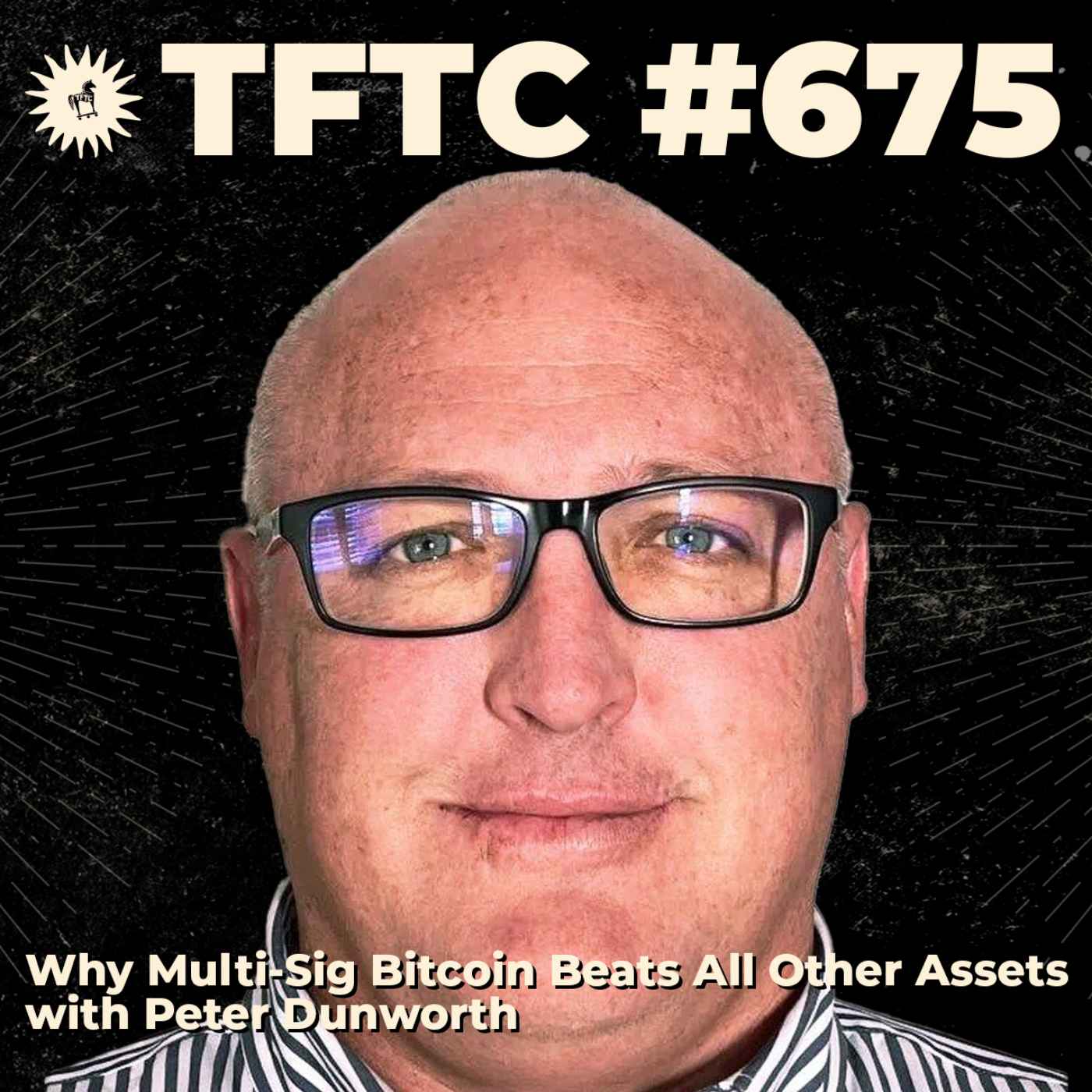
TFTC: A Bitcoin Podcast
#675: Why Multi-Sig Bitcoin Beats All Other Assets with Peter Dunworth
01:18:24
Loading summary
Transcript78 lines
- [00:07]
A
You've had a dynamic where money's become freer than free. If you talk about a Fed just gone nuts, all the central banks going nuts. So it's all acting like safe haven.
- [00:19]
B
I believe that in a world where.
- [00:21]
A
Central bankers are tripping over themselves to devalue their currency, Bitcoin wins. In the world of fiat currencies, Bitcoin is the victor. I mean, that's part of the bull case for Bitco.
- [00:32]
B
If you're not paying attention, you probably should be.
- [00:34]
A
Probably should be.
- [00:35]
B
Probably should be. Peter Dunworth. This is the second podcast I've recorded this year where I have to open up by apologizing because this show has been around for eight years and I can't believe it's taken me this long to get you on the show. The other, the other guest was Adam, back earlier this summer.
- [00:55]
A
That's some really good company. It's a pleasure to be with you and appreciate all the hard work you've done over the years. Listened to feels like hundreds of podcasts over the years. So thanks for all that you do.
- [01:07]
B
It's a labor of love, as I like to say. I get to sit down and have fun conversations, mentally stimulating conversations with people like yourself. And I think maybe to start with, I don't want to call it light hearted, but explaining your escape from Australia and maybe to set the scene there for generational wealth management under a bitcoin standard, it's really being hyper aware of the sort of tax regime that you live under, could potentially live under as governments grow more desperate to steal from their citizens.
- [01:46]
A
Sadly, it feels that way, doesn't it, that it doesn't matter where you live. It feels like the government's kind of, well, trying to screw the pooch and get as much as they can or blood from a stone. And just the conversation we had previously was our government in Australia, in their infinite wisdom, thought it was a very good idea to introduce an unrealised capital gains tax on pension balances. So the background of this is Australia's got one of the greatest pension systems in the world. We've got nearly $4 trillion sitting in it. And this has been on the back of maybe a 30 to 35 year workplace on the government to encourage people to put money into savings. And with one policy announcement, the current government in Australia has undone 35 years of begging people to put and pay money into this system. And so all of a sudden you've got the situation where 35 years of, I guess, propaganda to push people into saving for their retirement and moving that liability off the government balance sheet into being self funded for retirement. One policy of unrealised capital gains tax has basically woken up the entire 25 million people in Australia to realise that this is a captive capital structure that you can't access unless you meet the certain requirements allowed to take that money out of your super or pension at a future point in time. So just a massive own goal for the Australian government.
- [03:16]
B
So have they seen massive capital flight after this? And I guess take an even further step back? How long did they prep the the runways to implement unrealized cap gains tax and what is their justification for it in the first place? Because it's patently absurd on its face.
- [03:33]
A
Well, I'll caveat this by saying in the last week we've said we've seen that the Treasurer of Australia has walked back, that there will be no unrealised capital gains tax, but he's replaced that with the highest tax structure out of any of our entities. So he's replaced that with a 40% tax on any earnings in your superannuation and capital gains are considered earnings. So they really sort of tried to grease the skids, so to speak, about two years ago where they were talking about unrealised capital gains tax and anyone from an accounting background thought that was completely insane, particularly with no provision for having unrealised losses put in. And the problem with this is that I think the decision makers at the table didn't quite understand how accounting works. And they don't understand, I guess, the machinations involved to having a smoothly running economy and putting in an unrealized capital gains tax is a form of wealth tax that completely unwinds capitalism. And this was literally like the meme where the guys riding along in the bike sticks the stick in the spokes and then plays. This couldn't be a more telling interpretation of that meme than the Australian government talking about unrealised capital gains tax. But how it was positioned and the talk around that has been to position it as a trial balloon in the Australian pension system with the hope that you can then migrate that to all other entities and into the broader economy. And notwithstanding, in one of our states in Australia, we already have an unrealised capital gains tax called a windfall gain tax, where if the government rezones your property from rural to residential, they take 66% of the uptick in the value of that property.
- [05:27]
B
And they is it similar here in the United States where they can force you to get it reassessed and it will magically be worth more and then they'll just tax you on the back end of it, Correct?
- [05:38]
A
Yeah. So and, and they send you the bill for it and we've one of our clients actually I might mention who it is, but has basically had to deal with the government and said no, we're not accepting the, the rezoning because it would come close to bankrupting or totally disrupting the cash flows of the company because that's cash you have to pay up front for a potential future event. So it is like a wealth tax or an unrealized capital gains tax and the government can, can do that by literally just the stroke of a pen. And that's, that's the highly frustrating thing. And in Victoria, which is the state that that happened a lot of, there was a whole host of local farmers on the outskirts of Melbourne and as suburban creep had moved to their back door, the government needed to rezone. So these typically Italian and Greek immigrants run and own a lot of that land. The government comes along and literally rezones it and now the property's worth 10 times the value and they've got basically a bill for 60% that they can never hope to pay. It's dystopian to say the least.
- [06:47]
B
What is the justification? Is the Australian government such a fiscal debacle that they feel compelled to go take this? Is it moving overtly socialist? Is this like late stage fiat manifestations.
- [07:02]
A
That, that is a particular, that is a state in, in Australia, Victorian, which is probably the most left leaning state. A little quirk in the Victorian government. They signed up unbeknownst to the federal Australian government to the China's Belt and Road Initiative and the federal government had to step in and say hang on a second, you can't sign the Chinese Belt and Road Initiative to supersede the sovereign of the federal power to do that. So I think there's a left leaning bias to that state, more so than any other state. And this is where I look at say the American system where there's protection of states rights is really critically important, whereas we don't have any structure in Australia that has that depth or protection for individual states.
- [07:50]
B
Founding fathers knew what they were doing when they, when they made the Republic of States, the union of States, the United States of America if you will. But as it pertains to this particular threat of unrealized cap gains tax in Australia already exist in one state in Australia are bitcoiners advantaged in a sense that they can get their wealth out much easier than, than other Australians are tied up in real estate or other types of assets, I, I talk to.
- [08:24]
A
Talk to this till I'm blue in the face. And this is when you have an oppressive government, there's only really one asset that you can own. And Bitcoin really is magical when it comes to this sort of thing that no other asset can compete with. And the work I guess both of us have done around multisig, all of a sudden you can have your keys in three different jurisdictions. So what state or what jurisdiction are you subject to? And this is the beautiful thing about Bitcoin. Bitcoin is everywhere and nowhere at the same time. And that's the only meaningful asset that you can own that has no jurisdiction or jurisprudence over that actual asset. This is where working with high net worth families is trying to explain to them that this is the greatest hedge that they can hold. Because this, this is the asset that allows them mobility and optionality like no other asset. And if you look at and compare that to say property, property is basically subject to the jurisdictional laws of which that title tends. And if you look at stocks, basically you're still subject to whatever the jurisdiction you're in, whether it's the us, uk, Australia, it doesn't matter, you're still subject to law. And this is what is absolutely magical from an estate planning and wealth protection perspective when it comes to Bitcoin is that that thing can be anywhere and nowhere at the same time. And there are things you can do with this that you just can't do with any other asset. Like having, having it in three different jurisdictions at the same time. You can starting to explore the whole time locking and what you can do to time lock it. And this is the crazy thing about Bitcoin that no other asset can achieve is with a timeline, it doesn't matter what government mandate, legal decree or court order gets handed down. Even if you have the private keys, you're still going to be subject to whatever that timeline mandates and dictates. So education around Bitcoin and what, what its properties are and what it can do builds out. This is going to take a larger and larger portion of I guess everyone's net assets.
- [10:32]
B
Well, leaning into two aspects there, the multi jurisdictional multi sig and the time locks specifically like starting with the multisig aspect, if you set it up, you have a key located in three keys located in three different jurisdictions. Do you sort of have to decide which jurisdiction gets supersedes the other two in that quorum? And then with time locks, if you do time lock, your Bitcoin, let's say for a million blocks or whatever and the government tries to do something during that period where it's locked up, do you have legal protection saying yes, I own the asset, but I can't move it for this long. So you're shit out of luck.
- [11:17]
A
Yeah, that's true. That's exactly what happens. So typically you've got an owner of the bitcoin and this is where I spend a lot of time talking to bitcoiners about how to structure that. And the best legal way to protect your bitcoin, that that has a jurisdiction. Now there are ways and means you can do to protect that, like having offshore trusts or offshore companies. And then you're subject to, you can wrap that in a whole host of other things if you want to, but there needs to be a jurisdiction that it, that it pertains to. But there are legal protections you can take to protect yourself in that capacity. And so this is where, because Bitcoin is a set of private keys, there's no legal entity that has control over it. And this is what makes Bitcoin both exhilarating and terrifying at the same time because there is no appeal to authority to recover your Bitcoin in the event that you muck it up. And this is what makes I think self custody Bitcoin so powerful, but terrifying to a lot of people at the same time.
- [12:23]
B
Yeah, it's with great power comes great responsibility. To take a quote from Uncle Ben Parker from Spider man, it is equally exhilarating and nauseating at some point knowing like, all right, I'm got to exert extreme ownership over the control of this private key material that gives me access to my wealth. And it's scary, but it's also incredibly, what's the word I'm looking for? Exciting in the sense that there's so many new products and services that need to be built around these primitives to really make it easier for people to access. And when it comes to where Bitcoin is from, an industry standard, it's still very early days.
- [13:16]
A
Yeah, I look at the. There's a whole host of things that are taking place that are making Bitcoin far more user friendly. But I still feel like we're in the Ms. DOS phase of Bitcoin and how easy it is to function with. And I think there will be a breakthrough that will distribute this to the masses and make it easy to use. But as far as user experience goes, I still feel like we're in Ms. DOS typing in words. And if we get one wrong, then that's a catastrophic failure and nothing happens. So I'm waiting for that day.
- [13:48]
B
Now. We talk about this a lot of 1031, sort of the timing of capital deployment into the industry. And I think core to our thesis is that there's an order of operations to Bitcoin's ultimate success. Things need to happen, maybe not in a certain exact order, but you need sort of fundamentals to hit particular checkpoints where you can then go on and build more robust infrastructure. And what we were discussing before we hit record is something that I think really needs to take hold and the market needs to be saturated with products revolving around this concept, which is Bitcoin being used as collateral. I think when you think about the phases of Bitcoin's monetization, one of the biggest accelerants that I can think of is locking Bitcoin up in longer duration credit instruments to take not only take the supply off the market, to put more pressure on the price, but to decrease volatility and get people comfortable with this idea of Bitcoin as pristine collateral that is superior to other collateral assets. And not only that, I've heard you speak on this before, but really restructured debt in a way and begin to tilt the benefits towards the equity side of these credit structures and sort of recap a system built on debt with good collateral and good equity. At the end of the day, it's.
- [15:26]
A
Such a far out concept, but it has the ability to completely redefine our future. And I've listened to you and Luke Groman talk, Marilyn Hoddle, a host of others. We have a problem that we can't solve with the existing structure that we've used. And this is to probably a friend of ours, Jeff Booth's point. It's very difficult to I guess, create a solution from within the problem. And so Bitcoin to me represents the opportunity to completely redefine the problem and then solve it with a way that has the least damage to the existing structures. Which sounds ironic because ultimately it will end the structures as we know it, but it's the only peaceful way to get out of it. And this is where using Bitcoin as collateral moving forward very simply has, by the construct of Bitcoin itself, you need to run an over collateralized system versus an under collateralized system or a fractional reserve system that we currently hold. And this is where if you break down using Bitcoin as collateral and using that as the key form of collateral moving forward to effectively capitalize and collateralize our system that has the least downstream consequences for Mum and dad and retail or Main street investors. And this is what's really, really important that I don't think on a broader function we really understand is that Wall street has financialised everything that they can. They've financialised the residential property market in the US and broadly globally. That has seen devastating consequences that led up to the 2000, 2009 GFC. Basically people went homeless. It caused absolute economic chaos. It nearly brought the world to a grinding halt. Well it did for many people, but that was because people, Wall street in particular were monetizing those mortgage backed securities and effectively gambling on it. What Bitcoin I see allows. The key thing that Bitcoin allows with using this is collateral versus properties and stocks and everything else is it allows us to divorce Wall street consequences, Wall street speculation from Main street consequences. And that is a key fundamental difference to what we know today. At the moment we have Wall street speculating on everything that affects you and I and our day to day when they can speculate on a much more volatile asset. Because volatility, vitality, read into that what you will. All of a sudden there's far more movement in Bitcoin that allows them to have the speculation that they want without having a downstream consequence on increasing cost of living pressures, increased cost of housing, housing affordability. All of those things get divorced from the speculation that Wall street wants to, to wants to partake in. And so when we use Bitcoin as collateral, we have for the first time the ability to divorce Wall street speculation from Main street consequences. And this is going to be once that clicks and we actually start seeing Bitcoin underwriting all of the collateral and debt obligations that we made. It allows those assets to either maintain the prices that they've got or fall to the level that they would from an economic perspective, economic use case so there won't be any monetary premium in the properties and the stocks that we currently have.
- [18:50]
B
Sup freaks. This rip at TFTC was brought to you by our good friends at BitKey. BitKey makes Bitcoin easy to use and hard to lose. It is a hardware wallet that natively embeds into a two or three multisig. You have one key on the hardware wallet, one key on your mobile device and block stores a key in the cloud for you. This is an incredible hardware device for your friends and family or maybe yourself who, who have Bitcoin on exchanges and have for a long time but haven't taken a step to self custody because they're worried about the complications of setting up a private public key pair, securing that seed phrase, setting up a pin, setting up a passphrase. Again, BitKey makes it easy to use, hard to lose. It's the easiest zero to one step. Your first step to self custody. If you have friends and family on the exchanges who haven't moved it off, tell them to pick up a BitKey. Go to BitKey World. Use the key TFTC20 at checkout for 20% off your order. That's BitKey World code TFTC20SUP freaks? This RIP is brought to you by good friends at Silent. Silent creates everyday Faraday gear that protects your hardware. We're in bitcoin. We have a lot of hardware that we need to secure your wallet. Emits signals that can leave you vulnerable. You want to pick up silence gear, put your hardware in that. I have a tap signer right here. I got the silent cardholder replace my wallet. I was using Ridge wallet because it secured against RFID signal jacking Silent. The cardholder does the same thing. It's much sleeker, fits in my pocket much easier. I also have the Faraday phone sleeve which you can put a hardware wallet in. We're actually using it for our keys at the house too. There's been a lot of robberies. They have essential Faraday slings, Faraday backpacks. It's a bitcoin company. They're running on a bitcoin standard. They have a bitcoin treasury. They accept bitcoin via strike. So go to slnt.com tftc to get 15% off anything or simply just use the code tftc when shopping@slnt.com Patented technology Special operations approved. It has free shipping as well. So go check it out. I talked about this at Marilyn Hodl but and I've brought it up a lot. But I think it's because I truly believe this and think it's very important to understand. Like this is why we backed Battery Finance at 10:31. Talking to Andrew Hones and him describing the problem that exists in broader credit markets, but more specifically in real estate markets, commercial real estate markets is like you have this incentive as a real estate developer, investor, credit fund deploying to the space to make sure that the value, the underlying properties keep keeping, keeping up and to the right in terms of value. And that creates a perverse incentive for. For Main street for the little guy because it prices them out the real estate and what battery is doing with their dual collateralized bitcoin and real Estate structures is saying, all right, let's introduce Bitcoin to the collateral package. And over the course of this 10 year loan, if Bitcoin continues to do what it has done in the first 17 years of its existence, you should see an incredible appreciation of the equity held in this credit structure in the form of Bitcoin. And you may not have to care about the price of real estate going up as much. And so you can sort of begin to level off real estate prices and batteries starting small. But it's a strategy that I would like to see widespread. And so when you think about manufacturing a soft landing, I become convinced that introducing Bitcoin as pristine collateral into the credit system is one of the only ways to do that. The Fed and the treasury don't have the tools to, to manufacture that soft landing unless they incorporate Bitcoin in some way.
- [22:20]
A
I agree with that. And this is the. Doing what you suggested is the only way to create equity outside the system that is not going to implode if credit is withdrawn from it. And so if you look at property prices, stock prices, the rest of it, all of those are built on the fractional reserve banking system and the credit. The second you muck up the credit, it literally is a house of cards that's going to fall in on itself by doing what you propose. That is a way to build equity outside of the property market and the stock market that is going to be independent of those markets and their need for credit. And if you sort of peel this back, the underpinning thing of this, and this is where I've done a lot of work looking at say the Australian property market and to a lesser extent the US property market, we're highly reliant on property prices going up because everyone in the country is invested on, in higher property prices. So it's very hard to take the bet against that. But high property prices are really driven by two things, credit growth and net immigration or net numbers going up, adding to the system. And when you take away credit growth, because the problem we've got is a debt problem or a collateral problem. And this is sort of taking a side note on this. Everyone talks about the debt problem, but if we had the collateral to pay the debt, guess what? There's no debt problem. So I'd really love a clearer definition of the problem that we're facing because everyone's worried about paying the debt back. And it's like if we look at the microeconomics of this rather than the macroeconomics, if I borrow $100 from you and I give you my iPhone as collateral for the loan. If I don't pay you 100 bucks back, no problems, you've got a phone that you can sell for $500 tomorrow. But we sort of just gloss over that bit and get straight to a debt problem. And this is where, to your point, when we create equity outside of property and stocks through bitcoin, all of a sudden we get to build up an equity profile that is independent of being reliant on that credit growth for property prices to go up. So it's really important.
- [24:22]
B
Yeah. As we're walking through this and trying to steel man, in my mind I can hear people saying, well, we're just moving the risk. If Wall street wants to play with another volatile asset and they use Bitcoin, doesn't that introduce the same systemic risk that existed in 2008 with the housing crisis and stuff like that? And just playing through this in my head, it's similar. Hang with me for a second. It's similar to like how we describe bitcoin being perfectly suited for demand response because on the mining side of things in ERCOT, if the grid needs 70 megawatts of energy because demand spiking, bitcoin miners can shut down, that energy that they would have used can be. That electricity that they would have used can be delivered to consumers on the grid. And the bitcoin network works just fine because it's a distributed system and if part of the network goes down in a part of the world, blocks are still going to be produced. And similarly, moving into the collateral side of things, people are like, well, if bitcoin is being introduced as collateral into all these different sectors of the credit stack, doesn't that create systemic usage? But I think it's very similar to the demand response explanation where it's like, yes, it will be pervasively used as collateral. However, it'll be collateral in different types of instruments for different types of assets. And so you sort of have very distributed risk profile in my mind. So, like the chances of a systemic collapse, and particularly if it's being used as equity in these structures and you have a longer duration and you don't mark the market, you can really isolate the or diminish the risk pretty significantly. Does that make sense?
- [26:08]
A
It makes perfect sense. And this is where a lot of people will probably push back on that. Oh, well, you're going to have to market, mark to market, because this is a 24, 7, 365 asset. And it's like really like the Old joke of, you know, how do you know you've got a good accountant? Ask what one plus one is. If they're any good, they'll look around the room and they'll ask you what do you want it to be? You know, you just need to have some imagination when it comes to this. You look at the 10 year treasuries on the US banking or US bank's balance sheet, they're not mark to market. And that's what led to the whole blow up a few years ago with Silicon Valley, Silvergate and the rest of it. And so why can't we through a stroke of a pen and some accounting decree say that okay, this is not going to be basically it's not going to be mark to market, it's going to be only crystallized on the day that this expires. And that's a very easy fix. And to the point about how this gets steel manned. To me, a lot of conversations I have with say some of our older baby boomer clients, initial pushback gets pushed in where they say, oh look, bitcoin's great, but you can't live in a bitcoin. And that is the feature, not the bug. Because precisely for the reason that you can't live in it. And there is no monetary premium on bitcoin because it's 100% monetary premium or there's no industrial premium on it. It's all 100% premium monetary premium. The very fact that you can't live in a bitcoin is the reason why this should be used as collateral. Because at the moment we're obfuscating the whole, this whole form of collateral by using collateral that people live in that require basically if you look at that Maslow's needs hierarchy, one of the first things we need is shelter. Surely we should remove shelter, which is a primary human need from our collateral stack of what we need to secure credit moving forward. To me that just makes perfect sense. But I guess we've got a lot of work to do to educate everyone else to see it the way we see it.
- [28:05]
B
We do well and what we're describing now is the effect of bitcoin being introduced as a form of collateral into these stacks on different predominantly housing. But conversely, I mean, Sailors talked about this, Andrew Hones and I talked about this at a live event before. But if you begin to build out a forward looking duration curve of bitcoin held in different credit instruments with varying durations, that, that has sort of a flywheel effect that begins to kick in too. And I guess that leads to the question of how, how much of an effect do products like this have on the price of bitcoin over the long term, like how much bitcoin can be sucked into these instruments?
- [28:56]
A
I think a lot, a lot this, this can have. And it's funny, I had a conversation recently about the, the flywheel effect of the preferreds that say was looking to do and if it's going to take him, I think about four years to build this out. I heard through a friend that might take a little bit less, but it took him four years to build up that flywheel for the, at the market. And in the space of, what was it, three months, he sold nearly $20 billion worth of stock to basically go buy bitcoin. The credit markets are much, much bigger. And if you include the derivatives market, which is a form of credit, then it's probably 10 times bigger than what the equities market is. So imagine Saylor builds out for the Next, call it four years the ability to sell $200 billion worth of that preferred in the space of a three month period. That I think creates the escape velocity for a perpetual flywheel for him where he becomes the marginal purchaser and he dictates the marginal price of bitcoin because he is the buyer, he becomes the market. Just like the Saudis are responsible for I guess, the marginal price of petrol because they produce or don't produce. In that whole arrangement. Saylor ends up basically becoming integral to the bitcoin market in that capacity with strategy and the preferreds.
- [30:16]
B
Is that a good thing? Well, at the end of the day.
- [30:20]
A
If you look at the ethos of bitcoin and what led to its success at this point in time you'd say absolutely not. And I don't think that would be lost on sale. Decentralization, distribution, all of those things led to the success of where we are at this point in time. But the hope is that Sole is still a relatively small company in the grand scheme of things and there's, what is it, 100 plus companies that are bigger than in that have the ability to, to do that. So yeah, the other companies are going to get involved in it.
- [30:52]
B
Well, it's like companies getting involved in it, but then just in the private market, right, like in private credit too, it getting like. My hope is that it just becomes a, for lack of a better term strategy that people pick up on and it becomes widely adopted that you just have this, this massive dispersion of pockets of capital, implementing these collateral structures and you sort of diminish risk, diminish concentration risk that way. And that's my hope, is that it will become obvious. And obviously you mentioned it sailors building a track record. But companies like Battery Horizon are doing the heloc. Like the intersection of bitcoin as collateral and housing. Hopefully there's enough players there and they can develop a track record where it gets to the point where if you're in the credit space and you're not participating in these structures, that you're not doing your job right. And it becomes expected for people to introduce bitcoin as collateral into these packages.
- [32:04]
A
I've got no doubt. I just think we're very early. I look at the look at the new CEO of Vanguard and the first, first order of business for him is to create a Bitcoin etf. I look at that and think everyone will get there. It's just a matter of being educated in the space to realize that, hey, if we're not doing this, we're losing. So these guys are smart running these companies. They'll figure it out. And this is a beautiful thing about Bitcoin is it's all driven through personal economic incentives. And so they'll get left behind and lose if they don't.
- [32:37]
B
Sup, freaks? This rip was brought to you by our good friends at Obscura. If you've been listening to the show long enough, you know we care deeply about privacy. Particularly as you peruse the web, it is important to be using a vpn and Obscura is our VPN of choice. That is because it is a VPN built by a bitcoiner. For bitcoiners, it is the first VPN that can't log your activity and outsmarts Internet censorship. Obscura VPN works even in the most restrictive Wi Fi networks where other VPNs simply fail to connect with server locations across America and the globe. Obscura keeps your Internet access unrestricted wherever you are. I've been using it since it launched. I see no problems with speed. I can get on YouTube TV without any problems. It simply works. They can't log. You can pay in bitcoin. Go to obscura.net, use the code TFTC25 for 25% off an annual subscription. It's already a good deal. Their annual deal, the TFTC25 code, gets you 25% more off. Go check it out. Obscura.net, use the code TFTC25. Sup, freaks?
- [33:27]
A
This group is brought to you by.
- [33:27]
B
Our good friends at Unchained and they are holding another live event that you should check out. Markets are choppy, layoffs are in the headlines and rate cuts aren't fixing the core problem. That core problem is that the fiat retirement system is taking on Water. On October 28, Mark Moss and Unchained Jeff Vandru will explain why four 401ks were built to serve the system, not you. And how fees and hidden risks create an illusion of wealth. You'll learn why bitcoin security and growth curve make it a powerful long term savings asset. And how a Bitcoin IRA can let you roll over an old 401k with tax advantages intact. If you want a retirement plan that prioritizes sovereignty and purchasing power, this is the event. Register now@ Unchained.com TFTC Unchained.com TFTC and so how do you, how do you see this playing out? Long, drawn out, adoption, methodical, up and to the right. Follow the power, power, power trend curve if you will. Or is there an event horizon that we go over and experience hyper bitcoinization?
- [34:21]
A
I think, I think those two things are not mutually exclusive. I think that hyperbitcoinization event happens on a personal level where you as a person describe, you know, decide that you want to have more and more of your assets, time and energy invested in the bitcoin ecosystem. I know from a personal perspective that's exactly what I went through. I think that happens on an individual basis. At the same time you're going to have the power law continue. But like any good law, all good things need an exception to the rule. And I think we'll have a point in time when there is a break and it breaks to the upside. Is that going to be the fact that we have AI come in and AI realizes that the only form of payment they want to take from anything is bitcoin. That could be it. But we're really, I think, a precipitous moment in time where there's going to be an enormous amount of change that comes into the space that there are things that we can't predict. And I love the power law. I really appreciate Giovanni's contribution to the space because it gives us another thing to talk about. And now there's a mathematical law behind it. That's wonderful. But I think humans are irrational creatures and trying to I guess put a law against how we're going to behave. And it just feels, feels like whatever you try and what box you try and put us into, just human nature is we'll jump out of the box, give you something different.
- [35:43]
B
Well, I mean to paint the opportunity for listeners, particularly those of you out there who may be new to the show, new to bitcoin. One thing that you're famous for in the industry is really running the numbers on what amount of bitcoin will define generation, generational wealth throughout the time and expressing the potential total addressable market. And so for the TFTC audience.
- [36:15]
A
Would.
- [36:16]
B
You do us the pleasure walking through your sort of view of long term bitcoin price appreciation and how high could the price of bitcoin go over our.
- [36:27]
A
Lifetime when it comes to, I guess, how big the market for bitcoin is? I'll walk you through my thesis for it and I'm happy to be told that it's wrong. Why my thought process on this is incorrect and please put forward whatever your numbers are. But in thinking about this, Bitcoin is the first money that we've had which takes on the three functions of money at the same time. And if I just go through the three functions, the store of value, mean of exchange and unit of account. If we look at the store of value through time that was historically and even up until this day has typically been considered gold. Although in the last 50 years that's been obfuscated with real estate and stocks. But over the last 5,000 years it's fair to say that gold has been the go to store of value and that's been your measure of wealth. We've got the meat of exchange function of money, which is basically $100 trillion market, which is probably 80% plus of that is taken up with the US dollar. And it's a very important, I guess market to look, look after. And then you've got the unit of account which is our double entry ledger system. We haven't had an accounting upgrade for the last 600 years roughly since Da Vinci was a boy. And I look at this and think if you look at those three use cases of money and what are the, I guess the apex predators of those each three functions? Store of value is gold. The US dollar is the medium exchange function and that's $100 trillion market. And the unit of account market, which I peg at roughly $2,000,000,000. But other people say $1,000,000,000 has been done through the US dollar with a US dollar ledger or double entry ledger system. Bitcoin represents a significant upgrade on store of value with gold, firstly because it's digital, it's seizure resistant and it's censorship resistant. Meaning you can send it anywhere and no one can take it from you to make light of this, but it's true. Bitcoin is the only asset that you can die with. So if we think about who died with a lot of money and when they died, you look at the pharaohs, they literally built pyramids to basically put a pharaoh in it with a whole chunk of gold. If we didn't have. If they had bitcoin back then, we'd never see the pyramids. They'd just die with 24 words in their head, and they'd take it and never be found. Bitcoin replaces gold as a store of value, which is roughly a $30 trillion market cap.
- [38:58]
B
All right, we're back from our wardrobe change here at tft. Peter and I decided middle of the episode, you know, we're just going to go change our clothes and grow a beard out a little bit. I kid. We. We ran into some technical issues Monday afternoon when we were recording stemming from the Amazon Web Services blackout that took down a big part of the Internet. Apparently it affected Riverside, too. And so we've recorded probably about 35 minutes of a conversation before things started crapping out. But we're here to continue that. Peter, how have the last 48 hours been for you?
- [39:35]
A
It's been great. It's been fun watching people tear their hair out and realizing what centralized systems really are a problem. So, yeah, one win for bitcoin.
- [39:46]
B
Nick Zabo warned us trusted third parties are security holes, apparently for podcasting to Riverside Central. Third party.
- [39:55]
A
Who would have thought? Yeah.
- [39:58]
B
But maybe it was a fortunate disruption because as we were just discussing before we hit record again, I've thought of some things and you've thought of some things that we'd like to touch on as it pertains to bitcoin as collateral. Maybe I'll throw it over to you to talk about the three C's first, and then I'll position my thought of defi the great decentralization of finance versus the bitcoinization of finance. So we can go from there.
- [40:28]
A
Nice. Well, having some form of credit background, when you are assessing credit, you basically looked at the three C's character, capacity and collateral that the potential borrower was putting up and was going to effectively put forward. And the curious thing about bitcoin, because it is pristine collateral, it's the best collateral that's ever invented. It has a property that no other collateral has, and this is what makes it superior to any other, is that when you have bitcoin as collateral you only need one of the three Cs in your serviceability or assessment of credit worthiness. Do they have the collateral or not? Because the capacity to pay and the character to pay is completely irrelevant when you're holding the digital Barrick instrument. You don't have to as a lender, you don't have to subject yourself to serviceability criteria. You don't have to look at their income, you don't have to look at their credit rating to determine whether or not they're actually going to pay you back. Because you actually hold the underlying asset and have full control of it at all times of the day. And this is the very unique thing about Bitcoin is that it's 247365 liquid, whereas no other collateral on the planet has that ability. Now that is both a feature and a bug or a potential stressor. But I look at this and think that this collateral has properties that no other collateral has. And for that reason, having some form of credit background to understand what makes good quality credit. To me, Bitcoin as collateral completely redefines credit and lending across the board.
- [42:01]
B
It does. And we've seen this up close and personal at 1031, particularly with Unchained. It's astonishing to us how incredible their lending product is and how under appreciated the quality of their bitcoin collateralized lending desk is. And now what new entrants like Strike and older entrants like Leden, I think people are beginning to realize this, but just sticking on Unchained, I think the stat now is they've issued over a billion dollars in bitcoin collateralized loans over the last eight years and they've had zero loan loss, zero principal loss. So anybody that has given Unchained dollars to give out loans to bitcoiners looking to tap into the value of their Bitcoin without selling it has gotten their principal back. And with the attached interest rate that Unchained is charging. And so I think that's an incredible example of a billion dollars of loans issued. Not one dollar of principal has been lost.
- [43:08]
A
And over a significant period, that's been over a significant period of time too. And this is where hats off to Unchained. I love that team and think it's an incredible team, incredible company. And that loan product is to me what I define as industry leading because not only does it give protections for the lenders fronting the money or the capital providers fronting the money, but from a borrower perspective, to me that is ideal because in their multi seq set up you as the borrower get to see and ensure that your bitcoin is not rehypothecated. And that is as a borrower I think a really critical thing. And to me that's market leading, rotating.
- [43:47]
B
And it to me I agree it's market leading and it should be the standard. And we were talking about this on Monday, this idea of multi jurisdictional multi sig for the sake of preserving your wealth and protecting your wealth, securing your wealth and making it resilient as an individual. But that is just one application of multi sig when you bring it to escrow for collateral, that's where things really get exciting. This is something that I think is a part of the market that is lacking is these escrow services. For example, believe it or not, I've got a family, a growing family. My wife and I want a forever house. We're buying a house and we're not selling on the house until the end of the first quarter of next year. But to get the house we had to put a deposit down. And unfortunately for me, there is no product that exists out there that would allow me to put Bitcoin in a multisig wallet that I have no unilateral control over, that seller of the house has no unilateral control over. But you can imagine if we were able to construct something like an unchained vault where I hold a key, the seller holds a key and then unchained, acting as an impartial third party arbiter holds a key, I would be able to hold this deposit in Bitcoin. And if I'm willing to take the risk that I think bitcoin is going to appreciate in value between now and when we ultimately settle, it's a good deal for me. I don't have to sell Bitcoin. And then for the seller we can also make the agreement. Okay, if the price of bitcoin goes down, I can top up the, the escrow account, the escrow bitcoin wallet with enough bitcoin to service the deposit amount necessary.
- [45:32]
A
I think all of these products are going to come to market. Like you're at the forefront of that. You're effectively living in a hyper bitcoinized world. I'd like to think I am too. But it falls on, I guess us to try and push that boundary of forging those products so more and more people can access them. But the ultimate is to have your cake and eat it too. Not to be able to sell your bitcoin. Leave that in a construct that is that escrow and this is where I think the early days of that multiseq with with Unchained really forging that has been really critical and from a sort of broader adoption, sort of a bit of a love fest on Unchained because they do a phenomenal job. They've done a great job for so many years. One of the key features that they've introduced which I really love, which I think helps every bitcoiner on earth help their friends and family self custody is Connections menu. I'm not sure if you've gone through and seen how that works but to me this is one of the greatest inventions in multi seat ever because it totally de risks self custody for the novice if they've got a trusted partner or a family member or a friend who can actually guide them through that and you can leverage off their expertise but still get all the benefits of self custody.
- [46:47]
B
Yeah, the Connections product is I agree and I think Dhruv, Joe and the team there are extremely forward thing to Dhruv. I remember him giving a presentation back in 2018 in New York where they were first introducing their vault product and they've had this long term vision of similar to how we view the network of node topology, it being critically important that that is sufficiently distributed. The same thing can apply to private keys. Like we need a network of keys just as much as we need a network of nodes. And so products like their Connections product that make it easy for me if my grandmother or somebody wanted to buy Bitcoin and hold it in self custody it's like okay grandma, you don't have to worry about setting up a key. I'll hold a key, my brother will hold a key and Unchained will hold the third key. And we'll make sure that you own actual UTXOs that aren't being rehypothecated.
- [47:48]
A
That's the power of that. And I think it sort of distributes the responsibility to the pleb to be able to act as that for one of a term trusted advisor within their community to help on board. And I look at self custody. Bitcoin is really a journey. It's, you know, there's no solutions, only trade offs. So you really need to choose your own adventure when it comes to how you want to set that up. But the magic is in holding the UTXOs and that to me is one of the easiest ways to do that because it totally de risks and it lowers the technological threshold or understanding that a new user has to have similar to your sponsor Bitcoin Yeah.
- [48:27]
B
And then when you imagine again we're focusing in on individual holding use cases, but imagine what the world's going to look like when this is applied to everything. If you're selling oil internationally instead of having to work through the petrodollar system, it's like, okay, I want to buy oil from you in a big amount. I'm an Asian state or a large corporation that needs a big chunk of oil. As you go to somebody who's selling it from overseas, you say, okay, I'm going to put Bitcoin in this escrow wallet. I don't have control. You don't have control. There's an escrow service that holds it. You deliver the oil, Oil's delivered, okay, we'll release the Bitcoin to you. And that's just one example. When you talk about credit structures, we have sort of a waterfall distribution of proceeds within a credit structure over the duration of that loan. You put it in an escrow multi sig and you can distribute over time as certain KPIs and benchmarks are met. Like we are just at the very, very tip of the iceberg, the top snowflake on the iceberg or particle of ice. Whatever you want to say in terms of actually implementing and truly revamping the technical stack of the banking and financial.
- [49:42]
A
System in the world, this, this is what I don't think most people realize, that the capabilities and what you can do with Bitcoin cannot be done with any other asset. It doesn't matter how you structure the other assets. It doesn't matter whether you put them on blockchain or not. It's not a final sentiment layer. It is not the be all and end all. It's not the time chain in this. From a personal note, understanding sort of the machinations and how this is going to split, spread and infiltrate all of our systems, I look at this as effectively eating it from within. People will adopt it in whatever capacity they want. I look at, say, from a personal advice and planning perspective, the ability to time lock Bitcoin, if you have problems with certain generations, or you don't want to leave your Bitcoin to a certain generation, or you want to bleed that out in some form of annuity, guess what? Bitcoin is the only asset that you can do it with that is basically supernatural to the law. Doesn't matter what the law compels you to do. If you've time locked that, guess what? Unless you can break cryptography, it's going to trickle out as you intend it. Now there are just so many implications of this. And this to me is why bitcoin will be the base layer of collateral moving forward and sort of putting a bow, so to speak, on this system. In a bitcoin world, where bitcoin collateralizes the world, we need to have an over collateralized system. But we've been working with an under collateralized system. And this is where to me the total addressable market. And we'll come to that in a minute if you want to. But the total addressable market for bitcoin is much, much higher than anyone really comprehends.
- [51:23]
B
Yeah, I guess let's do it. We got about halfway through it, I believe. I don't know how far through it we got, but we were talking about it for 10 minutes before the AWS outage affected our ability to actually communicate across the oceans here via Riverside. But we were talking about the total addressable market. I was explaining to the audience that you're, we wanted to have you on for many reasons, but one of which is that you are relatively famous in our little niche bubble of bitcoiners for articulating the total addressable market in a way that many others don't. And makes me even more bullish than I've ever been in bitcoin because I think you really highlight that the nature of the distributed protocol with the native asset really changes the game. You're combining a bunch of different functions and systems and that doesn't have a narative effect, it has a compounding effect. Correct?
- [52:23]
A
Yeah. And this is where I think what we're seeing, I like to call bitcoin the first triple point asset. And in nature, in thermodynamics, a really curious thing happened. I didn't know this until basically starting bitcoin, but the triple point of water is a point in time where under certain pressure and under certain temperatures, water is in all three phases at the one point in time at the same place. So you can have, under certain atmospheric pressures and temperatures, you can have water sitting in liquid, gas and hard state all in the same beaker. And why do I talk about this esoteric triple point? Well, Bitcoin is the triple point asset in that it exists in all three states at the one time. And if we pull that back, what is, what is bitcoin when it comes to the function of money? The three functions of money are store of value, made of exchange and unit of account. And in a very high level, and I'll go into the detail, for the very first time in history, we have one single asset that exists in all three of those states as the apex form of that function. And this is the first time in history that it's happened. And so if we break that down for eons, we've used gold as the store of value and that's roughly a $30 trillion market. We've used US dollar as the main exchange and that's $100 trillion market. And then we've used our double entry ledger system and by default the US dollar as our unit of account and how we account for things. And if we go along those use cases, Bitcoin supersedes gold because it's censorship resistant, it's siege resistant, it's digital, and there's absolute digital scarcity. So by those four definitions, Bitcoin is a much better store of value then Bitcoin. So it will supersede a $30 trillion market and become the apex predator of that function of money. I'll skip over the medium exchange because I personally believe that Bitcoin's a much better medium exchange because it's censorship resistant and it's seizure resistant. And if you look at over the last four years, I bet Russia had their foreign reserves sitting in bitcoin. They wouldn't have been able to have that confiscated from the Swift network. I'll brush over that because I actually think for addressing the total addressable market, the mean of exchange market is the least important. And then I look at the unit of account is really a double entry ledger system is the same system that we've been working with since da Vinci was a boy. And now we've got the first innovation in accounting in nearly 600 years to a triple entry ledger system where anyone operating on the network can see exactly what's happening on that. And the unit of account market is by my accounts is probably a two quadrillion dollar market. Now some people say it's a one quadrillion dollar market, but in my mind it's probably more like two quadrillion dollars because we've got about one and a half quadrillion dollars in the derivatives market that needs to be accounted for. And what's interesting about this is that Bitcoin across those three functions of money is going to replace the store of value in gold, the main exchange in the US dollar and the unit of account in the double entry ledger system as the preeminent form of function for those, for those requirements. And a funny thing happens in economics. A lot of people look at this and think, oh well, Bitcoin should be the total addressable market for Bitcoin would be simply calculated by adding all three of those functions together. But that's not the case because we actually have one asset that is the form function for all three of those functions. And what that means is rather than adding those together, you're going to have store value, compete with mean of exchange, competing with unit of account for space on the blockchain. So rather than being additive, it's actually going to be compounding. So you need to really multiply and compete for that space on the blockchain. So it's not additive, it's actually more of a compounding effect where you need to multiply that. And then when you peel back the, I guess the economics around it, that people value the future money, I guess a lot more than what they value today's function of money, it allows everyone to store their money through time. And this is where the numbers I come up with just don't make any sense. And this is where I urge anyone to critique the thought process in coming up with, I guess, a value or a total addressable market for Bitcoin rather than attacking the number. Because to discuss that, it does sound retarded, but the logic of it is sound. If you actually peel back and want to discuss anything that you disagree with, please, let's go through it point by point. But what that ends up coming up with is a multi billion dollar Bitcoin on the back end of it. And this is where I look at that and a lot of people want to say that that's not possible because the total assets in the world right now are circa $1,000,000,000. And it's like, well, if we go Back to the 1850s, the total total assets of the world back then were probably close to, well, less than a billion dollars. So this pie is going to expand significantly and Bitcoin is the way to do that. And what, what is absolutely clear to me, when people understand Bitcoin, they're going to store most of their wealth in bitcoin and they're only going to use a small slither of that, say less than 1% per annum to actually spend on anything that they need. And so if you look at a pie chart with bitcoin at the moment, and it's all white and there might be a tiny little line down the middle of it that accounts for less than half of a percent of total assets in the world are in Bitcoin. Once we move through to a hyperbitcoinized world, that entire chart is going to look orange Thin little slither down the middle for all the other assets that are there. And the reason for that is, is that people want ultimate optionality which Bitcoin provides. And this is where a lot of people get lost on this and think that's not possible. And it's like, yes it is possible. And if we look at earlier to our conversation around having a collateral problem, not a debt problem, to solve the debt problem that we've got, we need to inflate some assets in some way shape or form. We can't inflate the bond market, it's counterintuitive. We can't really inflate the stock market. We've done a really good job inflating that. It's very difficult to inflate the property market because we already have a cost of housing crisis and affordable living problems. What's an asset that we can basically put an infinite amount of monetary energy into that's going to have very little downstream consequence for the world. And I look at that and think Bitcoin is the perfect vehicle to do that. And to our point earlier about the future of bitcoin that a lot of boomers miss is and they say, oh, you can't live in a bitcoin for the very reason that you can't live in a Bitcoin is the reason why they're going to inflate this asset to re collateralize the world. And when that happens, you're going to see basically that little pie chart is going to flip to mostly orange and a thin little white strip down the middle for all the other assets out there.
- [59:32]
B
So bullish billions of dollars for bitcoin on the back end of this. And another thing I would add if we're running with this, this idea and this thread, is that we, I think people severely underestimate the increased productivity that exudes once we get on a bitcoin standard too because we have this incredible waste and terrible asset allocation incentive that exists with fiat where you're just incentivize to throw money at everything and see what sticks and hope that 1 out of 10 capital investments makes a return big enough to make up for the nine losers. But with Bitcoin being extremely scarce, bring opportunity costs back to the market. The thesis, and I think there's pretty good historical sort of evidence that this does happen once you have a hard money standard, is that capital is only going to be dedicated towards things that are actually worthwhile and do increase productivity, profitability and more importantly, most importantly, the quality of living for the individuals living on this planet. And so, like, if and when we do transition to a bitcoin standard, I think people look at the total addressable market and where money is stored today, and they think, okay, this is the total addressable market. But you also have to add in, like what? Well, if Bitcoin makes us better capital allocators and capital finds ways to the most productive means quicker, then we could see an acceleration of economic production that will be stored in Bitcoin as well, just pushing the price even higher as a result.
- [61:15]
A
Yeah, I agree. And this is where that hurdle rate you talk of as a capital allocator, it gets very difficult to really assess viable projects because you now have a hurdle rate of 30, 40, 50%, whatever that might be. And if I step back from this, I look at what bitcoin represents is the opportunity for 8 billion people on Earth to go back to 2001 and buy Amazon stock and be Jeff Bezos. My forecast for the next 20 years is that this will outperform what Amazon's done over the last 25 years. And my point to this is that this is going to get very scarce very quickly because people want to have that future optionality. And you look at Jeff Bezos, you look at Elon Musk, they never sell their stock for the very fact that they know what the stock's going to do, it's going to go up forever in their eyes. They borrow on it, sure, but they never sell it. And this is where you look at the wealth that they've accrued over the last 25 years. They'd be lucky to spend 0.1% of the wealth that they have on an annual basis. So I look at that, and if you draw an analogy to how they hold their stock and what they do with their stock, to what they spend, they've got 99.9% of the wealth tied up in their stock and they never spend it. The same opportunities are going to be afforded to every bitcoin. And moving forward. And this is where we're going to have a real price squeeze Moving forward when 8 billion people figure out that's what they can do.
- [62:43]
B
What do you think the tipping point for this to really take off in earnest is? Is it external forces, governments printing too much money and really forcing the issue of debasement, or is it more of an information dispersion problem? Just not enough people really understand and intuit this to make the educated decision to allocate their wealth to Bitcoin in the first place.
- [63:11]
A
I think you raised three really good points, and I'm not sure what it is. I think it hits different people at different times. I think bitcoin is really a need, not a want. A lot of people want to get rich, but they don't want to take a risk on it, so they don't do it. It's only when they're desperate do they make the jump to actually committing to it. And I can tell you a whole host of stories that basically come to that point in time where I've had a whole host of friends have a chat to me about their situation and how bitcoin can solve it. And I look at this and think, understanding their situation, bitcoin really does solve a lot of those problems. At the same time, a lot of people really can't identify the problem that they're living in. Like a fish swimming in water doesn't know it's water. We are slowly getting ground down with this debasement and inflation to the point where people are working second jobs. I was just in LA having a conversation with an Uber driver. He was a. He was a bakery manager and he finishes his shift at 3 o' clock, after starting at 3 o', clock, and then he jumps straight in his car and he's an Uber driver for the next six hours just to make ends meet. And people are aware of the problem, but they just can't really articulate what that problem is. A huge thing that's happened in the last, I guess, week is JP Morgan and the banks coming out with the debasement trade. Now they've identified it and branded it. Everyone can now start articulating what the problem is. So, to me, I think we're on the verge of that. And I guess the really important thing, I think, for us as bitcoiners to do is just be good citizens and try and help people onto the lifeboat as quick as we can. Because there's a lot of people out there who are really struggling. And I genuinely do see bitcoin as a lifeboat to improve people's situations.
- [64:58]
B
Yeah. And I guess building on the Tamil thing to the. I guess unit bias comes in and really clouds people's judgments. They. They see bitcoin trading at $108,000, wherever it is today and say it's too expensive for me. Yeah, I miss the boat. And really just trying to nail home the point, like, we are still early. Like, what do you think it would take for that Uber driver that you met in la? How much should he be saving in bitcoin over what period of Time to have it make a material difference on his outcome.
- [65:33]
A
I love this question because I think the most important thing that anyone can do, and we live in some very polite civilized societies with great pension schemes. I would start with your pension, your 401k, your IRA, your superannuation, your UK pension system, whatever that is. And the reason why I'd start there is because that allows you to put money in that you really can't touch for the next 10, 20, 30 years or 40 years if you're young. And, and that allows you to have a risk free understanding of what that is. Because when you're, to quote an Aussie term on the bones of your ass and you don't have a dollar to rub together, it's very difficult to take a risk with the money that you do have. And so the pension money is money that you can't touch. That has to be a whole host of decisions or provisions need to be met in order to access that. And typically it's a long way off in the distance. So I look at that and think pension money is the ideal place to start with a bitcoin investment because that lets people put money in that's not going to hurt their day to day cost of living and housing and the rest of it. But once they see it working, then they can start applying that to their day to day. So putting aside cash, trying to save 10% of their earnings, and this is the problem that in society today is the number one rule is just don't spend well, spend less than you were is the number one rule my father gave me, which is just timeless advice for anyone, regardless of where you are on the economic spectrum. You know, you can have billionaires who are going broke because they're spending more than they earn, but if you manage to save a little bit each day, and this is the power of bitcoin, is that as long as you have that golden rule where you can save even if it's a dollar, you get to build momentum and most importantly, you can actually see and identify a way out. And that's the most critical thing because if you're saving into a savings account, you can save for 10 or 20 years and you're still not going to have a deposit for a home. But if you save for 10 years in Bitcoin, all of a sudden you've got a deposit, you've got the ability to buy a house, probably outright. So I think it's very important, sort of being able to determine and see a path forward.
- [67:42]
B
Yeah, just get off Zero. Start a little bit and you don't have to buy a whole bitcoin if you're new out there and you think, oh my gosh, I can't pay $108,000 for a bitcoin. You can buy a dollar's worth of bitcoin on many exchanges if you want to. But bringing this back, I wrote about it in the newsletter yesterday. Sort of shifting gears a little bit here to wrap up this two part conversation over the course of two days. This whole idea of the bitcoinization of finance which really ties into what we have been talking about with the intersection of bitcoin as collateral in traditional markets versus the decentralization of finance or defi as it's being pitched by many people in crypto and now more aggressively people in Wall Street. I think what's going to be the trend this cycle is what I wrote about yesterday is that real world assets are what we need. Bringing real world assets like real estate and stocks and bonds to the blockchain is going to unlock incredible innovation and accessibility to financial markets that plebs desperately need. And not only that, you'll be able to use these real world tokenized assets as collateral and decentralized financial systems that give you access to unique and exotic and competitive financial products. And I think that's just completely wrong. I don't think the average Joe needs access to multifamily real estate in the United States via tokenized real estate. I don't think that's what they need. I think they need better money. That's what I wrote about yesterday and I think just really driving home because people I've seen it. In the 12 years I've been in bitcoin, I've seen many different cycles and particularly altcoin cycles and the themes and memes that came with them and the shiny objects that were positioned in front of the retail public that they jumped on and ultimately regretted because they turn out to be pipe dreams for lack of a better term. But that's what I feel like is happening right now. Real world assets and defi specifically is like this dream of we're going to go re architect the financial system. I think that's completely wrong. I think what we've been talking about over the course of an hour long conversation over the course of two days, two different recording days is bitcoin is collateral and the bitcoinization of finance. We don't need to re architect the financial system. Love it or hate it, finance and contract law and financial arrangements have developed and evolved and matured over the course of millennia for specific reasons. And even though there may be a lot of rot in the traditional financial system, it doesn't mean that the bare bone framework doesn't make sense. We don't need to rebuild from scratch, we just need to re collateralize with better collateral. Don't really have a question but I think this is going to be an important sort of juxtaposition this bitcoinization of finance versus shiny object DeFi and real world asset tokenization. And I don't think enough people are really trying to draw a line between the two and say no well I think there's a line drawn between the two but I think people really need to hear the thesis that defi is complete pipe dream gobbledygook that is just accelerating and extending the high velocity trash fiat economy whereas we need to actually take our foot off the pedal of the financialization of everything and just get back to simple collateral arrangements.
- [71:28]
A
I couldn't agree more. And this is where I think there have been some businesses that have completely redefined this space that have left the US and global banking system as a whole sort of looking within and I look at tether and the success that they've had and think they don't rehypothecate, they don't offer loan products yet they're arguably the most profitable business owner for one of and I think the US banking system with all their fractional reserve and Aussie banking system is exactly the same. Getting back to good old fashioned banking is going to be where it comes to and I know we're trying to debunk the world and it's a dirty word but we have a collateral problem that Bitcoin can solve and this is where advice to anyone is just buy Bitcoin, sit on it for 10 years and then avoid all the shining objects on that 10 year period and you wake up and life will be very different. And it's to your point everyone doesn't matter if it's a banks it's defi the rest of it. Everyone is going to come to bitcoin and how that looks I don't know but I know the most important thing is to be holding UTXOs and and that is going to give you the maximum optionality you can have in time to do whatever it is you want to do.
- [72:43]
B
Avoid the shiny objects. That was the the byline of last night's last night's newsletter was tie yourself to the mast. Avoid the siren calls.
- [72:54]
A
Sounded like Ulysses. It's very difficult.
- [73:00]
B
Yeah. Anybody who's new here and you're seeing the shiny auto, you have the Scaramucci, you have Larry Fink, you have a bunch of other individuals with perceived high intelligence and innovation, you know, they viewed as innovators to an extent they may be, I'll give them that. But to another extent they are just cantillion errors who have ridden this wave of the fiat to basement trade over the last 50 years and have positioned themselves well to benefit. But they're benefiting from a system that is run at the core. And if we are going to transition to bitcoin, I think it's important to recognize that what's being positioned in defi and you can see what Coinbase, Coinbase just announced two weeks ago like oh, you now have access to millions of tokens that are trading on the base chain or whatever. It's like, how do you not realize that opportunity cost that exists and people have to hold their money somewhere and if you give them millions of tokens as an option to hold money, how do you not recognize that there's going to be a lot of money hopping from one token to the other with none of those tokens really holding long term value over the long haul? Peter has left us yet again. We're still having problems. Maybe it was the CIA, Peter, maybe it was CIA.
- [74:25]
A
The same problem as last time. So maybe it wasn't aws, CIA.
- [74:30]
B
CIA does not like this conversation. The Pentagon does not like US war gaming. On how bitcoin is going to take over the world. I was just explaining.
- [74:40]
A
It's only a matter of time.
- [74:41]
B
I was just explaining. It's funny to me how companies like Coinbase and people in crypto who view the world being hyper tokenized. It's like you have to hold your money somewhere at the end of the day and if you get people tens of millions, ultimately it will be billions of tokens. If they keep pushing down this, this route, like where is the money going to sit? Like you're just going to. They don't recognize the incredible dilution effect they're unleashing on the market and the if everything can be tokenized, nothing's going to have value in my mind then.
- [75:16]
A
That'S the beauty for bitcoin. The more tokens they release, ultimately the more people end up in bitcoin. Sadly they have to pay a price with paying a lot of a lot into those tokens. But they will find bitcoin hopefully sooner rather than later.
- [75:31]
B
They will. They ultimately do. Peter, before the Pentagon kicks us off again. Maybe we should wrap up with some final thoughts and anything we didn't touch on that you think we should relay to the audience right now.
- [75:47]
A
I think you and Matt have the greatest message out there. Stay humble, Stack sats and self custody Bitcoin. That's a message that's absolutely golden. That's survived the test of time. And I think if we reiterate that message, that's the most important message to get out there. And maybe from, from a guest saying it rather than you. It's a different voice. I really appreciate that message and it's just, I think the most important thing that we can do.
- [76:17]
B
Yeah, to some people it's too simple. It's not that easy. It is that easy. You don't have to be a stock picker. You just have to stay humble, stack sats, be productive, be a good member of society, be a good husband, a good father, good wife, good grandmother, whatever it may be. And save your money in bitcoin. Your life will get better. It's that simple. It's that simple, Peter. I can't believe this is the first time, but it won't be the last time. We'll do this again at some point. Definitely next year, maybe first or second quarter of next year. Catch up, follow as bitcoin adoption proceeds. And thank you for all the work that you do. Thank you for. Thank you for championing through the riverside issues that we've experienced now twice on Monday and today. And hopefully next time the Pentagon won't be listening in and trying to disrupt our conversation.
- [77:14]
A
Fingers crossed and Marty, appreciate.
- [77:20]
B
All right, that's all we got today, freaks. Peace and love. Thank you for listening to this episode of tftc. If you've made it this far, I imagine you got some value out of the episode. If so, please share it far and wide with your friends and family. We're looking to get the word out there also, wherever you're listening, whether that's YouTube, Apple, Spotify, make sure you like and subscribe to the show. And if you can leave a rating on the podcasting platforms, that goes a long way. Last but not least, if you want to get these episodes a day early and ad free, make sure you download the Fountain podcasting app. You can go to Fountain FM to find that $5 a month get you every episode a day early ad free helps. The show gives you incredible value, so please consider subscribing via Fountain as well. Thank you for your time and until next time.