← TFTC: A Bitcoin Podcast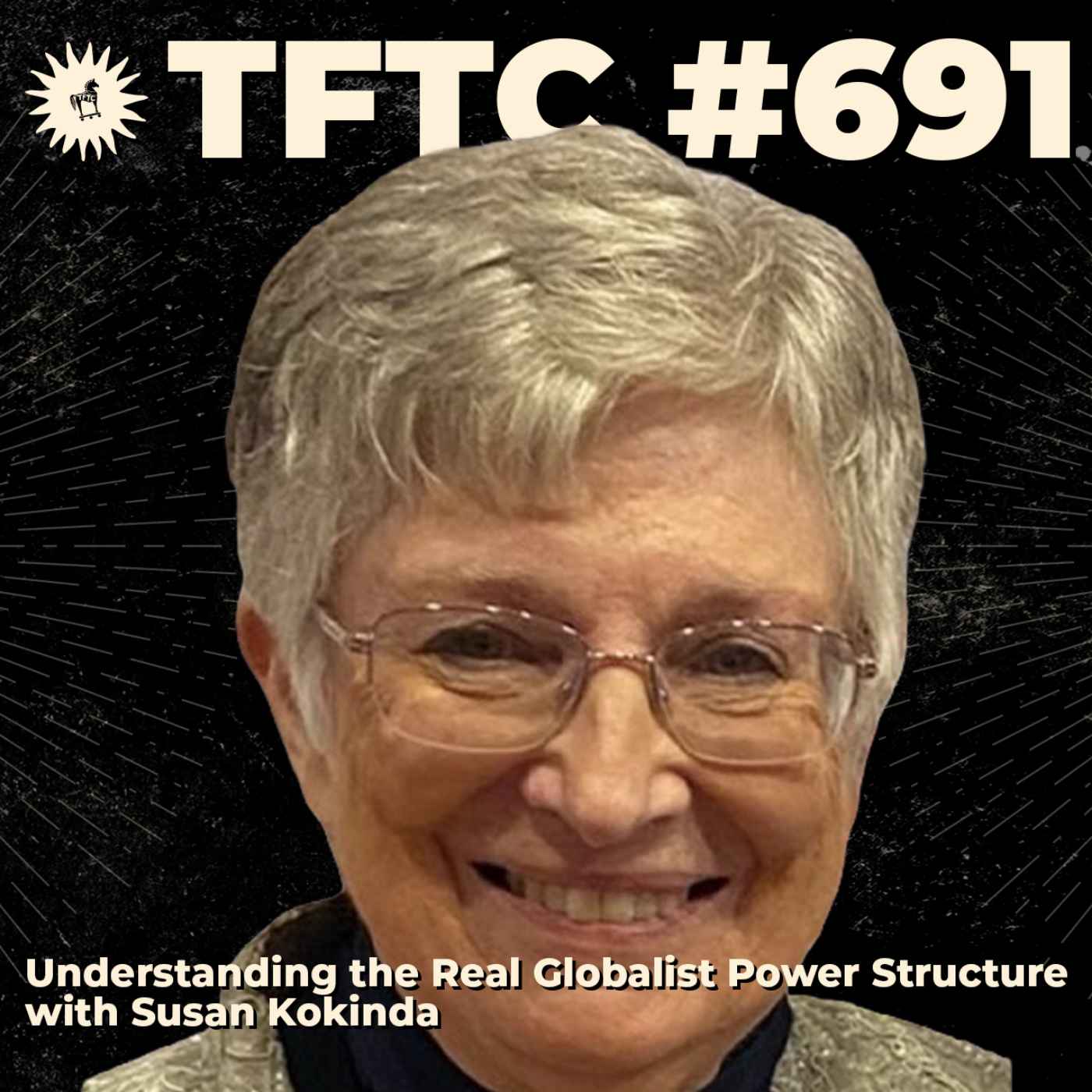
TFTC: A Bitcoin Podcast
#691: Understanding the Real Globalist Power Structure with Susan Kokinda
00:59:03
Loading summary
Transcript103 lines
- [00:07]
A
You've had a dynamic where money's become freer than free. If you talk about a Fed just gone nuts, all the central banks going nuts. So it's all acting like safe haven.
- [00:19]
B
I believe that in a world where central bankers are tripping over themselves to devalue their currency, Bitcoin wins. In the world of fiat currencies, Bitcoin is the victor.
- [00:29]
A
I mean, that's part of the bull case for Bitco.
- [00:32]
B
If you're not paying attention, you probably should be.
- [00:34]
A
Probably, should be. Probably should be.
- [00:37]
B
Susan Kukindo, welcome to the show.
- [00:39]
A
Thanks for having me. Looking forward to it.
- [00:42]
B
Like I was saying right before we hit record, I very much am looking forward to this. As I was explaining, we've had a recurring guest on Tom Luongo, who's very passionate about the City of London and the fact that most people have not diagnosed the City of London as the problem of geopolitics today, of global control. You've been on this subject for quite a while and have been putting out incredible content about how it pertains to what's happening in the world today. But first, I think just to give a high level synopsis of the City of London thesis, their control over the global economy and political affairs for the last 300 years and then we can pull it forward to today and what's happening.
- [01:28]
A
Sure. I mean, I think the fastest way for people to think about this is just think about what we fought the American Revolution against. We fought it against a British Empire. Now, what was that British Empire? Well, the British Empire was very much dominated by two institutions, the bank of England and the British East India Company, both of which represented kind of like the modern codification of imperialism, where you have private financial interests who actually have more power than the nominal governments. Now, it gets a little different when you have monarchies, but essentially when you're looking at the British Empire.
- [02:09]
You look at the monarchy and all of the institutions that are connected to that. I always remind people, for those of us who remember the old James Bond series, on Her Majesty's Secret Service, on Her Majesty's Secret Service who runs MI6. It's not the government, it's not the Parliament, but you have this complex of things which includes the bank of England, the British intelligence services. But then the City of London itself is this unique incorporated entity of I don't remember how many square miles, which has its own independent existence. And it is where the major financial flows of the world, you know, go through. So when you look at that, that complex, this is what we actually fought the American Revolution against, because their intention is we're going to keep everybody under our control through financial flows and by the way, through perpetual wars and, you know, and get them pitted against each other. And they have no place else to go for finances other than these private central banks or the institutions that are tied to the City of London. And then the upstart Americans came along and said, no, we don't like that. We want to be sovereign. We want to be sovereign politically, we want to be sovereign economically. And one of the most important things that we did, which was really quite as much we made an economic revolution as much as we did a political revolution. We created a national bank where the nation was not subservient to private bankers, but the national bank was subservient to the interests of the nation. And of course, that went, by the way.
- [03:55]
In various iterations. And then we ended up with our own central bank in 1913. So when you think City of London, think about this entire imperial complex, which is no different again than what we fought the American Revolution against.
- [04:11]
B
And is it safe to assume that today, in 2025, we are fighting yet another revolution? It's not only us this time around, but it's more behind the scenes than it was in 1776.
- [04:26]
A
Yeah. You know, most people in the MAGA movement and more broadly think of it from the standpoint of globalists and globalization. Well, there's nothing wrong with that. That's a good generic title for it. But the brand name is go back to the British Empire and then trace the institutions that they created that still exists to this day in terms of foreign policy, in terms of central banking institutions, in terms of intelligence agencies, and you'll see what it is we and Donald Trump are essentially fighting against.
- [04:59]
B
Well, let's dive into current events. There's a lot of activity off the coast of Venezuela. As we were discussing before we hit record, there is a new sort of economic policy that was. That was released earlier today, really focusing on the Western Hemisphere. If you look at the mainstream media, a lot of the pundits are opining about.
- [05:24]
Extrajudicial bombing of narco terrorists and that not being okay, war has not been officially waged through Congress. And so this is a bad thing. How does this all pertain to this inter cabal squabble, if you will, between.
- [05:43]
The west, the United States, the Trump administration, who would like the US to be sovereign economically and geopolitically, and the City of London?
- [05:52]
A
Well, this actually gets to the core of a very important aspect of this, because what you're dealing with, there's one more iteration, shall we say, of the city of London, and that's international drug trafficking. Historically, people are familiar with Britain's opium wars against China, which were used politically to basically make China subservient to them, but also financially, because there are huge dark money flows tied to the international drug trade in the trillions and trillions of dollars. And what you've seen emerging in south and Central America, with Venezuela as a key nodal point in all of this, is one of these nodal points for what we call dope Incorporated.
- [06:43]
Especially.
- [06:45]
One of the key transit points for a lot of this dirty money going back to the 70s and 80s and so on, has been Britain's offshore Caribbean islands, totally deregulated, no transparency. You can drive a gorilla of dirty money through these things and nobody will ever know it. So you've had this huge underbelly of the global financier elite, in particular the British side of it. And what you find in countries like Venezuela and other countries which to one degree or another.
- [07:22]
Are in contention with literally a narco terrorist government. I mean, if you think about this, if you think about the narco terrorists, not a bunch of guys from South America who are making money shipping fentanyl and cocaine into the United States, but as part of this global financier elite, this just happens to be their Latin or Central American division of it. You're literally dealing with what is the equivalent of an entire foreign entity down there. You know, I've often said, you know, people say, well, we've had failed wars on drugs. No, we haven't. We've never fought one. Because the real war on drugs has got to be against these financier interests. But of course, they don't function without the actual drugs flow of drugs as well. And the. And Wall street and London have never wanted a war on drugs, which is why we've never had a serious one. And that is what I think Trump is targeting. And this is a war, and it's a war in which there have been hundreds and hundreds and hundreds of thousands of American casualties. So he has declared this to be a national emergency. He's declared these narco terrorist gangs to be just that. And of course, you have the entire anti Trump opposition, which.
- [08:45]
Never seemed to notice how many innocent civilians Barack Obama droned when he was President of the United States, including infamous situations where they go in and they'd drone a wedding and then they'd go back in and they'd drone the first Responders, hundreds and hundreds of civilians and women and children were killed by Barack Obama in much less clear circumstances than what we're dealing with right now, which is a foreign financed and directed assault against the very lives of the American people. So this really does go to the heart as much as anything of the City of London.
- [09:27]
B
Well, to that point, how much influence has the City of London had on domestic politics here in the United States as it pertains to Venezuela? There's been a. I wouldn't even consider them headlines. There's been a lot of theories about the voting technology and the servers that were sort of storing the votes being located in Venezuela. Obviously, the deep state as a concept, particularly the CIA and FBI colluding with foreign interests to get certain things done has been a long running theory. How much of this, from your perspective is actually happening and how is it happening?
- [10:04]
A
I'm not ready to say from my own investigations and personal experience, how much of that is actually run through foreign countries. I mean, I'm politically active here in Michigan after the 2020 election. I got very much involved in election integrity efforts here in Michigan because it was pretty obvious what happened here at the infamous TCF center and the work that I've done over the years in terms of this. The vote stealing is primarily the absentee ballots. It's not gremlins in the machines and international information packets coming from Serbia or Venezuela. Is there something there? There could be. I don't think it's the most fundamental part. I think the most important thing for people to think about is the way that this imperial system, this British imperial system, has infected most of our institutions since the beginning of the 20th century. So it's not like you have to draw a direct connecto between this event and here's the address in London. But just look at how our entire foreign policy establishment for over 100 years has been inculcated in British imperial thinking. The British recognized that the United States was becoming a powerful force coming out of the civil war and going into the turn of the 20th century. They took care of some of our power by assassinating our best presidents like Abraham Lincoln and William McKinley. But at that point, they recognized even with that we were becoming an industrial power. Other nations around the world, nations like Russia, Germany, Japan, China and many others, were modeling themselves on the American system and not the British system. And the British said, well, we're going to have to figure out how to capture the United States intellectually. And you see the subversion of our education institutions, you see obvious institutions like The Council on Foreign Relations, which was founded in 1922 as a direct outgrowth of the British Roundtable. And the British Roundtable was very clear along with the Cecil Rhodes, will we have to bring the United States back into the imperial fold? We're going to figure out how to do that. So they started setting up institution after institution in the United States to just get us to do their bidding because they had corrupted the way we thought. And Donald Trump came along in 2016 and began to disrupt that. And he came back in 2024 and he's really disrupting that. Yeah.
- [12:41]
B
As it pertains to the Council on Foreign Relations, I think when USAID got decimated in the beginning of this administration, it was astonishing. I think the sort of meeting zoom recordings leaked a couple of months ago. But it was kind of. Kind of appalling may not be the right word, but it's very, very. It was astonishing how emboldened they were. Basically saying, we can, despite what's happening to usaid, we can, we can act sort of above that. We are coordinating to make sure that this isn't really a big disruption to what we're doing here.
- [13:20]
A
Yeah, I mean, I think it has disrupted a lot of what they're doing. And if you go back to the Venezuela situation, if you actually disrupt the global drug trade, you are going to be disrupting even more of the financial flows that this apparatus depends on. So Trump is a gigantic disruptor at this point, and they are obviously not amused.
- [13:42]
B
Sup, freaks? This rip at TFTC was brought to you by our good friends at BitKey. BitKey makes Bitcoin easy to use and hard to lose. It is a hardware wallet that natively embeds into a two or three multisig. You have one key on the hardware wallet, one key on your mobile device, and block stores a key in the cloud for you. This is an incredible hardware device for your friends and family, or maybe yourself, who have Bitcoin on exchanges and have for a long time, but haven't taken a step to self custody. Cause they're worried about the complications of setting up a private public key pair, securing that seed phrase, setting up a pin, setting up a passphrase again, BitKey makes it easy to use, hard to lose. It's the easiest zero to one step, your first step to self custody. If you have friends and family on the exchanges who haven't moved it off, tell them to pick up a BitKey, go to BitKey World, use the key TFTC20 at checkout for 20% off your order. That's BitKey World code TFTC20SUP freaks. Have you noticed that governments have become more despotic? They want to surveil more, they want to take more of your data, they want to follow you around the Internet as much as possible so they can control your speech, control what you do. It's imperative in times like this to make sure that you're running a VPN as you're surfing the web, as we used to say back in the 90s. And it's more imperative that you use the right VPN, a VPN that cannot log because of the way that it's designed. And that's why we have partnered with Obscura, that is our official VPN here at tftc, built by bitcoiner Carl Dung for bitcoiners, focused on privacy. You can pay in Bitcoin over the lightning. So not only are you private while you're perusing the web with Obscura, but when you actually set up an account, you can acquire that account privately by paying in bitcoin over the lightning network. Do not be complacent when it comes to protecting your privacy on the Internet. Go to obscura.net, set up an Obscura account, use the code TFTC for 25% off. When I say account, you just get a token. It's a string of token. It's not connected to your identity at all. Token. Sign up, pay with Bitcoin, completely private. Turn on Obscura, surf the web privately. Obscura.net, use the code TFTC for 25% off. Shifting. Before we come back to the National Security Strategy that was just released. I mean, shifting to Europe too, looking at what's happening there in terms of digital id, the increase in censorship, it seems apparent if we're running down this thesis and using this as the core framework from which we view the world, it seems that the city of London has very tight control over Europe, the continent of Europe. And I look as a Westerner, as a United States citizen, at what's happening in Germany, uk, Ireland, and completely dumbfounded by what's happening, particularly with censorship laws in this push. Now we have the UK trying to sue X for speech that people are putting on this American company's platform. What is the state of Europe and can they get out of this?
- [16:43]
A
Europe gave up its sovereignty with the eu.
- [16:46]
I mean, that was a grand experiment which the globalists succeeded in imposing on these countries. So when you're looking at the eu, you're basically looking at just a bunch of political and economic colonies, for that matter, with the exception of a few countries. I mean, obviously, as we know, there are a few countries in Europe, like Hungary and Slovakia and others, who are kicking back and have more of a national or sovereign kind of approach. But. And sometimes it gets. People get a little confused. Well, the British got out of Brexit, so aren't they different? Not really.
- [17:30]
They're perfectly capable of manipulating institutions, whether they're directly in them or not in them. And obviously, as you pointed out, the policies being implemented in terms of digital ID surveillance, destruction of economies, green policies, it's all of a piece, whether it's the British or whether it's the European Union.
- [17:53]
And from inside the west, again, the first major disruption of all of that is Donald Trump.
- [18:02]
But he's also not alone, because obviously, Russia under Putin has very much of a national sovereign kind of policy where they're acting in the interests of Russia, not in the interests of oligarchs, not in the interest of a global financier elite. And Trump's approach is, as long as you're acting in the interests of your country and not somebody else, I can work with you. And in a sense, that's the difference between a country that you may have an adversarial kind of relationship with, whether it's economically or strategically, like North Korea or China, where their leaders are more or less acting in the interests of their country as they perceive it in a place like Maduro, where I don't think Maduro is acting on behalf of Venezuelans, I think he's an arm of this narco terrorist.
- [18:55]
Apparatus.
- [18:59]
Which owes its allegiance basically, to this British imperial elite. So that's how Trump looks at things. If you're a sovereign nation, I can work with you. If you're acting under your own interests, we may have problems and it may take a while to work them out. But that's okay, I can work with you. But if you're just a tool of this global financier elite, it's going to be very different.
- [19:22]
B
How does the media play into all this? Because if you read the tea leaves of mainstream media, they are very adamant that Trump, too, is an abject disaster. And if we're polling public sentiment, obviously there's a contingent of Americans who think he's doing a good job. There's also a contingent who voted for him and think he's not doing enough. How would you basically describe what he's done so far in the context of this framework and what Would you say to people and how would you set their expectations? I think.
- [19:59]
A
Well, I think the most important thing that is not getting across through the media, whether it's the hostile mainstream media or I'll call the controlled opposition like Fox Media and so on, which quote supports Trump up to a point, but they still want war with Russia, they still want war with China, they still love Wall street and so on. So I think what is not getting out, although I think I've seen there's definitely a shift since the off year elections back at the beginning of the month in the administration is getting across to people the importance of the revolutionary change in economic policy that Trump is carrying out.
- [20:42]
And I will get to the national security strategy which was just announced this morning because I encourage everybody to read it. It's 33 pages. You know, just stop doom scrolling for a half an hour and read it because you will be shocked by how much of it is about economic policy. And I'm going to read one, one section of it. I haven't even had a chance to read the whole thing myself because I've been jumping from this to that. But this part friend of mine sent to me, he said this is our national security strategy, okay? We want a gainfully employed citizenry with no one sitting on the sidelines who take satisfaction from knowing that their work is essential to the prosperity of our nation and to the well being of individuals and families. This cannot be accomplished without growing numbers of strong traditional families that raise healthy children. And then the next section is pro American worker. American policy must be pro worker, not merely pro growth. And it will prioritize our own workers. We must rebuild an economy in which prosperity is broadly based and widely shared, not concentrated at the top or localized in certain industries or a few parts of our country. That's really quite stunning. And if you look at the whole of what Trump is doing and you can get a good handle of it if you watch the cabinet meeting from the other day. And I also recommend stop doom scrolling and just go watch the whole cabinet meeting. I mean, you know, put it on two times speed if you have to, but you're going to hear a team which is engaged in something that we have not seen in the United States in at least the post war period, which is the revival of our physical economy at the expense of the financier parasites of which City of London is first among equals. And just a forced march of getting investment back in to manufacturing, infrastructure, energy and creating the kind of good paying jobs where one income can raise a Family.
- [22:56]
Everything, including setting up the skilled trades apprenticeship program so we can upskill the population and people can go out and get those kinds of jobs instead of being uber drivers. Trump sees this as our national security policy, and he's absolutely right. And I think the more people understand this is where we're going and it may not all be tangible in 2025, and a lot of it might not be tangible, say in the first quarter of 2026. I think more of it is going to become tangible by the second and the third quarters. But whether you see the manufacturing jobs spring up in your community or not, people have to understand this is a revolution as big as anything we've had since Abraham Lincoln or George Washington.
- [23:45]
B
Well, it's very refreshing to hear that. And it's stunning that it is stunning to hear something like that come out of a National Strategic Security memo because it seems pretty straightforward throughout.
- [24:01]
A
The whole thing is just infused with this. Here's another one. The future belongs to makers. The United States will re industrialize its economy, reshore industrial production, encourage and attract investment in our workforce, and then it goes on.
- [24:16]
B
Well, we've been, we've been led to believe that we can't do it. We don't have, we don't have the intellectual capital, we don't have the raw materials resources. And the economy has been built in such a way over the last five decades that we're just not built for it. Which I think that last point is certainly true. But I think it comes with this assumption that we can't revert to an industrialized economy, which I find very hard to believe.
- [24:42]
A
And it was deliberate. And if we want to get back to the city of London, a key nodal point in the post war period was 1971 when Nixon took the dollar off the gold reserve standard and we ended Bretton Woods. Why did he do that? Because the dollar was under tremendous pressure by the British. Now there was probably another way out, but I wasn't there. I was very young. And Nixon relied on the people who had been trained in British imperial financial thinking, whether they were conservative or liberal. So he took that step and that began the process where everything was financialized. You know, our currency was financialized. It was no longer a sovereign currency. Then everything else became an income stream. Healthcare, manufacturing, transportation, energy. It was no longer, you no longer organized your economy to increase these kinds of physical activities. Everything was simply then tied to some parasite which just sucked everything out of it. And of course, free trade was the next nodal point in terms of it so we, by surrendering to City of London policies, hollowed out our economy and left us where we are today. But there's no reason we can't rebuild it. And that's what this administration is committed to doing.
- [26:02]
B
And you touched on the sort of position of the Trump administration, which was like, hey, if you're a sovereign nation that is truly looking after the interest of your nation itself and not being influenced by outside forces, were willing to work with you. And I watched your most recent video that you put on YouTube and you were talking about this, these nuclear related meetings that were happening around the world over the last last week. What is what happened and what is the profundity of what actually happened?
- [26:36]
A
Well, if you stop and you think about what is the combination of economic, strategic and political power that could actually challenge this City of London centered imperial behemoth?
- [26:55]
I would say it's four countries, the United States, Russia, China and India. So what happened this week? You had Trump's team, Witkoff and Kushner in Moscow meeting with Putin in a five hour meeting. And some of that meeting was definitely about economic policy, not just trying to work out the details and the nuances of the Ukraine mess. Simultaneously, you have the Chinese Foreign Minister Wang Yi meeting with Sergei Lavrov, his counterpart in Russia. As I said in my show, was this coordinated? I don't know. But the strategic optics are pretty clear. There are the three superpowers, those three superpowers. And then what's happened over the last couple of days, Putin is in India now, you know, the people who like to play geopolitics, make sure the superpowers are always at each other's throats, are going to say, oh well, China was in Russia because Russia wants to have some kind of counterweight against the United States. Or Putin is in India and India is having trade conflicts with Trump and they're playing that out. I don't see it that way. I see this kind of Trumpian world where these major sovereign nations are working things out amongst themselves. And it has nothing to do with the rules based globalist order. It has nothing to do with London, Europe, the city of London, the international financier elite that, you know, you actually are getting the kind of dialogue you need among these, especially these four nations, which ultimately can be the bulwark of, of both the political, economic and strategic reconfiguration of the world. But again, not on some block. You know, that's my problem with the brics. You know, it's this block of countries. And I was on A show the other day and somewhat contentious, with somebody saying, well, why doesn't Trump meet with the BRICs? I said, well, he's talking to Lula, he's talking to Russia, he's talking to China, he's talking to India, he's got problems with South Africa at this point. Why do you need brics? Why not just nation to nation to nation to nation and we figure out what's best.
- [29:06]
Why.
- [29:07]
B
Why can't the Trump administration just come out and lay this out, lay this all out and say, hey, here's what's going on? Because it's somewhat cryptic or it's imperceptible. If you're not in the weeds, as you are, what's the danger of laying out, or the opponents their ways of operating, particularly through time up to this point, and then saying, hey, this is what's happened. This is what we're trying to do.
- [29:36]
Why hasn't that happened? Because I feel like all of our.
- [29:40]
A
Lives a lot easier. Right, right.
- [29:44]
You know, I don't know why. I mean, I know there's certain realities that people should just be conscious of. First of all, I was with a group of people here in Michigan yesterday who supported Trump, but are very unhappy about certain aspects of his policies as they've evolved and so on. And I said, look, I'm not trying to make an excuse, but I want you to understand something. At best, he controls his government at the level of the cabinet secretaries and maybe one level down. I think you get below that and you still have. You can call it whatever you want, the deep state firmly embedded. So how much maneuvering room does he have to have to come out and just sort of bear it all. But I think if you look at. I think you're gonna see more and more of a much clearer view of this. In fact, two days where the administration, look, they're not gonna call it the British and the City of London. I mean, Trump has to deal with nations, you know, and if he has to go deal with Starmer, he'll go deal with him and he'll make nice with him, even though he may be undercutting the imperial policies that Starmer is beholden to. So you're not going to have Trump come out and say. I don't think. Come out and say it's the British. But what I think you're going to see increasingly is they are going to bring back much more of the focus on the globalist and the globalist institutions. And again, if people read this new National Security Strategy document, you're going to see over and over again attacking the globalist institutions or A couple of days ago the White House put out a very short, beautiful statement on the anniversary of the Monroe Doctrine, and I jotted down what it said. The American people, not foreign nations or globalist institutions, will control their own destiny. So I think that you're going to see this administration drawing the American people more and more into the real nature of the fight, which is these globalist institutions and those of us out there who have.
- [32:01]
A more, as I say, brand name version of it. We'll just keep educating people and showing them this is what this really means.
- [32:08]
B
Sup freaks? 2025 left many wondering was this an underwhelming year for Bitcoin or the quiet setup for an extended bull run on December 17th at 1pm Central join Preston Pitch, Connor Brown and Unchained for Bitcoin in 2025 a year in Review, a concise breakdown of the macro trends and policy developments that truly shaped the year. You'll hear what mattered most, where the market stands now, and what these inflection points reveal about Bitcoin's long term direction. If you want clarity on where Bitcoin has been and where it's headed next, don't miss this event. So go Register now at unchained.com/tftc that's unchained.comtftc Sup freaks? This rip is brought to you by good friends at Silent Silent creates everyday Faraday gear that protects your hardware. We're in Bitcoin. We have a lot of hardware that we need to secure your wallet. Emits signals that can leave you vulnerable. You want to pick up Silence gear, put your hardware in that. I have a tap signer right here. I got the silent cardholder replace my wallet. I was using Ridge wallet because it secured against RFID signal jacking. Silent the cardholder does the same thing. It's much sleeker, fits in my pocket much easier. I also have the Faraday phone sleeve which you can put a hardware wallet in. We're actually using it for our keys at the house too. There's been a lot of robberies. They have essential Faraday slings, Faraday backpacks. It's a bitcoin company. They're running on a Bitcoin standard. They have a Bitcoin treasury. They accept Bitcoin via strike. So go to slnt.comtftc to get 15% off anything or simply just use the code TFTC when shopping@slnt.com Patented technology Special operations approved. It has free shipping as well. So go check it out. Well, you mentioned the layer which he probably has the most power is at the Cabinet level. How would you compare his Cabinet in his second term compared to the first? Do you think he learned a lot of lessons during his first term and.
- [33:46]
A
That four years off, there's. There's frankly nobody in this Cabinet that I have seen a particularly large problem with. I mean, some people. Look, you have. And you also have the Trump effect.
- [34:03]
And I see this here in Michigan, where we have a bunch of people running for Congress and a bunch of people running for Senate, and some of them have run before, and frankly, some of them have run really terrible campaigns. And now you're seeing the ones who got any brains are running on Donald Trump's policies. That's the Trump effect. Did these people suddenly become better? I don't know. I hope so. But Trump has set a new standard. So I think it's the same thing with the Cabinet. I mean, I think there's some people who. Different kinds of tendencies in the past where you could have said they were more neocon. I won't name names. I'll just let people draw their own conclusions. But I think what you're seeing is that they're loyal to Trump and they are working as a team, and they get it, that this is transformational. So this Cabinet is amazing. I mean, whether it's Lotnik, whether it's.
- [34:58]
The Labor Secretary, whether. I mean, the biggest surprise for me is Scott Bessen. I ever think I would be cheering on a Treasury Secretary. Every Treasury Secretary that we've seen in my lifetime has just been a rubber stamp for Wall street in the City of London. And this guy Bessant gets it in terms of workers, Main street, industry, changing the direction of the country.
- [35:25]
He gave a really excellent interview once where he said, you know, the Democratic strategy has always been compensate the losers. You know, we take away your jobs, we take away your livelihood, we take away your future, and we throw some money at you. And what did he say? He said, I don't think we're losers. I don't think these people are losers. It's the system that was broken. Think about that. A Treasury Secretary saying it's the system that. That was broken. I think everybody in Trump's Cabinet understands that.
- [35:54]
B
Well, let's stay on Scott Besant for a while, because I think. Or maybe not for a while, but just dig a little deeper, because there's many. I mean, I come from the economic side of things. This is predominantly A bitcoin show. I think a lot of the problems that exist in America today come from the fact that central banks have corrupted our money. And there are many, myself included, who think that the Treasury Secretary is arguably the most important cabinet position in any current administration. When you consider the state of the economy and most importantly, the state of the national debt. And similarly to you, I wasn't too well aware of Scott Bessant until the rumor started that he could be in the running for treasury secretary. Started looking into it, and even a year ago, but now more so, it's like, okay, if there is going to be a guy in this position to try to reorient the American economy, this seems like an incredible candidate. How important is his position in your mind?
- [36:57]
A
I think it's really critical and I think it's really interesting. Trump keeps saying, I'd like him to be the Fed chairman, and Bessen says, no, I want to stay where I am, because, frankly, he has more power as Treasury Secretary because Fed is just monetary tinkering. And a chairman which is more amenable to what Trump is trying to do will be fine, like whomever he picks. I mean, everyone's assuming it's going to be Hassard and we'll be able to ameliorate some of the damage that the Fed does. But at treasury, you can actually do things. And very interesting interview that he did with Breitbart. I think it was, unless I'm getting my interviews confused, he recently did an interview at the treasury, and they asked him, what was the most surprising thing about you you found out about the Treasury Secretary job. He said, 40 to 50% of what I do is national security. Now, part of that is tariffs. But then let's get back to drug money flows and Venezuela and offshore islands and so on. You have somebody in that position who not only can play a role in terms of shaping economic policy to build up the industrial base of the United States again, but you have somebody in that position who actually knows what the enemy's financial operations are and is in a position to carry out financial warfare against it.
- [38:26]
B
Yeah, because you mentioned the Caymans, and I think I covered this in my newsletter earlier this year. But it's become more apparent that there's definitely some dark money things going on in the Cayman Islands, particularly, can bring this back to Scott Bessant as it pertains to Treasuries. There's a black box of treasury holdings within the Caymans, and a lot of people are suspecting that it is just a slush fund for these nefarious activities. Depending on how you count them, one could argue that the Cayman Islands technically is the largest holder, foreign holder of Treasuries in the world, surpassing Japan, the UK and China.
- [39:07]
A
Right. I mean, it could be. And you know, people have to keep this into account. You know, we, we have certain vulnerabilities. I mean, previous administrations, through their insane policies have left the United States extremely vulnerable. I mean, let's just talk about rare earths. And obviously there's, I mean, look at what Trump did with China. Bought us a year so that we can actually start getting production going on in the United States. But, you know, you look at the enormous debt of the United States, which is in the hands of other countries. So in a certain sense, to get back to your other question of why don't they just come out and say this? I think they're taking a whole lot of very careful, deliberate steps to put the United States in a position where it can defend itself, where it can begin to extricate itself from this financier system. But this is not the kind of thing where you just snap your finger and say, oh, bye, bye, city of London, we're on our own. And I think this question of US treasury holdings in other people's hands is a big aspect of it. So they have to have all of this in mind as they take each one of these steps.
- [40:18]
B
Yeah. So that leads to a couple questions. First of which is who is on board with us? Obviously you mentioned Russia, China, India, conversations happening over there. If they're acting sovereign, maybe they will play ball in the sense it's like, if you leave us alone, we'll leave you alone and we'll do some trade. Intermittent, maybe not even intermittently. We'll have good trade deals and you take care of the west, obviously. The national security memo that went out this morning, real big focus on the Western Hemisphere. We don't want to get into these foreign wars across the world anymore. We really want to focus on our locality, our geographic locality and the economies around us. Who in the Western Hemisphere, in your mind, is excited about this policy positioning?
- [41:09]
A
Well, obviously we've got Argentina and the administration is clearly trying to influence things in Honduras. You know, it's a difficult relationship with Mexico and with many of these countries in Central and South America. I think people have to be cognizant of the fact that you have almost dual power situations. Right. Where you have the narco traffico cartels with as much if not more power than the governments. So governments have to take that into account, you know, as they make their negotiations. Which is why I think this whole attack on, you know, what friends of mine many years ago called Dope Incorporated, this whole attack on the drug trafficking, the money flows that go with it, the terrorism that comes with it, that's going to be foundational to creating a situation where there are, where sovereign nations can actually act in their own interests. So I think it's, I think, I think our hemisphere right now is a work in progress. Of course we're not going to talk about Canada because that's in the hands of the central banker. Central banker Mark Carney.
- [42:20]
B
The Mark Carney.
- [42:23]
I'm sure you've seen the documentary by John Titus, All Plenary's Men. Basically, Mark Carney in the center of the HSBC Zeta cartel money laundering scheme. Obviously he was the head of the bank of England at one point.
- [42:39]
A
The only foreigner to ever be head of the bank of England. So this man is trusted.
- [42:45]
B
And the fact that the Canadians welcomed him in with open arms to be their prime minister, well, not a lot.
- [42:50]
A
Not all of them did. And it was one of those elections with a parliamentary system where you look at the nuances of it. He really is. Not that he doesn't have that much political support. And of course the western provinces are not happy. I mean he's trying to tackle in Trump world, so he's doing certain concessions in terms of internal flows of energy, which you never had before, to try and keep the Albertans happier that they've got some kind of economic development. But all of this is, I think, just biding time to continue to play his nefarious role.
- [43:29]
In that circumstance. But at least he's honest because when he was at the ASEAN summit about a month ago, he said the rules based liberal free trade order is over. They know it, they know Trump has ended it. And his job is to quietly try and figure out, well, how much can I sabotage it or how can I set up some kind of other operation. But among the smarter of these guys, or at least the ones that are getting their orders from the smarters of these guys, they know what they're up against with Trump and it'll be always, they always have a two front attack, you know, the frontal attack, you know, all the political stuff that he's being hit with in terms of the boat strikes and everything else, you know, try and knock out the people he relies on the most like Hegseth or Tulsi Gabbard or Cash Patel or whatever. And then, you know, the quieter okay, what do we, what are we doing to try and undermine these policies economically and politically in the back room? Yeah.
- [44:35]
B
Well, sticking on the narco boats, getting taken out. I think you had a really good explanation of what the second and third order effects of this are. I think it's important to go over those with the audience who may be looking at this and saying, hey, we're just indiscriminately bombing people in the Atlantic Ocean. What's going on here? But to your point of doping being a big part of this, there could be a strategic reason for bombing these boats, specifically in terms of the reaction and insights from the narcos.
- [45:13]
A
Yeah. And I was listening to a show the other day and one of the people, a retired general Blaine, I'm blocking on his last name. I think it's Holt. He made the point. Or maybe it was EM Burlingame, I can't remember. But one of them made the point that you look at that carrier group that's in the Caribbean, the USS Gerald Ford. Are they just there for firepower or think of the enormous electronic surveillance that you have and think of what happens when you bomb one of those drug boats. The communications lines light up and they're tracking all of this stuff and putting together a map of how this dope incorporated operation works and tracing it back to bank accounts and tracing it back to individuals and putting this entire map together. So it's like they're hitting at the bottom level of this to illuminate how this thing operates at the higher and higher levels. And I think they're dead serious. And that gets back to Scott Besant saying 40 to 50% of what I do at treasury is national security. Well, that's not just tariffs, that's this. Yeah.
- [46:24]
B
And so how do you think, do you think the City of London.
- [46:29]
Notices that its back is against the wall and it's going to lay over or.
- [46:34]
A
They'Re going to continue to do everything they can do. I mean, this thing around Hegseth and the bombing, I mean, if they could, they will try and turn this into impeachment territory. And we've got plenty of weak Republicans. I don't know that they would ever push it to that point over the next year. But you can bet.
- [46:55]
The key nodal point is the midterm elections. We have to hold the House and hold the Senate and optimally increase our margins, which is hard in an off year election and even harder. Make sure more of those Republicans are actually mega Republicans.
- [47:15]
But that to me, the battle over the next year is going to be that, because I think Trump will be able to continue to move legislatively. It'll be much more glacial than, I mean, we got the big, beautiful bill through, and Trump was a genius to put all of it in one bill.
- [47:35]
Maybe he can embarrass enough of these senators to get rid of the filibuster, but if he doesn't, I don't think you're going to see a whole lot going on legislatively except on some of these 80, 20 issues where people will just burn their congressmen and their senators butts. He'll continue to move in terms of executive orders in the presidency. I think we'll begin to see the effect of some of this economic restructuring. I think people will start to feel, I mean, if people are paying attention, the price of eggs are down, the price of gas is down. You know, the price of things that Trump has some control over are actually down. But people need to see jobs and they need to see, you know, a real change in the standard of living so that, you know, we're going to be in quite a, quite a tense, you know, year as we go into the midterm elections. But I think the big hole card for the City of London and the elites is they want to take this Congress away from Trump. And if they do that, I don't really know what it will look like, but it won't be good.
- [48:41]
B
Well, to that point, how critical for ensuring that we live in a free and sovereign country is this next year? Is it make or break?
- [48:51]
A
I think it's make or break. I mean, I think this is the equivalent of what Lincoln had to do to win the Civil War. If we had lost that Civil War, we, or if Lincoln himself had not been elected in 1861, we wouldn't be sitting here in a great sovereign republic. We'd be a bunch of squabbling Balkanized states. And.
- [49:15]
I think the next year is absolutely critical. And what I do with my shows, what I do with my political organizing is just try and educate the MAGA movement so they understand the nature of this fight and not only can back up President Trump, but create much more of a bench in terms of people who are running for office at every level, who think this way, who understand this, so that he's got much more maneuvering room, and we've got a much better chance of keeping people in the MAGA coalition not being diverted on all of this nonsense which is being spun up right now, Tucker versus Candace or whatever, and stay focused on what it is Trump is actually doing so that we have an electorate which is smart enough to make the right choices come next November.
- [50:07]
B
If you're looking at the polling day, it's not looking great right now.
- [50:10]
A
It never does at this stage of the game. And I think the administration realizes they've got to sharpen the message on the economy. So Peter Navarro was on Bannon week and a half ago, and Bannon said, did you jump the gun on the golden age? Like, it's not here, it's coming.
- [50:32]
And Navarro said, yeah, we got the memo. And so he's been doing on his substack, he's doing really good educationals in terms of this is where inflation comes from in this sector, and this is what we're doing. J.D. vance, I think, is taking the point on a lot of this, and Trump is going on the road.
- [50:53]
That's the best way you can do it. You send the man out there to talk directly to the American people about how you actually recreate an actual American economy. And I think as that kicks in, we'll see the poll numbers get back to something we can work with. Not that I necessarily trust polls all that much, but there's something out there.
- [51:16]
B
Yeah, it's.
- [51:20]
How did you get into this in the first place?
- [51:23]
A
It's a really long story.
- [51:27]
I've been political pretty much since I was hatched.
- [51:31]
I campaigned for Bobby Kennedy Sr. In 1968, and I was in California when he was shot. So, you know, I went through the. I saw the devolution of the United States coming out of those assassinations. And in the early 1970s, I ran into a man named Lyndon LaRouche, who you or some of your viewers may be familiar with, who was a physical economist, who pretty much saw where all of this was going, was very much of a maverick. He passed away a few years ago, and some of us took a different direction from those who are still affiliated with his widow, Helga Zepp larouche, who, for legal reasons I have to say I have nothing to do with, but I sort of have lived in the world of being in a maverick organization all my life. And then along comes Donald Trump. So that made it kind of easy.
- [52:27]
B
Well, I guess the last question I ask is economics, monetary, fiscal policy. I mean, there's many who believe. Bring it back to Scott Bessant. He had the now infamous fireside chat at the Manhattan Institute, I believe, in July of 2024, in which he said, hey, there's a global economic reordering underway, and I would like to be part of the team that is trying to advise the President on how to navigate this global monetary reordering.
- [53:01]
What does the monetary system look at? There's a lot of talk that the perceived independence of the Fed, which is very hand wavy, is going to be completely demarcated and that the treasury is going to take over monetary policy completely.
- [53:20]
What are you seeing in terms of the transition we have financially, particularly how the monetary plumbing works? If.
- [53:29]
A
Well, yeah, I think Bessant just this week said, you know, we want to basically cut back the mission of the Fed and so on. I think to the extent that they can do things administratively, you know, through executive orders and so on, they are going to try and, you know, reduce the negative impact of the Fed as much as possible.
- [53:53]
But I think the interesting thing they're doing because everybody's looking over here at the Fed, well, let's look over here at the alternate lines of financial flows that they're setting up. You know, when Trump first came in, he did put out an EOO saying, let's look at a sovereign wealth fund. I think what they've done is rather than one single new institution, first of all, they've got 18 to 20 trillion dollars of foreign investment coming into the United States, which is going to be directly channeled into productive investment, into steel plants, into shipbuilding, into nuclear power. A lot of it'll go into AI, but that means a lot of it needs to go into power generation and other things. So it's sort of like they're just creating an alternative to the Fed, and there's institutions inside various departments which are kind of like little reconstruction finance corporations, especially in energy and others, where they can again begin to channel credit into the real economy. I think the important thing that they're doing, however far they can move in terms of restructuring things institutionally between the treasury and the Fed, is just figuring out how do we start getting credit into the productive sector. And I think what they're doing is absolutely masterful. And it's not, oh, I'm going to introduce a bill tomorrow morning to get rid of the Fed. Yeah, you and what Congress is going to do that. You know, I mean, we're two, three cycles away from a Congress. I think, that would even consider something like that. Well, let's not wring our hands. Let's just figure out how do we get done what we need to get done. And I think as people begin to see, wait a minute, there's a different way to do this. This may still be over here, but over here, some really good stuff is happening, you begin to lay the political basis for perhaps ultimately getting rid of the Federal Reserve. But again, from where I sit politically, we're election cycles away from having an election cycle to do something like that. It's like people who say, we'll get out of NATO. Yeah, well, you and what Congress. Congress has to approve that.
- [56:05]
So give this administration credit for doing what they're doing, recognizing that there are certain things legislatively or institutionally they may not be able to do immediately.
- [56:17]
B
Just take the ground that you can while it's there.
- [56:19]
A
And there's a lot of it. There's a lot of it. When you actually want to do what Trump wants to do, which is reshore manufacturing, create real jobs and stop the wars, there's a lot he can do without turning the switch off on either the Fed or NATO.
- [56:37]
B
Susan, this has been incredibly insightful. Thank you for your time. Before we leave, is there anything we didn't touch on that you think is pressing any final notes, words of wisdom?
- [56:49]
A
Well, I would just say to your viewers, you know, what I said is this question of the midterms. And it's really critical that people are informed, are active, are smart, are engaged as much as they possibly can with one single mission, which is we have to defend Donald Trump, whatever form that takes. And in some cases, it may just be we just have to get the Republican elected whether he's good, bad or indifferent. In other cases, it's going to be we're going to get a really good candidate. You know, this is, you know, this is battlefront decisions that people are going to have to make. But people have to be engaged politically and not just sitting there. Doom scrolling, the latest social media scandal.
- [57:34]
B
Doom scrolling is very popular these days.
- [57:37]
A
Bad for your.
- [57:40]
And we have an antidote for doom scrolling@prometheanaction.com so I encourage people to head over there and see what we have to offer.
- [57:49]
B
We will link to that in the show notes. Again, Susan, thank you for your time. Thank you for your work, and hopefully we can do this at some point again in the future.
- [57:58]
A
Sure hope so, too.
- [58:00]
B
All right. Peace and love, freaks. Okay, thank you for listening to this episode of tftc. If you've made it this far, I imagine you got some value out of the episode. If so, please share it far and wide with your friends and family. We're looking to get the word out there also, wherever you're listening, whether that's YouTube, Apple, Spotify, make sure you like and subscribe to the show. And if you can, leave a rating on the podcasting platforms that goes a long way. Last but not least, if you want to get these episodes a day early and ad free, make sure you download the Fountain podcasting app. You can go to Fountain FM to find that $5 a month get you every episode a day early ad free helps. The show gives you incredible value, so please consider subscribing via Fountain as well. Thank you for your time and until next time.