← TFTC: A Bitcoin Podcast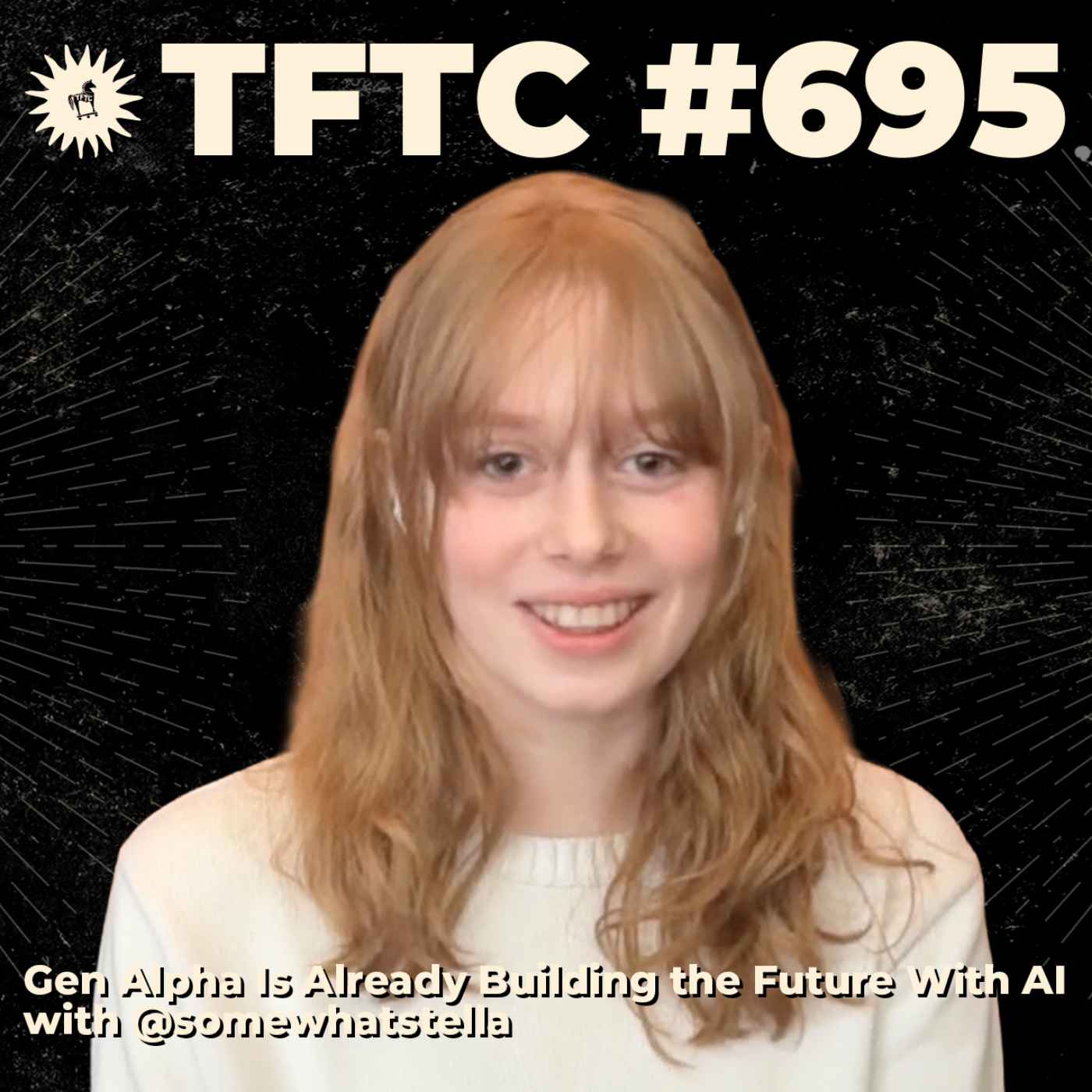
TFTC: A Bitcoin Podcast
#695: Gen Alpha Is Already Building the Future With AI with @somewhatstella
00:38:48
Loading summary
Transcript119 lines
- [00:07]
A
You've had a dynamic where money's become freer than free.
- [00:11]
B
If you talk about a Fed just gone nuts, all the central banks going nuts.
- [00:16]
A
So it's all acting like safe haven. I believe that in a world where central bankers are tripping over themselves to devalue their currency, Bitcoin wins. In the world of fiat currencies, Bitcoin is the victor.
- [00:29]
B
I mean, that's part of the bull case for Bitco.
- [00:32]
A
If you're not paying attention, you probably should be. Probably should be. Probably should be. What is up, freaks? Welcome back to tftc. We have a very interesting guest, the youngest guest in TFTC's eight year history. We've been doing this for eight years. And Stella, you are our youngest guest at 15 years old. Welcome to the show.
- [00:53]
B
Hi, nice to be here. How are you?
- [00:56]
A
Doing well, doing well. Like I was saying just before we hit record, I'm excited to have you on because we have an older audience. I didn't tell you this, but there's been a running theme on the show and discussion on this show and the other show I do with Matt o', Dell, which is how do we reach the younger generations?
- [01:17]
B
Oh, yeah.
- [01:17]
A
In Bitcoin, because it's a bunch of millennials, Gen Xers and boomers typically, that listen to this show. And so I'm very excited to get the perspective of somebody who's on the cusp of Gen Z and Gen Alpha. You get to choose which one you associate with, depending on how cool one or the other generation is. But this came to be because of an assignment you have at school at the Alpha School in Austin. And the Alpha School is, I'm not sure if you're aware, but outside of the Austin bubble, I think with tech forward and investment circles, people are looking at what's happening at the Alpha School around the country and saying, hey, this seems like a pretty cool model. Like I was mentioning, I listened to the Invest like the Best podcast with the founder Joe Lamont a few months ago and he was describing how he and the team, the administrative team at Alpha School, built the school. But I think getting the perspective of one of the students can be incredibly enlightening. So why don't we start there? Story about yourself, how long you've been in Alpha School and what it's like.
- [02:29]
B
I started Alpha in the middle of my ninth grade year. Before that, I was homeschooled pretty much my whole life and I was doing dual enrollment at the local community college, Austin Community College, acc. And I kind of just Found it boring, to be honest. It wasn't really causing me to do much with my life. I mean, sure, I'm at a college, but it didn't really feel all that inspiring or anything like that, which is why I decided to come to Alpha, because I wanted to do something more. I have plenty of ideas. I had plenty of ideas when I went in. And so I kind of knew that it was going to be great for me because I always preferred the idea of being an entrepreneur rather than working for somebody else. And so Alpha seems like a perfect fit. And it was when I joined it. You know, I can't imagine myself going anywhere else now.
- [03:26]
A
And so what is it like at Alpha School? What is a typical day? Like what, what do you, what autonomy and agency do you have over what you decide to focus on?
- [03:36]
B
We have quite a bit. We, we start our mornings with like three hours of academics. As I'm sure you know, that's kind of what most people do now, where we do pretty much the core subjects. We do have minimums that we have to do in each of them. Other than that, we get to completely choose what we want to do, in what order. I can do things whenever I want, I can do things in whichever way I want as long as I'm getting my work done. And we definitely have a lot of autonomy inside of academics and even outside of academics. We can go roam around the Austin city downtown. And then Masterpiece, obviously is a lot of autonomy. There's that.
- [04:19]
A
What's Masterpiece?
- [04:21]
B
Oh, Masterpiece, yes. That is our four year long passion project. So mine would be that website or I guess, later game that I'm working on making. There's people making like AI Teddy bears. There's going to, there's like a AI chatbot for helping teens with like dating. There's a lot of really interesting products here that are, you know, coming up. And that's what we call this, the Masterpiece, which is the four year long passion project.
- [04:51]
A
Yeah. And I think that's one thing that as a father with younger children, we got almost six, a three year old and a three month old and thinking about how they're going to learn moving forward. And as somebody who's really dove headfirst into incorporating AI into my business here at TFTC and what we do on the fun side, I often wonder, okay, when is the right time to introduce these AI tools into their life and what's the best way in which they can leverage them? How was AI introduced to the students at Alpha and how often do you.
- [05:34]
B
Use it I'm not sure about how it was introduced to other students because I knew about it way before I joined Alpha. Like one chatgpt released, my parents were like instantly hyped up about it. I witnessed the first YouTube video about it come out and they were so excited about it and we all watched it as like a big family fun thing. So I'm not quite sure how they introduce it to the younger kids since I joined in ninth grade, but we definitely do use it quite a bit. Specifically when it comes to Masterpiece in academics, it's a little more iffy because obviously we can't be doing any academic dishonesty or anything, but we can use them for if we're trying to, you know, better understand something or to help us with a topic we're really struggling with. As long as we're not cheating with it, obviously. So most of the work with AI goes into the Masterpiece section.
- [06:34]
A
And so how long have you been using AI personally? Three or four years now at this point.
- [06:38]
B
Yeah. Since when did it come out? 2022, something like that?
- [06:42]
A
GPT3? I think so. And I guess let's lean into it. What's your go to AI stack these days? For different tasks?
- [06:53]
B
For just. If I need help with any random thing, I'll typically go to ChatGPT. But for coding specifically I like to use. I share the $200 subscription with my mom and we just work on our own projects with it.
- [07:08]
A
Are you, Were you. Are you just as amazed as I am at the 4.5 update? It seems to be way better than the previous iterations.
- [07:17]
B
So good.
- [07:19]
A
Has it helped you with your Masterpiece project at all?
- [07:21]
B
Oh, definitely. My entire like website. I made it all with plot code. I don't know any coding myself. I guess I know like some basics. I tried doing the Khan Academy coding course when I was a little kid, but I never got further than making the snowman thing. And so, you know, QuadCode has pretty much done all of the coding for me. I haven't touched it at all. I haven't even opened the files, I don't think.
- [07:53]
A
And then when it comes to like actually hosting and launching the website, did you have to go through?
- [08:01]
B
Yeah, I did do that. That's not something Claude can really do, I guess, but it was really easy and it's fairly cheap too. Like the domain name I got is only $30 a year, so it's practically a non expense at that point. And you know, I just had to upgrade my Supabase, so that's, you know, getting a Little bit more expensive, but yeah, whatever.
- [08:24]
A
Well, let's talk about it.
- [08:26]
B
Okay.
- [08:27]
A
What you're building, I mean, your ultimate goal is this Sims like game.
- [08:32]
B
Yes.
- [08:33]
A
However, you have to build fundamental building blocks to get to that end state. And you've been working on somewhat of a storyboarding prototype.
- [08:41]
B
Yes. So since my game is kind of like AI Sims, you kind of need people's characters to have substance for the AI to go off of, for them to be correctly characterized, which is why I made my website, which is visual note taking, essentially, so that, you know, authors or other people, like, just with characters that they want to simulate, write down every little detail about their character, their story. They can storyboard it. They just. It's a visual way of planning out every little aspect and taking notes on it. And that's. That's what the website is really for. And it will be incorporated into the game, but for now, it's just the website itself because I haven't quite made the game yet.
- [09:25]
A
And what's the website?
- [09:27]
B
It's called bibliarch.com B, I, B, L, I, A, R, C, H. It's derived from two different Greek things. Bibli, from like biblio, as in book, and then arc, as in kind of like monarch or ruler. So it's. Oh, there it is.
- [09:46]
A
Okay, I'm in.
- [09:48]
B
Okay.
- [09:48]
A
Share this again. So let me think of a story I can tell. I'll create a new story. What do you recommend?
- [09:57]
B
I'd recommend the template.
- [09:59]
A
Okay.
- [10:01]
B
It gives a good view of all the nodes.
- [10:03]
A
Let's tell the story of Satoshi Nakamoto. Let's make this.
- [10:07]
B
Oh, wow.
- [10:10]
A
Free satoshi before bitcoin. Okay. Very responsive. Okay. Now what would you recommend I do here?
- [10:24]
B
Fill it out to your heart's content. You know, you can go into the characters and relationships to put in the characters and just look at the different types of nodes.
- [10:33]
A
Okay. Okay. We don't have to do this all. I think this is really cool to say affinity switching keyboards here. Yeah, so this is cool. So then you create like a relationship map.
- [10:51]
B
Mm.
- [10:53]
A
Okay. So, yeah, we can basically create these relationship.
- [10:58]
B
And if you press connect characters, then you can create how their relationships would look.
- [11:05]
A
Okay.
- [11:06]
B
You click one character, then the other character.
- [11:09]
A
Three Professional.
- [11:12]
B
Okay.
- [11:12]
A
This is really cool. So how long did it take you to build this?
- [11:17]
B
About the half. Half a semester it took to build that. And then for the second half of the semester, I've been just refining it, you know, fixing all the bugs. I released it to the public. This, like, the second half of the semester, you know, all that stuff.
- [11:37]
A
Okay. Using this now in such. Now I can see what you're doing. So you, you like to tell stories, you like to write. Yeah, fiction. And so as a storyteller, somebody who's written fiction in the past, what problem does this solve for you?
- [11:51]
B
Well, I. There are other websites like this. I've used them before, but the problem with those is that they're really expensive. The one that I used before this was Milanote, but they give you very limited storage and then you have to pay to a monthly subscription after you hit a certain threshold. And it's very annoying and it's kind of just unrealistic for the average person to be able to afford that, which is what inspired me to kind of make my note taking look like this. I had a different initial idea for how the note taking would look, but when I thought about it, I thought, hey, this could just be another grab for the game, another feature of it, rather than, you know, kind of setting the note taking aside, since it's kind of a major aspect of the game.
- [12:43]
A
And so with the game, is that the intention and the goal is to allow individual users, players to build their own universes and characters?
- [12:54]
B
Yeah, it's pretty much aiming to be, you know, as I said, the Sims is my major inspiration. But more so it's meant for plot simulation than life simulation. So you'll be able to simulate scenes, build like a world map, all of that stuff that usually games don't allow you to do because they have, you know, smaller ideas of what. Of playing.
- [13:21]
A
You know, it would be like, ready Player one, where individual universes created by individual players can interact with each other or.
- [13:29]
B
Oh, I never quite thought of other people's characters interacting with each other, but that could actually be great. It's more so for creating the universes themselves and like simulating the characters together that like exist in the same world. But I guess, I mean, you could create different worlds if you have different stories as well, or maybe share them with your friends.
- [13:51]
A
Yeah, this is fascinating. Somebody who's been away from the gaming scene for quite a while. It's been a while since I picked up the sticks or downloaded the game on my desktop. But I think that's one thing that's really sort of illuminating to me with this AI wave is just how there's a lot of people worried. I'm sure you may be aware of it in the mainstream. People are worried that AI is going to take people's jobs and that there's not going to be any use for for humans anymore. But having used it and leaned into it myself, I find it hard to believe there certainly will be some job disruption. But I think for individuals with creative desires and more importantly agency and the will to actually use this stuff, it's incredibly powerful. What's your perspective?
- [14:40]
B
That's exactly what I think. I don't think that AI is exactly a harm to the job market, just rather putting it in. Oh, I got a pop up on my screen. I don't think that AI is exactly a harm to the job market, but rather that it will change the kind of jobs available. So rather than going to work for some big gaming mega corporation, people will be able to make their own dream games. You know, before AI, you would see everybody saying, oh, I wish I could quit my job so I could just make my dream game. Or you know, growing up, all my friends wanted to make video games, but for the average person, you know, it's not really available to them with the time and money since it's expensive. And AI, I feel like just allows more people to be able to do what they want rather than work for somebody else. So I don't necessarily see it as a harm to the job market, but rather allowing more people to be their own boss and make their own products.
- [15:38]
A
No, it seems like that's a very big focus of Alpha and that naturally leads me and I'm sure you interact with plenty of kids your age outside of Alpha. Do you think there's going to be. I'm trying to think of the way the frame. Are you worried about people your age that aren't interacting with these tools yet?
- [16:01]
B
To be honest, a little bit, yeah. I feel like it mostly boils down to motivation issues. I see some friends of mine, they kind of just don't really have drives and so I'll tell them, hey, why don't you try out doing AI coding for this idea you have. And they kind of shoot it down because they aren't really willing to put in effort. And I feel like that's kind of the biggest issue here of people are just instantly shooting down things when it could be good for them. And that's probably the biggest problem is that they won't accept the responsibility and working towards things that they want. I just hope that AI will help them realize that it's going to be much easier than they think.
- [16:48]
A
And that's, I mean, the generation above you or you're straddling the older generation that you straddled Gen Z, that's one of the big problems that at least we discussed on this show a lot this year is this idea that a lot of particularly the older members of Gen Z don't think that there is enough to be inspired about and enough motivation to go out there and actually put effort in because they think the system is working against them. But again, to your point, and what I truly believe it's this, if you have these AI tools and you lean into them and you show some agency and some drive, you can actually do something productive. And that's what I hope and one of the things that I've been saying on this show is I hope Gen Alpha is sort of able to really lean into this opportunity considering how much time they have in front of them and take advantage of it.
- [17:46]
B
Definitely. I think that Gen Alpha has a better chance at this because they're being introduced to it much younger. So like, you know, I'll go babysit my younger cousin, not Will's kid, the other cousins. And my little cousin Elton will be, you know, talking with ChatGPT about a game idea he has and like creating ideas for his Pokemon fan game dream. And so I feel like the younger generation of Gen Alpha definitely has a much better chance of learning how to, you know, adapt to AI and use it to fuel their dreams. But I feel like Gen Z specifically is stuck in kind of a negativistic state that's harming them.
- [18:29]
A
Sup Freaks this rip a TFTC was brought to you by our good friends at BitKey. BitKey makes Bitcoin easy to use and hard to lose. It is a hardware wallet that natively embeds into a two or three multisig. You have one key on the hardware wallet, one key on your mobile device, and block stores a key in the cloud for you. This is an incredible hardware device for your friends and family, or maybe yourself, who have Bitcoin on exchanges and have for a long time but haven't taken a step to self custody because they're worried about the complications of setting up a private public key pair, securing that seed phrase, setting up a pin, setting up a passphrase. Again, BitKey makes it easy to use, hard to lose. It's the easiest zero to one step, your first step to self custody. If you have friends and family on the exchanges who haven't moved it off, tell them to pick up a bit key. Go to Bitkey World, use the key TFTC20 at checkout for 20% off your order. That's Bitkey World code TFTC20 sup freaks 2025 left many wondering was this an underwhelming year for bitcoin or the quiet setup for an extended bull run? On December 17 at 1pm Central, join PrestonPish, Connor Brown and Unchained for Bitcoin in 2025 a year in Review, a concise breakdown of the macro trends and policy developments that truly shaped the year. You'll hear what mattered most, where the market stands now, and what these inflection points reveal about Bitcoin's long term direction. If you want clarity on where Bitcoin has been and where it's headed next, don't miss this event. So go Register now@ Unchained.com TFTC that's Unchained.com TFTC that'S like. And that's why I'm really inspired by your entrepreneurial spirit leaning into this and I guess building on that biblioc and the games that may flow from it. Do you see this as something that you can monetize?
- [20:13]
B
I mean, yeah, I guess anything that you can make, you can monetize. I suppose. People use AI for making personal projects and projects they can monetize. It's really all just the same as long as it's driven by motivation. Mm.
- [20:35]
A
Yeah. And I'm seeing here it looks like there is a paid tier on Bibliarc and you can pay in bitcoin. Are you only accepting bitcoin?
- [20:44]
B
That is a donation page. I do accept non bitcoin but bitcoin is obviously an option. I would prefer bitcoin frankly. I'm right now working on a paid tier though which will, you know, allow users to do multiplayer. Multiplayer has kind of been the biggest like step up in this website and I've been working on it for a while because it, it requires real time and all this stuff that's just kind of a pain to make. But it's almost done and when it is, it will be under a paid tier since it, you know, takes up a lot of real time functions which I have limited of before having to pay extra. So yeah, it's going to be paid under a subscription, something like that. And yeah.
- [21:34]
A
Why do you prefer bitcoin?
- [21:36]
B
Well, because inflation really. I've mostly just heard about inflation from other people but in a way I'm pretty sure that I did dodge it. From what I've heard like half of the US dollars have been printed since 2020 and I've been investing in bitcoin since like way before 2020 when I was like 5 and 2015 that kind of stuff. And so I had pretty much all of my savings in bitcoin and so because of that I pretty much avoided all that massive inflation that would have been caused during that time. And it's kind of crazy to think about that because on top of it I was making money through bitcoin going up.
- [22:22]
A
That's incredible to hear. That's the other thing too. Start young in bitcoin. It's about time in the market, not timing the market. And so the fact that you're 15 and have been able to recognize the upside potential of holding bitcoin for long term is again, I think another benefit that Gen Alpha has moving forward. What does your peer group think of bitcoin? Are you unique?
- [22:48]
B
No, I have other friends that are like, you know, kind of in the bitcoin space. But I feel like I'm probably the biggest into it. I'll try to get my friends to, you know, my friend Lily is saving up for a computer and I'm telling her, lily, put your money in bitcoin while you save up for it or you know, other stuff like that. So I'm probably, I'm the biggest into it. But they don't have like negative feelings.
- [23:12]
A
Towards it or anything, just sort of indifferent. If you're not really into it, it's like, oh yeah, something can exist. Because that's always been a long, long standing assumption in the bitcoin space is that hey, Gen Alpha is really going to get this because you're 15, you were born. Gosh, it's hard after bitcoin, after bitcoin launched. So you've never lived in a world where bitcoin didn't exist, which is hard for somebody like me to fathom because I spent more than half my life with bitcoin not existing which is, yeah, it's interesting to go through but like building Bibliarc. What were some of the biggest challenges and sort of the roadblocks that you ran into?
- [23:56]
B
I'd say the biggest challenge was just Claude code not listening to me. Sometimes it likes to go off and do its own thing or messes everything up in one go and it's really annoying. Thank God for backups because I have almost lost everything at times. It's definitely the biggest struggle, just the AI being kind of incompetent at times.
- [24:23]
A
I think with 4, 5 I've noticed, I don't know if you've noticed this. The clock code has been way better.
- [24:28]
B
Oh yeah, it hasn't made giant mess ups in forever for me. That was pretty early in development that it was doing that.
- [24:36]
A
And so what's that flow look like when you're. Do you just use Claude? Do you connect it to cursor?
- [24:41]
B
Just Claude. I go in the terminal cd, jiggle, blah, blah, blah, get into the correct directory, and then Claude, and boom, I got it.
- [24:52]
A
Are you using their MPC framework at all?
- [24:55]
B
MPC framework?
- [24:57]
A
It's their agentic framework that lets you contract agents within Claude's app to do particular micro tasks.
- [25:05]
B
Well, I've never heard of it, so I guess not.
- [25:08]
A
Yeah, no. Mcp. Excuse me?
- [25:14]
B
Oh, I haven't heard of it.
- [25:16]
A
Yeah, no, just thinking about if you lean into that and create little agents to do little subtasks for you.
- [25:24]
B
Oh, this? Yes, My mom has. My mom's been doing this. I haven't yet. I've been meaning to, but she says that it's like, really helpful, and she gets them to write all different documents on different things, and then she tells the main Claude, go over these documents and review and tell me which way is the best way to do this in all subjects.
- [25:48]
A
Yeah, no, it's. And to be honest, I haven't leaned into it as heavily as I probably should be, but it feels like for Biblioc specifically, it could help you really accelerate this. And I think that's the other crazy thing. So over the course of your masterpiece building this, how we're talking about Claude 4.5, but, like, how. How more powerful have the AI tools gotten since you started on this project?
- [26:18]
B
Oh, yeah, definitely a lot more. When I started this, I was actually not using Claude, I was using Replit, and I ran out of the amount of stuff that I could use to code with reletric, which is why I moved to Claude. And instantly it was just so much better. You can really tell the difference, especially Replit versus Claude code or ChatGPT versus Claude code. Claude is so above all of the other models. And considering it'll only get better, it really makes me think that this is the complete future of coding. Why even learn to code after this?
- [26:58]
A
Yeah. Do you feel fortunate to be at Alpha, to be able to have the uptake and the ability to focus on stuff like this?
- [27:06]
B
Yeah. I talk to friends and they talk about how they don't have time to partake in hobbies and stuff like that. And it makes me realize I'm really lucky to have all the time to be doing this, because not only can I work on it at home, I can work on it at school, and it's so beneficial to me. And I feel like so many people could benef from a similar model in public schools or other things.
- [27:34]
A
Do you think it will get picked up by other school systems or private schools? Because just outside looking in and speaking with people like your parents who have sent their children there, it seems pretty clear to me that the structure of the curriculum and sort of the model at which you sort of have kids like yourself follow their passions and while doing so, in doing so, learning some pretty complex things and actually getting a good education seems like the right way to do it to me. I mean, I went to a Montessori school when I was younger and I think, I feel like it's very similar. Just find what children are passionate and sort of foster and nurture that passion and the best of your ability as a, as an educator. And it seems like Alpha is really taking that to, to another level.
- [28:30]
B
Yeah, definitely. I wish that, you know, public schools would incorporate this, but I don't know, I don't think that they'd actually do it because public schools seem more like they're trained to, they're trying to train you for, you know, being in the workplace, working these long shifts. To be honest, I don't know if it's really all that about education at this point. It's the exact same as like hundreds of years ago.
- [28:56]
A
Yeah. The Prussian model of public schooling systems. Learn how to get in line, listen to the bills, walk to your next class and learn the subjects that we put before you.
- [29:06]
B
Yeah.
- [29:07]
A
What is your, what is your great hope for your generation?
- [29:10]
B
My what? Oh, my great hope for my generation. I guess really just to kind of stop being so negative. Everything I see online with Gen Z is just really negative, really pessimistic and I feel like a lot of people are holding themselves back because they try to see the worst and everything to be, you know, correct or like, oh, you see, this AI thing is so harmful. I'm so, I'm so caring because I say this. It's kind of like almost fake. And you know, since the fakeness is coming in a way of, of negativism, it's kind of promoting more negativism. And I just wish that, you know, my generation could be more positive and more like, oh, this is a good tool we can use. We can, you know, make our lives better with this rather than only focusing on the downsides because pretty much everything has a downside and an upside. It's just you got to choose which one to look at.
- [30:11]
A
Yeah. It's a double edged sword if you will. With silver linings in between. Yeah, the moral social signaling is Gen Z's not the only ones doing people. I think that is something that is systemic throughout society, across all generations and especially in the age of social media. It's really easy to be a moral social signature signaler online because it's very easy to get social brownie points in the forms of likes and retweets and stuff like that. So it is weird, I mean being a millennial who was really at the perfect age to remember life right before the Internet pretty vividly in life when the Internet became popular and as it's progressed, I think that's another thing a lot of people don't realize is that you, me, my parents, your parents were born at this really interesting inflection point in human history where we're transitioning from the industrial age to the digital age. And how do we sort of evolve with these new technologies? And I think that's what we're witnessing. What you're describing now is sort of this confrontation with this incredible change in a very short period of time.
- [31:33]
B
My parents often, like they've mentioned to me before that back when the Internet was released, like the Internet started existing, people had the same reaction towards it that they have towards AI. And same with like the Industrial revolution. It seems like whenever any new sort of technology comes out, people tend to down on it rather than embracing it, even though it's the future. And you know, I, I find that very counterproductive and I don't even quite understand why people would be against it because it makes no sense to be anti innovation, especially since, you know, all of these tools that are created, people always think that they're going to take jobs, but they seem to make jobs. You know, the Industrial revolution causes more people to be able to do different things or like, you know, technology coming into play allows all these technological job with like, you know, decoding and digital art, all these things and AI, I think it's, you know, going to be the same. It's just going to give people more jobs, just not the same ones that they're used to.
- [32:38]
A
Yeah, when I think about it, I think there's great potential for an explosion in small and medium sized businesses. We can have a world of hundreds of thousands, millions of even small businesses of people using AI to build obscure niche products that exist on the Internet and interact with the physical world sometimes and give people agency to control their own lives and most importantly, not most importantly, but importantly their financial well being.
- [33:12]
B
Yeah, definitely, yeah.
- [33:15]
A
What are some other projects I mean, you alluded to some earlier in discussion, but what are some of your peers building for their masterpieces?
- [33:23]
B
There's, you know, the kind of poster children of the school, like the AI Teddy bear, the AI dating coach, that kind of stuff. There's a kid making a running app kind of based off of Pokemon. There's a girl making a kind of true crime thing for like teenagers to solve true crime cases. There's nonprofits for like helping voters come into things. There's, you know, multiple streamers. Streaming is actually quite big thing at my school. Surprisingly, you know, various topics over different things. Oh, modular clothing. That one's one of my favorites.
- [34:01]
A
Yeah, fill me in on streaming. Streaming culture is a culture that. It's the first time where I feel old, this emergence of streaming culture and I look at the streamers and kids your age will sit there and watch somebody on Twitch or Kick or whatever, live streaming platform and just watch that person sit at their computer and talk about things. What in your mind, what is, what is the draw, the allure of streamers and what are the pros and cons of that format?
- [34:31]
B
To be honest, I'm not too sure about the draw. I've never been big on streaming myself. I've heard other kids at my school say that it's kind of like nice to put on for like background noise if they're like studying or like playing the game alongside them. I guess I'm not quite sure altogether though because I have my own experience on it.
- [34:53]
A
You're a similar spot to me where it's like, okay, what the heck is going on over there? Let's get to know there's some like minded individuals on the cusp of Gen Z and Gen Alpha. Well, Stella, this has been awesome. Thank you for being the youngest guest ever.
- [35:07]
B
Thanks for having me.
- [35:10]
A
What have we not discussed that you think the audience, you would like the audience to walk away with, whether that's particularly what you're working on, Bibliarc, how Alpha works, or just a Message from a 15 year old gen Alpha, Gen Z to a much older audience.
- [35:34]
B
I guess just AI is the future, better embrace the future. I mentioned that already, but you know, that's a good message for an older audience because I tend to see older people kind of rebelling against new technology, I guess. But I don't think that your audience would be like that. I feel like they're pretty innovative.
- [35:55]
A
Yeah, very innovative. The best, the biggest, the brightest audience in the world here at tftc. So just an affirmation for all the audience members who are already leaning into AI. You're doing the right thing.
- [36:08]
B
Yes, Definitely.
- [36:09]
A
Yes. Awesome. Well, Stella, thank you for your time. Good luck finishing.
- [36:14]
B
Thanks for having me.
- [36:15]
A
Good luck for the rest of your tenure at Alpha School. I think it's really cool what you're building and what you're participating in at Alpha School. Like you said, I think this model should be replicated as widely as possible across the country, across the world, because I think it's the future of education. I'm a big believer in autonomy. As somebody who went to public and private school and sat in class, waited for the bell to ring, walked to the next class. Yeah, and I, I hated it. I and high school, we had a bit more autonomy. Not as much as autonomy as you had, but grade school, public school was like a prison to me. I think. I don't think it's changed much since I was. Since I was going to the public schooling system. And so hopefully this is a. A great model. I know it is a great model and hopefully more people become aware of it because I think the discussion that we had, a 15 year old being able to come on a podcast and talk with this much confidence and talk about something very interesting, which is building something using cutting edge AI tools like Claude is an example of like, hey, this is woke up. We should want our youths doing. This is what we should want them leaning into. So thank you for your time.
- [37:39]
B
Yeah, thanks for having me.
- [37:41]
A
Yeah, I wish you luck.
- [37:43]
B
Thank you. All right.
- [37:45]
A
Peace and love, freaks. Thank you for listening to this episode of tftc. If you've made it this far, I imagine you got some value out of the episode. If so, please share it far and wide with your friends and family. We're looking to get the word out there also, wherever you're listening, whether that's YouTube, Apple, Spotify, make sure you like and subscribe to the show. And if you can, leave a rating on the podcasting platforms, that goes a long way. Last but not least, if you want to get these episodes a day early and ad free, make sure you download the Fountain podcasting app. You can go to Fountain FM to find that $5 a month get you every episode a day early ad free helps. The show gives you incredible value, so please consider subscribing via Fountain as well. Thank you for your time and until next time.