← TFTC: A Bitcoin Podcast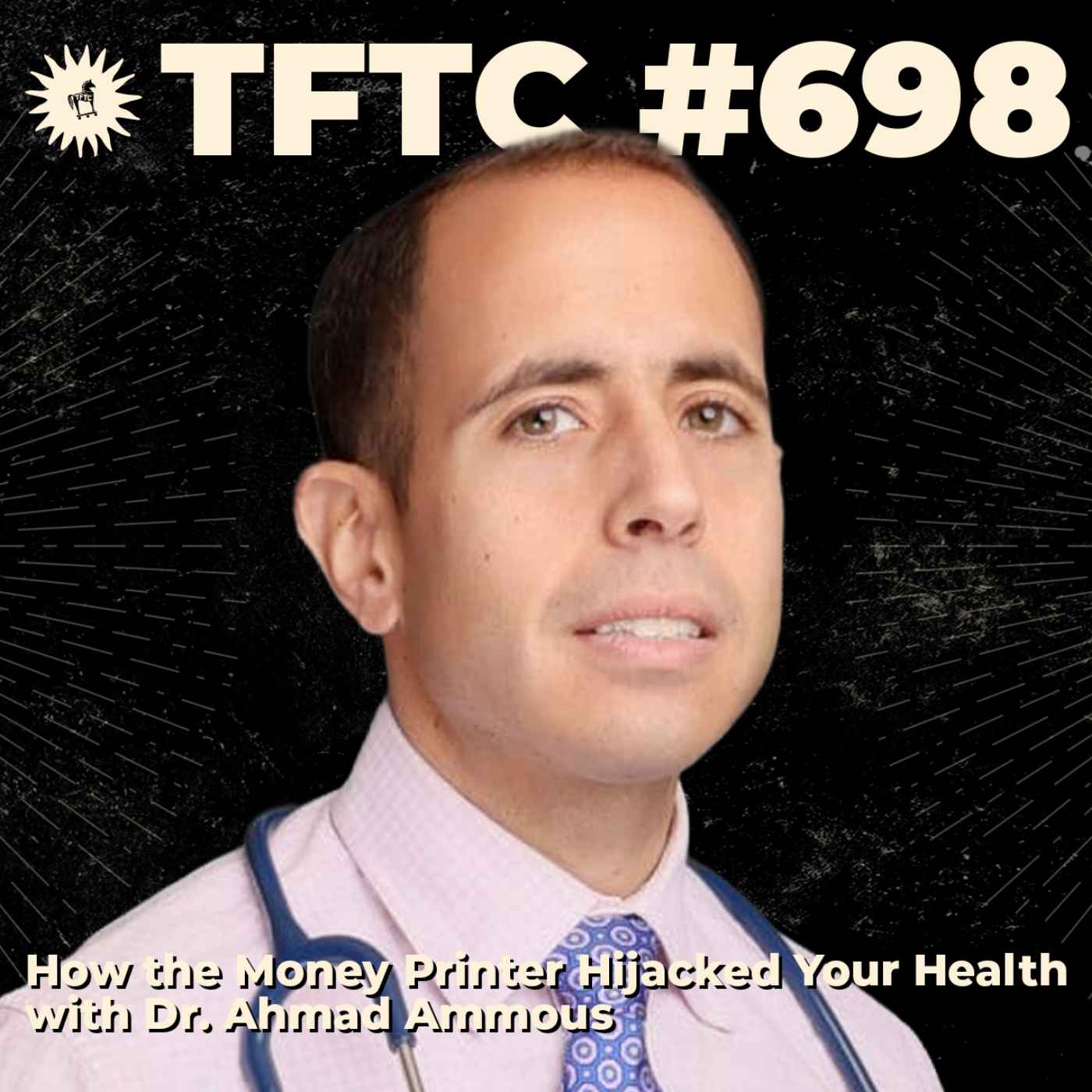
TFTC: A Bitcoin Podcast
#698: How the Money Printer Hijacked Your Health with Dr. Ahmad Ammous
01:07:45
Loading summary
Transcript88 lines
- [00:07]
A
You've had a dynamic where money's become freer than free.
- [00:11]
B
If you talk about a Fed just.
- [00:12]
A
Gone nuts, all the central banks going nuts.
- [00:16]
B
So it's all acting like safe haven. I believe that in a world where central bankers are tripping over themselves to devalue their currency, Bitcoin wins. In the world of fiat currencies, Bitcoin is the Victoria.
- [00:29]
A
I mean, that's part of the bull case for Bitcoin.
- [00:32]
B
If you're not paying attention, you probably should be.
- [00:34]
A
Probably should be.
- [00:37]
B
Dr. Ahmad Amus, welcome to the show.
- [00:39]
A
Thanks, Marty. Thank you for having me.
- [00:43]
B
Like I was saying, this is going to be a good follow up to the previous episode with Jessica Rose and Kevin McKernan where we really talked about the corruption of the peer review system within medicine, which is just one area of it. You're practicing doctor, and you've been writing a lot and talking a lot about fiat medicine. So I think maybe we'll just start there, jump right into it. Fiat medicine, it's your term for what you think is wrong with healthcare. Let's just walk through the thesis. How does fiat money specifically corrupt medicine at the root level? And where do you see it most visibly, day to day?
- [01:22]
A
Yeah. So thanks for the introduction. Medicine the way it is right now is not how medicine was practiced 100 years ago. Things are very different. And things are different in a bad way, in a monopolistic way where pharmaceutical companies have taken over the practice of medicine. And this was not possible without big government, without the Federal Reserve that is funding all of this and allowing certain institutions to take over medicine and dictate how doctors get to practice. All of these problems started in the early 1900s. So in 1903, the American Medical association was formed. And the purpose of the American Medical association was to standardize the practice of medicine, which sounds great on paper, that we want all doctors to practice the same way so that there are no a snake oil salesman, that everyone's up to a certain expectation. But what actually happened is only pharmaceutical medicine was allowed to prosper. Only medical schools teaching pharmaceutical medicine were allowed to continue their practice. And everything else was shut down. And this is why we live in a current state where all, all other healing modalities are suppressed and the only cure for anything is a pill.
- [02:59]
B
And I saw you were tweeting earlier today or earlier this week, prescription drugs are the third leading cause of death in the United States these days.
- [03:07]
A
Correct. I mean, this is such a crazy statistic that if we live in actually a honest world, everyone would be jumping on this and trying to figure out why. But this is like medications prescribed the way they should be prescribed are absolutely lethal. They lead to side effects, they lead to dysfunction in the body, they lead you in order to need other medications. And then these medications interact with each other. And so many of the problems that I see with patients are simply because of the medications that they're taking. And it's just pharmaceutical companies have such a huge propaganda and huge, huge control over this entire field that nobody discusses this.
- [03:58]
B
Can you talk about some of the, some hard examples of the side effects really being.
- [04:05]
A
Yeah, so I mean, the most prescribed medication in history are statins or cholesterol lowering medications. And these are absolutely detrimental to the body because cholesterol is essential for all important functions in the body. So cholesterol is an essential fat that's needed to regenerate your cell membranes, regenerate your neurons in your brains make hormones. It's needed for the immune system function. And this medication drops cholesterol levels significantly, leading to disastrous consequences throughout the body. So the way it's done is studies looking at statins only follow patients for five years maximum. Some of them are done for even just only months. They see that it lowers the cholesterol level and that necessarily. Okay, so that is good for your heart and the product goes on the market. But if someone gets a disease, often serious ones, 10 years from now, nobody connects it to the statin because there's no profit there. Honest. Researchers that make these connections and put that data out there, their material is not getting published. Journals are not going to accept their papers. And that's because all these journals are funded by the pharmaceutical industry.
- [05:31]
B
Yeah, go listen. Not you mob. Anybody listening to this should go listen to the episode with Jessica and Kevin because we dive deep into that pub peer and just the whole research complex and how it actually works, peer review and all of that is completely politicized and corrupted with money. But I think let's take a trip down memory lane, just talk about the history of this because this has been building for I think over a century. And you talk a lot about the Flexner Report and Rockefeller's influence specifically. What's the five minute overview of that seed that was planted over a century ago.
- [06:12]
A
Yeah. So the definition of a doctor back in the 1800s was there were many kinds of doctors. So there were what we call allopathic doctors, which is the tradition, which is the mainstream now Western sort of medicine, which works on suppressing symptoms. Suppressing works on mostly getting rid of symptoms. That's how things are treated. But there are also other healing modalities that actually have a much longer history of being practiced all over the world. This includes homeopathy, which aims to treat things like treat things naturally, aim to understand the symptoms and give a treatment that's complementary to that to help the body recover on its own. Also osteopaths and chiropractors were much more respected back then. And there were also naturopaths which aimed to heal people using just natural remedies, herbal remedies. So back then, someone who got sick would go to any one of these doctors. You had the choice if you thought that western medicine was better for you, if you thought the pill was better for you, you could go and do that. Then in 1903, the American Medical association was formed in order to standardize the practice of medicine. And then in 1910, they hired someone by the name of Abraham Flexner who wasn't really a doctor. But they hardened with the task of we need to revamp and improve all of medical education in the U.S. so Flexner went around the entire country looking at medical schools and he eventually decided that all medical schools that are not teaching pharmaceutical based medicine need to be shut down. So all of these naturopathic medical school, osteopathic medical schools, all of these were shut down. So more than 60% of US medical schools were shut down in the early 1900s. Flexner had strong ties to the pharmaceutical industry and he was heavily funded also by the Rockefeller foundation, where the Rockefeller foundation also was had heavy. Rockefeller's pharmaceutical products were used, were turned into pharmaceutical drugs. So there was a lot of benefit for them to push everyone to be on pills. Whether Rockefeller himself was aware of this is not clear because basically at a certain point his foundation was just based on money he has given before and other people were running it. I don't want to throw Rockefeller under the train, but definitely his foundation had a huge part to play in this. And so 60% of US medical schools were shut down. Only doctors practicing pushing pills were allowed to prosper. And this is the disastrous system that we live in right now, where nobody looks at lifestyle, nobody looks at natural treatments, nobody looks at natural things that have been used for hundreds of years. The only cure is just a pill.
- [09:41]
B
Yeah, I've experienced, well, we have experienced this and in our family, I mean, I've always been skeptical of the medical industrial complex, but post Covid my wife, her skepticism increased significantly as well. And I mean, I feel fine sharing this. I know she's comfortable Sharing it, because I think we've talked to many other couples who've had troubles, but we had trouble conceiving our third child between after our second and she went to doctors, wanted to push pills and do some injections and stuff, and she sort of faded that we went the naturopathy way. And after about six months of really fixing her diet and, and focusing on some herbal knees, we were able to conceive and have our third child. And something we experienced firsthand that this stuff does work 100%.
- [10:34]
A
And there's just hundreds and hundreds of years of knowledge about all these things. And overnight with the Flexner Report, all of that was suppressed. And currently, you know, anyone who discusses natural ways of treatment is just simply labeled as a quack. And we've lost all of that knowledge, unfortunately. And it's really, really frustrating for me because I've worked so hard to become a doctor and I studied so long. I did 11 years of training in order to become a doctor, and I had to start from scratch to learn all these things.
- [11:10]
B
And I mean, this is pretty well known now. But you look at the way that doctors are taught through the university system in the curriculum that's put before them, and nutrition is basically an overthought, an afterthought. You maybe have one class on it and it's not even really taken seriously. But this whole idea of preventative healthcare, particularly via good nutrition, is completely overlooked. It's all pills and remedies, synthetic remedies.
- [11:42]
A
Yeah, I had 40 minutes, one lecture that's 40 minutes long of nutritional education my entire medical career, and it was actually only they just taught us how to dose insulin based on what patients ate. That's all the nutritional education that I, that I've ever gotten.
- [12:03]
B
And now having sort of re educated yourself how, how much nutritional curriculum would you recommend for doctors? Like, how important is, is that aspect of health?
- [12:16]
A
It's extremely important. And it's quite crazy to live in a world where doctors tend to be some of the unhealthiest people you meet. And I have firsthand experience with this because I see them every day, my fellow physicians, and they just live in a plane where your daily choices don't matter. You know, disease is this thing that comes on you because of genetics, because of luck. And if you get sick, then you need pills, there's nothing you can do to prevent it, and your daily choices just don't matter. And this is the fundamental issue that needs to be addressed with any medical education that's going to be successful, which is lifestyle matters, your day to day choices matter. And you know, my co workers think that I'm just crazy because I think about these things. They still haven't realized that no, this is what actually works and they're just so completely brainwashed by the system that they have no realization about how important this stuff is.
- [13:30]
B
I guess let's dive deeper into the incentives too because I think if somebody in the turn of the 20th century, 1900 were to see what the healthcare system looked like today, they'd be completely petrified at the state of healthcare. And hopefully, conversely, we can look back 50, 100 years, 2075, 2100 and look back and recognize like oh, that anomalous period between 1913 and the mid 21st century was completely insane. And I think both people in the past and in the future will look at the financial incentives and the corruption that money has introduced to the medical system specifically and pinpoint that as the core problem at the root of this issue is just the monetary incentives that exist to push bills.
- [14:32]
A
Yes, if readers are interested in actually digging through the weeds of who actually led to this entire system being the way it is, very helpful. Book is called Murder by Injection by Eustace Mullins and he is the same person that wrote the Secrets of the Federal Reserve. And it's quite fascinating to see the same characters who were involved in creating the Federal Reserve, either them directly or their cousins or their best friends were also involved in creating the medical system. Both are centralized, both are aim to just control people. And it's not a coincidence that they happened at the same time. And you could argue that probably the hijacking of the medical system is ultimately the strongest way they were able to control people.
- [15:26]
C
Sup freaks. Healthcare Open enrollment has started. It will roll through the end of January. Opt out of traditional health insurance which doesn't care about you. It's impersonal, it's expensive. They deny an increasing amount of claims, premiums are going up. You don't have to live this way. You can opt out. I opted out four years ago. And Jo Crowd health. I've been a crowd health member, very happy crowd health member for four years. I've had two children. A couple of health events in that time period and crowd health has been there. You pay a monthly fee, you contribute to the crowd. We were paying $1,800 on Cobra as a family of three. Now we're paying around $900 a month as a family of five. And that's with crowd health and direct primary care. You can opt out of health insurance. Go to joincrowdhealth.com TFTC you're going to get $99 a month for the first three months if you use the code TFTC. Join crowdhealth.com TFTC Sup freaks? This rip of TFTC was brought to you by our good friends at BitKey. BitKey makes Bitcoin easy to use and hard to lose. It is a hardware wallet that natively embeds into a two or three multisig. You have one key on the hardware wallet, one key on your mobile device, and block stores a key in the cloud for you. This is an incredible hardware device for your friends and family, or maybe yourself, who have Bitcoin on exchanges and have for a long time, but haven't taken a step to self custody because they're worried about the complications of setting up a private public key pair, securing that seed phrase, setting up a pin, setting up a passphrase. Again, BitKey makes it easy to use, hard to lose. It's the easiest zero to one step, your first step to self custody. If you have friends and family on.
- [16:51]
B
The exchanges who haven't moved it off, tell them to pick up a bit key.
- [16:54]
C
Go to BitKey World. Use the key TFTC20 at checkout for 20% off your order. That's bitkey.world code TFTC20.
- [17:03]
B
I think it's important too to highlight just how centralized it is, because we're focusing on big pharma, but there's multiple players in this realm of centralized medicine, obviously a big pharma with the incentive to get the pills pushed because they're going to make a ton of money. But now you have the hospital systems, which are becoming highly centralized. Then paired with the hospital systems you have big insurance. And then paired with big insurance, now you have the federal government stepping in, or at least for the last 12 years with Obamacare, the American Care act here in the United States specifically. And they all sort of have this symbiotic relationship where they're all trying to basically grift and make things as expensive and least effective as possible so they can increase their bottom line.
- [17:54]
A
Yes, and probably the most centralized aspect about this is the issue of medical guidelines. So a physician nowadays can't just go and practice medicine the way they like. So there's a lot of information out there about what's the best thing to do for a patient. Certain societies started forming, let's say the American College of Cardiology or the American Family Physicians association, et cetera, to try and create guidelines or just easier summaries for physicians to follow, which sounds great on paper. We're just going to simplify it so that not every physician has to read every paper out there. There's actually an estimate that in primary care alone, around 1500 papers a day are published. So it's impossible for a physician to just read all of these every day. And so these guidelines were written there to kind of streamline the process. But what is the crazy thing about this is all these societies that write the guidelines are heavily funded by pharmaceutical industry. It be a society of like nine doctors and eight of them would have ties to pharmaceutical industry. They pay them to go on vacation, they give them research grants, they, they give them gifts frequently. And so all of these guidelines are of course favor favored to certain medications and usually expensive medications rather than generics that can be cheaper and help people save. And then these guidelines are actually used to go after physicians. So if you're not following the guidelines, if you are not following what the pharmaceutical company wants you to do, you're at risk of losing your license, you are medically liable. If you practice something that wasn't following the guidelines, you're at risk of going to jail. So say someone has high cholesterol, and I believe that high cholesterol is not bad. High cholesterol is actually good for you. If I don't put them on a statin and they get a heart attack, which high cholesterol is not a link to heart attacks, I am legally liable if they get that heart attack. However, if I do put them on statins and the statins themselves are actually increased inflammation in the body and could lead to heart attacks and they do get a heart attack, then I'm not legally liable because I follow the guidelines. So it's absolutely insane. It's just completely captured. And nobody can see past this insanity without, if you dare speak against this, you're going to be ostracized, you're going to be called a quack, and you're just not going to be heard and you're not going to get published. And that's how the system maintains itself.
- [20:54]
B
Yeah, I think there's a massive cognitive dissonance problem within the medical industry because a lot of people are making a lot of money and they've spent a lot of time. There's also a sunk cost fallacy where you spend a lot of time and money on your education and your residency and your career. And you don't want to believe that you went through this system that is not what you believe it is actually at the end of the day. But with that being said again post Covid, I do think there has been somewhat of an awakening within the medical field at least. I've had a number of doctors that have come on the show that have left the sort of centralized medical system, started their own direct primary care practices and marketing. Like, hey, I'm not part of this system, I'm going direct to the patient. Are you optimistic that there are more people within your field beginning to recognize this and sort of branch off and try to do things different way?
- [21:54]
A
Yeah, I mean every physician knows that something's wrong. You know, they're working hard, they're trying to get people healthy, but nothing's working and people just keep getting sicker. And the system's overburdened, that everyone is overworked, Everybody knows that what is causing it. Very few people are starting to realize this, but I think more and more people are starting to. So it is promising and we are grateful that there's an Internet where you can just post random things and you can learn so much by just going online and it's really helping a lot of people.
- [22:32]
B
Yeah, and you mentioned there the system sort of overburdened right now. I think a big driver of that is the insurance industry and this push towards universal free health care. And I think this ties back to money corrupting it. You need price signals in a market. And this idea of universal healthcare, while it sounds good on paper, if you're a fifth grader or an ignorant adult who doesn't understand economics, people really play to the heartstrings and the empathetic side of individuals not realizing that hey, medicine and the service that doctors offer is a service that should be priced and there should be pricing signals in the market. And this push for universal healthcare is completely corrupting that price signal and therefore overburdening the system because priorities aren't able to be able. The opportunity cost doesn't exist and so you don't know what to actually focus on.
- [23:38]
A
Yeah, 100%. I mean, an example I like to illustrate so that people understand this is if a random 70 year old knee start to hurt him, it's fine. You know, he could run it off, he could take some pain medications and rest for a week and then it'll be fine. It's quite different than if LeBron James knee starts to hurt him. So there's no such thing as healthcare for everyone. It all depends on the context. It all depends on what do you want out of Your knee, What do you want out of your eyes? What do you want out of your back? And so who gets to decide whether the 70 year old whose knee hurt them, should they get an MRI for their knee? If you leave it up to the 70 year old, of course he wants an MRI of his knee because it's free. LeBron James, his knee means a lot to them. To him, he's willing to pay for a knee MRI because it's just a wide spectrum of how much you can investigate everything and how much workup you're going to do for everything and how much treatment. The only way to give universal healthcare is to just have a lot of governing bodies that are deciding, oh, does this patient deserve an MRI or not? Does the 70 year old deserve an MRI or should we give it to prioritize it to LeBron James instead? And once you do that, then you have an entire industry that's just there as a third party. They're just trying to decide, allocate resources to allocate healthcare resources. And this is how you end up with Canada, where you have to work, we have to wait for nine months in order to get an mri. System is just, you know, it has to go to someone who's gonna approve it and then you're gonna have to wait in line. And it's just once you separate the price signals, when you separate it from the free market, there's no way that that's gonna work. Then you're just, this is just communism.
- [25:36]
B
And so do you think the solution to this is more doctors breaking off to this direct primary care? Because that's what we've been using in my family. We've opted out of health insurance. We use crowd health and then we supplement that with direct primary care doctors. And I find that the experience is far superior than sort of insurance networks of hospitals and pediatricians and physicians that you're thrown into 100%.
- [26:06]
A
I mean, we doctors are human beings. Like, if you are interacting with people and offering services that want them that, and you want to encourage them to come back so that they bring you more money, then the services we offer are going to be a lot better. Working in a system where everyone is insured and you're going to have to give everything to anyone. There's just no incentive for us to perform better. And that's why doctors are burnt out. There's no incentive. They are, they're just working, you know, working 9 to 5. They don't really care about their patients. The, their pay is not, is not affected by how they treat their patients. But all of the. All doctors that have branched out of this system are so much happier and their patients are so much happier. Do you.
- [27:06]
B
So what are like the long term, do you think the medical system will get fixed internally and basically have people recognize like, oh, we need to decentralize this, or do you think it'll be market forces? Do you think a bitcoin standard is needed to fix the system from scratch?
- [27:24]
A
Yeah, I think the system, the way it is right now, is going to collapse. How bad it's going to get before it collapses? Like, are people going to be dying outside of hospitals because there are no empty beds? Or are hospitals are going to run out of equipment, basic equipment to treat people? It's certainly possible. How hospitals are right now, that's kind of the direction we're heading. So there is no hospital in the US Right now. That's not overcapacity. There are people in the hallways. People wait in the emergency room for two days before they get a bed upstairs. You wait 20 hours before being seen in the emergency room. So these are all just indications of imminent collapse. Whether the system understands that it needs to go back to a free market standard before it collapses. Hopefully that happens. And also depends on how soon the entire world is just going to shift to a bitcoin standard and we get rid of all this mess.
- [28:29]
B
Little tangential, but I think it's all connected. And I've talked to your brother about this too, because it is crazy. If you just look at a hospital, like the architecture of it, the. The physical landscape of it, the fluorescent lights, the beeping noises, they're. I mean, you spend a lot of time in these places. I imagine they're not really. They don't really engender a sense of inspiration or they're very sterile and uninspiring and not a place that you want to be. Whereas hospitals used to be these grand buildings with tall windows, natural lights. And how much of the physical sort of landscape of the modern hospital has been corrupted by this too? And is the form factor of a hospital this day detrimental to people's health?
- [29:22]
A
Yeah, I mean, hospitals are probably the most toxic place to be in currently in the world. Like, you are better off if you can just heal yourself by staying in your bed. You're probably better off fighting this, whatever you have, than going to the hospital if you can afford, if it's not serious enough that you actually need what's in the hospital. I always say, like, for my older patients, it's one thing for them to get over like whatever infection they're going through or whatever health condition, it's another thing for them to survive the hospital stay. Because you're under fake light, you're not getting any care or attention because all the nurses are overworked, all doctors are overworked, the food is toxic, it's beeping, you can't sleep. Well, there is a term called delirium, which is basically confusion that happens with older people. And it's because, you know, they go to this place when they're sick and they can't sleep and the fake lights are on all night, so they don't. They, they lose their circadian rhythm. They don't know when it's day or when it's night, and they end up just confused and delirious. And your risk, there's a lot of people that die because of this because the body just has no connection to reality anymore. And it's, it's really scary.
- [30:53]
B
And.
- [30:56]
A
Yeah, hospitals are a toxic place.
- [30:59]
B
Do you think we need to rebuild them from scratch? Like, what would. If you were handed. Handed a fascist authority over the hospital system, you were able to rebuild the physical buildings where we're sending people when they get sick. What would they look like?
- [31:16]
A
I mean, yeah, again, the entire why hospitals are so toxic is because nobody in the medical field thinks that the food that you eat or the lights that you're under or, you know, the quality of your sleep is going to affect the way you heal. You know, it's just if we give you these meds, things will magically improve and you'll get out of here and things will be magical. That's what textbooks teach you. That's what pharmaceutical industry wants you to believe. Once we get to the point where we realize that all of these things are very important, then, yes, you don't want it to be filled with blue fluorescent light all the time. Have natural lights in from windows, use incandescent bulbs, minimize artificial light. That's also good. That's all good. Minimize the devices. So all these patients, they're hooked on to heart monitors when they come in. And this is all just, you know, emitting electromagnetic frequencies directly into their bodies the moment they walk in. That's also not great. And then the food, you know, they're given like typical American cafeteria food, you know, chicken fingers and fries. And it's. The goal is to, you know, minimize the cost of how much this meal costs the hospital. But it's, it's, it's toxic to this patient and it's all, it's all heart healthy, so they use vegetable seed oils and it's all low fat dairy and low fat meat and it's insane. It's insane.
- [32:46]
B
It's funny. And it wasn't like that because my mom and my aunts and my mother in law, my wife and I, we were born in the Same Hospital, late 80s, early 90s. And our moms talk fondly about the steak dinners they were given, steak and lobster after, after they gave birth to us. And it was like, oh, you guys are getting steak and lobster. We got like OJ and like a little plastic cup and some chicken fingers like in french fries. I was like for all three of our childbirths I would just leave the hospital and go find good healthy food and bring it back. It wasn't even worth taking the slop that they were offering you.
- [33:25]
A
Yeah, it's, it's bullshit and it's bad for you.
- [33:31]
B
Well, you mentioned light too. That's another thing. So again, post Covid, my wife has really leaned into the natural solution. So she's changed all the light bulbs in our house to incandescent. And I think it's definitely had an effect on particularly the boys, our sons, you can notice that they're much calmer because they're not subjected to these LED flashing lights all the time. Talking about preventative care. Obviously diet is heavy, but heavy focus. But how much is like natural light and avoiding LED fluorescent lighting and other things, Just getting out, walk, it's exercise generally.
- [34:13]
A
Yeah, it's 100%. It's so important. And some people argue that the light is even more important than the diet. A good way to understand this is in the cell itself. This is not a very, very known theory, it's not very well known. But the reality is in your cells you don't actually directly use food to make energy. You actually use light to make energy. Food you use in order to regenerate the cells. So make cell membranes, make chemicals, channels make proteins and fats in order to regenerate your body. But how your cell is actually powered is from the light that you're exposed to. This includes visible and invisible light. So lights work on your cells, work on this molecule called melanin, which is light sensitive. And melanin splits water creating an electric current. And this is the electric current that powers your entire body. The problem with blue LED bulbs, which only started in the 21st century, is that they only emit a very narrow spectrum of light that does not allow this process to happen efficiently. So you're not Splitting water efficiently. You're not, you're not powering your cells as the way you should. And this could be the reason why we all. The explosion of disease that we've seen over the last 20 years because we are all living under fake artificial light. We don't go out as much and we're all definitely sun deficient.
- [36:04]
B
It is crazy to think that in. It's even crazier to think about. The Biden administration tried to ban incandescent lights because it hurts the climate. Exactly. The climate. We got to worry about the climate. So we can't use good lights. I mean, putting the tinfoil hat on, how much of that is pure virtue signaling for the climate versus they know that they are going to sort of disrupt the natural health of individuals and by extension their psychology make them more manic and depressed and more impressionable. Is there nefarious intentions behind it or is it simply just larping for the environment?
- [36:49]
A
I haven't read the direct data on this, but I follow Dr. Jack Cruz intensely. He is very well versed with this topic and he says that DARPA basically has data that shows that blue light is able to control people by destroying their dopamine levels. And that's why blue light has just become prevalent everywhere. And I don't know what the intentions are. Dr. Cruz argues that it's definitely preconceived and it's definitely intentional. I know what the repercussions are and the repercussions are pretty bad.
- [37:33]
B
Yeah, speaking of repercussions too, it seems like at least in mainstream medicine and now even in the tech sector or in Silicon Valley, the solutions to the systemic health issues that exist in the United States and broadly in other parts of the world is to create these synthetic drugs that, that really help you get back to a better state. GLP1s I think being the most popular over the last, the last few years, Ozempic, Govi and others like them. Manjaro, what, what do you, what do you think of this, this trend, this like, oh, we can just manufacture health via these GLP1s and peptides.
- [38:17]
A
Again, it's just faulty, faulty thing to think. Thinking of this is like the complete fiat way of thinking about health, which is health comes from something outside of me. Health is just if I accumulate the correct series of pills, peptides, vitamins, then that's going to give me health. And it's just a completely fiat idea that's only started in the 20th century. It's the same as people thinking that inflation is necessary. It's that systemic. It's just completely false. And everything built on top of it is false. The reality is health starts from your daily choices. Everything you're eating, the light you're exposed to, how you move, this is what makes you healthy and this is what people need to be putting all this effort on. Problem is that we live in a fiat world where everybody has such a high time preference that nobody is willing to look into the future, look into things that take some time to give them some benefit. So nobody's looking into their lifestyle. Everybody's just looking for the easy fix. And there's a lot of people that are just feeding into it. You know, Brian Johnson tells you that the key for him to live infinitely is to take 100 supplements a day. And there are people that believe that. They want to believe that because it's an easier fix than no, it's just look at your fridge, look at your lifestyle, look at how stressed you are, look at how you treat the people around you. It's a lot more. It's a lot easier and therefore sells a lot better than the actual solution. But doesn't necessarily mean that it's going to work.
- [40:02]
B
Sup freaks?
- [40:02]
C
This rip is brought to you by good friends at Silent. Silent creates every day Faraday gear that protects your hardware. We're in bitcoin. We have a lot of hardware that we need to secure your wallet, emit signals that can leave you vulnerable. You want to pick up silence gear, put your hardware in that. I have a tap signer right here. I got the silent card holder. Replace my wallet. I was using Ridge wallet because it's secured against RFID signal jacking Silent. The cardholder does the same thing. It's much sleeker, fits in my pocket much easier. I also have the Faraday phone sleeve which you can put a hardware wallet in. Actually using it for our keys at the house too. There's been a lot of robberies. They have essential Faraday slings, Faraday backpacks. It's a bitcoin company. They're running on a bitcoin standard. They have a bitcoin treasury. They accept bitcoin via strike. So go to slnt.com tftc to get 15% off anything or simply just use the code tftc when shopping@slnt.com Patented technology, special operations approved. It has free shipping as well. So go check it out.
- [40:55]
B
Sup freaks?
- [40:56]
C
Have you noticed that governments have become more despotic? They want to surveil more, they want to take more of your data they want to follow you around the Internet as much as possible so they can control your speech, control what you do. It's imperative in times like this to make sure that you're running a VPN as you're surfing the web, as we used to say back in the 90s. And it's more imperative that you use the right VPN, a VPN that cannot log because of the way that it's designed. And that's why we have partnered with Obscura. That is our official VPN here at tftc, built by bitcoiner Carl Dung for Bitcoiners, focused on privacy. You can pay in Bitcoin over the lightning. So not only are you private while you're perusing the web with Obscura, but when you actually set up an account, you can acquire that account privately by paying in Bitcoin over the lightning network. Do not be complacent when it comes to protecting your privacy on the Internet. Go to obscura.net, set up an Obscura account. Use the code TFTC for 25% off. When I say account, you just get a token. It's a string of token. It's not connected to your identity at all. Token sign up, pay with Bitcoin, completely private. Turn on Obscura, surf the web privately. Obscura.net, use the code TFTC for 25% off.
- [42:08]
B
Not only, I mean, Brian Johnson, I think it's very funny that he's getting very popular right now. And again, I don't want to come off like pompous or anything, was like, hey, you were advocating for people to get the vaccine. You got it yourself, the COVID vaccine specifically. And that was another thing. So the COVID vaccine, I was immediately skeptical because of operation Warp speeds are like, hey, we're going to get this vaccine out in nine months. And everything up until that point that I've learned about vaccines and the safety of vaccines was like, they need to be tested for more than a decade before you can deploy them to the masses. And when they were like, oh, we're going to get this at nine months, it was immediately like, okay. Based off of everything I've learned about vaccine safety up until this point in my life, it just completely flies in the face of what we're supposed to be doing, so I'm going to avoid it. Then you have others that didn't, and not only didn't avoid it, but we're championing it and going further in some cases and saying that you were a monster if you didn't get it yourself because you weren't protecting your fellow citizen. And we're quickly learning a few years later that there are pretty terrible side effects to this. Increases in excess deaths, turbo cancers, heart issues and similar to GLP1s. And I think early data is showing that there's problems with this too. You don't know how this is going to to your point about high time preference, very high preference, particularly because we don't have enough data to know what the long term ramifications of this. Going back to what you were saying earlier about statins, it's pretty clear to me that we can see something very similar play out with GLP1s in terms of the long term effect on individual health.
- [44:02]
A
Yeah, the pharmaceutical industry is not interested in the long term consequences. This is just, it's up to you to deal with them. And. It's the biggest scam how these drugs are allowed into the market without intensive testing. And the people who are approving these drugs, people that work in the fda, they're known that once they quit their FDA jobs, they get very expensive, very well paying jobs in these pharmaceutical companies. There's a revolving door between the FDA and pharmaceutical companies. So you can't trust the people whose job is to determine the safety of these, of these drugs. The classic leftist argument is that what we need to do is oh, we need just stronger government that's not corrupt and we need people to, we need to make sure that the centralized authority has no relationship with pharma, etc. That is just, you're just adding more power to the government and therefore you're making them a more lucrative target for corruption. What actually needs to happen is we remove all the suppression of alternative medicine so that anyone who has a solution that they think works can put it out there and let the free market come up with ways to test these medications so it doesn't have to be the FDA that approves them. What if there are private societies that start to run experiments on these drugs and if you are interested in taking a GLP one, you will probably be willing to pay some money to this private society to test it for you before. And you know that this society is not biased, they're not government employees, you know that they're not corrupt and they have to put their financial ties out there. Like there are so many ways we can just optimize the system by having government get their hands off it. And this is what hopefully life on a bitcoin standard would look like. And the future is exciting once we get to that point.
- [46:21]
B
Yeah. I mean, you think of Scott Gottlieb going from the FDA to the board of Pfizer, then he's on CNBC and all the talking head shows, really pushing it and advocating. He literally went from the FDA to. He was Pfizer's representative on a bunch of these talking head shows. And very few people, obviously yourself, myself and others that are like minded were like, this is an obvious conflict of interest here. But like, how is this even possible? But it is the status quo of how this revolving door works.
- [46:59]
A
The entire Purdue Pharma and OxyContin and what led to the opioid epidemic in the US which has killed upward of 200,000 people. At least all of this, the drug was approved by one person in the FDA who after he finished his role in the fda, got a job at Purdue Pharma where he was getting around $350,000 a year. This entire thing was just because this someone made a few million dollars. That's it. This is how powerful, how easily corruptible the system is. And when you have an organization that's as big as fda, you are at risk of just the system being captured. And this is the system we live in right now.
- [47:49]
B
Yeah, I mean, speaking of that, obviously there was this big push for Maha RFK getting into Health and Human Services, and it seems like they're trying to shake things up at fda. But what's your perspective? Are they making any progress? Are they just being consumed by the centralized beast? Are we moving in the right direction?
- [48:13]
A
It's clear that he's causing some ripples. It's not as much change as I would have liked, but it's clear that he's fighting a huge beast that is not easy to shake off. But him now that the Hepatitis B vaccine is off the schedule, that's huge. And just one thing, one small change can lead people to start questioning. And this is what we need. The beast is just so big that it's very difficult for him to change everything. But I think even though he has had to water down his message a lot, he is causing some changes. So that's promising. But again, I believe that ultimately the solution is not going to come from the government the way we imagine it. The solution is going to come once we make this government just a lot weaker than it is right now.
- [49:07]
B
Yeah, well, in the interim, I think we've talked a lot about sort of doctors branching off, going direct primary care. But what advice would you give to someone who's frustrated with their current doctor, doesn't know how to find a physician. Like what would you, how would you advise the consumer of healthcare to contribute to the fixing of this problem?
- [49:29]
A
Yeah, I mean if you don't have any doctors in your community that you trust, direct primary care doctors that are less heavy on pushing pills or I think online you find a lot of good resources so you can research things a lot and don't rely on just Google and chatgpt to tell you what actually works because they base their data on the most popular health websites which are all pharmaceutical funded or based, are from a big hospital. So do your own research. The best way I recommend is try and find people who you trust, what they say you trust their opinions on medicine, follow them, see what accounts they follow, see what sort of things they recommend. And I think more and more doctors are going to start offering online services that you can get health advice, you can get recommendations online. And I think people should start actively.
- [50:32]
B
Looking for that and then beyond that before they even need to get to a doctor, if they hear what you're saying, they're like, okay, I need to focus more on preventative health care, get my lifestyle in order, improve my lifestyle, improve my health. What are sort of the lowest hanging fruits, first steps that you recommend people take?
- [50:55]
A
Yeah. So I mean the first thing to know is that diet is the cornerstone of health. And do we have time to go into a bit more details of diet or do you want me just.
- [51:07]
B
Yes, yeah, we have plenty of time.
- [51:08]
A
Great. So, yeah, I mean the, there's a lot of, there's a lot of confusing information out there about what the ideal human diet is. And there's a lot of extreme diets that might not be effective for everyone. What I tell people is that the most helpful resource I found to understand diet is the work of this dentist called Weston Price. So Weston Price was this dentist in the early 1900s. That was the time when vegan and vegetarian diets were starting to get popular. And everyone thought that a vegetarian diet is the answer to is the ultimate human diet. So Weston Price, what he did, he actually traveled the world going to tribes that haven't been touched by industrialization. These tribes had. Their local diets that haven't changed in hundreds or thousands of years. And so he went and saw what these people ate. And what he found is that these people tended to be very healthy because they haven't been touched by processed food yet. What all these tribes had in common is that they all had an animal based diet. So the Cornerstone of their diet was animal meat and fat and whatever else grows in the environment locally. So he went there trying to prove that a vegetarian diet is healthy. But what he actually found is the opposite, is that animal meat and fat were always appreciated by these older societies. So I think the ideal human diet should be built around animal protein and fat. And this should be the cornerstone of your diet. It should be there in every meal that you eat. If a meal doesn't have animal protein or fat, then it's not a meal. And whatever you eat on the side, I don't recommend that. I don't think a carnivore diet is for everyone. I don't think a keto diet is for everyone. But I think what's really helpful is to eat whatever grows locally in your environment. So if you live in the east coast of the United States, you're not going to have pineapples in December, you're not going to have mangoes in December. And funnily enough is that your metabolism is affected by the light that you're exposed to, so you are less able to handle the sugars from this pineapple or in December versus if you get it in the summer. So eat whatever grows locally in your environment. And of course, avoid anything that's processed, anything that comes from a factory. This, I think, is the cornerstone of a healthy diet. And if people do that, then you've got an 80% of the benefit with only 20% of the work. If you want to complicate things further, you can, but this is just a very good starting point.
- [54:06]
B
No, it is crazy how eating local, how humans are connected to their locality. And the one example that I always have fun telling people is that when we moved to Texas, cedar fever was a real thing for me. Cedar fever for the first few months. And then I had somebody tell me, hey, you need to go find some raw local honey and eat that so that you're getting exposed to these, these pollens and incorporating them into your body. And that's exactly what I did. And I didn't have cedar fever for the rest of my, the time I was living in Austin. And it's crazy how something as simple as that can contribute to better health.
- [54:52]
A
Yeah, it's quite simple. The, the, there's a lot of confusing information about diet, but I think that's a great way to start. Eat from a local farmer's market. Whatever grows there is whatever is local. And get a good butcher and you are solving 90% of the problems. Another very important thing about preventive health is the light that you're exposed to. Most of us these days are not getting enough sunlight. You want to try and be outside every day. Even if it's cloudy, try and go outside. You're still getting healthy rays of sunlight coming to your body. Even if your body is entirely covered up, even if just your eyes being exposed to the sun is good. What I recommend for people is aim for at least 10 minutes of morning sunlight before it's 10am Go outside 10 minutes looking in the general direction of the sun. That's just going to upgrade your metabolism for the entire day. Start, ramp up your metabolism and it's going to make you feel so much better for the rest of the day. If you are in an environment where you're under artificial light a lot, whether it's your office, etc. Try and go outside and take frequent breaks. So go outside at noon again and then go again in the afternoon. This being outside in the sun reconnects your circadian rhythm to the sun, re calibrates it and this fixes all your hormones and neurotransmitters for that day.
- [56:31]
B
And speaking of circadian rhythm, it's funny because when we were doing a natural, we're going the natural path to get my wife's body more in sync. In preparation for her third child, that was the first advice she got from her doctor was hey, go outside before 10am and make sure you're getting sunlight, particularly before 10am but bring this because it kicks off your circadian rhythm, your metabolism, get your neurotransmitters firing. But on this point of circadian rhythm, how important is sleep to all this as well?
- [57:07]
A
Sleep is very important. And what people don't realize is that sleep is the most important regenerative phase in your body to try and get rid of inflammation, to get rid of toxicity, to get rid of free radicals. Even if people sleep seven hours at night and wake up refreshed, there are still levels you can improve your sleep better. I think the major thing disturbing our sleep these days is artificial light exposure after sunset. This is a very, very important and it's a low yield fruit for anyone who's trying to improve their health is after sunset you want to limit the amount of artificial light you're exposed to. So blue LED bulbs are the worst. Trying to replace them with either candlelight or incandescent bulbs. But even with incandescents, you want to try and minimize the light that you're exposed to because that fake light that you're exposed to at night disturbs the synthesis of melatonin in your body. And melatonin is important not only to make you sleep, but it also has a lot of important regenerative properties in the body, including anti cancer and anti inflammatory properties. So be very conscious of the light that you're exposed to and that will help your sleep significantly.
- [58:32]
B
Somebody who values the sleep I need, I can't operate on less than seven hours, which, um, if I don't get at least seven hours, I'm. I'm pretty thrown off for the, for the whole day. And that's the light. It's something too. It's like I'm looking at a screen here. I've got another monitor right to my left here. And it's like something that is anomalous. Maybe not anomalous, but it's just new. The last three decades is like humans, particularly the workforce, most of it, at least white collar work. This is our lives are standing in front of these blue light emitting screens for hours upon hours every day, day in and day out. And then you add the phone to it and it's like most people never stood a chance.
- [59:20]
A
Yeah, I don't usually recommend gadgets. I'm not a Brian Johnson kind of figure. But if there's one gadget that people should invest in, it's blue blocking glasses. So what these do is they have red lenses. And what they do is that they don't allow the blue spectrum of light to come into your eyes. And it's very important because your circadian rhythm is set based on how much blue light you're exposed to, so you can get the other spectrum of light. But as long as you're not getting that much blue light, it still allows your melatonin to continue being synthesized. So what I recommend is after sunset, wear these blue blocking glasses so that even if you're exposed to blue light in your environment, at least your eyes are not getting exposed to them. And you're going to notice that the quality of sleep is just so much better once you start using them.
- [60:18]
B
Yeah, I've got to pick up a pair of those because I typically stay up a little later writing as well.
- [60:24]
A
Yeah, I used to think it was just, you know, just a gadget that's not helpful. And because I thought my sleep was very good, but once I tried them, my quality of sleep just became so much deeper and so much more refreshing and you feel so much better the next day.
- [60:40]
B
All right, I got to pick these up. Let's throw it on the Christmas list. To wrap this up though, really leaning into the bitcoin standard and how it can help medicine again. Like what? From like a doctor's perspective. So I've talked about this in many different capacities. I know there's a health services account, companies getting started up like a health savings account company. If you want to basically do a personal sort of health healthcare budget using Bitcoin over the long term to basically make sure that you can pay for medical expenses because you're saving in a, in a money that is going to increase the purchasing power. I've heard of doctors incorporating it into their practices to make sure that they're able to have a sustainable business. Obviously health insurance seems like a low hanging fruit if you have long duration health cost liabilities that you need to line up. Bitcoin is a perfect long duration asset to pair there. Where do you see Bitcoin being introduced into the medical system to help doctors and patients?
- [61:53]
A
Yeah, I think it has very important uses in the health space. Firstly is, you know, there have been a lot of doctors that speak up, speak out against the system and you know, they get repercussions where they, their funds are canceled, their bank accounts are confiscated, etc. So there are repercussions on free speech with people using fiat money. But if doctors that want to speak out start getting paid in Bitcoin, then if the people who like what you're saying, they can just send you Bitcoin directly. There doesn't have to be a third party that's meddling in between. And so that's going to help with doctors speaking out against the system and hopefully people getting out of this fiat system. Another aspect of this is one of the main problems with modern medicine these days is that all the small practices are getting taken over by bigger practices, bigger hospital groups, bigger clinics, etc. And the reason is because small fish can't survive these days because you need to be big in order to get access to easy credit. So you know, when we live in a debt based society, the more debt that you can get, the more you're able to survive inflation. And so all these groups are getting taken over by bigger groups because bigger groups have easier access to loans. Once we get off this inflationary system, once we get on a bitcoin standard, then still small doctors can still run their own practices. And I think that's going to be very helpful for their patients. And then finally the most important part is people writing medical guidelines, people deciding what needs to be researched, people pushing pills on us. They all get their power from this big Government, that's all powerful. And how is this government so powerful? Because it has access to the money printer and unlimited amounts of money. So once we get rid of this money printer, then the system, then there's no big enemy that we're fighting anymore. And, you know, smaller doctors, smaller clinics, more free research, more free medical guidelines can prosper. And that's going to help doctors practicing.
- [64:33]
B
Now, that was one thing that Jessica, Kevin and I covered. Again, this peer review process and the fact that it's completely centralized, they're trying to create a separate distributed peer review process and using bitcoin bounties to get certain papers peer reviewed. So if you have a priority or if you're just interested in a particular ailment or area of study and you don't want to wait for the centralized peer review networks and journals and publishers to look at your work and take it seriously, you just like, okay, let's use this system and we'll use a bitcoin bounty program to incentivize people to do the research, to review these papers. And I think that makes a ton of sense to me.
- [65:25]
A
Yeah, that's where the future is heading. And smart people are already starting to realize this. They're creating their platforms online, they're getting funding from bitcoiners, and the future is bright.
- [65:39]
B
It is bright. It's a white pill. The only pill I'd like to take here.
- [65:42]
A
Yes.
- [65:46]
B
Ahmad, this has been a pleasure. Where can anybody who's listening find out more about your work, get in contact with you if they have questions or suggestions or they were inspired? Where can people find more about you?
- [66:02]
A
Yeah, so on social media, on Instagram and X, I'm MooseMD. I also have a free newsletter that people can sign up for and amoosemd.com and I also offer online consultations for those interested also on my website.
- [66:20]
B
Awesome. Well, this has been a pleasure. We'll have to do it again because I think there's definitely going to be some change in the field of medicine over the next many years. Hopefully positive change. And we'll love to have you back on to discuss these things as they evolve.
- [66:40]
A
Great. Thanks, Marty.
- [66:42]
B
All right. Peace of love, freaks.
- [66:45]
C
Thank you for listening to this episode of tftc. If you've made it this far, I imagine you got some value out of the episode. If so, please share it far and wide with your friends and family. We're looking to get the word out there also, wherever you're listening, whether that's YouTube, Apple, Spotify, make sure you like and subscribe to the show and if you can leave a rating on the podcasting platforms, that goes a long way. Last but not least, if you want to get these episodes a day early and ad free, make sure you download the Fountain podcasting app. You can go to Fountain FM to find that $5 a month get you every episode a day early ad free helps. The show gives you incredible value, so please consider subscribing via Fountain as well. Thank you for your time and until next time.