← The 500 with Josh Adam Meyers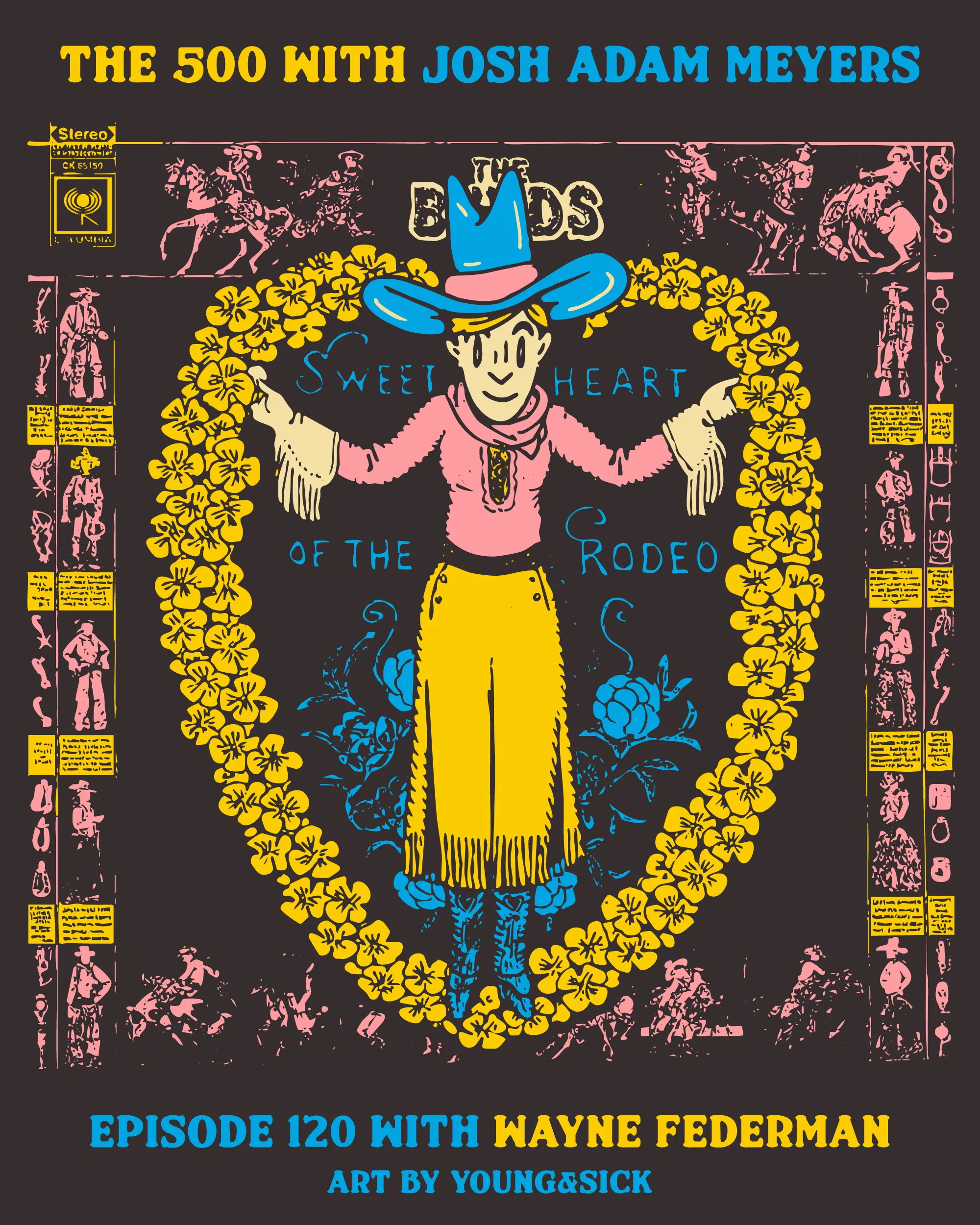
The 500 with Josh Adam Meyers
120 - The Byrds - Sweetheart of the Rodeo - Wayne Federman
01:26:22
Comedian and cultural obsessive Wayne Federman returns to The 500 to dig into Sweetheart of the Rodeo by The Byrds, unpacking how a rock band’s leap into country music reshaped American songwriting, sparked controversy, and quietly changed the future of popular music.
Loading summary
Transcript770 lines
- [00:01]
A
NextChapter podcasts.
- [00:08]
B
When you think about businesses that are
- [00:10]
A
selling through the roof, like Skims or
- [00:12]
B
Allbirds, sure you think about a great
- [00:14]
A
product, a cool brand and great marketing. But an often overlooked secret is actually
- [00:20]
B
the businesses behind the business making, selling,
- [00:23]
A
and for shoppers buying. Simple for millions of businesses. That business is Shopify. It's home of shop pay, the number one check checkout in the world. You can use it to boost conversions
- [00:36]
B
up to 50%, meaning way less carts
- [00:38]
A
going abandoned and way more sales going through. To checkout, upgrade your business and get the same checkout Allbirds uses. Sign up for your $1 per month trial period at shopify.com income all lowercase go to shopify.com income to upgrade your selling today. Shopify.com income.
- [01:12]
B
The 500 the 500J been walking us down through that 2012 edition so it
- [01:27]
A
ain't nothing to you. Hundreds more to go and in need of a friend the king of peaceful Angelo talking the five 500 until the end talking the 500 until the end
- [01:42]
B
with my man JL
- [01:48]
A
on the 500 talking the 500 until the end. Oh, that is the opening track. It's by the Birds. It's from their album Sweetheart of The rodeo from 1968. Wayne. A good year. I'm bringing you in early.
- [02:16]
B
I love it.
- [02:16]
A
I'm bringing you in early for the intro. For the intro.
- [02:19]
B
This is uncharted territory.
- [02:21]
A
It really is. No, we did this before and I think it went over as a hit. But people were like, you know, make sure Wayne covers most of his face the next time with a hat. Make sure he brings his fan fan sticks and make him exhausted from All Star weekend. But that's the album we're listening to.
- [02:38]
B
75th. 75th anniversary of the first All Star.
- [02:40]
A
Let me get through the intro before we start giving fast.
- [02:42]
B
I know.
- [02:42]
A
Can we get through this? No, no, not oh, you're saying no. Are you saying no, take your time. Or is it like a no, don't get through it.
- [02:48]
B
I meant no, take your time. I'm sorry.
- [02:50]
A
What am I doing now? I'm all fucking disco populate. Where was I? Sweetheart of the Rodeo. That's the album. It's number 120 out of 500 on my show the 500 with Josh Adenmeyers. And it should be Josh Adamyers and Wayne Fetterman.
- [03:04]
B
Should be.
- [03:04]
A
That's. That's next. As soon as we finish this. That's what we might be doing. He hasn't talked about it. We'll talk about it. Later. Thank you for joining me in the only podcast where comedians going through Rolling Stone magazine's list of the 500 greatest albums from 500 down to 1. And we're getting through the thick of it. Dude, we're in the thick way.
- [03:19]
B
120.
- [03:20]
A
I know. And we're not going to be using you much more because every album is going to be a much larger guest.
- [03:26]
B
Right. It's not Flying Burrito Brothers.
- [03:32]
A
Yeah, I get Bobby Blue Blands has got a hut coming up. We ain't got for Fetty Wap. We're always going to use him. People don't get used to that. He's always going to be here. If you're not watching the podcast, subscribe to the YouTube. If you guys love us and you really care about us, subscribe to the Patreon. Patreon.com backslash the 500 podcast. JT, Emily, Alex, Adam, everybody that's involved in the show. Peter, we love you to death. Oh, Logan, we love you as well. And me. And me and Morty Coyle, all the people that are a part of the show, we need your help because I think I'm gonna try to do all the final 50 of the episodes in one episode.
- [04:14]
B
That would be good. A marathon.
- [04:18]
A
It would be like the old Jerry Lewis Ms. Telethon. All right. We're doing Professor Longhair. The whole thing is we want to do this. It's an idea that I have. And the only way we could do it is if you guys help out. I'll put my own money up to get that final 50 all live, all in person with the guest trying to go for the biggest names possible for the final hundred.
- [04:37]
B
No Fetterman.
- [04:39]
A
No, you're there, dude. I'm gonna always use.
- [04:40]
B
No, no, no, I'm kidding. I'm kidding. I. I know somebody's gonna cancel at the last second.
- [04:44]
A
Always.
- [04:45]
B
And you're like, hey, can you do Dark side of the Moon? I'm like, yeah, I can do it.
- [04:49]
A
Yeah. Strom Thurman died. We had Strom Thurman.
- [04:53]
B
Oh, he was gonna do Dark side of the Moon.
- [04:55]
A
He was Dark side. He's a huge, big Floyd fan.
- [04:57]
B
I think he's.
- [04:58]
A
He's Team Gilmore. Thank God.
- [04:59]
B
I think he's dead.
- [05:00]
A
He is. Strom's way dead, but. All right, let's do our plugs now. I am this weekend because this comes out. I am. Where am I this week? Oh, I'm on a cruise. I'm doing the this is important workaholics cruise. I'll Be there on the 22nd through the 26th, 27th, and. And then I'll be in other places. Moon Tower Austin. We've got rumors. Winnipeg, Comedy Store, Los Angeles. That's just where we're recording the podcast. A big shout out to them. What do you got coming up?
- [05:32]
B
Well, finally it happened. Mel Brooks, the 99 Year Old man was released on HBO. Not only released, but currently as of today. Can I say the day?
- [05:46]
A
Yeah, of course. It comes out tomorrow.
- [05:47]
B
All right. February 17, 2026.
- [05:50]
A
No, don't be real. About the date. 2022. We recorded this way in advance at
- [05:55]
B
2:23pm as of now, as of this moment, still tomatoing at 100. The only project I've ever been involved with. That's perfect. Tomato rating, really? Yep. Not Carlin, not Shanley, not Legally Blonde, not stepbrothers.
- [06:11]
A
Should I go on such an IMDb list? What?
- [06:15]
B
It's 50 first dates. 40 yard version. None of them. Hundred.
- [06:20]
A
What about the.
- [06:21]
B
It's the curb your enthusiasm. Not 100.
- [06:25]
A
But that's close to it, though. It's got to be.
- [06:28]
B
It's all right.
- [06:28]
A
Yeah. You know, I'm saying.
- [06:30]
B
So it's. It's a documentary about this guy, Mel Brooks, Real name Melvin Kaminsky. Two parter on home Box Office dude.
- [06:37]
A
Judd loves doing a two parter, bro.
- [06:39]
B
Yeah.
- [06:39]
A
Judd has never done a single part. It's always a two parter. He does not trim any fat. Trim some fat, Judd.
- [06:48]
B
Okay.
- [06:49]
A
I know that's Paula Poundstone's got one coming out. It's nine parts.
- [06:53]
B
Is there a polar pont?
- [06:54]
A
No, but it should be.
- [06:55]
B
I see, I see.
- [06:56]
A
No, I love Judd. Keep doing what you're doing. I'm telling you.
- [06:59]
B
But it's fun. It's. So that is. How long have I been promoting that thing?
- [07:03]
A
Forever. You have two of them that came out. You have the Maria, and the Maria is.
- [07:08]
B
I might be at south by Southwest.
- [07:10]
A
I heard you're just doing festivals with her.
- [07:13]
B
I do fests.
- [07:15]
A
You like it? Like being back in the mix of the fest?
- [07:17]
B
Yeah, it feels. It feels pretty good, doesn't it? You know? Yes. Yeah.
- [07:21]
A
It's comedy summer camp. And you're the belle of the ball because you're with, you know, arguably, you're, you know. I love that. I love that you guys. How did that relationship start? You know, like you and Judd, I mean, obviously you'd be you both. I know you were both in New York and he was, I'm assuming. Was it Larry Sanders or like, was it through Gary?
- [07:39]
B
Want to keep Guessing or do you want.
- [07:41]
A
I think it's Shandling. Shandling brought you guys together.
- [07:43]
B
I love it.
- [07:44]
A
Am I right?
- [07:44]
B
Not even close.
- [07:45]
A
Fucking. You both did black tar heroin. You guys were. You guys were drug dealers.
- [07:52]
B
Yeah, yeah, we both were dealing cocaine.
- [07:54]
A
I knew it was coke. Yeah. I don't know.
- [07:55]
B
I went. Believe it or not. I was right down the street that way. In front of the laugh factory in 1985, believe it or not.
- [08:05]
A
That way.
- [08:06]
B
That way. Yeah.
- [08:06]
A
You pointed that way.
- [08:08]
B
I thought I pointed that way. Yeah, it's that way. Yeah.
- [08:10]
A
Cause it's weird where we are.
- [08:11]
B
We are down right now, and I'm gonna talk a lot about this store, this venue, this comedy store, and the birds, how it all's connected in a minute. But that's where I met Judd. He was a freshman at usc.
- [08:25]
A
And you were teaching a course in comedy. You were already 40 years into comedy.
- [08:33]
B
Ye. So I'm in my 87th year. It's going well.
- [08:38]
A
Who's in your class? Well, it was me. Socrates, Plato, Aristotle. He was younger Aristotle, but.
- [08:46]
B
And, yeah, so that's how we met. That's how I met Judd. And the whole documentary thing started because Judd was a feature film director.
- [08:55]
A
Oh, I know.
- [08:55]
B
Yeah. And had not done documentaries. But I helped him put together Garry Shanley's memorial service, which was. Jud. Did a big thing. He wrote some stuff, he showed clips, we went through. And then afterwards, Judd was like, I think this would make a good documentary, his life. And he started working on it before HBO came in and gave him money. He had self financed it, and then HBO heard about it and was like, yeah, let's do the Zen Diaries of Gersh. So I worked on that. And then since then, every.
- [09:28]
A
What year was that? What year did the documentary come out? Like 1918. 19, because I remember. And you probably was probably in the documentary. I don't know if you put the. I haven't seen it in so long. But when we did Bonnaroo, Judd and. And Eddie Vedder.
- [09:42]
B
Yeah.
- [09:42]
A
Did a song. I have it all on my phone, like, shot from the side stage. And it was so beautiful because Eddie was like singing the chorus and it was all notes that. That he had written. Gary, if you don't. If you don't. Which is crazy, if you don't know who Gary Shanley is. That's your. It's bananas. But I mean, it's so cool to see that. Is it really?
- [10:02]
B
Well, it's just, you know, he's been dead now since the. You know, for 20 years, almost. I know.
- [10:08]
A
And you know what's funny?
- [10:09]
B
18 years.
- [10:10]
A
I quote you a lot.
- [10:11]
B
Why?
- [10:11]
A
Because you always say, you know, you would talk to people in the. In the UCLA or usc. The USC course. And they. They were young kids that wouldn't know who fucking Jon Stewart was. Now they might.
- [10:23]
B
They might. Now could Jon Stewart come back? But yeah, their institutional knowledge is really limited because I'm not blaming them. They have been inundated with so many images and pictures and videos their whole lives that like, they don't have. Why would they care about the Marx Brothers, like a comedy team from the 20s when they have all these incredible TikTok videos and stuff?
- [10:48]
A
I think it's. I think.
- [10:49]
B
I mean, again, there are some nerds that obviously are into it.
- [10:52]
A
It's all starts like, the reason I love Woody Allen. I don't give a fuck. I love. I love Annie hall, dude. I think Annie Hall. I think everything.
- [11:01]
B
You mean the movie? The one Best Picture?
- [11:02]
A
The one Best Picture.
- [11:03]
B
You're the one that likes Star Wars. You're the one that likes.
- [11:06]
A
And it holds up.
- [11:08]
B
Okay.
- [11:09]
A
It's not. There's nothing controversial. One movie that's not creepy. He doesn't have a guy like Max. You're not hooking up with a 12 year old. Max. Max. You know what I mean? It's the one movie where he women his own age. No, but Mel Brooks. The reason, dude, Young Frankenstein is the funniest comedy I've ever watched in my life. And I his to this day. I would put, you know, I love Borat, which. I love Borat.
- [11:37]
B
I know you.
- [11:37]
A
I think I'm more of a Bruno guy than Borat.
- [11:40]
B
Oh, interesting.
- [11:41]
A
But I will say this.
- [11:43]
B
Yeah.
- [11:43]
A
I will say. I would say History of the World Part 1. I never watched Part 2 because it's a Hulu. It wasn't. It's not Mel. It's other people. And nothing wrong with that. I think Ike is great. I think Nick is great. I think Wanda is a brilliant. I love Wanda. All former guests.
- [11:59]
B
Well, she always delivers. Always delivers.
- [12:02]
A
Always. She gave me the best compliment anybody's ever given me after she did the jam at the Roxy on the anniversary, Wanda Seitz goes, josh, I love you so much, I'd smoke crack with your ass.
- [12:13]
B
All right, I'm looking for the compliment.
- [12:15]
A
We got to do crack.
- [12:16]
B
I will do crack.
- [12:17]
A
We should be talking probably for the
- [12:18]
B
first episode when we get to number one.
- [12:21]
A
All right. Oh, okay. Well, hopefully nobody dropped. Watch somebody drop out for the final episode. And all it leads up to Is that. We had Paul McCartney for Sergeant Pepper. We got Wayne Fetterman doing crack. All right. We'd be singing it much faster, but, yeah, History of the World loved it.
- [12:44]
B
More than Young Frankenstein.
- [12:45]
A
No, Young Frankenstein is. I mean, Marty Feldman.
- [12:48]
B
But, hey, can I ask you a question about that? Or may I ask.
- [12:51]
A
Please. So how did you not say.
- [12:55]
B
Right. Your Honor. Yeah. May I approach the bench?
- [12:57]
A
Good. Do it. Of course. My God.
- [13:01]
B
No, I'll allow.
- [13:02]
A
Oh, jeez. You know, mine's a kangaroo court.
- [13:05]
B
Jesus. Had you seen the Frankenstein, the whale movie, the Universal movie? Or did you know even what it was?
- [13:15]
A
You're talking about? Boris Karloff, the old one. Yeah, yeah, of course. My dad. So we used to.
- [13:21]
B
So you knew what he was parodying.
- [13:23]
A
I was very, very lucky. The reason I love all this old shit, you know, I love Nat King Cole. I love the Four Freshmen. I love the Ink Spots, I love jazz.
- [13:34]
B
It's surprising.
- [13:36]
A
My dad was a very, very. My dad very loved art. Loved art. And I used to watch him.
- [13:42]
B
Garfunkel.
- [13:43]
A
Hated Paul Simon. Loved art, loved Garfunkel.
- [13:47]
B
Hated Paul Starman.
- [13:49]
A
Love John Oates.
- [13:50]
B
Right?
- [13:50]
A
Hated Daryl Hall. Loved everybody in the Bengals.
- [13:55]
B
Yeah.
- [13:55]
A
Susanna hall, right?
- [13:56]
B
The cute one.
- [13:58]
A
Got those eyes. No. I mean, how can you not.
- [14:00]
B
Incredible.
- [14:01]
A
So. So my dad would, like. I would watch my dad watch things and watch him get emotional. He would. He would. You know. This is so funny. Like, watch it. Like I told you, I do stand up because my dad showed me comic relief at 6. Carlin. My stuff is stuff. Your stuff is shit. That bit right there, watching my dad watch that, I was like, that's what I want to do. And so was he. And also, it's being a Jew, and I'm. I am not a practicing Jew, but I. I get it. If I meet another Jew, I'm like, yes. We have the same bubbly. We had the same shitty food guilt, right?
- [14:37]
B
Genocide.
- [14:38]
A
Genocide.
- [14:38]
B
The whole thing.
- [14:40]
A
All the good stuff. All that makes the Big Mac possible. The secret sauce, the lettuce, the pickles.
- [14:48]
B
Right? Right. Weird buns, sesame seed.
- [14:50]
A
Oh, God. But my dad showed me all the great stuff. And so Mel was. He was. That he was a guy.
- [15:00]
B
He's a special.
- [15:00]
A
And then also all the offshoots, because I. You don't get. You know, I'm not even like. I mean, Naked Gun and. I mean, it's all the stuff that came. Airplane. Yes, dude.
- [15:11]
B
Something about Mary.
- [15:13]
A
Keep going.
- [15:14]
B
What about the Hangover? I'm just talking about great comedies, I think.
- [15:18]
A
I think you could see Mel Brooks in pretty much everything.
- [15:21]
B
Yeah.
- [15:22]
A
And what.
- [15:22]
B
I have a theory that whenever there's a gross out body function, we don't do this in the documentary, but when there's kind of a gross out scatological moment in comedy, they're usually these big things that can all be traced back to the Blazing Saddles. Flatulence. Yes, flatulence scene. So whenever you see either in the zit scene in Animal House, obviously the hair with the cum in it from Something about Mary. Right.
- [15:56]
A
And what other ones are there? There's just like, oh, the scary movie. The jism. He hasn't had sex in a while. Or her bush. And he, like, pulls her panties down and like fucking bats, flies.
- [16:08]
B
Anything like that. Like, can all be, I think, traced back to. He kind of opened the door to that. For better or for worse.
- [16:14]
A
But you know what I love the most about Mel's movies as I saw them so early, and it reminds me of the. Of the people always say who's the best character in the Simpsons? You go, well, as a nine year old, it's Bart, because that's what you understand, you connect with. But as you get older, you realize, oh, it's Homer. Homer is the genius, not Mo. Mo is great. Don't get me wrong, dude, I got a tattoo to my arm. Don't go, dude, I had no idea. I had. Mo says, like, no, I had no idea you had tattoos of the Holocaust here. 4545. 8675309. Can you imagine if that was your. That was your.
- [16:52]
B
And it's the song.
- [16:54]
A
You guys hear this? 867-530-9.
- [16:58]
B
We're getting dark. All right, we're getting dark here.
- [17:01]
A
What I'm trying to say, though, watching, which is where it needs to be. Which, which I was trying to say push boundaries.
- [17:07]
B
We pushed.
- [17:08]
A
I saved the Simpson thing to say it about Mel, which is. You realize, like, as a kid you are laughing at the gross, flatulent jokes and other things, but as you get older, you're laughing at the genius of, you know, you know, change for edifice. Hey, what's up? Like, you have no idea because you're not. You're not accustomed to, you know, you're not that. You're not, you're not the. The academia hasn't really hit your. You're four or five years old. So you're laughing at Gregory Hines, you know, feather going up, knowing he's getting a boner. But. But the genius of his wordplay is he's pretty funny.
- [17:49]
B
He's A funny dude.
- [17:50]
A
What was that like? Being respect. You spent a lot of time with him, I'm assuming just 10 hours.
- [17:55]
B
Just 10.
- [17:55]
A
Softest hands ever, I bet.
- [17:58]
B
Speaking of hand jobs, your hands are pretty soft.
- [18:01]
A
Your hands and his hands met. You guys probably molded together like Joel Silver and was it Ron Silver in Time Cop? Remember when the two Ron Silvers. Can you pull that up?
- [18:12]
B
Oh, my God. Pull up.
- [18:13]
A
When Ron Silver meets the other Ron Silver in Time Cop and they merge. That's always the way I feel when I meet somebody with the same buttery hands. With two buttery hands or same first name as you.
- [18:23]
B
Pull that up, by the way, just so you know. I know I have buttery, soft hands, but the. You know, as a kid, I work construction. Shut the fuck up. I know I did.
- [18:33]
A
I worked on a clipboard and told
- [18:34]
B
Mexicans no, no, no, no. In Florida. And then also worked in the dishwasher. Dishwasher, yeah.
- [18:42]
A
But you wear gloves.
- [18:44]
B
It didn't last long.
- [18:46]
A
It didn't last long also. How horrible is that? The Comedy Store doesn't pay for YouTube Prime. You got the most profitable comedy. You guys own the land that we're on, and they don't even fucking pay for it. You got to go through eight minutes of commercials to get to one clip. Here you go. Look.
- [19:00]
B
Wait.
- [19:01]
A
Get it.
- [19:01]
B
Get it.
- [19:02]
A
Right. Yeah. Time Cop, everybody. You guys seeing this? So first of all, this is. You know, Mel Brooks produced this, by the way.
- [19:08]
B
We're all going to be dead, and I'm going to win by default.
- [19:12]
A
Skip at a little bit. How long is this clip, first of all? Let's find out. A minute 39. Go a little. Yeah, there you go. Are you doing here?
- [19:20]
B
What do you mean?
- [19:20]
A
You called me. Oh, yeah. So the two always say.
- [19:22]
B
They're talking Message, you idiot. I don't think I've ever seen this. He can't lift it. Yeah, I. I know. It won the. It was nominated for many Oscars, right?
- [19:32]
A
It's a real mess now.
- [19:34]
B
I hope you have it. This is a real mess. You turned what was going to be
- [19:37]
A
a single Ordinary Murder. Push her into him. Go ahead. Get out of here. Go.
- [19:47]
B
She gets shot.
- [19:50]
A
You two should be closer.
- [19:51]
B
Keep him away from me.
- [19:52]
A
Same matter can occupy some space. Same matter cannot occupy same space.
- [19:57]
B
Oh, I see.
- [20:06]
A
Yep. Same special effects as a new avatar.
- [20:11]
B
What does he turn into?
- [20:12]
A
A glob. Because they're both from different time periods. You can cut that off now. That's. They're both from different time periods. And in Time Cop, which Is I
- [20:21]
B
thought he would like turn into Mandy Patampkin.
- [20:25]
A
You didn't have a stroke halfway through that.
- [20:27]
B
I couldn't remember that guy's name.
- [20:29]
A
Patinkin.
- [20:30]
B
Patinkin. Say it.
- [20:32]
A
I mean, you had it. Patankin. I mean, it doesn't make a difference.
- [20:36]
B
The worst.
- [20:37]
A
The moral of the story is I don't even remember what we're talking about. He also. What I loved about Mel was also, you know, and I. And that was the thing I wanted to put up a post as Catherine o' Hara died is that she was our generation's Madeline Kahn, like we did. I mean, Madeline Kahn. It might have been one of the funniest human beings to ever live. And then he also had Cloris Leachman who is just. I mean.
- [21:02]
B
Yeah.
- [21:02]
A
Brilliant. And every person he put in, you know, he, he. I mean even upwards of the last few films with like Robin Hood, men in tights and then. And then Dracula dead. Loving it. I mean, he's just, you know, putting Dave Chappelle. He recognized Dave Chappelle was going to be a talent. Gabe Carrey always work. Even though his career was in the. All right, let me finish this little thing. This dude and then we'll get back to the intro. Yeah, hold on. We're almost there. Only 20 more minutes.
- [21:30]
B
20 minutes.
- [21:30]
A
Patreon.com I got dates Josh Adamyers.com for tickets at Josh Adam Myers on all social media. And now I guess. I guess we got to talk about this because we're not going to do the normal. And here we go with number ba boo out of Be baba dooba because we're doing it. I want to say this.
- [21:46]
B
Yeah. Is.
- [21:47]
A
Well jumping into the episode now. So ladies and gentlemen, is what I wrote. You know, we are talking about a record today where a bunch of California rock dudes with bowl cuts and sunglasses decided to do out country Nashville. That's what I got from this.
- [22:03]
B
Yeah. They tried. Well, I thought they more just embraced it as opposed to outcome. But keep going.
- [22:08]
A
In my opinion, this is if Radiohead moved to Branson and started judging Chili Cook offs.
- [22:14]
B
It was. They did.
- [22:16]
A
This is insane, this record. And it was one. It's so you got to keep this in mind, Everybody. This is 1968, right?
- [22:23]
B
Once again, what am I listening to? We want to guess in 68. You know Hendrix.
- [22:29]
A
Oh, yeah. Oh, yeah.
- [22:30]
B
You're rocking.
- [22:32]
A
Let me fucking say. Bobby Blue Bland like a professor Longfeathers.
- [22:36]
B
No. So this. I never heard of this album when I was. And I was in the music scene.
- [22:42]
A
Which is so funny.
- [22:43]
B
You know what I mean? As a kid, I was like, into what?
- [22:45]
A
Florida. This is. Florida is just like Southern, swampier, California, weather wise, more racist.
- [22:52]
B
Believe it or not. This is. I was still living in Silver Spring when this album came out.
- [22:56]
A
Can you be Matthew?
- [22:58]
B
Okay, let's go, let's go.
- [22:59]
A
So yeah, it was. Dude, this is what I was just saying. 68 everything. He just said, we got the world on fire, you got psychedelia is peaking. Hendrix is lighting his guitar on fire. And the Birds are like counterpoint banjo.
- [23:13]
B
Well, this is the thing is the Birds as a band had already ushered in two new styles of music. One was what was called folk rock.
- [23:24]
A
Yeah, well, no, there was Dylan.
- [23:26]
B
Yeah. But Dylan had not electrified. Even though he. He did a little bit. But that song Mr. Tambourine, which is a Dylan song, and the electrified version of that became a number one hit. Bob Dylan, by the way, never had a number one hit.
- [23:42]
A
I'm gonna put on some country hat because I feel like this is.
- [23:45]
B
Yeah, this does.
- [23:46]
A
If you want to zoom in on this. This actually looks like it says New Balance, but it says Nickelback.
- [23:50]
B
Love it.
- [23:51]
A
This is a shout out meth syndicate, proud sponsor of all my shows, Method Syndicate.
- [23:56]
B
Love it. So. So they had already were the biggest band to do Country Road. Yes. There was other. Obviously the Beatles did act naturally. You know what I mean? It was act naturally. So it was. But that song ushered in what was called folk rock. Taking the folk music and Beetle Beat lizing it.
- [24:17]
A
But what about. What about Rubber? Not Rubber Soul? What about after. No, no. Is. Is it Rubber Soul, the folk record? No, there's a. Which one has like Norwegian Wood and.
- [24:26]
B
Yeah, that's Rubber Soul. Yeah, yeah, yeah.
- [24:28]
A
Fuck. It's crazy that I can't even remember. Like, I'm so. I'm so into the Birds right now. No, I completely forgotten about.
- [24:34]
B
But this is my point is they had. They were giving credit for popularizing that even though there was obviously folk rock before that, including Graham Parsons band that he called the International Submarine Band. This little. He had done it and. But they. They took the folk scene. They beat allies it. Right. And then he calls Eight Miles High. Do you know that song?
- [25:00]
A
Of course. That's the first instance of a psychedelic rock song.
- [25:04]
B
Also Birds.
- [25:05]
A
Also the Birds, which. But that's David Crosby Birds. That's the earlier shit. That's the shit that we did on the record before this. This is like. Yeah, this isn't.
- [25:13]
B
Yeah. So I'm saying that they wanted to try something Else new and maybe be on the. The vanguard of this new scene of maybe country music, which is the. You know, that's Graham Parsons called a cosmic, cosmic American music Americana. So that was maybe their idea for this. What did you describe as a crazy album?
- [25:38]
A
Who, me? I said, this record.
- [25:40]
B
What did I write was.
- [25:41]
A
This was like. I wrote. I. So I listen. I told you, I listened to this yesterday for the first time, which. And it's not like me being like, oh, this doesn't deserve the listens.
- [25:50]
B
This is.
- [25:51]
A
I, I. I was getting a massage, and I was like, oh, fuck, I got to do the podcast tomorrow. And I put it on, and immediately I'm like, this isn't David Crosby. This is not the birds that I. Yeah, I was like, I knew immediately. And what was so funny was so Joy, the girl, the. My masseuse, who's my physical therapist, my shit's fucked up. And she's like, this is good. She's like, I don't like this. I like that. And we're like, we're talking about it, and I go, man, this. This isn't the bird. This sounds like. And I literally go, when did this come out? 68 ago. I feel like Crosby, Stills, Nash, and Young is already across the Nash is already a thing at this point, probably. I'm like, ah, but that. And then I look, and then I see. Wait, let me look at the thing. I don't hear David's voice. I see Graham Parsons, and I'm like, oh, my God, that makes perfect sense. I said, this would be which one? I said, if this was. This is Radiohead moving to Branson judging Chili Cook Offs. I think this is the invention, because this is what I've researched, and I know you're gonna back this up. This is the album that has invented country rock, right?
- [26:59]
B
So they did folk rock, and then they decided to do country rock. Although I will make the argument that Graham Parsons had already dabbled in it and Bob Dylan did. Bringing it all back Home. Is this that album Subterranean.
- [27:12]
A
I love that.
- [27:13]
B
Yeah, but that's.
- [27:14]
A
Yeah, but that's like.
- [27:15]
B
No, I know.
- [27:16]
A
I can't talk about that yet. I really do. We all know. We all know that I'm not the biggest Dylan fan yet, right? I'm getting there as we're getting to the goodies. Yeah, but we. But all the old shit. Time out of mind can suck my balls. Love and theft. Go yourself, dude. Another fucking. Every song is 12 minutes long. About Jesus. First of all, it's all about a robbery. Yes, it's all true.
- [27:36]
B
It's all, like, love and theft is all small, long songs.
- [27:39]
A
No, maybe not love and theft, but time out of mind.
- [27:41]
B
Okay.
- [27:42]
A
Winner of album of the year, though. Or no, was it modern?
- [27:46]
B
I don't. I don't. Let's.
- [27:48]
A
Let's not talk about that. What I'm trying to say is we did. We did. I think we did. We've done the Flying Burrito Brothers. I know. We did Graham Parsons album with just his face and the blue background.
- [27:58]
B
No, we did Flying Burritos, though. We did.
- [28:01]
A
We did a Graham Parsons record. We did it with Tommy Chong. It was really early in the pandemic.
- [28:06]
B
Yeah. Well, he is a legendary guy because a. Because of his death. That he died out in Joshua Tree and that they flew. They stole his. Remember that they stole his body from that airplane and tried to fly it to Florida so his dad could get the money for the thing. It was just. Anyway, and he also had. You know, he's a trust fund kid. He was, like, so wealthy.
- [28:33]
A
Yeah. So wealthy. Never worked a day in his life. Softer hands than you and Mel Brooks, that I can attest to.
- [28:41]
B
No question. But he still, to this day, you mention his name, and there's sort of an angelic quality to both his vocals and his. Just his demeanor. As we died young and he died young.
- [28:55]
A
And that's kind of why. I mean, he never had a chance to age and get all crusty. Like, it's like, you know, Brett Fetterman style.
- [29:01]
B
Yeah.
- [29:01]
A
I mean, you look great, dude. You haven't been in the sunlight in years, dude. You walked out here with it.
- [29:07]
B
Okay, thank you. Thank you. But. But, yeah, so he has this kind of legendary status, and I think that elevates his. How. But as I said before, this album has no hit singles.
- [29:20]
A
Not one.
- [29:21]
B
And it didn't chart as an album. It didn't do well. And when they went down to promote it in Nashville, you know, they recorded a lot of it in Nashville with these, like, great pedal steel guitar guys and session dudes from that scene. They were. Nashville did not embrace them at all. They got, like, booed off. I don't know. Again, there's mixed stories about what happened when they played the Grand Ole Opry at the Ryman, but supposedly they were heckled, and they just didn't. Again, the divide between country music, which was seen as sort of like pro America.
- [30:03]
A
Yeah. Loretta Lynn stuff. We struggled. Yeah. This is right in the thick of all that.
- [30:07]
B
Even though there's many country songs that aren't what I would say, you know, conservative ideas. There's many liberal ideas also. I feel like that's a trope. But as a rule, country music was like, for the hard hats and the thing and that the hippie music came out of the, you know, the folk era. And that was all anti war, pro drug, pro free sex, pro, you know, all of these things. Long hair and super obvious. So there was a real divide. And this album tried to cross that terrain. I thought it was. The album's fine. The album is. The songs are good. They're good, but they're not. There's nothing like, oh, my God, I've never heard anything like this before.
- [30:51]
A
This is.
- [30:52]
B
This is so new. And unlike when Mr. Tambourine came out, or unlike when A Mile came out and you're like, oh, my God, Ravi Shankar, you know what I mean? They were adding, like, elements to the song. So again. But the Birds were falling apart, as you know.
- [31:08]
A
Well, no, that was the thing. Two things I want to. I want to piggyback. I want to ask this now because I want to go through the history, how we got Graham in the band so we can tell everybody just to make sure that we're not like, ignoring that. Because the, you know, the. The. The Birds might be not only one of those influential rock bands in American history, they also probably the pettiest. So with all the history of them. That being said, this album is once again the epitome of. Why the fuck is this on the list so high? That's a good. Not that it's on the list. Why? This is bigger than Maggot Brain. Like, they don't. They don't. This Stone Roses is.
- [31:50]
B
The thing is, I feel like the
- [31:51]
A
Rolling Stone sucks the dick of Graham. They love percent.
- [31:55]
B
I mean, I wouldn't. Yes, that's exactly correct.
- [31:58]
A
Totally, dude. Totally. Warren Zevon had to be. Had to be forced into the Rock and Roll hall of Fame. They couldn't elect grandparsons faster. The second he died, they put in the ballot. And the Rock and Roll hall of Fame wasn't Even created till 1992, if I'm not mistaken. Take us through the history of the Birds, because I think there's phases, right?
- [32:17]
B
Well, first of all, they were a band called the Jet Set. Obviously, Chris Hillman, which was this again, country roots, mandolin player. He used to play, like, bluegrass songs down in Orange county or south of LA. And Roger McGuinn, who was a folkie, his name wasn't even Roger, it was Jim McGuinn at that time. And he's had a come to Jesus moment when he saw heard the Beatles and then went to see a movie called A Hard Day's Night, which came out in August 1964. Have you seen that film?
- [32:53]
A
Of course, yeah.
- [32:54]
B
And in that film he sees a 12 string Rickenbacker guitar.
- [32:59]
A
Now the Rickenbacker is like the bigger, like circular kind of. No, no, it's not.
- [33:03]
B
No, it's 12 screen. It's actually a pretty thin neck.
- [33:06]
A
Pull it up. Because I, I, I, for some reason I thought it was that huge circular, like. Yeah, it is, yeah.
- [33:13]
B
Oh, debate. Okay. Yeah, yeah, yeah. But the neck, the thing that made this guitar incredible was 12 string. Acoustic guitars were impossible to play because the, the neck was so wide. But Rickenbacker figured out a way to make a narrow neck and a 12 str string guitar. And he just practiced on this thing every day and created this sound and was like, what if I electrify these, these folky songs that were big here on the east, on the east coast, obviously in the Village and then out here on the west Coast. We're right in the middle of it, man. So weird.
- [33:53]
A
Oh, I know.
- [33:54]
B
This is Sunset Strip, where again, the Troubadour, which is on Santa Monica, was had a hoot nanny night. They, they started getting into the folk scene. But the real epicenter of the folk scene was the ash grove on Melrose. 8162 Melrose, now home of the improv.
- [34:12]
A
Fuck off. Really?
- [34:13]
B
Yeah, yeah, that's where. Yeah.
- [34:15]
A
So a lot of Eddie was working there back then too. Eddie the bartender, he got fucking up with Antonio, the old fucking Latino server, he was schlepping chicken tenders.
- [34:26]
B
That's hilarious.
- [34:27]
A
Fucking Reed. I was like, hey, get your Rickenbacker out.
- [34:32]
B
So the folk scene was very. So those were the two big places where the folk scene was happening in la. And then Roger, you guys gonna go
- [34:41]
A
up and play your jangly guitars?
- [34:42]
B
It's me, Rita, speaking of the jangly Rickenbacker.
- [34:46]
A
I know, I know, dude.
- [34:48]
B
What's crazy is the Birds before, as the album had a residency here at the Comedy Store. It was then called Ciro's. No, Ciro's Ledisque or something like that. And this place. Yeah. And again, there was a whole scene of young music here on Sunset Strip. Because this was unincorporated. The lapd, this wasn't their jurisdiction. And the LAPD was notorious for cracking heads, being corrupt, and you know, there's movies and all. So this is after Ciro's, the nightclub had closed and so they called it Ciro's Le Disc. So they're trying to get the kids to come in and there was that. They had a two month residency right here.
- [35:37]
A
Not in this room, in the main room.
- [35:39]
B
In the main room.
- [35:40]
A
Really?
- [35:41]
B
Yeah. The Birds.
- [35:42]
A
Wow.
- [35:43]
B
Right here. I love that.
- [35:45]
A
Same place where Yakov Smirnoff exactly. Started his whole career.
- [35:49]
B
Exactly. What the.
- [35:54]
A
What a jangly sound.
- [35:56]
B
So. And. And then there, you know, there's an explosion of these clubs. The Roxy opens up.
- [36:01]
A
That's later, though. That's the seventies, though. That's like.
- [36:03]
B
Right, yeah.
- [36:05]
A
Lou Adler and. And yeah, yeah, I love that.
- [36:08]
B
David Geffen and all of those back there.
- [36:10]
A
I want to do. I want to go back to the rock clubs on the Strip.
- [36:13]
B
So. So anyway, it was a. It was quite a. It was quite a scene out here where. And then, you know the song. Hey, what's that Down. Everybody look.
- [36:24]
A
What's Buffalo Springfield?
- [36:25]
B
Right? Yeah, yeah, yeah. That song was about a riot that took place. Not a riot, but a big demonstration that the police broke up on Sunset. Right here.
- [36:36]
A
Crazy.
- [36:37]
B
Right over here at a place called Pandora's Box, which, you know where that club was at.
- [36:42]
A
Laugh Factory.
- [36:44]
B
No, no, Very close, though.
- [36:45]
A
Volcano.
- [36:47]
B
I sound. I know everything was an old. Yeah, yeah, yeah, exactly. Do you know the corner of Sunset and Crescent Heights?
- [37:01]
A
Yeah. Where the. The mobile or station is and. Oh, hide.
- [37:05]
B
Yeah. Do you know where like that little island is? Like.
- [37:10]
A
Yes, that's.
- [37:12]
B
It used to be bigger. And that's where the club Pandora's Box
- [37:14]
A
was always wondering why. Why is that thing there? You pull it up, show everybody like this. Like. That's crazy, man.
- [37:23]
B
Yeah.
- [37:23]
A
So it was where the Doors recorded LA Woman.
- [37:29]
B
Yeah.
- [37:29]
A
Is the Shake Shack.
- [37:31]
B
Right. So this was like a real scene before. And again, Ciro's, as you know, this was Ciro's, like, was this old. Look at that. Wow. What a.
- [37:43]
A
Cool. What a. That is so dated looking.
- [37:45]
B
Yeah. And then. So anyway, that's where everyone thinks that there's something happening here. That song, for what it's worth, I think is the name of the song is. Is about the hippies and it is about the hippies. But it was about like Kent State and the Vietnam War. No, it was about kids blocking traffic on Sunset Boulevard because the local residents couldn't get through. So they wanted to put a curfew on all of Sunset Boulevard at 10:00pm wow, that's crazy.
- [38:18]
A
I would never thought that.
- [38:19]
B
Yeah, no, no. But again, this is all connected to the Comedy Store.
- [38:23]
A
I love that.
- [38:23]
B
That all of these Venue. This venue that kept trying to do disco. And then like there was like a music club, La Disc Ciro's Ledisc. And then it was another thing. And then eventually became the Comedy Store. And now it's been here over 50 years. Right. And it's.
- [38:41]
A
It's an. It's, you know, the model for showcase clubs everywhere.
- [38:47]
B
Yeah. Oh, this place is also called Kaleidoscope and the Boss.
- [38:51]
A
But wait, that is all.
- [38:52]
B
But so anyway, I'm just saying we're in it. Yeah, the thing.
- [38:56]
A
How excited were you when I said we were doing it here? And then you saw that, you're like, oh, thank God.
- [39:01]
B
No, I just. Just kind of wanted to contextualize a little of that. Two of the most important comedy rooms in the world were once music clubs.
- [39:10]
A
I know.
- [39:10]
B
I doubt in the 60s, dude.
- [39:12]
A
The haha Cafe in the Valley is where fucking the Declaration of Independence was drafted.
- [39:17]
B
All right, I get your say. Okay.
- [39:19]
A
All right, so wait, is this phase one? Because I've got. I'm looking over the phases. We talked about the Rickenbacher, the Roger McGinn.
- [39:26]
B
Yeah, yeah, that's Chris Hillman and the two guys named Clark are in the band.
- [39:31]
A
Yeah, the rest of the band is still great. This is only a little crazy factor about their biggest song at that time, Mr. Tambourine Man. Roger is the only person from the band that actually made it on the record. The rest of the band was replaced by session musicians. Song goes to number one. They're now. They're clean cut, harmony singing, future of folk rock. And they're absolutely. No, not. They're not equipped for it emotionally. Because phase two, first guy quits because he can't get on fucking flights.
- [39:59]
B
One of the Clarks, right?
- [40:00]
A
Gene Clark.
- [40:01]
B
Yes.
- [40:01]
A
Fucking Gene.
- [40:02]
B
Yeah.
- [40:03]
A
He can't fly. He quits. Imagine being. That's crazy. Like being in the biggest band in America and thinking, you know what? I'm just going to stay home. Because that's happened a lot. One of the guys in Arctic Monkeys, he quit before he's had it. Don't want to go on tour. It's like. That always blows my mind how hard
- [40:20]
B
it is to even get to that
- [40:22]
A
level and then to quit right when you're there, you're a pubic hair away from being a multi, multi millionaire. And that's just. And all of this shit has happened because Clark leaves and that's. He's their best songwriter.
- [40:34]
B
He is a good songwriter.
- [40:35]
A
And that's year one, right? That is year one. Now phase three, which is 66 through 67 with Clark on starts getting what I would call weirder. Am I wrong?
- [40:45]
B
No, Tell me more, tell me more.
- [40:46]
A
Eight miles high. Yeah. I mean, aliens discovered jazz is the best way to put that song. It is. It is. They formed a Valiant, formed a garage band that.
- [40:56]
B
And then, remember, we've talked a lot about Jefferson Airplane and all those bands up in San Francisco would listen to that song. I was like, oh, there's something happening here. If I make woke Buffalo Springfield and they create, you know, they explode with psychedelic rock. And all the record companies go up there and try to sign every one of those, including Quicksilver, whatever they're called.
- [41:18]
A
Messenger Service. The greatest band ever. What about Mo? What is the one we just did? Mojo Rising or Monkey. No, it was.
- [41:25]
B
There was no Monkey.
- [41:26]
A
No, it was fucking. What was that? But right, so. But hold on, let me get this.
- [41:31]
B
No, I'm just saying, like, the Birds are so important as like a springboard band. And they were. At one point, they were like, this could be the Beatles, the Beatles of American Beatles. Because they were playing smart music, which was BOB Dylan songs, Mr. Tambourine Man. And then making accessible to teenagers. Wow. Number one on the charts. They're, you know. Number one on the charts.
- [41:59]
A
Yeah. I mean, so. And in Eight Mile High.
- [42:01]
B
I mean, and then they get experimental, just like the Beatles. They keep reinventing themselves, unfortunately, as you say.
- [42:11]
A
Yeah.
- [42:11]
B
They start to crumble from the inside.
- [42:13]
A
Crumble. I mean, right, because you have David Crosby, right, At his height. He's. He's becoming David Crosby with the drugs, hair growing out, opinions.
- [42:25]
B
Right. Well, you know what happened at Monterey with your buddy there, with Otis there. Yeah, Otis there, where he not only filibusters their set by making these long speeches about how politicians should all be on LSD and all of this stuff. Man's like, can we play our hits here? And then. But then jams with Buffalo Springfield and they were kind of rival.
- [42:50]
A
That was a rival, right? He plays with Stills. Or is Nash Graham. Nash. Who's. Who's in Buffalo.
- [42:55]
B
Stills.
- [42:55]
A
Yeah, Stills. And. And the guy that's coming in later when they add the watch.
- [42:59]
B
Right. Yeah.
- [43:01]
A
If you don't know this at this point, listening people like. We like to leave a little bit of mystery in the podcast for you. Okay. Figure it out.
- [43:07]
B
But I'm just saying, we had already talked about how he left that. Got kicked out of that band.
- [43:12]
A
He gets fired. He gets fired. Yeah.
- [43:14]
B
Let me say.
- [43:15]
A
You get kicked out, he gets fired. He's arguing about everything. He's Talking about everything. I'm just looking at some of this shit. It's like he's talking about politics, song choices, vibes, oxygen levels.
- [43:28]
B
And then he also had a hit song called something like My Main Girl or something like that. My Main Woman that he wrote for the Birds. That didn't do well. And it was like.
- [43:39]
A
They're like. Well, he responded, by the way, and
- [43:41]
B
then he ended up fine in the ultimate Woodstock generation band.
- [43:45]
A
Talk about the biggest. Fuck you. To be like, oh, we're the biggest band here, and it's just three of us. And I don't mean.
- [43:50]
B
And you got. Are crumbling over there. 100% going to Nashville to record some country album.
- [43:56]
A
But now.
- [43:57]
B
Yes.
- [44:00]
A
1968. How do you explain this? This phase? Phase? If. If. Wait, phase. All right, so phase one is full choir boys with electric guitars. And phase two is. What do you would call that? The first guy's going to quit because of airplanes. And phase three is Psychedelic Space Cowboys. Yeah. Space Space Four would be. Surprise. We're a country band now.
- [44:26]
B
Hey. Right?
- [44:27]
A
And people.
- [44:28]
B
Let me say, a lot of people love this album. I. I just don't know the album that well. It wasn't. Again, it was not on the chart.
- [44:35]
A
It shouldn't be on the list. We should not. If it is on the list, it shouldn't be.
- [44:37]
B
So you're mad at. That? You're mad at Rolling Stone?
- [44:39]
A
No, I'm not mad at it, Wayne. I just have you, so. I am perplexed. Okay, Perfect. I don't understand. It makes the rankings obsolete. It makes them meaningless. Because you're trying to tell me that this record is better than Bro Depeche Mode Violator.
- [45:02]
B
Okay, okay.
- [45:03]
A
You're telling me. Dude, this. Remember when we did the. If you haven't listened to Master Fleece Theater, which we need to record more of because I missed us hanging out with you guys. It was always fun when we did the albums that deserve to be on here. I'm gonna give you a little spoiler alert for mine. Fucking. You're telling me that this record is better and more important than Songs from the Big Chair by Tears for fears with four of the biggest. Three of the biggest songs of the 80s. Everybody wants to rule the world Head over heels shout. Three of the biggest songs of the 80s.
- [45:34]
B
I don't know why you're raising your voice at me.
- [45:36]
A
I know.
- [45:36]
B
I just. I did not put the list together. I'm responding to you.
- [45:41]
A
You didn't vote on this.
- [45:41]
B
I did not vote. I didn't have an absentee valid. I didn't have a voter id. I couldn't get in.
- [45:47]
A
This is what we need to save act for. If Trump's gonna do anything, we need to do it on fucking music lists. Who votes for him? These fucking bullshit. Because then they overcompensated by putting all black people voting. So. No. And I'm not. Dude, it's after the summer of George Floyd. I'm not being mean. I get it. So now we're in phase four in 1968. So enter Graham Parsons, wealthy Southern mystic, a country purist. Purist. I can't even say it. And I would say this from all the research I've done, I'd say a chaos magnet.
- [46:17]
B
Oh, I see. Maybe. I mean, he definitely. I mean, he was very. I never met the guy, but he just has this aura, this charismatic aura about him that women liked him. Women liked him.
- [46:31]
A
The outfit. Like, it was. It was like that neo country with.
- [46:33]
B
And I think maybe the confidence of having. Having unlimited funds.
- [46:37]
A
Oh, he was Chris Dalia, dude. It's just. Yeah, he'd be the greatest comic in the world. Never work a day in his life. He's got hands like Mel Brooks. He was the guy that said, he says, abandon the psychedelic and he'd make a traditional country. Am I wrong? Tell me if I'm wrong.
- [46:52]
B
No, this is what happened is they. The band was falling apart. It was down to just two guys. It's just Chris Hillman and McGuinn. And they're like, we can't have a two. This is not a band. So Chris Hillman, believe it or not, hires his cousin, I think, as the new drummer. And then Hillman, who again, was mandolin player, heard of Graham Parsons and brought him into the band. First as a piano player, then guitar player and songwriter and singer. So that's how he got into the band, through Ailman, not through Roger McGuinn. And Roger McGuinn's original idea for this album, sweetheart, was to do a kind of a history of Americana music, like jazz, blues, boogie woogie, folk, rock, da da da. Like a real hodgepodge because they were so good at all these different styles. And then Graham and Chris ultimately convinced him, take it to Nashville. Let's make a country. I feel like. Like this is going to be the next thing.
- [47:56]
A
Wow.
- [47:57]
B
Right?
- [47:58]
A
This is like. I mean, then the birds are just the opposite of that.
- [48:01]
B
I know.
- [48:02]
A
It's like Radiohead making a polka record. For real. I don't keep bringing up Radiohead. I mean, let me ask you, what were rock fans were they confused again.
- [48:12]
B
I was around at this.
- [48:13]
A
I don't think you were around, but you're Mr. Research King. I would have assumed you.
- [48:16]
B
Yeah, I think people were a little confused by it. And especially because, I don't know, they took it. They took a swing. I have no problem with that.
- [48:26]
A
I bet you country fans hated this.
- [48:28]
B
Yeah.
- [48:28]
A
I bet you they did not. I bet you. You said it, right. Nashville was like, fuck off.
- [48:32]
B
Right. They went on that famous radio show and they were. It was ridiculed. And they just country music hated this look. This long haired, freaky look and didn't want any part of it.
- [48:46]
A
It.
- [48:46]
B
And then these guys coming in here and like with their, you know, big record contract from. They were on, I think cb. Yeah, they're on Columbia. So.
- [48:57]
A
Wow. They. It's so the birds. The birds treaded water so the Eagles could. Could. Could ride in a fucking yacht.
- [49:08]
B
Like.
- [49:08]
A
I mean, that's literally what I'm getting from this because Parsons leaves immediately.
- [49:14]
B
Yeah. And so does Hillman. Yeah. So it's. Again, what happened was. And then obviously the Burrito Brothers and Poco, they all kind of like try to embrace this country rock thing. And guess who figures it out is who meet at the Troubadour right over here. Glenn Campbell, Don Henley, and they create. Ultimately they be, you know, take it to the limit. Yeah, they do. They figure it out.
- [49:44]
A
We did that. You know, it's funny. And I. And I. And Chris Porter, who is a southern rock great. Brilliant. If you don't know Chris boy. He's been on the show a few times. One of my oldest friends in comedy loves southern rock. He's from Kansas, which I guess would be the southern part of America. It's Midwest, but, you know, you could. Midwest has a Southerny feel.
- [50:02]
B
Okay.
- [50:03]
A
So more educated than like, I mean, Mississippi.
- [50:08]
B
Yeah. Okay.
- [50:09]
A
I saw my first neo Nazi in Tupelo, so I don't think they're in Kansas City. There might be, but. Because according to Romy Malik in Nuremberg, Nazis are everywhere. The he. We. He covered Take it to the Limit by the Eagles. And.
- [50:25]
B
And did he do the notes We.
- [50:27]
A
Dude, we killed that part. We killed it so hard. The harmony. Me and the band that I said I wanted to go. Can we just do. So meet me on an hour. Show me the signs. I mean, it was. I was. And I'm. You know, take it to the. I mean, it was one of my favorite moments because there is something very beautiful about a music that I hated for so long. I thought country music was the worst Part I thought it was horrible because you know what I thought it was. I thought it was what they did at the super bowl halftime show. The Turning Point thing with the, you know, I just want to catch my fish, milk my dog, you know, drink my beer.
- [51:06]
B
Right, right.
- [51:07]
A
I don't think those are the lyrics, but they're pretty close. The milking of the dog.
- [51:09]
B
Right.
- [51:10]
A
Is not. But that's what you thought country was. And I really think that thanks to this podcast and I hope so many other of the listeners believe this as well.
- [51:19]
B
Man.
- [51:19]
A
Is like to find. To listen to Steve Earl.
- [51:23]
B
Dude.
- [51:23]
A
Loretta Lynn. I listen to Loretta Lynn and I weep. I weep knowing from Coal Miner's Daughter, which is not. It's a. It's. It's. What's so funny about country is it's very much like reggae where it might sound positive through the music and the way that they're singing, but the lyrics are like heartbreaking. Heartbreaking.
- [51:44]
B
Yeah. Can I say, you know what country music is? What is it three chords in the truth.
- [51:50]
A
Did you come up with that?
- [51:51]
B
No, that's so. What is so that again, I like country music. So it's not like. I just didn't think there was anything outside of, you know. I hate to say Grant Parsons voice. There is an evocative, mystical quality about it.
- [52:07]
A
He sings on all of it.
- [52:08]
B
No, here's another interesting.
- [52:10]
A
Yeah. Take me through the take through the
- [52:11]
B
stats of this is that he sings on a lot of the songs originally and they had to take his vocals off because there was a lawsuit because. Remember that international submarine band I talked about? He had a contract with Lee Hazelwood, who you should know about this producer. And so they were worried. Columbia was worried that they were going to get sued because he still was under contract to International. So they. Eventually those. Those other vocals got put on like when they put out the sweetheart like box set and things like that. They got the original vocals. But he is. I believe he's just on two or three. Certainly his two songs. He sings on the hickory. Right. He wrote that.
- [53:05]
A
Yeah. So I've got. You're still on my mind.
- [53:07]
B
Right.
- [53:08]
A
Which is not. Dude, they didn't write half of this shit.
- [53:11]
B
There's nothing they wrote.
- [53:11]
A
Rob Dylan. You got the second song. I'm a Pilgrim is theirs was traditional, but it's arranged by Roger and Chris.
- [53:16]
B
Is it Merle Haggard song? Yeah.
- [53:18]
A
Y. Yeah.
- [53:18]
B
Yeah.
- [53:19]
A
There's others. A Woody Guthrie. There's the life in prison is the Merle Haggard. Which I. And then funny Dylan. Nothing was delivered one of my favorite songs are the final few. I didn't. But I also loved you Ain't Going Nowhere, man. Like, I really play the. Play the opening track on this.
- [53:35]
B
Yeah, that's the best song.
- [53:36]
A
That really is good.
- [53:38]
B
That's a good deal. I mean, right from the start. Steel string, steel guitars.
- [53:44]
A
I forgot you were wearing the headphones the whole time, right? Paul Oakenfold. This is beautiful. Yeah. I mean, come on, dude.
- [54:06]
B
Roger McGuinn had a good voice. It's this.
- [54:08]
A
No, it's this. This is the. The voice of. Is good. It's this harmony, which is what I know. The birds from. The birds have always have been a. You know, it's. You know how much I love vocal groups, dude. I'm my dad.
- [54:22]
B
So this was released as a single, the biggest. And it went to 75. It, like, it didn't really make any noise.
- [54:31]
A
Hold on, let me pull up my. My notes on the songs.
- [54:33]
B
What I wrote. Yeah.
- [54:35]
A
My God, people. I. Man, you know what? Do this for me because I'm always like, what are we gonna do when the podcast ends? I think this one.
- [54:46]
B
Or.
- [54:46]
A
No, no, no, no, no. When. When we're done with the 500. This list. The 2020 list that came out. You and I should do every episode hour. We don't know. Waste too much time, dude.
- [55:00]
B
Right.
- [55:01]
A
It would.
- [55:01]
B
By the way, this one's already over.
- [55:03]
A
Is it really where we at? Oh, fuck off, dude. I got you for three more.
- [55:11]
B
Clock is off.
- [55:12]
A
You did say almost over. I mean, you said it was over.
- [55:14]
B
I said it was. I thought it was already over. I thought we were like.
- [55:17]
A
Well, we talked about Mel for a while, but this was thorough. This was thorough. I think we do it and then we do. We do a guest and we get big guests and we do them live. And I'll fly in, we'll get a studio space. I'll pay for it, and we'll set it up with your shit. All your documentary shit up on the walls and all your Emmys and stuff. Stuff. And then I'll have my. Up on the wall.
- [55:38]
B
You'll have your T shirts. They cost 150.
- [55:42]
A
Oh, my Dior. And the. That you're like, what do you.
- [55:45]
B
What is this? What do you.
- [55:48]
A
What's that? A Mont Blanc.
- [55:49]
B
Right.
- [55:50]
A
Why does he have a Rolex nose ring?
- [55:53]
B
What was that word for, like, guys that heterosexual?
- [55:56]
A
Metrosexual. I'm not metrosexual.
- [55:58]
B
What are you?
- [56:00]
A
I am.
- [56:01]
B
You like like stuff, though. You like stuff.
- [56:04]
A
I like nice things. I fly first class.
- [56:06]
B
Yeah. Yeah. Oh, dude, tell me about the glasses.
- [56:09]
A
Oh, with these. No, these are. These are. Oh, I. Dude, I should have worn my Jacques Marie Mage. Yeah.
- [56:14]
B
Yeah. Guess what these are.
- [56:15]
A
Those are Moscow Warby Parkers. Those are $8, and you get a
- [56:20]
B
refund with the coupon.
- [56:21]
A
You got 14 more pairs. Yeah. Oh, yeah. They pay you to take them. It's like getting a Tesla in California.
- [56:29]
B
These are.
- [56:29]
A
These are. These are where. These are 1100 with the prescription. But they're. But they're also progressive, transitional. The reading, and they're regular.
- [56:40]
B
Oh, I thought politically progressive.
- [56:45]
A
These. These are fine with women. Women. Riley Gaines would hate these. All right, I guess. Do we need we go some more songs? What do we do? Because we got to get you out.
- [56:56]
B
So let's. I mean, again, these. The songs. I'm. I'm looking at the playlist right now is. Again, there's not, like a hit song off of here. There's nothing other than I would say maybe Hickory Wind, you know, which was the Grand Parsons, which is a beautiful.
- [57:13]
A
I don't think any of this really did well. I want to see if I can find the stats of how much it sold. Dude. But this is the thing Wayne is, like, looking over.
- [57:21]
B
This is, like, influential, and country people like it. And these songs, obviously, Hickory wins been covered dozens of times.
- [57:29]
A
I think. I think I know why this is on here. Tell me. Because I think this is. This is the invention of country rock.
- [57:34]
B
Yeah.
- [57:34]
A
Yeah, that's it. That's the only reason. It's because. It's because, like I said, it's like this was made so the Eagles could become one of the biggest bands of all time.
- [57:42]
B
Yeah.
- [57:42]
A
And.
- [57:43]
B
Yes. And before then, Poco and the Burritos and then the Eagles were the most commercialized.
- [57:47]
A
So that's why Graham's important, because Graham. Graham is a visionary. Because when you're that rich and you have that much money, you have all the time in the world to think about and listen to different music and.
- [57:55]
B
Right.
- [57:56]
A
And absorb another culture that he. He's 100. Not a part of.
- [58:00]
B
Well, he was. You know, he is.
- [58:02]
A
Where's he born?
- [58:03]
B
Florida, baby.
- [58:04]
A
That is Southern. All right. No, okay. You're right. That's. That's the most racist people I met in my life were from Florida.
- [58:11]
B
Two.
- [58:11]
A
Two police officers, too, by the way. They were the manager of a chicken wing restaurant I was the GM of. I ran into the ground. Yeah, dude. It's.
- [58:19]
B
So people still like this album? They know about this album. But yes, I think. Because even though I Feel like Dylan did it a little before they really leaned into it. Can I mention one other band that I always talk about on this podcast that no one knows, that in the early Ashcroft, excuse me, Ashgrove era of la, there was a band from Salem, not Massachusetts, Missouri, named the Dillard's. And they were one of the first to kind of merge electric and bluegrass into this. Into this. They always get forgotten with the Pocos and the Eagles. Excuse me, Eagles and all of this. But the Dillards, I always like to give them their props as an la, real LA influence. And we didn't even talk about maybe, you know, Laurel Canyon and all, you know, and all of that that was going on with Joni Mitchell and.
- [59:19]
A
And, you know, it's funny, I don't. I don't really ever. You know, when you think of Laurel Canyon, you think about the 70s sound. This is already.
- [59:29]
B
I know, but the start of it is in the.
- [59:30]
A
Sure, but.
- [59:31]
B
No, I agree with you. I agree with you.
- [59:33]
A
No, but we're taking a Jackson.
- [59:35]
B
Yeah, but. Yes, and. And. But a bunch of those guys. Yes. James Taylor and all of them, like. Which is like, more soft singer, songwriter.
- [59:44]
A
Yeah, I think. I think we're. I think we're talking about this band because of.
- [59:50]
B
You think it could. Country.
- [59:52]
A
I think. I think. I don't think it's because of them. I think it's of. Who came after the Eagles. Tom Petty.
- [59:57]
B
Yeah.
- [59:57]
A
Big star, right? This is big. I mean, it's not Big Star, because I think Big Sergeant way better.
- [60:04]
B
Yeah, but certainly Tom Petty, obviously, he covers Wilco, a lot of.
- [60:08]
A
Yes, Wilco. Jeff Tweedy, this dude. I even put the Smiths in there for some reason. I think there's. I think there's a correlation between, you know, the Smiths, maybe, because they're a musician's band.
- [60:23]
B
No question. No question. And, you know, I just feel.
- [60:26]
A
They're the David Tell. They're the David. They're the Wayne Fettermans of music, man.
- [60:31]
B
I just watched David Tell's evening at the Improv.
- [60:34]
A
He's. Dude, he's with me right now.
- [60:36]
B
Oh, really?
- [60:37]
A
He's in town doing Bray. He did my show last night.
- [60:39]
B
Yeah, man, what a set. On the evening. Evening. I mean, always.
- [60:43]
A
He's the best.
- [60:44]
B
I up, too, because he brought thanks for the Memories.
- [60:46]
A
Oh, dude. He brought me out to riff with him and, you know, and I was having a good show, so I was kind of. I wasn't setting him up the way I needed to. And then he made a joke. He said, thanks, for letting me get one in Josh. And I thought that was the end. I go, guys, give it up for David Tell. And he's like, we're done. And I was like. I was like, oh, no. He wanted to riff more like, what am I doing?
- [61:04]
B
By the way, there's a guy who plays fiddle on a number of these songs named John Hartford. It was a guy I also loved. He was in Nashville, I think, when they did it.
- [61:15]
A
And.
- [61:15]
B
And he wrote one of my favorite songs of all time called Gentle on My Mind.
- [61:20]
A
You were gentle on my mind?
- [61:23]
B
Close enough. Close enough. That's not it. For real?
- [61:29]
A
Oh, wow. Okay. Never mind.
- [61:30]
B
That's always on my mind. Oh, all right. That's all right. It's all right. It's no big deal. I. I literally thought you were going to light up when I said that song.
- [61:38]
A
But you thought I knew it.
- [61:40]
B
I. For some reason, I don't know. But anyway, it's great to be here at the Comedy Store next to the famous. The Riot House. Hyatt House.
- [61:50]
A
That's where I stay every time I come here.
- [61:51]
B
You do?
- [61:52]
A
Oh, yeah. They know me. Like me and Lekka. I see. I stayed there.
- [61:57]
B
Right here.
- [61:59]
A
We here for a week. I stay here all the time. This is the only place. Because I get a deal. Because I perform here at the Comedy Store.
- [62:04]
B
You do. And obviously you know about that. Comedian Steve jumped off the roof. Yeah, yeah, yeah.
- [62:12]
A
I don't think we need to talk about any of these.
- [62:13]
B
No, let's go. Let's wrap it up.
- [62:15]
A
I mean, don't yell at me. Jesus Christ. I'm sorry. We're over. What do you have to do? Make another documentary. Another two part documentary?
- [62:22]
B
Yeah, yeah, I'm gonna do a two part documentary on.
- [62:26]
A
On who?
- [62:27]
B
I was trying to think of the most obscure. On Jimmy Brogan. I'm doing Jimmy Brogan.
- [62:33]
A
All right, let's wrap this up.
- [62:35]
B
Okay.
- [62:36]
A
You ready?
- [62:37]
B
Let's wrap.
- [62:39]
A
You know what? We're coming with.
- [62:40]
B
I know. All right.
- [62:42]
A
What is your favorite song?
- [62:45]
B
Yes. You Ain't Going Nowhere. It's a Bob Dylan song. Obviously. It's from the Basement Tapes. That's the songs you recorded with the band, by the way. The band.
- [62:54]
A
We did it. We did this on the podcast.
- [62:55]
B
You did.
- [62:56]
A
We did the Basement Tapes, yeah.
- [62:57]
B
Oh, okay. So, yeah. So, I mean, the.
- [63:00]
A
Great. And that's a Bob Dylan record. I got behind. I really. Oh, dude, I. Yeah, I loved it. Just. We did it.
- [63:08]
B
If.
- [63:08]
A
Dude, if I just would have known a little. If I. If I just would have known. Highway And Blood on the Tracks, which I did a little bit. But if I really would have dug into them a little bit, I think I could have appreciated the way that we did it by going to Time out of Mind and then working our way down. But it wasn't really until the Basement Tapes and like John Wesley Harding that I was kind of like, okay, I get it now because the songs are shorter. And listen, he's. He's. He's a run on sentence. I won't say that he's not. I'm not gonna lie. The guy, he's redundant. A lot of songs are about life and death and Jesus and the devil and meeting at the crossroads and blah, blah, blah. But I'll say this. Loved the Basement Tapes. And I think the band is one of the most talented and also.
- [63:49]
B
Also part of the country rock world.
- [63:55]
A
They're all. They're there, but they're all. See, I would call the band more Americana rock. I don't call that country.
- [64:02]
B
All of these things that they're like. They're not specific dividers.
- [64:06]
A
But this. Dude, this is. There's a song about Jesus and Christianity.
- [64:09]
B
Oh, yeah. The Christian Life.
- [64:11]
A
That to me is country.
- [64:13]
B
Right.
- [64:13]
A
The, the. The. You know, up on Cripple Creek, it's just got a little. That's like a funky Americana rocky. Yeah, it's alt.
- [64:22]
B
Yeah. Where do. Yeah, where does that. Where does country end? Americana end or roots music begin?
- [64:27]
A
It's all very blurry. Okay. I would say my favorite song, surprisingly, is the Christian one. The second the Christian Life. No. God, no. It was. I'd say it's a blue. Blue Canadian Rockies or life.
- [64:37]
B
And.
- [64:38]
A
No, no, I think it's. I'll say life in prison.
- [64:41]
B
Oh, the Merle Haggard.
- [64:42]
A
I really like that. I also. I love that. I love the. Any song about regret and incarceration that
- [64:48]
B
is like, right from the start, like, I love country. Yeah.
- [64:51]
A
I love Merle. Anything you hated. What did you skip over?
- [64:55]
B
I didn't really skip over anything. I mean, I liked, you know, even I liked the Christian Life. I thought that was kind of an interesting take on that song.
- [65:03]
A
You love Christianity, of course. Catholicism. Not so much, though.
- [65:07]
B
Well, it's part of Christianity, just seeing it.
- [65:10]
A
But you love the movie spotlight. Hate.
- [65:13]
B
Yeah. Yes, I did.
- [65:14]
A
But you hate child molestation.
- [65:17]
B
Let's not go too far, okay?
- [65:18]
A
Yeah. Okay. I didn't mean to assume anything.
- [65:20]
B
I just like investigative reporters more than disliking.
- [65:28]
A
You love cardinals.
- [65:29]
B
I love Filene's Basement. I love the. Anyway, let's go you love.
- [65:34]
A
Who's that guy, Bob? Who's the dude you just pulled up? Jimmy. Jimmy Sunshine.
- [65:38]
B
Oh, Jimmy Broken.
- [65:39]
A
Jimmy Brogan.
- [65:40]
B
I love Jimmy, bro. I don't know why.
- [65:43]
A
Jimmy, we love you, buddy.
- [65:44]
B
I just was trying to do, like.
- [65:47]
A
I want to say something that's dead next time. Dead. That you're not going to run into in a week now.
- [65:52]
B
I love him so much. Love him.
- [65:55]
A
Hey, Jimmy, we got dropout. He's not going to do the pot anymore. You're my guy. All right. So I guess anything we skip over. I didn't really. I think the record's fine. I don't think there's anything I hated enough that I. That I was like, we're in agreement. But I also don't listen to the first time. I listened to it twice.
- [66:11]
B
No, go ahead.
- [66:12]
A
I only listen to the album twice. But I. But it was funny. I remember I was with Joy, and I go. And I started talking about the record, and then both of us went, oh. I actually don't mind this because at first it was background noise, and then we started listening, and from the listening, it became good.
- [66:28]
B
You got to hear the. That's the thing with country music. You got to hear the lyrics.
- [66:32]
A
Yeah, for sure.
- [66:33]
B
Yeah.
- [66:33]
A
Worst question. You know, it's coming.
- [66:35]
B
We'll make it PG if you can.
- [66:37]
A
Can you dry hump? Oh, no, that's not pg. Can. Can you neck and. And heavy pet with a. With a lady that you're going steady with?
- [66:48]
B
Well, I would. With Hickory Wind. I just think that song is. I think it's spiritual. And I. I could see.
- [66:58]
A
Put it on. Put it on.
- [66:59]
B
I could really be connecting with the girl.
- [67:04]
A
Here we go.
- [67:08]
B
Come on. Can you.
- [67:10]
A
Steel Petal is so beautiful.
- [67:11]
B
Cuddle up. Cuddle up to me.
- [67:13]
A
Well, this is the kind of country that I love. I love slow blues, and I love slow country. I love when it's like this. They don't make it like this anymore.
- [67:24]
B
You can see me, like, trying to grab her breast, like, maybe blowing in her ear. These are my techniques. Oh, my God.
- [67:36]
A
You just have a checklist of ways to turn a woman on over here.
- [67:43]
B
It's not so much blowing in her ear. It's the. Just soft. No, it's like breathing. So it's more soft breathing. It's more soft breathing. Yeah. Adorable.
- [67:58]
A
We take your brazier off.
- [68:00]
B
Yeah. Then they reaching around. Yeah, I could see this.
- [68:03]
A
Oh, man.
- [68:04]
B
How about you?
- [68:06]
A
I mean, I. This is a beautiful song. Yeah. I would. I would.
- [68:12]
B
To this. Okay.
- [68:13]
A
I, I. You got to understand But I. I. Some weird. In my day, man.
- [68:18]
B
You did.
- [68:19]
A
Oh, God. Tumble. Chumble Wumba tub thumping thing.
- [68:22]
B
Yeah. No, that's.
- [68:24]
A
I remember. I remember one time I was eating a girl out watching Dave Chappelle's Killing Me Softly, and he made a joke and I buffaloed. I laughed into her.
- [68:36]
B
Not even gonna respond.
- [68:37]
A
Clip that out. Make that the. Not even gonna respond to clip. All right, you know what? The M3. I'm gonna throw you side questions. Can this even be called a Birds record? When we think of the Birds.
- [68:54]
B
That's interesting.
- [68:54]
A
I don't think this is a Birds record. I think this is a Graham Parsons record.
- [68:57]
B
And I think if you know about the Birds, this is almost a quintessential Birds album because it's about a band always trying to reinvent themselves, like these different phases. And this is maybe their M.O. commercially, obviously went nowhere. Yeah. And again, the after. Really. Mr. Tambourine Man. And Turn, turn, Turn. The band was just on a slow, slow decline.
- [69:24]
A
Yeah. And then David leaves. And, I mean, this was actually the. You know, the. This is like getting a few more years out of him. They got a pacemaker put in with Graham and. Because if not, they're done.
- [69:35]
B
But Graham left, right? No, I know that Graham left before this. Like, they toured this album.
- [69:39]
A
Yeah. Oh, I didn't know that. I thought he at least stayed for the toys. He peaced out. Out.
- [69:43]
B
He pieced out to Burritos.
- [69:45]
A
Yeah. God, dude. Fighting Burrito Brothers. I just love that it's named after Burritos.
- [69:49]
B
Yeah.
- [69:49]
A
That's how popular they are.
- [69:51]
B
I know. I mean, I wish it was more like Jimmy Chong.
- [69:54]
A
Yeah. I was about to say that, too. Oh, my God. I was gonna do Chimichanga.
- [69:58]
B
What was your next one?
- [70:00]
A
It was gonna be the.
- [70:01]
B
That's a funny.
- [70:01]
A
The Hickory Enchilada Boys.
- [70:05]
B
Hickory Mexi Melts. Yeah.
- [70:08]
A
The Crunch Wrap Supreme.
- [70:10]
B
Love it.
- [70:10]
A
Love it. Let's do a documentary about that. Three parts. I don't think this is. I think I love what you're saying. I. I will say this because I think, you know, the last question is, how do you sum this up? Like, what would be.
- [70:23]
B
We've done it. We've. We've summed it up. We think this is an important album
- [70:27]
A
because it ushered into, you know, this is like, the format of the show. Dude. But I'm sorry, I went over time a little bit. I think, for me, I'm going to say this. I don't think this is a perfect record. It's definitely not massively Successful at all. I feel if you are a Birds fan, this must have confused the shit out of you and probably angered you.
- [70:48]
B
I mean, as a teenager or something like that.
- [70:50]
A
Yeah. And I think this split up the band, and I think all of that is fine. It's the history of music. But I think when you talk about the Birds, you have to really understand that it's like being an artist, sometimes you have to pivot creatively by choice and sometimes by necessity. And this is one through necessity. So this is taking a band of what could have been in a different direction. Because I love that you said this could have been the American Beatles, but instead what they did was change music at the beginning and then inspire a whole genre. That was a. That was. I'm going to use dirty language. Was a pubic hair away. Literally one little curly gray, dark in the bottom, gray on top.
- [71:44]
B
Well, I also would say that the. When I'm looking back at the Birds, like, even their two biggest hits, Tambourine man and Turn, Turn, Turn, were not written by. That them.
- [71:55]
A
Dylan and Pete Seeker, they wrote Eight Miles High, though.
- [71:58]
B
They did write Eight Miles High and they did write. So you want to be a rock and roll star. Those are the.
- [72:02]
A
A lot of people didn't write their heads. Elvis didn't write a lot of his.
- [72:04]
B
No, no, no.
- [72:05]
A
But you know that era. Oh, yeah, yeah, yeah.
- [72:07]
B
Of that era. That. And that's what def was a defining element of the Beatles success was like,
- [72:12]
A
they all wrote everything. The greatest writing, the greatest writing duo. And then you have two of the two. Well, you have one other guy just in the cut saying, hey, I'm about to write. I'm gonna give us the best solo record, by the way, the best use of any Beatles post. Post Beatles breakup album is in the movie Weapons. Have you seen Weapons? Yeah, when. When the kids run out at the beginning and they play, you know, Oh, my God, they use that George Harrison song and it's just like, go fuck yourself. It's the. It's the perfect. Just. I love it when. When you nail the. The image with the song. Scorsese has been good at that in his career. Tarantino, obviously. Kubrick, but more of like the music that he kind of put on. Well, no, 2001. But I will say this.
- [73:04]
B
It's just. It was.
- [73:04]
A
It's great. And I think. I think with this record, you know, anything's possible. Never. Never. You know, history isn't progressive. Sometimes we. We go backwards. Sometimes we take side turns. And I think, think. I think this album Is the epitome of. Of when you zig. When you think you're gonna zig, gonna zag.
- [73:24]
B
I like that they tried. I like that they tried, you know. And again, I. They had been. Tillman had already dabbled with the birds in kind of country esque songs before this album. There's a couple tracks that he had. He had done. So they tried. It didn't work completely, but, you know, it did bring us Hickory Wind and it brought us Graham. And then next thing you know, take it to the limit. Next thing you know, lion eyes.
- [73:51]
A
Wait, how did we. Oh, we did start late. Okay, we started late. Thank God. Hour 23 is perfect. I was like, are we doing an hour 45? This has been one of my favorite episodes we've done together though.
- [74:01]
B
Well, the history of this wet. I mean, this club zeros.
- [74:06]
A
I love it.
- [74:07]
B
I love the Astros, the Troubadour, Hoot Nanny night nights. Just to remember, one of those Hoot Nanny nights was, I believe is Monday nights at the Troubadour. So many people got discovered there, but obviously Steve Martin there. But Cheech and Chong got discovered there by Lou Adler and I don't know if you know, but those albums were huge.
- [74:30]
A
Oh, no, I know, I know. I.
- [74:32]
B
Huge.
- [74:33]
A
Steve Martin, man. All those guys. It's like we. It's. I always say this to people is like, you know, know. I know.
- [74:41]
B
Also at the Troubadour, just as John. Well, yes. Elton John's debut where he flies off stage.
- [74:47]
A
I love that. Oh, that's. And there's. You can listen to those records on Spotify, by the way. Whiskey. Go Go. Though I'll say this one of the. I'm one of my favorite live records of all time. The reason I. I fell in love with Otis Redding is Otis's three nights at the Whiskey Ago Residents. I mean, it is if you never listen to it. I talk about it all the time. It's.
- [75:08]
B
But real quickly, at the Troubadour, the Smothers Brothers were doing a set and a drunk John Lennon and a drunk. Who? Oh, Harry Nielsen.
- [75:19]
A
Oh, is this during the weekend of. Yes.
- [75:21]
B
Yeah.
- [75:21]
A
They're supposed to make a movie.
- [75:23]
B
Yeah, they should. They should.
- [75:24]
A
They're also. What do you think about the Sam Mendez Beatles things that's going to come out.
- [75:28]
B
Are you again. I know, I know this. We're way over. I'm a little worried. I'm a little worried about it. But we'll see. We'll see. I mean, I. Obviously I'm a Beatles nut, but the.
- [75:38]
A
He's got a good track.
- [75:39]
B
But anyway. Landon and get kicked out of the club. But guess who was there that night to tie it all back. Let me guess. Let me guess who was there witnessing the whole thing.
- [75:49]
A
What year?
- [75:49]
B
John Lennon with this whatever. 72. It's got to be 74. No, 74.
- [75:56]
A
I don't know who.
- [75:58]
B
Young comedy writer named Lorne Michaels.
- [76:02]
A
And what is.
- [76:03]
B
I talked to him about it once.
- [76:04]
A
What did he say?
- [76:05]
B
He just thought to talk to how
- [76:07]
A
out of control they were being really drunk. I didn't really like it.
- [76:13]
B
I was there to enjoy.
- [76:15]
A
I really wanted to see the Smothers Brothers. I thought they were.
- [76:18]
B
They're. Tom Dooley is incredible. You know, they're not only funny. Comedy duo. You know, he started out as a comedy.
- [76:26]
A
Hold on for a second. But I saw Eddie there working the bar because he's been working in Los Angeles since 1910. Promote away, dude.
- [76:35]
B
No, that's it. If you can. If you have HBO, check out Mel Brooks, the 99 Year Old Man.
- [76:40]
A
I. I'm. I am so excited. I haven't watched it yet because I want to make sure I can watch both parts. No, it's not. Dude. I'm a. I haven't even watched the Billy Joel one yet because the Billy Joel one is so. I mean, it's five hours and. And that's what I do love about Judd is that he's not gonna. He's like, dude, it's like. It's like if you're gonna do Dune, you gotta do two movies. You can't do the David lynch fucking bullshit where you do one movie at two hours. It wasn't even two hours. An hour 45. You gotta leave shit out. And that's important to the story. And for Mel to be truly told, you gotta do it in two Wayne Fetterman five parts. If you do one for you.
- [77:16]
B
No, I have to say it's. Well, anyway. People are really responding.
- [77:22]
A
How could they not?
- [77:23]
B
Well, people could be like, hey, this is too long. This could have been one part of this. No, but wait till you see what we do with it. I think you're gonna be very. Fingers crossed. Fingers crossed.
- [77:33]
A
I told you. I said this on the air. Is that right after we did my TV series, they did the screening of Blazing Salad Holes at Nokia. I was with Ryan Sickler and I wanted. Oh, fuck. I wanted to meet him so bad. It was for the riot comedy festival and I didn't get to. I didn't get to touch it, but I got to. Maybe I did Shake his hand. But he, he was going up a thing on his way to the stage. Oh, no, I did, I did touch him because I got, I got one moment to talk to him and just. I didn't get a picture. Didn't have time for that. But I got to have that moment. And to say, I grew up watching you. You're. I'm a comic because of you. Like, you're the. Watching my dad laugh and cry like cly with funny tears, it's just, it was everything and, And I was like. And it makes me so happy that you're a good guy, not a fucking sexual predator that marries his daughter like Woody Allen. Because now I can't watch Radio Days anymore. And I loved Radio Days. Is that too much?
- [78:33]
B
No, I like it. I like it.
- [78:34]
A
I didn't say the Woody Allen thing.
- [78:35]
B
So please report back when you see it.
- [78:38]
A
You know what I'll do? I'll watch the.
- [78:41]
B
You don't have to. I don't want you to watch it under any duress.
- [78:43]
A
Whenever you get a couple flights coming
- [78:45]
B
on, whenever you get around to it.
- [78:47]
A
Ladies and gentlemen, the one and only Wayne Federer. When you can't thank him enough for coming on for the 45th time on this, this journey. And I love you.
- [78:55]
B
I'm like the Eddie of podcast.
- [78:56]
A
You are. I mean, I don't even say your stats anymore, dude. The guy that does the art, the guy that does the art just knows how to draw you by memory. Follow him on Instagram at Wayne Fetterman. Oh, it's Insta Fetterman, right?
- [79:10]
B
Yeah.
- [79:10]
A
They this up after all this time. And for all things Fetty WAP, go to www.waynefetterman.com and please, please, please check out the documentary Maria Bamford Paralyzed by Hope. The Maria Bamford Story. Former guest. I told you did the Stooges. God, she's so sweet. She's such a. Oh man, I want to go check out one of her like, like 11am shows that she does. Yeah, I should. We should do that. We should go. We'll go together. We'll make a day of it.
- [79:36]
B
Why don't you go?
- [79:37]
A
I'll go and then, and then I'll report back. You love a report. You love a report back. Send me a text and watch The Mel Brooks 99 Year Old man on HBO Max right now. And like we said before, rate review. Always subscribe to the 500 leave us a five star review. I'm at Josh Adam Myers. Josh Adam Myers on all social media. Email the podcast@500pocketsmail.com and we got a Facebook group, too. I don't know if we still even are active on it. For new music. Who do you think was inspired by 1968? Sweetheart of the Rodeo Distrokid, our proud sponsor has brought you. Can you handle the Heat by Samantha Fish? And you can find links to the music on our website, the 500podcast.com next week. Ooh, I might need you for this because.
- [80:22]
B
Let me hear who it is. I'm very curious. This is 119.
- [80:26]
A
Yeah, you do it better than I did. Etta James.
- [80:29]
B
Oh, wow.
- [80:30]
A
Etta James. Guess the record.
- [80:34]
B
I know what this was. This is. Yeah, this is live. No,
- [80:43]
A
My love has Come Along. Yeah, that's it. Look. It's a great record.
- [80:48]
B
That's her biggest song.
- [80:49]
A
It is an easy list. Listen, people, if you don't. If you don't dig in to do your homework for this, you are selling yourself short. Wayne, thank you as always for coming on. I love you to death. And guys, big ups to the Comedy Store. Big ups to our man behind the board. You killed it.
- [81:03]
B
Chris.
- [81:03]
A
Chris.
- [81:04]
B
Thank you. Thank you. I know this one.
- [81:06]
A
I wanted to leave, but we got
- [81:07]
B
Chris Lee's the guy disc or LA Disco or whatever this place used to be called. Crazy, right?
- [81:14]
A
It's the best. I love this club. I love coming here. I love, love everything about this.
- [81:18]
B
One of these days I'll tell you the story of me hanging out with Sammy Davis Jr. Here talking about working zeros. But not today, okay? That's a tease.
- [81:29]
A
We'll hold him to it. I only want you for the mystery that filled just a taste. You only want me when you're losing when I'm walking away. Get in line. Are you blind wasting down. Just open up your eyes, bruh. Come on, baby, sit up. It's not complicated when I make it
- [82:17]
B
such a piece of cake.
- [82:23]
A
But every devil's got a dealer and he's walking my way. Get in line. Are you blind wasting time I'm just open up your letter. Black leather guarantee pleasure are you not giving me Cuz it's high pressure got a high temper oh we now never got your hand over he. Better make a move now darling dare not waste my time what you say? I beg your pardon? Kiss me like a lion. Black leather guilty pleasure oh you know you're in need cause it's high pressure got a hot temper. All you is now never can you handle the heat. I'm your r like a le gives you pleasure. You knew what it mean cuz it's how pressure. There ain't nothing better. There's now. Can you handle the heat? I can handle the heat. I said handle the heat. The 500. Keeping it flee See
- [84:40]
B
for the Fleece Nation on the 500.
- [84:58]
A
Monster Energy. Everybody knows White Monster Zero Ultra, that's the OG it kicked off this whole zero sugar energy drink thing. But Ultra is a whole lineup now. You've got Strawberry Dreams, Blue Hawaiian Sunrise, and Vice Guava. And they all bring the Monster Energy punch. So if you've been living in the White can branch out. Ultra's got a flavor for every vibe, and every single one is Zero Sugar. Tap the banner to learn more.
- [85:27]
B
Next chapter Podcast.