← The Agile Brand with Greg Kihlström®: Expert Mode Marketing Technology, AI, & CX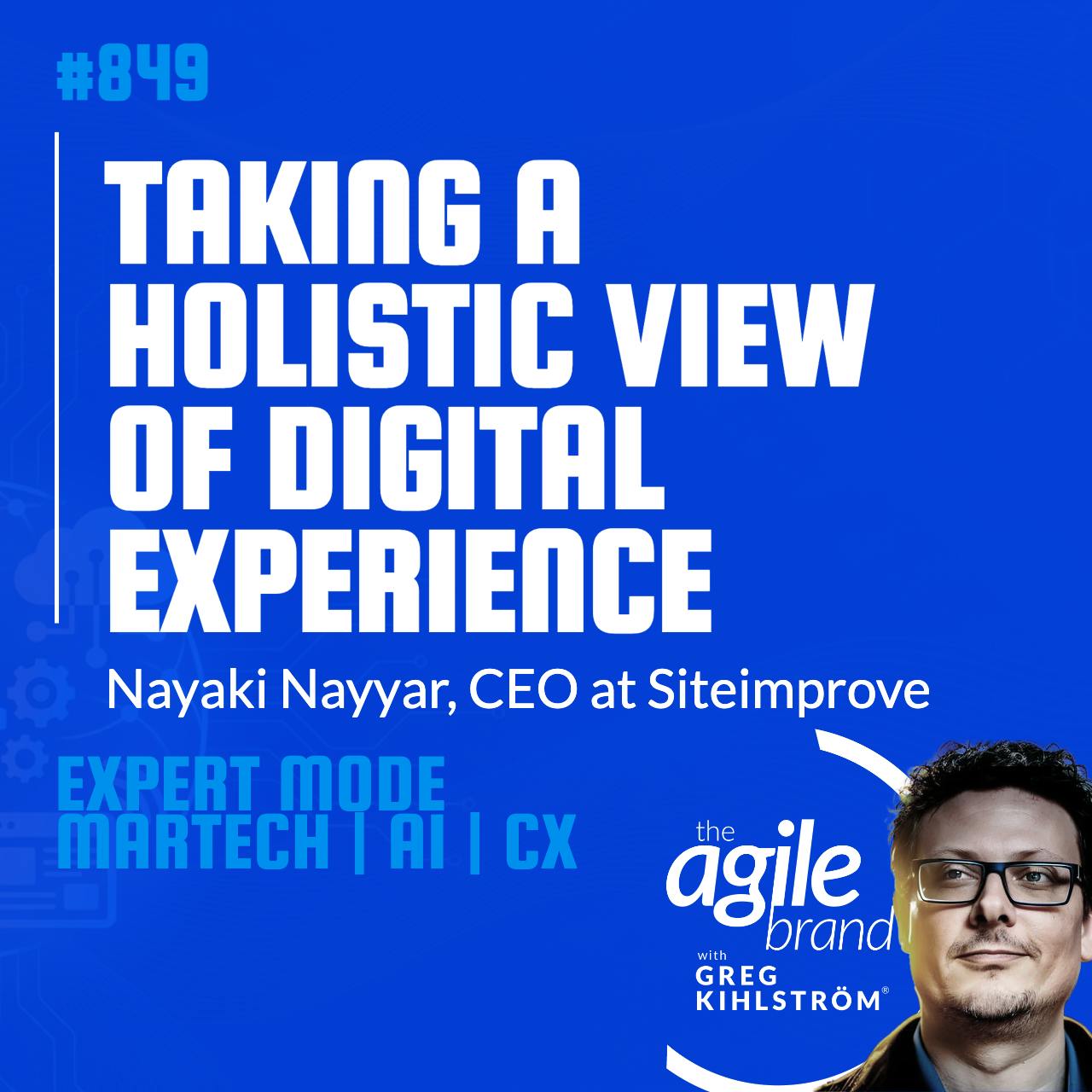
The Agile Brand with Greg Kihlström®: Expert Mode Marketing Technology, AI, & CX
#849: Siteimprove CEO Nayaki Nayyar on what it means to take a holistic view of digital experience
00:25:53
Loading summary
Transcript37 lines
- [00:01]
Strayer University Narrator
At Strayer University, we help students like you. Go from Will I To why not? For over 130 years, we've been innovating higher education to make it more affordable, accessible and attainable so you can reach your goals. Go from thinking can I? To Yes, I Can and keep striving. Visit strayer.edu to learn more. Strayer University is certified to operate in Virginia by Chev and its many campuses, including at 2121 15th Street north in Arlington, Virginia.
- [00:32]
Marine Corps Recruiter or Spokesperson
The wrongs we must right, the fights we must win, the future we must secure together for our nation. This is what's in front of us. This determines what's next for all of us. We are Marines. We were made for this.
- [00:54]
Greg Kilstrom
In the rush to implement AI across the customer experience, are we at risk of creating more digital barriers than we're breaking down? Agility requires a holistic view of the entire digital experience. It's the ability to see not just how individual channels are performing, but how they work together to serve every potential customer inclusively and intelligently. Today we're going to talk about what it takes to build that holistic view. We're going to explore how brands can unify their performance analytics to move beyond traditional SEO, the dual role of AI in both creating personalized content and ensuring it's accessible, and why inclusivity is becoming one of the most powerful levers for brand growth. Welcome to season eight of the Agile Brand Podcast. This season we're going all in on Expert Mode, MarTech, AI and Customer Experience, talking with the people and platforms behind the brands you know and love. Again, I'm your host Greg Kilstrom and I help Fortune 1000 companies make sense of martech, AI and marketing ops. Hit, subscribe or follow to make sure you always get the latest episodes and leave us a rating so others can find us as well. And make sure you check out our sponsor, TechSystems, an industry leader in full stack technology services, talent services and real world adoption. For more information, go to techsystems.com now let's dive in to help me discuss this topic. I'd like to welcome Nayaki Nayar, CEO at siteimprove. Nayaki, welcome to the show.
- [02:22]
Nayaki Nayar
Thank you Greg. Glad to be on the show and look forward to our conversation today.
- [02:26]
Greg Kilstrom
Yeah, yeah, absolutely. Definitely looking forward to this. Before we dive in though, why don't you give a little background on yourself and your role at site Improve?
- [02:33]
Nayaki Nayar
Yeah, I've been in the industry for over 20 years now, Greg. In fact, I started my career in in oil and gas as A customer shelf a little bit. And then Valero Energy. This was the golden age of refining when Valero went from a 5 billion to 65 plus billion. That's where my professional growth came from. After that I joined SAP. This was the cloud era when SAP was moving from on prem to cloud and I got to run their CX division, the customer experience division for almost five plus years. That was a phenomenal growth for us. Since then I had an opportunity to run growth and transformations across BMC leading up to an exit of 8.2 billion. Ivanti securonics and Inside Improve now. Really excited to be here. Inside Improve. We are on a phenomenal growth trajectory right now and looking forward to driving this for the next few years here.
- [03:38]
Greg Kilstrom
Yeah, yeah, that's exciting. So yeah, let's dive in here and we're going to talk about a few things but I want to start with from the strategic standpoint here and talk about this strategic shift to inclusive performance and just what that means. Exactly. So a lot of leaders are hyper focused still on classic SEO and conversion rates. Siteimprove talks about building high performing inclusive content experiences. So, you know, from a strategic standpoint, you know, what exactly do you, you know, does inclusive content experiences mean as well as, you know, how does reframing the goal from discoverability, kind of that SEO era discoverability to inclusive performance change how a leadership team should evaluate its digital investments?
- [04:30]
Nayaki Nayar
You know Greg, I love the word of inclusive performance. What you use. In fact, that's core to what we do and how we differentiate. If you look at siteimprove's core focus has been in what we call content compliance and content performance, helping our customers make sure all their content. When I say content, web content, mobile content, social content, documents, all content that they have, they have to make sure they keep that content compliant and at the same time also help the content to perform. MSA perform not just for traditional search engines, but also AI driven searches now, especially as the world is moving from SEO to AE or geo, whatever we call it. And that's where we focus helping both compliance and performance on one unified platform. That's a big differentiator for us, Greg. For us this is not an either or strategy, it's an and strategy. And I would say it's very, very unique. In fact, no other vendor has both of them on one single platform. Right. So when you use the word inclusive performance, I said, you know, Greg, got it. It's perfect. Spot on. It's what we do and how we differentiate. Right. So thank you for that word, of course, yeah.
- [05:49]
Greg Kilstrom
And to your point, you know, it is a differentiator, right. That, you know, performance and accessibility are really side by side. And you know, I think this goes back to this idea kind of legacy accessibility is thought of as a risk mitigation issue, a compliance issue, and so it's kind of treated operationally as opposed to as a performance measure as well. How do you advise brands to reposition it as a driver of growth, expansion and even brand loyalty?
- [06:24]
Nayaki Nayar
So Greg, let's take a step back. You know, when you look at the stats, one in every four individual in North America has some kind of a disability need, especially as they're consuming digital experiences or digital content out there. And also the stat is 4% or 5% of web content is not compliant or inaccessible in today's day and age, which is a huge opportunity for organizations or companies to make sure they can reach this large population of customers, consumers or even end users if they can only make that content accessible for everyone. Right. So I see this as a massive opportunity for growth or market expansion and also brand loyalty that they can help drive as they reach this broader audience.
- [07:14]
Greg Kilstrom
Yeah, yeah. So let's talk a little bit about, you know, the tactics here and you know, making some of this stuff happen. And you know, certainly site Improve has made some recent announcements in the AI space with AI agents, things like conversational analytics and keyword intelligence. Certainly there, you know, obviously there's a lot of talk about AI across the board, but you know, these sound like really, you know, specialized agents that are intended to potentially, you know, change the day to day workflow. Can you, can you talk a little bit about how they do that? How they, you know, are intended to really help a marketing team create more effective content and just do their jobs better?
- [07:56]
Nayaki Nayar
Yeah, you know, Greg, when I talk to customers, most of our customers are big, large, fortune firing companies, Global 2000 companies across financial institutions, manufacturing, healthcare and all. And every customer I've talked to so far, one of the biggest issue they have is just sheer volume of content. When you talk about shelves of the world, hobbits of the world, just the amount of number of websites, web pages that they have, keeping this content compliant and performing just a sheer volume of content is a big problem. It's humanly impossible to keep all of this manually. Right. So which is where AI plays a big role for us. In fact, last year, in 2025 is when we launched our new vision and strategy around what we call agentic content intelligence. And a big part of that agentic Continuance is intelligence is to bring these agents across every pillar. Accessibility agents, analytics agents, search agents to help with both compliance and performance issues. This year we have released quite a lot of agents. We start off with accessibility agents to detect issues and auto remediate those accessibility issues. We also released conversational analytics agents and when we say conversation analytics, think of it this way Greg. When you usually log into any platform or any application, users have to go hunt for the reports or dashboards. If you can only convert that experience using natural language, you should be able to just ask a question and the agent automatically generates the reports and dashboards. So that's what conversational analytics does. We brought that to market this year and we have been seeing massive adoption and really uptake from our customers. We also released what we call PDF Validate in addition to web and mobile documents is also a big part of digital content out there. And then customers can load all their PDF documents and make sure that content is accessible. Yeah, I mean we are bringing a lot of agentic use cases to market across both compliance and performance. We just started this journey. Fast forward next 612 months you will see us releasing more and more agentic use cases to really help auto remediate issues, detect any performance issues and address those performance issues.
- [10:25]
Greg Kilstrom
Yeah, yeah. I mean from my standpoint, I think the conversational analytics piece, it makes so much sense and I mean to your point, for those of us that have spent our lives making dashboards or hoping that the like out of the box dashboard that comes with the product or something has what we need and if not, you know, spending all that time like it's. It's amazing to be able to ask a question and get.
- [10:49]
Nayaki Nayar
Yeah, it's just beautiful. I mean when you actually look at. In fact we are converting the experience of the entire platform into more conversational. Yes. Reports and dashboards is I would say the number one step that we are taking. But extending that through the entire platform where you can user experience changes from just running dashboards, running reports, looking at various transactional interfaces to more conversational ask a question, get your responses and be able to transact using those natural language interface. Right. So that's a big focus for us.
- [11:28]
Greg Kilstrom
So I want to get back to you touched on a little bit about the. Just the challenge with large volumes of content. And so I feel like we've been through several different eras of this where there's certainly any large enterprise has legacy content that is difficult to pour through and find the right thing and all that. Now we've got Generative AI, which is amazing in many ways, but also opens up this. It's easy to create content and it's easy to create a lot of content and to do personalization, well, you need lots of variations. But with doing this and creating content at unprecedented scale, really there's a risk of producing a lot of, maybe generic, a lot of inaccessible and a lot of potentially off brand material. How does a content intelligence platform, you know, kind of corral all the, you know, maintain quality control, ensure inclusivity, you know, while, you know, while. While still maintaining that content engine.
- [12:37]
Nayaki Nayar
Yeah, I call it. We live in an AI world with infinite content. It's true, right? Creating content doesn't cost anything. Anyone can create content. And to your point, that content can be off brand and just doesn't address any compliance or performance issues. So to help address that, Greg, we have something called shift left. I don't know if you heard this word called shift left. Shift left is very common in the DevOps world. I come from a very strong engineering and product background. In that world. You actually shift left, you shift early in the process when the content is being created early in the process, during the content research phase, planning phase. Right. In the quantum briefs phase, when the content is being created to detect right there and then what kind of issues that are there in the content and address those, remediate those issues right up front versus doing it after the content is published and after it's already out there. Right. So both from the developer perspective and also the content author perspective, we have this in our platform where you can actually, early in the process, shift left, proactively address all kind of compliance issues, performance issues, early upfront, before the content goes into production and gets out into the general domain. Right. So that's a big part of our platform, big part of the capability, big part of what we call our. We differentiate. And in that journey, we've also integrated with pretty much all the CMS vendors, DXP vendors, CMP vendors, Greg. So that we can address all those compliance issues and performance issues early in the content lifecycle versus as an afterthought and from a developer Persona also, we have addressed that. As a developer, if you're building any web apps or mobile apps or any kind of a content, you can call our APIs and make sure all those accessibility issues are remediated upfront.
- [14:37]
Greg Kilstrom
Yeah, yeah. Because to your point, I mean, basically stop any potential issues before they, you know. Cause once they get out there, then we're creating 20 different image formats for every social platform and Email and all that. So, you know, and if all of those have the same issue, you know, to your point, we've got to go back kind of to the source, right?
- [14:56]
Nayaki Nayar
Yeah. I mean, unfortunately, customers, companies already have a large volume of content or out there already that they have to make sure they go back and reactively address all those issues. But because of what we are putting in our platform, in our content platform, where they can proactively, predictively address that upfront before the content goes out into the public domain. Right. So being able to do both in one single platform is a massive differentiator for us.
- [15:24]
Greg Kilstrom
Yeah. So I want to move to, I know we talked a little bit about measurement, but I want to get back to that topic as well and just, you know, this concept of unifying analytics and one of those differentiators that you mentioned is just having accessibility scores and performance metrics and SEO data as well, you know, in one place. What is a powerful and maybe even surprising insight that a brand might uncover when they're able to see, you know, usually they look in one place for each of these things. Right. So what, what can they uncover when they can actually see this stuff side by side?
- [16:02]
Nayaki Nayar
Greg, you should just put yourself in a customer shoes. And I talked to so many of these big, large customers, just the number of tools, tech platforms that they have just fragmented, whether it's accessibility platforms, SEO platforms, now AEO geo platforms. Right. For them to just look at which content is compliant or not compliant, which content is performing or not performing in the traditional search engines, which content is even showing up in the AI driven searches. It's a pretty, pretty complex problem just given the fragmentation of platforms. What we have done since we have brought all of that into one single dashboard. Like when you log in, you can see your compliance score and you can see your SEO score and you can see where you're ranking in the entire driven searches. That is an aha moment for all of our customers. I would say when you log in and you're able to see both on one single dashboard, one single platform, I think that's not just a differentiator, but I feel from a customer point of view, it's like, okay, I can see all of this in one, because at the end of the day, it's all about that content you're trying to make sure is addressing both your needs, compliance needs and performance needs. Right. And for you to go into different platforms to be able to do it, that fragmentation is a massive, massive issue and pain point for customers. Bringing that together and Showing that dashboard, usually when we do the demos and we show that dashboard, it's like it immediately clicks. Yes, I get it, I want it. And when can I get started?
- [17:35]
Greg Kilstrom
Well, and I would imagine that also going back to the other point about accessibility kind of being perceived as a cost center traditionally, I would imagine that also helps make the case there. When it's alongside these other metrics, it becomes very clear that it isn't just, you know, there's risk mitigation involved in it, but it's not purely, purely that. Right. So you know, for that cfo, you know, the, the classic, like the skeptical CFO that we've got to get things of marketing's, got to get stuff approved by, you know, in your mind, you know, how does that case get made then to them?
- [18:18]
Nayaki Nayar
Greg, I've worked with a lot of CFOs in my career and I will tell you this, CFOs are pretty risk averse. Right, right, right. I've heard, yeah, they are pretty because especially in the accessibility world, they want to stay out of trouble. They don't want all these lawsuits and the cost of those lawsuits. And when I say that both North America and Europe has these regulations right now, North America has ADA Title II with deadlines as close as April of this year. By end of April of this year, organizations of a certain size and above have to be compliant. And then there's a deadline coming up next year in April of 2027. Also in Europe, European Accessibility act requires all companies over a certain size to be compliant with the EAA. It was last year. By June of 2025 they were all supposed to be compliant. So given these regulations and given this requirement that every company of a certain size has have to be compliant, CFOs want that compliance checkbox? Yes, it's a checkbox. They want a compliance checkbox. It's a low hanging fruit with very minimal investment. You can make sure all your content is compliant. You don't want lawsuits. In fact, I think there's a study that said over 5,000 lawsuits just were filed just in 2025 in North America. It was I think 20% more than 2024. So we are seeing quite a significant increase in the lawsuits if your content is not compliant. And at the same time you also want to protect your brand reputation. Right? CFOs don't want their brand to have any kind of reputational issues. So I would say both compliance and brand reputation at the same time. Because on the same platform now you can also help improve the performance of that content. Right. So that's where the roi, the big ROI comes from. So we have never seen where we get pushback from CFOs or budget or key stakeholders because they see this as a big need. In fact, because of these deadlines, we are seeing quite a big nice tailwind of customers and opportunities coming our way.
- [20:33]
Greg Kilstrom
Yeah, yeah, yeah, definitely. So looking ahead a little bit, certainly, you know, we touched a little bit on just the, the changing search landscape. Right. So, you know, SEO is not going away, but you know, geo, aeo, you know, however it's referred to, is definitely on the rise and rather rapidly. I mean, just consumer adopt. I'm, I'm, I was actually pretty surprised at how quickly consumers are adopting AI in general, even for shopping and all that. You know, different topic. But you know, I think consumers are adopting AI very quickly with that. I mean, that classic search results page is changing. So how should brands be thinking about discoverability just given this shifting landscape?
- [21:22]
Nayaki Nayar
Yeah, Greg, I will say this. I mean, independent of which report you pick up these days, doesn't matter which stat you look at, whether it's 30% of the traffic has moved from traditional searches to AI driven, 50%, 60. I mean, everyone highlights the change or the shift of the traffic from traditional searches to AI driven searches. The question is not how much is shifting. The question is it is shifting. Acknowledging that it is moving and making sure that every company, organization and brand is ready for that shift and making efforts to figure out how they show up. If a company does not address the AE or GEO needs, if they don't proactively look at, okay, how they show up, I mean, they run the risk of being totally invisible. You may not even be visible. You know, companies and customers or consumers are searching for you or your brand or your services. In any of these AI driven searches, you may not even be visible. I mean, that's a big risk. You don't want to be invisible. And even if you're visible, your content may be so poor or so bad quality that it could be misrepresenting you as a company or a brand. So you also risk that. So you have to get ahead of it. The transition is happening. The question is not how fast or how much has moved. The question is, yes, it has moved and what are you doing about it? And I call it both. You have to make sure you're relevant for not just traditional searches, but also AEO. Right, A.E. or GEO. And that's another thing that we do in our platform. We do, of course, SEO is A big part of our stack. And now we have aeo. Also Gartner just released their first AEO visibility market guide. Just this month they just released and we got listed as one of the top vendors in that AEO space. So. Which is very good, very heartwarming for us to make a big leap into the entire AOG world.
- [23:20]
Greg Kilstrom
Yeah, yeah. I mean, and I do think that there are still even some pretty large brands out there that are thinking that, oh, it's, you know, it's different, but it's not that different. Right, but it really is. I mean I know this firsthand, you know, in even, I mean, I'm always testing stuff myself anyway. But also just the brands that I work with, it's significant. You know, there are similarity, there's overlaps, but there's significant. I mean it's, you know, you need to start investing in this, right?
- [23:49]
Nayaki Nayar
You need to start investing, you need to find a vendor that you can work closely with. You need to start co innovating with that vendor and working closely with a vendor to make sure your content and you show up in all those. I mean whether it is chatgpt or Perplexity or Grok does not matter. You have to be first visible, but also make sure that your content is telling your narrative, your story and your reputation. Right, so yeah, exactly.
- [24:18]
Greg Kilstrom
Well, thanks so much for joining today. A couple last questions as we wrap up here. The first one, if we were having this interview one year from today, what is one thing that we would definitely be talking about?
- [24:31]
Nayaki Nayar
Well, Greg, we talked about the very beginning inclusive performance. And our vision and strategy is both of these worlds compliance and performance coming onto one single unified platform. Fast forward a year, I would love to see this not just site improve, talking about it, but just in general the entire market and the ecosystem talking about it and making sure our complete vision comes to life and has a huge traction in the market.
- [25:01]
Greg Kilstrom
Yeah, love it, love it. Well, and last question for you. What do you do to stay agile in your role and how do you find a way to do it consistently?
- [25:09]
Nayaki Nayar
Well, I'm a techie at heart from the very beginning. I love playing with new tech, new trends and just staying ahead of it while I do it. We also have a very, very strong team at siteimprove. I'm very, very proud of the team and they stay ahead, they are very, very agile. So yeah, looking forward to the next few years of a journey driving growth, driving transformation and making a big impact in the agentic world.
- [25:37]
Greg Kilstrom
Yeah, love it. Well, again, I'd like to thank Nayaki Nayar, CEO at siteimprove for joining the show. You can learn more about Niaki and siteimprove by following the links in the show Notes this episode is brought to you by Tech Systems. They're leaders in full stack tech services, talent solutions and helping companies put it all in action. You can learn more@techsystems.com that's teksystems.com and thanks again for listening to the Agile Brand podcast. If you like the episode, hit subscribe and drop a rating so others can find the show too. And if you're in interested interested in consulting, advisory work, or if you need a speaker for your next event, feel free to reach out. Just visit GregKilstrom.com that's G R E G K I H L S T r o m.com the Agile brand is produced by Missing Link, a Latina owned, strategy driven, creatively fueled production co. Op. From ideation to creation, they craft human connections through intelligent, engaging and informative content. Content. Until next time, stay curious and stay agile.
- [26:44]
Nayaki Nayar
The Agile Brand.
- [26:51]
Strayer University Narrator
The Jack Welch Management Institute at Strayer University helps you go from I know the way to I've arrived with our top 10 ranked online MBA. Gain skills you can learn today and apply tomorrow. Get ready to go from make it happen to make it happen and keep striving. Visit strayer.edu Jack WelchMBA to learn more. Strayer University is certified to operate in Virginia by Chev and has many campuses, including at 2121 15th Street north in Arlington, Virginia. Okay, I have to tell you, I was just looking on ebay where I go for all kinds of things I love. And there it was.
- [27:26]
Greg Kilstrom
That hologram trading card. One of the rarest. The last one I needed for my set.
- [27:30]
Strayer University Narrator
Shiny like the designer handbag of my dreams. One of a kind. Ebay had it and now everyone's asking.
- [27:37]
Nayaki Nayar
Ooh, where'd you get your windshield wipers? Ebay has all the parts that fit my car. No more annoying, just beautiful.
- [27:45]
Strayer University Narrator
Millions of finds, each with a story. EBay things people love.