← The Agile Brand with Greg Kihlström®: Expert Mode Marketing Technology, AI, & CX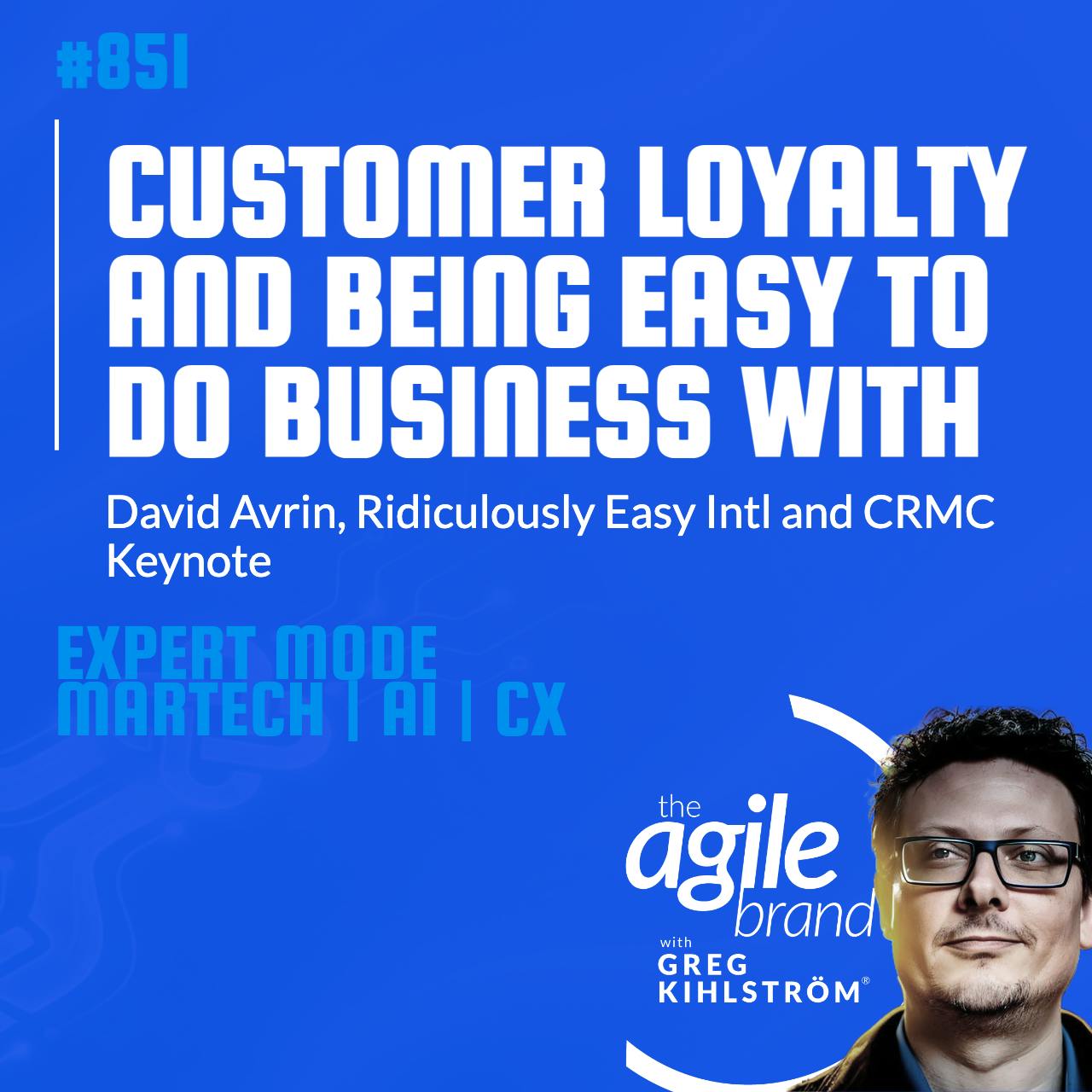
The Agile Brand with Greg Kihlström®: Expert Mode Marketing Technology, AI, & CX
#851: CRMC Keynote Speaker David Avrin on customer loyalty and being easy to do business with
00:24:39
Loading summary
Transcript32 lines
- [00:02]
A
And Doug, there's nowhere I wouldn't go to help someone customize and save on car insurance with Liberty Mutual. Even if it means sitting front row at a comedy show.
- [00:12]
B
Hey everyone, check out this guy and his bird. What is this, your first date?
- [00:15]
A
Oh no. We help people customize and save on car insurance with Liberty Mutual. Together. We're married. Me to a human, him to a bird.
- [00:22]
B
Yeah, the bird looks out of your league.
- [00:24]
A
Anyways, get a quote@libertymutual.com or with your local agent.
- [00:27]
B
Liberty Liberty Liberty Liberty.
- [00:31]
C
At Strayer University, we help students like you. Go from Will I To why not? For over 130 years, we've been innovating higher education to make it more affordable, accessible and attainable so you can reach your goals. Go from thinking can I? To Yes, I can and keep striving. Visit Strayer. Edu to learn more. Strayer University is certified to operate in Virginia by Chev and its many campuses, including at 212115 Street north in Arlington, Virginia.
- [01:03]
B
Hi, I'm Greg Kilstrom, your host of the Agile Brand, and here's a question for you. What if the key to customer loyalty isn't about creating memorable, delightful moments, but about being utterly forgettable in the best possible way? Agility requires more than just rapid campaign execution. It demands a deep seated ability to reevaluate and re engineer core processes in response to shifting customer expectations. Today we're going to talk about the powerful and perhaps counterintuitive idea that the greatest predictor of customer loyalty isn't satisfaction or delight, but simply how easy you are to do business with. We're going to explore why reducing customer effort is a critical competitive advantage and how enterprise brands can identify and eliminate the points of friction that drive customers away. Welcome to season eight of the Agile Brand Podcast. This season we're going all in on Expert Mode, MarTech, AI and Customer Experience, talking with the people and platforms behind the brands you know and love. Again, I'm your host Greg Kilstrom and I help Fortune 1000 companies make sense of martech, AI and marketing ops. Hit subscribe or follow to make sure you always get the latest episodes and leave us a rating so others can find us as well. This episode is brought to you by crmc. Drive your customers to new horizons at the premier retail event of the year for retail and brand marketers. Learn more about CRMC 2026 June 13 in Frisco, Texas at www.thecrmc.com. to help me discuss this topic, I'd like to welcome David Avron cx, keynote speaker and author at Ridiculously Easy International and keynote speaker at CRMC, taking place June 1 through 3 in Frisco, Texas. David, welcome to the show.
- [02:49]
A
Thank you so much for having me. I'm looking forward to this. I'm absolutely looking forward to the CRMC conference coming up at the beginning of June as well. What a stellar lineup. And not just from the main stage, but in terms of those in the audience as well. It's going to be an awesome conference.
- [03:06]
B
Yeah, yeah, same. Yeah, I'll be there. Looking forward to it as well. Before we dive in to the main topic, why don't you give a little background on yourself and what you're currently doing?
- [03:18]
A
Sure. I've spent the last 25 years speaking and teaching about marketing and customer experience. As a matter of fact, the early part of my career, I had a marketing firm, worked with some significant brands, and then I sort of discovered that you can actually get paid to teach people what you know. And I was exposed to the speaking industry and it's been a phenomenal ride. But what's really interesting is, is I made a big shift in my business about eight or nine years ago. I spoke on marketing. I wrote books on marketing that were published in seven languages around the world. But of course, the world changed and the drivers for consumer behavior changed in a significant way. I spent the early part of my career helping organizations position themselves, craft the verbiage to be very persuasive. And what we saw was a big shift that it became less important what we say about ourselves. Not unimportant, mind you, but certainly less important and much more important about what other people say about us. And that social media and Yelp and TripAdvisor and Rotten Tomatoes and Glassdoor has become the significant driver for consumer behavior. We look to avoid making a bad decision. We look to see what's the consensus in the marketplace and. And that drove a whole shift in my business from marketing to customer experience and the research that we've had in my books in that subject. So today I travel the world helping organizations become ridiculously easy to do business with.
- [04:57]
B
Love it. Love it. Well, yeah, let's dive in here then. And I think that's a great segue to. We'll start at the strategic level here and just to kind of tee off. What I introed is you argue that loyalty is driven more by low effort than high satisfaction. And kind of to the point about customer experience being so key for enterprise leaders who have invested heavily in customer delight initiatives, this might be A challenging concept and counterintuitive. Could you unpack the research or the shift in consumer behavior that supports the premise?
- [05:37]
A
Yeah, yeah. You know, it's not that customer delight is unimportant. We all know, of course, it's very, very important. But to an extent today, what we found in our research is that people certainly appreciate a nice experience. They appreciate a smile, but what they really bristle at is their time being wasted. And so the drivers today are much less about whether somebody had a successful experience or successful transaction is how hard was it to do what they wanted to do. Not everybody's looking for a relationship. I work with enterprise leaders all the time and I'll ask them, what's your competitive advantage? And they'll point to their eyes and I'll say, it's this, it's the relationship. And I'll say, well, you're looking for a relationship, but it's probably hard to hear. But most of your customers and clients aren't looking for a relationship. They appreciate the relationship. They're looking for whatever they're looking for and they want to get in and out. You know, we, we want to make, we want to build a great relationship. Relationships are a retention tool. They're generally not instrumental in terms of attracting customers and clients. So what constitutes success oftentimes is different from the perspective of, of the customer as opposed to the, the business itself. And so in our research, and we, we've got an exciting new research study that just came out in the last couple of months called the Frequency of Customer Friction. And we decided to ask something a little bit different. So I've got a lot of colleagues who've done really terrific research on customer sentiment. How do customers feel about X or Y or this kind of an interaction or the relationship? And we wanted to ask a different question. Not just how do they feel, but what are they likely to do as a result? So it's very much a behavioral study and the results were a bit shocking and I think should serve as a wake up call for many in business because it said exactly what sort of they. How you preface this conversation, which was that the biggest driver of customer satisfaction or of customer loyalty is, was effort. How hard was it to do what it is that they wanted to do? And so I think by and large businesses are very good at serving their customers. I was on a podcast recently and somebody asked me the question and they were saying, listen, if we've been talking about this for 50 years, how is it that businesses, that companies, the enterprise, that they just don't get it. And I said of course they get it. Of course I'm a big fan of business. People are very smart, they're very good at what they do. It's just hard. It's hard balancing some measure of predictability and creating that customer journey and managing that Germany, that journey and changing customer expectations. And it's not just for satisfaction. Their expectation is for speed. Speed of access, speed of information, speed of issue resolution, flexibility, choices, simplicity of process and of course convenience. And in many ways today convenient is, is better than better because the opposite of convenient is inconvenient. So and I don't mean to be all over the place, but it's, but it's customer expectations are changing and what customers really want from enterprise is driving their behavior and it's driving their loyalty.
- [08:58]
B
Yeah, well, and also isn't again, I don't disagree with the customer delight is a good thing either. But at the same time to me it feels very, there's inside out view of the world which is we've got these departments that do these things as well as wouldn't it be nice if every customer had a relationship with us and all those kinds of things. Ideally to your point, the outside in view is I just want to like book my plane ticket and you know, and yeah, if I get in the, in the sky lounge also that's cool. But like I, I just want to do the thing that I was there to do and, and relationship is very low on my list with most brands. Right. So isn't that, isn't it also just kind of this, this inside out view that that needs to change? Right.
- [09:52]
A
Well, I just think it needs to be enhanced. Yeah. And part of that is, is when decisions are being made are the right people at the table. One of the biggest challenges is oftentimes when operational decisions are being made, it's, it's the bean counters I say affectionately, it's the, it's operations and you know, who's not in the room marketing, customer experience. They're the ones who are, who are left to deal with the customer to implement the policy that might be errant in some way because I think it's a little shortsighted and I think that's the first step in making all of this better and more aligned with changing customer expectations. Is the right people need to be in the room when policy decisions are being made.
- [10:38]
B
Yeah, yeah, well and also, you know, in enterprise orgs I work with many as well and you know, sometimes friction is not intentional and it just kind of, you know, it happens, but sometimes it's actually intentional in terms of compliance and security and departmental silos that, you know, should or shouldn't exist, but they do exist. How can leaders differentiate between some of that, let's say essential friction, you know, compliance isn't going away, security necessary, you know, all that privacy, you know, how do you differentiate between the good friction and the bad friction and do something meaningful about it?
- [11:20]
A
You know, it's a great question because some friction absolutely is required and there's going to be a measure of, that's just how business is done. That's just the cost of doing business. But there, there is a difference. And some of it is really where the rubber meets the road. It's when a retail enterprise, for example, they require a receipt for a return. That's understandable. Right. It helps prevent fraud. That's, that's important friction. But the unnecessary friction is when you say, okay, you need a receipt, but we're only going to give you store credit. Yeah. One part was protecting the enterprise and compliance, and the other part was just a decision on your end that makes you a pain in the ass to your, to your customers. Right. When an organization needs, they want to send you a validation code. Right. I understand that. Right. That's necessary friction to prevent fraud. But then when they make it very, very difficult to cancel a subscription, that's unnecessary friction. Right. Those kind of things that make people very frustrated. One of the things I talk about in my book, which is all on brand, about being ridiculously easy to do business with, is that they, you know, when you see, like online, it's a free subscription or a free subscription to an app or something else, but it's not free. It's not free because they require a credit card number and you know that you're not going to remember to cancel and a year from now you're going to forget you even had that and they're going to automatically up you for another year and it's going to take two hours to cancel. I mean, those are the kinds of things that I think are, are intentional and somewhat unscrupulous. But you look at it from a bean counter perspective and a lot of these memberships, they make a lot of money on people forgetting that they have memberships. I don't know. That's the way we want to do business. And so as you talk about sort of the difference between the necessary friction and the unnecessary. The necessary is compliance. The necessary is protecting them from, from fraud. The unnecessary are things that make life difficult for your Customers and clients. And the problem is, once again, we're designing these customer journeys because they make sense for us. They give us a measure of predictability that we can budget for. I mean, here's how they find. Usually learn about us online or visit us in person or online, make a purchase, make a selection, customize, pay, deliver, follow up, whatever that we've got this journey and it works. And where it doesn't, we tweak it. Because if we can have a greater level of predictability of our customers behavior. Right. Makes sense that we have predictability of, of cash flow and we can budget for that, we can train for that. The problem is, is your customers haven't read your employee manual. Right. They don't know how they're supposed to do business with you. They know how they want to do business being driven by a lot of other industries and it's all changing. So that's sort of the disconnect. Part of what I'm going to talk about at CRMC in Texas as well is how do we understand those changing customer and client expectations for speed and flexibility and simplicity and. Right. I travel the world, I ask organizational leaders, what do you think your competitive advantage is? And I'll tell you, it's always the same thing. It's our quality. Right. It's our commitment. It's about the people. And I say all of those are important. Here's what the research shows your customers are prioritizing, no surprise, speed and choices and convenience. Right. And so how do we connect that, how do we keep that conversation going? And we've got a lot of research that supports some of those assertions.
- [15:07]
B
How much of the, the friction do you especially, you know, in, in large, you know, enterprises, you know, how much do you attribute to just the, the siloing, the, you know, one, one hand not knowing what the other is doing. And you know, what, what can a, what can leaders do? Certainly they, they know that these things exist within the org. Some things, you know, again for compliance reasons or whatever are not going to change if, if ever, certainly not overnight. But what's a step that, you know, like a CMO or someone can take to, okay, I know there's a problem. What's a small thing that I can do to start bridging some of those gaps that maybe just were never a priority before?
- [15:48]
A
Well, oftentimes when we talk about siloing is that each department is making their own decision and they're all making good decisions. They're making honest decisions based on what they're experiencing. But of course, customers are dealing with multiple departments in some respect. And so it's those regular conversations as I put my cat down on the ground and don't edit that out, by the way. People like that.
- [16:17]
B
Cats are good.
- [16:19]
A
It's having a regular conversation of what are you experiencing or what points of internal friction or frustration or are driven by that lack of communication internally. You know, we talk a lot about, or I talk a lot about customer experience, cx. But of course there's the ex. And that employee experience is who's. I ask organizations and employees all the time who's waiting on you for something because ultimately it goes back to the customer, whether it's dealing with a vendor or dealing with shipping or billing or all of those kinds of things as well. And so it's sort of what are some of the common things that you're experiencing? Does it involve another department? What could we do? And it's asking the questions to foster a better communication. It's not about it being accusatory and it's not about, you know, breaking down, you know, everything and rebuilding it. It's generally tweaking because I think, once again, I'm a fan of business. I'm not on stage or in the consulting work that I do, ripping things apart. It's generally, it's a tweak, it's a recognition of something that's changed maybe in the last couple of years because most organizations have their systems in place that were built 10, 20 years ago and think about how much has changed.
- [17:36]
B
Yeah, yeah, definitely. And so let's talk a little bit about how we measure success here as well. And certainly there's a number of KPIs that they're not going away. Lifetime value and other things are not going anywhere. But how do you work with orgs to make the case to start simplifying? And what are some of the initial metrics that they can use to start seeing, okay, we're heading in the right direction?
- [18:06]
A
I think most organizations and the leaders understand the metrics that they're looking at, but I think it's part of a different mindset and that it's looking at the difference between a static economic model and a dynamic one and just overly simplify it. Not to make this an economics class, but. But a static economic model assumes cause and effect. If we cut this, we save that much money. And it probably plays out most commonly in self checkout at a grocery store. Right? If you just get rid of all your checkers, you don't have to pay your Checkers, everybody does it themselves. Look how much money we're going to save. Look how much money we're going to make. But of course we don't live in that world. A dynamic economic model assumes that the customer sentiment and preferences and prejudices play into our decisions. And so you look at that dynamic where the bean counters think, look how much money we're going to save. I've got a restaurant fairly close to us that we really like, one of these Genghis Grill. And they raised their prices as they probably needed to do and people stopped going and they were out of business within six months. Right. But, but normally we think if you, if you, if you increase your prices, you're going to make this much more. Organizational leaders understand this. But to people have that conversation between operations and finance and marketing and customer experience because those behaviors play into it. I have a grocery store very close to where I live just south of Denver, Colorado and it is gorgeous. It's, it's used as a training facility. It's probably one of the best looking grocery stores. And it's dead in the mornings and half a mile away there's another grocery store that's jam packed. What's the difference? There is nobody to help you check out your groceries until 8am and I've asked them because I go workout in the morning and I stop and I've got a grocery cart full of groceries and I say, is there somebody could check me out? And they said, we don't have anybody till 8 o'. Clock. I said, you have 40 people in the store stocking shelves. And they said, yeah, corporate wants us to drive people to self checkout. And my question is, do your customers want to do self checkup? Well, some do, but the fact that there is no option, there's a disconnect. That static economic model said we're going to save so much money. And yet what happened is people voted. They voted with their feet and their time and their dollars and the grocery store is empty in the morning because there's nobody to help. And so to answer your question about specific metrics, I think you can look at attrition, you can look at behaviors, you look at cameras. There's so many things that play into it, but it's really understanding and keeping that conversation going of recognizing that people have choices and organizations can make decisions all they want. And at the end of the day the people are going to decide do we like that or not? Not just are you capable and qualified and competent and compliant from a regulatory perspective, but here's the question I want all of your listeners and your viewers to think about as well. Are you also preferable? And that's what it comes down to. Are you preferable to the competition? That's why I said the greatest predictor of that loyalty isn't just satisfaction, it's effort. How hard is it to do business with you? And so for me, of course, everything's on brand about being ridiculously easy to do business with. Yeah.
- [21:24]
B
Love it. Love it. Well, David, thanks so much for joining today. Got a couple last questions for you as we wrap up here. First, as we mentioned, you're given a keynote at CRMC coming up in Frisco, Texas, in June. What are you most looking forward to about the event?
- [21:39]
A
You know, what I'm actually looking forward to? I love presenting. I love to teach. I love that interaction. Unlike most conferences where I speak, you know what I'm really looking forward to is attending the conference. The lineup is phenomenal. The audience is filled with the right people. And as you and I both know, at many of these conferences, the real value is the serendipity of the unexpected conversations in the hallways, the between sessions. There is no other conference that has an attendee list like this one. And so they were very gracious because I'm speaking. And I asked them, I said, can I stay not just to engage with those who might have seen me speak and might have some questions or want to engage, but to learn alongside everyone else because everything's changing. Part of that's my content as well. But I'm looking forward to learning alongside everyone else and breaking bread with the other attendees at the conference.
- [22:39]
B
Love it. Love it. And last question for you. What do you do to stay agile in your role, and how do you find a way to do it consistently?
- [22:47]
A
I was going to joke and say fear is a hell of a motivator, but the reality is I spend a lot of time on airplanes. I know that this podcast is probably somewhat evergreen, but over the next seven weeks, I'm on 24 airplanes.
- [23:01]
B
Oh, wow.
- [23:01]
A
And 33 continents and six countries. I learn and I read and I watch because it's crucial that I do so. And so I have brilliant colleagues, even in my space and other spaces. And so I. And something I tell my kids, who are no longer kids as well. I tell them, I said, you want to future proof your business? Spend 20 minutes at the beginning of every day and watch a video or learn a lesson or read something that contradicts what you believe about the world. And so it's a little bit trite to talk about being a lifelong learner, but I am a daily learner because my biggest fear is irrelevance and so it's really important that I stay on top of things. I'm booked sometimes a year, 18 months in advance and sometimes they'll say, can you send me your slide deck like nine months in advance? I said I can, but it's not going to be the slide deck that I'm going to present because things are changing and it's incredibly important for all of us to continue to learn daily. And that's why I think CRMC is going to be so important. And for somebody who misses that conference, you can't afford to miss a year, right of that kind of knowledge and insights and relationships. So there's the long answer to your short question is I learn daily. Yeah.
- [24:23]
B
Love it. Well, again I'd like to thank David Averin, cx Keynote speaker and Author at Ridiculously Easy International and keynote speaker at CRMC, taking place June 1 through 3 in Frisco, Texas. You can learn more about David, Ridiculously Easy International and CRMC by following the links in the show notes. This episode is brought to you by crmc. Drive your customers to new horizons at the premier retail event of the year for retail and brand market marketers. Learn more about CRMC 2026 June 13 in Frisco, Texas at www.thecrmc.com and thanks again for listening to the Agile Brand podcast. If you like the episode, hit, subscribe and drop a rating so others can find the show too. And if you're interested in consulting, advisory work, or if you need a speaker for your next event, feel free to reach out. Just visit GregKillstrom.com that's G R E G K I H L S t r o m.com the Agile brand is produced by Missing Link, a Latina owned, strategy driven, creatively fueled production co op. From ideation to creation, they craft human connections through intelligent, engaging and informative content. Until next time, stay curious and stay agile.
- [25:40]
C
The Agile Brand. This summer, don't squeeze in, spread out. Find homes big enough for your whole guest list on vrbo. That's vacation rentals done right. Book your stay now.
- [26:00]
A
DISH has been connecting communities like yours for the last 45 years, providing the TV you love at a price you can trust. Watch live sports news and the latest movies, plus your favorite streaming apps all in one place. Switch to DISH today and lock in the lowest price in satellite TV starting at 89.99amonth with our two year price guarantee. Call 888-add-D dish or visit dish.com today.