← The Agile Brand with Greg Kihlström®: Expert Mode Marketing Technology, AI, & CX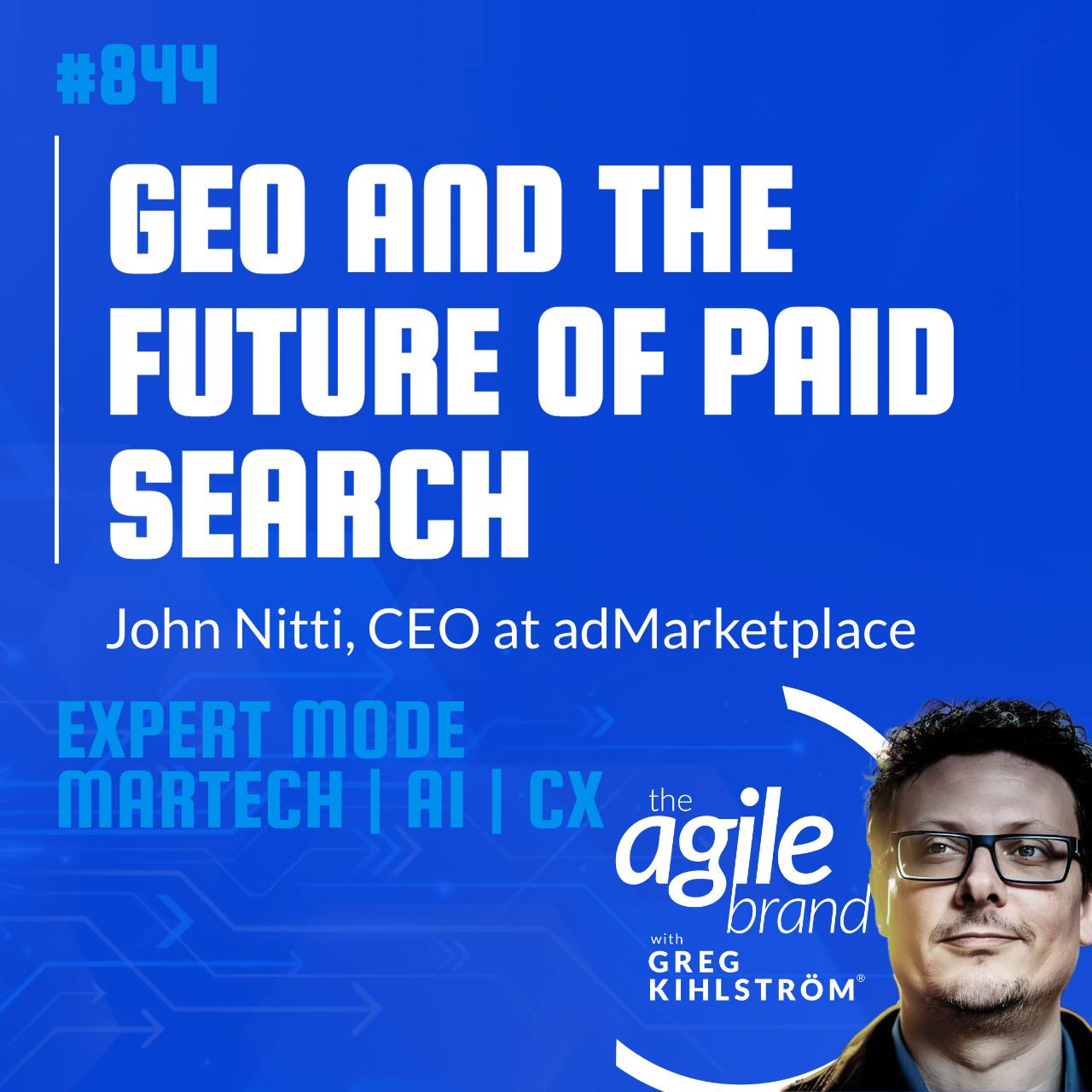
The Agile Brand with Greg Kihlström®: Expert Mode Marketing Technology, AI, & CX
#844: adMarketplace's John Nitti on GEO and the future of paid search
00:21:20
Loading summary
Transcript44 lines
- [00:01]
A
The Jack Welch Management Institute at Strayer University helps you go from I know the way to I've arrived with our top 10 ranked online MBA. Gain skills you can learn today and apply tomorrow. Get ready to go from make it happen to made it happen and keep striving. Visit strayer.edu Jack WelchMBA to learn more. Strayer University is certified to operate in Virginia by Chev and its many campuses, including at 2121 15th Street north in Arlington, Virginia.
- [00:31]
B
I sold my car in Carvana last night.
- [00:33]
A
Well, that's cool.
- [00:33]
C
No, you don't understand.
- [00:35]
B
It went perfectly. Real offer down to the penny. They're picking it up tomorrow. Nothing went wrong.
- [00:39]
C
So what's the problem?
- [00:41]
B
That is the problem. Nothing in my life goes as smoothly. I'm waiting for the catch.
- [00:44]
C
Maybe there's no catch.
- [00:46]
B
That's exactly what a catch would want me to think.
- [00:48]
C
Wow.
- [00:49]
B
You need to relax. I need to knock on wood.
- [00:51]
C
Do we have wood? Is this table wood?
- [00:52]
B
I think it's laminate. Okay. Yeah, that's good. That's close enough. Car Selling without a Catch Sell your
- [00:57]
A
car today on Carvana. Pick up fees may apply.
- [01:03]
C
For over two decades now, many marketers have built their careers on mastering SEO on Google and paid search. But what if the playbook you spent your entire career perfecting is about to become obsolete? Agility requires not just adapting to new technologies, but a willingness to fundamentally question and reimagine the foundational channels you've built your business on. It demands that we look beyond incremental improvements and prepare for architectural shifts in customer behavior. For years, the search landscape has been relatively stable, but generative AI is rewriting the rules of how consumers find information and how brands can connect with them at the moment of intent. Today, we're going to explore what this means for the future of advertising, the new commercial opportunities emerging, and how brands can find customers on new surfaces beyond the traditional search engine results page. Welcome to Season eight of the Agile Brand Podcast. This season we're going all in on Expert Mode, MarTech, AI and Customer Experience, talking with the people and platforms behind the brands you know and love. Again, I'm your host Greg Kilstrom, and I help Fortune 1000 companies make sense of martech, AI and marketing ops. Hit, subscribe or follow to make sure you always get the latest episodes and leave us a rating so others can find us as well. And make sure you check out our sponsor Tech Systems, an industry leader in full stack technology services, talent services and real world adoption. For more information, go to techsystems.com. now, let's dive in. To help me discuss this topic, I'd like to welcome John Nitti, Global Chief Business Officer at Ad Marketplace. John, welcome to the show.
- [02:42]
B
Thanks, Greg. Pleasure to be here. Thank you for having me.
- [02:44]
C
Absolutely, yeah. Looking forward to talking about this. Definitely a topic top of mind for many, many brands and many, many people within those brands. Before we dive in though, why don't you give a little background on yourself and your role at Ad Marketplace.
- [02:56]
B
Yeah, sure. Thank you. Thank you. So I've global Chief Business Officer here at Ed Marketplace started at the beginning of the year, so I'm on week five.
- [03:05]
C
Congrats.
- [03:07]
B
Thank you very much. Overseeing the demand side of our business and that approach to clients and agencies, supply side and working with our publishing partners to help monetize many of those surfaces that you had mentioned in your intro and then marketing, as well as how we're talking overall to our customers Marketplace and, and how we can keep, keep those folks educated on the ever evolving consumer journey. Right. And that's, that's, you know, that's the exciting part of why I came to Marketplace. Before that I was at X, you know, X or formerly known as Twitter for, for 10 months and before that, you know, Verizon for 10 years on the client side. And then, yeah, I won't go through my, my laundry List of LinkedIn or My, My resume, but many agency and client side opportunities, opportunities as well as publisher opportunities as well throughout my career.
- [03:53]
C
Great, great. Well, yeah, let's dive in and start with the big picture here from the strategic lens. How is generative AI search not just an evolution of what's been before, but really more a fundamental re architecture of how consumers discover products and services. And what are you seeing as the biggest strategic blind spot for brands right now?
- [04:20]
B
Yeah, look, I, I think a lot of things with AI have accelerated, accelerated things that were already sort of in motion. Right. So distributed intent had already started to happen. Right. It's just now with AI that has accelerated the need to address it the same way that, yeah, data, data hierarchy and data hygiene and structured data was always a need within organizations, but until AI and that need to have structured data in order to utilize AI that advanced, a lot of things that were being worked on or would have been put off for another year because things worked well enough. Right. And so I think AI chat and LLM entering into the intent area. Right. In which had historically been, you know, search engine results driven, is only an acceleration of that. Right. But we started seeing that distribution of intent, you know, Even years in advance. Right. If you think about things like buy now, pay Laters, or, you know, fintech apps that had started as payments, that became shopping experiences. Right. That inherently have intent and search built into them, the consumer itself has already started to be distributed in that fashion across multiple platforms. And I think AI has only accelerated that yet again, further.
- [05:38]
C
Yeah. And so you've pointed to competitive remedies as a, as a key factor here, which might feel abstract to marketers that are and have been traditionally focused on performance and performance marketing. Can you maybe explain that a little bit and explain how regulatory changes are creating a strategic opening for brands to diversify their search spend away from those traditional walled gardens.
- [06:07]
B
Yeah, Like, I think it's a couple of different things. Right. So the regulatory and specifically Google. Right. People have felt locked in. Right. On what they had to do. Now there's an openness, right. Starting on February 3rd, there's an openness of you're not locked in to that. Right. And so that only will help stoke, I think, further change and evolution. And that's a good thing. I think the evolution, again, like I had mentioned earlier, of what the consumer has already shifted to. Yeah. And then also, if you think about just even the marketplace approach of things that have started to become blurred together. Right. To your point. Yeah. Search, SEO and SEM had been separate, and then you need to look at them, you know, obviously, you know, together. Right. Social had been a separate strategy, programmatic, a separate strategy. All of those things, I think are starting to come together. Right. And have connective tissue. You need to look at it in one whole aspect of performance marketing. Right. And so I think that again, that is all evolving in a more quickly, in a quicker, you know, pace than. Than had been expected, but I think is a good thing. Right. It enables choice and again, the consumer is always going to move first. Right. I, in the beginning of my career is at American Express, where the CMO at that point in time, John Hayes drilled into me customer centric marketing and be where the customer is. Right. And I think that's, that's an important part of, as any performance marketer, if you want to convert and capitalize intent, you need to be in those different environments and where the consumer is signaling that intent.
- [07:31]
C
Yeah. Well, and to that end, let's talk a little bit more about those, you know, emerging surfaces. I know you touched on this a little bit earlier, but, you know, everything from the buy now, pay later app or other, you know, a lot of when marketers hear search, they think of the traditional search bar and what we've been doing again for, for a few decades now and things like that. But you know what, what are some examples to kind of build on, on what you've already shared that marketers should really be keeping in mind to kind of expand the definition of search.
- [08:06]
B
Yeah, no, definitely. I think marketers need to keep in mind the, the totality of the ecosystem too. Right. I think a lot of marketers are very concerned from an AI standpoint, which they should be with more of geo. Right. Like, like what do I need to do to make sure that I'm creating the right content, that I'm allowing for discovery, that I'm indexing properly within all these LLMs, which is part of it. Right. But let's not ignore again how what that user journey is. Right. And how do you make sure that you take as much friction out of that process as possible? If you go into a lot of those journeys currently they're broken links or there's not an easy way you may get the result, but you may not be easily able to get to where you want to go to make a purchase. Even though you're signaling I want to make that purchase, what is the best price or where can I buy? I'm not actually getting there. Right. You talk about intent and low hanging fruit of a conversion. Right. And so that's what we're focused on is yes, worry about GEO and how you're preparing yourself but don't forget about how you're taking friction out of that user experience. Right. And so we launched back in October with Opera. We're not influencing the search result or the result from the LLM but, but if you hover over, we'll give you a link to then go purchase. And even just this week we've launched, it'll show you a picture of the product, give you the price point and let you know exactly where you're going from a transparency and trust standpoint. Right. And that's just meant to enable it and so and make the user experience better, but then help help people monetize. Right, Help. There is the Monet monetization flow for both the client and the publisher that need to do in a transparent way. You need to do it in a, in a, in a responsible way. And I think, you know, looking at how you enable and improve that experience and not just try to make it a, a sponsored like or something that they feel is not, not genuine. So we're not never going to influence the actual LLM result. Right. That needs to be True. Right. And you need to trust that. But you should make it easier to both, you know, as the user to navigate and then for the publisher and or retailer to convert that, that intent. Right. And that's, that's the journey that we're on. Similarly, within the the buy now pay laters that have evolved and become, you know, shopping apps, right. You know, you go into those experiences that was first way for you to finance or way for you to utilize a credit card. Or even if you think about, you know, the evolution of where PayPal and Venmo from a peer to peer payment perspective has gone, those have become marketplaces of their own. Right. And so how do you capitalize on that if you are a retailer? Right. How do you capitalize that if you're a partner? And you know, we're working with those folks to also make those experiences better and to get people to that success event in a quicker and more efficient fashion.
- [10:35]
C
So for those AI driven search experiences, what does that look like from that, from the advertiser end? I mean for those that are used to bidding on keywords and you know, they know Google Ads inside and out and stuff like that, these are conversational experiences, these are curated experiences. What's different, I guess what's the same and what's different from the advertiser perspective?
- [10:57]
B
So from an ad marketplace standpoint, we're trying to keep it to similar success metrics, right? Our overall success metric, our goal for our clients is driving roas, right?
- [11:06]
C
Yeah.
- [11:07]
B
And ultimately buy a cost per click, right. And so that's very much search like and very much familiar. Right. However, to your point, what, what is your keyword strategy? Right. How do you look at category? How do you look at vertical? To your point, you need to open it up a little bit more and look at things a bit differently. Right. And, and understand what conversations you want to be a part of and where do you want to send them from a, a product, a product perspective at that point versus sending them to a general landing experience. Right. You want to be able to take that as much as intent and semantics as possible and have that be what you're serving up in those instances. And so our technology is doing that, making it more relevant. Right. Driving relevancy by scoring. But it does, it takes the, the tactics from a CPP CPC perspective that you've been used to. But you do need to expand and look at a different know, keyword and, and category strategy to make sure that you're capturing the full intent. Right. You can start with the same Exact. Give us your, your Google list, right? And, and yeah, we can execute that against that, but you may not be capturing the, the full extent of the intent and opportunity that's out there
- [12:13]
C
to fall into the, the Roas comment. So when we talk about measurement here, I mean attribution, right? This is, these are more surfaces. These are, you know, as marketers love to have yet another place to try to attribute from. How does, what does this look like from a, from an attribution standpoint? And, and yeah, I mean are, are marketers, should they still be thinking about incrementality and all of, all of those things that they're currently doing or are there other or additional ways of thinking?
- [12:44]
B
Yeah, I mean, totally. I think we. Many conversations now around incrementality, right, because everybody's trying to prove it out, I think in a good way, right. Largely search has been last touch, right. For the most part or last click, I should say. And that attribution is only a partial view of what you're really contributing to the conversion or the success event. And so as you start to look at incrementality, you will get a partial, a broader view, right, of like, all right, perhaps I'm, you know, ad marketplace is not just contributing to my, my digital sales, but is also having an impact to in store, right. When you, when you start to do true incrementality testing and know what you have on, what you have off, it should help us get to better, you know, attribution overall. And so that, that's exciting. And, and it's a lot, it's a big part of a lot of the conversations because again, this all comes down to, is from a marketer perspective is you're fighting for attention, right? You're fighting to, you're fighting to get in front of in a bigger, fragmented, more competitive place, right? Where in, in traditional, you know, video format types and things like that. I may not be watching ads anymore, right? And so, and then when I go into other experiences, I'm being bombarded via multiple different angles. And so that the more that A, you know, we, we pride ourselves on our publisher relationships to have either exclusive or preferred type of placements that you can't just buy everywhere else, right? Because we don't want to be commoditized into an ad network like model, right? And then B, that you can, can break through and really identify the true intent, right? And then those moments and what are those signals that somebody's sending of, of a conversion, right? And how do you inform that eventually with data Right. If, if a, if a customer or a client is going to bring us data, say, well, here are the signals that, that we see via the research that we've done that identify somebody that's going to convert at a higher level. How you do, do we also start to take that into account as we work with our partners?
- [14:40]
C
Yeah. I mean, do you think the, because of the conversational nature of, of AI based search is there. It would seem like there's just richer intent data. I mean we're, you know, consumers are having conversations. Even, even the most detailed search query in Google is not the same as a, you know, 10 minute conversation with, you know, ChatGPT or whatever.
- [15:03]
B
Well, and you can string several query points together right into one. Right. And to your point, that's a lot of the work when you get into semantic modeling and the work that we're doing to ensure the right match as well. Right. Because you don't want to mismatch from that perspective. And so that's extremely important. And why we've been in beta for so long or sort of alpha for so long and are going to be moving to beta is to get that. Right. Because you don't want to lose that trust and that efficacy. But it's definitely something that, you know, is, is you need to again, broaden from where you had been on. Here are the specific terms that convert to. There are other steps within this process that are happening in the same query string now that you need to also be aware of. Right. And how, and how you're going to render what's going to show up.
- [15:50]
C
Yeah. So taking this forward, you know, a year or two even what are, what skills or even team structures, how does this change that? I mean, I would imagine some things may not change, but you know what, what does change about marketing teams to be able to compete in this new search paradigm?
- [16:12]
B
Look, I, I think I mentioned or hinted at a little bit earlier there. I think there's going to be, you know, an evolution, right. Of an emerging of, of disciplines. Right. So things that had been siloed and disciplined departments of the past. Right. Of how you looked at SEO, SEM, Social, programmatic. Right. And even direct buys. Yeah. We'll start to merge more together. Right. And you'll have more, you should have more audience and segmentation that is pulled throughout. Right. And knowing, you know, when I, when I was at, when I was at Verizon, my, my, one of my biggest pain points was telling an existing customer to switch. Right. That should never happen. Right, Right. Simplistic level. Right. But it still happens in a lot with a lot of marketers. Right. And so I think there's just going to be a upskilling of understanding what is the impact, right to your point of AI and the different ways that a consumer is able to interact and show intent and where they are. So then you be upscaling up training from that perspective. But then emerging of things that had been sitting separate before was what are the connective tissues and how do those teams come together, Right. Because that's all performance driven. Right. And so instead of having different performance channels competing against each other, I think you're going to see that merge together overall.
- [17:23]
C
Yeah. So if you were to make a prediction about the relationship or maybe a changing relationship between brands, consumers and AI search that will become mainstream soon enough, you know, what would it be?
- [17:38]
B
Look, I think everyone should be testing, right? And that, that, that's whatever your common theme that you hear back from folks when you mention anything AI related is that it's super early, whatever, but everybody, everybody should be testing because you need to know where, where it can improve or where maybe the, the issues, right. You need to expose those things earlier on. And so I think that's, you know, if from a prediction of 2026 is that everybody should be testing and preparing, right? And getting yourself prepared because it, it is come, it is coming. But I think the, and the other thing that is the themes I would say from a prediction standpoint is that, and it shouldn't be a surprise, but trust, transparency and ethics, right. Is also going to be large, right. I think there's a huge, in all parts of AI, a huge consumer distrust in the back of the minds of is this real or is this AI? Right? Those are two different things inherently versus how is AI and how are these tools helping me do something more quickly, helping me get to where I want to get to more more quickly and helping me sort and rank things in a more efficient way that helped me get to that, that end, that end success event, but in a, in a trustworthy and transparent way where I'm not being fooled or mistaken. Right. And I, and I hope we learn as an industry, you know, if you think about the past, right. Content farms, not 100% transparency or trust, right. That's what drove a lot of results. Right. And so I hope we don't, we learn from sort of, you know, past, you know, past faults that we've made with the consumer overall and really focus on how you can actually drive relevance and be, be useful because that you know all businesses went. Right. If it's useful. And you're going to put at me at an earlier point in time and make it easier for me you all day long. Right? We're going to.
- [19:21]
C
Yeah. Love it. Well John, thanks so much for joining today. One last question for you before we wrap up here. What do you do to stay agile in your role and how do you find a way to do it consistently?
- [19:32]
B
Yeah, no, great, great question. And I always joke my I have a younger brother that's two years younger than me and he's a, an engineer. Right. That and a telephony and Cisco certified engineer that has to constantly get recertified. Right. And I always use that as an example of a. He's way smarter than me. But, but just that you need to continually push yourself to learn. Right. And you need to be comfortable, be uncomfortable because change is the only consistent. And so if you're not educated in these areas. Right. If you don't know what, what are the nuances and again really get into like I said, you need to be testing. Right. Because you need to understand what will work and what won't work. Right. Or how I need to be. How I better need to structure what I'm doing to be prepared for what AI is going to bring, even if I'm not going to execute it in 2026. And so I continually try to push myself to be uncomfortable, to be in those conversations and to try different things that may not be in my comfort zone. Right. You have subject matter for a reason, but you need to continually do, like I said, be recertified in these areas as the consumer changes and as technology changes and as the opportunities change. Right. And so I think that's, you know, and pushing into these new areas of testing and both, both for me on the partner side. Right. What different publishers and and platforms should we be working with that maybe didn't exist six months ago, but we should be working with now? And then on the, on the customer side is like how, how am I helping them solve for their solutions and challenges? Right. And how do we need to evolve what our product and offering is to basically meet those needs? Right. To your earlier point of it's the evolution of all these things that had been separated that may now be triangulating together. How do you change what that is to help solve for your clients in the future?
- [21:13]
C
Yeah, I love that. Well, again I'd like to thank John Nitti, Global Chief Business Officer at Ad Marketplace for joining the show. You can learn more about John and Ad marketplace by following the links in the show. Notes this episode is brought to you by by Tech Systems. They're leaders in full stack tech services, talent solutions and helping companies put it all in action. You can learn more@techsystems.com that's tek systems.com and thanks again for listening to the Agile Brand podcast. If you like the episode hit subscribe and drop a rating so others can find the show too. And if you're interested in consulting, advisory work, or if you need a speaker for your next event, feel free to reach out. Just visit GregKilstrom.com that's G R E G K I H L S t r o m.com the Agile brand is produced by Missing Link, a Latina owned, strategy driven, creatively fueled production co. Op. From ideation to creation, they craft human connections through intelligent, engaging and informative content. Until next time, stay curious and stay agile.
- [22:21]
A
The Agile brand,
- [22:26]
C
Dish, has been connecting communities like yours for the last 45 years, providing the TV you love at a price you can trust. Watch live sports, news and the latest movies, plus your favorite streaming apps all in one place. Switch to Dish today and lock in the lowest price in satellite TV starting at $89.99 a month with our two year price guarantee. Call 888-ish or visit dish.com today.
- [22:57]
A
At Strayer University, we help students like you go from Is it possible To Anything is possible by offering access to up to 10 no cost gen ed courses so you can reach your goals affordably and fast. Visit strayer.edu to learn more. No cost genites provided by Strayer University Affiliate Sophia. Eligibility rules apply. Connect with us for details. Strayer University is certified to operate in Virginia by Chef and has many campuses including at 2121 15th Street north in Arlington, Virginia.