← The Agile Brand with Greg Kihlström®: Expert Mode Marketing Technology, AI, & CX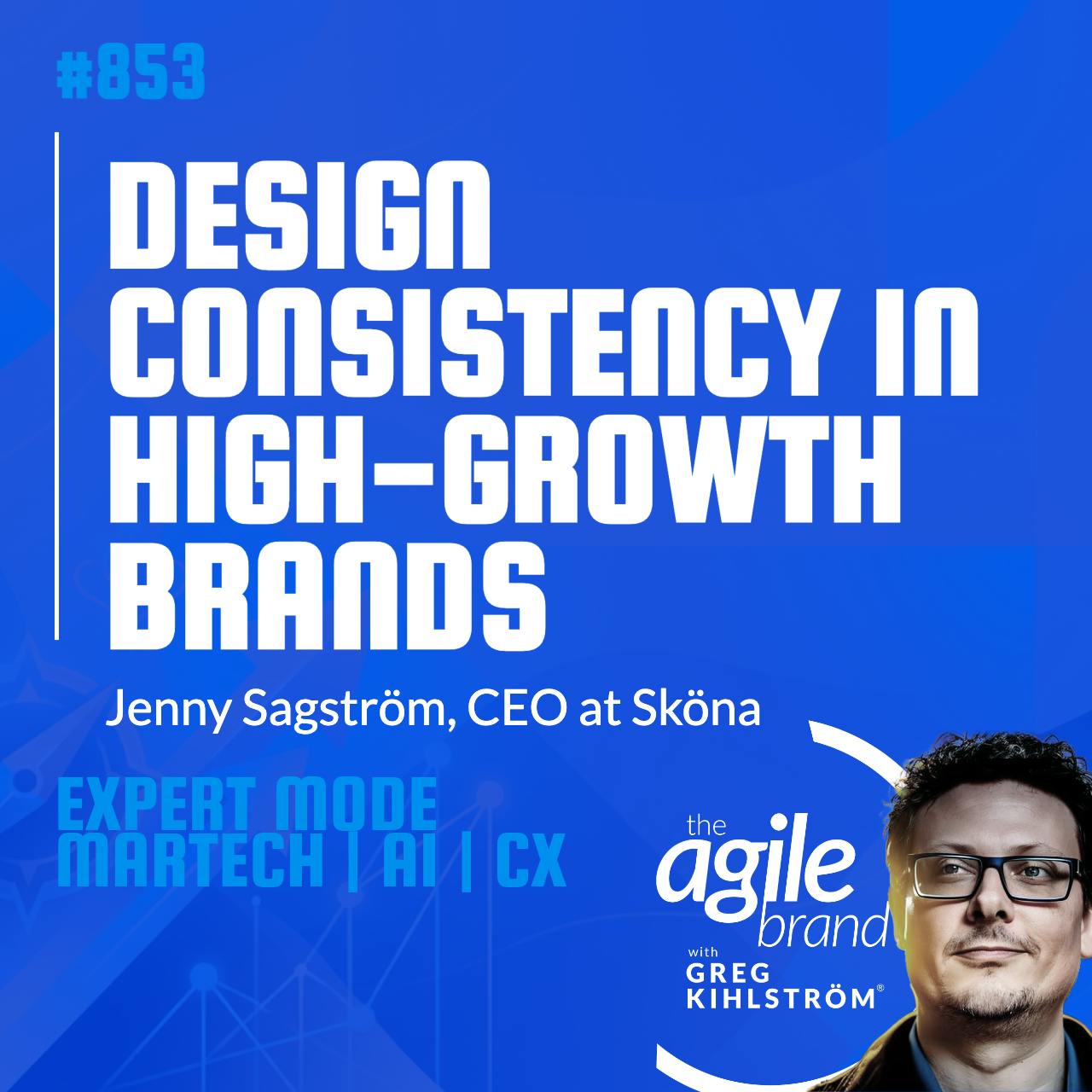
The Agile Brand with Greg Kihlström®: Expert Mode Marketing Technology, AI, & CX
#853: Sköna CEO Jenny Sagström on design consistency in high-growth brands
00:25:18
Loading summary
Transcript38 lines
- [00:00]
Vrbill Advertiser
With Vrbill's last minute deals, you can save over $50 on your spring getaway. So whether it's a Mountain Escape city break or a week at the beach, there's still time to get great discounts. Book your next day Now. Average savings $72 select homes only the
- [00:16]
Strayer University Advertiser
Jack Welch Management Institute at Strayer University helps you go from I know the way to I've arrived with our top 10 ranked online MBA. Gain skills you can learn today and apply tomorrow. Get ready to go from make it happen to made and keep striving. Visit strayer.edu Jack WelchMBA to learn more. Strayer University is certified to operate in Virginia by Chevin as many campuses, including at 2121 15th Street north in Arlington, Virginia.
- [00:48]
Greg Kilstrom
In the race for B2B growth, we often prioritize speed over everything else. But what's the real cost when your brand starts to look like a collection of spare parts cobbled together by different teams? Agility requires a strong foundational framework to enable speed without sacrificing coherence. It's about empowering teams to move quickly and independently while still ensuring every customer touchpoint feels like it comes from one unified brand. Today we're going to talk about why brand and design consistency is often the first casualty of high growth B2B environments and paradoxically, one of the most critical assets to protect. We're going to explore how that fragmentation happens from different teams launching products to rapid hiring, and why building a consistent brand isn't just a nice to have, it's a direct line to building trust and long term value with your customers.
- [01:40]
Welcome to Season eight of the Agile Brand Podcast. This season we're going all in on Expert Mode, MarTech, AI and Customer Experience, talking with the people and platforms behind
- [01:49]
the brands you know and love.
- [01:51]
Again, I'm your host Greg Kilstrom and I help Fortune 1000 companies make sense of MarTech, AI and marketing ops. Hit subscribe or follow to make sure you always get the latest episodes and leave us a rating so others can find us as well. And make sure you check out our sponsor Tech Systems, an industry leader in full stack technology services, talent services and real world adoption. For more information, go to techsystems.com now let's dive in
- [02:19]
to help me discuss this topic. I'd like to welcome Jenny Sagstrom, CEO at Skona.
- [02:23]
Jenny, welcome to the show.
- [02:25]
Jenny Sagstrom
Thanks for having me. Great to be here.
- [02:27]
Greg Kilstrom
Yeah, Looking forward to talking about all this with you. Before we dive in though, why don't you give a little background on yourself and your role at Skona?
- [02:35]
Jenny Sagstrom
Yeah, I'm the CEO, co founder of Skona. We are a B2B tech focused creative agency. And we were founded in San Francisco in 2004. So this is our 22nd year in business. And we also have an office in Stockholm, which is where I'm actually located today. I think maybe our specialty, our niche, our expertise is definitely working with tech companies. And to date we worked with more than 150 different enterprise tech brands.
- [03:09]
Greg Kilstrom
Great, great. Well, yeah, let's. So let's dive in. I love Stockholm. I know we were just talking a little before the show, but wish we could be doing this in person, but remote will have to suffice.
- [03:21]
Jenny Sagstrom
Yeah, well, maybe not in March. A better time would be the summer.
- [03:26]
Greg Kilstrom
Right, Right, totally. So, yeah, let's start off, and I want to start from the strategic level here and talk about this idea that inconsistency is the killer. And in your experience, where does that killer instinct manifest first? Is it lost deals, employee confusion, or even a diluted market position?
- [03:50]
Jenny Sagstrom
It's such an interesting question. I think it's actually all three. But if you actually think through the question, you know, what comes first and what leads to what? I would say that where you start to see it first is in that diluted market position, things are not looking the same. Messages are different, messaging is different, which in turn, I think leads to that employee confusion where, you know, they don't even know what the answer. What the. What the answer to the questions are. And in turn, when they're dealing with the customers and the clients, that's where you get those lost deals. So I think it's actually a 1, 2, 3. But backwards going from diluted market position to employee confusion to loss deals, I guess you could then argue also that perhaps some of that employee confusion is what's causing the diluted market position. But for simplicity's sake, let's. Let's go with that first answer. But that's kind of how I see it. And I think what you're hoping for is when you get that consistency rolling, you get to a situation where the opposite can happen. Where, you know, one plus one doesn't just become two, it becomes three and four. And each, each part of that brand leverages and reinforces the other and helps create something bigger.
- [05:11]
Greg Kilstrom
Yeah, well, and that kind of brings us to the flip side of this. Let's call it the glass half full part is this idea that design consistency equals clear, communication equals trust. So for a B2B exec out there who might See design as kind of not necessarily just a nice to have, but a soft discipline. How do you make the case that this trust translates into some of those hard metrics like lifetime value and reduced sales cycles?
- [05:46]
Jenny Sagstrom
Yeah, there's so many parts of me that go against this question because I don't think that design is a soft discipline. I think the design is how you visually interpret and come into contact with a brand. And I think that brand is the most important thing any company have. In B2B, I would say it's actually even more important. And I always use this example that if you think about it in your private life, you know, you go to the store, you buy the wrong shampoo or toothpaste or whatever, no big deal. Cost per unit is not that high. You don't like the toothpaste, you buy a different one next time, no big deal, no harm done. And that's the B2C world. In the B2B world, if you are an accountant working in a large organization and you're responsible for implementing a new accounting system, if you pick the wrong system, if it doesn't fulfill on what the promise is, if it's not secure, if people don't adapt it across the organization, and if people complain about it, that's basically career suicide. Um, and so for me, the, the, the risks are so much higher in B2B, which is then why brand that is design becomes so much more important. And I think that's, to me, where the idea of nobody ever got fired for buying IBM came from. You intend to, in those situations, you herd towards what's safe and secure and a strong brand, whether whatever it stands for is safe and secure. So to me, that's why we, I would say to a B2B exec, that design is not a soft deal at all. It's actually the hard currency, the most hard currency you have. And I think if you pull it out even longer, always makes me think of the Apple brand, right? They, you know, they have I think 30 to 40% margin on their iPhones. They've sold 1 billion of those products. It's not necessarily better than an Android per se, but it's the brand. They have the ability to charge that margin on all of their products. And I think that's what you're looking for. To me, the brand, the design, that's almost an insurance policy that allows you to be able to charge with a higher margin on your product.
- [08:15]
Greg Kilstrom
Boom.
- [08:16]
Jenny Sagstrom
How's that for, how's that for soft?
- [08:19]
Greg Kilstrom
Yeah, no, I love that and I love that the insurance, the policy of concept as well. So let's, let's talk a little bit about how this is done then. And you know, so a bit, a big part of this, a big part of about building the brand is that consistency. I mean, you know, you know, an Apple product from you know, 100ft away or whatever because you know, just design elements, things like that. When a company is scaling rapidly, you know, whether that's, you know, hiring fast, entering new markets, new product launches, all, all of the above. What are some of those critical maybe non negotiable guardrails that a brand needs to establish so that they don't have brand drift? Let's, let's say.
- [09:04]
Jenny Sagstrom
I love, I love that expression brand drift. I'm going to steal that. I think the first thing you mentioned is the key there that you always recognize an Apple product from miles away, right? It's the rounded corners. It's all those things. And what are those? They're part a design, visual design system. So to me that's the first non negotiable having a really strong visual design system that has been stress tested and that can hold as it gets applied throughout. So that's to me, number one. Number two is of course that a brand is just so much more than the logo or the visual brand design system. It's how the employees act, it's how your employees respond to. So I would say that onboarding and employee training is almost, it's just as important because that's all part of that brand and I think, you know, empowering people to do what they need to do to do the right thing for the brand, the furthest out from the center of the organization that you possibly can is key for me in that, so that I'd say brand design system, employee onboarding and training, communication. I think, you know, as managers, as leaders, I think people always often feel like I already told them, I told them once already, I told them twice already. Well, sometimes you got to tell them seven times so you know, don't be afraid to repeat and having those manuals constantly and reinforced about how the brand acts. And I think that then goes with my last tenant which is probably around leaders leading with a strong presence. So you know, showing up for all hands, continuing to train. If your brand is scaling rapidly and you have new teams around the world, make sure you go there, make sure you visit them in person so that you can continue or the brand can continue to basically create that flywheel on, even on a local basis, assets growing quickly.
- [11:09]
Greg Kilstrom
Yeah, yeah. Well, and of course there's always, there's a lot of people with, and teams with a lot of different needs in, in the organization as well. And so just to pick on may it, it may be a trope, but it's still true. You know, the, the sales team that needs the, the flyer for some sales meeting or something like that, and they're, and they're like, well, the stock stuff doesn't work for this exact need, so they start making their own stuff. Or you know, it could be not just sale, it could be anyway. It could even be different teams within marketing not feeling like they're getting what they need from, from a system or something. What are the operational structures that you've seen work best to kind of mitigate against some of that and while still, you know, giving, you know, some creative freedom within, within bounds and doing that. That thing that we're talking about, which is maintaining that, that centralized brand integrity.
- [12:07]
Jenny Sagstrom
Yeah, I think I've seen lots of different models. We obviously work as a supporting agency. We have been in a model where we are the brand guardian on a global basis. I would say that tends to work better for companies that aren't yet with thousands of employees. When you have hundreds of employees, I think it makes sense. And you know, so, so we worked in that capacity. We've also worked in the capacity where, you know, we work with a brand team in San Francisco and we execute what they tell us to do for different regions and then have that get sent out. And we've also obviously been on the other end. So my team in Sweden have been the little agency that, you know, get sent something from a centralized place somewhere that they've never been to and they get asked to execute. So I think all three of those models kind of work. But I guess, I mean, for me, I'd be dumb not to say that I don't prefer to be the brand guardian. Working closely with an agency, with a, with a company and helping steer that brand. That's, I mean, I think that's better. But I do think that the natural progression is to then go to a more centralized system when the brand grows. So I see all, I see both, both ways. But if I get to pick, I want to be the brand guardian any day.
- [13:42]
Greg Kilstrom
What are some of the brand drift, just to go back to that term doesn't happen necessarily overnight. Right. How do you. I don't know if it's, it's actual measurement, KPIs or just kind of signals, but, you know, how do you, how can you start to tell that a brand is. The consistency is breaking down, that it's, it's kind of, it's losing its, its, you know, kind of central idea across all the different assets being created and things like that.
- [14:14]
Jenny Sagstrom
I think it's the first thing is what you mentioned just a second ago about those poor sales guys we're picking on now who didn't have their flyer. But that is the first sign, right? People going rogue all over the place, creating something, whether valid or not, if they don't feel like they have what they need, I'd say that's sort of the first sign. Another sign which is we see a lot is as marketeers, I think we are so intimately working with a brand, we have that tendency to be, to get bored with it much quicker than our audience. So we're just going to try this and we're just going to change this. You know, we've already done this. We forget that the audience hasn't seen it 10 times like we have. It might be their first time or if we're lucky, their second time. So that insistence on, you know, changing or trying things out because we think it's already tried much more, more, much sooner than it needs to be. I think if you're on the inside, I've noticed that when things are breaking down, usually the approval chains take forever. You know, like something that you think would be approved and ready to go in, you know, a day or two or so ends up being a big old drag. And I think that is because there's that insecurity internally in the organization because no one really knows what the brand support supposed to be anymore. And so then, you know, things just don't get approved and pushed out there. And then I think, you know, obviously the outcome of that is what you mentioned initially, that there's an inconsistency. PowerPoints don't look the same. And then I think, you know, you get to a point where you're on LinkedIn, the company is advertising some messaging that them never shows up on the homepage or in any other communication. So you know, I think to me that, that this discrepancy in messaging is what the outcome of all those things are.
- [16:16]
Greg Kilstrom
Yeah, yeah. And then so maybe the inverse of that is starting, you know, launching a new brand. And whether it's a brand new brand or just a, you know, a revised brand for an existing org, once a company commits to doing that and, and reinforcing this brand, what are some of the measurements that they should be tracking? I mean, it's possibly some of the same things that you already said, but like are there with a, with a clean slate? Let's say what, you know, what, what can a brand do to, you know, set things right from the start?
- [16:53]
Jenny Sagstrom
It's so funny. I always get this question because I think universally as marketeers, we're struggling with this, right? We, and I think we have to figure it out. We have to, we have to learn how to speak CFO language and we're not really that great at it. So I love the fact that you're even bringing this because I think we as a collective have to continuously work on how to do this better. But how I like to think about it is you have to be proactive. If you are the cmo, you're going to be reporting to a board who are going to ask you a bunch of KPIs and you can either lead them to report the KPIs that you can affect and control or if you don't take that lead, you're going to be told what to report and there might be things that you can't actually affect. So I think by taking control, taking charge, we can sort of build the black box any way we want to and make sure that we include things that we can affect inside of that dashboard. So first off, if there's budget for it, always an awareness study, you know, we see less of that in B2B than we should. But you know, some of the new AI tools is making it more within reach for more organizations. So I think obviously an awareness study is a great place to start. You have to know where you're coming from in order to know how the stuff you're doing is affecting it. But then in this black box I would put very basic stuff like search, overall website traffic. We're also seeing things like overall mentions be brought back into measurement again, especially for looking into more pr, looking into more awareness. And then of course, leads, we can't get away from it. Everybody wants the leads. So I would be dumb to say not to include that. But I also think it's important to think about pipeline and think of it as a whole. Working closely with sales, we try to avoid getting into the situation where it's MQLs versus SQLs and instead try and think of it as a holistic pipeline where we're actually driving ROI for the business like we are, you know, at. I'd love to, you know, have those measurements where we're looking at how much business we actually drove as a marketing department.
- [19:17]
Greg Kilstrom
Yeah, yeah, love It. And then, you know, I think we touch on AI at some point in every episode, if not, you know, some episodes solely about AI. But, you know, so let's go there now for a little bit at least with all the AI powered content out there, you know, certainly there's lots of benefits of, you know, speed to doing things and everything like that, but from a visual and a brand consistency, even, even written content, you know, consistency, maybe. Where are we today with. With AI generated content and brand consistency? And you know, what are in the, in the longer term is there, are, are these tools a threat to brand consistency in general because it's just so easy to do things that people kind of look the other way about consistency? Or are we, are we on a path to getting things kind of better and in a, in a better place, even though we're not necessarily there now? I, I kind of answered the question, but. And I know that was like 10 questions in one, but feel, feel free to pick a couple.
- [20:25]
Jenny Sagstrom
All right, I'll give up. Pick a couple. I think. Where are we today? Well, where we are today, A friend of mine who works in SEO told me the other day that one of their clients, or not just one, but that they had gotten quite a few requests to produce 10,000 variations of creative for this. You know, the Google, I think it's pmax or whatever the algorithm is called, that feeds into the LLMs and 10,000 variations of creative. That's just insane. And that's not doable without AI. So where we are today is okay, if that's what we need to be providing to the LLMs in order to show up. Okay, how are we going to do that? We need to rely on AI. But what we're also seeing is that we need a human in the loop. Someone needs to be fact checking, someone needs to be controlling and quality assuring what the AI is producing for us today. So both of those things can be true at the same time? I believe so. I think that's where we are. And where is it going then? That's so hard to tell. I think that we are using AI as an agency to get better, faster and test our thinking and do more and all of those things. I'd like to think that AI will help us do more with more as opposed to do more with less. Because I think that even while the volume might be producing might be increasing, the experience, the expertise, the taste, having done, the reps that the agency have will still matter. And I think what we can. The difference is that agencies can come in and help make those brave decisions that I think are hard to make without the experience that agencies have. So I think, I mean, it's hard to say where we're going. I'm going all in on more with more.
- [22:35]
Greg Kilstrom
Yeah, Yeah, I love that. I love that. That's great. Well, Jenny, thanks so much for joining today. A couple last questions as we wrap up here. The first one, if we were having this interview one year from today, what is one thing that we would definitely be talking about?
- [22:52]
Jenny Sagstrom
Maybe. Oh, this is so hard. I've been trying. I've been trying to get better at predicting things, following, you know, as a thought, practice, actually, as I, you know, as you develop, as you get. Try to get smarter as you try to read more. It seems like something that people do a lot is this prediction business. I find it incredibly hard, especially since we live in like this black swan world where things you never thought would happen keep happening. But if you ask me, I'd say it's probably what we started out talking about, which is this sort of almost erosion of trust that we're seeing and branding and trusting and how those go hand in hand. And I think that the brand is becoming more and more important in this area of trust where we're lacking trust. It's becoming. It's standing for something more than a logo. And I think that that credibility gap which we're starting to see with so many of these big organizations is becoming the real brand killer. So I think some. We'd probably be talking a lot about trust and what that means in marketing in future organizations and where we're going.
- [24:10]
Greg Kilstrom
Yeah, yeah. Well, and last question for you here. What do you do to stay agile in your role and how do you find a way to do it consistently?
- [24:19]
Jenny Sagstrom
So easy? I never plan for anything. No. Well, a little bit is true. I think if you work in the tech business, you know that anything that is planned more than six months ahead is a total waste of time. So definitely not planning too far ahead and practicing staying agile. Like you said, having a plan B, having a plan C, sometimes even a D and an E, I feel like that's my job, is trying to think about all the backup things that could possibly happen and stay open to rolling with whatever possibilities might be coming our way.
- [24:57]
Greg Kilstrom
Yeah. Yeah. Love it. Well, again, I'd like to thank Jenny Sagstrom, CEO at Skona, for joining the show. You can learn more about Jenny and Skona by following the links in the show notes.
- [25:08]
This episode is brought to you by Tech Systems. They're leaders in full stack, tech services, talent solutions and helping companies put it all in action. You can learn more@techsystems.com that's T E K systems.com and thanks again for listening to the Agile Brand podcast. If you like the the episode hit, subscribe and drop a rating so others can find the show too. And if you're interested in consulting, advisory work, or if you need a speaker for your next event, feel free to reach out. Just visit GregKilstrom.com that's G R E G K I H L S t r o m.com the Agile brand is produced by Missing Link, a Latina owned, strategy driven, creatively fueled production co. Op. From ideation to creation, they craft human connections through intelligent, engaging and informative content. Until next time, stay curious and stay agile.
- [26:03]
Strayer University Advertiser
The Agile Brand.
- [26:09]
Vrbill Advertiser
With Verbal's last minute deals, you can save over $50 on your spring getaway. So whether it's a mountain escape with friends, a family week at the beach or sightseeing in a new city, there's still time to get great discounts. Book your next day Now. Average savings $72 select homes only.
- [26:39]
Strayer University Advertiser
At Strayer University we help students like you go from Is it possible to Anything is possible by offering access to up to 10 no cost gen Ed courses so you can reach your goals affordably and fast. Visit strayer.edu to learn more. No cost gen eds provided by strayer University Affiliate Sophia Eligibility rules apply. Connect with us for details. Strayer University is certified to operate in Virginia by Chef and has many campuses, including at 2121 15th Street north in Arlington, Virginia.