← The Agile Brand with Greg Kihlström®: Expert Mode Marketing Technology, AI, & CX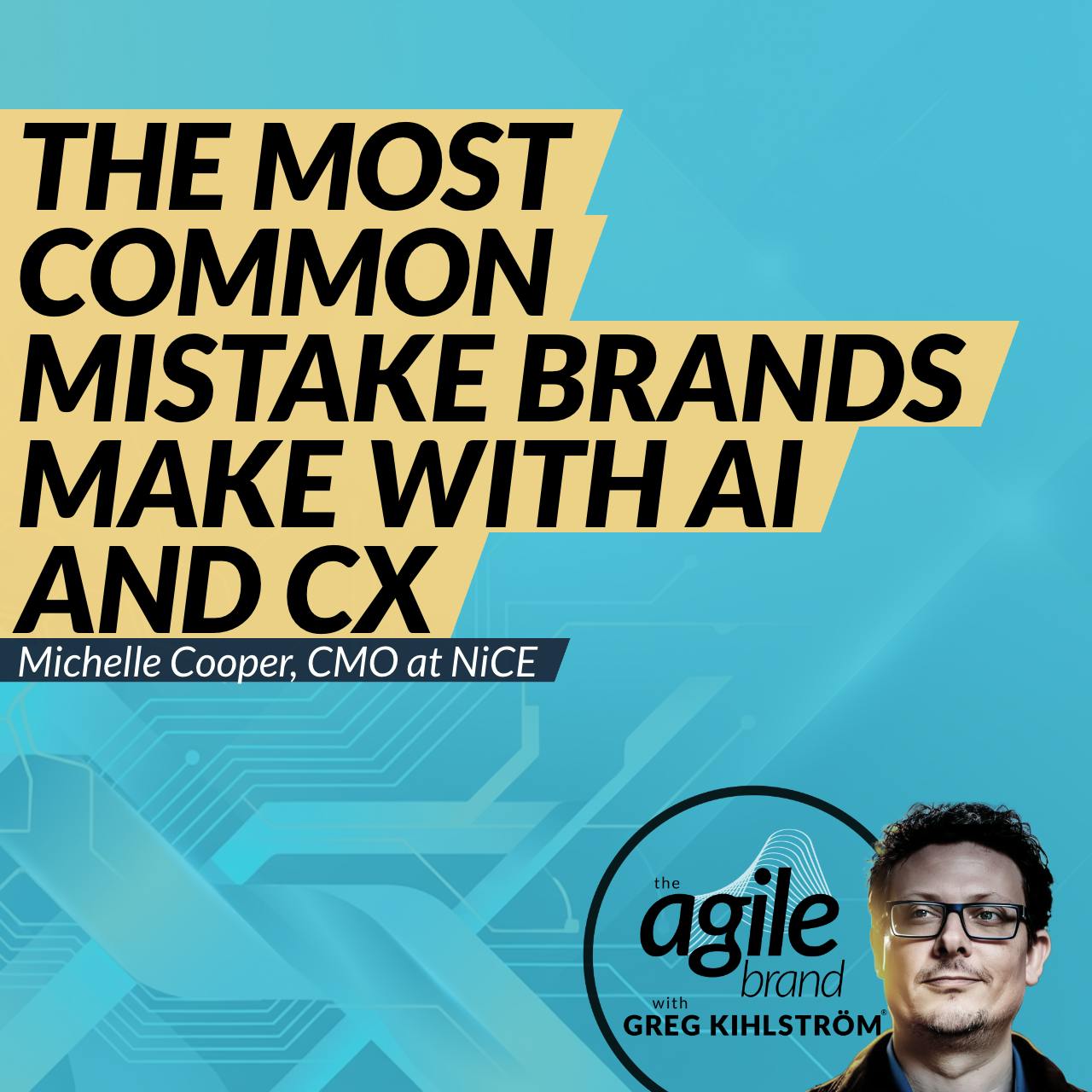
The Agile Brand with Greg Kihlström®: Expert Mode Marketing Technology, AI, & CX
#841: NiCE CMO Michelle Cooper on the most common mistake brands make with AI and CX
00:18:47
Loading summary
Transcript42 lines
- [00:01]
A
The Jack Welch Management Institute at Strayer University helps you go from I know the way to I've arrived with our top 10 ranked online MBA. Gain skills you can learn today and apply tomorrow. Get ready to go from make it happen to made it happen and keep striving. Visit strayer.edu Jack Welchmba to learn more. Strayer University is certified to operate in Virginia by Chev and its many campuses, including at 2121 15th Street north in Arlington, Virginia.
- [00:30]
B
Mom, can you tell me a story?
- [00:32]
C
Sure.
- [00:32]
A
Once upon a time, a mom needed a new car.
- [00:35]
B
Was she brave?
- [00:36]
C
She was tired mostly. But she went to Carvana.com and found
- [00:39]
A
a great car at a great price. No secret treasure map required.
- [00:42]
B
Did you have to fight a dragon?
- [00:43]
C
Nope.
- [00:44]
A
She bought it 100% online from her bed, actually. Was it scary? Honey, it was as unscary as car buying could be.
- [00:51]
C
Did the car have a sunroof? It did actually. Okay, good story.
- [00:54]
A
Car buying you'll want to tell stories
- [00:56]
C
about Buy your car today on Carvana. Delivery fees may apply.
- [01:03]
B
We've all been sold the dream of AI Transforming the Customer experience but what if the most common approach is actually making it worse? Agility requires more than just implementing new technology. It requires a deep understanding of the human interactions that technology is meant to support. It's about adapting your tools and processes to enhance human judgment, not just automate it. Today we're going to talk about moving beyond the hype of AI in customer experience. We're going to explore how to ground an AI strategy in not just the technology, but in the real human moments that define a brand and discuss why empowering your frontline team might be the most critical and overlooked component of a successful transformation. Welcome to season eight of the Agile Brand Podcast. This season we're going all in on expert mode, martech, AI and customer experience, talking with the people and platforms behind the brands you know and love. Again, I'm your host Greg Kilstrom and I help Fortune 1000 companies make sense of martech, AI and marketing ops. Hit subscribe or follow to make sure you always get the latest episodes and leave us a rating so others can find us as well. And make sure you check out our sponsor, Tech Systems, an industry leader in full stack technology services, talent services and real world adoption. For more information, go to techsystems.com now let's dive in to help me discuss this topic. I'd like to welcome Michelle Cooper, CMO at Nice Michelle. Welcome to the show.
- [02:30]
C
Greg. Thank you so much for having me.
- [02:32]
B
Yeah, looking forward to talking about this with you. Before we dive in though, why don't you give a little background on yourself and your role at nice?
- [02:38]
C
Absolutely. So, as you mentioned, I'm the CMO of nice. I've been in my position about eight months, so it's been a whirlwind of a cycle. But it is so great to be on kind of the front lines of really helping our customers transform their customer, customer experiences.
- [02:57]
B
Love it. Well, yeah, and we're going to talk about quite a few things here, but want to start with really the strategic look at things and kind of reframing this AI and CX strategy. And so you've stated that many AI initiatives in CX fall short because they're designed around technology. Instead of those customer moments that I mentioned in the intro, can you unpack that a little bit? You know, what does a customer moment first AI strategy actually look like in practice for an enterprise?
- [03:28]
C
Yeah, absolutely. And to your, to your comment, I think a lot of companies are kind of approaching this AI era from a technology right, from a tool perspective. And yes, the tool and the technology that you pick and select is critical in your journey, but where you really need to start is in thinking through, like, what are the customer moments that matter? What are the business processes that you're trying to evolve? What are the outcomes that you're ultimately trying to get to? And a lot of times we see, you know, organizations start with the technology first versus the outcomes. And I really think that's the, that's the opportunity and also the challenges that as companies really build their AI strategy and journey and that they really need to be thinking through and taking into consideration.
- [04:17]
B
Yeah, well, and a lot of leaders in, you know, figuring out their strategy, a lot of, a lot of them are seeing this as a way to automate a lot of things, you know, increase efficiency and thereby potentially reducing headcount on the, on the front line. You've argued for just the opposite, really using, using AI to empower them. How do you make the business case for investing in AI to support that human judgment rather than simply replacing it?
- [04:46]
C
Absolutely. And I think that yes, the technology absolutely affords an efficiency opportunity, but if you're only thinking about it that way, you're missing a huge, you know, huge opportunity for us. We think about the AI as a way to be able to help our customers understand when those moments of, at the moment of interaction and engagement. How do you make sure that whether that's an AI agent or a human agent, that you're giving them the context of the Intent, a historical perspective. You're guiding them with, you know, information about that customer. You're recommending the next, the next best action. So it's not about just automation for automation's sake, but it is really focused on how and when you're able to deliver a better customer outcome. And a lot of times, yes, there's cost savings, yes, there's efficiency, but it's really more about what are those interactions and those special moments that you can really create for your customers, you know, in that, that, that, that, that moment, that instance that really at the end of the day makes a difference between them continuing to value and select your brand or to possibly make another decision.
- [06:07]
B
Yeah. And some of that at least requires really enabling that front line to be able to serve customers in the moment. Right. And so when we talk about using AI to help those employees to show up better, what does that look like on a typical day for a customer service agent? What specific information or capabilities is AI able to provide them in real time that they may not have had before?
- [06:36]
C
Absolutely. And being a customer service agent is, I mean that is a heroic, heroic job and effort. Right. It's not easy. So the technology really helps them become, to your point, much, much more effective and empowered. So a typical day might look like, instead of toggling in between multiple systems, to be able to really understand why the customer is there, to being able to do that in one platform, to being able to give them an understanding of who they are, what they care about, which solutions they have, maybe some historical intent in regards to their previous interactions and then being able to power them with real time coaching recommendations, information on sentiment to really help personalize that experience and deliver, you know, the best, you know, possible customer outcome and ultimately get to resolution the fastest. The other thing that is really important is these days is that now with AI, not only is it AI in context of co pilots and real time coaching and agent assistance, but it's also being able to automate tasks with AI agents or agentic agents, to be in the, in the, in the background to be able to ultimately get to that, that resolution. And I think we're kind of seeing like the whole journey change. You might start with an AI agent, right. And, and start your customer journey and your interaction there. You may then go from an AI agent to a human agent and that orchestration layer and that passive information with that intent and is so critical in making sure that from the moment that they interact to the moment of resolution that that really is seamless and as personalized as Absolutely. As possible.
- [08:32]
B
Yeah. Because, I mean, it does seem like that is one of the key points that can really make or break that. I always use the example of when you call up your bank and you have to keep giving them your account information over and over again, no matter who you get transferred to too. It's like. Yeah, yeah.
- [08:48]
C
And that's really the new battleground. Right. Is really thinking about how you're going to orchestrate your AI in a new operating model as you go forward.
- [09:02]
B
What do you see as maybe the either single biggest or, you know, one of the biggest mistakes that you see organizations make when they try to implement AI tools for frontline teams? You know, is it technology? Is it training, leadership? You know, where, where, where do the, the biggest failings seem to be?
- [09:19]
C
Oftentimes we see the, the biggest challenges is just trying to take AI and automate their existing business processes. Right. And, and almost treating it as a technology project versus a transformation. And I think one of the things that is so powerful about AI today is you can completely, completely reimagine the way that work gets done, what's handled by AI agents versus human, how to make those, how to balance the handoff and the orchestration between those two worlds. So I think that for me is the thing that we see most is you have to go into this with a complete new orientation about rethinking the work that you do and how will it be done going forward in this new environment.
- [10:08]
B
Yeah. And of course, when it comes to measurement, I'm sure there's a lot of traditional metrics that don't go away because you adopt AI. But let's talk about when the goal is to empower employees and improve quality of human interaction. Are there either new KPIs or different KPIs that should either be added or prioritized when we're looking at it from this lens.
- [10:35]
C
Absolutely. And you already see a lot of the industry starting to pivot. There's to rethink, you know, some of the traditional metrics like average handle times. Right. Average call times. Right. And those were really predicated on efficiency and, but now it's really more focused around resolution, quality customer effort, you know, first call to resolution, how quickly can that happen and being able to really measure those things and to make the correlation between how those ultimately impact, you know, brand trust, reduce customer churn, increase loyalty or nps. And I think when you just look at the research in regards to how, when you can move the needle on an NPS score, you know, just how much that really correlates to ultimately to, you know, customer loyalty and, you know, revenue. Right. Whether that's protection of revenue or expansion of revenue, it really allows you to tie and link everything that you do from a customer experience perspective in a contact, in a call center, back to really the growth, you know, priorities, you know, of that specific business.
- [11:53]
B
Yeah. And of course, you know, one of the things that you touched on already, but from a measurement standpoint is we are ideally, we are improving the employee, you know, the employee experience so that, that contact center customer service agent, they are spending less time rooting around to things. They're ideally dealing with less frustrated customers because we're able to know more and know more quickly and, and all of those kinds of things. How do you connect that, you know, something like an improved employee experience to the customer? You know, so something like customer lifetime value, you know, how do you recommend doing that?
- [12:31]
C
Yeah, absolutely. So it's interesting is that one of our customers, Lufthansa, actually right now, they're already automating 70% of their tier one and tier two interactions with the Gentec AI agents. Right. So. So it allows them to be able to handle higher call volumes, to be able to action and ultimately resolve those interactions in a much, much more efficient way. But what it allows you to be able to do is to shift some of the things and some of the work that your call center agents used to do that were very, very time consuming to be able to shift them to higher value, you know, opportunities and interactions. And I think that it allows them to be able to focus their time and energy on those. Again, I come back to this word moments, those moments that absolutely matter most to their consumer. So I think there's more satisfaction in being able to feel like you control the work that you're doing and seeing that direct correlation between the customer outcomes and customer satisfaction and also equipping them and enabling them with copilots and knowledge and recommendation engines, simple things. Like a lot of their time would have historically been spent on just capturing the notes and the resolution and the next steps. All of that is automated today with AI and allows them to really free up their time to focus on what matters most and that's their customers.
- [14:03]
B
Yeah, yeah. And then so looking forward, you know, it definitely seems like there is going to be increased personalization. I mean, you know, even, even just empowering the frontline employees with more information and more, more fulsome information is, is helpful. Is there a line, you know, in, in the bank example that I, that I gave it's like, I don't want to say my account information out loud five times for many reasons. You know, it's. It's sensitive information. You know, that. That carrying that kind of stuff forward is helpful and makes it feel more secure. In some cases, customers may feel like that level of personalization may also be intrusive or something like that. How do you balance that, helping the customer by bringing that stuff forward and by personalizing the experience while still not making them feel comfortable about the level of personalization?
- [14:59]
C
Absolutely. I think the. I mean, to your point, the personalization is so powerful, and I just actually read recently a stat that says, you know, it really is kind of a competitive edge. I mean, it's like 2x right. When you can absolutely find, you know, from a customer loyalty perspective, when you can find that right balance. I think what we advise our customers on is really being very transparent about the data.
- [15:26]
B
Right.
- [15:26]
C
That you have. You want to be proactive in the way that you use it, but you don't want to be creepy about how you use it to target. So we want to be really, really thoughtful about being very transparent around how and where you're using it and to not overuse it. But I do think at the end of the day, the opportunity is that we, as consumers, all of us, want to feel like we're understood. We want to be able to get to whatever we're trying to solve for faster. And that personalization, absolutely, the benefit of it when it's done right, allows us to really feel connected and have that trust with those brands that we select and ultimately choose to do business with. So I think as a industry, you'll see this continue to evolve. But I think we all have an opportunity to be really, really responsible. And it starts with that transparency on how and what and where you're using it.
- [16:26]
B
Yeah. Yeah. Love it. Well, Michelle, thanks so much for joining today. I got a couple last questions as we wrap up here. The first one, if we were having this interview one year from today, what is one thing that we would definitely be talking about?
- [16:40]
C
I believe we will not be talking about AI as a tool. Oh. Or as a feature. I think that will be table stakes for every organization and company. But I really do believe the conversation will shift to AI as an operating model. Now, how do you begin to think about managing a hybrid workforce where you have AI agents and human agents seamlessly working together, and then how do you orchestrate that work and the handoffs as you go through the customer journey? So I think AI becomes much more the discussion will pivot and become much more around what's the operating layer and operating model that company needs. Companies need to be able to really manage in this new environment.
- [17:26]
B
Yeah, yeah, I love that. Great. Well, last question for you. What do you do to stay agile in your role and how do you find a way to do it consistently?
- [17:35]
C
That's a million dollar question, but for me it's carving out time to learn you. I think that the market's changing so fast, technology's changing so fast, as you know in marketing, just in customer experiences general. But I think you absolutely, as a leader have to carve out time and make sure you're making that a priority. The other thing for me is I try to incorporate AI into my daily life. I think to be able to embody it, you've got to be a practitioner of it. So making that a priority for myself and our team as we move forward. I have this mantra about being an AI first marketing organization and it starts with me and really embracing that. And then I think the last thing is that, you know, as a, from a mindset perspective, as leaders, we all just need to be able to recognize that we're going need to learn and pivot and fail very quickly in this environment where things are changing so quickly, we just have to be able to be able to react and pivot. And some of that comes with learning this, you know, as we move through this new environment.
- [18:41]
B
Yeah, I love that. Well, again I'd like to thank Michelle Cooper, CMO at NICE for joining the show. You can learn more about Michelle and NICE by following the links in the show notes. This episode is brought to you by Tech Systems. They're leaders in full stack, tech services, talent solutions and helping companies put it all in action. You can learn more@techsystems.com that's T E K system systems.com and thanks again for listening to the Agile Brand podcast. If you like the episode hit, subscribe and drop a rating so others can find the show too. And if you're interested in consulting, advisory work or if you need a speaker for your next event, feel free to reach out. Just visit GregKillstrom.com that's G R E G K I H L S t r o m.com the Agile brand is produced by Missing Link, a Latina owned, strategy driven, creatively fueled production co op. From ideation to creation, they craft human connections through intelligent, engaging and informative content. Until next time, stay curious and stay agile.
- [19:47]
C
The Agile brand
- [19:52]
A
VRBO makes it easy to claim your dream summer spot with early booking deals from homes with pools to poolside loungers. When you book a vrbo, you don't have to reserve any loungers. They're all yours. All you have to do is book early. Book with vrbo. The Jack Welch Management Institute at Strayer University helps you go from I know the way to I've arrived with our top 10 ranked online MBA. Gain skills you can learn today and apply tomorrow. Get ready to go from make it happen to Made it happen and keep striving. Visit strayer.edu Jack Welchmba to learn more. Strayer University is certified to operate in Virginia by Chev and its many campuses, including at 2121 15th Street north in Arlington, Virginia.