← The Agile Brand with Greg Kihlström®: Expert Mode Marketing Technology, AI, & CX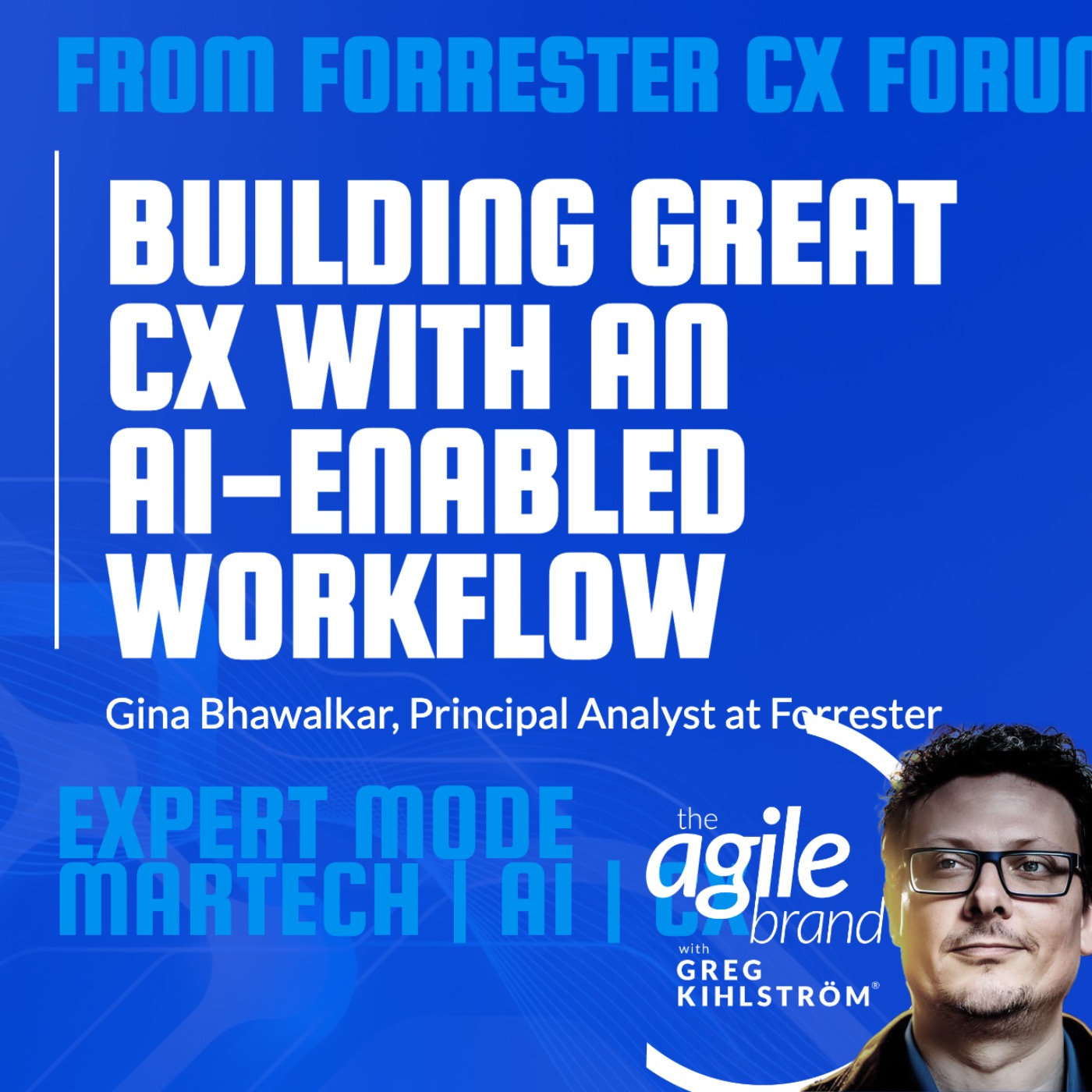
The Agile Brand with Greg Kihlström®: Expert Mode Marketing Technology, AI, & CX
Forrester's Gina Bhawalkar on building great CX with an AI-enabled workflow
00:27:30
Loading summary
Transcript76 lines
- [00:00]
Nick
Hey Yetis, this is Nick and Jack from the Best One yet podcast. Now the last company we worked at, they used Paylocity and everything just worked. It wasn't until launching our own media business this show that we realized how rare that is.
- [00:12]
Jack
Because Paylocity is one delicious burrito of operational needs. They roll up hr finance and it seamlessly into one delicious bite.
- [00:21]
Nick
When everything wraps together like that all at once, your workforce, your tech stack, your business. You don't need more tools. You don't even need cilantro.
- [00:26]
Jack
You need one.
- [00:28]
Nick
And that is why Paylocity built a single platform to connect hr, finance and IT with AI driven insights and automated workflows that simplify the complex and power what's next.
- [00:37]
Jack
Or as we call it, a delicious operational burrito.
- [00:40]
Nick
Yes, we do experience a one place for all your HCM needs besties.
- [00:45]
Jack
So start now at paylocity.com 1paylocity.com O
- [00:49]
Nick
N E
- [00:53]
Acast Announcer
ACAST powers the world's best podcasts. Here's a show that we recommend
- [01:00]
Brooke Devard
hello hello, it's Brooke Devard from Naked Beauty. Join me each week for unfiltered discussion about beauty trends, self care journeys, wellness tips and the products we absolutely love and cannot get enough of. If you are a skincare obsessive and you spend 20 plus minutes on your skincare routine, this podcast is for you. Or if you're a newbie at the beginning of your skincare journey, you'll love this podcast as well. Because we go so much deeper than beauty. I talk to incredible and inspiring people from across industries about their relationship with beauty. You'll also hear from skincare experts. We break down lots of myths in the beauty industry. If this sounds like your thing, search for Naked Beauty on your podcast app and listen along. I hope you'll join us.
- [01:45]
Greg Hillstrom
Hi, I'm Greg Hillstrom, host of the Agile brand, and here's a question for you. As generative and agentic AI promise to accelerate everything we do, are we at risk of becoming incredibly efficient at producing forgettable customer experiences? Today we're here in Brooklyn at Forrester CX Forum east and we're going to talk about building better experiences with an AI enabled design workflow. Specifically, we're going to cover balancing the speed of AI with the intentional human led decisions required to craft exceptional experiences, the role of a robust design system in scaling high quality AI powered experiences consistently across the enterprise, and how to identify high value AI use cases for your design workflow while maintaining responsible practices that build customer trust.
- [02:35]
Greg Kilstrom
Welcome to Season eight of the Agile brand podcast. This season we're going all in on Expert Mode, MarTech, AI and Customer Experience, talking with the people and platforms behind the brands you know and love. Again, I'm your host, Greg Kilstrom, and I help Fortune 1000 companies make sense of martech, AI and marketing ops. Hit, subscribe or follow to make sure you always get the latest episodes. And leave us a rating so others can find us as well. Now let's dive in.
- [03:02]
Greg Hillstrom
To help me discuss this topic, I'd like to welcome Gina Bawwalker, principal analyst at Forrester.
- [03:08]
Greg Kilstrom
Gina, welcome to the show.
- [03:10]
Gina Bawwalker
Thanks for having me. I'm excited to be here.
- [03:12]
Greg Hillstrom
Yeah, looking forward to this, looking forward to the conference, but also looking forward to talking with you about this. And before we dive in, why don't you give a little background on yourself and your role at Forrester?
- [03:22]
Gina Bawwalker
Yeah, absolutely. So my background is in user experience. I've been a user experience designer, UX researcher. Before Forrester, I led user experience teams at several companies, predominantly in financial services. And then I got hired eight years ago by Forrester to essentially cover the field that I was working in. So I got hired to do research on how companies build and scale their design practices. And to date today I still cover experience design, but the topics have obviously changed a little bit. So today I do a lot of research on design systems, on how AI is impacting the profession of experience design, which I know is what we're here to talk about today. And then I also lead Forrester's coverage on digital accessibility compliance. So I tend to do a lot of research on how do we ensure our designs are responsibly designed, inclusive, and that we're not leaving anyone out essentially in the experiences that we put into market.
- [04:22]
Greg Hillstrom
Yeah, yeah, great. Well, yeah, I'm talking to the right person about this topic here. So let's dive in here. So, you know, I talk with a lot of leaders on the show and elsewhere. So many are under pressure to do AI and do it rather quickly. Right. From your research. And you know, what's the primary risk that organizations face when they prioritize the speed part of AI over the quality part of that? Not only the implementation, but that end user experience.
- [04:54]
Gina Bawwalker
Absolutely. I mean, there's a lot of risk associated with moving too fast right now. But to your point, that pressure is really there. So to me, the biggest risk, it comes down to trust and this further erosion of consumer trust we see in our data at Forrester, that trust is already pretty low, particularly in AI powered interactions. So think of things like virtual assistants and chatbots. I mean, we're talking less than 20% of consumers actually trust those experiences. And so this is what brands are up against. And the problem is when we prioritize speed over quality, that results in experiences that aren't actually aligned to a customer need, that aren't accessible, that are riddled with usability issues that make me think, what is this even about? It reflects poorly on the brand. And so all of these things just add to this trust problem that already exists. And then if I could add one more, because I mentioned I do a lot of research on accessibility compliance, I'm seeing a lot of brands face this risk of putting experiences into market that don't meet accessibility standards because they're trying to move so fast that they're foregoing the important testing they need to do to make sure they're not falling out of compliance with accessibility regulations. And so that erosion of trust, accessibility risks, those are the biggest challenges I see right now. If organizations don't pivot back to quality and not sacrifice that due to this need to work more quickly.
- [06:26]
Greg Hillstrom
Yeah, because I mean, the customers, sure, they want their brands to adopt things that they're using and technologies that they want to access, but the customers aren't really asking for speed, are they?
- [06:40]
Gina Bawwalker
No, absolutely not. At the end of the day, customers aren't asking for AI, they're not asking for technology. They have a job to be done or, or they have a goal. And whatever you're creating as a brand, it has to service customers being able to accomplish that goal. And so this is why I think the organizations that have really robust practices around experience research have a leg up at this moment in time because they're actually grounding decisions in deep understanding of those customer goals and those customer journeys. And that's increasingly going to be the secret sauce to differentiating in this time when it's very, very easy to create.
- [07:19]
Greg Hillstrom
Yeah, ye, well, and so that probably, you know, that brings us to this concept of a human led intentional decision model. Can you maybe unpack that for us? You know, what, what does that mean and what does it look like when it's done?
- [07:32]
Gina Bawwalker
Well, I would boil it down to we need to make sure we're using AI as an accelerator, but not a replacement for human judgment. And so what that means in practice is as a brand, you need to continue to invest in hiring and developing professional designers, professional developers, professional PMs, because these people possess these unique qualities that AI does not. And I'm talking about things like discernment being Able to actually look at a design and say, yes, this is high quality, this is actually aligned to something customers need, possessing empathy. Machines are not empathetic. People are empathetic. Making sure that we are designing with deep customer understanding in mind, ethical rigor. So think of the humans on your teams, they're stewards of quality. And so that's why we talk about this human led decision model. Also part of this is redefining design principles in this age of AI. And I'll give you just one example, Greg, which is I interviewed a chief design officer at National Australia bank, leads a huge design organization and he told me they have this internal team principle now of never delegate understanding. And he said this is so important as they're making decisions about the role AI will play in planning, conducting and analyzing research. Because there's this risk that if you just say we're going to let AI do all of it, then all of a sudden the people in your organizations, they don't hold any of that customer knowledge in their heads. And that's not good because that knowledge is the foundation of customer obsessed decision making. And so yes, we absolute need to create principles like this to ensure we stay grounded in the decisions that we're making. And then the last thing I'll say is companies that really get this human led decision model right, they are grounding their decisions in where to deploy AI in the customer experience, in discovery research. So for example, this might look like organizations standing up user research squads where the whole purpose of this squad is to look at those hundred use cases for AI that the company has in mind and to go out and vet them with customers to actually do research. Does this align to a customer goal? Would customers trust AI to do this thing that we're considering and so making sure that at the end of the day it's all about grounding things in what your customers actually need and want and value. That's the key.
- [10:06]
Greg Hillstrom
Yeah, yeah, that never delegate understanding. That really resonates with, I think I've seen many interfaces designed by AI, or at least I swear they were because you know, they make a certain kind of sense, but not the, not a human sense. Right.
- [10:23]
Gina Bawwalker
And they also, I mean you've probably had this experience I have, where a lot of experiences are starting to all look the same. Right. And so that's another risk. Going back to your earlier question of we don't want to feel just like any other brand out there, we don't want to become a commodity. Right. We want to create experiences that are differentiated, that Feel like our brand that adhere to our brand principles, promises. And that comes from making sure that you're not just letting AI create and deploy experiences, but making sure that human expertise and judgment is part of the equation.
- [10:58]
Greg Hillstrom
Yeah. So then how do you do it right? There certainly are benefits of scale and other things with AI. And so integrating AI into a design system would make a lot of sense, not just handing over the keys to your earlier point, but integrating it so that we can benefit from it. What does that look like when it's done?
- [11:21]
Gina Bawwalker
Well, yeah, so you mentioned the word design system there. And I probably say this word more than anything else these days because I do believe it's the critical foundation that every organization needs to design effectively with AI. And so there's a few things that brands need to do right now. One is every brand probably has some semblance of a design system. It may be essentially a style guide. It may be reusable component libraries that are articulated in both design and code. Whatever you have, there's important work to be done to make sure that design system is AI ready, that it's machine readable, because it's not just humans using it anymore to assemble experiences, it's AI as well. So making sure everything in your design system is optimized for aeo, for example, that you have thorough documentation. So AI knows when do I use this rule versus this rule or this component versus this component. All of that's super critical. And then there's also a lot of opportunity to use AI to evolve the design system itself. Because this is a common challenge I hear from brands is we know we need a mature design system, but we don't have enough resources to do it. So I've seen organizations use AI to help create documentation for the system, to use AI to spin up variants of components more quickly than they could in the past. And then we're ultimately gonna be working towards this world where AI also becomes a contributor back into the design system. You hear a lot about design system contribution models and those are really centered around people and teams today. But the most advanced companies we're studying, they're also enabling AI to make decisions like I need a variation of a component that we don't have in the system. So I'm going to create it and then I'm going to essentially feed it back into the system so others can use and benefit from it as well. So really interesting stuff happening there in the context of AI and design systems. But I think we predicted this year that 8 of 10 companies would invest more in design systems to mitigate AI risks. And we are very much seeing that play out. I think that's one of those predictions where we'll be able to confidently say, yes, it came true, which is not the case with most predictions.
- [13:42]
Greg Hillstrom
And so for those companies investing, obviously every company is different, every experience is different in some ways. But where's a way for or a framework even for identifying those high value, low risk use cases to start this, because some may be a little not quite as far along as others.
- [14:05]
Gina Bawwalker
Absolutely. So journey mapping is probably something a lot of people listening to this podcast are familiar with. I recommend that teams actually map their internal journeys. How do you work together across product design and development and where are the biggest bottlenecks in that process today? Those are great places to start. How could AI help us collaborate better? How could AI help us reduce the amount of rework that happens at this phase in the journey? So really picking those places where things aren't going so well today, maybe this is an opportunity where AI could help us do better, create better quality outputs, work better as cross functional teams. So I think it's start there. Don't just try to point AI at everything. We see brands making this mistake in their.
- [14:53]
Greg Hillstrom
I've seen that.
- [14:54]
Gina Bawwalker
Yeah, but it applies internally too. I actually interviewed a large tech company where they said the biggest mistake they made was they told their designers, start experimenting with AI. And it was like the Wild West. People were using these tools for all these different purposes, but there was no focus to it. So they ended up saying, okay, no, we need to really hone this in on where we see the biggest opportunity in the design process today. And for them, that was getting from idea to prototype faster. And so they refocused all their experimentation on implementing that particular AI use case. So thinking very intentionally about where you point AI in your workflow is essentially the advice that I would give. There's,
- [15:39]
Framer Announcer
you know, that moment when marketing wants a landing page, design mocks it up and engineering says, yeah, we'll get to it. Thousands of businesses from early stage startups to Fortune 500s are choosing to build their websites in Framer, where changes take minutes instead of days. Framer is a website builder that works like your team's favorite design tool. With real time collaboration, a robust CMS with everything you need for great SEO, and advanced analytics that include integrated A B testing. Your designers and marketers are empowered to build and maximize your dot com. From day one, changes to your Framer site go live to the web in seconds with one click without help. From engineering. Framer is also an enterprise solution, giving brands like Perplexity, Miro and Mixpanel the confidence they need to build their websites in Framer. Learn how you can get more out of your.com from a framer specialist or get started building for free today@framer.com Agile for 30% off a Framer Pro annual plan. That's framer.com Agile for 30 percent off framer.com Agile rules and restrictions may apply.
- [16:43]
Acast Announcer
Acast Powers the World's Best Podcasts Here's a show that we recommend
- [16:51]
Brooke Devard
if you've
- [16:51]
The Agile Brand Announcer
ever dreamed of quitting your job to take your side hustle full time, listen up. This is Nikayla Matthews Akome, host of Side Hustle Pro, a podcast that helps you build and grow from passion project to profitable business. Every week you'll hear from guests just like you who wanted to start a business on the side. If you can't run a side Hustle, you can't run a business. They share real tips and so I started connecting with all these people on LinkedIn and I saw target supplier diversity was having office hours. Real advice. Procrastination is the easiest form of resistance and the actual strategies they use to turn their side hustle into their main hustle. Getting back in touch with your tangible cash and sitting down and learning to to give your money a job like it changes something. Check outside Hustle Pro every week on your favorite podcast app and YouTube.
- [17:41]
Acast Announcer
Acast helps creators launch, grow and monetize their podcasts everywhere. Acast.com.
- [17:53]
Greg Hillstrom
And certainly another big thing. You know, I hear all the time is just There certainly is plenty of experimentation continuing to go on, but I feel like the bill is coming due as far as showing ROI and kind of proving the model, no pun intended. How do you advise leaders to measure success of things like what you're describing? What are some of the key metrics that would go into this?
- [18:22]
Gina Bawwalker
Yeah, the most obvious one that people are quite good at measuring is the efficiency metrics, right? But what I tell people there is don't focus on we saved this amount of money or we reduce the hours to create concepts from this to this. Talk about it as how much effort were we able to reclaim and reinvest back into the business. And so for example, many companies are cutting the time to do analysis and synthesis in research, in some cases from weeks to days. Fantastic. Don't go and report that as hours saved in analysis and synthesis. Talk about it as we can now do 15 more studies per year because we've freed up that time. And because we can do 15 more studies per year, we can now ensure that X more decisions at our organization are being infused by that important customer understanding that we gain through research. And so I would encourage you to think about efficiency in that way. But then other metrics that I've seen, obviously things like fewer rounds of rework, this is a problem today in product design and development is lots of spin, lots of circling that happens and having to constantly iterate and iterate and iterate on designs because teams can't make decisions effectively. And so if we can use AI, maybe by creating high fidelity prototypes that help us get to alignment faster and we can measure how many fewer cycles of rework happen, that's a really powerful outcome that we can talk to. Then obviously you should be looking at your UX metrics. So at the end of the day, if you're a bank and the main experiences that you're creating are mobile banking and online banking apps, then are product outcomes improving? Is AI actually leading to better experiences as reflected in things like more conversions, higher rates of task success, higher ease of use scores? So those are all critical metrics as well?
- [20:26]
Greg Hillstrom
Yeah, I mean, it seems like, I think a common thread across that is any major competitor in a market is probably going to be doing similar enough things to get efficiency. Right. So what's the differentiator is what the humans are doing, right? Is that safe to say? I mean the human creativity or strategy or just best use of time, right?
- [20:50]
Gina Bawwalker
Absolutely. I mean, in my talk at this event, I talked about it as your humans are still your superpower. So to your point, the people who have those great thinkers in the organization, the organizations that recognize that by saving time we can grow the business more, we can enter new markets, we can stand up new products, those are the organizations that are going to win in this AI era, not the ones who say, oh, we're saving all this time in our product design development process, we can fire 40% of our designers and developers. You could certainly think that way. Right? If you just want to keep doing the status quo things that your company's always done, but if you want to grow your business, that's not the right.
- [21:29]
Greg Hillstrom
Yeah, that's not a long term play. Let's not a long term play.
- [21:32]
Gina Bawwalker
Yeah, absolutely.
- [21:34]
Greg Hillstrom
And so you've touched a little bit on responsible design, but I want to talk a little bit about that as well because I think it's, it's a pretty broad topic. It's not just one thing that it covers as well. And certainly if Consumer trust is not exactly at its peak right now either. Certainly a critical piece there. What are some of the most common blind spots you see when organizations implement AI and experience design that that could inadvertently erode that trust even more? I guess.
- [22:12]
Gina Bawwalker
Absolutely. So I would say three things come to mind. One would be kind of related to the accessibility piece that I mentioned earlier, not putting your AI outputs through the rigorous testing needed to make sure that they aren't violating ethical principles such as accessibility. LLMs are not creating accessible designs in code by default. Some organizations make the mistake of thinking they are, but they're not. So it's still really critical to make sure that you are running the appropriate automated and manual tests to ensure you're not violating those standards. So that's one, I would say blind spot that needs to be overcome. The second is in agile, right. You have the DVF framework, Desirability Viability Feasibility Framework. We published a report a couple years ago on responsible design where we propose that a fourth dimension be added to that, which we call impact. And this is how are you considering the end impact that implementing this product or feature is going to have on customers, on society, on the environment. And if it's determined that it's more likely this thing would harm customer society environment than help, then we pull back and we don't implement that particular thing. So that's the second, I guess pitfall is not considering that important impact dimension. But the good thing is there's really great tools out there to do that. So my favorite is bad headlines workshops. I don't know if you've ever done one of these gray, but it's essentially okay. We're considering building this thing for customers. Let's imagine the worst possible headline that could be published if we don't get this right. And that can end up surfacing some really great conversation around, whoa. Actually, there's so much risk of things growing wrong. Like these headlines are really, really bad, we probably shouldn't even go here. We should be looking at other use cases instead. Consequence scanning workshops are also really helpful here. I've heard of Black Mirror brainstorms. If you've ever watched Black Mirror, we don't want to be a Black Mirror episode. So the intent of all of these is just to explore potential flaws that could allow for abuse or other negative outcomes on our customers. And then the third thing that comes to mind is jumping into use cases that aren't ready for primetime. For example, I see some research teams exploring AI moderation tools. I think there's potential in These tools. But the fact of the matter is that right now the interfaces are clunky, they're odd. It's a very strange participant for the experience. If you've ever been in a research study where AI is moderating it, it might ask you the same question three different ways at different points in the interview. And you're like, what's going on here? Right. And it doesn't really make you trust that brand. And so being very careful not to dive into some of these use cases that while promising, they're just not quite ready yet, the technology is not quite there. So those are a few of the kind of pitfalls that I see and things I would be very careful about to make sure that your designing and deploying these experiences responsibly.
- [25:24]
Greg Hillstrom
Yeah, yeah. So let's look ahead a little bit and certainly we've talked about quite a few things here that require, I would say, a mindset shift if nothing else. But what do the teams look like that support this? So what are some of the skill sets or other things that design and CX professionals are going to need to really embrace this and make it great?
- [25:54]
Gina Bawwalker
It's a combination of general AI literacy and then function specific AI skills. General AI literacy. Anyone at the CX forum here this week has heard us talk about Forrester's aiq, our artificial intelligence quotient, which is a great tool for leaders to understand where your team is at from an AI perspective and how that compares with your perception of where they're at as leaders and identify specific ways to just uplevel their understanding of basic AI concepts. So that's like task number one. And then on the more function specific skills. So leaders of design teams, CX teams, your teams need to get really good at speaking machine. I'm borrowing that term from John Maida. He wrote a whole book on that topic. I brushed it off and started reading it again recently. We have to know how to speak to these AI tools, right? So effective prompting. If we're using AI tools to create prototypes, how do we effectively tweak prototypes to get to good outcomes? So that's really important, evaluating the quality of AI outputs. So practicing what does it look like to detect bias? What are the types of things we need to be spotting? And then we talked a bit about responsible design. I hope that all product design development teams will brush up on ethical design practices, because AI is not the steward of ethical and responsible design. The human is. And it's more important now than ever because the opportunity for things to go wrong, it's just happening on a massive scale that we haven't seen before. So those are some of the biggest things. And then obviously just getting comfortable with ambiguity with change. The tools are going to keep evolving. We see new tool announcements every week. And so I think as professionals just getting comfortable with the fact that things are going to keep changing and we need to be comfortable, experimenting, trying things out, knowing things aren't always going to work perfectly, but being curious and maybe
- [28:01]
Greg Hillstrom
even just a tad a little bit of skepticism. Right. I mean, again, I talk very positively about AI and all this stuff most of the day, but I know not to just take it at its word or the first result of a prompt. Right?
- [28:20]
Gina Bawwalker
Yes. And I think over index on the skepticism.
- [28:23]
Nick
Right.
- [28:24]
Gina Bawwalker
Ask more questions. I think anyone listening be the person in the meeting who's asking those tough questions like who could we be leaving out if we launch this experience? What's the potential bad headline that could result if we launch this experience? These are the things that are gonna prompt those necessary conversations that often aren't happening because organizations are moving so quick.
- [28:45]
Greg Hillstrom
Yeah, yeah, yeah. Well, Gina, thanks so much for joining today. A couple last questions as we wrap up here. First, you know, Forrester, CX Forum east is about to kick off here. What are you most looking forward to?
- [28:58]
Gina Bawwalker
I'm really excited about the unveiling of our new EX Index. It's the new component of a brand's total experience score. This is really exciting to me because when I was working in the field of ux, I would often be mapping customer journeys and then I would map employee journeys to show, hey, look, if the employee journey is broken, the customer experience is also broken. But it was a hard sell, right? Business leaders, they need to see the numbers to really prove to them that employee experience is so important to creating great cx. And so I feel like our new EX Index does that. And so I'm super excited.
- [29:37]
Greg Hillstrom
Nice, nice. Looking forward to it.
- [29:39]
Framer Announcer
Yeah.
- [29:39]
Greg Hillstrom
And last question for you. What do you do to stay agile in your role and how do you find a way to do it consistently?
- [29:46]
Gina Bawwalker
So I work on the west coast, but I work for a company that's on the east coast. So a nice benefit of that is I really have meetings after 2:00pm Pacific Time. And so one of the things I've done is on Fridays from 2 to 5pm I focus that time on experimenting with AI tools and how they could help me improve my research workflow. So a lot of the things we talked about today, what are the bottlenecks in my research workflow. Where do I feel like I'm not getting to the level the standard of quality that I hold myself to? And are there ways where I could use copilot or other tools forcers made available to me to be more effective? And so I think just having like dedicated time blocks where I really focus on keeping up to date with all things AI has been super helpful for me.
- [30:34]
Framer Announcer
Love it.
- [30:35]
Greg Hillstrom
Well again I'd like to thank Gina Bawwalker, Principal Analyst at Forrester for joining the show. You can learn more about Gina and Forrester by following the links in the show notes.
- [30:45]
Greg Kilstrom
And thanks again for listening to the Agile Brand podcast. If you like the episode hit subscribe and drop a rating so others can find the show too. And if you're interested in consulting, advisory work, or if you need a speaker for your next event, feel free to reach out. Just visit GregKillstrom.com that's G R E G K I H L S t r o m.com the Agile brand is produced by Missing Link, a Latina owned, strategy driven, creatively fueled production co op. From ideation to creation, they craft human connections through intelligent, engaging and informative content. Until next time, stay curious and stay agile.
- [31:26]
The Agile Brand Announcer
The Agile Brand
- [31:31]
Nick
Hey Yetis, this is Nick and Jack from the Best One yet podcast. Now, the last company we worked at, they used Paylocity and everything just worked. It wasn't until launching our own media business this show that we realized how rare that is.
- [31:43]
Jack
Because Paylocity is one delicious burrito of operational needs. They roll up hr, finance and it seamlessly into one delicious bite.
- [31:52]
Nick
When everything wraps together like that all at once. Your workforce, your tech stack, your business. You don't need more tools. You don't even need cilant.
- [31:58]
Jack
You need one solution.
- [31:59]
Nick
And that is why Paylocity built a single platform to connect hr, finance and IT with AI driven insights and automated workflows that simplify the complex and power what's next.
- [32:08]
Jack
Or as we call it, a delicious operational burrito.
- [32:11]
Nick
Yes, we do experience a one place for all your HCM needs besties.
- [32:16]
Jack
So start now at paylocity.com 1paylocity.com O
- [32:21]
Jack Myers
N E what makes a leader worth following?
- [32:24]
Tim Spengler
What should you really care about in your job? As technology is changing so quickly, is
- [32:29]
Jack Myers
it just gonna be about machines talking to other machines? I mean, should you quit your job and start something on your own? What would that take?
- [32:35]
Tim Spengler
What does success and risk look like when we're all at the starting gate together?
- [32:40]
Jack Myers
These are the questions we answer each week on Lead Human with Jack Myers and Tim Spengler.
- [32:45]
Tim Spengler
Join us each week and subscribe at your favorite podcast platform and YouTube.
- [32:50]
Jack Myers
We'll tell stories, we'll hear from some of the best, and we'll try to figure this out together.