Loading summary
Transcript126 lines
- [00:00]
Commercial Narrator
Okay, so you know, t mobile 5G home Internet is easy on the wallet, but here's some big news. It's now the fastest 5G home Internet according to the experts at Ookla Speed Test. And yeah, it's a great value because you get a 5 year price guarantee. T Mobile 5G home Internet. It's the fastest 5G home Internet at a great price with savings that stick. Check availability@t mobile.com home Internet price guarantee. Exclusions like tax and fees apply. It's the fastest. Based on OOKLA Speed test intelligence Data from the second half of 2025.
- [00:39]
Interviewer
All rates reserved.
- [00:42]
Dan Flores
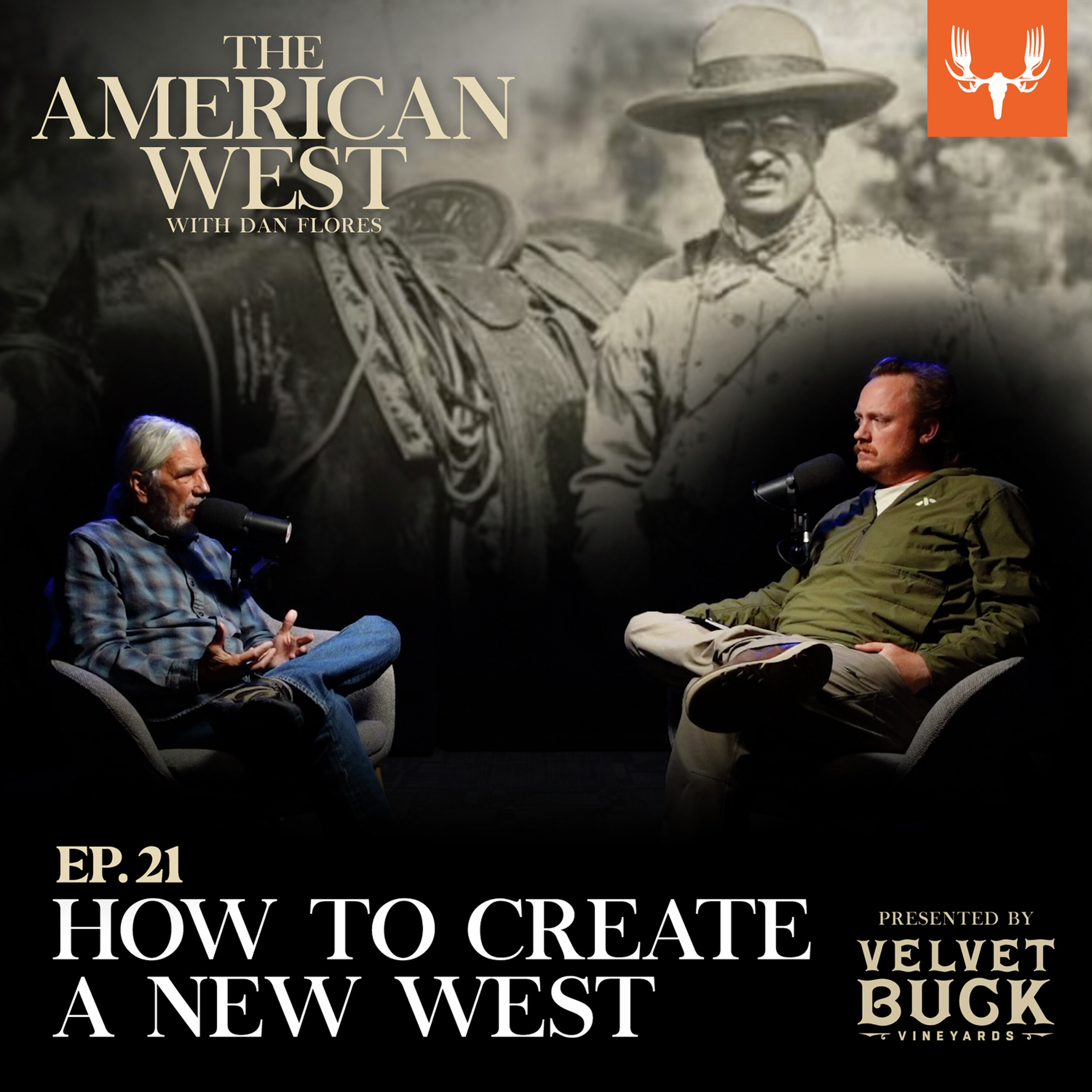
Along with Thomas Jefferson, Theodore Roosevelt was the American president most fascinated with nature.
- [00:48]
And with the American West.
- [00:50]
And like Jefferson, Roosevelt transformed the region he loved. I'm Dan Flores, and this is the.
- [00:57]
American west, brought to you by Velvet Buck Wine, where the hunt meets the harvest.
- [01:04]
A portion of each bottle goes to support backcountry hunters and anglers.
- [01:08]
Limited supply available@veletbuckvineards.com Enjoy responsibly.
- [01:30]
How you create a new west and a new America. He was a former President of the United States and might hold that office again. He was also an internationally known sportsman and advocate of adventurous living whose demise would have caused shockwaves. But descending the unexplored Rio da Duvida, the river of doubt, in early 1914, Teddy Roosevelt was injured and ill and had watched his great South American adventure with legendary explorer Candido Rondon almost disintegrate in the Brazilian jungle. No novelist could have written the scene better for him. We've reached a point where some of us must stop, he told his son Kermit. I feel I am only a burden to the party. It was classic Theodore Roosevelt, a romantic hero who, despite his fame, was willing to sacrifice himself for his companions. The party had none of it, of course, but the incident is a window on the characteristics that led Theodore Roosevelt to the life of accomplishment and adventure he created. Few things Teddy Roosevelt ever did were easy. Maybe that is why he gloried so in challenge. By sheer force of will, he turned himself from a weak, sickly adolescent into a hardy and robust Harvard undergraduate who boxed and hunted, and eventually into a lifelong advocate of what he called the strenuous life. That same determination marked his administrations as President of the United States, enabling him to enact major progressive social policies, central to which was the first comprehensive environmental program in American history. Roosevelt's ideal image of an American was someone who knew the natural world, which was why conservation of an endangered nature of was central to his accomplishments, as with Thomas Jefferson, whose goals for the west enabled Americans to grasp its outlines, we shouldn't be surprised to discover a similar fascination with nature in the president who laid down America's and the West's environmental foundation. But in contrast to Jefferson, who sat on his mountain in Virginia and imagined the West, Roosevelt experienced the west and the world firsthand. Roosevelt was from one of the eastern families of patrician elites so visible in the history of the west. His birth in 1858 almost made him a Civil War baby. But as his mother was a Southerner, the Civil War and Reconstruction were always forbidden topics. Nature, wild animals and the west, on the other hand, were the focus of long discussions between Roosevelt's father, who was an early disciple of Darwin and a founder of the American Museum of Natural History, and an uncle who was a naturalist. When he was only 10, Roosevelt's family toured Europe, and despite young Teddy's frequent attacks of asthma, he and his father climbed Mount Vesuvius. Three years later, they were on a boat descending the Nile in Egypt, where with a new shotgun, Teddy shot and collected more than 100 birds for his own museum, as he called it. In a situation of many options, Teddy did not surprise his family when he announced that he wanted to train as a naturalist. Like a significant number, though not all of nature obsessed Americans. Audubon was one. So were George Bird Grinnell and Aldo Leopold. Teddy Roosevelt and his interest in nature began in a boyhood of observing, pursuing and hunting wild animals in wild country. His yearning to make natural history a profession was officially abandoned at Harvard, though Teddy wanted a natural history career after the fashion of the great naturalists like Alexander von Humboldt or John James Ottoman, he wanted to explore exotic locales and hunt and collect new species. By his time at Harvard, natural history had become a Darwinian exercise of laboratory work. Teddy and a fellow ornithology enthusiast instead worked on and published the Summer Birds of the Adirondacks. And by his junior year, Roosevelt had decided that that the professional natural sciences was not going to be his career. Long interested in history and in writing interest, that turned out to be a way to explore and hunt and collect in the imagination. With a Harvard degree in hand, Roosevelt turned to a book project about how the American frontier had advanced from the Eastern seaboard westward. Although much of his story was set east of the Mississippi, with men like Daniel Boone and Davy Crockett as its heroes, Roosevelt called the book the Winning of the West. By this time in his life, Roosevelt had made a series of trips to outback Maine and in 1880, he and his younger brother Eliot journeyed to Iowa and Minnesota, where, as was common at the time, they killed more than 400 birds and animals, yet were disappointed with their take. To this point in his life, Roosevelt had not yet been to the actual west, where, in his imagination, it was still possible to experience the world of the frontier hunters he was writing about. But in September 1883, after running his first political campaign in and getting elected as an assemblyman to the New York legislature, he finally boarded a train with connections to the real West. To Roosevelt, cultured men looked to Europe, but manly men looked to the west for their inspiration. So his destination was as far in the Dakota Territory as trains would take him, and his mission was specific. Roosevelt wanted to engage in that most Western of acts, shooting a buffalo before such a thing was no longer possible. His younger brother by then was hunting tigers in India and had faced a stampeding buffalo herd in West Texas. Everyone knew buffalo were almost gone by then, but there were a few, and a buffalo head on the wall of your study would convey where your sympathies lay. Until the late 1880s, however, Roosevelt seems not to have faced the issue of declining animal populations with much awareness.
- [08:47]
Narrator
His soon to be friend in the.
- [08:49]
Dan Flores
Conservation field, journalist George Bird Grinnell, was already developing a much more progressive credo.
- [08:56]
Narrator
Roosevelt's, and hence the country's ideas about the natural world and we'd inherited were.
- [09:02]
Dan Flores
About to be shaped into a modern form by this Western experience. Buffalo had become the mammalian representative of.
- [09:13]
Narrator
America for all the world in the 19th century, but their story had now.
- [09:18]
Dan Flores
Taken a much darker tone.
- [09:20]
Narrator
Everyone knew that American market hunters were killing buffalo by the thousands on a daily basis. The Last of the Buffalo became a.
- [09:28]
Dan Flores
Phrase that defined the 1880s, the way the Roaring Twenties would define find a.
- [09:33]
Narrator
Decade 40 years later.
- [09:36]
Dan Flores
It was the decade when William Hornaday.
- [09:38]
Narrator
Collected bison specimens for the National Museum's diorama in the belief that this might be the only way future Americans would get to see buffalo.
- [09:47]
Dan Flores
The painter Albert Bierstadt finished his grand oil, the Last of The Buffalo, in 1890, the same year a band of Lakotas was Massacred by the 7th Cavalry.
- [09:59]
Narrator
At wounded Knee for performing a dance to return buffalo to the West. Grinnell also chose the Last of the Buffalo as the title for his widely read book from Scribners and Sons. The demise of America's most iconic animal.
- [10:16]
Dan Flores
Was in the air, and many wondered what that meant.
- [10:20]
Narrator
In 1883, though, for Roosevelt, a buffalo trophy represented America's largest ultimate prize. Stepping off the train in North Dakota, he hired a guide named Joe Ferris, who, in perfect symmetry for that decade.
- [10:36]
Dan Flores
Was from eastern Canada and had himself.
- [10:40]
Narrator
Only been on the scene in the west for a year. They made the Maltese Cross Ranch their headquarters and set out on horseback on.
- [10:48]
Dan Flores
What turned into a 15 day quest.
- [10:52]
Narrator
The days of Audubon, describing the sound of the vast herds and in this.
- [10:57]
Dan Flores
Same country as resembling continuous rolling thunder.
- [11:01]
Narrator
Were now gone forever.
- [11:04]
Dan Flores
That year of Roosevelt's hunt, the Fort.
- [11:06]
Narrator
Benton shipper Ig Baker sent a grand total of 5,000 buffalo hides down the Missouri River.
- [11:14]
Dan Flores
The next year he shipped none at all.
- [11:17]
Narrator
The bison story was already exemplifying that in the scope of world history, the the United States had engaged in a more complete destruction of wild animals and.
- [11:28]
Dan Flores
A wider diversity of them than any.
- [11:30]
Narrator
Modern country in existence. Roosevelt's bison hunt was a revelation to him. Initially, he wrote his wife Alice that buffalo are too rare for me to hope to get one.
- [11:43]
Dan Flores
Over the course of two weeks of.
- [11:45]
Narrator
Horseback travel that took them into Montana territory, they found a handful of Roosevelt.
- [11:51]
Dan Flores
Wounded one bison he never found, and.
- [11:54]
Narrator
Missed shots at another pair before finally downing an unsuspecting bull barely 50 yards distant. A handsome animal whose glossy fall coat was in fine trim and shone in the rays of the sun, he said.
- [12:10]
Dan Flores
The celebration became the stuff of Western romance.
- [12:13]
Narrator
Teddy did a freestyle Indian dance and paid Ferris $100 on the spot.
- [12:20]
Dan Flores
Hooked on the curious, fantastic beauty of.
- [12:23]
Narrator
The Badlands before he departed, he bought an interest in his first ranch there, the Maltese Cross. On a return trip the next year.
- [12:32]
Dan Flores
1884, he bought a second property he.
- [12:35]
Narrator
Called the Elkhorn, along the Little Missouri, the nearest neighbor 12 miles away. These western experiences were pivotal in Roosevelt's life. They gave him a base of operations in the west and put him in contact with individuals whose character stood naked in that setting.
- [12:56]
Dan Flores
He later commented that he learned how.
- [12:58]
Narrator
To evaluate people in those years, an affirmation of his evolving belief in strength, directness and the will to make things happen.
- [13:08]
Dan Flores
He also learned much more now about.
- [13:11]
Narrator
The western animals he had read about. From Elkhorn, he hunted deer and pronghorns, and farther west in the bighorns and the bitterroots, grizzlies, elk and moose. He hunted mountain goats in the Coeur d' Alenes and caribou in the Selkirk Range. Working on the grand history that became the Winning of the West, Roosevelt concluded that this kind of life, a life roaming the wilderness and hunting, was the very path that had allowed Europeans to become Americans. Living it, he felt as he put it absolutely free as a man could feel. But experiencing the west of the 1880s was accompanied by a sadder realization. In a violation of his western fantasies, Roosevelt was discovering that in fact there is not much game. Buffalo were gone. Elk and deer and grizzlies weren't far behind. When it shot his buffalo, he knew full well that it was, as he put it, part of the last remnant.
- [14:17]
Dan Flores
Of a doomed and nearly vanished race.
- [14:20]
Narrator
Yet he had still shot his bull. That had to have been on his mind when he began to realize that in fact, everything seemed to be disappearing. This onslaught on western nature was being.
- [14:33]
Dan Flores
Delivered by what Roosevelt now referred to.
- [14:35]
Narrator
As skin hunters and greasy nimrods, all of them products of greed and self interest. The wild wild west afforded remarkable freedom that was evident. But frontier anarchy without restraint was devouring.
- [14:52]
Dan Flores
The world with no regard whatsoever either.
- [14:56]
Narrator
For its perpetuation or for future generations. This was unexpected and depressing. So was losing both his wife and his mother almost simultaneously that decade, which sent him into an emotional spiral, calling on the sunshine and champagne air of the West. To help overcome these tragedies, Roosevelt turned to writing articles for a magazine called Outing and working on a book he would title Hunting Trips of a Ranchman.
- [15:27]
Dan Flores
Which appeared in print in 1885.
- [15:31]
Narrator
By the time the winter of 188687 ruined his ranching operation, he had enough material for another pair of hunting books, Ranch Life and the hunting trail in.
- [15:42]
Dan Flores
1888 and the wilderness hunter in 1893.
- [15:48]
Narrator
These were the books that established Roosevelt's reputation as someone who knew the west.
- [15:52]
Dan Flores
And and understood what was happening to it.
- [15:56]
Narrator
They also brought him into contact with.
- [15:58]
Dan Flores
People who were about to push him.
- [16:00]
Narrator
Much farther along the road to environmental thinking. Roosevelt met Grinnell, editor of a famous conservation themed magazine called Forest and Stream. Following Grinnell's quite critical review of hunting trips of a ranchman bursting into Grinnell's.
- [16:20]
Dan Flores
Office demanding to know why the journalists had been underwhelmed. Roosevelt ended up impressed with his fellow.
- [16:26]
Narrator
Ivy Leaguers knowledge of the state of the west and its fast declining wildlife. With Grinnell's coaching and friendship over the next 15 years of his career, Roosevelt launched the intellectual journey that would ultimately transform America and bring it into the 20th century. Their organization of elite hunters, the Boone and Crockett Club, along with Grinnell's Audubon Society, provided platforms that translated their western experiences into a rethinking about freedom and nature.
- [17:01]
Dan Flores
The particular epiphany that became the foundation.
- [17:05]
Narrator
For this rethinking wasn't an easy One. But for those who loved American nature.
- [17:11]
Dan Flores
The evidence for it was everywhere.
- [17:14]
Narrator
Pure self interest of the Adam Smith sort, which had driven capitalism for most of American history, was growing close to leaving nothing for the future. Largely through witnessing the loss of the wild animals he loved. Roosevelt was coming to an undergirding principle for the political revolution known as progressivism. Capitalism's excesses, it turned out, were going to have to be curbed and regulated. And the lesson then being offered by railroad and oil company domination of state governments meant to Roosevelt and progressives that the only entity truly powerful enough to regulate capitalism was the federal government. In search of a word that might symbolize what he had in mind, Roosevelt borrowed the term conservation from British governance of India to conserve something meant to save it to ensure its perpetuation. As an American, Roosevelt saw conservation in democratic terms. He would develop programs wherein the federal government would conserve American nature for what he called the greatest good, for the greatest number, and for the longest period of time. A great country and a great civilization, Roosevelt believed, needed to understand itself. The first step involved taking some sort of action to curb the market hunt for wildlife that for three centuries had systematically destroyed everything from deer, turkey, great auks, passenger pigeons, and plume birds like snowy egrets in the east to a near obliteration of western wildlife, most shamefully, America's iconic animal, the bison. Until 1900, the US federal government had stood by and allowed unregulated capitalism to have its way with wildlife. But in that year, an Iowa congressman named John Lacey stepped forward with a plan to engage Washington in halting these abominations. Lacey acquired his status with the new wildlife activists following a series of celebrated incidents in Yellowstone park In the early 1890s, US army game warden Ed Wilson had arrested a notorious park poacher, whom a local judge promptly released, citing a lack of any law to prosecute him. A few weeks later, Wilson vanished without a trace. Other wardens found Wilson's hidden remains a year later. That story brought a forest and stream reporter to Yellowstone who soon elicited from another poacher that his own arrest and release had involved the massacre of 80 Buffalo. Most of the bison still left in the park at that point, Lacey introduced and secured passage in congress of the 1894 Yellowstone Park Protection act with $1,000 fines for killing wildlife. Six years later, Lacy decided to take on the biggest monster of them all, a practice that since colonial days could have made fair progress, filling the Grand Canyon with the bodies of all the American birds and animals killed for money. White haired Bearded, slender, Lacey was about to turn 60. In history and in his career, the time had come. Calling on the federal government's constitutional power to regulate interstate commerce, Lacey drew up an act he called the Wild Birds and Game Preservation act that at last landed a body blow on the wild animals economy. At long last, a federal law stopped the shipping of slain birds, animals and their body parts from states where market hunting was still legal to states where it wasn't. It was already too late for passenger pigeons and wild bison. It verged on too late for snowy egrets, Carolina parakeets and a lengthening list of others. But the Lacey act finally put a long, hesitant U.S. federal government in play. In his speech describing the bill before Congress, Lacey referenced both passenger pigeons and bison. But he proclaimed that all was not lost, that there still remains much to preserve, as he put it. In truth, the Lacey act put the burden for enlightened laws on the states. Following a Supreme Court case that ruled that wildlife was the property of the states where the animals resided, states now began creating what they called game departments and enacting policies on behalf of at least some of their wild animals. For guidance in that endeavor, they looked to the new U.S. biological Survey, headed up by another Ivy Leaguer, C. Hart, miriam.
- [22:31]
iHeartRadio Announcer
This month, iHeartRadio is celebrating the stars of the 2026 Winter Games. Representing Vienna, Virginia, Ilya Malinin, redefining what is possible on the ice known as the Quad God, the reigning world champion arrives in Milano, Cortina, as the only skater in history to land a quadruple axel in competition. He isn't just performing a routine, he's pushing the laws of physics. Malinin steps onto the Olympic ice, looking to turn his technical revolution into pure gold. For more Winter Games Gold Search olympics on the iHeartRadio app.
- [23:04]
Narrator
In 1901, when an assassin's bullet cut down President William McKinley early in his second term, his Vice President was a 42 year old former New York congressman and city mayor who Republican party operatives referred to as that damn cowboy. Teddy Roosevelt, the youngest man ever to serve as president with a prodigious, manic, depressive personality, had the chance to transform America fall into his lap. Here was a stunning opportunity to take on the issues that had dominated his life since childhood. If celebrated, individual freedom was the very cause of the destruction of America's animals, not to mention its forest, its grasslands, its fisheries, its archaeological sites, then expanding government power to regulate such freedom was the only course that could preserve the country. What he and his policymakers called conservation became his personal campaign to save the animals and landscapes he believed had created Homo americanus in the first place.
- [24:17]
Dan Flores
The whole standpoint of the people toward.
- [24:20]
Narrator
The proper aim of government, Roosevelt would write, were brought out first by this conservation work. The proper aim of government, he was now convinced, was to moderate the selfishness and thoughtlessness inherent in human nature. What conservation and progressivism would do was set America on a different path, a sharp detour from the 3 century attempt to make the US a clone of the countries of Western Europe. The idea was to create a nation that stood separate and new. Nothing in Roosevelt's programs said that quite like his enthusiastic endorsement once he became president of the existing public land system. Roosevelt's massive additions to this distinctly American form of land ownership and public access in the form of new national parks and national forests, wildlife and bird refuges and national monuments amounted to a wholesale reset. I'll have more to say in the next episode about the origins and direction of America's public lands, one of our very best contributions to world ideas and policy. But it was Teddy Roosevelt who took that embryonic system and made it a badge of American uniqueness. Histories of the presidents tend to label Roosevelt's conservation programs as one of the nation's grand transformative policy triumphs, and that claim is no exaggeration. Conservation's successes were breathtaking. To begin, Roosevelt oversaw the creation of six new national parks, a form of preserved wildlands America had invented with Yellowstone and Yosef three decades earlier. Starting with Pelican island in Florida, which he designated by executive order in 1903 as a reserve and breeding ground for native birds, and continuing with a pair of national bison ranges in Oklahoma and Montana to rescue our iconic mammal. Then on through his lame duck period, when new bird reservations, a total of 51 of them, seemed to precipitate like rain from the heavens, Roosevelt created a national wildlife refuge system that preserved millions of acres of prized bird and mammal habitat. The forest reserves that he and Grinnell celebrated in the 1890s were at 42 million acres when Roosevelt assumed the presidency. Renamed national forests by Roosevelt's chief forester, Gifford Pinchot, they swell to 172 million acres, including Tongass, a 17 million acre monster in Alaska by the time Roosevelt left office. Using the new antiquities act of 1906 to protect America's archaeological sites and to set aside landscapes of unique geological importance, he proclaimed another extensive body of preserves from the public lands in the form of 18 national monuments, a new conservation category. Devil's Tower in Wyoming, one of many scores of nature spots Christian Americans had assigned a satanic association became the first of these. But the Grand Canyon itself was another of those early national monuments, and just eight years, Roosevelt removed more than 230 million acres of general Land office holdings from private entry, retaining them in public ownership, setting aside more public lands than any other president, and transforming the future of the country in the process. Providing refuges for America's big mammals and birds was a primary reason he did almost all of it. Douglas Brinkley's Wilderness Warrior, probably the best recent biography of him, lays that triumphant story out in point by point detail. But Roosevelt was human, and as are we all, a product of his time and place. While he could explain the tragedy of wildlife loss with lovely analogies, the destruction of the wild pigeon and the Carolina parakeet has meant a loss as severe as if the Catskills or the Palisades were taken away.
- [28:55]
Dan Flores
He wrote.
- [28:56]
Narrator
When I hear of the destruction of a species, I feel just as if all the works of some great writer had perished. But despite that, he resisted drawing the conclusions from Darwin that many disciples thought the great naturalists intended. Roosevelt had grown up versed in Darwin, read Darwin himself when he was a young teenager floating the Nile, believed from that point onward that humans were indeed primates that had evolved from earlier forms. Nonetheless, the animals he hunted did not, perhaps for him, simply could not become evolutionary near kin of humans. While Roosevelt was president, his writer friend John Burroughs precipitated a public controversy about the accuracy of a popular new genre, a form of literary natural history that attempted to provide insight into the lives of wild animals. Most of the new authors of animal stories were not scientists, but many of them, notably John Muir, Jack London, and Canadian writer Ernest Thompson Seton, had extensive outdoor experience and employed scientific methodology. Seton, ironically enough, won the John Burroughs medal for his comprehensive Lives of game animals book. William T. Hornady praised Seton's work. Looking back on this nature faker controversy label so by Roosevelt, from today's vantage, what seems apparent is that its practitioners were trying to take on the big implications of Darwinism in the world around them. Theirs was a response, and it strongly appealed to the reading public to the bleak nature red and tooth and claw conclusions that Thomas Huxley, Herbert Spencer, and Alfred Lord Tennyson drew from evolution. Instead of finding humans condemned because we'd turned out to be mere animals, nature writers like Seton looked for examples among birds and mammals of traits humans admired. Compassion, cooperation, loyalty and ability to reason and to transfer cultural learning across generations, and most of all, self awareness and individuality. In one of Seton's Stories and Scribner's. In 1900, a captured female coyote named Tito sits chained in a ranch yard, observing the techniques stockmen are using to wipe out the coyote kind. When she escapes and has litters of her own, she passes on her knowledge about how to avoid traps and poison, which in Satan's telling, was why coyotes were surviving when so many other creatures were not. In his famous wolf sports story Lobo King of Karumpa, Seton wrote about a canny New Mexico wolf with one fatal flaw, his fidelity to his mate. As he put the matter in Wild Animals I have Known, Seton's theme was we and the beasts are kin. Given the perspective of contemporary 21st century bird and mammal research, with its emphasis on self awareness, tool use, theory of mind, perceptions of fairness, cultural transmission, grief over the loss of mates and individuality, all those things these writers seem to be working with, all that seemed to be lacking in the best writings of the Seton London Muir genre were double blind, replicable experiments. But at the time the well respected Burroughs, furious at what he saw as chicanery, went on the attack. Non human animals, Burroughs thundered, were purely creatures of instinct, nothing more. That drew Roosevelt into the fray. Simply enough, the nature fakers were misleading their readers, he told the public. In a private communication to the editor of Collier's magazine, Roosevelt went further. He echoed the lines in Darwin's the Descent of man when he wrote the editor, I believe that the higher mammals and birds have reasoning powers which differ in degree rather than kind from those of humans. But, he continued, he meant different in degree from the lower reasoning powers of, for instance, the lower savages. In other words, if we can take this astonishing comment literally, Roosevelt believed the resonances and parallels between animals and humanity and did not really apply to modern First World humans, only to tribal indigenous peoples who were lower in their evolutionary progress. Obviously Roosevelt had not absorbed the lessons.
- [34:04]
Dan Flores
Of Columbian anthropologist Franz Boas, who was already arguing against Western ethnocentrism by positing that all humans were equally evolved but with cultures that followed very different trajectories.
- [34:20]
Narrator
Jack London at least would eventually get.
- [34:22]
Dan Flores
A measure of revenge, telling Collier's readers that the truth was that President Roosevelt does not understand evolution, and he does not seem to have made much of an attempt to understand evolution. That sentiment surfaced in a particularly troubling way in Roosevelt's public endorsement of a book by fellow Ivy Leaguer and conservationist Madison Grant. Grant's the Passing of the Great Race, with its advocacy of eugenics, made enough of a white nationalist case to impress Adolf Hitler while getting ridiculed in F. Scott Fitzgerald's the Great Gatsby. The first time I visited the American Museum of Natural History, I'll confess to doing a double take of the statue of Teddy outside the main entrance. It presented Roosevelt as the classic great man on horseback looking out over Manhattan's Central Park. Innocent enough until you realized that he was being flanked and escorted by both native and African Americans on foot on either side of him. The effect in modern New York was jarring enough that In January of 2022, the statue was taken down. John Muir got in a twist of the knife too, making a case for protecting a much bigger piece of Yosemite, including the Tuolumne Canyon, soon to be the target of a dam.
- [35:55]
Narrator
Muir and the President spent three nights camping in Yosemite without bodyguards. That gave the legendary writer activist, no.
- [36:05]
Dan Flores
Shrinking violet himself, a chance to confront.
- [36:08]
Narrator
Roosevelt around their campfire.
- [36:11]
Dan Flores
His question was something many had wondered about, but only the Scottish poetico trampo was willing to broach. Mr. Roosevelt, when are you going to get beyond the boyishness of killing things? Author of numerous books and magazine articles on hunting, probably already planning the African safari he would take as soon as he was out of office, Roosevelt's response was an evasive Muir. I guess you're right. Roosevelt then went on to support the O' Shaughnessy Dam in Yosemite park and.
- [36:48]
Narrator
In an eight month expedition to Africa.
- [36:50]
Dan Flores
In 1909 proceeded to shoot 5,013 mammals, 4,443 birds, and 2,322 reptiles and amphibians, all for science and the Smithsonian's cabinets, of course. So then, like everyone else who lived in the past, Roosevelt's worldview did not always conform to our sense of right and wrong in the present. But Teddy Roosevelt still works for me.
- [37:20]
Narrator
As an American hero.
- [37:22]
Dan Flores
The country lost something of incalculable value when, as the author of yet another book he titled the Strenuous Life. Teddy Roosevelt stepped away from the presidency in 1909 after serving only one full term, then went on his safari in Africa, followed by his exploration and mapping of of the least known remaining source.
- [37:47]
Tributary of the Great Amazon river back home.
- [37:52]
The most nature obsessed president since Thomas Jefferson had turned the country over to his successor, portly William Howard Taft, whose passion about outdoor endeavor was for the.
- [38:06]
Narrator
Rugged and manly sport of golf.
- [38:19]
Interviewer
Dan, at the beginning of this episode, as I was reading through the script, one thing really struck me and I think when I when all the real famous anecdotes about Teddy Roosevelt come to mind. He sort of has this boyish quality to him.
- [38:36]
Dan Flores
Yeah.
- [38:37]
Interviewer
And as I'm reading this script, you realize just how young he was when he's doing a lot of this stuff. Like when he goes to hunt the last buffalo. He's 25.
- [38:49]
Dan Flores
Yeah, that's right.
- [38:50]
Interviewer
And you think about when he bursts into George Bird Grinnell's office to argue with him. He's still in his 20s.
- [38:55]
Dan Flores
That's right.
- [38:56]
Interviewer
And that sort of behavior all of a sudden starts to make a little more sense. Obviously, he carried that with him, but even the. Even the Boone and Crockett Club, he's. He's less than 30 years old when. When he establishes that. And that really struck me in the first part of this episode was how active he was from finishing at Harvard up until, you know, his early 30s.
- [39:20]
Dan Flores
Yeah. I mean, he becomes president when he's 42, and that's in 1901. So the. Those scenes in the beginning of the. Of this particular episode happen in the 80s, you know, and so it's like he. As you said, he's in his 20s. And so he's a very young man. He's, you know, and he's sort of got what almost certainly, one would argue, as a kind of a manic depressive kind of personality. And fortunately for America and the world, he's in the manic stage for most of his life. I mean, he certainly has some moments of depression, but. Yeah, so he's a very young guy, and he's, you know, and he's ambitious. And of course, he comes out of this kind of patrician, elite New York family that enables him to kind of view the world as his oyster. He can do anything he wants to do. He can be any kind of person he wants to be. And what he decides he wants to be from a very early age is he wants to be a naturalist. He wants to sort of be Alexander von Humboldt or, you know, John James Audubon, someone like that, who gets to go out into the world and have adventures and hunt and he hunts throughout his life, everywhere he goes, even on that Brazilian adventure on the Rio de Dubia. I mean, he takes time out to go on a jaguar hunt. And he gets himself a jaguar on that particular trip, too. So that's kind of.
- [40:57]
Narrator
He's a person who had every opportunity.
- [41:00]
Dan Flores
To do whatever he wanted to do in life. But he knew from a very early age what it was. And, I mean, he went for it with a tremendous amount of energy.
- [41:10]
Interviewer
Yeah. I think another point that stood out to me in this. In this chapter is you emphasize how his conservation ethos fit within this broader progressive stage in American political development. And I think that's. Unless you've studied progressivism and you're familiar with it as a movement at the turn of the century, it sort of gets left out of our understanding of conservation. But I wonder if you can talk a little bit about what you mean when you refer to the progressivism of the Roosevelt era and sort of what shape that took and what impulses guided it.
- [41:52]
Dan Flores
Yeah, that. That's a useful question to be sure, to provide some context. I mean, what I did with the script for this particular episode was to couch progressivism for Roosevelt primarily in conservation. And that's. I think that's the natural direction from which he comes to it. But progressivism was a kind of a bigger movement in American life in those years, a political movement. It was. It was a movement that prevailed in both parties, both the Republican and the Democratic parties. And, I mean, Roosevelt was a Republican, but he was certainly strongly influenced by progressivism. And it was kind of an argument at the turn of the century that capitalism, particularly big corporate capitalism that was emerging in those days, was a pretty scary force in American life, and it needed to be corralled and reined in some. And the argument became, in the conservation realm and in several other realms, too, that the federal government was the primary player in doing that, although many of the states had strong progressive kind of political developments as well. But the idea was to insert the government, whether at the state level or the federal level, into the economic life of the country in order to do things like regulating drugs that were sold in pharmacies and having the government began to intervene in making sure that the food that was sold in grocery stores was healthy, and it extended to child labor laws and a variety of different things. What I try to do in this particular script, as I mentioned a minute ago, is to couch what Roosevelt's particular passion about progressivism is in the conservation movement. That establishes very much the beginnings of the whole environmental movement in the United States. And this, of course, is 125 years ago that this happens. But much of what becomes the kind of framework of conservation and environmental thinking in America comes out of this particular period. And it does involve, as Roosevelt said, a different role for the government than had been the case in American life up to this point. So if you're a fan of, you know, kind of the anarchy of the.
- [44:36]
Narrator
Wild, wild west, this is the point.
- [44:39]
Dan Flores
At which Americans, and particularly someone like Teddy Roosevelt, who thinks, as he says, a great civilization and a great country needs to understand itself, that you have to step in and say, okay, you know, that level of freedom is great, but we're going to have to regulate things and make sure that just kind.
- [44:58]
Narrator
Of pure selfishness doesn't prevail to the.
- [45:01]
Dan Flores
Detriment of the future, especially.
- [45:05]
Interviewer
And the other sort of intellectual thread that shapes Roosevelt's worldview is, as you point out, that a Darwinism. And you also point out that he fit within a ongoing debate between what the implications of Darwinism were and how that. I mean, I think it's interesting to point out that you can look at a wild animal and think of it in two very different ways through the lens of Darwinism, as you did in this chapter.
- [45:42]
Dan Flores
Yeah. And I tried to do this in a way to provide a kind of a fresh look at that sort of famous nature faker controversy where Roosevelt and William Burroughs in particular.
- [45:58]
Narrator
Charged these writers.
- [45:59]
Dan Flores
Like Jack London and John Muir and Ernest Thompson Seton with. With faking the animals that they were writing about. And the truth is, with the perspective of another 125 years of research.
- [46:20]
Narrator
It.
- [46:20]
Dan Flores
Looks as if actually the people who were getting it right were probably the writers themselves, you know, and. And I think Roosevelt stepping into the fray, which he, of course, he couldn't resist doing. For one thing, this was a subject dear to his heart. And for another thing, he's, you know, he inhabits the bully pulpit as the president. He tends to sort of step into every debate that's out there. And I think that what you get out of that story, as I told it in this particular episode, is probably a fresh look at how this played out and who, in fact, probably had the better notions about the relationship that people and other animals have. I mean, I have always loved that line that Ernest Thompson Seton uses in Wild Animals. I've known where he says, we and the beasts are kin. And that's what these writers are trying to convey. But Burroughs and Roosevelt in particular, pushed back. They were resistant to that. And so it makes for a kind of an interesting take on Roosevelt. And we tend to think of him, you know, in pretty heroic terms, but sometimes he wasn't right about things. I think this may have been one of those times. Yeah.
- [47:48]
Interviewer
And at the beginning, you. You link him, and maybe again at the end, you link him to Jefferson as the two, you know, chief executives who are most interested in the West. And Jefferson, I think, you know, they both have a curiosity about animals and landscapes, but when it comes to Their legacy. Sort of think about Jefferson is redrawing the boundaries, and then Roosevelt is sort of reorganizing internally what the west would look like in terms of public lands and. And all that.
- [48:21]
Dan Flores
So, yeah.
- [48:24]
Interviewer
I don't often think of the two of them in the same. In the same breath, but it's an interesting. It's an interesting pair of. To just sort of consider the. The similarities between the two.
- [48:36]
Dan Flores
Well, I think, you know, and I'm not. Not sure exactly when I began associating Jefferson and Roosevelt, although the west is a common denominator for both of them. And in a podcast like this, I mean, we sort of started back in some of the early episodes with Jefferson and Lewis and Clark and the. The expedition up the Red river into the Southwest. So there's a kind of a natural combination there, I think. But at some point, you know, in my thinking over the years, I began to sort of look at American presidents and say, okay, so among them, who are the ones who are sort of interested in the kind of values that I'm interested in, in nature, in wilderness, in landscapes, in wild animals? And the two, of course, who immediately popped to the top of that list are Thomas Jefferson and. And Teddy Roosevelt. And, you know, and since Roosevelt, it's difficult to really find another American president. I mean, for one thing, we don't have very many presidents coming from the west, where, as a result of the lifestyle we get to have in the American west, that, you know, it's probably more possible for someone to be interested in those kinds of subjects. But, yeah, it's almost as if Teddy Roosevelt and Thomas Jefferson are the. Almost the only ones who have that kind of concern. And so that makes them kind of particular heroes of people who are interested in Western history.
- [50:13]
Interviewer
And last question here, which dovetails nicely with that answer, we do often think about Roosevelt as a hero. On the other hand, he's one of these figures, as you point out the big controversy over his statue outside of the American Museum of Natural History. And he's one of those figures where I think he's obviously, you can read things that he's written and he espouses viewpoints and values. They're at odds with my own viewpoints and values. On the other hand, you can't help but acknowledge the tremendous amount of good he did for wild places, wild animals and all that. And so I don't know. I'm. I don't know if there's necessarily a question there, but he's sort of like an uncle, where you don't you don't really agree with everything he says, but you don't dismiss him out of hand for what some might chalk up today is like these. These horrible, you know, racial views, things of that nature, especially when you lump them in with characters like Madison Grant and.
- [51:25]
Dan Flores
Yeah, yeah, and it was unfortunate that he. He blurbed Madison Grant's book, of course, which is a book that a lot of people regard as an unfortunate production from someone in the United States who shouldn't have been thinking those terms. But, you know, what I will say, and I said it in the script here, is that as someone who's interested in history, and I know Randall, you know this too, because we used to talk about it in graduate classes, you have to think about people in terms of the times they live in. And I mean, you can't look at someone like Teddy Roosevelt and say, okay, so this guy, he should be smart enough to understand the way we think in.
- [52:11]
Interviewer
Right.
- [52:12]
Dan Flores
In the 2000 and twenties. I mean, the truth is, a century from now, we have no idea what thoughts and expressions and values that we have that might be regarded as completely unsatisfactory to somebody living 100 years in the future. And so I have a difficult time looking back on people like that and divorcing them from their time.
- [52:39]
Interviewer
Right.
- [52:39]
Dan Flores
And the period they're living in and trying to evaluate them based on how we would look at them today. It doesn't mean I'm not willing to say things, as I did in the script, about the particular statue. I mean, that wasn't Teddy Roosevelt. That was, you know, other people using the Roosevelt image. But he did do the Madison Grant thing, and he did say some unfortunate things about what groups of people, you know, might actually share the cultures and. And abilities of wild animals. And it wasn't, you know, Western humanity, in his view. It wasn't the people who sat around the dinner table with him, in other words. So I think that you can be critical and understand somebody in the past, but also try not to, you know, to just completely dismiss them. I mean, I think that's an unfortunate thing that we've been doing recently, and I'm encouraged a little bit by the fact that I think we're getting to get over that.
- [53:40]
Interviewer
Yeah, there does seem to be a bit of. A bit more pause.
- [53:43]
Dan Flores
I think there's a bit more pause. And I think, I mean, you know, we're trained as historians to think in terms of history and historicism is about doing that sort of thing, understanding that people occupy a particular point in time. And you have to understand their time to fully appreciate who they are.
- [54:04]
Interviewer
Well, Dan, thank you. Always fun to chat, Roosevelt.
- [54:06]
Dan Flores
Oh, it is indeed. No kidding.