Loading summary
Transcript21 lines
- [00:00]
Interviewer
Okay, so you know t mobile 5G home Internet is easy on the wallet, but here's some big news. It's now the fastest 5G home Internet according to the experts at OOKLA Speed Test. And yeah, it's a great value because you get a 5 year price guarantee. T Mobile 5G Home Internet it's the fastest 5G home Internet at a great price with savings that stick. Check availability@t mobile.com home Internet price guarantee. Exclusions like tax and fees apply. It's the fastest based on OOKLA Speed Test intelligence Data from the second half of 2025. All rights reserved. When you're in the back country, don't forget your own backcountry. Keep it pristine and confidently clean by bringing along wet extra large Dude Wipes. Just like your truck gets muddy out in the wild soaking your butt, you'd never clean your vehicle with dry paper towels, so why would you clean your butt with dry toilet paper? Wetter cleans better. So ditch the itch and switch from TP to wet Extra large Dude Wipes. Dude Wipes. It is the best clean. Pants down. They're available at Amazon. That's where I usually order mine from, but you get them at Walmart Nationwide. Fantastic product. Proud to be doing ads for these boys at Dude Wipes.
- [01:17]
Meat Eater Host
Welcome to Meat Eaters 12 and 26 presented by Moultrie Mobile and ONX Maps, 12 of Meat Eater's biggest and baddest haunts from the last year. Released throughout 2026. These are long form episodes so you get more of what you love. The first one up is My Baited Bear Hunt in Manitoba. If you've ever wondered what a baited bear hunt is like, you'll love this episode. My favorite part was watching a younger bear spend an hour trying to figure out how to get a creatively hung beaver carcass down from a tree. Check it out now on Meat Eater's YouTube channel and be on the lookout for more 12 and 26 in the coming months.
- [01:57]
Dan Flores
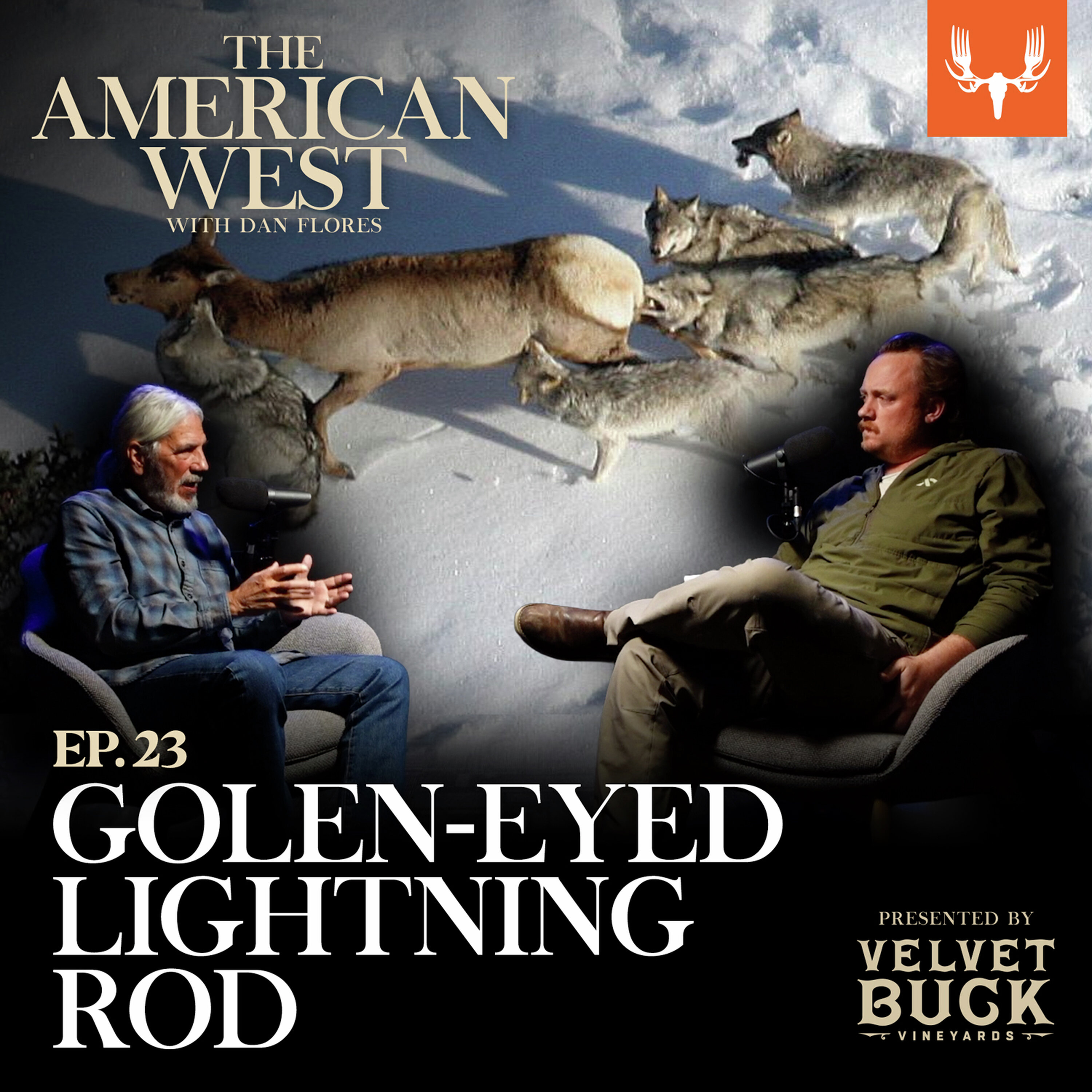
In the first half of the 20th century, America came very close to destroying its wolves, which were saved by the insights of a new science that changed the country's understanding of predators. I'm Dan Flores and this is the American west, brought to you by Velvet Buck Wine, where the hunt meets the harvest. A portion of each bottle goes to support backcountry hunters and anglers. Limited supply available@velted buc vineyards.com enjoy responsibly. Golden eyed lightning rod. In the 1920s as flappers and jazz and Hollywood captivate American cities, a man named Bill Kwood is engaged in a different cultural project. At 50, Kwood is a stocky stump of a man with a face like a granite cliff. He's a professional assassin of wolves, but says he loves the animals he watches die. He's a real fellow. The big gray is lots of brains. I feel sorry every time I see one of those big fellows thrashing around in a trap bellowing bloody murder. Kwood is the sort of American that writer D.H. lawrence, getting his first extended exposure to this country, will describe as stoic, a killer. And what he is doing is mop up work. Where the continent only three centuries before had easily held 100,000 wolf packs by the 1920s, few packs remain anywhere in the U.S. outside Alaska, the Great Lakes country and the Lower South. Kwood is after the last survivors. In the west, few enough animals that ranchers and government hunters hired on their behalf have started giving the animals individual names. They call two of these last gray wolves. K. Wood is tracking down rags and greenhorn. Animals that had once lived in packs once had mates and pups. Rags and greenhorn are enduring lives of lonely desperation. Like a significant percentage of gray wolves who turn to livestock, they're too old and frail to bring down elk without a pack's help. Younger wolves who ended up stock killers often had suffered crippling injuries, frequently by losing multiple toes or an entire foot escaping the serrated jaws of the Newhouse 4 and a half steel trap. Rags had seen two of the mates he had had during his lifetime panicked and helpless in a trap. He learned from that and is himself unmaimed. Rags is an old wolf, the ranchers say 17. But he's probably closer to 10 or 11 and now either travels alone or with two younger wolves who are far less crafty. As for greenhorn, this female wolf, named for a local mountaineer Kwood's Front Range home has teeth so worn she's been reduced to strangling her prey. In her past, she's escaped traps and spit out a strychnine bait before it could kill her. When K. Wood goes after her in 1923, the ranchers claim she's 18 years old. Whatever her real age, she is slowly starving to death. These are wolves the federal agency K. Wood works for should leave to die natural deaths. But rags and greenhorn live in a nation that cannot brook a single wolf remaining alive anywhere. It's Rags turn first. Across weeks of time, Cawood sets his traps and Rags digs them up. With a wolf that smart, the former bounty Hunter rigs a trap set designed to snare a wolf to by a back leg as it digs up other traps with its front paws. It works with a trap biting into a rear leg and a second trap sprung on the drag line of the first bouncing after him on a three foot chain. The old wolf spends a final day in tortured flight. In the end, hemmed into a box canyon, he confronts a fate he's escaped for a decade. Purposefully, he limps straight towards K. Wood, yellow eyes fixed and staring as the metal clanks over the rocks behind him, K. Wood stoically shoots the equivalent of an octogenarian wolf in the head. Next, greenhorn. It's December, cold and snowing on the Front Range and with her teeth mostly gone and the elderly wolf can't down a deer, let alone a cow, she's desperately hungry. She knows the scent of strychnine. But Caywood has attracted her with a horse's head wired to a juniper around which he's placed chunks of fat suet soaked in poison. Greenhorn shies away from the smell again and again. She knows from her own experience and from wolf culture to that this scent means tragic danger. She's witnessed the thrashing, vomiting end game more than once, but she's starving to death. She circles back, picks up a chunk of suet, swallows it. Then another. And one more. It's the day after Christmas, 1923. K. Wood believes she's the last wild wolf born in the state of Colorado. By the early 20th century, a new institutional player emerged to confront wolves and other predators in the United States. Before 1905, it seemed that Sea Hart Merriam's new Bureau of Biological Survey, created to map the wildlife that was left in post frontier America was sitting pretty. Teddy Roosevelt was present and the Bureau was dear to his heart. But Congress was growing testy about funding an agency interested in pure science. At livestock association meetings, Western ranchers were arguing that the vast western public lands Roosevelt had set aside from homesteading were refuges for predators that attacked their stock. Since the Fed had created this situation, the ranchers believe the Fed ought to fix it. So in an act of self preservation, the Bureau of Biological Survey remade itself into the solution to the country's so called predator problem. Claiming that America suffered from, these are the Bureau's words, wolf infested national forests and the federal public domain. The biological Survey engineered its own public support. Between 1907 and 1909 it issued four reports on the so called predator big game livestock relationship in and around the new national Forest. A young, slightly educated Minnesotan named Vernon Bailey, who was a whiz at trapping animals, authored most of them. An agency like the bureau, his reports claim, could bring orderly and scientific control to wolf destruction. By hiring trained hunters and trappers, men like Bill Kwood Bailey held seminars for national forest managers, teaching them how to find wolf dens and the best strategies for destroying pups and packs. Forest service rangers proceeded to kill 1800 wolves and 23,000 coyotes in the national forest within a year. Teddy Roosevelt would hereafter refer to Bailey by a favorite nickname, wolf Bailey. In 20th century America, there was literally no opposition to this campaign of annihilation. America's beloved nature writer John Burroughs opined that predators certainly needed killing, since the fewer of these there are, the better for the useful and beautiful game. As he wrote, wildlife activist William Hornaday insisted that firearms, dogs, traps, and strychnine are thoroughly legitimate weapons of destruction. No halfway measures suffice. Not even John Muir spoke out. Although Muir did worry that slaughtering wolves might induce what he called a penalty for interfering with the balance of nature, there was another constituency for the war on predators, too. Destroying wolves would produce all the deer and elk America's new sport hunters could ever want. No one asked whether sport hunters would focus on the same animals in an elk herd that wolves did, because no one knew anything about wolf prey relationships then. But advocating replacing predators with human hunters was a stroke of genius, bringing all manner of sportsman's groups, firearms manufacturers, and state game and fish agencies to the cause of wiping out every wolf on the continent. So without conducting a single research project on the wolf's role in nature, the biological survey engineered massive public support for wolf extermination. And in 1914, Congress approved an appropriation of $125,000 for the Bureau to launch the war. Within two years, the Bureau had 300 federal hunters in the field. Under Merriam's leadership, the biological survey was now a critical federal agency on behalf of a civilized America made in the image of European countries that had long ago destroyed their own predators. The one field of 20th century wildlife science in which Americans became acknowledged global leaders was in fact the destruction of so called undesirable species. If your assignment was to mass kill wolves, the way to go was poisoning entire populations. And you did that by strewing poisoned baits by the thousands across the American landscape. As for the target animal, the campaign brooked no mercy or compassion. At one point, Vernon Bailey inquired of his boss about the proper dose of strychnine. So a poisoned wolf might die within a humane three minutes. Knowing full well that any expression of mercy towards wolves was a political liability, Miriam shot back, you had better go at once to the hospital in Albuquerque. Inasmuch as no sane man could possibly make such an absurd and utterly preposterous statement as this, you are obviously in need of mental treatment. Miriam went on. We want the cattleman behind us, Sabe. With its new funding, the bureau was building a plant in Albuquerque to produce strychnine baits in volume. Chillingly, they called it the eradication methods lab. By 1921, this federal killing facility had moved to Denver, in which location it eventually perfected an amaz witches brew of ever deadlier predicides. But for the next two decades, federal poisoners relied on strychnine. It was potent, twisting wolves into a strychnine signature. Their bodies wrenched and their tails shot straight out as if they'd been struck by a bolt of lightning. Federal hunters quickly grasped the wolf's fatal flaw. The smaller American canids. Coyotes had evolved an adaptation called fission fusion. Living in social groups when possible, but capable of scattering when ecological pressures called for it. Fission. But wolves are so strongly family based that wolf killers realized that killing one animal and using its scent on your baits meant, as one bureau hunter put it, you could quickly kill all the members of whole families of wolves. With unmistakable evidence that the remaining members of the wolf family have been seeking the lost member. Neuroscience studies at this very moment are verifying the brain chemistry grief that wild canids suffer from the loss of their mates. At this fecund moment, two new developments were about to alter the arc of the country's wolf story, though in 1915, scientific naturalists founded the Ecological Society of America. And at their first meeting in Philadelphia, the founding members, Frederick Clements and Edith Clements, Charles C. Adams and Victor Shelford, agreed on a focus for their new discipline. There was adaptation and natural selection, of course, along with investigating the flow of energy through nature and an analysis of serial stages and climax conditions. Shelford, who had just published his landmark Animal Communities in Temperate America, pushed his colleagues to work on biotic communities as well. In 1915, the society counted 307 members. But it was an old fashioned topic, an idea Western culture had known since the time of Herodotus and Plato as the balance of nature that pushed ecology towards rethinking the role of predators. The biological survey's policies had assumed the European folk position. Predators were evil and disposable. Their eradication made for a civilized nation. The ecologists believe there might instead be Dynamic equilibria at work in the natural world. That assumption would become the crux of a raging battle in American and Western science for the next half century. The other development of the moment was America's creation of a National park service in 1916. Initially, Yellowstone, the world's first national park, had emerged as a symbol of just how far the wolf warriors intended to go. In 1914, Yellowstone had invited Vernon Bailey to come and show its personnel the best techniques to exterminate wolves. Yellowstone's tallied till the death of the last gray wolf in the park. That happened in the year 1926 was 136 wolves, 80 of which were puppies. Between 1918 and 1935, the world's first great wildlife park issued a death sentence to 2,968 coyotes. All the while, the eradication methods lab was cranking out the strychnine until by the mid-1920s, Bureau hunters had distributed an astounding 3,567,000 poisons, poison baits across the country. Yet amid the wolf end game in America, evidence of Darwinian natural selection and an emergent wolf culture of survivability was emerging. Stanley Young, a hunter who would rise through the ranks at the Bureau, believed of these last animals that it is probable that never did more intelligent wolves exist. Like 18th century sperm whales that famously figured out how to avoid whaling boats and harpooners, wolves like Rags and Greenhorn drew on the accumulated cultural learning of scores of wolf generations and taught their pups about rifles, traps and poisons. No wonder the last ones were so smart.
- [18:44]
Meat Eater Host
Welcome to Meat Eaters 12 and 26 presented by Moultrie Mobile and ONX Maps. 12 of Meat Eater's biggest and baddest hunts from the last year released throughout 2026. These are long form episodes so you get more of what you love. The first one up is my baited bear hunt in Manitoba. If you've ever wondered what a baited bear hunt is like, you'll love this episode. My favorite part was watching a younger bear spend an hour trying to figure out how to get a creatively hung beaver carcass and down from a tree. Check it out now on Meat Eaters YouTube channel and be on the lookout for more 12 and 26 in the coming months.
- [19:24]
Dan Flores
Ranchers and federal hunters named many of the last wolves in the West. Along with rags and Greenhorn in Colorado, there was also Old Lefty, Old Whitey, Bigfoot, Phantom Wolf and Unaweep. In Oregon, there was a last wolf called Sican, a King Lobo in New Mexico, snowdrift and the Prior Creek wolf in Montana, Aguila in Arizona, and the Custer wolf in South Dakotas. Three Toes or Clubfoot were common wolf names referencing all the animals crippled by traps. There were red wolf renegades too, including Traveler in Arkansas, Black Devil in Oklahoma and Crip in Texas, another maimed animal. Given the accounts federal hunters left of their protracted efforts to kill these wolves, there's little doubt these were indeed remarkably intelligent animals. And why not? As they were experiencing on all sides, humans were engaged in a crusade to wipe out their kind entirely. But as the 1920s dawned, what seemed initially to be a natural ally mounted the first real challenge to the Bureaus. Scorched earth Wolf war. The American Society of Mammalogists met for the first time at the Smithsonian in 1919. Bureau founder S.E. hart Miriam became its first president, with Vernon Bailey and Bureau mate E.A. goldman as charter members. Like Bailey, Goldman had field experience, but he lacked a college degree. Nonetheless, the Bureau tasked these two men to explain and defend the wolf war against university trained ecologists. Among that group was a young forester interested in wildlife, Aldo Leopold. There was also Joseph Grinnell, a cousin of the legendary conservation hero George Bird Grinnell. Grinnell was an original thinker whose ideas quickly challenged the very premises of on which the Bureau based its predator war. The first blowup happened at the Mammalogists 1924 meeting. Grinnell had just published a foundational piece on ecological niches, a fundamental insight into nature critical to appreciating what might happen if America destroyed its wolf population. Grinnell and his graduate student, E. Raymond hall, in search, insisted from this work on niches that the Bureau was wiping out animals that were playing an essential role in the continent's balance of nature. As it turned out, both the ecologists and the Bureau men were unaware that the natural world in America was about to offer powerful examples of the implications of emptying predator niches. But Goldman and Bailey decide they had heard about the balance of nature a few times too many. If the US actually let predators live, they argued, there would soon be nothing but carnivores left. In a throwdown essay, the Predatory Mammal Problem and the Balance of Nature, that he authored for the Journal of Mammalogy, Goldman insisted that the coming of civilized man meant that the balance of nature has been violently overturned, never to be re established. Thus, large predatory mammals, destructive to livestock and to game, no longer have a place in our advancing civilization. But Joseph Grinnell had come up with another idea, and this one vexed the Bureau as much as niches and the balance of nature. Now there was a national Park Service with an organic act directive charging it with preserving nature for future generations. But how to do that? And in what form? Grinnell and zoologist Tracy Storer had a suggestion they laid out in an article for the journal Science. In their opinion, preserving nature meant predaceous animals should be left unmolested and allowed to retain their primitive relation to the rest of the fauna. As tourists were already showing, they wrote, wolves, coyotes and lions were exceedingly interesting to park visitors. Wasn't a complete nature what preserving nature in the parks intended? Offering predators permanent refuge in American national parks Dumbfounded bureau personnel, New bureau director Paul Reddington was incredulous. We face the opposition, he told his employees, of those who want to see the mountain lion, the wolf, the coyote and the bobcat actually perpetuated as part of the wildlife of the country. One of the scientists keenly interested in this debate had published an essay he called the varmint question, Heaping praise on the bureau when he was just out of Yale. So Aldo Leopold was not a vocal critic of the bureau as the wolf debate roiled science. But as conference chairman of the American Game Protection association's meeting in 1928, Leopold's position about predators was obviously evolving. No public agency should ever control predators without substantial scientific research first, he wrote for the association. Poisons should only be used in emergencies and no predatory species should be exterminated over large areas. Now, as professor of game management at the University of Wisconsin, Leopold dropped more deeply into ecology. The field worried critics were already calling the subversive science. One of the issues he particularly studied was the response of nature to predator removal. The 1920s witnessed the rise of a new meme to describe a new natural phenomenon. The meme word was eruption, and it referred to a sudden ungulate population explosion that caused herds to eat themselves out of forage and then crash spectacularly. The cause effect seemed straightforward. The famous Kaibab eruption on the north rim of the Grand Canyon was preceded by bureau hunters erasing the 30 wolves, 781 mountain lions and 5,000 coyotes from the north rim. The resident mule deer then exploded from 4,000 animals to 100,000, leading to a catastrophic die off. It made Kaibab a national story. Eruptions became a moral that wouldn't go away. With wolves vanishing, deer and elk experienced crazy population oscillations Somewhere in the country almost every year. Something in nature obviously was amiss. Leopold would go on to do a study of eruptions, finding reports of only two of them before 1900, but a whopping 42 between 1900 and 1945, the number rising sharply after 1920 eruptions, seem to supply evidence for the so called Lotka Volterra equations, ecological models of how prey and their predators follow an oscillating algorithm of rising and falling populations in harmony with one another. But the inertia of the wolf warp was now an unstoppable undertow in America. The Bureau's move was to go to the American public with a series of canned articles attend to those lauding the G men hunting crime celebrities like Al Capone and John Dillinger. US Agents stalk desperados of the animal world. The headlines of those stories read There still had been no science to study the larger role of wolves and predators in American nature. But by the 1940s, that was finally about to change. The two Minnesota brothers, Olaus and Adolph Murie, were soon to become legendary figures in American conservation, having done landmark studies on elk and Jackson Hole and on the porcupine caribou herd in Alaska. Olas would conduct a game changing study of coyotes in Jackson Hole, which appeared in print in 1935. Brother Adolph Burey's own Ecology of the Coyote in the Yellowstone saw print in 1940. Both works concluded that far from being arch predators that deserved extermination, coyotes produced actions in the world that were virtually all either beneficial to humans or neutral. The Murray brothers would become famous as ethical researchers who followed their evidence. Unfortunately for the bureau, now renamed the U.S. fish and Wildlife Service, the Mure brothers work did not lead to the conclusions it hoped for wolves either. By 1940. In 1940, Mount McKinley in Alaska was the only American park that still had wolves. After centuries of unexamined wolf killing, perhaps it was time to figure out something about wolf ecology. So in 1939, Murie went to Alaska and spent three years engaged in the unthinkable actually studying wolves interacting among themselves and with their prey. It was arduous. Murie said he walked 1700 miles the first year. But everyone who reads his classic the wolves of Mount McKinley can't help but thrill to his excitement at studying the mythic animal Americans had reflexively tried to exterminate. After three years in Alaska, Murray understood what the Bureau had been too arrogant are myopic to see. Wolf prey relationships clearly were ancient, predating Europeans by thousands or maybe millions of years. Natural selection had long sorted out the details. Yes, wolves and coyotes ate pronghorn fawns. So pronghorns had evolved a solution. They gave birth to twins an heir and a spare. Yes, wolves preyed on Dall sheep and caribou, but they caught the very young and the very old. Wolves held sheep numbers in check and kept them from overgrazing their mountains rather than destroying their prey. Wolf predation probably has a salutary effect on the sheep as a species, Muir wrote. Wolves did kill caribou calves. But as Muir studied the relationship, he realized that caribou herds are no doubt adjusted to the presence and pressure of the wolf. These things were ancient. They predated all humans in America. Muri did one other thing readers of his book never forgot. He brought the wolves he studied to life as individuals. Dandy, Robber Mask and Grandpa had unique personalities. Pack members seemed affectionate and caring of one another. These were not the wolves Old Worlders feared from the animus they had brought ashore. They weren't. The wolves the Bureau's public relations articles implied were animal gangsters. They were the wolves that had been in North America all along. The Wolves of Mount McKinley was the country's first entree into into a modern sensibility about wolves and predators built on science generally. And once the blindfold was off, it was hard for the scientifically literate ever to put it on again. At almost the same time Yuri's book came out, old Bureau veterans Stanley Young and E.A. gulman finally published their two volume the Wolves of North America. A book that has manned the wolf section of every American library for almost a century now. They proudly pointed out that by the 1940s, from New England to Virginia, wolves were now entirely gone. The Rocky Mountain states, with all their public lands barely held 100 wolves. California's last wolves are down to fewer than 50. There were only 60 Mexican wolves left in the Southwest as World War II ended. The only places in the lower 48 that still had sizable populations were the upper Great lakes country with 1400 wolves and the Mid south with some 450 red wolves. Young and Goleman were unrepentant wolf assassins. They laid out their book like it was a military campaign against Germany or Japan. Full of accounts of wolf depredations, photos of wolf killed stock claims that game was disappearing because of wolves. They evinced dismay that stock raising Hispanic settlers in the Southwest and California had never attempted predator control since the authors claim wolves had slowed Anglo American settlement of the continent by decades. The 1:1 atrocity they couldn't level against America's wolves were attacks on humans. Not that they didn't look hard for some example, but they simply couldn't find one In a case of future meet past, Aldo Leopold reviewed the wolves of North America in 1945. How could it be, he wondered, that Young and Goldman didn't acknowledge the deep history of their subject? If wolves were as destructive a force as they implied in their book, how had the continent's wolves failed to wipe out its own mammalian food supply before Europeans ever arrived? Leopold asked. Leopold had visited Europe and studied its wildlife policies, so he knew the bureau men never questioned the old World model. But European countries had nothing comparable to the vast wild public lands Americans had set aside. And their model was based on folk tradition established long before ecology was born that simply was not, as Leopold said, scientific. The new wolf book reflected the naturalists of the past rather than the wildlife ecologist of today. Leopold wrote. Ouch. In 1949, America's star biologist finally published the book of his that would set the country on its modern path of wolf recovery and restoration. Leopold's A Sand County Almanac became both a best seller and a philosophical foundation for the ecology movement sweeping America as part of the 60s cultural revolution. We're damn lucky he got it out. He died of a heart attack battling a grass fire that very year. Because A Sand County Almanac changed the world. In vivid poetic passages, Leopold's book introduced us to the insights of a mind that had tracked every breakthrough in ecology. By then he had concluded that the old balance of nature idea actually lacked the flexibility to account for a natural world that that was endlessly changing. He was now thinking of natural settings as interlinked communities of species with predators at the top. We know those communities today as ecosystems. Leopold's ideas were epiphanies for many. For one, he laid out an ecological philosophy for living. He called the land ethic that included his golden rule of ecology. A thing is right when it tends to preserve the integrity, stability and beauty of the biotic community. It is wrong when it tends otherwise. The genius that built the United States had always been self interest. Adam Smith and John Stuart Mill had hit on a trait fundamental to our evolution. But Leopold did not say an act was right when it preserved humanity or economics. Instead, he called on readers to think of the innate rights among them the simple right to exist of other species in an earthly community that included us. Leopold's admirers called his new idea Bio A Sand County Almanac's most unforgettable scene was Leopold's own myth of personal redemption. The chapter titled Thinking Like a Mountain was not merely a poetic rendering of his view that the United States had an opportunity to create A distinctively American policy towards nature. For readers soon to be immersed in painful soul searching about so many unexamined assumptions in American life, Leopold's story of shooting a wolf, watching the green fire die in its eyes, and realizing what a miscalculation he had made about the ancient centrality of predators in the biotic community offered America a whole new trajectory. We were wrong. I was wrong, his story said. But it's not too late. Ever since a Sand county almanac fell into the hands of readers, there has been a quiet murmur of disbelief from some about whether its most stirring scene really happened. Did Leopold actually shoot a wolf and experience an ecological epiphany as he watched it die? Some 50, 16 years ago, a group of committed fans that included respected Leopold biographer Susan Flater, determined that indeed, the wolf story was factual. In 1909, early in his career as a forester in the Southwest, Leopold was surveying the boundaries of the Apache National Forest along Arizona's Black River. Today, Rob, right in the heart of the recovery area for endangered Mexican wolves. From a casual mention of the incident in a letter to his mother, it seems that one morning he and a companion shot a pair of animals Leopold called timber wolves. So that part of his story, at least now stands confirmed as historical fact. Whether Leopold's troubled reaction to watching a wolf die and grasping the implications happened in 1909 or far later in his life is the part that we can't know. But maybe it doesn't matter. We do know that Aldo Leopold didn't get to see his America begin to think like a mountain, in his memorable phrase. But he had pointed us towards a new understanding and a new destiny destination in our history. And in that destination, the wolf would return to its ancient, rightful place on the continent.
- [40:17]
Meat Eater Host
Welcome to Meat Eaters 12 and 26, presented by Moultrie Mobile and Onx Maps, 12 of Meat Eater's biggest and baddest haunts from the last year released throughout 2026. These are long form episodes so you get more of what you love. The first one up is my Baited Bear hunt in Manitoba. If you've ever wondered what a baited bear hunt is like, you'll love this episode. My favorite part was watching a younger bear spend an hour trying to figure out how to get a creatively hung beaver carcass down from a tree. Check it out now on Meat Eater's YouTube channel and be on the lookout for more 12 and 26 in the coming months.
- [40:58]
Interviewer
So, Dan, in this this episode about wolves, you make the point that ecology you can think of it as a subversive science.
- [41:09]
Dan Flores
Yeah.
- [41:10]
Interviewer
And sort of all the broader implications about thinking. Thinking of the natural world in terms of connections and dependency and all that stuff. I wonder if you can kind of just begin by explaining ecology and what it meant to people at the moment that it sort of had this almost like ground shaking effect.
- [41:31]
Dan Flores
Yeah. The Ecological Society of America dates 1915, and ecology obviously comes out of the Darwinian revolution. In fact, within about three or four years of the publication on the Origin of species in 1859, a German scientist was calling for a new science that applied the insights of Darwin's on the Origin of Species. And he called it. He used a Greek term that refers in fact to communities, and he called it ecology. In the United States, as I said, we don't get an ecological society of ecologists until 1915, although there are already in that first meeting, there are 307 of them. So there are already 300 practicing ecologists in the United States by that time. And the reason this is important in this discussion of wolves, and this is a. The story of wolves, I mean, I talked a few episodes ago about wolves in the west in the 19th century. And this is the story essentially of how we came to understand the role of wolves in American ecological life. And so if you're trying to figure out, for instance, why there is in the modern west this movement to. To restore wolves to Montana, Idaho, Wyoming, Arizona, New Mexico, now, Colorado, obviously, and California has wolves now, and so do the Pacific Northwest states. The reason this has become a thing in our time is because of these developments in science that I try to describe in this particular episode. This is how and why it happens that in our time we're making the attempt to recover wolves. The problem, of course, was that during the time when science is discovering the ancient and extremely important role wolves have always played in North American history, we are still employing the old folk tradition out of the old world, which had been telling us for hundreds of years, you're supposed to kill every predator that exists. Predators are evil. Predators may even be satanic. This is what Adam and Eve confronted when they had to leave the Garden of Eden. They had to confront predators. So we need to cleanse the world of predators. And this kind of thinking was imported to the United States, obviously without any kind of scientific background whatsoever. And so we're still, as a country and a government agency that I talk about here, the Bureau of Biological Survey is committed to it on behalf of particularly the livestock industry. We're still trying to wipe out every Wolf that roams across North America. And this is happening at the same time that the science of ecology, the subversive science, is beginning to describe for us the role that these animals have been playing in North American history for time immemorial. And so that puts at odds these two really powerful forces, Science on the one hand, and this old folk tradition on the other. And they battle it out for most of the first half of. Of the 20th century about what's going to happen to wolves. And I will say that for the most part, for the early part of this story, it's the old folk tradition of killing every wolf you can kill that prevails. But by the end of the period that this script goes to, basically by 1950, we have begun to realize that this is probably a mistake. We've made a mistake with this because we. We haven't known enough about how the world has worked. Yeah.
- [45:49]
Interviewer
And you tell the story of wolves in the 20th century, one that we just sort of touched on is the history of science and changes in scientific thought. But then there's another lens. That's the history of the growing bureaucratic state or administrative state and thinking about institutions and institutional missions and, you know, the prerogatives for getting funding and all these sorts of things like that very much shapes the reality on the ground in the west in terms of what animals live in places like Montana. And so you mentioned earlier this agency, the Bureau of Biological Survey. And I wonder if you can just sort of drill down on what it is that the Bureau of Biological Survey is up to when it takes on this mission.
- [46:38]
Dan Flores
Yeah. And in my book Wild New World, I spent some time talking about the origins of this particular agency. And what it really is is a government agency founded in the 1890s to try to take stock of what wildlife is left in America after the destruction of the frontier period. And it's founded by an Ivy Leaguer, a Yalie, named Sea Hart, Miriam. And he early on has the idea that what he's going to do is to send people out, his personal appointees, to sort of do surveys about what is left. And so it's kind of a pure science approach that by the early 20th century is resulting in the biological survey not being able to make a good case to Congress for appropriating money for them, because Congress is sort of reluctant to appropriate money for an agency that's just doing pure science. And so what Miriam understands by about 1905, and he immediately moves in the direction of this once he gets a good grasp of how, how he's. He's going to have to act to make his agency survive. He realizes he's got to find a mission that Congress will appropriate money for. And since the public lands have left many people in the livestock associations in the west convinced that one of the things the public lands are doing is, is to providing a kind of breeding. They're providing a breeding ground for predators, for bears and mountain lions and wolves and coyotes. The livestock associations, which have been using bounties for a long time to try to control these animals, turn to the government and say, you guys should do something about this thing that you've screwed up. And Miriam realizes, okay, this is our new mission. We need to make ourselves the solution to. To the predator problem. And that's basically what he does. And at that point, Congress begins to appropriate an enormous amount of money, I mean, to the point where by the early 1930s, they give the Biological Survey $10 million to try to wipe out predators. And so this agency that started as a kind of little pure science agency to try to figure out what was left at the end of the frontier has now become a major federal bureau designed to eliminate as many predators in America as they can.
- [49:26]
Interviewer
And once an agency hitches its wagon to an interest group like that with a mission like that, it's very hard to reconsider their actions in light of new science.
- [49:38]
Dan Flores
It is very hard. And so that's where this big conflict emerges, because as the ecologists began to discuss this war on predators that the biological survey is mounting, I mean, and they're carrying it out at every level. Vernon Bailey, who is wolf Bailey, as Teddy Roosevelt calls him, who's the expert on how to kill wolves, how to find their dens, how to kill puppies. I mean, he even goes to Yellowstone and Glacier and teaches the managers there, here's how you get rid of your wolves. So that. That's why in the 1920s, we basically eradicate all the wolves in Yellowstone national park, all the wolves that are in Glacier. I mean, one place after another, we are figuring out. And of course, the way they're doing it primarily is poisoning them with strychnine, because these wolf killers have realized that the way to get rid of mass numbers of wolves is to poison them. Because wolves in particular have an Achilles heel, and it's their emotional attachment to their families, their pups and their mates. I mean, one of the things I mentioned in this particular script is, as I did earlier, is that we've got right now in the recent 1925 or 2025, neuroscience meeting, studies being done on the chemical expressions of grief in wild canids from losing their mates. And that's what these hunters realized just by experience in the teens and twenties. If you can kill one animal out of a wolf pack and then bait your sets, your poison sets with the scent of that animal, you can kill every single animal in the pack, one after the other. And that's why wolves turn out to be relatively easy to get rid of with poison. It's because of their particular binding affection to their mates and to their pups. So, I mean, by the middle 1920s, the Bureau of Biological Survey has put out three and a half million poison baits across mostly the west, but other parts of the country too, with the goal of wiping wolves completely out.
- [52:03]
Interviewer
And when you're describing this, this conflict, there's sort of one individual who embodies it, you know, personally, and that's Aldo Leopold. Right, yeah. Who I think is underappreciated as a, as a thinker about natural. The natural environment. Right. And I mean, he's really sort of an intellect. He has profound intellectual influence on how we view the natural world today. But, you know, he starts out as a guy in public service and he's a boots on the ground, you know, public land manager and he's an ecologist. And he undergoes this sort of conversion. Yeah, as it were. That, that I think is like, it's easy to understand the bigger story when you sort of look at it through Leupold's eyes.
- [52:57]
Dan Flores
Yeah, that's. That's a good way to look at Aldo Leopold, because Aldo Leopold, in his lifetime goes from expressing the sort of folk sentiment of the more wolves, the more predators you kill, the better it is for, for game, for livestock herders, to becoming the person who by the middle of the 20th century sets up what happens in the last half of the century where after the Endangered Species act is passed, we not only proclaim various species of wolves to be endangered, but under the recovery provisions of that act, we start recovering them. So as Aldo Leopold, that's a good way of thinking of him. He starts. I mean, he writes an article when he's a young man called the Varmint Question, where he praises the Bureau of, of Biological Survey and their wolf war. But by the 19 teens and 20s, you can begin to track the changes in his attitudes. He becomes a professor of ecology at the University of Wisconsin, a very famous public intellectual, even by the 1930s. But you can see that his opinions are changing. And one of the things that changes Them is he does this study of these ungulate eruptions that are taking place in early 20th century America. And I mean, I talked about this in the script, so I'll just be brief about it. But what was happening was that as predators are being removed across the American landscape, we were starting to get. And this happened all over the country. I mean, this didn't happen just in the west. It happened in places like Pennsylvania, South Carolina. You were getting these huge eruptions, these huge, this huge growth in populations of mule deer, white tail deer, elk, moose. And then they would outstrip their food supply and there would be this tremendous population crash where thousands of animals would die in the winters for lack of food. They had browsed the browse line too high to be able to reach. And Leopold decided he was going to do a historical study of this. So he wanted to know how many of these eruptions that happened in the 19th century. He was able to find two, but he found 45 of them that had happened after 1900 when we began to have success in removing predators. And so it made him, it gave him an understanding of what the relationship was between predators and their prey. And, and then he, he goes the full distance, of course, and sort of not only becoming. Coming to realize how important wolves are in America to encouraging us to begin to restore them.
- [56:01]
Interviewer
Well, Dan, I'm sure there's more to say about wolves, probably more than can be said, but leave it there.
- [56:08]
Dan Flores
There'll be more wolves to come after at least one more episode.
- [56:11]
Interviewer
Indeed.
- [56:11]
Dan Flores
Yeah.
- [56:30]
Meat Eater Host
Welcome to Meat Eaters 12 and 26 presented by Moultrie Mobile and and ONX Maps. 12 of Meat Eater's biggest and baddest hunts from the last year released throughout 2026. These are long form episodes so you get more of what you love. The first one up is my baited bear hunt in Manitoba. If you've ever wondered what a baited bear hunt is like, you'll love this episode. My favorite part was watching a younger bear spend an hour trying to figure out how to get a creatively hung beaver carcass down from a tree. Check it out now on Meat Eaters YouTube channel and be on the lookout for more 12 and 26 in the coming months.