Loading summary
Transcript69 lines
- [00:00]
Dan Flores
Amazon Health AI presents Painful Thoughts why did I search the Internet for answers to my cold sore problem?
- [00:09]
Ad Host
Now I'm stuck down a rabbit hole
- [00:11]
Dan Flores
filled with images of alarmingly graphic source in various stages of ooze. I can clear my search history, but I can never unsee that. Don't go down the rabbit hole.
- [00:24]
Ad Host
Amazon Health AI gets you the right care fast.
- [00:28]
Randall
Healthcare just got less painful.
- [00:30]
Ad Host
I'm not joking man. I use Montana Knife Co. Knives in my garage where I handle furs and wild game. I use them out in the field. I use them in my kitchen. They are manufactured locally in Montana. They are designed, tested and built by hunters. Montana Knife Company is a hunting knife company first and foremost and if you ever need your knives sharpened, just send them back and they will sharpen them for free. Montana Knife Co. Working knives for Working People MKC knives sell out within minutes of being released, so head over to montanaknifecompany.com to see what's available. Now when you're in the back country, don't forget your own backcountry. Keep it pristine and confidently clean by bringing along wet extra large Dude Wipes. Just like your truck gets muddy out in the wild soaking your butt. You never clean your vehicle with dry paper towels, so why would you clean your butt with dry toilet toilet paper Wetter cleans better. So ditch the itch and switch from TP to wet extra large Dude Wipes. Dude Wipes. It is the best clean pants down. They're available at Amazon. That's where I usually order mine from, but you get them at Walmart nationwide. Fantastic product. Proud to be doing ads for these boys at Dude Wipes.
- [01:46]
Dan Flores
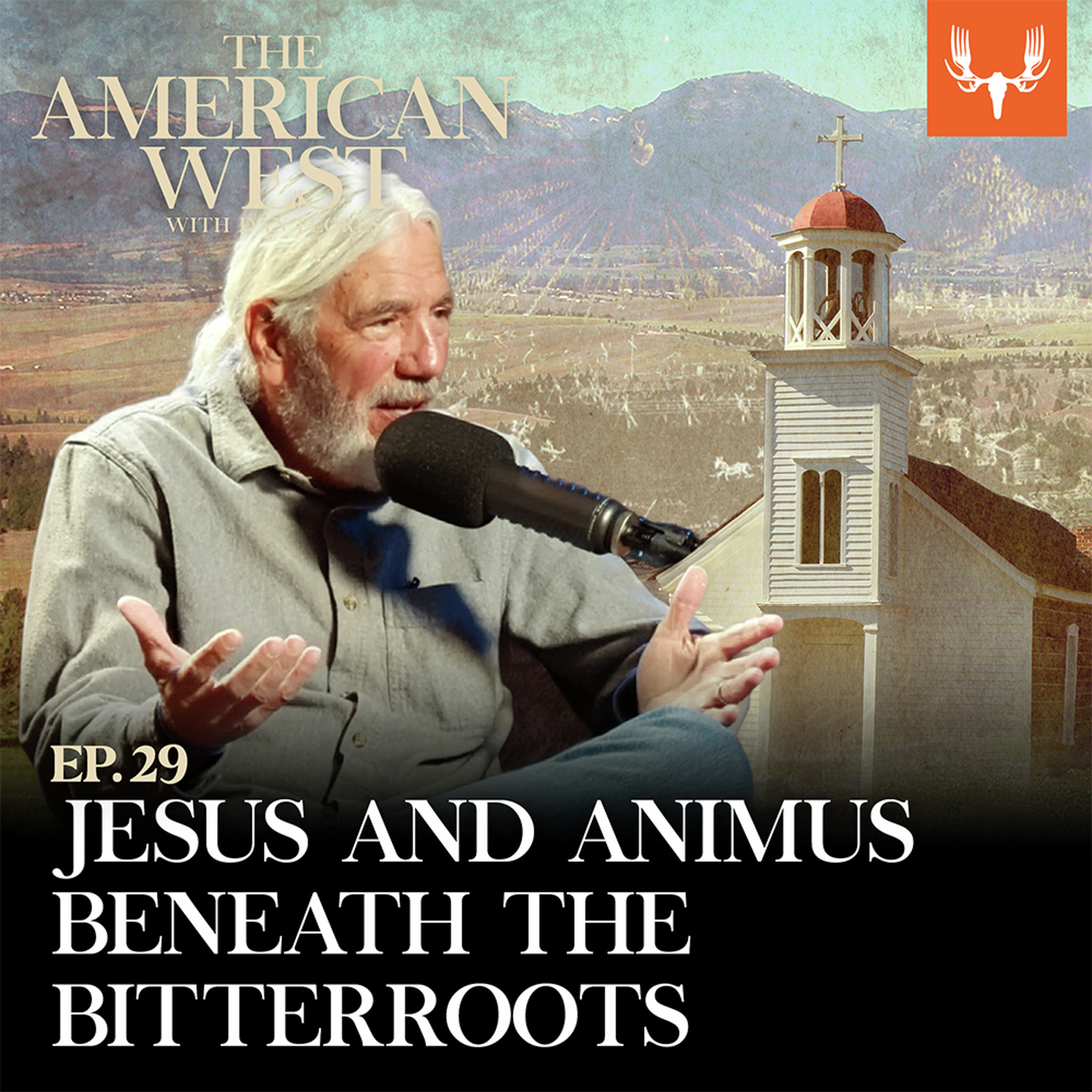
The history of Montana began with an earnest plea by its native people to learn Christianity. But the mission collided with reality when the two sides could not agree on the purpose of religion. I'm Dan Flores and this is the American West. Jesus and Animus beneath the Bitterroots. One exquisite Rocky Mountain autumn morning during the decades I lived in Montana, I walked past tourists and tent on a roadside historical marker and descended down to the gray cobbles of a famous Little Montana stream named Lolo Creek. Then I picked my way west along the ice clear bouncing waters for a quarter mile or so while yellow cottonwood leaves rotated with studied deliberation against the hump blue profile of the Bitterroot Mountains. I was here because I'd recently read a centuries old journal entry about this spot somewhere along these cobbles, a few of them perhaps minutely smaller now since it was nearly 220 years ago some of the Lewis and Clark party, leaving the Bitterroot Valley's pleasant plains of wild hyssop, that was their biblical term for sagebrush, approached what they called the Tremendous mountains and came upon an arresting site. One of the many expedition members who kept a journal, Joseph Woodhouse, described it this way. Wednesday the 11th of September, 1805.
- [03:42]
Randall
A beautiful, pleasant morning past a tree
- [03:45]
Dan Flores
on which was a number of shapes drawn on it with paint by the natives. A white bear skin hung on the same tree. We supposed this to be a place of worship among them. Lewis and Clark's group of Blue Ridge and Missouri hunters, despite many admirable qualities, famously misfired more than once when it came to grasping Indian religions. But not this time. Their path up Lolo Creek had indeed led them past assumes or medicine or power shrine of the people whom Jefferson's explorers were calling the UTLA chutes. These were the people Lewis and Clark had met at the upper end of this valley. Meanwhile, many days earlier, from them they had acquired additional horses and instructions on how to find a trail on this trail for crossing the Bitterroot Mountains to the waters of the Columbia river and onto the Pacific Ocean. Local inhabitants of this valley for generations beyond count, these native people then thought of themselves and still do, with a name that translates to the Bitterroot Salish. For a long time, everyone else mostly ignored their wishes about their name and referred to them as the Flatheads. Now, religious thinking, yours, everyone else's, and for sure that of every Native person who ever lived is a tricky thing. I'm not myself a person of a religious faith, although, like most of us, I spent many a Sunday morning with parents who commanded me with let's to church. I know from those years that religion is not just a belief system one happens onto. It functions as a philosophy of life and an exploration and explanation of the meaning of existence. Which is why most anyone who touts the certainty that their own religion is the only true one shouldn't be surprised to find just about everybody else outside their circle more than passing annoyed with them. But suspend your own convictions about the validity of your religion for a moment and ponder this question. While individual conversion from one religion to another occurs frequently, what happens when an entire people with a perfectly serviceable religion falls on hard times and begins to wonder if someone else's gods might not be more sympathetic? How would something like that play out? And what does that say about the practical function of religion anyway? Interestingly, those very questions occupy the intersection of events that two centuries ago led to the creation of the western state of Montana. And we do indeed know something about how a religious story like that would play out. Because a middle aged French priest who came to the west in 1840 left the future a book and a score of drawings and paintings devoted to that very history. This story then is one of those, much like the writer Mark Twain used to preface with a wonderful sentence, I will now tell you a tale that has in it a touch of pathos. I'm not Salish, although I've known people who are, which is one kind of identification. And once, over a 20 year span, I built and lived on a small mountain ranch in the valley the Bitterroot Salish had occupied for a vast stretch of time, which is another way to identify with them. When I moved to Montana in the early 1990s and began exploring the five valleys around Missoula for a place to live, it was the Bitterroot Valley that won my sweepstakes. I'd known it would years before. I'd read fairly extensively about the mountain valleys of Montana, then on summer road trips to the west, had driven and camped in most of them. It made me laugh to try to pronounce Bitterroot the way most of the locals did, where the root in Bitterroot doesn't rhyme with your boots, but rather with the foot you slide into it. But this beautiful mountain valley just west of the Continental Divide exerted an undertow pull on me that I've never gotten over. With a chance to live in the state, I found myself transfixed by the Bitterroot's 75 mile succession of 9,000 foot humpback mountains, split one from the other by soaring granite canyons, every one of them with a trail reaching far back into one of the biggest national forest wildernesses in the West. Below those vast public lands stretched a north south valley four to eight miles wide, slit by its clear, cold namesake river into a west side and an east side. For all the high mountain drama on the west side of the valley, what drew me repeatedly was the more modest mountain range on the east side. Called the Safire Mountains. It was a lower undulation of green ridges and peaks with a savannah parkland at its feet. This was drier, more open country than the uniformly green mounds of the Bitterroots. It was a place where sagebrush grew and the main Bitterroot Range to the west stood in panoramic relief. In today's Montana, grizzly bears and gray wolves and Yellowstone park and the TV series Yellowstone and its spin offs fill people with fantasies about Montana Ranchers and wilderness adventure. But in the case of the Bitterroot, the reality is that before the arrival of Old Worlders in this part of the west, the beautiful valley had spent a very long time with as the primary home of the resident population of Salish, whom Lewis and Clark found here in the Bitterroot's own version of America's native lands dispossession. Though in an 1855 treaty with the U.S. those Salish had signed away 23,000 square miles in the Bitter route and in return got a 2,000 square mile reservation in the Mission Valley north of Missoula. The US Government and Montana Territory then methodically forced their last bands under a leader named Charlot finally to abandon their natal valley in the 1880s or the Flathead reservation 70 miles to the north. But the Salish had been here for so long, had lived in and managed the Bitterroot Valley for such a vast amount of time, that their presence had put on an indelible cultural imprint on the place as a result of Salish ecological practices. For example, the grand ponderosa pines in the valley, especially those on the Sapphire Mountainside, left American observers like C.E. dutton astonished in his case in the year 1887. The trees are large and noble in aspect and stand widely applied. Dutton Road Instead of dense thickets where we are shut in by impenetrable foliage, we can look far beyond and see the tree trunks vanishing away like an infinite colonnade. The ground is unobstructed and inviting. What Dutton called an unobstructed and inviting look was actually the result of of centuries of understory burns. The Salish residents had set a human fire ecology cycle that varied between three and 30 years. Then there were the valley grasslands. The natural cover of rough fescue, blue bunch wheat grasses and Idaho fescue appears from pollen evidence to have expanded in the Bitterroot Valley and became purified of sagebrush and rabbit brush 2,000 to 3,000 years ago, when the Salish arrived as full time residents and began to fire the valley regularly along with the shrubs. Douglas firs also decreased, although in truth Salish fires probably skipped and jumped around enough to create many different mosaics. But bunch grasses and giant scattered yellow belly ponderosas thrived under Salish management. There may have been fewer than a dozen big pines per acre, even in the draws. In both the Bitterroot and Sapphire ranges, fire blackened mountains were common because the bunch grasses were cool season matures that dried and lost their nutrition in the summer. Bison were only infrequent visitors to these mountain valleys. But elk did well and horses loved the place. The Salish got their horses early, by the early 1700s, directly up the mountains from New Mexico. By the time Lewis and Clark arrived a century later, the Bitterroot was already known as a horse valley and supplied many of the expedition's mounts. In 1857, trader John Owen figured the Salish had 4,000 horses in the valley, about 10 per person, which required some 100,000 acres of grassland to nourish them. When the Pacific Railroad survey arrived that same decade, John Mullen wrote that the Bitterroot Valley was 4 to 7 miles wide and naturally covered with luxuriant grass, over which several thousand horses were roaming, scarcely noticed. Another observer spoke poetically of this product of Indian ecology as constituting rolling seas of bunch grass. In other words, by regularly refreshing their landscape, these Salish set fires were a good part of why the ecology of the Bitterroot country looked the way it did, and they lived as well as they did. I, of course, am not in a position to speak for the Salish, but I will say that these were people with a fine reputation. Everyone who came to know the Salish two centuries ago thought of them as an exceptionally intelligent and practical people. As for the religion that explained the world to them, their religious or spiritual intelligence told them that there was an animating power in the universe that surged through everything and that broke the surface like islands in a lake and a wide host of animals, power spots and helpers. The Salish religion was many complex things, but most of all, it was, and still is, a rational way of explaining why things happen by dent of a fierce and pragmatic assessment of the effects that religion produced. As with most religions, a primary reason for trying to figure out why things happen had everything to do with influencing the outcome. But the Salish had the kind of fine intelligence that demanded proof. They did not believe anyone's sumus or religious explanation for why things happened until the power of it could be demonstrated. What makes the rather famous story I want to tell now a poignant one is simply this. Because of change and a world of events larger than they could conceive, during the third decade of the 19th century, the Bitterroot Salish apparently began to doubt the ability of their religion to continue to make things happen for them. Waves of disease, especially smallpox, that their shamans could not combat kept washing across the mountains into their valley. Then there was the bizarre 15 year policy on the part of the Hudson's Bay Company to keep the Americans out of Oregon by Trapping a fur desert from the Mission Valley through the Bitterroots and the Snake river country down to the Wasatch. They that brought these interior mountain valleys to the brink of ecological ruin. In the midst of the fur desert years. A mountain man named Josiah Pilcher, who was among the Salish in 1828 and 1829, wrote that in the absence of game and fish, they are driven to every extremity to sustain life, devouring every bird, beast, insect and creeping thing they can get hold of the and tearing up the ground for roots. As buffalo numbers west of the Continental Divide began to fade away by the 1830s, Salish shaman's attempts to call buffalo into the Bitterroot Valley failed. And across the Divide in the Big hole in the Three Forks country where the Salish had long journeyed to hunt buffalo and now love to run their ponies after the pounding herds, the far more numerous bullets, Blackfeet, who lived east of the Divide, imposed an US only moratorium on buffalo. This was something the Salish simply could not abide. Yet another traveler to the Salish in their valley home in the 1830s noted that the only cause assigned by them for their perpetual warfare is their love of buffalo. Another reflecting on the frequent thrashings the better armed Blackfeet gave them, so said that the Salish had considered peace but decided that going to buffalo was just too important to them. And anyhow, war kept their people alert. They told him,
- [17:49]
Shady Rays Advertiser
When I was in my 20s and I was trying to get my life in order, I had a goal of keeping a pair of sunglasses and not losing them. The goal was that simple. Sunglasses, cheap just get lost. And I needed to manage my life. And this was a key data point because we all know that moment, the one when you realize you left your favorite sunglasses in the woods, on the roof of your truck or at a gas station three states away. I've been there. But then I found Shady Rays and it changed the game. These sunglasses are made for real life. They're good looking, polarized, durable and not stupidly expensive. And here's the wild part. If you lose or break them even on day one, Shady Rays will send you a brand new pair. No guilt trip, just replacements. So now I actually wear my sunglasses without fear. On hikes, in the woods, at concerts, on the boat, wherever. Shady Rays is eyewear backed by a lost and broken protection. Head to shadyrays.com and use code BEAR for 40% off two or more polarized sunglasses. Try for yourself. The Shades rated five stars by over 300,000 people O'Reilly Auto Parts can help
- [19:01]
Ad Host
take the guesswork out of check engine, ABS or maintenance lights in your vehicle with O'Reilly Veriscan. The service is free and provides a report with solutions verified by ASE certified master technicians. O'Reilly Veriscan can identify the most likely problem with just one scan scan. If you need help, O'Reilly Auto Parts can recommend a shop for you. Don't ignore a check engine, ABS or maintenance light. Ask for O'Reilly Veriscan Today, a free service exclusively at O'Reilly Auto Parts. When you're in the back country, don't forget your own backcountry. Keep it pristine and confidently clean by bringing along wet extra large Dude Wipes. I'm. I'm glad to be doing dude wipe ads because I buy dude wipes anyways. I've been a long time dude wipe. I'm a dude wipe dude all the time. Just like your truck gets muddy out in the wild soaking your butt. You never clean your vehicle with dry paper towels, so why would you clean your butt with dry toilet paper? Wetter cleans better. So ditch the itch and switch from TP to wet extra large dude wipes. Love them. Like going on a ten day moose hunt. I just bring a pack along. Not only that, so they're extra large. Okay. If you're a little baby, you get little baby wipes. If you're a man, you get extra large dude wipes. And when you're out in nature, it's going to inevitably call. So make sure you bring along wet dude wipes and three adventure sizes like day hike single wipes, 18 pack weekend wipers or you know, for long trips you got a 48 count pack. And it's not just that. Like when you're out camping just sleeping in a sleeping bag, let's say you're gone for 10 days, whatever. I use them just to clean up at night. Like, you know, scrub the old pit, scrub your arms if it's all dusty. Just kind of get your neck and everything cleaned up. I love having them with me. Dude wipes. It is the best clean pants down. They're available at Amazon. That's where I usually order mine from that Amazon. But you get them at Walmart nationwide. Fantastic product. Proud to be doing ads for these boys at dude wipes.
- [21:07]
Dan Flores
In this situation, with their traditional religion now shaky and protecting them. Early in the 1830s, the Salish came to the conclusion to call on the most powerful new religion they could see anywhere on their horizon to come to their aid. For at least two decades before the 1830s, there had lived among the Salish a scattering of displaced Iroquois from the Great Lakes, many of whom had been converted by Jesuit missionaries and were at least nominally Roman Catholics. A crucial one of these eastern Indians come west seems to have been John Gray, who was not only a disciple of the mysterious faith called Christianity, but also a hand to hand fighter of awesome reputation. Gray, in other words, manifested observable religious power. Many of the white mountain men, French and American, who were now coming among the Salish were also men of demonstrated power and and ability, and they were adherents of this same new religion. But when the Salish attempted a facsimile of the Catholic chants and prayers, Iroquois advisors like Ignacy Lamus insisted that the sumis would boomerang unless everything were done exactly right. That was an explanation that made sense to native people who had always insisted on precision in their own religious ceremonies. What followed then became famous in early Western history to secure teachers who would show them exactly how to practice the new religion. In 1831, the Salish and other allies from the Mountain west made the first of a series of legendary journeys to St. Louis to ask for priests. They continued to do so until the Belgian Jesuit Father Jean Pierre de smet, finally established St. Mary's Mission in the Bitterroot Valley in September of 1841. Three years before that, in 1838, a Salish Buffalo hunting party had suffered a horrifying defeat by the Blackfeet out on the plains. So their fourth journey to St. Louis had literally been one of desperation. Father de Smet said that with tears in their eyes, they begged me to return with them. All this native pleading to be taught Christianity was just too much for missionaries back East. The widely circulated stories drew de Smet to the mountain tribes and Protestants like Jason Lee Marcus and Narcissa Whitman and Henry and Eliza Spalding to or the potential for religious and cultural misunderstandings between these native people and the missionaries now arriving among them was enormous. For their part, the Salish had only glancingly heard of the deity these Old Worlders called Jesus. In the Salish religion, animal masters and locales in the landscape were sacred. Dreams could be evidence used in convicting someone of a crime. Sexual freedom was available for both men and women, and the Salish readily acceded women's right to divorce. Christian missionaries to American Indians had long believed that ideas like these meant that Indians must be disciples of the supernatural force Christianity thought of as the source of evil. In fact, few native peoples, the northeastern group Europeans called the Iroquois of the Hardy nosana of were an exception. But few people believed there was an evil force in the world. But to the missionaries, if Indians embraced animal deities and knew nothing of Jesus, then they must worship Satan. This European conviction that people holding nature sacred worshiped dark forces led to tragedy on numerous occasions long before the 1840s. It had also produced violent backlashes against missionaries by native people people, most famously the pueblo Revolt of 1680 in the Southwest when persecuted native shamans had led an uprising that drove Europeans from the Pueblo world for more than a decade. When he arrived beneath the bitter roots, Father de Smet had in mind a region wide reduction of tribes, similar to the famous Jesuit reduction in Paraguay. Utterly misperceiving Salish motives, he interpreted their eagerness as evidence that they were the elect of God, he said, a people who evinced the greatest simplicity, docility and uprightness, and who also had the courage of heroes. Fortunately, there were many effective points of convergence between the two religions. Both Salish animism and Catholic Christianity embraced chants, songs, ceremony and prayers. Both spoke of a sacred yearly round, sacred colors and objects, power spots, the use of water and incense for purification and feast days. To the Salish, their spirit helpers seemed similar to the Catholic saints, just with different names. Despite the infectious enthusiasm all around, from the start, the priest noticed some trouble spots. For one, the Salish not only lacked notions of good and evil, they had no sense of a heaven and a hell. And the more they heard about this particular idea, the less they liked it. Two, the priests who actually ran brand new St. Mary's Mission, 20 year old Father Gregory Mingarini and 42 year old Father Nicholas Point, noticed right off that Salish prayers consisted in asking to live a long time, to kill plenty of animals and enemies, and to steal the greatest number of horses possible. What the Catholics offered was salvation of the soul and its journey to heaven. What the Salish appeared to want from religion was something else entirely. The sumis our power to make things happen in this world. The sky is to him non existent, the Jesuits wrote. The Indian thinks only of the earth and wants only the earth, since it is the earth that gives existence to everything anyone knows. Thus it is to the earth that he addresses his first prayers. Among the Europeans, it was Point, a Frenchman with a manic depressive personality and a fine thing for us today, also a wannabe artist with some rudimentary art skills who labored to preserve the details of this classic interaction of ideas. Point's paintings and drawings, along with a book he wrote Wilderness Indian Life in The Rocky Mountains are founding historical documents in Montana history. He portrayed, for starters, the romantic setting of St. Mary's Mission with the Bitterroot river and mountains behind it, capturing with that romance the high hopes of the priests who were the first American settlers in present Montana. But Point also had an anthropology curiosity about Indians living presumably like the progenitors of modern man. He found the Salish, their lives and their worldview an exciting counterpoint to European ideas. Point closely observed their religion and would journey with them to the Buffalo Plains. The Frenchman persuaded a distinguished Salish warrior the missionaries called Ambrose. His real name was Schilche Lumela, which meant Five Crows, to allow him to paint a version of the warrior's pictograph of war exploits. That's a one of a kind combination in the history of Western art. Here, as Point wrote, deep in the Rocky Mountains, surrounded by scenes about which I had often dreamed as the beautiful ideal of all natural perspectives, he studied a Salish religion that took him by surprise. They assigned manitou, or spirit, to phenomena like the sun, the thunder and so forth, he marveled. Their practice of religion centered on the application of what they called medicine or sumis, and Point perceived three versions of it. The first and most important was medicine of utility, or the power to acquire with the least possible effort the greatest possible abundance of things necessary for life. Medicine was also important for purposes of ostentation, for dress and status. And medicine was likewise called on when one intended malice towards another. Medicine, in effect, was the power to make things happen in this world. It did not focus on outcomes in a second life. Despite the missionaries hopes of saving souls, it's clear enough that they came face to face with this reality pretty quickly. As much as the Salish wanted to please their instructors in this new religion, the Indian sense was that it was a mastery of religious detail that was important to produce worldly success. One of Point's paintings, which he called Ignace's Medicine Power, presumably made that clear. In it, the Frenchman showed a famous Iroquois Salish known as Young Ignace in a trance like state outside a sweat lodge. Surrounding him were the animal helpers. Horse, elk, dog, wolf, beaver, deer, perhaps a lynx, that were his special aids to make the things happen in the material world. To live long, to have many lovers, to be a successful hunter and horse stealer, and to vanquish foes in battle. Those were the whole intent. As for his and the missionary's own feelings about such quests, the Frenchman countered Ignazi's ideas with a painting he called Worshiping False Idols. Its dark evocations of licking flames, a rhythmic tambourine, and shamanistic incantations capable of summing forth devilish spirit forces struck at the heart of the problem the priests believed they faced in turning the Salish towards Christianity. Before very long at all, a road test for the new religion was at hand. It was time for the fall buffalo hunt on the prairies, and the Salish and their mountain allies, the Nez Perce and the Pend Oreillays, assembled for the journey as they made preparations to cross the divide. That autumn of 1841, Nicholas Point sat down to his sketchbooks to capture just why these Indians had tried so valiantly to get the Jesuits to come to their valley. Point gave his painting an obvious name, Blessing of the Arms, before leaving for the hunt. It showed a presiding Catholic Sacred Heart as well as a priest with suspended angels. One of the angels, in fact, fully armed, hovering over the gathered Indians who are holding their weapons aloft for blessings. Why do that? To make their guns impervious to misfires and to the whims of bad spirits who might draw a ball off its mark. As the missionaries surely must have realized, none of this was about saving souls. The Salish intended Christianity as a salvation of a people in real time. Point and the young Italian priest Gregory Mingarini accompanied this assemblage on their journey across the mountains to the buffalo plains beyond. But Point quickly found that the number of bison, as he put it, has so diminished that the hunting camp with which I was traveling had to March 24 days before finding any trace of a herd. Why so few? It's the result of the campaign of extermination carried on by American commerce, he wrote. Trade of manufactured status goods and firearms was part of it, but the compensation of destroyed Indian men and enslaved Indian women. Point believe the Frenchman's painting Father, Mother and Daughter on the Hunt depicts what he called the barbarous euphoria that drew the Salish from their protected valley out into open country and into harm's way. But for the now slightly Christianized Indians, the telling moment for the new religion was when they confronted the black. And that moment came quickly. The Pend Oreille group were caught in a surprise Blackfeet attack and were on the verge of being wiped out when a miraculous event occurred. Culex, a woman warrior among them, rallied them, and they managed to kill 28 of the enemy under her leadership that routed the Blackfeet into a panicked retreat. Then another miracle followed. In one hunt surround, the Salish took down 153 Buffalo. With those kinds of obvious successes, the watching Blackfeet refused to attack the mountain tribes again. They were too powerful. The new religion had worked. This is probably a story that ought to have a happier ending for the two principals, priests and Salish. But in the real world, it naturally could not turn out that way. Indian expectations and Jesuit expectations were arrows shot from different bows that flew past one another in flight. Following the Paraguay model of offering Christianity to all the regional tribes, De Smet and the missionaries decided to extend their hands to the Black Father. At one point, when a party of enemy Blackfeet was at the mercy of a Salish hunting party, the priests actually intervened to save the doomed Blackfeet party to the complete confusion of the Salish. There were other problems in offering the power of the new religion to enemies. Young men among the Salish soon came to resent the notion of universal brotherhood. How was one supposed to earn stakes, status and war honors if there was peace with everyone? The final straw came when the missionaries persuaded the Pend Oreille headman, Loyola, to give up buffalo hunting in favor of becoming a farmer. Almost at once, Loyola, who had been a wealthy example of Indian success, became impoverished and lost status in his tribe. At this juncture, the Salish shaman, Bear Track, or Alexander, as the priests called him, turned from Christianity back to his white buffalo medicine. He remained aloof from the missionaries after that, yet remained respected among the Salish. Most tellingly of all, Salish Sumish didn't keep working until 1845. The mountain tribes enjoyed unprecedented successes over the Black Fish. But after the Blackfeet got their own mission, founded by De Smet himself, Salish fortunes seemed to worsen. Then word came from Oregon that the Cayuses had murdered Marcus and Narcissa Whitman. And in the aftermath, no Indian had suffered some divine retribution. With that, Nez Per shamans began disrupting Mass at some, leading the new priest, Father Anthony Ravalle, to report to his superiors that the majority gave up private prayer and vented insult and injury every day upon the missionary. When word got out that the Blackfeet shamans had decided all the Christian missionaries should be assassinated, the Salish went out on their fall buffalo hunt and never even discussed the trip with the missionaries. In 1850, the Jesuits finally abandoned St. Mary's Mission in the Bitterroot Valley. This particular morning, so many long years later, as I walk along Lolo Creek with the Bitterroot slopes rising in a series of dark green humps both north and south, I look for but do not find that Sumas shrine to the grizzly. I do know that the Salish still visit sumi spots like the Medicine Tree farther up the Bitterroot River. And of course nowadays the cross is in prominent display in every little town in the valley. A rapprochement of sorts, I suppose. But then I walk past the tourists again to get to my jeep and this time there are arguing. Over what? I can't be certain, although for a long moment it sure sounds like an argument over religion.
- [39:10]
Shady Rays Advertiser
When I was in my 20s and I was trying to get my life in order, I had a goal of keeping a pair of sunglasses and not losing them. The goal was that simple. Sunglasses just get lost and I needed to manage my life. And this was a key data point because we all know that moment. The one when you realize you left your favorite sunglasses in the woods, on the roof of your truck or at a gas station three states away. I've been there. But then I found Shady Rays and it changed the game. These sunglasses are made for real life. They're good looking, polarized, durable and not stupidly expensive. And here's the wild part. If you lose or break them even on day one, Shady Rays will send you a brand new pair. No guilt trip, just replacements. So now I actually wear my sunglasses without fear. On hikes, in the woods, at concerts, on the boat, wherever Shady Rays is eyewear backed by a lost and broken protection. Head to shady rays.com and use code bear for 40% off two or more polarized sunglasses. Try for yourself the shades rated five stars by over 300,000 people.
- [40:21]
Ad Host
O'Reilly Auto Parts can help take the guesswork out of check engine, ABS or maintenance lights in your vehicle with O'Reilly Veriscan. The service is free and provides a report with solutions verified by ASE certified master technicians. O'Reilly Veriscan can identify the most likely problem with just one scan scan. If you need help, O'Reilly Auto Parts can recommend a shop for you. Don't ignore a check engine, ABS or maintenance light. Ask for O'Reilly Veriscan Today, a free service exclusively at O'Reilly Auto Parts. When you're in the back country, don't forget your own backcountry. Keep it pristine and confidently clean by bringing along wet extra large dude Wipes. I'm I'm glad to be doing dude wipe ads because I buy dude wipes anyways. I've been a long time dude wipe. I'm a dude wipe dude all the time. Just like your truck gets muddy out in the wild soaking your butt, you Never clean your vehicle with dry paper towels. So why would you clean your butt with dry toilet paper? Wetter cleans better. So ditch the itch and switch from TP to wet extra large dude wipes. Love them. Like going on a ten day moose hunt. I just bring a pack along. Not only that, so they're extra large. Okay. If you're a little baby, you get little baby wipes. If you're a man, you get extra large dude wipes. And when you're out in nature, it's going to inevitably call. So make sure you bring along wet dude wipes and three adventure sizes, like day hike single wipes, 18 pack weekend wipers, or you know, for long trips you got a 48 count pack. And it's not just that, like when you're out camping just sleeping in a sleeping bag, let's say you're gone for 10 days, whatever. I use them just to clean up at night, like, you know, scrub the old pit, scrub your arms if it's all dusty. Just kind of get your neck and everything cleaned up. I love having them with me. Dude wipes. It is the best clean. Pants down. They're available at Amazon. That's where I usually order mine from. It's not Amazon, but you get them at Walmart, nationwide. Fantastic product. Proud to be doing ads for these boys at Dude Wipes.
- [42:31]
Interviewer Randall
So, Dan, in this episode you tell the story of St. Mary's mission and the arrival of the Jesuits among the Bitter Salish. And it's really an interesting story because I think for a long time it was sort of told, or you might find like in a local tourism brochure, this very simple narrative of, you know, they sought out priests and the Jesuits came and they lived together peacefully for a number of years. Right. But there's so much more going on underneath the surface. And so I wonder if you can just begin by talking about the different understandings of faith between the two sort of main actors in this story and how just a fundamental difference in what religion is or what faith is sort of set this off on a course that was sort of inevitably resulted in a breakdown.
- [43:39]
Randall
Yeah, it did result in a breakdown, you know, and so this is the beginning, sort of the founding story of the state of Montana. I mean, there certainly, obviously had been a lot of history played out by native people there for a long time. And there had been fur trappers from the Hudson's Bay and from the American Fur Company and all that coming back and forth through the valley. But this was through Montana even. But this was the first time there had ever been an attempt to actually settle on the part of people who weren't native. And you know, this was not just a fur trading post. This was something, I mean, and the church is still there, right? I mean it's, you know, you can. It's kind of a tourist attraction in Stevensville, Montana today. But it's a story that, I mean, I completely agree, Randall, with your take on it. It's a story that has often been simplified as here's the beginning of Montana. These native people journeyed repeatedly to St. Louis to get priests to come visit them. And the clergy, the Jesuits finally did. And it was a wonderful thing. And it's the beginning of Montana. Well, the truth, of course, is that it featured a classic kind of early contact misunderstanding between the native people in western Montana. And these priests were largely Europeans. I mean, one of them, Father De Smet, was Belgian. Nicholas Point was a Frenchman. The other guy, the other guy who was their primary sort of go to guy was an Italian. And so they were, they were sort of Old Worlder slash Americans who brought the western worldview to it. The idea, you know, that we're going to take the true religion to these indigenous people and lift them up and civilize them. And that's what the Jesuits thought they were doing. And they were really excited about the fact that here are native people who have actually journeyed repeatedly to get us to come. And when they got there, what they discovered, and the reason we know this really well, is because of Nicholas Point's work, particularly that book he wrote. What they discovered was that they had a different conception of what they were doing than the Salish did. The Salish were caught in a situation where their valley, which they had lived in for 3,000 years. And they had long, not only lived well in that valley, but they had also long gone to Buffalo, just over the divide. Only about a three days travel and less than that by horse. Once they acquired horses, they were sort of in the throes of a really bad period because the fur trappers were competing with one another for control of the West. And the Hudson's Bay Company had come up with this strategy of imposing a
- [46:57]
Dan Flores
fur desert through the Mission Valley, the
- [47:01]
Randall
Bitterroot Valley, the Limhi Valley, the Snake river country, the Wasatch. And so for 15 years these, these brigades of trappers came up and down these valleys and basically wiped out not only the furbearers, but they killed off a lot of the game that, that the Salish were existing on. So the Salish Were in a hard. They were in a hard place and they were looking for some way to get out of it. And one of the ways, of course you do, that is you appeal to your deities, your appeal to religion to help you escape this situation. So that's why they were sending their dignitaries to St. Louis to try to bring the Jesuits out. And once everybody got arrayed at St. Mary's Mission, then it began to occur to Nicholas Point in particular, who sort of had an anthropologist interest in religion. Wow. This is not exactly what we thought it was going to be. What they want from religion is for everything in the present day world to work well. Right. And what we want, of course, is to save their souls, convert them to Christianity, send them on to an afterlife. And they don't even have a concept of anything like that.
- [48:22]
Interviewer Randall
Yeah, you make that point that the missionaries were trying to save souls and the Salish wanted them to save their world.
- [48:31]
Randall
Yeah, that's it.
- [48:33]
Interviewer Randall
And to the Salish, there's not. It's hard to see value in a system of religious belief if it doesn't produce results.
- [48:45]
Randall
That's precisely what became the rub in this situation, because. And the Salish were. They were.
- [48:56]
Dan Flores
They were very practical.
- [48:57]
Randall
I mean, religious power was all about demonstrated results.
- [49:04]
Interviewer Randall
Right.
- [49:04]
Randall
And so you couldn't just tell us that if we, you know, adopt the practices of your religion, then things are
- [49:13]
Dan Flores
going to be better. You're going to have to show us.
- [49:16]
Randall
Right. So that became one of the interesting aspects of this story too. And of course, the, the field trial of how well Christianity was working for them was how they were going to do when they crossed the divide into Blackfeet country.
- [49:32]
Interviewer Randall
Right.
- [49:33]
Randall
And went to hunt buffalo where the Blackfeet were trying to keep them away. And that then became an interesting aspect of the story too.
- [49:44]
Interviewer Randall
Yeah, the. I think it's interesting because one of the interesting aspects of this is that from the Western perspective, religious conversion is sort of a wholesale replacement of theology. Right. As if there's sort of a form, you know, blank space and a form and you cross out the old religion and you write in Catholicism, what have you. But the Salish really have sort of a piecemeal approach to aspects of Catholicism that they like and other aspects that they don't like. And so they don't adopt it. And I think that speaks to like the, you know, the utilitarian vision that, that you described earlier. Like they don't like the idea of damnation and hell.
- [50:40]
Randall
Yeah.
- [50:41]
Interviewer Randall
Because it's unpleasant. So why would you have that as part of your.
- [50:44]
Randall
And the more they heard about it, the less they liked it.
- [50:47]
Interviewer Randall
I really enjoyed that line. Yeah, yeah. The Blackfeet story is like they initially, when they go over and they buffalo hunt, they initially have some success. Right. They have a good hunt. And there's a woman, Salish woman, who's a warrior who demonstrates. She takes out a bunch of Blackfeet warriors. And it bodes well for the missionaries, right?
- [51:18]
Dan Flores
Indeed.
- [51:18]
Randall
I mean, that first trip across the divide, I mean, it's difficult to find buffalo for a while. They do find the Blackfeet, and it's kind of an amalgamation of the mountain tribes who often went to Buffalo together. So it's Nez Perce bands, it's Pend Oreille groups, and it's a Pend Oreille contingent that actually is about to be wiped out by the Blackfeet when this particular female warrior, Culex is her name, suddenly rallies the troops and manages to turn the battle around. And I mean, and Nicholas Point actually painted a watercolor of this scene of her leading a charge on the Blackfeet camp. And the Blackfeet are scattering in panic.
- [52:15]
Dan Flores
And a lot of. I mean, what you have to remember
- [52:18]
Randall
about these kinds of encounters is that often native people would gauge how successful their particular power was on a certain day.
- [52:29]
Dan Flores
And if things did not look good,
- [52:32]
Randall
even though the Blackfeet probably outnumbered the Pend Oreille's.
- [52:36]
Interviewer Randall
Yeah.
- [52:36]
Dan Flores
Suddenly it looked like the Pend Oreille
- [52:38]
Randall
had more power than one would expect. Ordinarily, Blackfeet no doubt had heard something about the Jesuits going to them and teaching this new religion. So the Blackfeet panicked and scattered across the landscape. And that, of course, was a kind of a miraculous outcome of a battle that looked like it was doomed. And then the other thing that happened is within a few days, this combined group of mountain tribes finds a herd of buffalo and one surround, they kill more than 150 of them. And so, man, everything looks good at this point, this new religion. Absolutely. Because as one of the Salish told Nicholas Point, this is another kind of line I've always loved about this story. What do you want out of religion? Well, what we want is I want
- [53:32]
Dan Flores
to have a lot of lovers.
- [53:33]
Randall
I want to steal more horses than anybody has ever heard of.
- [53:38]
Dan Flores
And I want to be able to
- [53:39]
Randall
kill all my enemies anytime I want to.
- [53:41]
Dan Flores
That's why religion is supposed to.
- [53:43]
Randall
Yeah. Produce.
- [53:44]
Interviewer Randall
And that's a sticking point because the Jesuit. The sort of universalist impulse of the Jesuit missionaries is to bring everybody together.
- [53:55]
Randall
Oh, yes.
- [53:56]
Interviewer Randall
And. And the Salish have a real issue with the Jesuits extending their, their teachings to the enemies of the Salish. Right. And also to try to, you know, get them to avoid engaging in hostilities by which they achieve social standing.
- [54:16]
Randall
Yeah, that's right. That's exactly.
- [54:18]
Interviewer Randall
So there's these robbing points that emerge.
- [54:20]
Randall
Yeah, these are the points at which the story doesn't go so well because, yeah, the, the Christian missionaries are trying to. Trying to apply the beliefs of universal brotherhood among the Salish. And two things basically happen because Father de Smet has the notion that they're going to do a region wide reduction of tribes. And so we're also going to take the religion to the Blackfeet and the Crows and whoever wants it. So we're gonna also go to your enemies and build a mission. He informs the mountain tribes. And the other thing, of course, is that the doctrine of universal brotherhood, it begins to occur to some of the young men among the Salish. Well, how do you get war honors? Right. How do you rise in status and marry the woman you want to marry and, and acquire wealth if everybody is a universal brother? And so that sort of flies in the face again of something that they had brought as part of their cultural tradition to this whole game. Not expecting that the missionaries were going to say, well, we're gonna, we're gonna try to get you all to establish peace with one another.
- [55:43]
Interviewer Randall
Yeah.
- [55:43]
Randall
And they kind of decided, you know, that's not really what we want.
- [55:48]
Interviewer Randall
And so the story, it's. The story ends with sort of a whimper rather than a big blowout. And you mentioned in this episode the Pueblo Revolt and also the Whitman Massacre, as it's commonly known. Right. And so there are these very prominent instances in the west of religious missionaries coming to violent ends with indigenous folks. And then in the case of the Salish, it sort of seems that they just sort of lost interest and they developed some sort of, you know, a standoff. And the missionaries abandoned St. Mary's right.
- [56:35]
Randall
They abandoned the saints.
- [56:36]
Interviewer Randall
I wonder if you can sort of explain in your thinking why things ended this way instead of perhaps in violence.
- [56:46]
Randall
Well, I think the Salish, for one thing, they wanted to please the missionaries, they wanted to please the priests. And I think they were not inclined to act violently toward them. Although Father Revalli, who, Anthony Revalli, who becomes the last priest to serve at St. Mary's Mission, I mean, in about 1849, 1850, and they abandoned the mission in 1850, he says that every time they tried to hold mass, you know, there were. Yeah, There were Nez Perce shamans coming in and, and casting aspersions and denigrating Jesus and. And so it didn't turn out to be a violent end. Not like the, the Whitman massacre in Oregon where those missionaries actually were killed by the Cayuses, but. Or the Pueblo Revolt in New Mexico either where you had several Franciscans who ended up being killed. The Salish didn't do that, but they, they and the next person, the Ponderes made it known, I think to the missionaries after this 10 year experiment. It lasted basically about 10 years that we brought you here. We wanted you to come for one reason. You seem to want us to do something that we didn't really want to do. And then you took your religion to our enemies across the mountains. We're not really interested in what you have to teach us anymore. And so the St. Mary's experiment that founds Montana comes to an end. The building still remains and it's rebuilt now. But one of the things that the existence of the mission did was it allowed a host of other whites, non natives to come to the Bitterroot Valley. John Owens, a traitor, ended up establishing a post there about a mile and a half away from the mission. During the last few years that the mission existed. And so that became ultimately the permanence, the permanent settlement that around which Montana kind of coalesce.
- [59:00]
Interviewer Randall
Yeah, and I think it also worth mentioning that's what ultimately led to the dispossession of the Salish. Because the story doesn't end with. No, the story doesn't end with the, the missionaries retreating. The Salish within a few decades are removed to the Flathead Reservation. And kind of one of the more tragic removal stories in Montana.
- [59:25]
Randall
Yeah, it is. And It's. So only five years after the Jesuits abandoned St. Mary's the Salish are. They sign a treaty, a Stevens Treaty. Isaac Stevens, the territorial governor, signs a treaty with them in 1855 where they're going to be removed from the Bitterroot Valley and settled in the mission Valley about 70 miles to the north. But a contingent of the Bitterroot Salish refused to leave. And they remain in the valley until the 1880s when they're basically forcibly removed. And that's one of the signal events of that part of Montana. When the Bitterroot Salish are finally. They cross the bridge over the Clark Fork river in Missoula. And of course in the courthouse in Missoula there are paintings of Charlot and this last group of Bitterroot Salish crossing the Clark Fork river and heading north to the Mission Mountain Reservation.
- [60:31]
Interviewer Randall
Yep. Well, Dan, appreciate it.
- [60:34]
Randall
You bet. Randall, good talking. Thanks. Thanks.
- [60:55]
Ad Host
You ever get that feeling? The walls closing in the concrete jungle suffocating you? You crave some wide open spaces, the chance to connect with nature. Maybe in a spot all your own. We'll head over to land.com they've got ranches, forest, mountains, streams, you name it. Search by acreage. You can search by location. You can search by the kind of hunting and fishing you're dreaming of. Land.com it is where the adventure begins.
- [61:23]
Shady Rays Advertiser
When I was in my 20s and I was trying to get my life in order, I had a goal of keeping a pair of sunglasses and not losing them. The goal was that simple. Sunglasses just get lost. And I needed to manage my life. And this was a key data point because we all know that moment. The one when you realize you left your favorite sunglasses in the woods, on the roof of your truck or at a gas station three states away. I've been there. But then I found Shady Rays and it changed the game. These sunglasses are made for real life. They're good looking, polarized, durable, and not stupidly expensive. And here's the wild part. If you lose or break them, and even on day one, Shady Rays will send you a brand new pair. No guilt trip, just replacements. So now I actually wear my sunglasses without fear. On hikes, in the woods, at concerts, on the boat, wherever. Shady Rays as I wear backed by a lost and broken protection. Head to shadyrays.com and use code BEAR for 40% off two or more polarized sunglasses. Try for yourself the shades rated five stars by over 300,000 people.
- [62:34]
Ad Host
O'Reilly Auto Parts can help take the guesswork out of check engine, ABS or maintenance lights in your vehicle with O'Reilly Veriscan. The service is free and provides a report with solutions verified by ASE certified master technicians. O'Reilly Veriscan can identify the most likely problem with just one scan. If you need help, O'Reilly Auto Parts Parts can recommend a shop for you. Don't ignore a check engine, ABS or maintenance light. Ask for O'Reilly Veriscan Today, a free service exclusively at O'Reilly Auto Parts.