Loading summary
Transcript57 lines
- [00:00]
A
You guys are always hearing me talk about Montana Knife Co. I love these guys. Hands down. Favorite knives. The blades are incredibly solid. These are high quality tools that put in the work. Well you asked for it and I've been asking for it. And MKC finally did it. They're launching their very first folding knife. It's called the Montana. It'll be dropping soon. Go to mkc.com right now and sign up for email and text alerts so you don't miss the drop. MKC.com Montana Knife Company Working Knives for Working People Again MKC.com when you're in the back country, don't forget your own backcountry. Keep it pristine and confidently clean by bringing along wet extra large Dude Wipes. Just like your truck gets muddy out in the wild soaking your butt. You'd never clean your vehicle with dry paper towels so why would you clean your butt with dry toilet paper? Wetter cleans better so ditch the itch and switch from TP to wet extra large Dude Wipes Dude Wipes it is the best clean. Pants down. They're available at Amazon. That's where I usually order mine from, but you can get them at Walmart nationwide. Fantastic product. Proud to be doing ads for these boys at Dude Wipes. You ever get that feeling? The walls closing in the concrete jungle suffocating you? You crave some wide open spaces, the chance to connect with nature. Maybe in a spot all your own. Well, head over to land.com they've got ranches, forest, mountains, streams, you name it. Search by acreage, you can search by location, you can search by the kind of hunting and fishing you're dreaming of. Land.com it is where the adventure begins.
- [01:41]
B
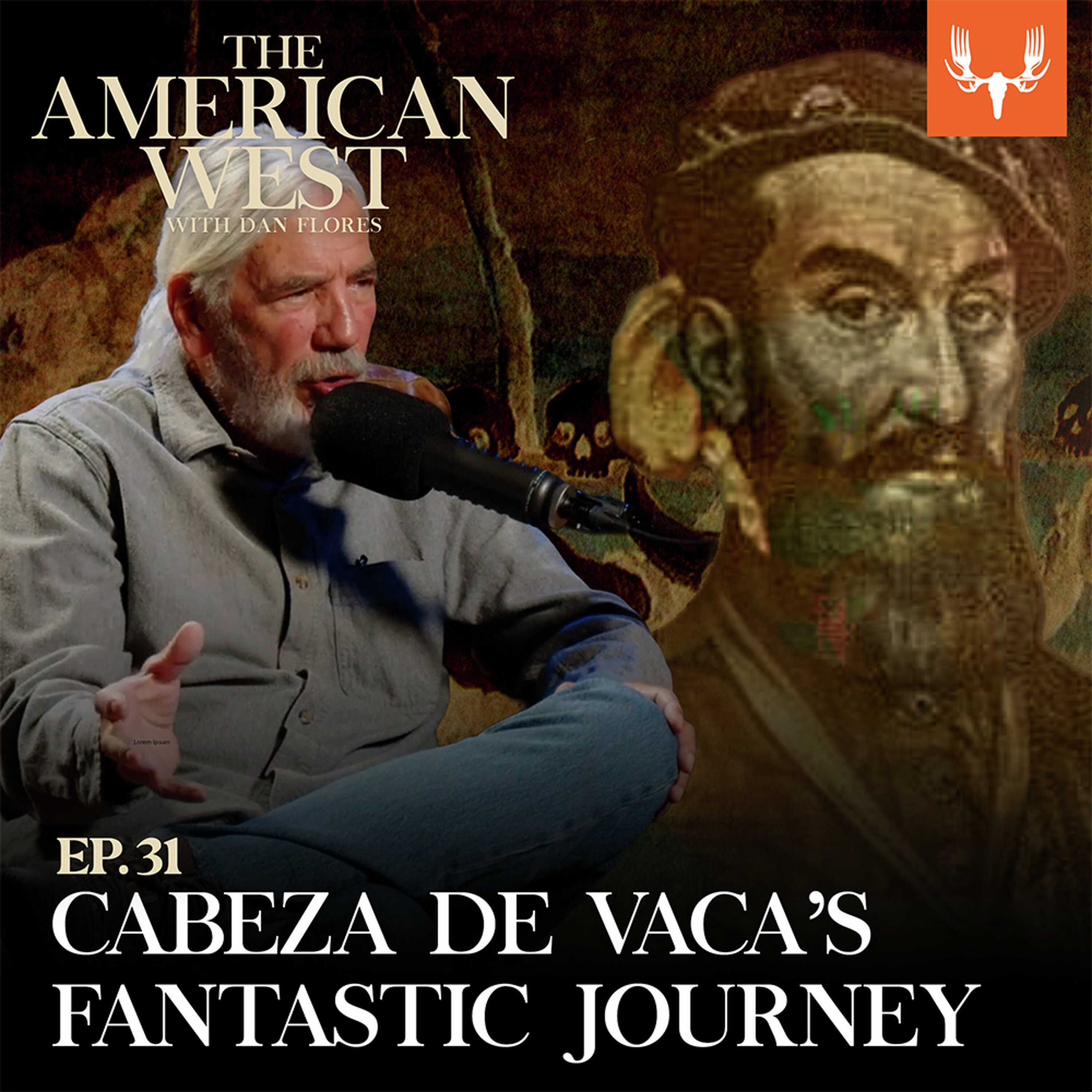
Cabeza de Vaca was one of the only survivors of a shipwreck that stranded him on the Texas shore near in the 1520s, but turned misfortune into one of the great journeys in Western history. I'm Dan Flores, and this is the American West. Cabeza de Vaca's fantastic journey after 10,000 years how would you intuit that the world as you've known it is about to change forever? Maybe you dream it, which at one insightful moment in the 1500s, is how a group of native people located far inland on today's Lake Superior foundation first understood that everything was on the verge of shifting. In this band of Ojibwas, a prophet had a dream that disturbed him. And although he took a long time analyzing and thinking about it, eventually he shared it in his dream. Strange people with baffling customs had crossed the big waters in canoes of giant size and landed on the distant coast, he said. They had pale skins and bushy hair on their faces and knives that were frightfully sharp. What else? His listeners asked. They also possessed long black tubes, the dreamer related, which they pointed at animals and birds, and from which smoke and a noise so terrific emanated that he was startled even in his dream. In the version that has come down to us, the dreamer didn't say what had befallen those animals and birds when the smoke cleared and the den faded. There's a good chance that by the time the Ojibwas sensed this impending alteration in their world, the unprecedented newcomers were already probing at various parts of North America. Fishermen and whalers from ports hundreds of miles across the great eastern ocean, which for so many centuries had isolated America from the human history unfolding on Earth's largest landmass, had been sailing west to exploit outer banks whaling and fisheries. Already by the 1520s, far to the south, there had been shipwrecks of the giant canoes on North American coasts. By the 1580s, the strange people with hair on their faces and black tubes that spewed thunder and smoke were coming ashore up and down the coast, wearing bizarre garments and speaking languages no one had ever heard before. The natives tried to make sense of them. Do you come for firewood to warm yourselves? Some of them asked. There's a theory of how first contact between cultures unfamiliar with each other unfolds. It bears a resemblance to what's called biological first contact, when creatures wholly new to a landscape, say mongooses released in Hawaii, encounter birds, and birds encounter them that have never seen one another before. The theory goes that humans making first contact experience it in two stages. In the initial stage, you can only interpret someone standing before you through the history of knowledge already in your head. They may be in strange or no garb, vocalizing unintelligibly, gesticulating, or making expressions and body language signals you you can't decipher. But your reading of them rests on how your culture has prepared you to see. Misunderstandings at this stage can be epic. In the science fiction classic the Sparrow, written during the 500th anniversary of Europeans arriving in America, first contact with a civilization among the stars happens. That when a scientific and religious order on earth receives a marvelous and beautiful auditory signal from space, interpreting it as a musical tribute to the deity, Earth dispatches a ship that includes a religious ambassador entrusted to make first contact. He discovers that the gorgeous music that lured earthlings across vast distances was are indeed poems sung into space by a planet's beings who are joyous. He has come and expect joy from him. In First Contact's second stage, both sides produce a more realistic assessment of one another. In the Sparrow, Earth's ambassador realizes the songs that drew him across space are not in fact celebrations of God, but tributes to lurid sexual encounters with the alien species. Attracted by the song's oral splendor, the singers discover that a celibate Jesuit from Earth doesn't react as they expected five centuries ago. the outset, American natives and Old Worlders widely misinterpreted one another as and their motives. Over time, they came to see one another with more discerning and realistic eyes. In the next thousand years, we Earthlings may have a chance to see First Contact theory in action if we encounter some new form of intelligence. For now, the confrontations that took place in America and on Pacific islands in the 1500s and 1600s are the most instructive examples we have. In the Caribbean and on Atlantic, Gulf and Pacific shores, natives isolated from the rest of humanity for 15,000 years now stood face to face with Europeans and Africans on missions of discovery, exploitation, colonization and survival. The stakes for accurate mutual understanding could not have been higher, but every encounter was filtered and mediated by the information already in people's heads. The most famous instance in American history was the conviction on the part of the Aztec king Moctezuma Zox Koyotzin that the shocking appearance and technological wizardry of the Spaniard Hernan Cortez was a fulfillment of a prophecy that that their culture hero Quetzalcoatl would one day return from the sky. There are other remembrances from North America. On first encountering Europeans, the New England Abenakis believed they were seeing the cannibal giants of their ancient stories. Witnessing strange newcomers apparently unharmed by strange afflictions devastating their own villages, native peoples in Virginia concluded that Europeans were the spirits of their own dead come back to life. Those misses were far from a one way street. Encountering American natives, Europeans also struggled. Once they figured out America was not Asia, but a new unsuspected continent, they had to decode their religious and cultural beliefs that neither the continent nor its inhabitants were supposed to exist, as did these people they called Indians. Europeans of the age interpreted the world through religion. In their case, a religion that had spread during the Roman Empire's colonization efforts throughout Europe a thousand years earlier. The Judeo Christian tradition sprang from Middle Eastern agricultural and herding origins. Its first cause deity resembled a human and he presided over earth from somewhere in space. Springing from a highly localized beginning, this religion had nothing to say about the wider world. Europeans now confronted America. Its peoples, its often bizarre new animals were entire new mysteries. Ransacking that religious story for clues, Europeans could come up with only one a reference in the first volume of their sacred text, the Old Testament. And it's in Kings 17:6 to 10 lost tribes that had left the Middle east were never heard of in the known world again and never returned. It was well into the 1800s before the idea that Indians must be descendants of Old world Hebrew speakers crashed on the rocks of reality. But reality didn't prevent the American born religion of Mormonism from emerging out of the puzzlement of first contact. With this idea still intact, with so little to go on, Europeans seeing tattooed Americans wearing odd hairstyles, clothing fashioned from the skins of strange animals and feathers from unfamiliar birds, drew on the memories of their religious traditions and history. This was how European pagans, whose nature religions Christianity had long ago defeated, once looked and acted so the conclusion came readily. These were people who had never heard of the deity Old Worlders called Jesus. They apparently regarded animals as sacred and godlike. They believed in sexual freedom for both men and women. They thought women had the same rights to divorce that men had. Therefore, the newcomers concluded these Indians must be disciples of the supernatural force the colonists believed, a source of evil. If Indians embraced animal deities and trees and nature and had never heard of Jesus, then in the Christian worldview the only other option was satanic worship. European and American teachers of religion spent the next 300 years attempting to banish the devil from the New World. First contact theory predicts these kinds of wide misses cultural misconstructions based on the idea that truth is found in one's own belief system, but with more experience with one another. Evidence based conclusions eventually replace most predetermined reactions. Spending time among Europeans, native people realized the newcomers were not after all, a realization of their storied traditions and prophecies. They were merely a group of ordinary humans, previously unknown, who for some reason possessed interesting and effective tools that possibly could provide new ways of controlling the world. By the 1620s and 1630s, as Native people watched the newcomers struggle to learn their languages and saw them appear helpless living off the land. And savvy observers formed a different impression. One of them, a highly intelligent and widely traveled Huron or Wendat headman named Kanderoch, who debated the Jesuits who were attempting to convert his people to Christianity, apparently traveled to Europe Candiaroch later appeared as Native antagonist in a widely read 1703 book about the relative merits of Native and European worldviews, wherein he concluded that while Europeans possessed many remarkable technologies, as a people they seemed generally dim witted, greedy and ignoble. In this second stage, European conclusions about the natives soon enough settled on a new assessment as well. Native religions might matter to members of the European clergy, who would stubbornly continue efforts at converting tribal people to Christianity for centuries. But in the larger game that was now afoot in North America, the worldview of the Natives wasn't nearly as important as their obvious interest in Old World technological marvels Europeans were unloading on American shores. The more experiences Europeans had with native people, the more they concluded that, like themselves, Indians were self interested and therefore rational. First Contact Stage two now revolved around a new exactly what were these indigenous Americans willing to trade for a transformative technology? Cabeza de Vaca, the shipwrecked Spaniard who would lead a small group of survivors on a fantastic trans west overland journey in the mid-1530s. It was the first transcontinental crossing of America ever by an Old Worlder offers one of history's best examples of the wild misunderstandings of of first contact over the years. I've read Alvar Nunez Cabeza de Vaca's Relacion at least five times, and I've never gotten over the sense that none of the better known journeys of Western exploration equals the tale this one tells. I can't think of another real life American adventure story that outdoes it. Coronado, Lewis and Clark, Fremont, at least on all his trips except for one. Even John Wesley Powell going down the Grand Canyon all remained far more in control of their circumstances than Cabeza de Vaca and his companions did. Those other Western explorers were never forced by fate into the kind of Joseph Conrad Heart of Darkness world. Cabeza de Vaca faced among the many literally undecipherable nations of the interior of America 500 years ago. No one else in early American letters enacted the classic shaman's journey from the known to the unknown and back again.
- [17:10]
C
The way Cabeza de Vaca said he
- [17:12]
B
did his was a completely singular experience in a part of Earth Europeans hadn't even known existed three decades earlier, Washed up on the southern shores of the new continent. De Vaco wondered if the people Spaniards were calling Indians were in fact rational beings. The Gulf coast peoples he was among regarded their dreams as more real than waking. Reality was, the Spaniards discovered that if the natives dreamed, you had committed some offense. The dream itself was sufficient evidence of guilt. When he finally returned to civilization to tell his tale of almost a decade spent among native people, de Vaquia argued that the tribes of the American Southwest had allowed him safe passage because they were convinced the Europeans were wizards who could cure the sick and bring back the dead, and de Vaca had not
- [18:16]
C
attempted to disabuse them of those notions.
- [18:20]
B
What kind of man was this? One of the best modern editors of Cabeza de Vaca's Relation or Relation describes de Vaca as an honest, modest, and humane man who underestimated rather than exaggerated the many strange things that came under his notice. That is, this editor continues, if we accept the account of his marvelous healings, by which he means if we actually believe this part of the man's story. Anticipating some pushback, de Vaca himself tells us that better than to exaggerate, I have lessened in all things in the story I tell. When he left his hometown in Southern Spain in 1527, Alvar Nunez Cabeza de Vaca never imagined himself the future author of a North American First Contact chronicle. Born just before Columbus stumbled into the Americas in 1492, de Vaca, curious, curiously bore his mother's last name from an ancestor who'd guided a Spanish army through a mountain pass hid marked with the head of a cow. The family must have been an important one, for somewhere de Vaca acquired a well rounded education. He also had good contacts. King Charles himself had made de Vaca treasurer of a major expedition to the southern coast of North America. No small thing, it turned out. A good head for figures was wasted on the Pedro Narvaez expedition to colonize Florida. Narvaez, with whom Cavesa de Bacca sailed, had petitioned for a grant somewhere in America, and without once consulting the tribes who lived there. And one of those acts of astonishing colonial era arrogance, the Spanish crown had given Narvaez North America. From Florida south to Tampico, Mexico, the colonizing party set out in five vessels from San Lucar de Berrameta in 6-15-27, 600 strong, but reduced to 300 after a storm and desertions in Santo Domingo, somewhere off the Gulf coast of Florida, the entire fleet was sunk by what was most likely a hurricane. The survivors managed to assemble a flotilla of small craft to push westward along the gulf shore. But at Narvaez's insistence, what remained of the expedition became an everyman for himself. Disaster at Point Some at some point during this dark time, the tiny vessels passed the Mississippi's mouth and finally crashed on an island they called Malhado misfortune, probably today's Galveston island on the coast of Texas. Here they found themselves among people they called the Kapokes and the Hans, large and well formed natives whose occupation of the island was only seasonal. 82 Spaniards were shipwrecked on this island in November of 1528. By the spring of 1529, only 15
- [21:55]
C
of them were left.
- [22:02]
A
Iconic summer moments deserve an iconic drink. It is Mountain Dew and American Original. From their beginnings in the foothills of Tennessee to the biggest Fourth of July yet, the the refreshing citrus kick of Mountain Dew is the perfect companion to your American summer adventures. No matter where you go or who you are with, bring Mountain Dew to amplify your celebration. When I was in college, Dew was the daytime beverage of choice for all things summer. Rope swings into the river, jumping off bridges into the river, tubing the river, fishing the river, riding snowboards down the Lake Michigan sand dunes right out into the waves and shooting off fireworks at night. You name it, we were powered by Dew. It's been tasting great since 48. That's right, two brothers created Mountain Dew in the foothills of Tennessee back in 1948. The refreshing citrus kick is perfect for summer and 4th of July at the Grill on the beach or right in the living room. Enjoy the refreshing citrus kick of Mountain Dew in American Original. Tasting great since 48. Look for American Dew limited time packaging or find it in stores near you@mountain Dew.com that is Mountain Dew.com O'Reilly Auto Parts can help take the guesswork out of check engine, ABS or maintenance lights in your vehicle with O'Reilly Veriscan. The service is free and provides a report with solutions verified by ASE Certified Master Technicians oreilly. VeriScan can identify the most likely problem with just one scan. If you need help, O'Reilly Auto Parts can recommend a shop for you. Don't ignore a check engine, ABS or maintenance light. Ask for O'Reilly VeriScan today, a free service exclusively at O'Reilly Auto Parts. Service opens doors and at American Military University, it can open doors for the whole family. If you have a loved one who served in the military, you may qualify for reduced tuition. AMU offers flexible online programs designed to fit your schedule so you can keep moving forward wherever life takes you. Learn more at amuapus.edu Military open doors to the future for you and your family with the help of American Military University.
- [24:25]
B
Some members of the Spanish party had been sick since their approach to Florida. De Vaca would describe in his relation what happened next. After this, the natives were Visited by a disease of the bowels, of which half their number died, they conceived that we had destroyed them. But because some of the Spaniards were dying of the same affliction, the native shamans on the Gulf shore finally resisted this explanation. On Gulf shores, almost exactly five centuries ago, this first meeting of Europeans and western Indians was becoming an inexplicable and epic disaster. 600 settlers aboard five sailing ships had initially set out from Mexico on the Narvaez expedition. Now, four years later, by the end of the year 1529, three Spaniards, one African American, and no ships remained. And in the country where these survivors still lived, native people now were dying by the thousands. Nor, as de Vaca renders it, was this continent. Europeans had barely touched a revered virgin land with exotic animal and bird life in staggering abundance, which English, Dutch and French observers would describe a century later. Spaniards like Cabeza de Vaca were in America earlier. And for both native people and wildlife, those few decades between the 1520s and the 1620s were more critical than anyone knew, as the dwindling cadre of shipwrecked Old Worlders had struggled earlier in their sodden horsehide rafts from Tampa Bay to Galveston. In the months after their 1528 shipwreck, they found a different America than later Europeans would. As their expeditions collapsed in the Gulf of Mexico, the Spaniards had rummaged the coast for cornfields, fan palms and whatever wildlife they could find. Amazingly, there didn't seem to be much, and the animals and birds they saw largely were made up of creatures the Spaniards recognized from Europe. There were deer, bears and lions, along with rabbits, hares and civet martens. An animal with a pocket on its belly dismayed the Europeans, who had never seen a marsupial before. But then the American possum would puzzle colonists for the next 150 years. The Gulf coast lagoons did hold vast numbers of birds. They saw geese, ducks, herons, flycatchers and quail in great numbers, along with many different birds of prey soaring above the waters. But the wild creatures they saw weren't numerous enough to feed them. They ended up killing and eating all their surviving horses to keep themselves alive, both along the Gulf shore and later in Texas. Cabeza de Vaca's account seems to portray a pre contact America many thousands of years old and densely enough populated that wildlife at this point in history was scarce. The so called virgin soil epidemics, caused by dozens of diseases introduced from the Old World, was in the future and about to change all that slashing America's native population from nearly 5 million to fewer than a million. Just a few decades away, Cabeza de Vaca and the dwindling Spanish survivors were almost certainly advance agents of that change. But meanwhile, the natives they were among enslaved and sometimes executed them. Likely the Kapokes and the Hans were various bands of of the coastal hunter gatherers today known as the Caronkawas. According to de Vaca's relacion, the Spanish survivors were among bands of natives who regularly seemed short of food. For three months of the year, De Vaca says, everyone ate nothing but oysters. Deer and other wildlife were so scarce that it seemed an accident that anyone possessed a deer skin. Many times, Cabeza de Vaca wrote, I was three days without eating. The fat season was when the tunas of the prickly pear cactus were ripe. But that season lasted only three months. Southern Texas in the 1520s seemed a long way from a new world Eden. Slowly their situation began to change. By the time there were down to only four, a pair of developments allowed the final surviving castaways to escape their lives as slaves. First, Cabeza de Vaca said, I set to trafficking. By which he meant that he became a traitor, exchanging skins, ochre for paint, flint for points, seashell and conches, and a fruit like a beautiful being of the highest value among them, which they use as a medicine and employ in their dances and festivities. That new occupation exposed him to a larger world inland of the coasts. And as a result of a classic first contact misunderstanding and tragic circumstances, early Europeans unwittingly released across America, all four Old worlders discovered now that in the eyes of the natives, they were becoming sacred beings. It happened this way. The ill Spanish castaways who'd made it to Texas had obviously infected the local natives, as English colonists would discover a century later. Every town the Europeans visited suddenly seemed to suffer from mysterious afflictions the native shamans could not cure. But as Indians continued to die while the remaining group of castaways did not, word of that strange circumstance began to spread. The native conclusion was that the Spaniards must be wizards and healers. As Cabeza de Vaca would write it, they wished to make us physicians without examination or inquiring for diplomas. At first, de Vaca insists, we laughed at what they did, telling them it was folly that we knew not how to heal. Then, seeing the changed reaction to them, they fell silent and did what was necessary. Somewhere near the present day city of San antonio, Texas, in 1535, Cabeza de Vaca did what was necessary, and so he claimed, at least brought a dead man back to life. After that, he wrote, we all became physicians, and that saved them. Hearing from inland groups that there were Christians like them far to the west and the south. The four of them, Cabeza de Vaca, Andres Dorantes, Alonso Maldonado, whose father in Spain actually was a doctor, and the African Esteban, were able to perform the first trip transcontinental crossing of North America by Old Worlders. Unfortunately, much of it became a blur for them. Even three centuries later, large areas of the southwest that they traveled were still unknown to mapmakers. A common passage in de Vaca's account reads, we left there and traveled through so many sorts of people of such diverse languages, the memory fails to recall them. He did recall that on their entering native towns, the residents rejoiced over the famous healers, hoisting them like heroes and carrying them without letting us put our feet to the ground. The tribes they traveled through, he concluded, were all very fond of romance. In town after town, the inhabitants would line up by the hundreds to be touched and cured. Word spread ahead of them that they were the children of the sun. As they moved through an increasingly desert landscape, they were soon accompanied by a retinue of 4,000 or more natives attentive to their every need. What Cabeza de Vaca conveys in his remarkable first contact account is the state of a native America that had been richly inhabited for 10,000 years. It's the story of a truly historic moment in time. In it, America is not a virgin of any sort. The part of the continent they traveled through was brimming with people. As a result, it was not always brimming with other kinds of life. As the healers and their followers moved westward, they left the America most like Europe and entered the more Asian like part of the continent. Here, three kinds of deer, mule deer, and elk now joined. White tailed deer appeared and became more numerous. One evening, locals brought the healers to five dressed deer apiece. There were also burly creatures the Spaniards called wild cattle, which their informants said sometimes migrated from a northerly direction all the way to Florida. Cabeza de Vaca only saw these new and unfamiliar creatures three times. They had small horns and flocky coats, he said. Some were tawny and coloring. Others were black. The next Spaniard to write a description of buffalo, Pedro Castaneda of the Coronado expedition added intriguing additional details about this new animal. They had manes like lions, he said. They carried their tails over their backs like scorpions, and they were as numerous as fishes in the sea. So populated was the America These Spaniards moved through that. They stayed in towns virtually every night of their journey. But of the villages they visited, only among the cattle hunters, the most southerly peoples who lived among the buffalo, did the Spaniards get a sense of American Natives, who lived very well off a great surplus of wild animals. This cow nation seemed rich, with many skins to gift. They had nothing they did not bestow. Cabeza de Vaca, said one of the Spaniards. Dorantes traveled farther north and found himself among the farming masters of the Southwest, the Pueblo descendants of the Chacoan empire. These, he said, lived in the fixed dwellings of civilization. That line in Cabeza de Vaca's account would spin off events ultimately leading to the founding of the Spanish Southwest and luring a steady stream of incoming Old World settlers to places like Arizona, New Mexico, and California. Eventually, the Spaniards reached the west coast of Mexico, where frontier troops rescued them in present Sonora. The European influence was immediately noticed. The lands became vacant and native people scarce. And where they were not, Spanish slave hunters rode the Indians down. De Vaca concludes his relation with the wonderful evocation of the shaman returning groggily from his journey through a strange world that seemed less real by the moment. Other Europeans were astonished at the sight of me, so strangely habited as I was, he said, and in company with Indians, they stood staring at me a length of time, so confounded that they neither hailed me nor drew near to make an inquiry. These four had lived through one of
- [37:28]
C
the contact period's most harrowing experiences.
- [37:32]
B
What might seem a grand adventure to us now from another perspective was a tragedy on an operatic scale. At the heart of Cabeza de Vaca's account are stories of native people growing sick and dying of contagions his fellow Europeans had unleashed among them. Yet everywhere these agents of the Old World traveled, they were among native people who treated them the true source of so much death and grieving, not as pariahs of the Apocalypse, but as holy saviors. As reward for his tribulations, Cabeza de Vaca was appointed governor of the Rio de la Plata in Brazil. But he suffered the outcome so many Spanish colonial officials underwent in the Americas. Charged with crimes by arrival and arrested and removed from office in 1543, Cabeza de Vaca passed away in 1557, after his relacion had gone through two additions and had made him famous in Spain and its colonies. As for his companions Maldonado and Dorantes, they found wives and married and settled down with stories that intrigued all who heard them for the rest of their lives and and Esteban in a demonstration of how truly fleeting the fame that had carried them across the continent could be. In 1539, Esteban guided the Franciscan Padre Marcos de Niza into the American Southwest in search of rumored cities of gold outside the walls of Hawiku, the first Zuni village they came to in today's western New Mexico. They must have encountered natives who were farther along in their first contact experiences outside those walls. They put Esteban to death, apparently for falsely impersonating a shaman.
- [39:43]
A
O'Reilly Auto Parts can help take the guesswork out of check engine, ABS or maintenance light your vehicle with oreilly Veriscan. The service is free and provides a report with solutions verified by ASE certified master technicians. OReilly VeriScan can identify the most likely problem with just one scan. If you need help, OReilly Auto Parts can recommend a shop for you. Don't ignore a check engine, ABS or maintenance light. Ask for OReilly Veriscan Today, a free service exclusively at O'Reilly Auto Parts. Service opens doors and at American Military University, it can open doors for the whole family. If you have a loved one who served in the military, you may qualify for reduced tuition. AMU offers flexible online programs designed to fit your schedule so you can keep moving forward wherever life takes you. Learn more at AMU apus Edu Military Open doors to the future for you and your family with the help of American Military University. When you're in the back country, don't forget your own backcountry. Keep it pristine and confidently clean by bringing along wet extra large dude wipes. I'm I'm glad to be doing dude wipe ads because I buy dude wipes anyways. I've been a long time dude wipe. I'm a dude wipe dude all the time. Just like your truck gets muddy out in the wild soaking your butt. You never clean your vehicle with dry paper towels, so why would you clean your butt with dry toilet paper? Wetter cleans better so ditch the itch and switch from TP to wet extra large dude wipes. Love them. Like going on a ten day moose hunt. I just bring a pack along. Not only that, so they're extra large. Okay? If you're a little baby, you get little baby wipes. If you're a man, you get extra large dude wipes. And when you're out in nature it's going to inevitably call. So make sure you bring along wet dude wipes and three adventure sizes like day hike single wipes, 18 pack weekend wipers or you know for long trips you got a 48 count pack. And it's not just that, like when you're out camping, just sleeping in a sleeping bag, let's say you're gone for 10 days, whatever. I use them just to clean up at night, like, you know, scrub the old pit, scrub your arms if it's all dusty. Just kind of get your neck and everything cleaned up. I love having them with me. Dude Wipes. It is the best clean Pants down. They're available at Amazon. That's where I usually order mine from. Zon Amazon. But you get them at Walmart nationwide. Fantastic product. Proud to be doing ads for these boys at Dude Wipes.
- [42:29]
D
So Dan, in this episode you're describing the incredible adventure of Cabeza de Vaca. But before we get into the argument that you outline in this as it relates to sort of first contact, I want to just take a minute to acknowledge or marvel at the fact that this story has even been passed down to us. Right. It's one of those, it's one of those historical episodes that for. No, there's so many reasons why these guys could have or should have died along the way and then we wouldn't have any knowledge of this. But in the end, the information that resulted from it gives us sort of unprecedented insight into pre contact North America.
- [43:24]
C
Yeah, it really does. I mean, most of our early accounts of America from say the Dutch or the English, even the French, are from 70, 80 years later. And one of the problems with that is that those accounts from say 1600, 1620, from the Plymouth settlement, those give you an idea of North America as this mythic virgin continent that is just brimming with wildlife and riches of all kinds and has in fact a small native population that in some respects the later European arrivals seem to almost ignore. I mean, it's as if they, they believe and some of them actually make this argument that God has sort of scoured the landscape of the indigenous people to make way for these Europeans to settle the Americas. And what Cabeza de Vaca allows you to see as a corrective to that is what North America looked like 70 or 80 or 100 years earlier, before the there had been any large scale introduction of European diseases which were the agents that had wiped out so much of the native population.
- [44:57]
B
So he's there.
- [44:58]
C
I mean, as the story goes, it's clear he's an agent of some of those infections, but he's there at a time prior to what we usually get an account of from, particularly from the English a century later.
- [45:15]
D
And he describes at one point you mentioned that it Seems as though almost every night they're staying in towns while traveling on foot.
- [45:24]
C
Yeah.
- [45:25]
D
And to the modern imagination, you look at that part of the country, and you think it'd be difficult to achieve that in the 21st century if you're traveling by foot. But he's describing a landscape that's sort of alien to our historical imaginations.
- [45:41]
C
Yeah. We tend to think of America as being lightly populated. I mean, what demographic scholars have sort of figured out over the last 30 or so years is that prior to contact, North America had a population of native people that was probably getting pretty close to about 5 million north of the Rio Grande. So including what is now the United States and Canada. And that's, of course, a part of the world where we have well over 400 million people now. But nonetheless, the population had grown to almost 5 million north of the settlements, the Indian settlements in Mexico. And what we also know is that in the wake of these disease epidemics, the native population of that same region dropped to about 900,000 people. So these disease epidemics, it's one of the great human disasters of all history. In fact, a lot of scholars refer
- [46:46]
B
to it as the great dying.
- [46:48]
C
They think that the Americas probably had one sixth of the world's population of people at about the time that Europeans arrived and ended up losing somewhere between 85 and 95% of that population as a result of the exposure of these American natives, who have been isolated from
- [47:12]
B
the rest of the world for 15,000 years. And what that meant was they had
- [47:16]
C
been isolated from all these diseases that had emerged in the Old World in Europe and Asia and Africa that had
- [47:25]
B
come about as a result of the domestication of animals.
- [47:28]
C
Most of our major diseases are the result of living in close contact with domesticated hogs and chickens and ducks and cattle and horses. I mean, smallpox, influenza, all these common diseases are part of a domesticated kind of agricultural model. And North American and South American native people had never been exposed to these diseases. So they really get taken out by what scholars refer to as the virgin soil epidemics. And this Cabeza de Vaca story gives you a kind of an insight on the ground as to not only what America was like before these disease epidemics swept like a conflagration. Conflagration across the landscape, but also
- [48:21]
B
how
- [48:22]
C
native people reacted to these very first Europeans that they saw. And that was very much a kind of a classic first contact story. Yeah.
- [48:33]
D
And this. A lot of your argument in this episode is about the nature of first contact.
- [48:42]
B
Yeah.
- [48:44]
D
And you. You explain a Sort of a two stage model where there's this attempt by both parties to understand one another in the context of what they already know. And then at some point it becomes clear that's not the case. But you draw on some science fiction as well to sort of explain or help us understand what's going on. And so just broadly speaking, in terms of like thinking about history, in terms of models, how useful do you find that? I mean, it helps. I think it gives us a very clear understanding of what's happening on the ground during all of this chaotic interaction. But there's also like a very messy reality of the past that not everything happens the same way. So I kind of wonder if you could just speak to that in terms of the big picture, how you think about using models like this in your, in your historical analysis.
- [49:47]
C
Yeah, this is definitely a model of first contact. It's a theory of how first contact works which essentially argues that when two completely different cultures confront one another for the first time, I mean, in the initial sort of interactions, the only way you have of evaluating the other is from what's already in your head. And this American Old Worlder vs Indigenous Native American kind of confrontation is a really great look at how that worked because we do have some examples from both sides, sort of how the native people look at. I mean, very. And it's obviously a varied kind of interpretation depending on what your culture is telling you. But we have some examples of how native people looked at Europeans and then also what the Europeans brought that was in their heads, where they tried to interpret these people who shouldn't actually even exist, this continent shouldn't exist, these people shouldn't exist. So how do we explain who they are? And those kinds of settings and those periods, those pregnant moments, I think are just rife with the possibility of huge misses. And one of the reasons I wanted to tell that that science fiction story about the sparrow, and the sparrow was written by a woman who was very definitely writing her novel at the time of the 500th anniversary of the arrival of Columbus in the Americas because she wanted to write a novel about first contact and sort of. And delve into this particular model. I think it's probably a good novelistic analogy of how big the Mrs. Can be.
- [51:45]
B
And then over time, this model argues,
- [51:48]
C
people settle out and began to learn more about one another and start making more realistic appraisals of what the other group is like. But it, I mean, you're exactly right, it's messy. It proceeds in different, at different speeds, in different places. And I think the outcome, for example, of Esteban's journey into New Mexico at the end of this story is an example of. So that kind of information is proceeding more quickly for the Zunis maybe, than it was for some of these interior people in what is now Texas.
- [52:26]
D
Yeah. I think what's so interesting about that episode is the way the group had survived during the whole course of this journey was by, quote, unquote, impersonating a shaman.
- [52:41]
C
Yeah.
- [52:42]
D
And that's what allowed them to travel freely and be welcomed among different communities. And then ultimately, what Estevan is killed for is the transgression of, quote, unquote, impersonating a shaman. So there's. You can see here in these two different stages, in these two different contexts, the same actions bring about different results.
- [53:09]
C
Yeah, they do.
- [53:10]
B
And. Yeah.
- [53:12]
C
And, you know, one of the just kind of crazy aspects of this story is that these four survivors from this huge expedition, I mean, the expedition that the four survivors come from is certain. That was 600 people and five ships and. And only four of them end up alive after about three or four years. And they sort of accidentally discover that the way to not only live amongst all these native people, but to travel, because they've heard that far to the west they. There are people like them. The way to get there and make this transcontinental crossing is to do so as healers, as shamans, as physicians, as Cabeza de Vaca's account puts it. And what's kind of crazy about it is that the diseases they're healing are the ones they themselves have brought to the people. And so this population of the interior of the southwest of native people is they're all completely being struck down by diseases their shamans can't cure. And what strikes them about these Europeans and the African Esteban is they seem to be immune.
- [54:33]
B
And so if they're immune to this
- [54:35]
C
while everybody else is being taken out, then they must be special and physicians. And so they. That's, in effect, the story of how Cabeza de Vaca and his three companions managed to do the first European transcontinental crossing in American history and finally get back to their compatriots.
- [54:54]
D
And you make. Putting it in that context of a transcontinental crossing, you make the case at some point in this that de Vaca's journey surpasses Lewis and Clark and John Wesley Powell and all of these cross continental journeys that are maybe come to mind more immediately when you think about the American West. What specific qualities do you think about this episode make it stand out. It's. There's like the loss of control that they experience. There's this cultural immersion aspect to it. It's also sort of a. Psychologically, it seems like a very strange transformation that they go through. I just wonder what your big takeaways are from this. When you think about what stands out the most about de Vaka's travels, I
- [55:48]
C
think all those things you just mentioned, I mean, unlike John Wesley Powell or Lewis and Clark, de Vaca and his companions are the. Their journey is out of their control. For most of the time they're in North America. So they're not on top of what's happening the way, for example, Lewis and Clark are with Meriwether Lewis, setting out every morning and knowing we're going to go this many miles and we're looking for this particular landmark and all of that. Cabeza de Vaca and his companions, for one thing, the continent is completely unknown in front of them. They have no idea what it's like, how big it is, how far you have to go to finally get to other Spaniards that the Indians tell them are far to the west. And I think another aspect of it is that clearly they're the four survivors
- [56:49]
B
of a group that started out 600 strong.
- [56:52]
C
And so, I mean, Lewis and Clark, you know, they lose one guy who has an app, an appendix rupture on the trip out, and they have another couple of guys who. One of them gets shot through the buttocks in a hunting accident. But there's nothing like losing almost everybody where only a very tiny percentage of people manage to survive. And then the other thing, and you, you mentioned it as well, Randall, is in order to survive, they have to become a part of the cultures that they're intertwined with. They have to, to a degree, go native and.
- [57:35]
B
And join
- [57:37]
C
the worldview that they find themselves within. And of course, John Wesley Powell, John C. Fremont, none of those people ever have to do anything like that. No.
- [57:50]
D
Yeah, it's. It's a. It's a remarkable story. It's almost too good to be true. So it was fun chatting with you about it.
- [57:59]
C
I can't wait till somebody does a movie with Antonio Banderas. No doubt as a divine.
- [58:05]
D
That'll be a. That'll be a blockbuster.
- [58:06]
C
Yeah, no kidding.
- [58:07]
D
Thanks, Dan.
- [58:08]
C
You bet.
- [58:27]
A
Summer is messy in its own way. Sand, sweat, snacks, water, gear. And you don't want anything slowing you down. WeatherTech is built for it, giving you the freedom to go all in. Floor liners, cargo liner and seat protectors. Keep up with your Summer adventures I we literally I have Weathertech in all of our vehicles. American made, built to last, easy to clean. If you're going to go all out this summer, you need WeatherTech. Visit weathertech.com today.
- [58:55]
E
Hi, this is Gronk from Dudes on Dudes and talk about a perfect partnership. I'm here to tell you about protecting your end zone with Dude Wipes. If you're still wiping with toilet paper, you need to listen up. Dude Wipes are a wet, extra large flushable wipe that leave nothing behind in your behind because they are wet and we all know wetter cleans better. Unlike dry wiping with toilet paper, dude wipes clear instead of smear. Goodbye dingleberries. Goodbye itch and irritation. Plus if you take Gronk sized grumpies or as I like to call them, Gronkies baby wipes won't do. You need extra big Dude Wipes to handle the job. And they come in different scents and pack sizes, including a single use on the go pack that you can take wherever you go for that home field advantage. So don't fumble the ball with toilet paper. Stop being an A hole to your B hole and start using Dude Wipes. Available on Amazon and major retailers nationwide. Dude Wipes Best Clean Pants down.
- [60:01]
A
You ever get that feeling? The walls closing in the concrete jungle suffocating you? You crave some wide open spaces, the chance to connect with nature. Maybe in a spot all your own. Well, head over to land.com they've got ranches, forest, mountains, streams, you name it. Search by acreage, you can search by location. You can search by the kind of hunting and fishing you're dreaming of. Land.com it is where the adventure begins.