Loading summary
Transcript43 lines
- [00:02]
Dan Flores
When the moments in your life are too important to miss, you can trust O'Reilly Auto Parts to keep you and your plans on the road. Our professional parts people can test your vehicle's battery and even give it a charge if needed. In most cases, we can install your new battery for free. It's just one of the many services we provide at O'Reilly Auto Parts to ensure life's best moments. Don't find you stranded. Oh oh oh. O'Reilly
- [00:29]
Commercial Announcer
Auto Parts when you're in the back country, don't forget your own back country. Keep it pristine and confidently clean by bringing along Wet Extra Large Dude Wipes. Just like your truck gets muddy out in the wild, soaking your butt, you'd never clean your vehicle with dry paper towels, so why would you clean your butt with dry toilet paper? Wetter cleans better, so ditch the itch and switch from TP to Wet Extra Large Dude Wipes. Dude Wipes it is the best clean. Pants down. They're available at Amazon. That's where I usually order mine from, but you get them at Walmart Nationwide. Fantastic product. Proud to be doing ads for these boys at Dude Wipes. Did you hear? Phelps has teamed up with a bunch of other high end brands to do the ultimate elk Giveaway. Anyone who is 18 or older can sign up to win an amazing gear package that includes a new rifle or bow along with great supporting gear. The winner will pick their rifle package or archery package. For every $25 spent, you get 10 additional entries. The signups end July 26 at phelpsgamecalls.com
- [01:40]
Dan Flores
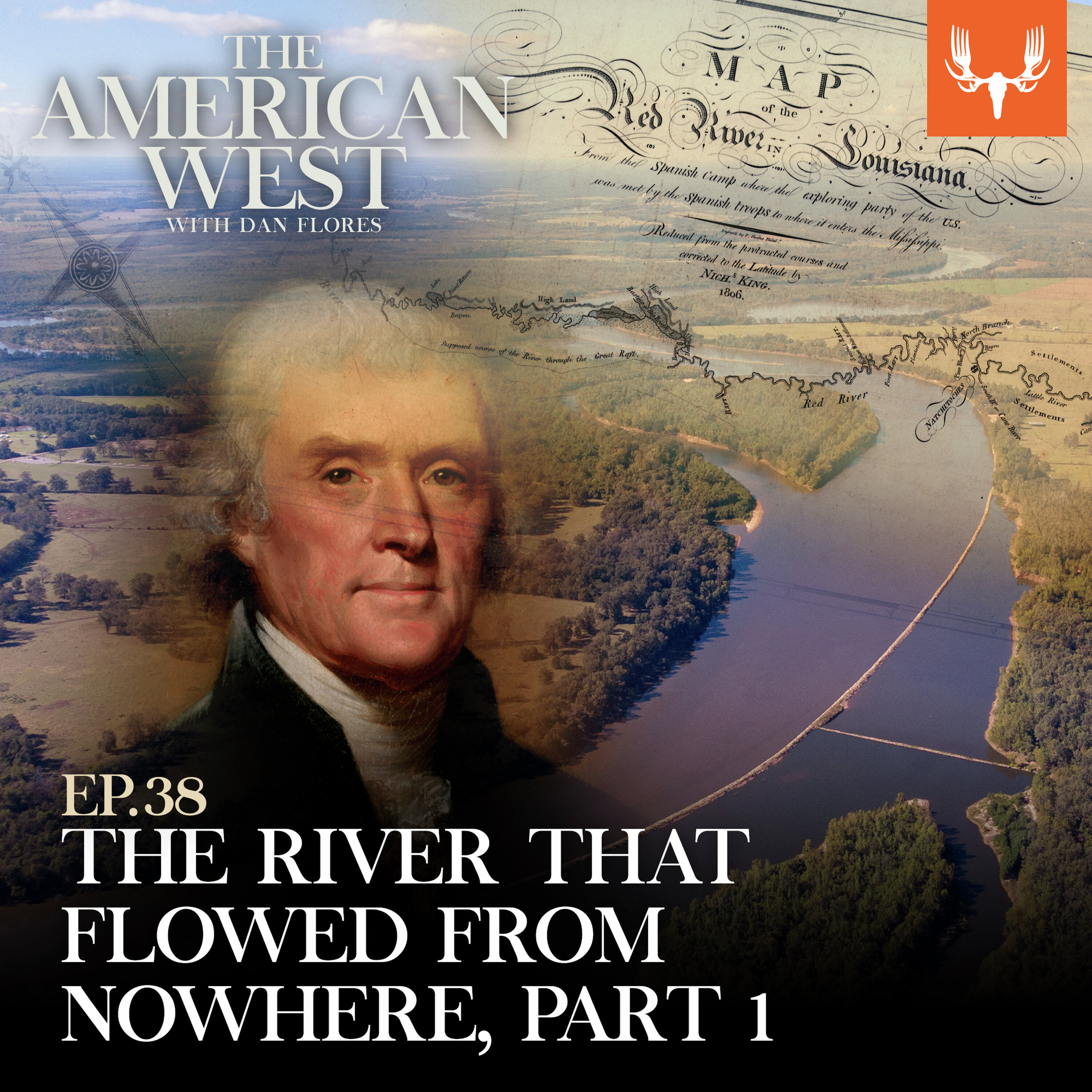
Like Apollo 13, Thomas Jefferson's Red river expedition into the west was a failure. This is how their story should have gone. I'm Dan Flores, and this is the American west, The river that Flowed from Nowhere, Part one Years ago, with dogwoods and redbuds firing the first bolts of color through the drab late winter woods of Virginia, I stood looking westward across the Blue Ridge Mountains on Thomas Jefferson's veranda atop the small mountain where he built his experimental home of Monticello. I just spent an hour touring the home and domestic world of the American President, whose fascination with what lay towards the sunset brought the American west into the country's future. I'd looked with a kind of numb amazement at the bed Jefferson rolled out of as soon as the morning light was strong enough to see the hands on a clock near a writing table where so many graceful sentences tumbled from his mind. But the thing that had riveted me the most was, was to find hanging on the West Wall, appropriately, of Monticello's receiving room, a map of the continent as cartography had understood it two centuries ago. The two rivers Jefferson regarded as the most intriguing rivers of Western destiny, the Missouri of the north and the Red river of the south, were there, their confluences with the Mississippi fixed on the map by mathematical coordinates. By the time he died in 1826, Thomas Jefferson felt he knew the Missouri, its course and its marvels. Lewis and Clark had made the Missouri and the Columbia on the other side of the Rockies live in his mind. But the Red, his receiving room map showed the old fruit city of Natchitoches on the Red. True enough, beyond that, this river he thought of as next to the Missouri, the most interesting water of the west, angled off on this map into blankness, a ruinless unknown. That featurelessness hadn't been filled in wasn't from lack of trying. As I described in episode seven of the American west with a script called Jefferson's Southwestern counterpart to Lewis and Clark, the President's attempt to explore the Red river was a fully engaged and valiant one. But like the Apollo 13 mission's failure to reach the moon through circumstances beyond its control, equally valiant. Spanish opposition to Jefferson's second major probe into the west brought the Red river expedition to a halt and after it journeyed only 615 miles into the Southwest. Disappointingly for Western history, especially given the expedition's rather mysterious destination, plus the quality of an expedition leader like Thomas Freeman, who had the training and ability to have brought that world to life, Jefferson's probe ended short of where the real west began, and especially in Dr. Peter Custis, Jefferson's 25 year old naturalist, whose medical degree under famous professors at the University of Pennsylvania made him the first American trained scientist ever appointed to a Western exploring party, the Red River Expedition had included a writer who could have given us an account on a par with Meriwether Lewis. Western journals. Standing there in Jefferson's receiving room, looking up at that map, he must have experienced some regret about more than once I decided I couldn't resist. I knew well that despite at least two other government attempts to find the sources of the Red river, this was a geographic mystery that wasn't finally resolved to until three quarters of a century after Jefferson's attempt. In the 1870s, the same decade that Sir Richard Burton tracked the Nile to its sources in Lake Victoria in darkest Africa, an Army Corps of Topographical Engineers officer named Ernest Ruffner finally figured out the Red river, long one of the great geographical riddles of the West. But if the outcome of Jefferson's Red river expedition had been different, here is what I think his naturalist, Dr. Peter Custis, would have told the president and American history about a river and a western setting whose full exploration might well have made him famous foreign. The upper Red River, 1806. 1807. Pawnee Villages on the Red River, 97 degrees, 37 minutes, 30 seconds west of Greenwich, September 10, 1806. Dear President Jefferson, obedient to your instructions, sir. You will have from Mr. Freeman's hand another description of our ascent of the river to this point, including a fuller account of the diplomatic arrangement entered into by our party and Captain Viana, who commanded the Spanish force sent out from Texas to arrest our exploration of the river. I will note only Mr. Freeman's and Captain Sparks agreement with the Spanish representatives that in our further progress upriver, we confine ourselves sensible to the president's own orders, to an examination of the Red river only and no other major waters flowing from the Mexican mountains, and per the agreement with Captain Vianna, that we locate our encampments and examine the country only on the north side of the main river until such time as a formal agreement delineating an accepted boundary between the possessions of the king of Spain and those of the United States can be made. Fortunately to this arrangement, thus far in our journey, the country lying to the south of the river has not presented a face materially different from that to the north. Indeed, the most interesting topographical variations we have seen in the extensive meadows that characterize the first thousand miles above the river's mouth have appeared on the north bank, while one division of the Indian village where we have been encamped since the first instant of the present month, does lie south of the channel. The two larger divisions, including the lodge of Awahikai, the main chief of these peoples, are fixed on the north bank, our tents, space for which was cleared by the women of these tribes. Contrary to assumption, there are four different, though related peoples in this village now sit comfortable comfortably on a rise of ground well north of the riverbed, in part to escape the sandstorms that frequent winds of this region stir up from the channel. Mr. Freeman, Captain Sparks, and myself, meanwhile, were invited into the lodge of the great chief, where we want for nothing, agreeably to the orders of the President and Mr. Dunbar, our advisor in Natchez. As with my four previous missives, I've attached a list of species observed, 41 additional botanical observations, and 28 new specimens, properly dried and packed in a leather cartouche sealed with bear Grease for delivery by messenger into Mr. Dunbar's hands. This accompanies a description of 11 additional trees and not found below the place where we treated with the Spaniards. We have surely entered a new and very different country from that of the river below. My measurements, descriptions and proposed scientific names for several species new to science are also enclosed, although I will take occasion here to mention a few of the more remarkable. From the point where we met the Spanish army to this a distance of 380 river miles measured by line, and approximately half that distance in a straight Tangent according to Lt. Humphrey's calculations, required a full six weeks travel on the river. While in no wise a challenge approaching that presented by the mazes of the great swamp earlier in the summer, this part of the Red river affords its own obstacles to navigation, chiefly in the form of low water. At this season of the year, on separate occasions our party were obliged to encamp for multiple days awaiting thunderstorms, which occur but infrequently in this country, but fortunately discharge astonishing quantities of precipitation when they do, in order to raise the level of the river sufficiently to float our barges. Thus did we proceed to this spot, stopping, waiting with appreciated opportunities to hunt and botanize, then hurrying up river with the freshens. The Indian agent and natchitoches Dr. Sibley was undoubtedly correct when he represented the Pawnee villages as the upper limit of navigation on this river. As to the nature of the country, if the river between the head of the great raft and the bluff where we encountered the Spaniards appeared to me as the paradise of the world, awaiting only our countrymen to claim its fertility, the country since has presented equally a garden, but of a very different kind. It is not like anything I have seen before, and indeed unlike the descriptions we had received of it, causing me to wonder if it can properly be described by first hand observers to people who have never seen its analog. Its transformation begins almost immediately beyond the point where we met the Spanish force. The cause of the gradual change from tall woods to vast open meadows is not yet obvious to me, but direct observation seems to refute the notion expressed in the recent literature that the prairies of the interior of Louisiana are the dried beds of ancient lakes. Nor can the soil be faulted for its fertility, for it is so rich, black and even greasy to the hand that we followed the hunter's custom of calling this region the black prairies. The first evidence for the the alteration appeared two days upriver from our encounter with the Spaniards, when with our caddo guides, Cut Finger and Grand Osages Mr. Freeman and I left the boats under command of Captain Sparks and ascended out of the sandy margins of the river and the cotton tree bottoms to look over the uplands on the right bank. What immediately demanded attention was that the tree growth of the hills were, although composed of many of the same species as those downriver, was here sensibly dwarfed in size. Species of oaks, of which there are several, which were 60ft high in the vicinity of the raft here, at full maturity, possessed a height of no more than 35ft. Nor was this a local phenomenon of soil, for the same dwarfing extended to many, many other common species and was observed across all the face of the country we traversed. Equally worthy of remark, the copses of upland meadows we had seen here and there downriver, almost exclusively occupied by an orange hued bunch grass growing to knee height here, became much extended, so that woods and meadow began to occupy occupy almost the same balance of ground. No doubt linked to these phenomena, the horizon had now become visible in many places at a distance of a mile or more. I thought this inexplicable transformation might correspond to the slowly rising elevation of the country as measured by our barometer, a view reinforced when, during a delay occasioned by low water and the Indians, our interpreter, Mr. Talapoon, and I had the opportunity to ascend the Coyomichi, a north tributary of the Red river, famous among the hunters for its beaver. On that excursion, two days travel by pirro brought us to a piney mountainous country and eventually to a fine, long mountain valley that in aspect and elevation so closely resembled the Blue ridge that my eyes filled for home. The mountains here, however, run east and west, rather than north, south, and under close examination, the similarity is only partial. With much difficulty on account of heat and swarming ticks, we ascended the sandstone and slate ridges, where the barometer showed an elevation of more than 2,400ft above the sea. The view to the north was of immense meadows inset with picturesque peaks, through which flowed a south branch of the Arkansas River. The Caddos used the same name for this river and the mountains. Coyomichi. It means horned screamer, and it refers to the cries of the giant woodpeckers, the great ivory bills being particularly numerous here. In these mountains, I observed that the vegetation often differed markedly from one side of the ridge to the other. Seeing the heights so thinly clothed with scrubby oaks and specimens of pinus twisted into fantastical shapes gave me the notion that, as in the Blue Ridge, perhaps it was elevation that was producing the Change we were witnessing in the country. Above the mouth of the Coyo Michi, we entered a region the hunters called horse prairie, and while cotton trees still flank the margins of the river, we we were now in a country where the uplands were composed of prairie almost entire, the only trees away from the river being those found in the declivities of the hills. The country also grew choppier. The crest of the hills from one to three miles apart. The tree the Indians used to make their boughs full of large yellow fruit of a pebbly surface, is plenty on the Mardi origins of these prairies. Here I first saw at great distance a small group of quadruped animals. I thought goats escaped from a Spanish settlement, but then they turned from me and escaped across the prairie with a rapidity only a winged Pegasus goat could have reached. This may perhaps be the astonishing creature described by Mr. La Harpe and to me by Mr. Hendry, with the unlikely ornamentation of a single horn. We saw these animals several more times, always at great distance, rendering me even more anxious to resolve their mystery. In these same prairies, at about west longitude 96 degrees, we also met with the first of a peculiar species of burrowing squirrels. In size, they are a little different from the fox squirrel, but possibly possess a yellowish coat and are equipped with a very short tail tipped in black, and reside in extensive underground colonies defended by sentries. I give a more precise description of this squirrel elsewhere, along with a proposal for a scientific name from a specimen I prepared of one Mr. Freeman collected with an admirable rifle shot. The small owl in my collection is from one of these squirrel towns, for the two species appear to coexist in the squirrel colonies with a species of weasel, a very fleet and cunning animal, and possessed of a masked face. I have not yet been able to collect one, but I am certain it is new, as it is not in Linnaeus. The appearance of these vast grassy meadows, almost constantly dappled with the shadows of clouds floating above them and grazing peacefully upon their surfaces. The first small droves of buffaloes and bands of wild horses we had seen, produced a strange and unexpected reaction from almost the entire party. We were filled with a sense of euphoria, and had we possessed horses, I've no doubt we would have dashed madly away in pursuit of distant herds. The President may envision something of the appearance of this country from the view he commands to the southeast from his mountain home in Albemarle county, except that no eminence of any height is required for such views. In the country approaching the Pawnee villages on the Red river, such views surround one on every side. A great salvo of thunderstorms played across the horizon west of us as we followed the river through these extensive prairies, which affected a steady rise and muddying in the river's waters, the tents of which fully illustrate its name. Nonetheless, these welcome storms much eased our ascent. By 10 August, the Black Prairies began to fall behind us, and we entered a sandier country, thickly overgrown as far as the eye could penetrate both north and south, perhaps 20 miles in each direction, with dwarfed oaks of several species and in some cases, so dense with smilax and other underbrush that the woods were impossible to penetrate. This, the hunters called the first Cross Timbers, for the Red river is bisected by two such unruly tangles. I suspected that the sandy soil was the cause of this growth, but our French guides, Mr. Grappi and Talopoon, claimed that these oak corridors were the result of droppings from the wild pigeon flights that were endlessly passing over us at tremendous speeds bound for the south. Prairie openings continued to appear, however, and on several occasions Talapoon returned with the choice cuts of a buffalo he had killed barely seared over our campfires. This was certainly the most sumptuous meat I've ever tasted.
- [22:21]
Commercial Announcer
We have a blast every summer. Fishing, swimming, camping out, shooting bows, sitting around the fire. Last weekend we were floating a creek and then doing some metal detecting, and we found what I believe to be a very old horseshoe. It's all the best. And if you're looking for the perfect companion to your summer adventures, try the refreshing citrus kick of Mountain Dew. From its beginnings in the foothills of Tennessee, invented by two brothers back in 1948, Mountain Dew has been a constant. And they've got proud American roots. It's an American original of citrusy goodness. You can celebrate summer and America's 250th birthday with mountain Dew. Whether you're at the grill, on the beach or right in your living room, sipping on a Mountain Dew is a great way to start a damn good time. Enjoy the refreshing citrus kick of Mountain Dew. An American original. Tasting great since 48. Look for Mountain Dew in stores near you at Mountain Dew dot com. That's Mountain Dew dot com.
- [23:24]
Dan Flores
Check engine, ABS or maintenance light on. Take the guesswork out of your warning lights with O'Reilly Veriscan. The service is free and provides a report with solutions verified by ASE Certified Master Technicians. And if you need help, we could recommend a Shop for you. Ask for O'Reilly Veriscan today.
- [23:48]
Commercial Announcer
Auto parts. When you're in the back country, don't forget your own back country. Keep it pristine, steam and confidently clean by bringing along wet extra large dude wipes. I'm. I'm glad to be doing dude wipe ads because I buy dude wipes. Anyways, I've been a long time dude wipe. I'm a dude wipe dude all the time. Just like your truck gets muddy out in the wild soaking your butt. You never clean your vehicle with dry paper towels, so why would you clean your butt with dry toilet paper? Wetter cleans better. So ditch the itch and switch from TP to wet extra large dude wipes. Love them. Like going on a ten day moose hunt. I just bring a pack along. Not only that, so they're extra large. Okay. If you're a little baby, you get little baby wipes. If you're a man, you get extra large dude wipes. And when you're out in nature, it's going to inevitably call. So make sure you bring along wet dude wipes and three adventure sizes like day hike single wipes, 18 pack weekend wipers, or you know, for long trips you got a 48 count pack. And it's not just that. Like when you're out camping, just sleeping in a sleeping bag, let's say you're gone for 10 days, whatever. I use them just to clean up at night. Like, you know, scrub the old pit, scrub your arms if it's all dusty. Just kind of get your neck and everything cleaned up. I love having them with me. Dude wipes. It is the best clean pants down. They're available at Amazon. That's where I usually order mine from. Is that Amazon? But you get them at Walmart nationwide. Fantastic product. Proud to be doing ads for these boys at dude wipes.
- [25:21]
Dan Flores
By August 19, we emerge from the sandy oak country into a prairie more extensive and vast than we have yet seen. The soil calcareous rather than loamy, black as below, with white limestone full of shells exposed in the stream beds. Indeed, rather than prairie, this country might properly be considered called, following General Wilkinson's map, the Great Plains or the Grand Prairie. Open and elevated, it was exceedingly pleasant and more insect free than any country in my experience. Among numerous species new to me is a gourd I collected. I found it growing in all the buffalo waddles that indent this plain so profusely that at the low angles of of the sun, their craters cast a pox of shadows across the smooth grasslands. We found buffaloes and wild horses in such plenty in this grand prairie that the mind cannot grasp their abundance. So, too were white wolves, which we saw in the hundreds every day, trotting along at the heels of the buffaloes, and so tame, we began to feel we must have been invisible to them. Alligators, so numerous in the vicinity of the great raft, are no longer found on the Red river where it courses through these prairies. Four days before reaching the Pawnee villages, the vast plains gave way to another broken country, and once again oaks and common cedars overspread the land, but growing in more park like fashion here, as if the country were regularly swept by fires, as indeed the hunters and Indian guides assured us it was. It was here that I collected the spiny shrub the hunters called musquit, which grows in the declivities only never on the uplands, as it appears to be sensitive to the great prairie conflagrations which burn it up. According to Talapoon, who has traveled extensively in the direction of the Spanish settlements to the south, it becomes more common and grows to a much larger size. Farther south, many species eat the bean like seed pods. Due to Mr. Freeman's urgency to reach the Pawnee villages, so we might continue on to the Mexican mountains in the vicinity of Santa Fe before winter. I did not have sufficient opportunity to study the habits of the buffalo and the wild horses, but knowing the president's keen interest in the latter particularly, I will seek occasion to do so. I do note that bears and lions remain common, that the Virginia deer, not being hunted much by the Indians in buffalo country, are as common and tame as barnyard stock round about the Pawnee villages. In addition to the white wolves, which on intimate acquaintance are grizzled gray and some even of a black color, there is another wolf midway in size between the fox and the white wolf. It is more sharply made than the white wolf, rather more blonde in coloring and very vocal like its kin, but replaces the large wolf's mournful howls with barks and yips of great variety. I am sending along a skin and skull. I have named it Canus ludovicianus. One final observation about the country bee trees and the honeybee, which the Indians call white man's fly, do not now occur past about 97 degrees west, but our Caddo guides say they find them farther upriver every year on account of emissaries sent in advance of us by Dhehuit, the great Caddo chief, to apprise the Pawnees of our mission. Our arrival here was expected and greeted warmly by the Pawnee chief, Oahuakai, whose name means Great Bear. Mr. Freeman will offer the presidential eye a fulsome account of his speech to the assembled Pawnees, informing them they were now children of the U States, expressing our desire for trade relations, distributing gifts from our stores for this purpose, and presenting Oahukai, a US Flag, which he wrapped around his person, then hoisted above his village. After some haggling, he agreed to trade us sufficient horses for 24 of us to continue our journey upriver, for which we embark tomorrow, September 11, accompanied by Talapoon and three Pawnees. Captain Sparks has now appointed Corporals Reed and Osborne, with two more enlisted men to remain at the Pawnee villages to guard one of the flatboats and three piros our party will use to descend the river when we return from its exploration. The rest of the party, 22 in number and commanded by Lt. Humphreys, will set out downriver tomorrow in the other large flatboat and piros, Obedient to the president's instructions. In our short stay, I have attempted a Pawnee vocabulary, several words of which appear similar to those of the. A young Pawnee woman, Shide ah, remarkable for her address and intelligence, was my principal informant in this and other endeavors. Her name is that of one of the the common shrubs in this vast country and means wild sage. The Pawnees, some of whom call themselves Iskanes, others Taioves, others Oahes, and still others Wichitas, are a beguiling and handsome people, numbering about 400 now, greatly reduced by the smallpox. They came to this fine spot on the river within the memories of some of those still living, and say they formerly lived on rivers to the north, including the Arkansas, and knew white men there many generations ago. Several Spaniards, raised from childhood as Indians, reside among them, and on inquiry said they wished no other life. At a distance. Their houses resemble those of the caddos, but are constructed on a different plan and include space inside for their best horses. On account of frequent attacks on their villages by the Osages. Like the caddos, their women grow maize, squashes, and beans of various sorts, also melons, which they raise in sufficient quantities to store and to trade with the noble nomadic aitans, or kumench, as some call them, for products of the chase. The Pawnees themselves generally only hunt buffalo extensively in the winter when they desert their villages for the purpose. They are a generous people in every respect. One example will suffice. The women of the villages were much taken with Samson, my black man. They said they were long familiar with the black white man, as they called him, some of whom had lived with them in the past. They exhorted him, and indeed not him alone, to sport with them in their green corn dance and their gaming, which goes on nearly every night. He did so with such enthusiasm that he caused Mr. Freedman a certain anxiety. Yet none of their husbands uttered a word of reproach as I wrote the above. Sitting outside my tent with a fine view across the yellow grasslands, which form overlapping horizontal plains into the distance. A Pawnee warrior named Tadoussuk, a fair Spaniard captured as a child and raised to adulthood as a Pawnee, says he confirmed to. To Mr. Freeman that the Spanish force dispatched from Santa Fe, under command of a man named Melgares, is still upon the prairies. He says also that the river we are exploring forks, but while the right fork will take us to Rocky Mountains, it will not take us near Santa Fe. He says that the left fork is longer, but reaches a place not known to Indians and Spaniards as El Llano Estacado. He says this last is a very dangerous place to the unwary or unlucky. A place, he says, that can confound and confuse your obedient servant, Peter Custis. January 15, 1807, Natchitoches. Dr. Sibley's home. My dear President Jefferson. While my letter of appointment instructed me to convey specimens and scientific data to Secretary of war Dearborn, sir, and I attend. No disrespect to him. I am aware that the contents of my accounts are intended ultimately for the presidential eye, so I will direct my remarks most specifically to your concerns, Mr. President, so you may understand fully the nature of the country we have explored, as well as the circumstances about the decision for the route Mr. Freeman concluded we should follow to perform a correct mapping of the Red river and. And the bounds of Louisiana. I inquire of your health, sir, as always, as well as that of my old friend Mr. Lewis. Dr. Sibley tells me that his voyage on the Missouri and Columbia has been an entire success and that he is the toast of Washington. I beseech you also, sir, to assure my family of my safety. Dr. Sibley has. Has told me of the false accounts of our fate in the New Orleans papers, which I fear may have found their way to Charlottesville. You will learn from Mr. Freeman's report the chronology of our exploration to the source of the river, his success in delivering your message to the Indians respecting our wish for peace and trade and the transfer of their electricity allegiance to us. Mr. Freeman has given me to Understand in very confidential terms your certain disappointment that the Red river does not access Santa Fe, the Mexican mountains, and the possibilities thereof. My account of our journey from the Pawnee villages to the head sources of the Red river, with a brief notice of our return to Natchitoches, follows. We left the Pawnee villages on September 11, 1806. At daybreak, the party selected to penetrate to the remotest sources of the river, consisting of 23 citizens of the United States, my black man, and three Indian guides. Our cavi, a word the hunters use to refer to a party's drove of horses, consisted of 37 riding horses and mules which were employed to pack our scientific instruments, collections and presents, and flags for the tribes of river. We left the scattered oak woods the first day and soon entered a country that for vastness and desolation I took then to be the equal of any on earth. Many days at a stretch passed with no precipitation of any sort and the sky an immense inverted blue bowl over our heads. The sun was harsh, the light exceedingly bright to the eye, and the yellowed grasses began to mimic the dwarfing we had early observed and tree growth. I attempted my first images with the camera obscura of this region. They will show the presidential eye, a land rolling away like gentle ocean waves in every direction from our tiny party, consistently away from the river. The effect of such travel was to surmount the wave crest before us with the expectation of having achieved an overlook, only to find another higher crest directly ahead. Species new to science in this region included a wild chicken different from the grouse of the eastern states, and the prairie goat. I saw distantly in the prairies short of the Pawnee villages, but did not collect there. I now believe this animal to be an antelope or gazelle, similar to those of Africa and found in great numbers in a part of Louisiana that resembles Africa south of the Sahara. It is an exceedingly actively made creature, remarkably light of frame and with bulging eyes made for seeing across these great distances. Both males and females possess true horns, not antlers which they shed. We saw no specimen with the single horn described by our informants, nor do we believe such a variation exists. Herds of elk and droves of wild horses also inhabit this wild, desolate country. We saw regularly used Indian trails along the river, but far more common were the paths of the buffalo and wild horses which so crisscrossed the river's embankments and the sparsely grass uplands as to give it at first impression that of a thickly settled and inhabited region. On our Outward trek, however, we saw but few buffalo here, although their droppings and skeletal remains abounded. Four days after leaving the Pawnee villages, we began to see the blue profile of mountains some distance to the north, and on the morning of the sixth day, we met with the great forking of the upper Red River. In truth, there are three forks altogether, a considerable stream bed with but little water entering from the southwest, followed 10 miles upriver by a division in the main stream, the smaller fork flowing a wholesome clear water down from the mountains now closer in view, whilst the widest of the three beds presented the coiling swipe of a sandy stream disappearing into the plain directly westward. We named these rivers the Dearborn, the Jefferson, and the Dunbar, in honor of our expedition. Expedition sponsors. Mr. Freeman's account will explain at length the reasons behind our decision to explore only two of these, the Maine or Jefferson Fork, to its source. While attempting an examination of the interesting mountain or Dunbar Fork. On our return journey, Mr. Freeman had employed the Pawnee Tadoussuk as our chief guide into this unknown region, for Mr. Talapoon had only vague and secondhand knowledge of it. With Tadoussuk riding with Mr. Freeman on our point on the 20th day of September, 1806, we directed our horses up the Jefferson Fork and proceeded on. This followed one of the great storms we met with in this country on a day that began entirely clear, but by noon had produced directly before us a columnar cloud climbing ever higher above our heads, which by 4pm had spread into the dark shape of a smithy's anvil. Its tumult commenced with bolts of lightning that struck the prairie in plain view and threw geysers of mud and rock and grass 100ft into the air. This was followed by rain and blinding sheets, and with such fury of wind that we were obliged to pull our horses to the ground and lie beside them. Yet this was but prelude to the pummeling we received from stones of hail the size of hen's eggs, which fell about us like artillery. Ultimately, the storm stampeded our cavi, which required most of the day following to gather. Yet within an hour, hour of starting, the storm passed, and the sun came out, showing a country glistening white with hailstones. The storms of this country appear fully the equal of the vastness of its scale. We travel for almost a week through this sandy desert, inhabited principally by the burrowing squirrel and and vegetated in place by grown oaks, now reaching only to the height of the knee, also increasingly by kinds of cactus. Here we encountered the large crested Cuckoo, which the Indians call snake bird for its skill in killing rattlesnakes. It secures them behind the head with a rapid dart of the beak and smashes the head on rocks till the serpent leaves lies senseless. On the autumnal equinox, a line of mountains rose portentously in our path to the west, appearing at first like a low stratum of blue clouds before us. I say line because from the distance which we thought very near, but that required two long days to cross, a frequent miscalculation in all this upriver region. Owing to the extreme transparency of the atmosphere, these mountains appeared to constitute an almost uniformly horizontal summit, with but few peaks visible and others of an odd block shape. To our discomfort, as we neared this line of mountains, the water in the river, though clear, assumed a taste so salty and so liable to expand in the mouth that it was with difficulty that we drank of it. And I was kept busy treating the men for the cramping. These indeed may be the salt mountains about which the President has been so curious. We now entered a country much gashed and torn, where the soil was red as blood, like the red beds of Georgia, and crystallized spiderwebs of salt, most often laid in horizontal strata, were exposed in an array of striking patterns in the tributaries. Wild horses were here extremely abundant, and repeatedly we were forced to rout the stallions which sought to toll away our remounts. Here, too, a new kind of deer made its appearance, different from the common deer in several particulars, among them its black tip tail and mule like ears, but most readily in its gait, hence our name for it hopping deer, as if it presented a kind of general template. There was also a large hare that differed from the familiar kind not just in size, but in a black tail and remarkably long ears. Tadoussuk said there were times when the hares swarmed the entire country, so many they rivaled the buffalo. All the while, the strange mountains loomed before us, assuming forms and shapes such as I have never seen in the art of Rosa or Turner or anyone else. Some agreed that that these bizarre and unprecedented forms, carved from rock layers of the mountains, most resembled the turrets, towers and porticos of castles on the Rhine. Others, with some familiarity with the Orient, thought they must have been built by the same hands that constructed the towers of Constantinople.
- [47:01]
Commercial Announcer
We have a blast every summer. Fishing, swimming, camping out, shooting bows, sitting around the fire. Last weekend we were floating a creek and then doing some metal detecting, and we found what I believe to be a very old horseshoe. It's all the best. And if you're looking for the perfect companion to your summer adventures, try the refreshing citrus kick of Mountain Dew. From its beginnings in the foothills of Tennessee, invented by two brothers back in 1948, Mountain Dew has been a constant. And they've got proud American roots. It's an American original of citrusy goodness. You can celebrate summer and America's 250th birthday with mountain Dew. Whether you're at the grill, on the beach, or right in your living room, sipping on a Mountain Dew is a great way to start a damn good time. Enjoy the refreshing citrus kick of Mountain Dew, an American Original tasting great since 48. Look for mountain Dew in stores near you@mountain Dew.com that's Mountain Dew.com.
- [48:04]
Dan Flores
Check engine ABS or maintenance light on Take the guesswork out of your warning lights with O'Reilly Veriscan. The service is free and provides a report with solutions verified by ASE Certified Master Technician. And if you need help, we could recommend a shop for you. Ask for O'Reilly Veriscan today.
- [48:27]
Commercial Announcer
Auto parts. When you're in the back country, don't forget your own backcountry. Keep it pristine and confidently clean by bringing along wet extra large dude wipes. I'm. I'm glad to be doing dude wipe ads because I buy dude wipes anyways. I've been a long time dude wipe. I'm a dude wipe dude all the time. Just like your truck gets muddy out in the wild soaking your butt. You never clean your vehicle with dry paper towels, so why would you clean your butt with dry toilet paper? Wetter cleans better so ditch the itch and switch from TP to wet extra large dude wipes. Love them. Like going on a ten day moose hunt. I just bring a pack along. Not only that, so they're extra large. Okay. If you're a little baby, you get little baby wipes. If you're a man, you get extra large dude wipes. And when you're out in nature, it's going to inevitably call. So make sure you bring along wet dude wipes and three adventure sizes. Like day hike single wipes, 18 pack weekend wipers, or you know, for long trips you got a 48 count pack. And it's not just that. Like when you're out camping just sleeping in a sleeping bag, let's say you're gone for 10 days, whatever. I use them just to clean up at night. Like, you know, scrub the old pit, scrub your arms if it's all dusty, just kind of get your neck and Everything cleaned up. I love having them with me. Dude Wipes. It is the best clean. Pants down. They're available at Amazon. That's where I usually order mine from that Amazon, but you get them at Walmart nationwide. Fantastic product. Proud to be doing ads for these boys at Dude Wipes.
- [50:02]
Randall
So, Dan, in this episode, you give us a counterfactual account of the Freeman and Custis expedition, which we talked about in a earlier episode.
- [50:16]
Dan Flores
Yeah.
- [50:19]
Randall
And I want to begin by just asking you how much of this draws from your imagination and how much of this draws from the evidence. Right. What. What if you were to sort of go through line by line or page by page, how much there was there and how much there came from somewhere else?
- [50:45]
Dan Flores
Well, you know, like, probably I haven't written a lot of fiction. I've written a little bit. Yeah, probably like most people who write folks fiction, historical fiction particularly, you actually do a lot of research.
- [51:01]
Randall
Right.
- [51:03]
Dan Flores
And because I knew this expedition well, because I wrote the only major book that exists on it, and I read a lot of the accounts that both Thomas Freeman and Peter Custis assembled for the tribunal piece of the river that they actually did get to explore. One thing I can say is that I think I'm probably pretty close to the tone and the writing style that Peter Custis brought to these submissions that he made to the government and on the expedition before it was stopped by Spain in the summer of 1806, he submitted four of these reports. And so what I had in mind for the counterfactual version, okay, I'm going to invent an excuse to allow them to keep going. And so I'm going to let him continue to do exactly the same thing. Custis is going to submit two more major reports about what the river is like as they explore onto the sources of it. And then the other thing I would say, of course, is that many of the people mentioned here, the names of individual people, are all directly out of history. In the second part of this, when we get farther west among the Comanches, I use the names of Comanche leaders who existed at the time. And the reason I know all this is because I've done. Done enough research and written sort of all around this, this kind of story that I knew from the moment I sat down to write this, who the people were who were out there, who Freeman and Custis would be encountering. That Pawnee leader, Oaxacai. He's a real guy. The young woman who is going to help him with the Pawnee vocabulary, she's a real person. The guy who. The Spanish kid who's raised as an Indian, who guides them further west. Tadoussuk. He's a real person. And these are all people that I know about from having done research about this part of the world. And then I'll add one other thing to this, and this is probably going to be more germane when we get to the second half of the story of this adventure that I'm sending them on. I spent quite a number of years living in the part of the world where Freeman and Custis are going to end up going.
- [53:41]
Randall
Yeah.
- [53:41]
Dan Flores
And I wrote two books about that part of the world, one of them which was about all the canyon country that was out there, and almost every one of which I explored on foot and camped out in. And so it's also. The story is also informed by the fact that where I have them going, and they are going to be going to the very logical places that they would have gone had they actually continued on. I've been there and hiked and camped and climbed in past years. So it's a pretty well informed counterfactual story.
- [54:23]
Randall
Yeah. You didn't take crazy liberties with what happened to them along the way. It's sort of a pretty straightforward.
- [54:30]
Commercial Announcer
Yeah.
- [54:32]
Randall
You know, I was curious because I don't know that we discussed this in the prior episode that covered their expedition, but you obviously wrote a book on Freeman and Custis, but in this episode, you're writing from the perspective of Peter Custis, and I wonder how well you know him in that. And I guess to better explain myself, so much of what we think or hear about Lewis and Clark, so much is made of Meriwether Lewis's disposition and his personality and how it shapes his writing of the story. And so this doesn't necessarily have much to do with what you wrote here, but I'm very curious to, if you can add some texture to Custis, the person whom you're sort of inhabiting in this episode.
- [55:30]
Dan Flores
Well, because I wrote the primary book on this expedition, I mean, and it was a story that was almost completely unknown in American history, really, until I did the first version of it, which I call Jefferson and Southwestern Exploration, I felt a strong obligation to figure out who these people were. And so I did quite a bit of research to try to come up with some sense of who Peter Custis was. He was the cousin of George Washington's wife. Martha had married Augustus. Martha Washington had been married before she married George Washington, and she married into the Custis family in Virginia, which was like the Randolphs and the, the Lees. And it was one of those big, well heeled landed families in Virginia, very near Charlottesville, where Jefferson lived in Albemarle county, the same county, which is why Jefferson knew him. And so he's related to a lot of heavyweight figures in that part of the world. And he's a young man who says, and I found a letter in the research I did on him where he says that he wants to use his share of the family inheritance to pay for a liberal arts education at a top American university. And so he goes to the University of Pennsylvania, which at the time, I think you could probably argue that University of Pennsylvania may have been the top university in the country. And it particularly was in terms of natural history, because it had a very famous early American, a natural historian named Benjamin Smith Barton. And that's who Custis went to study with. Now, when you studied natural history in the 18th and 19th centuries, what you got a degree in was medicine. You got an MD Degree because medicine used botany, what was known as materia medica, in order to cure people. And so Custis went to the University of Pennsylvania, studied under Benjamin Smith Barton. I actually, in doing research on him, was able to find another student's lecture notes about the lectures that Benjamin Smith Barton gave to the classes when Peter Custis was taking classes with him. And so I knew that Barton was a. He was a promoter of Linnaeus and Linnaean natural history. I mean, he was very up to date on, on all of his scientific work. And so he prepared Custis, I think, really well, the way Custis got this appointment, he hadn't yet graduated from the University of Pennsylvania with his MD degree. But Jefferson was casting about for a naturalist and he first tried William Bartram, the guy who had written Travels. Yeah, why don't you take the posts of naturalists on my Red river expedition? And William Bartram was 66 years old. So he said, well, I feel like maybe I shouldn't go. But he recommended a young man named Alexander Wilson, who was of course Audubon's predecessor as the first great bird ornithologist. Guy wrote the first big book on American birds. But the problem was Jefferson had already selected Thomas Freeman, who was an Irish immigrant. He was not a native born American. And Alexander Wilson was also an immigrant. He was a Scottish immigrant. And Jefferson didn't want to confront having people say politics of that, yeah, that you're appointing all these guys from some other part of the world to lead this expedition. So instead he picked Peter Custis to do it and Custis after the expedition. I mean, the expedition actually has, in his case, a sort of a tragic conclusion because all of his materials are turned over to a guy named Nicholas King, who evidently couldn't read Peter Custis's handwriting. And whenever the publication of the Red river expedition came out, this Nicholas King guy so mangled Custis's Latin binomials that anybody who would have read those reports would have thought, so. This guy is an idiot. He actually doesn't know Linnaean science. And I think, in a way, that turned Custis away from natural history. He moved to New Bern, North Carolina, and became a doctor, a kind of a country doctor, and married the daughter of a fellow doctor and was there for. I mean, he lived to 19 or to 1842. He outlived everybody else that was on the expedition. And there are several kind of accounts of people who used him as their doctor, who referred to him as lovable but gruff, but. So that's kind of about as much as you can put together about somebody who's alive in the beginning of the 1800s.
- [61:07]
Randall
Sure.
- [61:08]
Dan Flores
There's not even a photograph of him. For example. We don't have a photographic image or a painting as exists for. For William Clark and Meriwether Lewis.
- [61:17]
Randall
Yeah.
- [61:18]
Dan Flores
Of either one of these guys.
- [61:19]
Randall
Huh. As I was reading this episode, I thought that maybe the. One of the parts of this that was most fun for you was describing animals and landscapes in the. In the mind or in the words of someone who has never seen them before, and drawing analogs to the old world or to. You know, it's like the famous prairie wolf of Lewis and Clark, and you got to do that for yourself. So I wonder if you can just
- [61:55]
Commercial Announcer
talk a little bit about what.
- [61:56]
Randall
That. What you did there.
- [61:59]
Dan Flores
Well, yeah, that's one of the fun things about doing this. Absolutely. Is that progression from east to west is something that I grew up doing.
- [62:12]
Randall
Yeah.
- [62:12]
Dan Flores
Because growing up in Louisiana and being fascinated with the West, I mean, as soon as I was able to get keys to a car, I was taking off and driving and through all this country and watching these same things, watching all the vegetation gradually dwarf and shrink away, and watching it become possible to see the horizon. I mean, in Louisiana, you can't see an horizon that's more than 50ft away. The trees are so dense. But as you go west, of course, the country opens up more and more until finally you can see horizons a mile away and eventually 20 miles away. And very rapidly, not only is the landscape changing, but all the animals are Beginning to change. And that has always been something that I've had a. A lot of fun sort of imagining how people would react to that. And I've known, because of the research I've done, I've known pretty much where the first prairie dog towns showed up, the first chance you had to see pronghorns, where you were going to encounter mule deer for the first time. And it's going to be fun, I can tell you, to carry this on where they're going to end up, because as I said in this script, one of the fascinating things about this particular river which Jefferson regarded as he wrote next to the Missouri, the most interesting water of the west is the Red River. And he thought it came out of the so called Mexican mountains, the Southern Rockies, near Santa Fe. And I think the reason he's sending these guys there is because what he's anticipating is what becomes 15 years later, the Santa Fe trade.
- [64:00]
Randall
Trade. Trade route.
- [64:01]
Dan Flores
Yeah, the trade route. And so that's why he's so interested in having them go here. But what becomes the big mystery of all of this is that the Red river doesn't head in the mountains near Santa Fe and nobody could find where the Red river headed for most of the 19th century. So what I'm going to have these guys do is they're going to discover a mystery that actually American geographic exploration doesn't find until the 1870s. And it's going to require them to just stick to the course of the river and track it all the way to where it goes. But all of these other expeditions kept saying, well, it must head here. And they would just try to go to some spot and they would find a river, but it would be the Canadian or it would be the Pecos and it would never be the Red river that Jefferson wanted to explore. So as I said in the introduction to it, I mean, it's the same decade that Sir Richard Burton discovers the sources of the Nile.
- [65:05]
Randall
Yeah.
- [65:06]
Dan Flores
That we finally figure out where the Red river comes from.
- [65:09]
Randall
Yeah. Well, Dan, looking forward to seeing where you take us next year.
- [65:13]
Dan Flores
Yeah, it's going to be, it's going to be fun, I think in episode two of this.
- [65:18]
Randall
All right, see you.
- [65:19]
Dan Flores
Thanks, Randall. Check engine ABS or maintenance light on. Take the guesswork out of your warning lights with O'Reilly Variscan. The service is free and provides a report with solutions verified by ASE Certified Master Technicians. And if you need help, we could recommend a shop for you. Ask for O'Reilly Veriscan today.
- [66:01]
Commercial Announcer
Oh, oh, oh.
- [66:02]
Dan Flores
O'Reilly.
- [66:05]
Commercial Announcer
Auto Parts. Did you hear? Phelps has teamed up with a bunch of other high end brands to do the Ultimate Elk Giveaway. Anyone who is 18 or older can sign up to win an amazing gear package that includes a new rifle or bow along with great supporting gear. The winner will pick their rifle package or archery package. For every $25 spent, you get 10 additional entries. The signups end July 26 at phelpsgamecalls.com.