Loading summary
Transcript89 lines
- [00:00]
Ad Host
I got in my hand here. It was just clipped to my pocket, but it's in my hand right now. The Montana It's MKC Montana Knife Company's first folding knife design tested. Built by actual hunters, the Montana is the first folder Josh Smith has built at production scale with a team of engineers and machinists who could match what he does on the bench. Head to mkc.com today. That's mkc.com these things are great. You are going love this folding knife. You ever get that feeling the walls closing in the concrete jungle suffocating you? You crave some wide open spaces, the chance to connect with nature. Maybe in a spot all your own. Well, head over to land.com they've got ranches, forest, mountains, streams, you name it. Search by acreage. You can search by location. You can search by the kind of hunting and fishing you're dreaming of. Land.com it is where the adventure begins. When you're in the back country, don't forget your own back country. Keep it pristine and confidently clean by bringing along Wet Extra Large Dude Wipes. Just like your truck gets muddy out in the wild soaking your butt. You never clean your vehicle with dry paper towels, so why would you clean your butt with dry toilet paper? Wetter cleans better, so ditch the itch and switch from TP to Wet Extra large Dude Wipes. Dude Wipes it is the best clean. Pants down. They're available at Amazon. That's where I usually order mine from, but you get them at Walmart nationwide. Fantastic product. Proud to be doing ads for these boys at Dude Wipes.
- [01:39]
Dan Flores
The west and his stories have been rendered in many ways, some of which I've made an effort to address in this podcast. In the deep past, there's archaeology and paleontology, which is how we know about the Clovis people or the collapse of the Chacoan empire, or woolly mammoths and dire wolves. As part of the West's disappeared bestiary, there's ethnology and anthropology and folklore, which have preserved our oldest Western literature in the form of the coyote stories and have told us a great deal about Western cultures, native or not. The visual arts, which I've addressed several times, gave the world our first visual impressions of the west and interpreted the frontier photography followed to capture a West that intrigues us because it looks less like our west than we'd expect. But as for history, literary fiction, and poetry, literary art is the form of books about the west, and there are so many, and that allows us to experience the past, present, and future of this region in ways no other way of knowing can do. Except, of course, for Western movies, which will take up in the next episode of the American West. The truth is that even among a group of Ph.D. western historians, no hour long discussion is going to probe some ultimate resolved truth about which are the best books on a subject as vast as the American West. All we can do here is offer up to listeners and viewers a tiny sample of our personal favorites and explain why we're advancing these above all the other possibilities. Our street cred for this exercise probably rests primarily on this reality. We have all been voracious readers of books about the west for a long time and have also taught university courses that were steeped in information from books. I'm going to go last with my own choices, but I'll start this out with a quick exercise that will give you some idea of of the literary possibilities when you take on a subject like the American west in literature the last time I taught a graduate class in the history of the west at the University of Montana was in the fall of 2013. I'd organized the bibliography of books on the West I handed out to the PhD and MA students in that class into 14 subfields. I looked at them again the other day. Here's how they broke down and and how many books I listed in each subheading. First was Overviews of the west. There were 46 titles in that one the native west through the early 20th century 123 titles Western exploration and imperialism 77 titles the first extractive economy, the fur trade got 40 titles Understanding the West Through Science and art in the 19th century 43 titles Frontier Extraction, Mining and Logging 60 titles Settler Societies, Farming and Ranching the West 76 titles Class, Ethnicity and Gender in the West 112 titles Western Infrastructure and the west of the City 68 titles History of the Western Environment 104 different titles Contemporary West Tourism, Politics and Modern 115 titles Modern Western Issues Like Water Power, the Economies of the new West 46 titles a Western Sense of Place as Expressed in art and film 97 titles and a Western Sense of Place Expressed in history and literature 81 titles. The calculator on my phone tells me that's 1,088 books. I haven't kept lists this complete in the past decade, but the number of high quality books like these on the west released by top New York publishing houses or university presses putting manuscripts through peer review has probably doubled by now. Choosing, in other words, is not going to be easy.
- [06:04]
Randall
Dan, welcome back. It's great to be with you as always.
- [06:07]
Dan Flores
Great to be here again, Randall.
- [06:09]
Randall
We're talking favorite books about the American west. And we are joined today by a very special guest, if you'd like to introduce her to our.
- [06:17]
Dan Flores
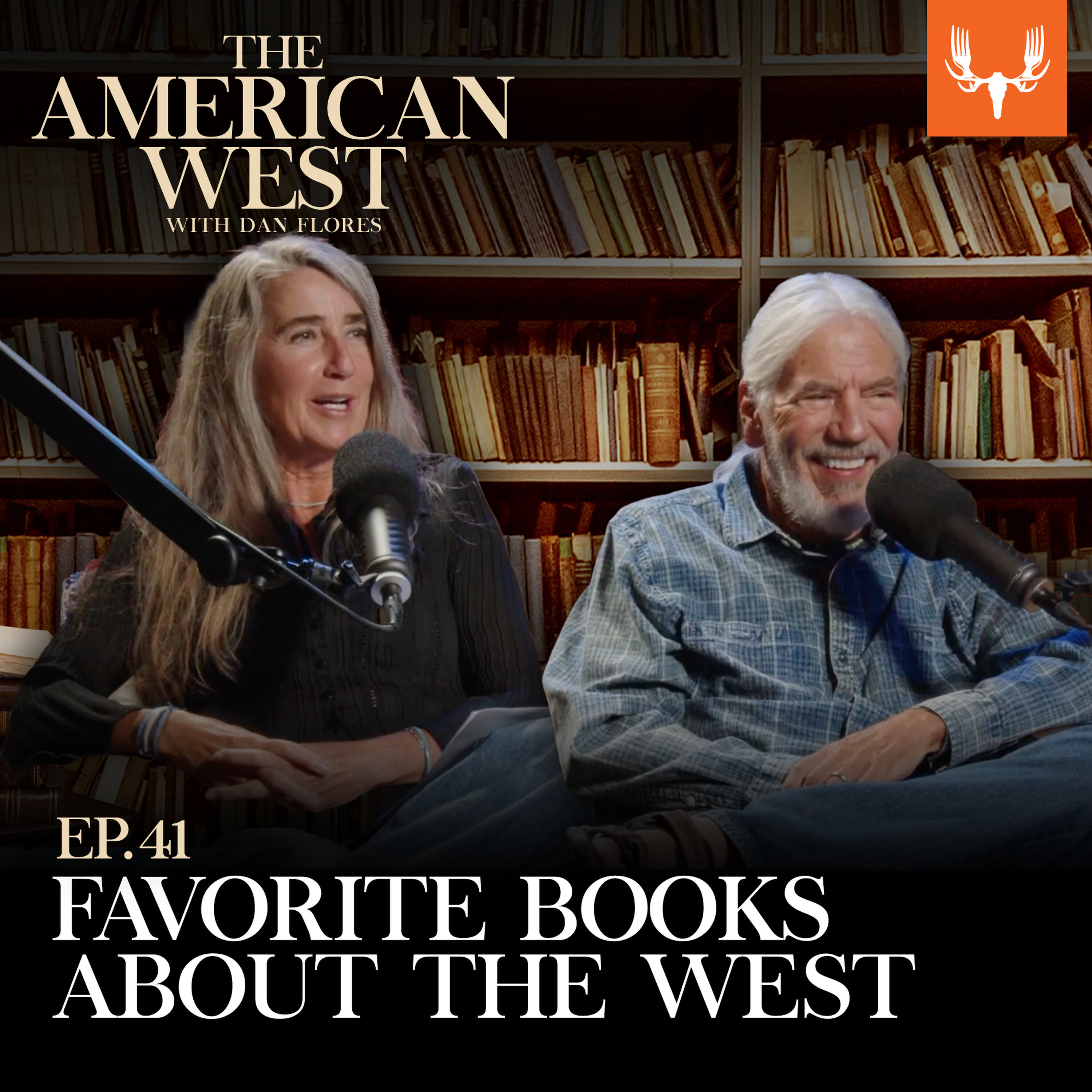
Indeed we are. So we have done these primarily with Randall and me over a lot of the episodes. Steve joined us in the beginning, but for the first time we've got another guest. And this is a special guest because this is my wife, Sarah. Sarah Dant. But she's not here because she's necessarily married to me. She's here because she is a top notch historian and author about the west. And she's a former professor at Weber State University. In fact, she was a distinguished professor there and also the chair of the history department for too many years, I think. But most of the last part of her career she was the chair of the history department at Weber. And she's also the author of one of the really outstanding recent books on the American West. It's called Losing An Environmental History of the American West. And it's a stunner also available as an audio book, too. So it's the kind of thing you can put into your. Put on your Bluetooth as you're driving across the west and sort of absorb information while you're looking at scenery, which
- [07:31]
Randall
I would have selected had you not been here. I thought it would be awkward to choose your book.
- [07:37]
Sarah Dant
Oh, no, I'm way into flattery. So, yeah, if you want to just sort of supplement, that'd be cool.
- [07:42]
Randall
Yeah, no, it's a great. It's a great book.
- [07:44]
Dan Flores
Yeah, it's a terrific book. So Losing Eden is the title of it. What we're tasked with today is coming up with favorite books out of an enormous body of material that's out there about the West. And we're going to just kind of go straight to the topic. And we're gonna begin with Sarah.
- [08:04]
Sarah Dant
Oh, yeah, I'd love to start. Well, thanks for having me on the pod, especially since I know that this is coming to an end here pretty soon. And this seems like a very fitting way to. And so I will say that one of the things I tried to do in choosing the books that I wanted to talk about today was to think about how you have structured the podcast, which is not your typical Gunfight at the OK Corral, Wild west, stereotypical west, but instead a much more thoughtful, nuanced, and even sometimes controversial West. So I decided to talk about three books today that I felt like had a couple of or three Actually, really kind of important themes to them. One being that they're all really well written. And I feel like anytime that you can read good writing, it makes your own writing better. It just is. It's an inspirational form of communication that I can't get enough of. So all three books that I chose are, I think, really well written. The second thing about them is that they do. They get at this myth of the West. What's your term for that? Tribal history of white people. Yeah, yeah. And go about undermining that in important and powerful ways. My favorite question to ask about the west is the at what cost question. Not so much as a finger pointing, blame kind of thing, but instead to get at what are the consequences of the choices that we've made. How does that affect change over time? And one of the things that all three of these books, I think, speak to is this idea, and I know that you've talked about this in your podcast, that the past doesn't stay in the past. It's very much a part of who we are today in the West. So if people care about what they know, and I think they do, if you want to know more about the geography of the west, people of the west, the animals, the plants, then I think you could. You can start with these three books and do pretty well. So the first book I chose was Wallace Stegner's where the Bluebird Sings to the Lemonade, Living and Writing in the West. And, you know, I feel in some ways bound to start with Stegner because there's really no one who has written better about the west than him. He's often called the dean of Western history, and with good reason. And so, you know, he's written a lot of books. He's won the Pulitzer Prize. He won the National Book Award. We only got 84 years of Stegner. He died really tragically in a car accident in Sant Fei, of all places. So I picked where the Bluebird Sings to the Lemonade Springs because It's like a 16 essay, greatest hits of Stegner collection. And I feel like it's a way to get at many of the ideas that he brought to us that are really seminal. He talks about the importance, for example, of aridity in the West. He's the one who says that we have to get over the color green, which is. That's a great way of phrasing it. And he talks about how it's aridity that polishes the stars and gives them their brightness. It takes chlorophyll out of the environment. It shapes the mountains and craggy hills into badlands instead of soft hills like you would get back east. But then he also talks about there's a whole capsule history of conservation in there, which is a nice primer on all things the West. He is good at talking about sort of what are the consequences of the choices that we've made. As I said, that was one of my criteria for picking a book. And he had a quote, and I just wanted to hit it as sort of. Before I open it up to you guys. He says we may love a place and still be dangerous to it.
- [12:32]
Randall
Just for listeners who might not be familiar with Stegner, could you give a quick sketch of his life and the sort of imprint he made on Western literature?
- [12:46]
Sarah Dant
Absolutely. And you're the podcast host. Do you want to tackle that? Because I know you're going to talk about Stegner, too, I think.
- [12:53]
Dan Flores
Yeah. Stegner is the author of one of the books I chose as well, which is, I think, an indication he's probably in our choice, is the only person who appears more than once. And there's an obvious reason for it, because he stands kind of head and shoulders above most other Western writers in the elegance of his prose, for one thing, but also because he trained so many writers. I mean, he had a Stegner to kind of give a really quick biography of him. He was one of those people who lived, as he said, in 22 different places and eight different states when he was growing up, almost all of them in the west, some of them in Canada, Some of the places were outside Calgary. But he also spent a lot of his youth in Utah, and he lived for most of his adult life in California, because after getting a PhD from the University of Iowa in English literature and sort of having Bernard devoto, another famous Western historian and Western writer, become his mentor, Stegner ended up at Stanford, where he started a creative writing program, and he trained people like Edward ABBEY and Thomas McGuain and, I mean, a whole host of Wendell Berry, a whole host of kind of famous writers about nature and about America and the West. So he was this kind of remarkable giant in Western letters, and that's why he tends to turn up. And he's gonna turn up again, as I said in my conversation.
- [14:35]
Sarah Dant
Well, and he's also the author of some of the books that were an attempt to discuss the. At what cost of, say, damming our national parks, Glen Canyon, the place no one knew. He wrote the literature that went with the photographs to help people begin to realize this is dinosaur. He wrote these books that helped people create a value for the Western landscape that wasn't extractive, that we could love this place without doing damage to it if we protected it as a park.
- [15:16]
Dan Flores
Yeah. He's also got a famous line that I think probably all of us have used. I mean, I had forgotten, for one thing, that it was Stegner who said, we have to get over the color green, because I used that as the title of one of the episodes. But he had a very famous line about the American west as the geography of hope. And I think everyone in this room has used that line at one time or another.
- [15:45]
Sarah Dant
Yeah. And he also talks about the west as. I think I used this at the end of Losing Eden. He said, it's hard to be peasant, pessimistic about the west, even though you may be able to chronicle all of these problems and challenges, it's hard to be pessimistic about the west because this is also, as he says, the native home of hope. And so, yeah, in many ways, it's lyrical writing, it's compelling writing, and it's good history at the same time.
- [16:15]
Randall
Tara, what's your second book here?
- [16:17]
Sarah Dant
So my second book I chose actually a former graduate student of yours and I think maybe a contemporary of yours, Rosalind Lapeer. She wrote a book, a really astonishing book called Invisible Storytellers, Story Takers and the Supernatural World of the Blackfeet. And she is an enrolled member of the Blackfeet tribe and Metis. And she wrote this as a really, in many ways, astonishing hybrid books because she's classically trained as an academic historian, so she knows how to do good archival research and all of that. But she's also trained by Blackfeet elders with traditional economic or, excuse me, ecological knowledge, ethnobotany. And so this book powerfully weaves together these threads of kind of traditional history with a lot of the stories that she heard growing up from elders in the Blackfeet community. And it becomes this revelation on the Blackfeet movement from when they were called Buffalo Indians, or what she calls Buffalo Indians prior to removal and relocation, the stories that those elders told about that time in their lives. The story Takers is about the ethnographers who came and took many of the stories of the Blackfeet in the late 1880s and 1890s. And then how has that kind of translated for her, Even as a 20th century Blackfeet academic woman? And one of the things that she does, which I know you've done to great success, Dan is use the first person narrative. And you know, of course our English teachers in college always said, no, bad, you absolutely are not supposed to do that. But in the right hands, you her that works really, really well. And so she also, I think, brings in this book an important perspective that again ties in with a lot of what you've tried to do in the podcast, which is this assumption that a lot of people carry, that Indians are somehow 19th century people and then they disappeared and we don't have them anymore. They just sort of exist in displays at the Smithsonian or something like that. And she is able to very much contemporize native peoples and where they are fitting into current America, not just as some relic and icon of the past.
- [19:11]
Dan Flores
Yeah, Roz was with us in doing the Ken Burns film, the recent film on the American Buffalo, and she was one of several, but one of the really great native voices in that particular film. And she's had quite the career and quite the success since those days in Missoula back 20 or so years ago. And so, yeah, she's an outstanding writer and this book is, it's a hell of a choice because that's really a powerful book.
- [19:50]
Sarah Dant
Well, and one of the things that, you know, this invisible reality idea is that she is able to talk about how the black feet have a relationship with the supernatural and that, that they don't feel the need to fear nature because through their supernatural guides they can control nature. And it was this source of tremendous security and stability if you didn't have to worry about thunder or rain or snow, because you could, if you really needed to, you could borrow the Beaver Bundle or utilize the supernatural, as she calls it, to help you live a better life. And for students especially, it was always fascinating for them to see someone who could put those two ideas together so well. And Roz would talk to my classes and I mean, it was just non stop. We'd go way over time every time.
- [21:04]
Randall
Yeah. And it, it actually, I mean, I'll. In a little bit here, I'll talk about Fool's Crow, which I think would also pair nicely with, with that one.
- [21:15]
Ad Host
We have a blast every summer. Fishing, swimming, camping out, shooting bows, sitting around the fire. Last weekend we were floating a creek and then doing some metal detecting and we found what I believe to be a very old horseshoe. It's all the best. And if you're looking for the perfect companion to your summer adventures, try the refreshing citrus kick of Mountain Dew. From its beginnings in the foothills of Tennessee, invented by two brothers back in 1948. Mountain Dew has been a constant and they've got proud American roots. It's an American original of citrusy goodness. You can celebrate summer and America's 250th birthday with mountain Dew. Whether you're at the grill, on the beach or right in your living room, sipping on a Mountain Dew is a great way to start a damn good time. Enjoy the refreshing citrus kick of Mountain Dew, an American original. Tasting great since 48. Look for mountain Dew in stores near you@mountain Dew.com that's Mountain Dew.com when you're in the backcountry, don't forget your own backcountry. Keep it pristine and confidently clean by bringing along wet edge Extra large Dude Wipes I'm I'm glad to be doing dude wipe ads because I buy dude wipes anyways. I've been a long time dude wipe. I'm a dude wipe dude all the time. Just like your truck gets muddy out in the wild soaking your butt. You never clean your vehicle with dry paper towels, so why would you clean your butt with dry toilet paper? Wetter cleans better so ditch the itch and switch from TP to wet Extra large Dude wipes. Love them. Like going on a 10 day moose hunt, I just bring a pack along. Not only that, so they're extra large. Okay, if you're a little baby, you get little baby wipes. If you're a man, you get extra large dude wipes. And when you're out in nature, it's going to inevitably call. So make sure you bring along wet dude wipes and three adventure sizes like day hike single wipes, 18 pack weekend wipers or you know, for long trips you got a 48 count pack. And it's not just that. Like when you're out camping just sleeping in a sleeping bag, let's say you're gone for 10 days, whatever. I use them just to clean up at night. Like, you know, scrub the old pit, scrub your arms if it's all dusty. Just kind of get your neck and everything cleaned up. I love having them with me. Dude wipes. It is the best clean pants down. They're available at Amazon. That's where I usually order mine from that Amazon. But you get them at Walmart Nationwide. Fantastic product. Proud to be doing ads for these boys at Dude Wipes.
- [23:44]
Dan Flores
Check engine ABS or maintenance light on. Take the guesswork out of your warning lights with O'Reilly Veriscan. The service is free and provides a report with solutions verified by ASE Certified Master Technicians.
- [23:58]
Ad Host
And if you need help, we can
- [23:59]
Dan Flores
recommend a shop for you. Ask for O'Reilly Veriscan today.
- [24:04]
Randall
Oh, oh, oh.
- [24:05]
Sarah Dant
O'Reilly Auto Parts.
- [24:16]
Randall
What's your third book?
- [24:17]
Sarah Dant
So my third book is one that has just come out. It's called the Westerners. And I'm going to make sure that I get the title right here. Myth Making and Belonging on the American Frontier. And so this is by Megan Kate Nelson. She was a Pulitzer finalist for her book the Three Cornered War, which looked at the Civil War in New Mexico, which is not the usual setting for the Civil War. And she does a similar strategy with this book that she did in Three Cornered War, which is that she chooses seven protagonists and follows them across and through the west to explore and sort of bust once again this Western ideology and myth making that has become so pervasive. And it's, so it's one thread of it is tracing these seven individuals. And I'll talk about a couple of them for just a minute. But then the other thread is the erasing that has been happening to many of these communities because they don't fit some whitewashed iconography of here we come, white people on the overland trail or on horseback pushing cows. And it really, it pushes aside a lot of the good, bad and ugly history of the west that makes it much more rich and compelling. So, I mean, of the seven, it would be hard to pick one individual. She talks about Sacagawea, for example, in a very different way than we're used to. Not just the night at the museum stereotype that we all have seen in the movies, but instead as this full fledged member of the Lewis and Clark expedition. And I know you're gonna talk about Lewis and Clark too. So it's like you and I called each other, planned it. And so she talks about her not as just there she is, a guide out in front of the men, but instead she's an ethnobotanist, she's a translator, and she gets to vote equally with the men. And so that's really compelling. She talks about Jim Beckwourth, the fur trader, mixed race fur trader who, as she calls him, sort of is the Forrest gump of the 19th century because his narrative weaves in and out of all these other people.
- [26:57]
Randall
Hard to box, put Jim Beckwourth in one box.
- [27:01]
Sarah Dant
No, And Jim Beckworth doesn't want to be put in a box. And he'll tell you fantastic stories, maybe 30% of which is based on truth, right?
- [27:10]
Randall
Yeah, that's a. When you read his memoir, it just doesn't add up.
- [27:17]
Sarah Dant
Well, there's just no way.
- [27:18]
Dan Flores
Yeah.
- [27:18]
Sarah Dant
There's just no way.
- [27:20]
Randall
Yeah.
- [27:21]
Sarah Dant
And she talks about Poly Bemis, who was a Chinese woman trafficked from China to Idaho of all places, and found her way there. I asked her who was your favorite character, and it was Gertrudis Barcelo from Santa Fe. She became the most wealthy woman in Santa Fe by dealing Spanish Monty, which is a card game of chance. And Megan said. I said, well, so why did you pick her? And she said, sarah, she's a badass, and I really like her. And it gave Megan the chance to learn how to deal Spanish Monty. And so I will just. This is a note to any of you who meet Megan, do not let her con you into playing a game of Spanish Monty, because she will take all your money, she'll take your house. She'll be devastating to you. But she's very much someone who's going after again, this myth making of the west and the erasure that has happened to a lot of the many voices that create who we are in the modern West. And by recovering them, I think she's creating, helping us to understand how the west that we're living in today is what it is. Hmm.
- [28:50]
Dan Flores
All right, so those are your three.
- [28:52]
Sarah Dant
Those are my three.
- [28:53]
Dan Flores
Those are her three. So, Randall, what about you?
- [28:56]
Ad Host
Sure.
- [28:58]
Randall
So as you just alluded to, the first book I chose is Stephen Ambrose Undaunted Courage. And it's not. I was selecting, so I didn't have a single through line through all my three selections. I sort of picked from three different nodes of how I think about books and where they fit into my life. But this, this is a book that's very accessible to the general reader. I was thinking of, you know, some of Michael Punk's books are also fall into this category. Or Timothy Egan's the Big Burn. Like, that's another one.
- [29:39]
Dan Flores
Yeah.
- [29:40]
Randall
But Undaunted Courage is sort of the foundational modern work on Lewis and Clark for general readership. I tried to find how many copies it sold, but it's a book that you'll find in every airport, every Barnes and Noble, and probably on the bookshelf of every. Somebody has an uncle. Every person probably has an uncle who has this book on their bookshelf. And I can say my relationship to it was in my first year as an undergrad. I was just reading a lot late at night, just reading a lot of personal books. Sort of my extracurricular reading. I was just churning through books. And this was one that I picked up. I'D seen it around for years, and I thought, this is something that I should read. Just to kind of put it under my belt and kind of did something to me where I started thinking about the West. You know, I'd come out with my family on some. Some high adventure type trips. We did Yellowstone, we did Glacier, we did the classic family road trips. But this is a book that kind of lit a fire and I think shaped what I was interested in academically and then also what I gravitated towards in terms of my own personal path in life. And as far as Lewis and Clark goes, I don't think that there's a single story in the history of the west that is so far reaching. In terms of all the different. It just touches on everything that you think about wherever your interests lie. In the west, there's tribal history and Native America. You know, there's sort of the first encounter. There's the suite of animals that they encounter along the way. And you're sort of imagining this wild west before it's colonized. There's the element of sort of national ambition and state building in the West. The Jefferson vision for the West. There's also the aspect of it just being a. A survival epic, a journey of sort of incomprehensible distance with very rudimentary equipment and supplies. And so I think, like, if you were. If you were in a position where you wanted someone to become interested in Western history and someone who maybe hadn't given a thought to the west previously, I think this one is a good one to light the fire. But I think you could say the same thing for the Big Burn or any of Michael Punk's books. They're just. They read very easily, they have a tremendous amount of information, but they also tell a story that's very compelling just from an entertainment value, for lack of a better term.
- [32:39]
Dan Flores
Yeah, yeah. That book in particular, I mean, it tells a through story. I mean, that's part of the appeal of the Lewis and Clark expedition, I think, is that there is a beginning, there is a very long middle, and there is a conclusion to it. And so it answers to what story is supposed to be.
- [32:58]
Randall
Yeah, And I think we. We had a guy on the podcast a few months ago, this vast enterprise is a new book on Lewis and Clark. And I said to him, I said, I think that that book could be the new Undaunted Courage because it tackles this subject that's so compelling in a way that's accessible but also asks bigger questions. And so I think those two also pair Together nicely.
- [33:28]
Dan Flores
Yeah.
- [33:29]
Sarah Dant
Well, he had to have been flattered by that. There's the great. And I think it's Ambrose who first comes up with the report that it's Clark who's dead reckoning, the measurement of how they're moving across the landscape to make the map. And, you know, dead reckoning is not exactly a precision science. And yet over several thousand miles, he's off by just a couple dozen.
- [33:53]
Randall
Yeah, I mean, there's.
- [33:54]
Sarah Dant
It's astonishing.
- [33:55]
Randall
It's a book you could flip to. You could flip a few pages. Flip a few pages, and every one you'll find some nugget like that that just adds to the richness of the story. So that's one.
- [34:07]
Dan Flores
That's a good one.
- [34:08]
Randall
That's my sort of point of entry to Western history. The other book, which I mentioned earlier is James Welch's Fool's Crow, which is a novel written in 1986. And it is a novel that is the story of a young Blackfeet man, and it's sort of the story of his life or his transition into manhood. And it's mapped onto the story of the Blackfeet people, which culminates in the Marias Massacre, which is like this epic moment of tragedy. It's sort of an unreal. I mean, I think a lot of our listeners probably haven't heard of the Marias Massacre, but it's one of these real tragic moments in the history of the U.S. army and Native peoples on the plains. But what's really special about this book is it is sort of fully immersed in the Blackfeet worldview. It's not, you know, if I were to try to write a book about with a Native protagonist, it would never get away from the fact that there's a white guy dressed up in Indian garb, you know, But Welch is. I believe he was a tribal member in the Blackfeet.
- [35:35]
Dan Flores
He was enrolled.
- [35:36]
Randall
Yeah, he was an enrolled tribal member. And it is told. It's told through the eyes of. As you said, it has. The cosmology is woven into the story. It's inextricable. And it's just a really well written, sort of musical, colorful narrative. And there's just not a lot out there that I can compare it to, because you step into a different world, you see the world through different eyes. There's vocabulary and just the way that things are talked about in reference to one another on the landscape, just in a way that I would never get there. And so I think that's one,
- [36:29]
Dan Flores
you
- [36:30]
Randall
know, one of the many things that books can do or that a good writer can do is remove you from your place in the world and plop you down in another. And it kind of tips the world upside down. So that's. I don't know, the last doing this, I realized I should reread it because it's been a little while. But I don't know when the last time you read this book was or what your history with it is.
- [36:56]
Dan Flores
Well, I had the great good fortune of knowing Jim and spending some time with him. And in fact, I went to a very private. There were only about six or seven people at his 56th birthday party out at Onyx Smith's house that Bill Kittredge hosted out there for Jim. And I got to attend that. So I got some good insight into Jim Welsh. And one of the things that one should know about him as a writer is that he was not only authentic in writing books like the Death of Jim Loney and Fool's Crow and a whole host of other things, he was a really funny guy. I mean, and so he kept us in stitches that night of his birthday party, telling us, you know, and the stories were usually told on him. I mean, he claimed. And everybody. Everybody laughed. I think it actually was not true. But he's claimed that when he first got to Missoula, he went over to Bill Kittredge's house and said, so I'm your new graduate student. I'm gonna learn how to ride under your tutelage. And that Kittredge, the first thing he said to him was, the Indians here, why don't you go get a pizza for us? And so Jim would tell stories like that on himself. I mean, after he. He published the Death of Jim Loney, which brought him critical acclaim, he got a posting at the University of Washington in the English department there. And he said he spent the first two, three weeks in his office listening to people out in the hallway saying what he thought was fuck you. Fuck you. And finally he mentioned that to one of the other professors. And the guy said, now, Jim, they're saying, foucault. Foucault. That's a great. So, I mean, and Jim, you know, so he endlessly told stories about himself like that, where he was sort of the butt of the joke. And that, of course, was pretty endearing.
- [39:03]
Randall
Well, and I think Fool's Crow, it's not like a funny book, but you can get a sense it's a lively book. It's very. There's a lot of humanity in there.
- [39:20]
Dan Flores
And the Death of Jim Loney, of course, which is his 20th century version of the Blackfeet story, is not a. It's a tragic book. It's not funny. Yeah. Which is, I think one of the reasons I wanted to say that about him is that as a.
- [39:32]
Randall
No, it adds depth to. But yeah, that's. So that's. That's my second choice. And then my third choice here is Elliot West's the Last Indian War, the Nez Perce Story. And this is one book I picked out of a mental bucket that included anything Eliot west has written. Amen, Contested Planes, Continental Reckoning, and also Donald Worcester, specifically his biography of John Wesley Powell, River Running West. And when I think of these books, I think of big books that cover an important subject or tell an important story, but sort of masterfully weave in bigger picture American history. Wesley Powell, I think that the Powell book in particular, Wurster, does this job of just pulling all the little threads of John Wesley Powell apart. And you understand how the world around him sort of shaped the course of his life. Right. And in the last Indian War, I could have picked any of those. I'm not sure that the last Indian War in my mind is head and shoulders among them, but it tells the story of the Nez perce War in 1877. And in this book, one of the things that Eliot west does that shaped my thinking or kind of rearranged my mental furniture is he makes you think about the relationship between Indian wars and the Civil War. And he talks about 1877, obviously is the end of. If you were going to periodize Western history, you'd think of 1877 as the end of the Indian Wars. But for most in other parts of the country, you think about that as the end of Reconstruction at the end of the Civil War. And so one of the things I want to pull it here, one of the lines that he has in there that kind of made this book stick is he says that Confederates and Native people are some of the few people who have had United States citizenship forced on them at gunpoint. And he talks about this period as sort of a top down nation building. You can see the parallels in terms of bringing together the modern United States. And it looks very different in the south than the West. But there are certainly some interesting parallels. And then interestingly enough, too, he talks about the relationship between efforts of the federal government to assimilate Native people and efforts of like the Freedmen's Bureau in the south to assimilate former slaves.
- [42:41]
Dan Flores
Yeah.
- [42:42]
Randall
And so he, throughout the book you know, he tells this story that's very compelling. And again, it's like this epic sort of chase and towards the Canadian border with these big. Like the Battle of the Little Big Hole is kind of probably the most well known episode in that story. But he takes a story that is just sort of part of the canon of Western history. He packs it with all of this broader national context that makes you think about the past in complex ways, intellectually serious ways. And then he also picks apart the historiography. And he tells you throughout, this is what people have said about Chief Joseph. Here's what they've disagreed on. He offers his own sort of interpretation based on his reading of the evidence. Similarly, when he tells the story of the Battle of Little Big Hole, he says, here's what the US Soldiers said about it. Here's what Native people said about it. And so it's really, I think, this book and the others in that bucket. But Eliot west, in my mind, does it better than anyone else. It's sort of a master class on thinking about the past in terms of both storytelling, making these connections that wouldn't be otherwise apparent to you, and then also showing you how you arrive at conclusions about the past based on these different voices and the evidence out there. So that's one that. I think I first read it in one of your graduate seminars, but it's always stuck with me as just, you can't do it better than Eliot West.
- [44:33]
Dan Flores
Yeah. And I think what you really hit on that, to me, has always astonished me about Eliot, is he's got such a comprehensive view of the histories that he writes that he's able to kind of give you this feeling of standing apart and watching the world operate. And that's a. That's a rare kind of gift. And of course, it comes from having taught Western history for many, many, many years and written a lot of really great books. But he's always had that. That vision, that really big vision where he's able to put things together in a very. In a large way, and it's really, really helpful.
- [45:17]
Randall
Yeah, this just occurred to me. But it's. It's sort of like going through a museum with a very experienced docent who can not only tell you about the exhibits and how they. Or the displays and how they relate to one another and kind of walk you through what the curator wanted to tell. But he can also tell you about how the building was built.
- [45:41]
Dan Flores
Yeah.
- [45:41]
Randall
And he can tell you about how this stuff got into the building. And. And so you walk away from that with not just A to B to C, but the big pig. Like the 40,000 foot view of how you arrived in this place.
- [45:56]
Dan Flores
Yeah, that's, that's Eliot's talent.
- [45:58]
Sarah Dant
Well, and one of the things I appreciated very much about that book is that you know how it's going to end. So it's not like it's some, you know, it's like Apollo 13, you know, they're going to get home okay. But nevertheless, he can tell such a story. And it's like one of the few quotes that a lot of people know. I will fight no more forever. Okay, so, but let's back up and then figure out how do we get to this? And I mean, if it weren't historically accurate, you would think, man, this is a terrific novel. And because he writes it so well too, but, but having something that everybody knows how it's going to end and yet you can hardly wait to read the next chapter. Because I didn't know that. I didn't know that.
- [46:49]
Randall
And he's also a funny guy. And that's something that I remember in Continental Reckoning. Chuckling just with these sly asides here and there where you see the humanity behind what's otherwise just like a. The most informative chunk of writing you've ever encountered.
- [47:11]
Sarah Dant
Tour de force.
- [47:12]
Dan Flores
Yeah.
- [47:13]
Ad Host
Yeah.
- [47:13]
Dan Flores
Indeed.
- [47:15]
Ad Host
When you're in the back country, don't forget your own back country. Keep it pristine and confidently clean by bringing along wet extra large dude wipes. I'm. I'm glad to be doing dude wipe ads because I buy dude wipes anyways. I've been a long time dude wipe. I'm a dude wipe dude all the time. Just like your truck gets muddy out in the wild, soaking your butt. You never clean your vehicle with dry paper towels, so why would you clean your butt with dry toilet paper? Wetter cleans better. So ditch the itch and switch from TP to wet extra large dude wipes. Love them. Like going on a 10 day moose hunt, I just bring a pack along. Not only that, so they're extra large. Okay. If you're a little baby, you get little baby wipes. If you're a man, you get extra large dude wipes extra. And when you're out in nature, it's going to inevitably call. So make sure you bring along wet dude wipes and three adventure sizes, like day hike single wipes, 18 pack weekend wipers, or you know, for long trips you got a 48 count pack. And it's not just that. Like when you're out camping, just Sleeping in a sleeping bag. Let's say you're gone for 10 days. Whatever. I use them just to clean up at night. Like, you know, scrub the old pit, scrub your arms if it's all dusty. Just kind of get your neck and everything cleaned up. I love having them with me. Dude Wipes. It is the best clean. Pants down. They're available at Amazon. That's where I usually order mine from. It's not Amazon, but you get them at Walmart, nationwide. Fantastic product. Proud to be doing ads for these boys at Dude Wipes.
- [48:43]
Sarah Dant
When the moments in your life are too important to miss, you can trust O'Reilly Auto Parts to keep you and your plans on the road. Our professional parts people can test your vehicle's battery and even give it a charge if needed. In most cases, we can install your new battery for free. It's just one of the many services we provide at O'Reilly Auto Parts to ensure life's best moments don't find you stranded.
- [49:09]
Dan Flores
Auto Parts I want to tell you about a product that should be an every modern outdoorsma's and outdoor woman's kit. Balisol. Think about the tools that define the West. The leather saddles, the rifles, the wooden grips. All of them needed protection. For more than 100 years, Balisol has been the world's most useful multipurpose oil, earning the trust of hunters and mechanics everywhere. This isn't just another oil. Balisol cleans, lubricates and protects your valuable items all from a single can. It works its way deep into tools and hinges, breaking down rust and grime and leaving behind a thin protective film that prevents corrosion. Balisol works on metal, wood, leather and plastic. Plus it's not only a powerful trusted product, it's also 100% eco friendly, skin safe and non carcinogenic, unlike so many competing oils out there. So stop cluttering your workbench with specialized sprays. Get, get Balisol, the must have multitasking oil for every mechanic, plumber, electrician, hunter, fisher and handyman. Right now you can get 15% off your order. Just go to Balisol.com and use the promo code WEST. Again, that's Balisal.com promo code WEST. Well, those are great choices. So it's time for me, I suppose, to come up with mine. And I will say that like you, Sarah and Randall, what compels me by certain books is often the grace of the language and the command of the information and the ability to tell a good story. And so what that has meant is that out of the three books that I chose. Two of them are actually novels, and one of them is going to require a little bit of an explanation because it won't, at first glance, appear to be something that one would think of as a classic book about the American West. But the three books that really speak to me. And again, this is like both of you, this is one of the most difficult decisions one can come to trying to come up with. Okay, three favorite books. But one of my favorite ones has always been Wallace Stegner's beyond the Hundredth Meridian. I mean, this is a book that was published in 1953, and the author, Wallace Stegner, has been gone now for almost 40 years. So more than 40 years. So this is a book that has withstood, I think, the test of time. I love Don Worster's biography of John Wesley Powell. I mean, Don is a great friend and one of the. He is probably the modern dean of environmental history in the American West. But I've always really loved the Stegner book, and I'll tell you a couple of reasons why. One of the things I like about Stegner's work, and I like this about most writers who I admire, is that they not only go into the archives and not only read a variety of secondary works to inform this kind of broader vision, but when it's necessary, they put on the hiking boots and the backpack and. And go out into the world to see the settings of what they're attempting to describe in the book. And that's one of the things Stegner always did, because this book requires it in that about a third of it is about John Wesley Powell's descents down the Colorado river in the 1870s. And so you have to get out on the landscape and see the river, see the Grand Canyon, understand what he's talking about. I mean, and Powell was all over the west in the years when he was such a major figure and major bureaucrat and government figure in the west in the late 19th century. And so Stegner had to go practically everywhere that Powell went. And he uses that to describe the landscape in a way that you can't unless you go. And the other thing I really love about this kind of writing is I am entranced by the notion of those first visions of a kind of, at least for white Americans, an undiscovered country. And Powell gave us a remarkably vivid description of what the west was like at a time when none of us now can really go back. This is our time machine for seeing what it was like in the 1870s through the early 20th century. And finally, this is a biography of Powell and all the things that Powell attempted to do in the West. I mean, Stegner sort of posits William Gilpin, who was the first territorial governor of Colorado, as the foil of the book. Gilpin saw the west as no different from the East. We can apply all the standard settlement techniques that we used in the east to the west, and rain is going to follow the plow, and it's actually going to eventually be green in the West. And John Wesley Powell, of course, understood what the west really was, and so he attempted to come up with settlement plans. And ultimately, I think, to probably, to Stegner's horror, a certain amount of horror, Powell came up with a mapping strategy for almost all the dams and reservoirs that we have today because he realized you had to manipulate water in order for people to settle the West. But it did produce a kind of what we've come to believe was an overreach on the part of a hydraulic empire in the West. So that's one of my books, and we've talked about Stegner already. Second book is a novel, and I will start this one out by telling you that it took me three attempts to read this book. I would get to page 60 or page 90 on the first two attempts and put it down, telling myself, I simply can't read about this much violence and bloodshed. The book is Cormac McCarthy's Blood Meridian. It is widely regarded as probably the best American novel since Moby Dick, since Herman Melville wrote Moby Dick. It's in that category of novels about America, which means that it's probably the best novel. Many people think of it as the best novel anyone has written about the American West. I'm trying to remember if it was the New York Times. I believe it was. At a canvassing of literary figures, critics, professors of Literature in 2006, asking them for the best novels written about America over the past 50 years. Blood Meridian came in number two in that list. Having said all that and also about to say the language is incredible. It's lyrical, it's descriptive. The guy writes probably some of the best sentences anyone has penned in the English language for a very long time. This is an imminently disturbing book. It is a book that is based on the real life events of a gang called the Glanton Gang. Right after the Mexican War, this group of Southerners and Texans, primarily with a sprinkling of people from other parts of the country, formed in the new Southwest that had just been added to the United States as a result of the Mexican War and began to contract with the Mexican government that was at the time at war with various bands of the Apaches down on the southwestern border, particularly in the area around Big Bend, today's Big Bend National Park. They contracted with the Mexican government to sell them the scalps of Apaches that they killed on behalf of this war that Mexico was having with these particular bands of a very large tribe. What the Glanton gang also did, because they realized this is a part of the world where the Mexican settlers themselves are part native, in some cases significantly native, that you could also kill Mexicans in small little towns that nobody knew much about and scalp them and turn their scalps in, and the Mexican government wouldn't be able to tell the difference between Apache scalps and those of the Mexican townspeople. These guys carry this on. This is a real event that Cormac McCarthy, who is a Tennessee writer originally who had moved to El Paso, he ended up living his life, just died a few years ago in Santa fe. But Cormac McCarthy, of course, wrote a whole host of things that have become films. All the Pretty Horses is one, no country for Old Men is another, which became one of his films. The Rogue, the Counselor, all of those have become films. And although this particular book has been attempted to be made into a film, there has not ever been a successful version of Blood Meridian. And I mean there is, it's optioned to a film company right now as of 2023, but everybody is convinced it's too violent for anyone to ever be able to make into a film. I mean, it is non stop Quentin Tarantino kind of violence. And so let me just say one other thing or a couple of other things about it. It has a protagonist who is known throughout the book. Until the last chapter, he's known as the Kid. And in the last chapter he becomes the man, because this is 30 years after the episodes of the 1850 period. And the other character, the most memorable character there is by the way, an imbecile, a kid who is mentally challenged. Who they around their camp, they keep him chained up like a dog or an animal and lead him around by a leash. But the most memorable character in Blood Meridian is a character called the Judge. And it's difficult to determine exactly who he is. I mean, who he reminds me of. I once read Dostoevsky's the Brothers Karamazov and there is a Grand Inquisitor character in Dostoevsky that the Judge really reminds me most of. He is 6 foot 7, he has no hair on his body, including his head. He is pale. He is also the best edge in the book, the best educated person in the entire Southwest, who is endlessly spouting philosophy and history and art and literature. And he is also the most vicious, sadistic sociopath you can possibly imagine. He kills people, children and animals and takes tremendous pleasure in it. And he is himself unkillable. He survives to the end of the book, at which point he manages to pull the kid into an outdoor bathroom and close the door. And McCarthy never tells you what happens. He has someone later come along and open the door and be absolutely horrified. But you don't know exactly what has happened inside this bathroom. The book ends with an epilogue. And the epilogue consists of two figures. One walking into the distance, digging post holes in the ground for what you assume are going to be fences across the west, barbed wire fences. And the other person in the far distance is picking up the bones of all the slaughtered animals from America's push westward. So this is a hell of a book. In other words. Okay, I'm going to end this with one other choice. And it's also a novel, and this is going to be one that, as I said, I'm going to have to make a kind of a. Offer an explanation for. This is the only book that I have read seven times. It's a book by a man named Kim Stanley Robinson. He's a science fiction writer. He has a PhD in English Literature from University of California, San Diego. Wrote a dissertation on the novels of Philip K. Dick. And if you know who Philip K. Dick is, you know that he is one of the great science fiction writers. We have at least four or five movies of Philip K. Dick's stories that are out there. Total Recall being one of them, Blade Runner, Blade Runner being another one. Kim Stanley Robinson wrote a trilogy back in the 1990s and early 2000s that is usually known as the Mars Trilogy. It is considered the most literary, scientifically accurate and compelling novel anyone or set of novels anyone has yet written about the settlement of Mars. The one that really compels me is Red Mars, the first one in this trilogy. And the reason I'm so drawn to it is because what he does very purposefully is to use the settlement of Mars as a recasting of the American west in the 19th and 20th centuries. He does it very purposefully. It's visible on all kinds of levels. And just to make sure you don't miss it, his primary character in Red Mars is named John Boone. And John Boone is a. He's the first person who. First human who has ever set foot on Mars and then goes back 15 years later with 100 people who comprise the so called first hundred, who are all scientists, literary figures, artists, philosophers, and what Kim Stanley Robinson does with this trilogy, because the three books, Red Mars, Blue Mars and Green Mars cover about 75 years of time. And when these people arrive, most of them are in their 50s, as he has in Red Mars. Science invent what is called the treatment. And it is a way to go into your body and reset your genetics. So all the mistakes that, that your body has made as it has aged are eliminated. And these people end up living 170, 180, 190 years. Now they become extremely old physically, but they are completely healthy for all those years. And what he does with this book that really I think delights me is he has John Boone, Lewis and Clark, like, go out in a rover and explore the Martian landscape and sort of take notes like a naturalist would, like Meriwether Lewis did on the Lewis and Clark expedition, about what the landscape looks like and what Mars could be if we decide to terraform it and turn it into, in effect, what we have done to the American West. So that's my final choice, and I'm sticking with it.
- [66:02]
Randall
All right, well, I can't argue with you, but I know you've always had a fascination with the interplay between science fiction and Western history, so I think it's only fitting that that's where we end up. It's kind of got your own personal stamp on this collection here.
- [66:22]
Dan Flores
Indeed.
- [66:23]
Sarah Dant
Well, and I think it's nice that this is a collection of, you know, novels and more academic things and less academic things. So it really, I think, is a. It's a good collection of faves.
- [66:37]
Randall
Yeah. Well, it's always fun to talk books with you guys.
- [66:41]
Dan Flores
Been great fun.
- [66:41]
Randall
Thanks very much.
- [66:42]
Sarah Dant
Thanks for having me.
- [66:43]
Randall
Yeah.
- [67:02]
Ad Host
You ever get that feeling, the walls closing in the concrete jungle suffocating you? You crave some wide open spaces, the chance to connect with nature, maybe in a spot all your own. Well, head over to land.com. they've got ranches, forest, mountains, streams, you name it. Search by acreage, you can search by location, you can search by the kind of hunting and fishing you're dreaming of. Land.com. it is where the adventure begins.
- [67:31]
Sarah Dant
When the moments in your life are too important to miss. You can trust O'Reilly Auto Parts to keep you and your plans on the road. Our professional parts, people can test your vehicle's battery and even give it a charge if needed. In most cases, we can install your new battery for free. It's just one of the many services we provide at O'Reilly Auto Parts to ensure life's best moments and don't find you stranded.
- [67:58]
Ad Host
Auto Parts when you're in the back country, don't forget your own backcountry. Keep it pristine and confidently clean by bringing along Wet Extra Large Dude Wipes. Just like your truck gets muddy out in the wild soaking your butt, you'd never clean your vehicle with dry paper towels, so why would you clean your butt with dry toilet paper? Wetter cleans better, so ditch the itch and switch from TP to Wet Extra Large Dude Wipes Dude Wipes it is the best clean. Pants down. They're available at Amazon. That's where I usually order mine from, but you can get them at Walmart nationwide. Fantastic product. Proud to be doing ads for these boys at Dude Wipes.