
Podcast
The Avian Behavior Podcast
Hosted by Hillary Hankey · EN
If you are into animal behavior and positive reinforcement training, you're in the right spot. World renown animal behavior consultant, falconer, and educator Hillary Hankey dives deep with conversations and case studies on parrots, birds of prey as well as horses, dogs and all kinds of animals on topics of behavior as well as nutrition, ethology, and problem solving.
15episodes
Episodes
Newest firstAll episodes

What to Do When a Bird of Prey Won't Step Up
4w ago00:41:44Tap to summarizeWhat should you do when a bird of prey avoids the trainer, flushes during an approach, or will not step onto the glove? Where do you even start with a bird of prey? Before focusing on the step-up, take a closer look at the environment. Housing, perch placement, privacy, approach paths, and opportunities to move away can all affect whether a bird is able to learn and participate. In this lesson, I use the early training of an African Fish Eagle to explore: • How to assess a bird's environment, temperament, and learning history • Why immobility is not always calm behavior • How inappropriate housing can increase avoidance • How space can function as a reinforcer • Why trainers should build movement and husbandry skills before prioritizing the step-up • How a broader behavioral repertoire gives a bird more ways to succeed Although this lesson features an African Fish Eagle, these principles apply broadly to hawks, falcons, eagles, owls, vultures, and other ambassador birds that are difficult to approach or reluctant to engage. We rely on principles based on the constructional approach and using space as a reinforcer, starting off by rating birds on an avoidance scale from 1-5 that helps us formulate a starting point. This podcast episode is adapted from Building Confidence with Birds of Prey, a course in the Avian Behavior Lab. Download our free Environmental Learning-Support Workbook here This video is adapted from Building Confidence with Birds of Prey, a course in the Avian Behavior Lab. You can get your free 14 day trial with the code AVIAN
Transcribe →
From our Owl Ambassador Masterclass: Health and Quarantine Considerations with Your New Owl
Jun 500:53:49Tap to summarizeThis is an excerpt from our Masterclass on How to Raise an Ambassador Owl. We added this lesson after fielding many questions about quarantine procedures, and wanted to ensure that an ambassador owl would still have a viable start to their career in conservation education. Here we cover specific signs of illness, potential practices that can lead to stress, and what to do if your facility puts your new ambassador under strict quarantine protocols. For visuals, you can check out our video. For the full Masterclass, check out https://avianbehavior.thinkific.com/courses/owl-ambassador For more classes in our subscription based online learning program, use the code AVIAN for a free 14 day trial https://avianbehaviorlab.com For free resources, including our podcast, blog, and best practice guidelines, check out https://avian-behavior.org
Transcribe →
81 The Expert Card
May 1200:39:50Tap to summarizeWhat does it mean to be an expert, and what happens when expertise becomes a shield from scrutiny rather than a commitment to precision? In this episode, Hillary examines the role of authority, rhetoric, and responsibility in professional animal training spaces, especially as conference season brings new ideas, disagreements, and uncomfortable conversations to the surface. Prompted by recent concerns from trainers who felt confused or unsettled by remarks at a professional conference, this episode draws a careful line between scientific discourse and rhetorical labeling. Here we ask broader questions about what our community should expect from its leaders. How do we assess skill without moral ranking? How do we talk about positive and negative reinforcement without turning functional processes into ethical identities? And how do we create professional spaces where newer trainers, women, consultants, employees, and others with less social power can ask questions without fear? Hillary discusses the problems with vague categories like "grade school" trainers, and why labels like these do not tell us anything meaningful about fluency, judgment, safety, or the animal's learning. She also revisits the constructional approach, clarifying that it is not about "replacing" behavior or choosing one type of reinforcement over another, but about building repertoires, identifying functional contingencies, and expanding degrees of freedom. The episode then pivots toward stronger models of skill assessment, including the Dreyfus model, as a more useful way to evaluate trainer development through observable criteria, contextual judgment, autonomy, adaptability, and standard of work. At its heart, this episode is a call for more rigorous, compassionate, and accountable leadership in the animal training field. Expertise should make us more precise, more open to revision, and safer to learn from — not harder to question.
Transcribe →
80 Mentorship and Falconry with Simone Lupson-Cook and Lauren McGough
Apr 1600:57:43Tap to summarizeThis episode is a conversation between friends Simone Lupson-Cook, Lauren McGough, PhD, and Hillary Hankey about what mentorship means to them, growth through falconry over the years, and how to navigate complex relationships. Set on a sunny outdoor deck while casually bird-watching and enjoying morning coffee on a warm winter morning in Southern California, this long conversation invites the listener to celebrate curiosity with bird behavior and learning. Come learn with us in the Avian Behavior Lab. Guided courses, private forum, and live trainings with dozens of bird species. Free 14 day trial with the coupon code AVIAN.
Transcribe →
79 Transitioning from a traditional to choice based training paradigm
Mar 2700:49:03Tap to summarizeExplore the transition from traditional to choice-based training for ambassador raptors with Hillary Hankey. This professional discussion is a presentation from the 2026 NWRA conference that looks into evolving welfare standards, the science of behavior, and the distinction between coercion and choice. Learn about the benefits of choice-based methods, including reduced stress and improved feather condition, and understand the strategic steps for successful implementation in avian programs. For a free 14 day trial of the Avian Behavior Lab, use the code AVIAN
Transcribe →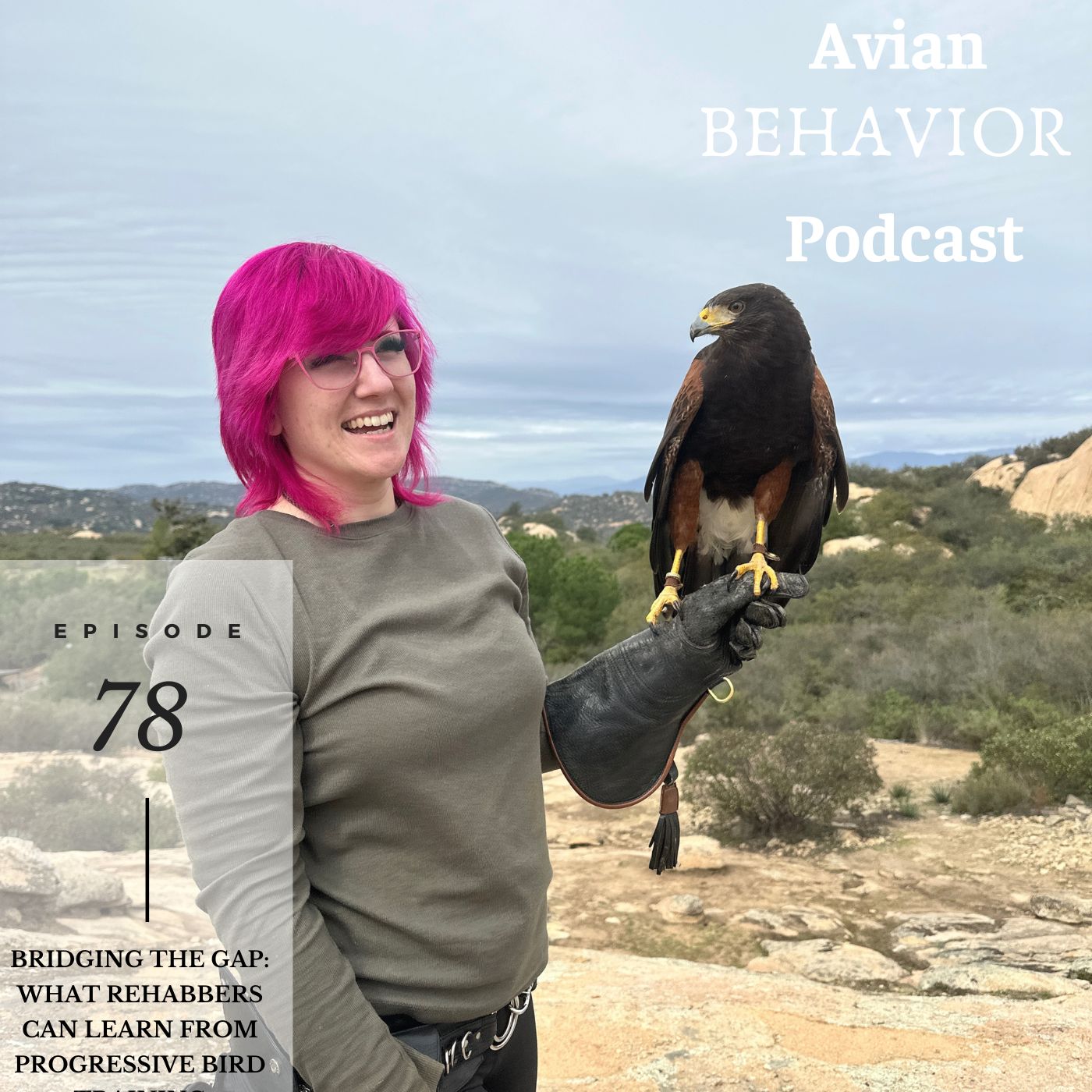
78 Bridging the Gap: What Rehabbers Can Learn from Progressive Bird Training
Mar 27, 202500:45:03Tap to summarizeIn this heartfelt and insight-packed episode, Hillary Hankey sits down with winter intern Levi Soucek, a wildlife rehabilitator, educator, and outreach coordinator at the Southwest Virginia Wildlife Center. Levi reflects on her transformative 12-week internship at the Avian Behavior Ranch, sharing how hands-on progressive training experiences reshaped not only her approach to ambassador bird care—but also reignited her passion for the work. We explore: What it means to truly train with positive reinforcement (beyond the buzzwords) The power of choice-based training and offering degrees of freedom Levi's "aha" moments while working with challenging birds like a Great Horned Owl and Andean Condor How foundational concepts finally clicked in real time Practical takeaways she's bringing back to her rehab center—from training strategy to team communication This episode is also a reflection on team dynamics, mentorship, emotional labor in animal care, and what it means to feel valued and connected in your work. Whether you're a rehabber, falconer, educator, or companion parrot trainer, Levi's story will leave you inspired, informed, and energized to take your own training to the next level. You, too, can become a member of the Avian Behavior Lab. Start off with a free 14 day trial with coupon code AVIAN
Transcribe →
77 Parrot Recall
Feb 19, 202500:38:03Tap to summarizeThis is an excerpt from our live parrot recall training, focusing on the pitfalls of over-training and the importance of recall in various scenarios. We share examples of a black palm cockatoo named Jupiter, whose wings were rehabilitated using falconry techniques, and a 24-year-old cockatoo named Henry, who was initially clipped. Hillary emphasized the need for systematic and methodical training, avoiding forceful interactions, and using neutral or positive reinforcers. She highlighted the importance of generalizing recall to different environments and surfaces, and the potential issues of circular reinforcement. She also addressed specific questions about training a blue and gold Macaw, stressing the need for space and appropriate training methods. Come join us in the Avian Behavior Lab with a free 14 day trial using the coupon code AVIAN
Transcribe →
76 Tips for Traveling with Parrots
Nov 14, 202400:27:35Tap to summarizeTraveling long distances with your parrot doesn't have to be stressful. We have moved cross country with our bird family many times. What happens if your bird hates the dark, like one of our palm cockatoos did? What about hotel stays or what supplies to bring while traveling with your parrot? What crate do you travel in? We have you covered with this guide, plus the bird food pumpkin pie story that Hillary's family still tells over 20 years later. Try out the Avian Behavior Lab with a free 14 day trial with the code AVIAN Check out our YouTube Channel for more info
Transcribe →
75 Avoidance Behaviors and Weight Management in Birds of Prey
Oct 1, 202400:22:19Tap to summarizeOur Fall 2024 Bird of Prey Workshop focused on key topics such as managing fear and aggression in raptors using the constructional approach and non-coercive negative reinforcement and using progressive weight management techniques. Handling fear-based reactions, like those seen in a juvenile bald eagle, requires careful arrangement of the environment and building skills with your bird to have more reinforceable behaviors. The workshop also highlighted the importance of fitness and motivation over strict weight control, ensuring the bird's health and well-being remain a priority. Get on our email list for more news, behavior tips and announcements. Join the Avian Behavior Lab with a free 14 day trial using the code AVIAN
Transcribe →
74 Training your bird for transportation
Aug 22, 202400:16:50Tap to summarizeTraining your bird for transportation isn't just an important part of education programming, it's a good life skill to have. For wildlife rehabilitation organizations, nature centers, and other small bird of prey centers, this is an essential skill that trainers rely on. For companion parrot people, this is an important behavior to trainer before it is needed in case of emergencies. This episode is an excerpt from our roadmap on Your Bird's First Education Program inside the Avian Behavior Lab. It's full of tactical advice on how to shape calm behavior for riding comfortably in a crate in a vehicle. We talk about what to do about tidbitting, why we don't use food very much to shape this behavior, and what we use to reinforce with instead. We discuss challenges with equipment and how to use context to shape the behavior. Support courses in the Avian Behavior Lab include our latest updated version of Crate Training, the roadmap, Creating a Training Program, and How to use context to shape a behavior.
Transcribe →