← The Bobby Bones Show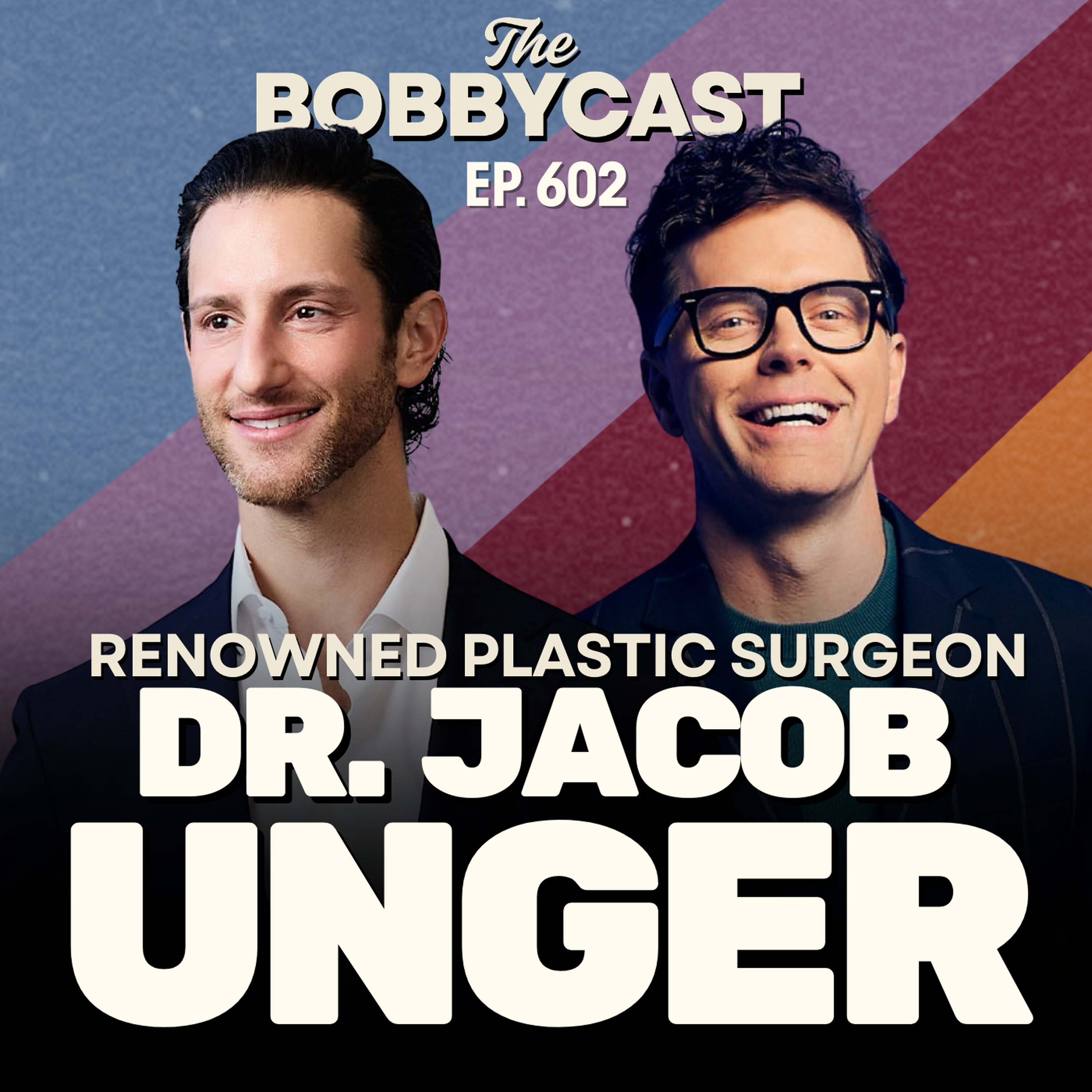
The Bobby Bones Show
BOBBYCAST #602 - Plastic Surgeon Dr. Jacob Unger Explains Celeb Surgeries, Boob Jobs and Liposuction
01:02:31
Loading summary
Transcript436 lines
- [00:00]
Pharmaceutical Advertiser
This is an iHeart podcast.
- [00:02]
Amazon Pharmacy Advertiser
Guaranteed Human Amazon Pharmacy Presents Painful Thoughts
- [00:10]
Dr. Jacob Unger
it's been a long, bumpy road dealing with yet another bladder infection and driving to the pharmacy to pick up meds. I went over a pothole and a little pee came out, so now I get to stand in line with pee pee pants.
- [00:24]
Amazon Pharmacy Advertiser
Next time, skip the pain and get fast free delivery with Amazon Pharmacy. Healthcare just got less painful
- [00:34]
Pharmaceutical Advertiser
Eczema is unpredictable, but you can flare less with epglis, a once monthly treatment for moderate to severe eczema. After an initial four month or longer dosing phase, about four in ten people taking ebglis achieved itch relief and clear or almost clear skin at 16 weeks, and most of those people maintain skin that's still more clear at one year with monthly dosing.
- [00:54]
Pharmaceutical Safety Information Reader
MGLIS Lebricizumab LBKZ, a 250mg injection, is a prescription medicine used to treat adults and children 12 years of age and older who weigh at least 88 pounds or 40 kilograms with moderate to severe eczema, also called atopic dermatitis, that is not well controlled with prescription therapies used on the skin or topicals or who cannot use topical therapies. Eglis can be used with or without topical corticosteroids. Don't use if you are allergic to ebglis. Allergic reactions can occur that can be severe. Eye problems can occur. Tell your doctor if you have new or worsening eye problems. You should not receive a live vaccine when treated with ebglis. Before starting ebglis, tell your doctor if you have a parasitic infection.
- [01:28]
Pharmaceutical Advertiser
Ask your doctor about ebglis and visit ebgliss.lilly.com or call 1-800-LilyRx or 1-800-5979.
- [01:35]
Inner Balance Advertiser
Dealing with fatigue, mood changes or skin shifts. Labs keep coming back normal. Meet Oestra from Inner Balance all in one doctor prescribed Prescription Strength Bioidentical Hormone Cream designed for menopause and perimenopause relief. Oestra combines two hormones for relief in one simple treatment, replacing the five or six products. Many women juggle just one drop 10 seconds a day. Take the quick two minute quiz online. To order Oestra today, visit innerbalance.com to feel like yourself again.
- [02:03]
Podcast Host (Bobby)
That's innerbalance.com spring into deals with stay green premium two cubic foot mulch five bags for $10 plus stay fresh with up to 35% off select major appliances
- [02:16]
Dr. Jacob Unger
and save an additional $100 on select laundry pairs.
- [02:20]
Podcast Host (Bobby)
Our best lineup is here at Lowe's Lowe's. We help you save. Valid through 56 mulch. Offer excludes Alaska and Hawaii.
- [02:28]
Inner Balance Advertiser
Seeloes.com for more details visit your nearby Lowe's.
- [02:42]
Dr. Jacob Unger
But it's really a natural extension of taking someone whose leg was mangled in a car accident and making it so they can walk again. Taking a bone and plugging it into a blood vessel in the leg and taking a leg muscle and turning it on top of it to protect it and putting it all back together. That's where plastic surgery was born.
- [03:00]
Podcast Host (Bobby)
Hey. Today I'm talking with Dr. Jacob Unger. He's a board certified plastic surgeon and in town where we live in Nashville. A founder of the Nashville Plastic Surgery Institute. I am very curious about all things plastic surgery. I'm going to start this conversation off asking about Brazilian butt lift because I was told to so big shout out to Dr. Unger because he answered all my questions and he knew some of them were pretty stupid. But we're going to talk about everything. Mostly it's I'm just curious how much stuff costs, what recovery is like what procedures he does, what he's best at. Like it's just a course here in plastic surgery and a little bit in life. And if you guys want to follow him on Instagram, it's rjacobunger. We talk about why people go overseas for certain surgeries. So Here he is, Dr. Jacob Ungar. Alright, Dr. Unger, good to have you here.
- [03:49]
Dr. Jacob Unger
Great to be here.
- [03:51]
Podcast Host (Bobby)
Would you have me call you Jacob or Dr. Unger?
- [03:54]
Dr. Jacob Unger
I feel like Jacob, when you introduce
- [03:57]
Podcast Host (Bobby)
yourself to people, what do you introduce yourself as?
- [03:59]
Dr. Jacob Unger
Like in the real world or. Yeah, real world, Jacob.
- [04:01]
Podcast Host (Bobby)
Oh, you do?
- [04:01]
Dr. Jacob Unger
Always.
- [04:01]
Podcast Host (Bobby)
Oh yeah, man. I tell you, I'm a fake doctor.
- [04:03]
Dr. Jacob Unger
Yeah.
- [04:04]
Podcast Host (Bobby)
Because I got a fake doctor. It's an honorary doctorate and I almost want people to call me doctor. So if I had earned it like you have, it'd be all doctor all the time.
- [04:12]
Dr. Jacob Unger
Yeah, I hear you. You know, I think I find that the people who are doctors don't really need that.
- [04:18]
Podcast Host (Bobby)
Yeah, that's why I'm demanding it, because I'm really not. I'm a fake doctor. Yeah. So I have a lot of questions about what you do for a living, but I was telling Amy, my co host on my radio show that you were coming in.
- [04:27]
Dr. Jacob Unger
Yeah.
- [04:28]
Podcast Host (Bobby)
And I just want to start with her question so I don't forget it. She specifically said to ask you about a bbl. So we're going right to it and we're going to talk about other things. Too. But a BBL is a Brazilian butt lift. Is that correct?
- [04:42]
Dr. Jacob Unger
That's the acronym.
- [04:43]
Podcast Host (Bobby)
Is that a real thing?
- [04:45]
Dr. Jacob Unger
Totally a real thing. It has, like, nothing to do with Brazil. What it really refers to is adding fat, fat grafting to the butt.
- [04:53]
Podcast Host (Bobby)
And do people here do that?
- [04:55]
Dr. Jacob Unger
Yeah.
- [04:55]
Podcast Host (Bobby)
Okay, so it's not from Brazil and you don't. Is it because Brazilian. Is it because Brazilian butts are big?
- [05:01]
Dr. Jacob Unger
Yeah.
- [05:01]
Podcast Host (Bobby)
Is that why it's called that? Interesting.
- [05:04]
Dr. Jacob Unger
That's the name of the game. Yeah. So, you know, we can take fat from different parts of the body and put it in different places and get it to live in that new spot. And so we can face breast, buttock, and you can take fat where you don't want it and put it where you do.
- [05:16]
Podcast Host (Bobby)
Does it ever not take?
- [05:18]
Dr. Jacob Unger
Yeah, for sure. So, you know, it's important you go to someone who does a lot of whatever you want done. And even in the best of hands, not all of it survives. You know, fat needs blood supply like all of the rest of our body. And you're taking it out of its blood supply and putting it into a new area with blood supply, but you need blood vessels that actually grow into that fat and revitalize it and make it alive. And so, you know, if someone just squirts a big ball in there, it's not going to work because the outside might get blood supply, but those cells will die way before they get any blood.
- [05:50]
Podcast Host (Bobby)
And if people come to you and say, I want a Brazilian butt lift, is that something that you have done?
- [05:55]
Dr. Jacob Unger
Yeah, for sure. So, you know, listen, my practice is not very flashy, showy from a result standpoint. It's all super kind of natural, elegant, soft. And so when I have patients that ask for that, it tends to be like fit moms who have lost a little bit of volume, a little bit of muscle tone maybe over time. They're working out a lot. They're getting kind of thinner post kids a lot and they want a little bit more shape. And so we call it. They would call it a skinny BBL or an athletic bbl, not like overdone proportions, not super big and round, just kind of like filled out a little more youthful.
- [06:33]
Podcast Host (Bobby)
I want you to know that I'm going to ask some dumb questions. And I'm not being funny, like even asking about Brazilian butt lifts. I didn't know if that was like a superhero thing or if that was like something a lot cooler. Yeah, it was just like something that the Kardashians did on tmz. Like, I Didn't know, but that's really something. But are there other parts of the body that people want fat put on?
- [06:50]
Dr. Jacob Unger
For sure.
- [06:51]
Podcast Host (Bobby)
Is it all Brazilian then? Is it like a Brazilian?
- [06:53]
Dr. Jacob Unger
No, Brazil only got the butt. Everyone wants it.
- [06:56]
Podcast Host (Bobby)
Where else would someone want fat?
- [06:58]
Dr. Jacob Unger
So some of the main areas are the face. So revolumizing the face. As we age, we lose volume in our face. And so you can put some fat back in there that's obviously very small volume unless you want to look crazy. And that basically all stays because there's a lot of blood supply to the face and very little amounts of fat being added. So that's a really common area. The other most common area is the breast. So trying to revolumize the breast not with implants, but with fat.
- [07:28]
Podcast Host (Bobby)
Okay, so that's different.
- [07:29]
Dr. Jacob Unger
Yeah, totally different.
- [07:30]
Podcast Host (Bobby)
So that's not a boob job? I guess it would be a boob job.
- [07:34]
Dr. Jacob Unger
It is a type of one, but like the classic boob job or, you
- [07:38]
Podcast Host (Bobby)
know, breast augmentation, Scientifically speaking. Yes. We're both doctors here.
- [07:41]
Dr. Jacob Unger
Yeah, we are both doctors.
- [07:42]
Podcast Host (Bobby)
Yeah.
- [07:43]
Dr. Jacob Unger
Yes, sir, doctor. So it's, you know, placing implants into the breast to create more volume, and that is still the gold standard if you want to actually have larger and fuller breasts. Fat doesn't work quite the same.
- [07:56]
Podcast Host (Bobby)
Do guys ever come in for Brazilian butt lifts? Is that a guy thing at all?
- [08:01]
Dr. Jacob Unger
Yes. Not in my practice.
- [08:04]
Podcast Host (Bobby)
Okay. But guys can do it. Yeah, sure, I guess. I mean, you could do anything, right?
- [08:08]
Dr. Jacob Unger
Sure.
- [08:08]
Podcast Host (Bobby)
You've never done one on a dude here?
- [08:10]
Dr. Jacob Unger
Actually. Actually, that's not true. There's a close friend who's in the public eye who wanted a juicier butt. And so we put a little bit of fat in when we were sculpting from some other places instead of throwing it out. Very few.
- [08:23]
Podcast Host (Bobby)
Can you take fat from somebody else's body?
- [08:26]
Dr. Jacob Unger
No.
- [08:26]
Podcast Host (Bobby)
Oh, it has to be your own fat.
- [08:27]
Dr. Jacob Unger
Has to be your own fat. Cause that'd be like a transplant with, like, random tissue. That would not. That would not go well. Doctor, you should know that.
- [08:34]
Podcast Host (Bobby)
What do most cold calls come in for?
- [08:37]
Dr. Jacob Unger
It's a great question. I don't really know. I try to stay out of all the business side of everything from intake, you know, costs, all that kind of stuff. I just try to focus on doing surgery and kind of doing my art. I think it's a. You know, we don't. It's a lot of word of mouth in my practice, so.
- [08:58]
Podcast Host (Bobby)
But if someone comes to the front door and they're Asking about something. What's the surgery? Boobs.
- [09:03]
Dr. Jacob Unger
So no one walks in the front door looking for plastic surgery. That strain off the street.
- [09:06]
Podcast Host (Bobby)
I'm not being funny.
- [09:08]
Dr. Jacob Unger
I literally thought you sounds like a donut man.
- [09:10]
Podcast Host (Bobby)
But you'd be like, I should stop by and see if they can do so. People don't really just come in to say, what do you got? It's not like a tattoo shop where you pick one.
- [09:18]
Dr. Jacob Unger
It's not like you're not driving. I was like, surgery sounds like a good idea and walk in and get something. So it's all phone call, emails, Instagram.
- [09:27]
Podcast Host (Bobby)
I really thought people would show up and be like, how much for a Brazilian butt lift if you were to do one?
- [09:33]
Dr. Jacob Unger
I really don't know.
- [09:34]
Podcast Host (Bobby)
You don't know? You know the price.
- [09:36]
Dr. Jacob Unger
No, that's like, you know, it's so awkward. I keep myself completely out of that. I have a team, like, an incredible team.
- [09:43]
Podcast Host (Bobby)
More than 5,000?
- [09:45]
Dr. Jacob Unger
Yes.
- [09:45]
Podcast Host (Bobby)
Okay. I just don't. I have no idea.
- [09:47]
Dr. Jacob Unger
Listen, I think it probably ranges from, honestly, from, you know, 10 to 100,000, depending on where you are in the country or the world.
- [09:57]
Podcast Host (Bobby)
A hundred thousand dollars?
- [09:58]
Dr. Jacob Unger
Not. Not in my office.
- [10:00]
Podcast Host (Bobby)
But I mean, no, I'm not even talking about you specifically.
- [10:02]
Dr. Jacob Unger
Like, yeah, for sure.
- [10:04]
Podcast Host (Bobby)
My butt better do the percolator without me doing any of my other muscles at all. Like, it just naturally.
- [10:09]
Dr. Jacob Unger
Yeah, just bounces.
- [10:10]
Podcast Host (Bobby)
It's like a button. I should push a button. Yeah.
- [10:13]
Dr. Jacob Unger
Ye.
- [10:13]
Podcast Host (Bobby)
That's wild. What do you do the most of?
- [10:17]
Dr. Jacob Unger
So I kind of do them two things. Facial rejuvenation, facelifts, and then mommy makeovers or mommy makeover, quote unquote, which is post mom surgery, breast and tummy, and that's. I operate four days a week and it's basically just those on rinse and repeat.
- [10:34]
Podcast Host (Bobby)
Are you considered a plastic surgeon? Is that still the term?
- [10:36]
Martha Stewart
Yes.
- [10:37]
Dr. Jacob Unger
Yeah.
- [10:37]
Podcast Host (Bobby)
Why is it called plastic?
- [10:39]
Dr. Jacob Unger
So it comes from the Greek word plastikos, which means to mold. So it has nothing to do with plastic. There is no plastic in plastic surgery. That's a misnomer. But our job is to kind of sculpt and create and return form and function. You know, Plastic surgery spans the gamut. All reconstructive surgeries are plastic surgery, hand surgery, craniofacial, meaning fixing the facial skeleton or cleft lips and palates. That's all plastic surgery.
- [11:08]
Podcast Host (Bobby)
I don't like that then, because I just assume plastic means plastic. Yeah, I think it gives you guys a bad look. Interesting, because I think, oh, they're a plastic surgeon, I go like a Barbie or Ken doll. They're made of plastic, they're perfect. So it's trying to make them perfect out of plastic. It's unfair. But that's why I ask, are you a plastic surgeon? But that makes more sense.
- [11:30]
Dr. Jacob Unger
Your answer does. And funny enough, plastic surgeon is what you need to look for. So there are other surgeons that call themselves cosmetic surgeon or aesthetic surgeon. They haven't done residency in plastic surgery, which is a very long, very competitive process. And so in America, if you're a doctor such as yourself, you're legally allowed to perform any type of medicine that hospitals will give you privilege for and the patients will see you for. And so because plastic surgery is not an insurance or cosmetic surgery is not an insurance reimbursed thing. It's a cash pay thing. A lot of doctors try to set up a, set up a practice and perform it without training.
- [12:17]
Podcast Host (Bobby)
When you hear about people like behind Waffle House or doing their own apartment,
- [12:21]
Dr. Jacob Unger
how'd you hear about it?
- [12:22]
Podcast Host (Bobby)
Yeah, but like, people die.
- [12:24]
Dr. Jacob Unger
Oh, yeah.
- [12:25]
Podcast Host (Bobby)
Like if they're like. Because I will hear the stories or see the stories about people taking like, fix a flat and putting it into their butt or some. Does that ever. Because we hear the bad stories. But does that ever work successfully?
- [12:37]
Dr. Jacob Unger
Oh, God, no. No, no, no. I mean, listen, maybe short term they stay alive, they make it out of the office and they problem down the line. You know the problem with, with plastic surgery? Two. Two things, right? You're only going to hear about all the crazy, terrible stories and you're only going to notice the bad work. Good work is like, how does that chick still look so good? You know? And that's because well done plastic surgery shouldn't change the way you look. It should just make you look and feel like the best version of yourself.
- [13:05]
Podcast Host (Bobby)
So what is your story as far as being a doctor? What did you want to be when you grew up?
- [13:09]
Dr. Jacob Unger
A doctor. So, you know, listen, I. I think your story is super inspiring. I. My story is not the same, but not that dissimilar, right? I grew up two cool hippie parents. They met in Dallas, Texas.
- [13:22]
Podcast Host (Bobby)
Where'd you live growing up?
- [13:24]
Dr. Jacob Unger
I was born in Dallas and then I was there until I was about 8. And then they wanted to get out of Texas. My mom's from the beach in Jersey. Her mom died young, so there was a house. We moved to Jersey. And then I basically spent my formative years like Jersey shore kind of kid close to New York, and then moved, you know, moved around Ever since.
- [13:43]
Podcast Host (Bobby)
But they were doctors.
- [13:44]
Dr. Jacob Unger
Oh, no, I'm the first doctor in my family.
- [13:46]
Podcast Host (Bobby)
Wow, that's awesome.
- [13:47]
Dr. Jacob Unger
Yeah, that's.
- [13:48]
Podcast Host (Bobby)
It's seemingly rare. A lot of the folks that I know that are lawyers, doctors or lawyers somewhere in their family, because I think to have a profession like that, it has to be something that seems attainable.
- [14:00]
Dr. Jacob Unger
Yeah.
- [14:01]
Podcast Host (Bobby)
And I think with a lot of doctors or lawyers, like, to me it was almost like New York or la. It wasn't attainable. That's fiction. That was fantasy land. Like, I'll never go there. That's just where they make TVs and movies. I didn't even know a doctor growing up. Definitely didn't know a lawyer. And so I think a lot of doctors and lawyers, they know it's attainable because they see it, which is crazy about your story. If you didn't have any doctors in your family and you still wanted to be a doctor.
- [14:24]
Dr. Jacob Unger
I mean, we did not have a lot of resources, but there was a lot of love and support. And when I was three years old, I wanted to be a neurosurgeon. And that was my first enrichment project. When I was in kindergarten. I made a map of the brain and. But why parents? No idea where I came. I mean, I don't know, maybe I watched Doogie Howser young or something like, you know, I mean, I just, I thought I wanted to use my brain. I wanted to help people. I, you know, I know that was my thing from a young age, but, you know, what caused that spark? I don't know. And then I pursued it.
- [14:58]
Podcast Host (Bobby)
Were you always the kid that wanted to be a doctor?
- [14:59]
Dr. Jacob Unger
Yeah.
- [15:00]
Podcast Host (Bobby)
So did you take your studies seriously, your whole scholastic career?
- [15:04]
Dr. Jacob Unger
Not as seriously as I should have. I've had some, you know, some good wake up calls and some good lessons along the way. You know, I was, I was good at school and all that. I was especially early on in Texas. I got a lot of accolades because I was in a. You know, I was one of the only English speaking kids in the district. And so like, that alone set me up to look pretty good. And you know, I would change grades for math. And then I moved to New Jersey, which was not a really great area either, and I skipped a grade. And so I had all this kind of academics behind me. And then in high school I got a little lazy. Hung out with some older kids. I did well, but I wasn't number one in my class. And so you went to Arkansas and went to Tulane, which was awesome for undergrad. Wasn't really where I was planning to go. I thought I'd go to UPenn or Harvard or something like that. Although, of course, no one in my family has done anything like that. But I thought, it'll work. Little did I know how challenging all that stuff is. And when I got to college, I was. I had a little chip on my shoulder, and then I kind of grinded starting then and ever since. And so I was, you know, upper section of my class out of 300 in my random public high school. And then I was, you know, valedictorian in college.
- [16:18]
Podcast Host (Bobby)
Really?
- [16:19]
Dr. Jacob Unger
Yeah.
- [16:20]
Podcast Host (Bobby)
That's awesome. So where'd you go to med school?
- [16:24]
Dr. Jacob Unger
Nyu.
- [16:25]
Podcast Host (Bobby)
Okay, so now you're.
- [16:26]
Dr. Jacob Unger
So that's. So then. So, you know, then I went to Tulane and I. This is when my parents stopped giving me advice. I did this special program that would allow me to get accepted to medical school after two years of undergrad if I had, like, straight A's basically, and did a mate. And all of my pre med requirements were done in two years with a major outside of science. I was a philosophy major in college, and I did it, and I got into Tulane. And I was really young, you know, I went to college young because I, you know, did all that stuff early. And my parents were like, I was into medical school at 18. My parents were like, jacob, you're. You're going to Tulane. This is amazing. You're in a med school. I was like, you know, I think I might want to be a plastic surgeon. I think I want to be in New York. They're like, we're not paying for any of these MCAT courses because there are these expensive classes to take the test. You know, I didn't need the test to get in because there wasn't even time to take it. They're like, you're going to take this test and try to go somewhere else? Like, yeah, I think I want to give it a whirl, see if I can get to New York. So they wouldn't pay for the class. So I just bought that study book, that Princeton Review thing, and I just read it cover to cover and took the test and it went well and was able to get an nyu, which is. That was the premier place that I wanted to be in because that was kind of where plastic surgery started in America.
- [17:44]
Podcast Host (Bobby)
So why plastic surgery, though? Because you go to med can be anything.
- [17:49]
Dr. Jacob Unger
Absolutely, yeah.
- [17:49]
Podcast Host (Bobby)
What pushed you that direction?
- [17:51]
Dr. Jacob Unger
So I came in wanting to do that, but I didn't know what it was actually. And I got there, I walked into the Dean's office first day of med school. I said, I need research, because, you know, research is a big thing to set you apart as a medical student. You have to publish. And so he set me up with a group, and I knew plastic surgery was the most competitive field. This gets into my competitiveness. Chip on the shoulder. I wanted to do the hardest thing, and I didn't know what it was, but I knew it was surgery. I knew I wanted to use my hands. And what I learned through medical school was, you know, I love medicine because you can think and figure out solutions to problems, diagnose and treat. Right. A lot of surgery is, you know, the diagnosis is given to you perform the same thing over and over. And so I didn't like that. And so plastic surgery is kind of the surgeon's surgeon. That's what it's kind of called in the medical field because we have to fix all the interesting, complex problems from a form and function, from a skin and muscle and bone standpoint that surgeons need help with. And so I was like, oh, cool. I get to solve problems and use my hands. Cool field. Yeah.
- [19:02]
Podcast Host (Bobby)
I think as you talk about being a plastic surgeon, I can feel my relationship with what a plastic surgeon does change in that I told you, my relationship. We just thought of it as plastic. I think of Ken and Barbie. Let's just create the perfect person, like television has taught me. But you're right, like, so many doctors probably have to send people to you that there's been an illness, an injury. And it's not you giving somebody a bbl, it's you trying to get someone back to as close to normal as they can possibly be.
- [19:34]
Dr. Jacob Unger
Right.
- [19:35]
Podcast Host (Bobby)
Is that accurate?
- [19:36]
Dr. Jacob Unger
100%. And that's. That's where aesthetic surgery or cosmetic or elective surgery comes from. It's kind of like the ultimate, the pinnacle of trying to create the best shape and form and function. Right. So, yes, you might be making an improvement, but it's really a natural extension of taking someone whose leg was mangled in a car accident, making so they can walk again, taking a bone and plugging it into a blood vessel in the leg and taking a leg muscle and turning it on top of it to protect it and putting it all back together. You know, that's. That's where plastic surgery was born.
- [20:10]
Podcast Host (Bobby)
Yeah. I have an unfair association of plastic surgery with only being esthetically pleasing. And that's the pure purpose of it. And I don't think that's fair. I don't think it's fair for me to think that. And I haven't had that realization until right now.
- [20:25]
Dr. Jacob Unger
Yeah.
- [20:26]
Podcast Host (Bobby)
Because again, you guys, meaning guys, women doctors, you are doing so much more than just that. But because I see on TV so much that just the celebrity versions of it, the boobs in the butt and the lips, that's all my association with.
- [20:41]
Dr. Jacob Unger
You're in that world, right? I mean, you're going to be surrounded by celebrities and trying so hard to look so good all the time. So, I mean, I think that your idea of it is probably the standard public idea, but we have a mutual friend that had breast cancer and plastic surgeons address breast cancer from a rebuilding and reconstruction standpoint. Skin cancer on your face. You know that dermatologic surgeons and plastic surgeons fix all those holes from skin cancer, so on and so forth.
- [21:13]
Podcast Host (Bobby)
Let's take a quick pause for a message from our sponsor.
- [21:18]
Amazon Pharmacy Advertiser
Amazon Health AI presents Painful Thoughts I
- [21:23]
Dr. Jacob Unger
I can't stop scratching my downtown. Mm, yeah, but I'm not itching to go downtown and tell a receptionist I'm here to talk about my downtown. Some things you'd rather type than say out loud.
- [21:37]
Amazon Pharmacy Advertiser
There's no question too embarrassing for Amazon Health AI. Chat your symptoms and get virtual care 24. 7 Healthcare just got less painful
- [21:48]
Pharmaceutical Advertiser
Eczema is unpredictable, but you can flare less with ebglis, a once monthly treatment for moderate to severe eczema after an initial four month or longer dosing phase. About four in ten people taking Eclipse achieved itch relief and clear or almost clear skin at 16 weeks, and most of those people maintain skin that's still more clear at one year with monthly dosing.
- [22:07]
Pharmaceutical Safety Information Reader
Empglis Librekizumab LBKZ a 250mg per 2ml injection is a prescription medicine used to treat adults and children 12 years of age and older who weigh at least 88 pounds or 40 kilograms with moderate to severe eczema, also called atopic dermatitis, that is not well controlled with prescription therapies used on the skin or topicals, or who cannot use topical therapies. EPGLIS can be used with or without topical corticosteroids. Don't use if you're allergic to Epglis. Allergic reactions can occur that can be severe eye problems. Problems can occur. Tell your doctor if you have new or worsening eye problems. You should not receive a live vaccine when treated with ebglis. Before starting ebglis, tell your doctor if you have a parasitic infection.
- [22:41]
Pharmaceutical Advertiser
Ask your doctor about EBGLIS and visit eglis.lilly.com or call 1-800-lilyrx or 1-800-545-5979.
- [22:48]
Inner Balance Advertiser
Dealing with fatigue, mood changes or skin shifts. Labs keep coming back normal Mitoestra from Inner balance all in one. Dr. Prescribed prescription strength bioidentical hormone cream designed for menopause and perimenopause relief. Oestra combines two hormones for relief in one simple treatment. Replacing the five or six products. Many women juggle just one drop ten seconds a day. Take the quick two minute quiz online. To order Oestra today, visit innerbalance.com to feel like yourself again, that's innerbalance.com Ever
- [23:19]
Martha Stewart
wonder how to make hosting look effortless? Here's a secret. When prepping for cooking and baking, get ahead of the mess with new Reynolds Kitchens countertop prep paper. Just lightly wet the counter so the paper grips. Lay it down and drips and spills stay on the paper, not on your counter. Cleanup is as simple as lifting it away to reveal clean counters. Effortless it is thanks to Reynolds Kitchen's countertop prep paper. Wet it, set it, prep it. Done. Available in the Reynolds wrap aisle at Walmart, Target, Amazon and Costco.
- [24:06]
Podcast Host (Bobby)
And we're back on the bobbycast. Whenever you finish a surgery, do you know, like, I just crush that or do you have to like, wait till it all heals?
- [24:17]
Dr. Jacob Unger
You know, you gotta keep some humility about you or you're gonna, it's not gonna go well. So I usually, I'm usually very pleased in the surgery. I feel really good about it, but I'm never like, oh, this is perfect. See, you never, you know, I always want to be like, is this exactly what I wanted? I want to, you know, I'll write notes after every surgery. I'll say, you know, right, breast was really complicated for X number of reasons. I do a lot of revisionary surgery from, with problems from around the world. And I'll say, you know, this was really hard. It was super tight here and it looked pretty good. But you have to imagine how the patient will evolve, how their skin will change, how the tissue will change with gravity, with stretching. So you can't have it always exactly what you want on the table because then it'll change.
- [25:04]
Podcast Host (Bobby)
Post op, if I get my car washed, I know when it's done, my car's washed. I can just look at it and be like, it's done. But when you finish on someone, they have to heal still. So the final, final result is not like, you know, because you've done it so many times. Probably what's going to happen but you don't know the final, final result. Right. Till it totally heals up. Yeah, I think that would be what would keep me humble.
- [25:23]
Dr. Jacob Unger
Yeah. Yeah, it does. Because you know what I always say, I can't control how you heal. Right. You know, I mean, with experience and, you know, a lot of reps, you can get a pretty good idea of where things are going to end up, but you don't really know. People can have bad scarring or good scarring or stretchier skin or tighter tissue. And so, you know, you gotta. This field will humble you no matter how good you are.
- [25:56]
Podcast Host (Bobby)
Do a lot of people say they have a deviated septum and they just come in to get cosmetically fixed?
- [26:00]
Dr. Jacob Unger
I think people sometimes want to have a reason to have surgery besides just wanting an improvement in shape.
- [26:06]
Podcast Host (Bobby)
A deviated septum is a real thing, though.
- [26:08]
Dr. Jacob Unger
Oh, for sure.
- [26:08]
Podcast Host (Bobby)
Like, I didn't even know. I had a friend that had a real deviated septum.
- [26:11]
Dr. Jacob Unger
Yeah.
- [26:11]
Podcast Host (Bobby)
And after he had it, because he. Before he went in, he would close one and it. When he'd breathe, it was like he always had a cold.
- [26:19]
Dr. Jacob Unger
Right.
- [26:20]
Podcast Host (Bobby)
And again, my association with deviated septum was people lying just to get a nose job. He had a real one and he came out of it and his nose looked no different, but he had.
- [26:29]
Dr. Jacob Unger
That's called the septoplasty.
- [26:31]
Podcast Host (Bobby)
I wouldn't have known that. Yes, but he had that done. And so I was like, oh, that's a real thing. Right. But then I hear, and I know of people who say that, but I actually know that they went in because they just wanted it fixed or they wanted their nose changed a bit.
- [26:45]
Dr. Jacob Unger
And honestly, I think people are so much more upfront about plastic surgery now. They're embracing it as opposed to hiding it. I think that that's less common. I mean, Hollywood has kind of led the charge on that people are coming out and on social media, there's a new celebrity every day talking about what they had done, why they did it, and why they did it for themselves, and pulling out of the darkness. I mean, it's not something to be ashamed of. I'm obviously biased, but we all want to look how we feel and feel like the best version of ourselves. And we exercise and we eat healthy and we study and we meditate and we do all these things. And so having kind of the physical shape and form that matches how you feels like, to me, a natural extension of how we're able to evolve and with technology, you know, do things safely.
- [27:38]
Podcast Host (Bobby)
What do you think about red Light because there's a couple versions and other people that have the little mask and we have the bed, the big. And so that goes deeper. So do you subscribe?
- [27:48]
Dr. Jacob Unger
Yeah. So it's real for sure. There is real studies in peer reviewed journals that show that red light can have an impact on a variety of different things in the skin from a skin remodeling and, you know, just kind of revitalization. So it's a great low risk, good return thing. Yeah.
- [28:08]
Podcast Host (Bobby)
I think my problem with it's been you can't really tell.
- [28:11]
Dr. Jacob Unger
Yeah.
- [28:12]
Podcast Host (Bobby)
And I've read some studies. I read a study that NASA did with plants that blew my mind. And these were basically. I'm gonna dummy this up, but it's basically a bunch of injured plants and they did red light on them for an extended period of time and they healed back so much faster than the plants that were also injured that they did not use red light on. And they did this over and over again.
- [28:30]
Dr. Jacob Unger
Right.
- [28:31]
Podcast Host (Bobby)
So it wasn't repeatable. Yes. And so like, to me, that's enough for me to go for it, but I don't ever get out and like, dang, I just got red lighted like crazy. That feels great.
- [28:41]
Dr. Jacob Unger
So, so listen, plastic surgery, like I perform every day, obviously it's one way and then three hours later it's another way. Like, it's a big, fast change, but it's a big thing to do. It's, you know, downtime. The lower kind of insult to the body you're performing, the slower the build. Right. Like skincare, sunscreen. Let's talk about sunscreen. We all know that we put on sunscreen. Helps prevent skin cancer, also helps with wrinkles. That's because the sun damages your skin, destroys the elastin in your skin, reduces the collagen. You don't put on sunscreen, be like, man, my skin's awesome. It's a 40 year game you're playing, so keep doing the red light. You look good. You'll look better in 10 years than if you never did it.
- [29:26]
Podcast Host (Bobby)
40 year games. That game sucks. What? It kind of. And I know vitamins work, but red light to me kind of feels like vitamins because I don't take vitamins and feel good.
- [29:38]
Dr. Jacob Unger
You don't, you know, you don't need you. First of all, you don't really need to take vitamins because we live in America and whenever everyone's diet gets basically everything you need in there.
- [29:46]
Podcast Host (Bobby)
I don't know, sometimes I don't eat vegetables for like a month.
- [29:48]
Dr. Jacob Unger
Oh yeah. I'M talking to you.
- [29:51]
Podcast Host (Bobby)
Yeah, sometimes I. I need them.
- [29:53]
Dr. Jacob Unger
You should probably take this.
- [29:54]
Podcast Host (Bobby)
Just like, supplements, certain things, but. Okay, go ahead.
- [29:58]
Dr. Jacob Unger
So. No, I was. I was just saying it's. You don't need red light to, you know, feel good or even look good. What it is, is small incremental gains. Just like, you know, good skin care, to just have that skin constantly turning over. And it's subtle.
- [30:17]
Podcast Host (Bobby)
We think about saunas.
- [30:19]
Dr. Jacob Unger
We have one. I love it. My wife uses it all the time. I think. I think they're good for you. We have an infrared sauna, which is hot, but that energy goes into the body a bit more. Listen, do I think it's the end all be all of health? Clearly not. If that were the case, everyone in Scandinavia would live forever and have no problems. And we would. In 90% of people in Sweden, they have a sauna. Everyone has them. I think there's a lot to all these little things. Cold plunging and. And all of the.
- [30:54]
Podcast Host (Bobby)
What do you think about cold plunging?
- [30:56]
Dr. Jacob Unger
Listen, I like it.
- [30:57]
Podcast Host (Bobby)
Do you do it?
- [30:58]
Dr. Jacob Unger
Yeah, I do.
- [30:59]
Podcast Host (Bobby)
Why do you? Because I've done it. I'm not a hater of it, but I've done it.
- [31:02]
Dr. Jacob Unger
I find it. You definitely get adrenaline rush. You get a dopamine hit from that, you know, which is cool. I think it can. You know, I don't do it a lot. I'm pretty thin, so I get cold quickly. I like the mental game of how long can I take this? How calm can I be? You know, just kind of working on mental health, mental strength, fortitude. I tell my kids, you know, never give up perseverance. I just want them to learn grit and toughness.
- [31:28]
Podcast Host (Bobby)
Okay, so yours is about discipline. Yours is about pushing yourself more than it is physically, what it's doing to the body.
- [31:33]
Dr. Jacob Unger
Yeah, I would say. I would say that's the bigger part for me. That's what I certainly love about it. But I'll feel good when I get out of it.
- [31:40]
Podcast Host (Bobby)
You know what? I feel cold.
- [31:42]
Dr. Jacob Unger
You don't feel it kind of floaty or euphoric? How long do you stay in?
- [31:48]
Podcast Host (Bobby)
Long enough. Like, whatever the time is. Like, I look on the Internet, how long? And it's like, if you stay two minutes, you know, you get a gold coin or something, whatever that is. I do, but then to me, there is that, oh, I feel kind of awake feeling that I do like. But it's the dread pre. It's the drying off now I'm wet. I don't like being wet. Just generally speaking. I don't even like getting in the pool. We got a pool. I don't like getting in the pool. People are like, you ever swim in your pool?
- [32:13]
Dr. Jacob Unger
No.
- [32:13]
Podcast Host (Bobby)
Why? I don't like being wet.
- [32:15]
Dr. Jacob Unger
Yeah.
- [32:15]
Podcast Host (Bobby)
So, like, that's a part of it, too. There's just a lot of, like, weird elements. But I subscribe to all these things. Probably work a little bit, but they only work with consistency. If you're. If it's like a sauna or red light or what, like, you have to be consistent at anything for it to
- [32:35]
Dr. Jacob Unger
function well, as most things in life.
- [32:38]
Podcast Host (Bobby)
Correct.
- [32:39]
Dr. Jacob Unger
I'm not going to learn guitar because I tried once to do Guitar Hero, so, yeah, I think that's totally right. Again, this is not a one and done kind of thing. This is like a commitment. This is a lifestyle. These are lifestyle things.
- [32:50]
Podcast Host (Bobby)
So, you know, if I went in and had some fat taken off my
- [32:55]
Dr. Jacob Unger
stomach, I knew it. I knew that's why I was here,
- [32:58]
Podcast Host (Bobby)
and I would do that. I would have asked you to, like, bring the pliers and the scissors and let's get it done. The problem for me is not any sort of stigma. It's the recovery. I don't recover. I don't like being wet. I don't want to recover.
- [33:13]
Dr. Jacob Unger
Okay.
- [33:14]
Podcast Host (Bobby)
I don't have time to recover.
- [33:15]
Dr. Jacob Unger
I know.
- [33:15]
Podcast Host (Bobby)
It's like I run so, so hard, and I'm on red all the time that I don't have a couple weeks to be like, hey, I'm just gonna. But is it. Let's say I went in and I was like, hey, I got a little fat here, help me out. Because I'm in pretty good shape. And let's say I did that. How long would it be until I could, like, play pickleball and run again?
- [33:34]
Dr. Jacob Unger
So, you know, listen, I know that feeling. That's kind of how I am set on go at all times. You know, my mother's always, honey, you're so tired, you know, and just kind of the way it is. So. I totally hear what you're saying. Surgery's not that long. Liposuction is a little bit of a quicker recovery than other things. I mean, healing takes time. But from a recovery standpoint, you can be back to some exercise. Like, one week might be sore, it might hurt a little, you know, but again, that's all up here. You're not going to hurt anything because nothing's been kind of cut and sewn. You can't tear anything apart. But, you know, I give patients a pretty quick recovery timeframe. The quickest that science Will allow. Because most of my patients are super active and have a lot going on. No one really wants to be down. So by six weeks from any surgery I'm doing, you can do anything. Rock climb.
- [34:27]
Podcast Host (Bobby)
Could I dunk?
- [34:28]
Dr. Jacob Unger
You can definitely learn to dunk just
- [34:30]
Podcast Host (Bobby)
from liposuction, because I couldn't dunk before,
- [34:31]
Dr. Jacob Unger
but if I can dunk after, I thought as much. Yeah, yeah. This will make you dunk. Liposuction.
- [34:37]
Podcast Host (Bobby)
So liposuction in my mind is you take a. The dentist and goes, and you just suck out the fat. Is that true?
- [34:44]
Dr. Jacob Unger
In very few words, yeah. So liposuction is done with cannulas. They're kind of like metal straws. Okay. And they have holes on them. And you have to put some fluid into the fatty tissue of the body first, kind of let it set up, and then you go in back and forth with multiple little access points to try to create a smooth, even playing field, essentially by removing fat where you want to remove it. And so it really is. It's an art. It's sculpting. I mean, there's some science. Of course, there's science behind the safety. There's science behind when to know, when to stop. But it's really just to your eye and touch and experience what you need to remove and what you need to leave behind.
- [35:24]
Podcast Host (Bobby)
Can fat come back in the spots that you've sucked it out?
- [35:27]
Dr. Jacob Unger
That's a great question. Once you remove fat cells, they're gone forever. You can't get new fat cells. So after you're about five years old, the fat cells you have are the fat cells you have. As you gain weight, those fat cells expand or contract.
- [35:42]
Podcast Host (Bobby)
Oh, they're not more fat cells.
- [35:43]
Dr. Jacob Unger
No more fat cells.
- [35:44]
Podcast Host (Bobby)
The fat cells are just getting fat.
- [35:45]
Dr. Jacob Unger
That's it. Fat cells get fat. So they kind of swell. If you look at it, they kind of look like. Like chicken wire. That's what fat cells in the body look like. And those fat. Those chicken wire holes get bigger or smaller. So if you have a problem area where you tend to gain all your weight and you suction out fat from that area, fat will not go there as preferentially. I mean, you'll still gain weight in all the areas. But if it used to go to your belly and now you gain ten pounds, you might feel it more, you know, in your hips or thighs more so than that area do.
- [36:15]
Podcast Host (Bobby)
Generally, guys get it, like, on their. Because I have it right on my stomach here. I also have a surgery where I have scar tissue where it kind of grows back.
- [36:24]
Dr. Jacob Unger
Weird.
- [36:24]
Podcast Host (Bobby)
Anyway, I have my spleen taken out. So I got from my sternum down to, you know, almost my. What you guys would call, I use clinical terms, my wiener area. There's a scar.
- [36:36]
Dr. Jacob Unger
You really are a doctor.
- [36:37]
Podcast Host (Bobby)
Yes. So I have a scar. And again, because of that, my stomach's just a little weird. I have no belly button. A little weird anyway, but that's still where the fat goes on me. Is that most dudes?
- [36:47]
Dr. Jacob Unger
Yeah, that. So men tend to gain it in the midsection. Women, you know, tend to gain it more in the hips, thighs, kind of area, as a general rule. So, you know, men that come in for liposuction, the key to really everything I do is making, you know what I tell patients. I want the skin to match the deeper tissue. So right now there's a little bit more fat, There might be a little bit of extra skin. If there's extra skin already, I won't do liposuction because all it's going to do is remove fat and leave more skin. So I tell everybody, you know, a bunch of saggy skinniness isn't better than kind of a fuller, slightly more plump thing. So a lot of things have to be aligned for liposuction to be the solution.
- [37:29]
Podcast Host (Bobby)
Do you ever tell people no?
- [37:31]
Dr. Jacob Unger
All the time.
- [37:32]
Podcast Host (Bobby)
Tell me about that.
- [37:34]
Dr. Jacob Unger
I mean, by the way, if you find a surgeon that only tells you yes, run, because you know that that's really saying no is more important than saying yes. I. My job is to educate on the front end, make sure that we're aligned, expectations are appropriate, and then maybe you're a candidate to have a surgery. And a lot of times people want things that aren't realistic or have unrealistic expectations or want something that's not real. And so no is how I spend most of my consult days.
- [38:10]
Podcast Host (Bobby)
Is an unrealistic expectation if someone wants a whole lot of fat taken out. Like, what would be an unrealistic expectation? Like if you get your haircut, you take in a picture and do this.
- [38:20]
Dr. Jacob Unger
Sure.
- [38:20]
Podcast Host (Bobby)
Does that happen?
- [38:21]
Dr. Jacob Unger
Yes. So somebody. A good example would be a breast patient. Let's say there's a fuller figured woman that has low breasts, she's older, and she brings in a picture of a swimsuit model. Well, she's not going to have those breasts. Right. Like, that's just not in the cards. Right. There's too much tissue, the chest is too wide. Things have changed too much, you know, so people say, this is what I want. And that's an easy no. I don't. I don't see much of that disconnect. But you know, people will also bring in a picture. They'll say, I feel I'm so tired now. I don't look as good as I used to. This is me just a few years ago. I want to look like this. And they'll bring in, you know, maybe an AI kind of airbrushed picture. You're like, I can't make you a cartoon. That's not gonna happen, right? So again, most of my patients are incredibly lovely, very reasonable, you know people, you want to be your friend. I mean, that's what I look for. If I don't like you, if I don't connect with you, then I'm not the right doctor for you.
- [39:28]
Podcast Host (Bobby)
The Bobbycast we'll be right back.
- [39:32]
Amazon Pharmacy Advertiser
Amazon Health AI presents Painful Thoughts why
- [39:37]
Inner Balance Advertiser
did I search the Internet for answers to my cold sore problem? Now I'm stuck down a rabbit hole filled with images of alarmingly graphic source in various stages of ooze. I can clear my search history, but I can never unsee that.
- [39:55]
Amazon Pharmacy Advertiser
Don't go down the rabbit hole. Amazon Health AI gets you the right care fast. Healthcare just got less painful.
- [40:02]
Pharmaceutical Advertiser
Eczema is unpredictable, but you can flare less with ebglis, a once monthly treatment for moderate to severe eczema after an initial four month or longer dosing phase. About 4 in 10 people taking Hecglis achieved itch relief and clear or almost clear skin at 16 weeks. And most of those people maintain skin that's still more clear at one year with monthly dosing.
- [40:21]
Pharmaceutical Safety Information Reader
Hempglis Lebricizumab LBKZ a 250mg per 2ml injection is a prescription medicine used to treat adults and children 12 years of age and older who weigh at least 88 pounds or 40 kilograms with moderate to severe eczema, also called atopic dermatitis, that is not well controlled with prescription prescription therapies used on the skin or topicals or who cannot use topical therapies. EBGLIS can be used with or without topical corticosteroids. Don't use if you're allergic to ebglis. Allergic reactions can occur that can be severe Eye problems can occur. Tell your doctor if you have new or worsening eye problems. You should not receive a live vaccine when treated with ebglis. Before starting ebglis. Tell your doctor if you have a parasitic infection.
- [40:55]
Pharmaceutical Advertiser
Ask your doctor about ebglis and visit ebgliss.lilly.com or call 1-800-LilyRx or 1-800-545-59.
- [41:03]
Inner Balance Advertiser
Fatigued mood changes, skin shifts. Labs say everything's normal. You're not alone. Most estrogen or progesterone topical and oral treatments only work about 20%. Oestra from Inner Balance is a prescription strength bioidentical hormone cream for menopause and perimenopause relief. Vaginal HRT like Oestra offers better absorption, effective symptom relief, fewer side effects. Stop juggling multiple products. Feel balanced again. Visit innerbalance.com feel like yourself again.
- [41:31]
Martha Stewart
That's innerbalance.com this is Martha Stewart from the Martha Stewart Podcast. Ever wonder how to make hosting look effortless? Here's a secret. When prepping for cooking and baking, get ahead of the mess with new Reynolds Kitchens countertop prep paper. Just lightly wet the counter so the paper grips. Lay it down and drips and spills stay on the paper, not on your counter. Cleanup is as simple as lifting it away to reveal clean counters. Effortless it is thanks to Reynolds Kitchens countertop prep paper. Wet it, set it, prep it, done. Available in the Reynolds wrap aisle at Walmart, Target, Amazon and Costco.
- [42:26]
Podcast Host (Bobby)
This, this is the bobbycast if I wanted to get pec implants because my whole life I've been very insecure about my chest. Okay, when I was 13, I had the chest of a 13 year old boy. When I was 30, I had the chest of a13 year old boy. It really never matured past that 13 year old boy. And I'm beyond that now. But if I did, is that something that's done for guys, that it makes them look like strong at the gym?
- [42:53]
Dr. Jacob Unger
I don't do that at all. I do no implants in males. I do no implants in women other than, you know, breast implants. There are a small group of surgeons that I know around the world that do that routinely. So they have the experience to do it because it's not a super high request surgery. So you better find someone who does that's really specialized in kind of male bodybuilding enhancing style surgery. But there's a lot of problems, you know, with that. I mean, the male pick is obviously a big muscle. It's used a lot. The implants for men are these kind of very rigid pieces of silicone. And so I mean, it's just something I've, I've totally avoided. So I can't do that for you.
- [43:34]
Podcast Host (Bobby)
Yeah, no, I'm never gonna. I'm 13 forever. I'll die 13 years in my chest. Yeah.
- [43:38]
Dr. Jacob Unger
Calves also not common at all. None of these solids. None of these solid implants are common, especially in the United States. They're more common in Asia, Middle East. They don't look very good, I don't think, which is, you know, why I don't do them most of the time. So, yeah, I would steer clear of that.
- [43:56]
Podcast Host (Bobby)
You ever hear about those people that break bones and get taller? Like the surgeries where they break and they put a rod in?
- [44:03]
Dr. Jacob Unger
Yeah.
- [44:04]
Podcast Host (Bobby)
That's crazy, huh?
- [44:04]
Dr. Jacob Unger
Elizarov. Yeah.
- [44:05]
Podcast Host (Bobby)
Is that what it's called?
- [44:06]
Dr. Jacob Unger
Well, the Elizarov method was invented in Russia and, like, I think the 1800s. I mean, you're testing my memory here, but, you know, that's a real thing. You can cut. So we actually. That was one of the big projects at nyu. It's called disrupt extraction. Osteogenesis, which is big words, but it means taking a bone, pulling it apart slowly, and allowing new bone to fill in. So it was first done in the legs, then it was done in the jaw. We do it for babies all the time that have certain craniofacial abnormalities. Very, very small chin, no airway. They have to have a trach. When they're born, you can rebuild the jaw, stretch it out so the tongue pulls forward, and they can get rid of a trach, live a normal life. Right. Wow. That's very common in a children's hospital. Hospital. You go to Vanderbilt right now, there's a. I'm sure. I don't know, but a number of children in the pediatric icu, they get a quarter turn. The residents go by and do a quarter turn, you know, twice a day or four times a day, depending on where you are, to stretch out that jaw. So that was the chairman at nyu, bringing it back to why I went there for med school. He was this really famous craniofacial surgeon. He wrote the first paper on doing that in the jaw, as opposed to the lake in dogs. And, you know, that kind of set him up for a big career. And one of the reasons why I wanted to go there.
- [45:20]
Martha Stewart
But it's.
- [45:20]
Dr. Jacob Unger
It's a real thing.
- [45:21]
Podcast Host (Bobby)
Yeah. One dude grew, like, 4 inch. He didn't grow. One dude put in like. He grew. I grew. I keep saying grew. He was 4 inch taller. Once he was healed, he walked a little funny.
- [45:29]
Dr. Jacob Unger
Yeah.
- [45:29]
Podcast Host (Bobby)
And then you're like, is it worth it? You're walking a little funny with your new rods and your. So I think that's wild. You know what else wild? That show. This one. You ever watch that? That shows crazy, that show. You had to look at that and be like, what are they doing?
- [45:42]
Dr. Jacob Unger
Yeah, that was. That was a little overstepping probably. You know, I mean, for those that
- [45:47]
Podcast Host (Bobby)
don't know, let me explain to people watching this or listening to this. The swan epic show, by the way. Yeah, but it shouldn't have been real. No, they both can exist, like, epic show, but they shouldn't have been, in my opinion. It was somebody who went in and they were like. Everything was like, off. And they were like, fix me. And they did like 42 surgeries on them, and all of a sudden they walked out and they were like a swan. Everything.
- [46:09]
Dr. Jacob Unger
Yeah, that was a wild. That was a wild. Is that the 90s?
- [46:12]
Podcast Host (Bobby)
Probably early 2000. Mike, would you look at this one? 2004.
- [46:15]
Dr. Jacob Unger
2004. Really? Yeah. So kind of like that Nip Tuck era. It's kind of early. You know, that 90s plastic surgery was so kind of under the radar, you know, 70s and 80s. You look in Manhattan, socialites would get facelifts. But like, super hush, hush and very, very small, small volume. As things got more refined and better and safer, kind of started ramping up and things went a little wild in like, kind of the late 90s, early 2000s again. I was. I was young at that point, so I. Oh, I.
- [46:44]
Podcast Host (Bobby)
Peace with the swan, though. That's wild. That's the wildest thing I've ever seen.
- [46:47]
Dr. Jacob Unger
That was it. And then. And then everyone, like, man, we're gonna. We're gonna reign that. Rein that in a little bit.
- [46:52]
Podcast Host (Bobby)
Whoever greenlit that show, I should have a talk with. That's crazy, because they would have, like all these surgeries at once and they'd present them and they still look jacked up. But still, though, is great. That, like, that was wild, rewarding surgeries for you as a human being. Like, can you tell me about a couple that you've done where you're just so proud of your work because you've helped somebody's life?
- [47:14]
Dr. Jacob Unger
Yeah. I mean, you know, not to sound like overblown, but it's like almost countless. Like, I mean, you. You know, that's what's important for me to realize it. It's not just fixing a hole from cancer that people are appreciative of and life changing for. You know, the more common thing I see now, you know, moms are the best example. They have babies, they nurture their children, they raise their children. It does a toll on the body, without a doubt. Stretching out the stomach, the muscles, the skin, breasts get deflated and change, you know, no one gets spared. Right? Supermodels, I see supermodels, they, they get, you know, a lot of changes in their bodies too. And to help a woman kind of restore herself and feel like herself again, there's a lot of happy tears and there's a, you know, it's a really special thing to get to be a part of, you know, that journey for people. And then on the reconstructive side, as you can imagine, you take someone who's having, you know, a burn victim that can't turn their neck and you do a surgery to rebuild the neck so that it's flexible and pliable again. Or somebody cuts their thumb off and you put it back on for them, which I.
- [48:28]
Podcast Host (Bobby)
That's happened.
- [48:29]
Dr. Jacob Unger
Oh yeah, I've done it countless times in residency. I don't do that, you know, anymore. That's. You need a big academic center. So I trained in Dallas Parkland Hospital, biggest public hospital in the country. And we had, we were on what's called replant call replanting fingers and arms every single day for six years. The plastic surgery department of plastic at UT Southwestern.
- [48:50]
Podcast Host (Bobby)
So there are that many people losing fingers and arms.
- [48:53]
Dr. Jacob Unger
Oh, it's non stop. I mean, they fly them all in. You know, everyone's.
- [48:55]
Podcast Host (Bobby)
That's crazy.
- [48:56]
Dr. Jacob Unger
I mean, it happens multiple times a day.
- [48:59]
Podcast Host (Bobby)
And so they come in and okay, if that happens, do you put it on ice? Because that's what TV says. Like, let's say I chopped a finger off and I'm like, oh my God, there's my finger.
- [49:08]
Dr. Jacob Unger
Wrap it in a wet paper towel, put it on ice, go to a major academic center.
- [49:13]
Podcast Host (Bobby)
But does that mean hospital?
- [49:15]
Dr. Jacob Unger
Sorry, a major academic hospital, like a Vanderbilt. These services, this is very, very, you know, you have like primary care. It's like your doctor, then you go on up. This is like what we call quaternary or fourth level care. It takes a big team of specialists, special microscopes, microsurgeons who do this all day. You're not going to find it at like every random hospital in small towns, but they'll ship you.
- [49:40]
Podcast Host (Bobby)
That reminds me, we were both too young to have been adults when this happened. But, and I'm only partially being funny because I'm curious about this, but remember when Lorena Bobbitt cut off John Wayne Bobbitt's penis and threw it in the field?
- [49:53]
Dr. Jacob Unger
So I reattached two penises. You have.
- [49:55]
Podcast Host (Bobby)
Okay, and I again, ha ha, whatever. But that's serious stuff. Like how does that, how do you get it to work? Again, does it work fully ever again?
- [50:02]
Dr. Jacob Unger
So, I mean, what's one of the. I've presented this case, you know, it's not that common. There's only a couple of the papers written about penis replants. The, the, the kid, he was young, you know, one of the ones. Anyway, he was getting erections before he left the hospital. I mean, again, medically speaking. And you know, it was working that fast. Oh, you're in the hospital for a while.
- [50:25]
Podcast Host (Bobby)
Oh, you are. You don't walk in a couple threads and it's like.
- [50:27]
Dr. Jacob Unger
No, it's a, it's, it's a couple of, couple of weeks of hospital.
- [50:30]
Podcast Host (Bobby)
How do you get it to work again though? Because it feels like there's a lot of blood vessels.
- [50:34]
Dr. Jacob Unger
Yeah, you got to plug all those tubes back together. So it's called microsurgery because we use a microscope. Under the microscope, we do tiny little needles that you really can't see. The, the sutures for. That is much thinner than a human hair, you know, a couple microns thick. And you sew them, you know, interrupted little stitches all the way around the circle. Put the two tubes, reconnecting them all. Nerves, arteries, veins.
- [50:58]
Podcast Host (Bobby)
Any of the nerves or veins. Artificial
- [51:03]
Dr. Jacob Unger
then? Not in that particular case. But you know, if you lose a finger, sometimes there's nerves in your fingers or fingers aren't too good without nerves. And so there are what are called nerve grafts. They're off the shelf, meaning they're products that are in the hospital. And you can take that little. It's basically like a, a nerve sheath without the DNA from a person. And you can use that to plug in and then the nerve can regrow through that tube.
- [51:28]
Podcast Host (Bobby)
This is going to be the stupidest question. Please respect it. Could you attach somebody else's penis onto my spot? No, you couldn't?
- [51:37]
Dr. Jacob Unger
No. So listen again. That's a transplant, right? So the body has an immune system. The immune system recognizes self and non self. That's why some people have allergies. That's pollen. Your body sees it as a problem, fights it. If I plug someone else's DNA onto you, your body's gonna be like, what are these cells?
- [51:54]
Podcast Host (Bobby)
What about an organ transplant, though? What if someone had a matching penis?
- [51:58]
Dr. Jacob Unger
So you could, if your identical twin had a much bigger penis than you, you could take it from him and put it on you. Identical twins. It would work.
- [52:05]
Podcast Host (Bobby)
Really?
- [52:05]
Dr. Jacob Unger
Yeah.
- [52:06]
Podcast Host (Bobby)
That's crazy.
- [52:07]
Dr. Jacob Unger
Yeah. So, you know, you have to immunosuppress transplant patients because they have to be really close. I'm Sorry.
- [52:13]
Podcast Host (Bobby)
Yeah, make that a little easier.
- [52:14]
Dr. Jacob Unger
So if you get a, you know, you have a kidney, you need a kidney transplant. You have to find a match. You probably heard, like, the donor has to match. You can't take any old kidney. It has to be someone who's really similar to you. Sometimes family members are matches they have. Again, this is not my area, but there's a variety of factors that they look at to see what immunologic things, what immune system things match up. And you need enough of those to match to be a match to get that kidney. Even with that, you're on serious medicine for the rest of your life to dumb down your immune system. So someone with a kidney transplant gets sick, it's a big deal. They're in the hospital real quickly. They have to get a lot of antibiotics because their immune system doesn't work the same.
- [52:55]
Podcast Host (Bobby)
Why you've had to replace two penises. And that's not even. That's crazy that it could even work, even a finger. Like, it's crazy that you can get it to function again.
- [53:03]
Dr. Jacob Unger
Yeah, it's cool.
- [53:04]
Podcast Host (Bobby)
Yeah. What was the first human you ever cut into? Were they alive?
- [53:10]
Dr. Jacob Unger
I guess not. No. Speak. You know, the first humans that we cut into was going to be in general anatomy. You know general anatomy? Like cadaver type? Yeah, yeah. But you're not learning surgical technique. You're just learning all the structures. The first human I cut into was.
- [53:25]
Podcast Host (Bobby)
Are you nervous? Your first. Your first surgery?
- [53:28]
Dr. Jacob Unger
Yeah, for sure. It was med school. You know, I was operating with. With the surgical team, and that's how it was teaching hospitals work. I was super gung ho. Like I said I would finish my plastic cert, my. Excuse me, my medical school work. And then late at night, I go to the hospital and figure out what plastic surgery cases were happening, reconstructing all these things, ask if I could come in and scrub in and then get to know you better and better and better and let you do stuff.
- [53:52]
Podcast Host (Bobby)
I'm meaning to ask this in a positive way, but were you a super nerd for it?
- [53:56]
Dr. Jacob Unger
Yeah.
- [53:56]
Podcast Host (Bobby)
Like you wanted it. You were so nerdy for it. Like you wanted to be there when it wasn't even your time to be there.
- [54:00]
Dr. Jacob Unger
I was there all. All the time.
- [54:01]
Podcast Host (Bobby)
That's awesome.
- [54:02]
Dr. Jacob Unger
My time to be there.
- [54:02]
Podcast Host (Bobby)
That's what I want my surgeon to be.
- [54:04]
Dr. Jacob Unger
Yeah.
- [54:04]
Podcast Host (Bobby)
I want my pilot to be that, too.
- [54:06]
Dr. Jacob Unger
Yeah.
- [54:06]
Podcast Host (Bobby)
I want my pilot to be outside the simulator. Be like, can I get in? I know it's not my time, but that's what I want all my surgeons, I want my pilots, anything that. Because you have our life in your hands.
- [54:17]
Dr. Jacob Unger
Yeah, yeah, it's been, it's, you know, now at this stage of my career, I'm actually trying to learn how to extricate how I see myself from just being a surgeon. You know, it's been the focus of my life. You know, I'm in my early 40s. For the last 20 years, I've been like focused on basically that. Right. And you know, you're not. You're now you're a father and you're a husband and you have friends and you're not just a radio, you know, you're not a radio host. You're not just, you're not a personality alone. So much of my, of my self worth has been wrapped up in what I do. That, you know, it ends up being a little unhealthy at some point, you know, you have to remember that you're a person and, you know, connect with my kids and wife and friends and find other interests because it's easy to just do nothing but that forever. You get zoned in, you get focused, and you get worried that if you're not doing more, then you're not doing enough.
- [55:17]
Podcast Host (Bobby)
And so, yeah, my entire identity has always been about what I do. And I'm starting to, as you said, not have that be the sole focus. That's also hard to release that because of the goals that I've always had. Because a little bit of me starts to have real life come into play and it's not the sole focus. And I start to go, wait, if I slow down, if I start to lean into these other parts of my life that are valuable. But if I take the gas off of this radio show podcast, whatever I'm doing, I'm going to lose it there. I struggle with that because I've always been such a nerd for all this.
- [56:04]
Dr. Jacob Unger
Yeah, I mean, I feel a lot of similarities with you. So what my executive coach would say is, you know, what motivated me early on? You know, fear. I didn't want to. I didn't want to have nothing. I didn't want to be able to afford to send my kids to school. I wanted to achieve something. I wanted to accomplish something different. But, you know, that fear doesn't serve. I'll speak for myself. It doesn't serve me anymore. I don't need to live my life upset when everything isn't perfect. And, you know, this week I should have done one more surgery because I could have and I had the time. And why wasn't it full? And why did no one come in for that? And. And, you know, I spend my. I spend. You end up spending your life, like, kind of miserable or frustrated or upset, and I'm not gonna. You know, I'm not gonna let my foot off the gas. This is who I am. I'm going to strive for excellence. I don't need to do it in such a way that I'm just beating myself constantly. You know, that served me, but it's time to, you know, move on with it, with the next. Next phase.
- [57:07]
Podcast Host (Bobby)
Did you find having kids change that, you know?
- [57:11]
Dr. Jacob Unger
Oh, my wife, she's gonna laugh when she hears this. So when my first child was born, I was a resident, I was on my chairman's rotation, said, babe, I have big surgery with Dr. Roark. That was my chairman and one of my big mentors tomorrow, do not have this baby. Of course she had the baby. I had to skip work. It was okay. I took three days off, and then I went right back to the grind. I'm like, this is my training. You know, you'll be fine. Your mom's coming to town. Cute baby, high, you know, second child. I was in early in practice. I took one day off. I went in for the day of the baby, and I said, you're good, right? You go, I'll get you home tomorrow. But I went back, like, I have patients. They're. You know, they've moved their life to have surgery. I can't cancel. Third child. We scheduled it. I had it born on a Sunday, so I took no days off. My wife's pretty upset by this point. This is only six years ago, and I thought it was so cool, you know, I was like, I'm earning for my family, and I'm. All my wife wanted was me to be around, and all my kids want is me. And so, you know, that was ramping up to the most extreme, kind of overdone. And I used to think it was cool. Just, like, I used to brag about not sleeping. You know, we were always trained. Like, I haven't slept in three days. I'm still operating. You know, someone eventually was like, you know, that's not cool, right, dude? I'm like, oh, okay. So trying to. Trying to recognize what I'm really going to care about on my deathbed. And I really do care about my patients, and I want my family to be proud of me, and I want to be a pillar of my community. And I. You know, I love that. Whatever reputation I've been able to to create has been one of, you know, trusting and loving in good bedside manner. And that is all a big part of who I am. But I can't shirk everything else and just expect it to stay there and be there for me.
- [59:12]
Podcast Host (Bobby)
So let's take a quick pause for
- [59:14]
Amazon Pharmacy Advertiser
a message from our sponsor Amazon Health AI presents Painful Thoughts I I can't
- [59:24]
Dr. Jacob Unger
stop scratching my downtown. Mm, yeah, but I'm not itching to go downtown and tell a receptionist I'm here to talk about my downtown. Some things you'd rather type than say out loud.
- [59:37]
Amazon Pharmacy Advertiser
There's no question too embarrassing for Amazon Health AI. Chat your symptoms and get virtual care 24. 7 Healthcare just got less painful Eczema
- [59:48]
Pharmaceutical Advertiser
is unpredictable, but you can flare less with ebglis, a once monthly treatment for moderate to severe eczema. After an initial four month or longer dosing phase, about four in 10 people taking emplis achieved itch relief and clear or almost clear skin at 16 weeks. And most of those people maintain skin that's still more clear at one year with monthly dosing.
- [60:07]
Pharmaceutical Safety Information Reader
Emplis Lebricizumab LBKZ, a 250mg per 2ml injection, is a prescription medicine used to treat adults and children 12 years of age and older who weigh at least 88 pounds or 40 kilograms with moderate to severe eczema, also called atopic dermatitis, that is not well controlled with with prescription therapies used on the skin or topicals, or who cannot use topical therapies. EBGLIS can be used with or without topical corticosteroids. Don't use if you're allergic to Eglis. Allergic reactions can occur that can be severe. Eye problems can occur. Tell your doctor if you have new or worsening eye problems. You should not receive a live vaccine when treated with ebglis. Before starting ebglis, tell your doctor if you have a parasitic infection.
- [60:41]
Pharmaceutical Advertiser
Ask your doctor about ebglis and visit eglis.lily.com or call 1-800-LilyRx or 1-800-545- fatigued
- [60:48]
Inner Balance Advertiser
mood changes, skin shifts, labs say everything's normal. You're not alone. Most estrogen or progesterone topical and oral treatments only work about 20%. Oestra from Inner Balance is a prescription strength bioidentical hormone cream for menopause and perimenopause relief. Vaginal HRT like Oestra offers better absorption, effective symptom relief, fewer side effects. Stop juggling multiple products. Feel balanced again visit innerbalance.com, feel like yourself again.
- [61:16]
Martha Stewart
That's innerbalance.com this is Martha Stewart from the Martha Stewart Podcast. Ever wonder how to make hosting look effortless? Here's a secret. Getting ahead of the mess with new Reynolds Kitchens countertop prep paper. Just lightly wet the counter beforehand so the paper grips and stays in place. Then lay down the Reynolds Kitchens countertop prep paper so drips and spills stay on the paper, not all over your kitchen counter. You can roll out dough, prep a party spread, or cook alongside family. When you're done, cleanup is as simple as lifting the paper and revealing that clean counter underneath. Effortless. You can use it for cooking and baking, prep and even crafting, especially when you need extra working space. Because when the mess is already handled, you can focus on what matters. The food, the people, and the moment. It may look effortless, but now you know. It's Reynolds Kitchens countertop prep paper. Take a tip from me. Wet it, set it, prep it. Done. Make it easy. Make it with Reynolds Kitchens countertop prep paper. Available now in the Reynolds wrap aisle in Walmart, Target, Amazon, and Costco.
- [62:42]
Podcast Host (Bobby)
And we're back on the Bobby cast. I started to have mortality thoughts now, which I never really had. That's just the getting older part.
- [62:50]
Dr. Jacob Unger
Yeah.
- [62:50]
Podcast Host (Bobby)
And I was always the youngest. Always the youngest at. At a high level.
- [62:54]
Dr. Jacob Unger
Right.
- [62:55]
Podcast Host (Bobby)
Always. And now that's catching up, too. And so you start to go, what if I'm gonna die soon?
- [63:01]
Dr. Jacob Unger
Yeah.
- [63:01]
Podcast Host (Bobby)
Like, maybe if I just die now, I'll be cool still. I die cool. Anything about that? You don't think about that?
- [63:06]
Dr. Jacob Unger
Yeah. Well, I'm not cool, so I don't need to worry about that. But, you know. Yes. Like, someday, though, the public might not be as interested in you. Right. Like, down the line for whatever reason. And so that's not all that makes you. That's not all that makes you important. That's not all that makes you, you know, a light in this world. So I think gaining some perspective, especially while you still have all the accolades and everything going and all the stuff you've done. I've been here for 11 years now in Nashville, and obviously I've known about you because everyone knows about you for all this time. And I've seen. I've watched that growth your career, what you've done, how hard you've pushed, how many things you do at the same time. And I connect with that, and I look up to that. You know, it just. You can get caught on that treadmill and kind of lose everything else.
- [63:59]
Podcast Host (Bobby)
Yeah. Having a kid. And again, we're so new in the kid state process. I don't know.
- [64:04]
Dr. Jacob Unger
It's a baby.
- [64:05]
Podcast Host (Bobby)
It's a human. I don't know. It's not a process. Felt like a science experiment sometimes. Not gonna lie. But, yeah, it's like that stuff starts to set in a little bit where it's like, I really need to allow these other things to come in, because if I don't, they're gonna come in anyway.
- [64:16]
Dr. Jacob Unger
Yeah.
- [64:16]
Podcast Host (Bobby)
And so I'm going through that a bit. A couple other questions that popped in my mind, and I hope I'm not speaking out of turn here. And maybe you've said you've worked with Kristen before.
- [64:26]
Dr. Jacob Unger
Yeah.
- [64:27]
Podcast Host (Bobby)
Okay. So if I'm wrong, but I believe you to Kristen Cavallari's breast augmentation. If it's a celebrity on the table, is that more pressure?
- [64:37]
Dr. Jacob Unger
You know, she's awesome. She's a. She's a sweet, dear friend as well, which is always, you know, which is actually another layer of pressure. Right. Operating on your friends, which I've done a lot by this point. It's obviously a little more under the microscope. There's a little bit more stress, especially when you first start operating on people in the public eye. And I try to put that aside maybe leading up to it, but then I'm no athlete, but being in the zone kind of thing, I want to be in my flow state. I'm doing my thing. It could be person A, B, C, or D does not matter. And I come up for air at the end, and it's been three hours, and, you know, it's like a total time warp. And, you know, then I might be like, oh, you know. But I really try to approach everything the same. I think that's when you mess things up, when you try to, like, you know, be extra cool or do something extra because you're worried about that person or patient.
- [65:32]
Podcast Host (Bobby)
So it's got to be a weird relationship because let's say you do a breast augmentation on somebody, and then you see them two years later, do they just go, look, Doc, they're still good,
- [65:42]
Dr. Jacob Unger
Usually to everybody, honestly, right after.
- [65:46]
Podcast Host (Bobby)
But if you just see them, like, years later, that's probably just normal to be like, how are they
- [65:54]
Martha Stewart
sure?
- [65:55]
Dr. Jacob Unger
I mean, you know, listen, it's a private thing. I want to respect people's privacy. So I will never come up to you.
- [66:00]
Podcast Host (Bobby)
No, but they may come up to you.
- [66:02]
Dr. Jacob Unger
Yeah, they come up to me. Then I'll take their lead. Like, you know, whatever.
- [66:05]
Podcast Host (Bobby)
That's wild.
- [66:06]
Dr. Jacob Unger
Yeah. Yeah. You know, I always say like 16 year old me is super impressed with adult me. It's like you see a lot of boobs. Wow.
- [66:17]
Podcast Host (Bobby)
Do you feel fulfilled with your, your career choice?
- [66:20]
Dr. Jacob Unger
Yeah.
- [66:20]
Podcast Host (Bobby)
That's cool. That's the coolest part of all this.
- [66:22]
Dr. Jacob Unger
How about you?
- [66:26]
Podcast Host (Bobby)
Sometimes I, I feel like a failure still. Tremendously, like, tremendous. I, I, I live in a failure state.
- [66:36]
Dr. Jacob Unger
Right.
- [66:37]
Podcast Host (Bobby)
So it's nice to know that if I were fired, I would still be able to buy groceries for the rest of my life. Like that's a comfort. But I feel like, but I feel like a failure constantly in my guts, like, deep, deep, deep. So I think I'm fulfilled when I can do cool things for people.
- [66:57]
Dr. Jacob Unger
Right.
- [66:58]
Podcast Host (Bobby)
That's awesome. Yeah, I think that's where my fulfillment comes from. All this stuff goes away tomorrow. Nobody knows who I am in two days. If you know it's not real. But like, I cling to it at the same time. So I don't know, it just depends what day it is. Yeah, but it's like I'm more fulfilled for you after having this conversation because again, my association with plastic surgery is what television has told me. And that is unfair. Yeah, because you realize that's Slick Willie, the plastic surgeon. He's doing boobs and butts to make women. But really there's like so much more involved. It's so involved that I'm kind of embarrassed I ever felt that way about it. And also you're like in shape and cool and good looking.
- [67:35]
Pharmaceutical Safety Information Reader
You're like, look at the guy, look at him.
- [67:37]
Podcast Host (Bobby)
He's so, you know, must think that he's hot stuff. Do you get that? You know, like you're, you're like really good. You're like really in shape. You can't do it to yourself though, can you? You can't, like.
- [67:48]
Dr. Jacob Unger
No, I've never had any cosmetic surgery.
- [67:49]
Podcast Host (Bobby)
You haven't?
- [67:50]
Dr. Jacob Unger
No.
- [67:51]
Podcast Host (Bobby)
Dang. Could you do it to yourself?
- [67:53]
Dr. Jacob Unger
I actually did do a small procedure on myself, you know, little fatty tumor. It's called lipomas. Like a little kind of ball under the skin. You ever heard of that?
- [68:02]
Podcast Host (Bobby)
Not familiar now.
- [68:03]
Dr. Jacob Unger
I had one on my stomach and I'm like, I think I can do this. So I had my team around me, I lay down in my own chair, I numbed it up, took a knife, I cut into it, I spread it, I got it out and I sewed it up. So I did one little surgery on myself. But no, you can't do like real surgery on yourself.
- [68:17]
Podcast Host (Bobby)
And You've never been weird about seeing guts and stuff?
- [68:19]
Dr. Jacob Unger
Never?
- [68:20]
Podcast Host (Bobby)
No, Never hard to cut into flesh. Like, when my baby was born, I didn't want to cut the umbilical cord. I didn't, by the way, because I said, is there a benefit? If there is, I'm happy to do it. If it's gonna benefit the baby in any way, give me the garden shears. And they were like, no, I'm out.
- [68:36]
Dr. Jacob Unger
That's fine.
- [68:37]
Podcast Host (Bobby)
I don't like cutting mistake. I'll be honest with you. I pick up. I do a full fork, like, lollipop. I don't like cutting meat. So for me, not the job. But you'd never been an issue.
- [68:47]
Dr. Jacob Unger
No. You know, I don't have a lot of natural talents, but, like, that was. That's certainly something that set me up. I mean, it was never a problem for me. I. You know, one of my sons loves it, right? He's watched me do surgery. I have a surgical center in my office. It's all private, so he can kind of watch from the window. And he's always been super enamored with it. My other son, he's like, oh, God. You know, and it's so cute. He's like, I think I can get over. Because I want to be a plastic surgeon. Like, daddy, too. It's, like, so adorable, but I think so. And by the way, I don't think just because it weirds you out when you're young or it doesn't portends one, you know, answer or the other. You could start feeling kind of grossed out and get over it.
- [69:34]
Podcast Host (Bobby)
I don't like it.
- [69:35]
Dr. Jacob Unger
You know, I don't. I don't like eyeballs. Like, poking eyeballs. Like, I don't like watching.
- [69:40]
Podcast Host (Bobby)
Huh.
- [69:41]
Dr. Jacob Unger
Cutting.
- [69:41]
Podcast Host (Bobby)
Like torture or surgery?
- [69:42]
Dr. Jacob Unger
No, I'm not a fan of torture.
- [69:45]
Podcast Host (Bobby)
Okay.
- [69:46]
Dr. Jacob Unger
No, no. You know, like a lens replacement in the eyes where you cut through the cornea and open it.
- [69:51]
Podcast Host (Bobby)
Got it.
- [69:52]
Dr. Jacob Unger
That. That.
- [69:53]
Podcast Host (Bobby)
That's too far.
- [69:54]
Dr. Jacob Unger
A little weird for me, huh? Yeah.
- [69:57]
Podcast Host (Bobby)
Congratulations on everything. Like, people really respect you because, you know, since the show started on Netflix, it's been, for the most part, just people I'm super interested in. And so, like, I'm. And I hope my questions have been coming from a sincere place, even though they've kind of been funny. But I really do wonder this stuff, and I think that I was just kind of. I had the wrong impression. But, like, I.
- [70:21]
Dr. Jacob Unger
That's.
- [70:22]
Podcast Host (Bobby)
It's been a super enlightening last hour for me, so I really appreciate you.
- [70:25]
Dr. Jacob Unger
That's awesome.
- [70:25]
Podcast Host (Bobby)
Answering those questions.
- [70:26]
Dr. Jacob Unger
I really appreciate it. You know, I mean, I want to make my family proud. And, you know, honestly, being invited on this felt like a big deal. So, you know, you're the first non
- [70:38]
Podcast Host (Bobby)
celeb we've had on Netflix. I think you're a celebrity. Don't take that. Don't be offended by that. You know what I mean? You know what I mean?
- [70:44]
Dr. Jacob Unger
It's a fair statement.
- [70:45]
Podcast Host (Bobby)
Don't find offense in that because hopefully that didn't.
- [70:48]
Dr. Jacob Unger
I'm only a celebrity to, like my mother.
- [70:49]
Podcast Host (Bobby)
Regardless. What's your favorite surgery to do? If you got one surgery and they're like, you can specialize in one thing, what do you do?
- [70:59]
Dr. Jacob Unger
My answer has always been, I love my little mix. I love doing really. So, fine, I'll give you an answer. Thank you. Okay, fine. So complex revisionary breast surgery is probably what I'm best known for. From a. A broader.
- [71:16]
Podcast Host (Bobby)
What's complex about it?
- [71:17]
Dr. Jacob Unger
Like, people that have had problems or issues. You know, maybe an infection, maybe a heart, a scar tissue issue, or asymmetry malposition, meaning implants in the wrong spot that. I've tried to have it fixed multiple times. I do a lot of, like, cleanup work, and that's. That's a fun challenge.
- [71:34]
Podcast Host (Bobby)
I have a friend that's a vet, and people will just send her pictures, like, their dogs poop or like, being their dog is sick or something. Do you ever. People just send you pictures of them?
- [71:41]
Dr. Jacob Unger
Yeah.
- [71:42]
Podcast Host (Bobby)
Like, what. What is this? What can I do? Really?
- [71:44]
Dr. Jacob Unger
A lot of nude selfies. Yeah.
- [71:47]
Podcast Host (Bobby)
You could get away with that, though. I mean, that's a way. No, honey, I'm a plastic surgeon.
- [71:52]
Dr. Jacob Unger
Listen. My wife does all my Instagram stuff along with Sophie in my office, who's awesome, and a lot of stuff. I don't really go on there much. And, you know, it'd be probably. I have no interest, but probably pretty easy to pull off the fair, you know, like, no one.
- [72:06]
Podcast Host (Bobby)
I would think. So my final question is, if I don't get enough sleep and I don't eat right, my performance the next day is probably not going to be good. I might get away with it once, but because I have to be mentally focused, I got to be there physically. Yeah. I have to be on, so I have to take care of myself. Do you feel that way? Like, going before surgery, like, the night before, it's eat right. Get to sleep on time. Like, you have to do the fundamental things right, so you can do right for them?
- [72:35]
Dr. Jacob Unger
Of course. Yeah. I mean, work out at five every morning, you know, I go to bed early every night. You know, when I'm not on vacation, I get up, I have my same routine every morning. I kiss the kids and make my, you know, it is very much like game day ritual, if you will. You know, every day I wanted to be consistent and you know, I owe that to my patients and you know, I want to feel the best version of myself. So. I fully agree.
- [73:02]
Podcast Host (Bobby)
Mike, do you have anything? Because I'll end. But if there's any question, I just didn't ask because I have a hundred that come at me all at once. Anything that comes to your mind. Okay, that means I've done a good job.
- [73:12]
Dr. Jacob Unger
Okay.
- [73:13]
Podcast Host (Bobby)
If he's got nothing, that means I've done a good job. I like that people can just reach out to you on Instagram.
- [73:17]
Dr. Jacob Unger
Yeah, sure. For sure.
- [73:20]
Podcast Host (Bobby)
Yeah. Or yeah, sure.
- [73:21]
Dr. Jacob Unger
Yes.
- [73:21]
Podcast Host (Bobby)
We said it before you came in. We can say it again.
- [73:24]
Dr. Jacob Unger
But yeah, Instagram, now there's a website.
- [73:27]
Podcast Host (Bobby)
But don't just stop by. Don't do like. Because if people don't. Apparently people don't just stop by and walk in and be like swinging by
- [73:32]
Dr. Jacob Unger
looking for advice is not going to work. It's not going to work too well. Yeah. Set up an appointment.
- [73:36]
Podcast Host (Bobby)
Dr. Uncle, thank you for your time. This has been awesome, Bobby.
- [73:38]
Dr. Jacob Unger
I really appreciate it, man. Thanks.
- [73:40]
Podcast Host (Bobby)
Thanks for listening to a Bobbycast production.
- [73:50]
Inner Balance Advertiser
Dealing with fatigue, mood changes or skin shifts. Labs keep coming back normal. Meet Oestra from Inner Balance all in one doctor prescribed prescription strength bioidentical hormone cream designed for menopause and perimenopause relief. Oestra combines two hormones for relief in one simple treatment, replacing the five or six products. Many women juggle just one drop, 10 seconds a day. Take the quick two minute quiz online. To order Oestra today, visit innerbalance.com to feel like yourself again. That's innerbalance.com Eczema is unpredictable, but you
- [74:23]
Pharmaceutical Advertiser
can flare less with Epglis, a once monthly treatment for moderate to severe eczema. After an initial four month or longer dosing phase, about four in ten people taking EB GLISS achieved itch relief and clear or almost clear skin at 16 weeks. And most of those people maintain skin that's still more clear at one year with monthly dosing.
- [74:39]
Pharmaceutical Safety Information Reader
Empglis Lebricizumab LBKZ a 250mg per 2ml injection is a prescription medicine used to treat adults and children 12 years of age and older who weigh at least 88 pounds or 40 kilograms with moderate to severe eczema, also called atopic dermatitis, that is not well controlled with prescription therapies used on the skin or topicals, or who cannot use topical therapies. EBGLIS can be used with or without topical corticosteroids. Don't use if you are allergic to ebglis. Allergic reactions can occur that can be severe. Eye problems can occur. Tell your doctor if you have new or worsening eye problems. You should not receive a live vaccine when treated with ebglis. Before starting ebglis, tell your doctor if you have a parasitic infection.
- [75:14]
Pharmaceutical Advertiser
Ask your doctor about evglis and visit evglis.lilly.com or call 1-800-lillyrx or 1-800-545-5979.
- [75:21]
Podcast Host (Bobby)
I'm U.S. transportation Secretary Sean Duffy. We all get distracted when we drive,
- [75:26]
Dr. Jacob Unger
whether it's from our phones or kids
- [75:30]
Podcast Host (Bobby)
in the backseat bickering.
- [75:32]
Dr. Jacob Unger
But how we handle these distractions can
- [75:35]
Podcast Host (Bobby)
be a matter of life or death. Before before you get on the road for your next road trip, please put
- [75:42]
Dr. Jacob Unger
your phones on silent and take a mental note to focus on driving.
- [75:47]
Podcast Host (Bobby)
Paid for by nhtsa.
- [75:50]
Sophia Donner
This is Sophia Donner from OK Storytime this summer. Find your next obsession on Prime Video and listen. We're not saying you need another obsession, but there could be a lot worse ones. Steamy romance, addictive love stories, and the book to screen favorites you've already read twice, so why not watch them a third time off campus? Elle, the Love Hypothesis and more Slow Burns Second Chances chemistry you can feel through the screen and it makes you wish you were actually in that movie. We've got binge worthy series. Can't miss movies. Perfect for when you're ignoring your own problems or procrastinating as one does. Your next obsession is waiting. Watch only on prime.
- [76:27]
Pharmaceutical Advertiser
This is an iHeart podcast. Guaranteed Human.