← The Book Review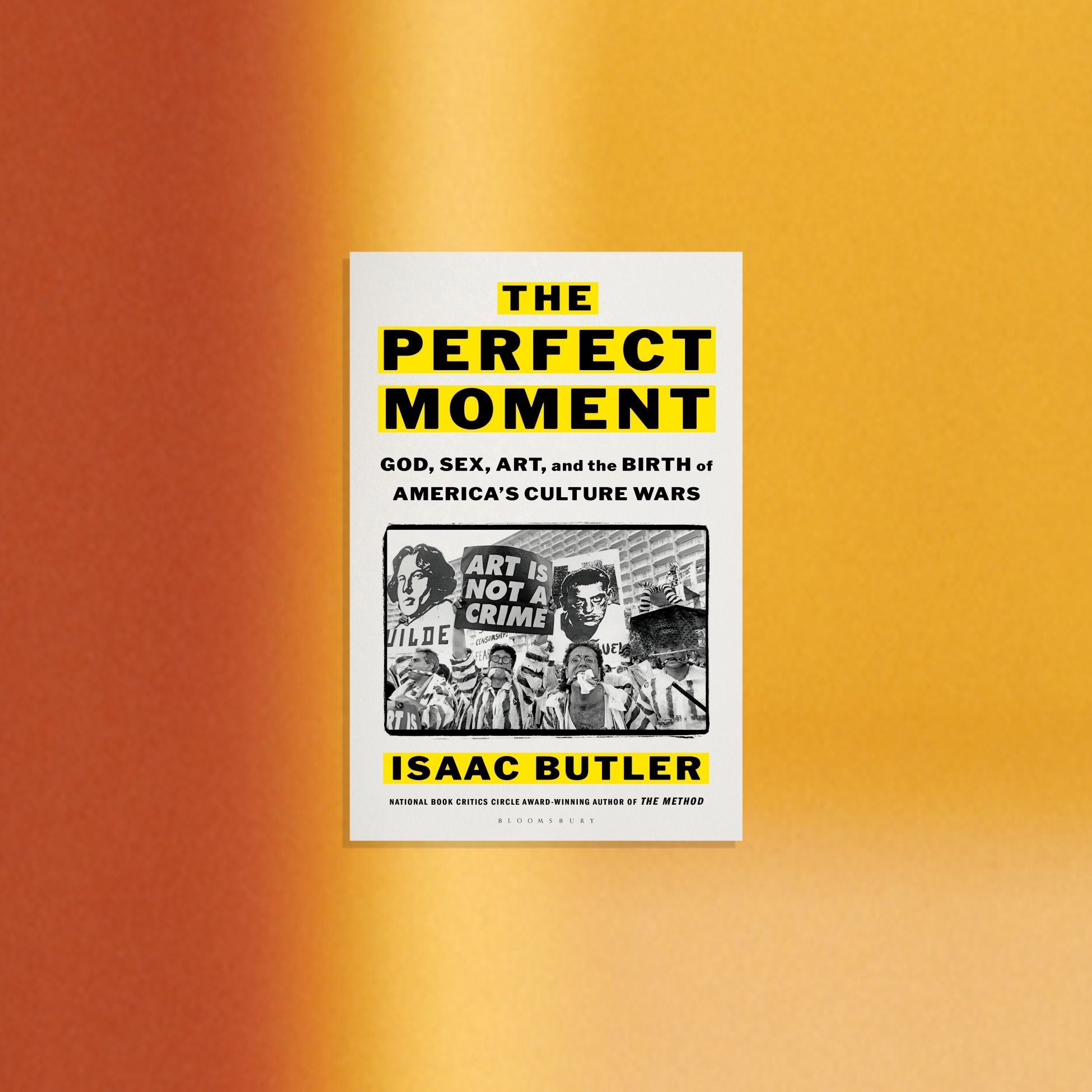
The Book Review
Art, Outrage and How the Culture Wars Began
00:34:56
Isaac Butler, an author and cultural historian, joined the “Book Review” podcast to discuss his new book, “The Perfect Moment: God, Sex, Art and the Birth of America’s Culture Wars.”
Loading summary
Transcript105 lines
- [00:01]
A
All aboard. Choose your perfect Caribbean escape with Princess Cruises. Maybe you spend a day relaxing on the top deck, golden sun, a refreshing pina colada, and nothing on your schedule except dinner and a show. Other days you embrace a tranquil shore, snorkel mask in hand, ready to explore white sand beaches and crystal clear waters. The best part, relaxation and discovery are both on the itinerary. Sail to the Caribbean with Princess Cruises. Visit princess.com or contact your travel advisor to book Princess Cruises shipped registered to Bermuda.
- [00:35]
B
The thing I'm always trying to figure out as a cultural historian is that relationship between the works of art and the context in which they are made. You know, how do those two things really shape each other?
- [00:48]
C
I'm Gilbert Cruz. This is the book review from the New York Times. And today we're going to be talking about the culture wars. What are they? How did they start? Who has been on the front lines and how long have we been fighting them? Here to answer those questions is Isaac Butler. He is a cultural historian, theater director, teacher and author. He has written The how the 20th Century Learned to Act, an examination of the Stanislavski acting system, and the World Only Spins Forward, a sweeping oral history about the landmark play Angels in America. His new book tackles the emergence of America's culture wars during the 1980s and 1990s. It is titled the Perfect God, Sex, Art and the Birth of America's Culture Wars. And I will not use the title for the obvious pun here, but let's say it seems an appropriate moment to be talking about all of this. Isaac, thank you so much for joining us.
- [01:50]
B
Thank you so much for having me, Gilbert. Yes, a convenient moment for us to be talking a, I don't know, resonance moment, something God, sex, art.
- [01:59]
C
That's a lot. You're trying to tackle a lot here. The birth of America's culture wars, however, is the thing. Obviously we need to start with this is a term, culture wars that gets used a lot. But right as we start this conversation, I would love so that we're all on the same page, give me a succinct definition that is going to be useful as we continue to use this phrase over this entire conversation.
- [02:21]
B
Sure. The succinct way that I would use the phrase is when cultural creations, you know, works of art, TV shows, albums, what, what have you become? Political issues in and of themselves. A very clear example from the era of my book that, you know, middle aged people like me will remember very well is the 2 Live Crew album as Nasty as They Wanna Be. Right. Which was eventually the subject of an obscenity trial and all sorts of things. But even before that, this is a thing that's being debated by politicians. You know, what are we going to do about this? Should this be legal? You know, so there are those kinds of fights. And because America does not have a fixed national identity in the way that, like, France does. Right. Where there's, like, literally a board of venerable people who decide what is French and what is not, we don't have that in the United States. Culture wars are going to flare up all the time because, you know, the arts are how we decide who we are. That's the terrain in which the soul of a nation or of a person is really explored and developed. So America is particularly prone to them.
- [03:33]
C
So it has to be attached to a work of art or a piece of art?
- [03:36]
B
I believe so, yes.
- [03:38]
C
So why now? You wrote two books about theater, and now you're dipping into the world largely of art and different types of art, photography, performance art, a little bit of other stuff. But what was it about this moment that you said? Well, I guess as stressful as it may be, this is the thing I have to dip into next.
- [03:59]
B
Yeah, and it was stressful, I'll be honest. But this was a story that had been sort of part of my life ever since I was in high school because I grew up in Washington, D.C. and in fact, I make a couple cameo appearances in the book, just talking about what it was like to live through this time. My mother was very involved in the Arts in D.C. at the time, and so was I. I was a child, professional actor in D.C. and so it really felt like the culture wars of the 80s and 90s that I grew up in were repeating again with many of the same forces, sometimes the same people, the same mistakes being made. And so I really wanted to tell the story of this time for its own sake, because I think it's an important story. And then I also think that story has incredible resonance for today.
- [04:52]
C
In the book, you go back a bit, you identify a specific moment in the 70s before that laid the foundation. But more specifically, a playbook for the cultural wars that were to follow. Can you sort of touch on what that was and what are the elements that were then later applied to other controversies?
- [05:14]
B
Yeah, so it's this really wild thing called. Often called the Kanawha County Textbook War, which makes it sound like a Ken Burns documentary.
- [05:22]
C
You know, it's like, that should be a play. Someone should write a play with that.
- [05:26]
B
Dear Martha, today I go to fight in the textbook Wars. You know, it sort of has that feeling in it. Basically, what happened, and this will sound very familiar to people today, right, is that a school board was going to approve a new curriculum. So, you know, hundreds of books, thousands of pieces of educational material.
- [05:45]
C
And what state was this in, by the way?
- [05:47]
B
West Virginia, in Kanawha County, West Virginia, to bring the county's curriculum in line with the state regulation that said, hey, you got to diversify your curriculum, basically, right? You know, meeting the students where they are, helping them use the materials of their own life to connect to the. The stories and whatnot. There was one member of the school board who was an evangelical Christian, the wife of a minister, a former minister, and she had gotten elected specifically on an anti sex ed platform, and she led this fight against adopting the curriculum that I think even she would say rapidly spun out of control, right? So it started with, hey, let's delay these books. And, you know, months later, thousands of minors are going on wildcat strikes. Every grocery store in the county is closed down. People are shooting at cars. I mean, it really. Schools get bombed. I mean, it really spirals out of control. And it's a fascinating, fascinating story in its own right. Why I was interested in it is it brings together a lot of the players that are going to show up later in the book, various evangelical leaders. The Heritage foundation goes down there, which is a new organization at this point to help out. And there is this playbook that has to do with using selective and sometimes completely dishonest quotations from larger works to inflame an audience, hyping up, I would say, exaggerated sense of grievance and persecution, often from actually quite powerful people, you know, and then capturing the supposedly mostly nonpartisan expert boards that are supposed to be making these kinds of decisions in our society, capturing them so that they can then advance your ideology. You know, it's moves like that which really find their apotheosis in the second Trump administration. I think that's pretty clear. And then on the left side, you know, we often try this playbook of like, well, let's just give them a little bit of what they want, and then they'll go away. And that is a mistake that recurs throughout the story of my book. And it's a mistake that's recurred throughout this second Trump administration, because it turns out when you do that, what you actually do is empower them to ask for more.
- [08:05]
C
You really dig deep on the way in, which after this sort of precursor happens, we go to the late 80s and early 90s and there's an organization that, at the time, I didn't realize this, at the time was still fairly young, had become sort of the center of so many fights over arts and arts funding and the appropriateness of using taxpayer dollars for this and that. And that is the National Endowment for the Arts. Tell me about the nea, which, honestly, I just. I thought it had been around for so long.
- [08:43]
B
No, it's only 1965.
- [08:45]
C
I had. I didn't realize why. What was it? Why did it start? And then what was the reason that this fairly, you know, in my opinion, at least, seeing it described, you know, like pretty anody governmental organization all of a sudden became the center. Yeah, the hot center of all this.
- [09:05]
B
So the National Endowment for the Arts is really a great society program. It's launched in 1965. It's not the first time the government tries funding the arts, but they try to do it differently for a bunch of different reasons. And I will just say right now, I think the National Endowment for the Arts in its original form for those first 25 years is really the best of what the federal government can do. It had a tiny budget, but it had an enormous, enormous impact. So part of what's going on is after World War II, America is one of the two superpowers on Earth. They have this idea as almost every, you know, if you even go back to the colonial period or the Renaissance or whatever, every country that's, like, steps up to the plate and is like, we run the show now, they start massively investing in the arts. They do that to help create a national identity. They do that to create something for posterity, for the history books. They do that as kind of not propaganda, but as sort of advertisement for their way of life, you know, et cetera, et cetera and so forth. And we were doing the same thing, but importantly, we were doing the same thing in the shadow of the Cold War. So the Soviets directly fund and directly control the expression of their artists. And we wanted to get as far away from that, and we pioneered this model that's really brilliant. That's often called the arm's length model or the hands off model, which is that the NEA sets the categories of things that you can apply for, but it does not choose the winners. The winners are chosen by civilian peer review panels that the Endowment organizes, and those panels then make those choices. And those panels are made up. You know, in the visual arts, it might be some curators, some fellow artists, a major funder, you know, and when
- [10:49]
C
you say winners you're saying grant money.
- [10:51]
B
Grant money, yeah.
- [10:52]
C
You're winning grants that could be relatively small but big for you as a working artist.
- [10:57]
B
Correct. And the NEA really helps create the 20th century in art. Like we talk about it as the American century in art. And that is a lot of that's due to the nea. I mean, if I had it handy, I could read the hundreds of visual artists they sponsored. They really helped create the national dance movement of the second half of the 20th century. The regional theater movement really wouldn't exist in its present form without the National Endowment for the Arts. The number of symphony orchestras, you know, just like exponentially multiplies, et cetera. They are funding a lot of traditional stuff, Shakespeare in schools, folk art preservation, all that stuff. But they're also funding like really bleeding edge artists. And it's really the only place in the federal government where both people of color and LGBTQ Americans have a power base. And you can see why that's anathema to the right and especially the Christian right. And then when government money starts going to art that the religious right is offended by, they see an opening to attack and to build power within the Republican Party.
- [12:05]
C
Coming up, Isaac talks about the art that was at the center of the culture wars and what these very public fights meant for the actual artists.
- [12:21]
A
This message is brought to you by Apple Card Spring always feels like a reset, clearing things out, simplifying what you don't need. Apple Card is built with that same idea in no annual fee, no late fees, and no foreign transaction fees. No fees, period. Get started and apply in the Wallet app on your iPhone today. Subject to credit approval. Variable APRs for Apple Card range from 17.49% to 27.74% based on creditworthiness rates as of January 1, 2026. Existing customers can view their variable APR in the Wallet app or@card.apple.com, apple Card issued by Goldman Sachs Bank USA, Salt Lake City Branch terms and more@applecard.com this podcast is supported by the Freedom From Religion Foundation. America is an idea, but progress isn't guaranteed. Today, those founding principles are being challenged by efforts to mix religion and government. The Freedom From Religion foundation is working to protect the Constitution and keep power where it belongs with we the people. Visit FFRF US NYC or text NYC to 511-511- text NYC to 511-511 and keep state and church separate. Tax fees may apply.
- [13:27]
B
Are you looking for the best deal on a new home? Discover the Dr. Horton home of the week. With new construction homes now selling in ellensburg from the mid-3002, Dr. Horton has the right home at the best value for you, offering one and two story homes near Central Washington University. Your new home is within reach. So what are you waiting for? Learn more about the Dr. Horton Home of the Week, visit drhorton.com and schedule a tour today. Dr. Horton, America's builder and equal Housing opportunity builder.
- [13:57]
C
So, Isaac, you briefly reflect on the fact that for a very long time, there was an implicit understanding in America that art and politics maybe were separate things. And one of the things, as you say, that defined the culture wars that define this period was the smashing together of these two things.
- [14:17]
B
Yes.
- [14:18]
C
All of a sudden, culture becomes a central focus in political debate. You start in the book by talking about the controversy around Martin Scorsese's film the Last Temptation of Christ. Activists are calling it blasphemous. They're trying to get it pulled from theaters. But then it all moves over into the world of fine art, performance art. And I didn't realize this until I read your book, that so many of these fights were over photography. There's Andres Serrano, famous for photographing a crucifix submerged in his own urine. There's Robert Mapplethorpe with his sexually explicit images. And then you had David Wojnarowicz, who actually sues after a conservative religious group crops his work to make it appear more explicit. So what was going on? What was happening in photography at that time that made it such a battleground for all of these fights?
- [15:13]
B
That's a really fascinating question. Part of it is that it involves real people and real bodies. I think really gets under people's skin. If it's something controversial, like a guy with a finger stuck in his urethra, for example, to take one that comes up a bunch in the book, or Robert Mapplethorpe's self portrait, where he has a bullwhip stuck up his butt and he's sort of turning to the camera. He sort of looks like a devil. They're real people. So, like, a real thing is happening. So that's part of it. And another thing is the immediacy of photography. The rapidness with which a photograph can be taken and then developed is really important in this moment, I think because of the AIDS crisis. Because, you know, these artists, all their friends are. They're dying and all their friends are dying. You know, if you look at, like, Nan Golden's work, you know, she's taking, like, very immediate photos in social gatherings and then printing them and getting them out there. And so there's that kind of rapid response feeling to it as well. The arts are really where the point of view and needs of people with AIDS in the LGBTQ community can be expressed during this time period. Because Reagan's not talking about it, the religious right of the right wing is trying to stop people from talking about it at all. And so the arts become a really welcoming home for that perspective, because the arts have, you know, throughout history, been a place for outsiders.
- [16:41]
C
I wonder if you could tell me what were some of the tactics that people like Jesse Helms, a longtime Republican senator from North Carolina, and all the organizations that were opposed to funding this kind of art. What. What were they doing? How were they getting their supporters and other people riled up about what they didn't want in museums?
- [17:00]
B
Well, one of the great ironies is one of the main ways they were doing it was by distributing these images to all of their followers to piss them. Right. Like Jesse Helms. And there's a guy named Donald Wildman who runs this group, the American Family Association. You know, they are unbelievably major distribution vectors of the very images that they're trying to fight. You know, there's a couple of.
- [17:23]
C
Because the Internet didn't exist, you couldn't see these images if you did not actually go to the museum.
- [17:28]
B
Yes. I mean, one of the things my book is really about is pre Internet political organizing. Right. And it's. It's really fascinating because the big thing that the right really pioneered, figured out, innovated on, and the left never caught up to them, was direct mail appeals. And what Donald Wildman is doing is he's taking the worst examples he can find and sometimes maybe making up some examples, and he's xeroxing them and mimeographing them and putting them in an envelope. And they promised people that if they didn't fight back against this, literally one of the letters says physical persecution of Christians won't be far behind.
- [18:06]
C
Well, I'm curious. You know, these campaigns really escalate. They set off changes in Congress as you write a bunch about things, go all the way to the Supreme Court, when a group of performance artists that eventually become known as the NEA4 get their funding vetoed and they sue. So just what was it like for them? What was it like for these artists, other artists? What's the effect on their ability to work, their reputations?
- [18:33]
B
You know, there's some debate about this, because I think we have this assumption that all press is good press. And once you're the subject of a controversy, it's good for your career. Everyone I talked to, with the exception of Andre Serrano, disputed this. Andre Serrano is absolutely like, Jesse Helms gave me my career. I wrote him a thank you letter in 2000 about it.
- [18:53]
C
Right.
- [18:53]
B
You know, he's very open about that. But if you read the memoirs by the four performance artists who came to be known as the NEA4, they were like, you know, my artistic homes couldn't book me because it was too dangerous. They had to hire extra security. I got death threats. You know, no one could see my work for what it was. They were just looking for the controversial thing. There's a lot of pain around that. There's a lot of fighting back against shame, against, you know, trying to find pride in your work again. And just. It's exhausting to be under siege like that all the time and trying to create your art. So for the individual artists who were swept up in this, it was very, very difficult. David Wojnarowicz was dying of AIDS for much of the time that he was dealing with this. And there were many people I spoke to who were like. I just kept telling him, like, just take care of your health. Why are you worrying about this? Like, there's nothing you can do about it. Please take care of yourself. And he just wouldn't do that because he wanted to fight back. For the rest of the arts field, I think it unquestionably had a chilling effect. Congress passes a bunch of rules, basically, the. The main one is called the decency clause, to try to hem in what the NEA will fund. And once that happens, if Gilbert, if you were the curator of the Cruise Museum, you know, and you can.
- [20:10]
C
I sure am.
- [20:10]
B
Yep. You can only apply to the NEA for one grant, you know, a year, you're going to apply for the least offensive show you're doing. So that gives those things an edge in the marketplace of ideas. And so you really, really see, many people would say to journalists, even at the time, like, I'm not gonna program this stuff right now. So the chilling effect on the field was real.
- [20:33]
C
You have a very personal connection to art.
- [20:38]
B
Yes.
- [20:39]
C
To theater, to all this stuff. You touched on it. You touched on it in the book. You were a professional theater actor in D.C. where you live, starting at the age of 12. And I'm wondering between that and your mother being on various boards, sort of like family connections to various art institutions, how you think that has affected the way that you think about all this. It really seems like this is Sort of. This is at the fiery core of who Isaac Butler is.
- [21:09]
B
I don't know who I would be without the arts being the core of who I am. It happened so early. You know, I loved art of all kinds from such an early age. You know, I saw my first Philip Glass opera in fourth grade. That's high art. But then there's also TV and movies. You know, like, I remember seeing Fantasia at the Uptown theater in Washington D.C. when I was three years old. And it was really one of my foremost artgoing experiences in my entire life. In part because I had a bloody nose during it and had to be carried out of the film bleeding and screaming into an around the block line appearance. But I just. I can't imagine myself without it. One of the things that I tried to do in this book, and I talk about this in the introduction to the book, is like, because of that and because of my own background, like, I'm not going to pretend to be objective about this stuff. I think that would actually be very silly and would do me, the subject matter and the reader a disservice. Instead, I'm going to, when appropriate, tell you what I really think and feel about this stuff and then try to control for my biases as much as I possibly can and be honest about that. And then the reader is free to disagree with me if they want to, because one of the great things about free expression is that we can disagree about stuff and then be enriched by that disagreement. And I really truly believe in that.
- [22:21]
C
What do you think the role of the government should be in the arts?
- [22:25]
B
I think the NEA is classically constructed, the hands off model, you know, all of that stuff was really brilliant and worked really well. And I would love to go back to that. That is not what we have right now. The post doge NEA has all these rules about what you can and cannot fund.
- [22:42]
C
But why? Why do you, Isaac, think that this should be?
- [22:45]
B
Oh, why? I'm sorry, I misunderstood your question.
- [22:47]
C
Yeah, yeah.
- [22:48]
B
Well, I mean, beyond the fact that the results speak for themselves in terms of what was accomplished over the NEA's first 25 years, the truth of the matter is that I believe in a vision of American citizenship where we are more than just our capacity to make money, we're more than just our productivity. The arts are an absolutely vital part of being a human being and of being a citizen. And I genuinely believe that the government has a place in guaranteeing that the arts can flourish so that human beings in our individuality can flourish as well. To me, art isn't exactly, quote, unquote, useful. You know, it's not a wrench or a light bulb or a. I don't know, you could tell it's almost lunchtime because I'm going to say, you know, like a chicken salad sandwich or whatever. But art is incredibly enriching to who we are, and each different art form, each different medium has a different role to play within that.
- [23:44]
C
I want to ask you about this thing that you just mentioned. You know, sort of trying to account for and, you know, solve for your biases, but also just saying in the book, this is who I am. This is what I believe you wrote recently on your substack, something about what it means to write a book like this. You said, quote, I want to reiterate. The job of the historian is to illuminate the past. It is not to create an extended analogy by which you can convince people to agree with your politics. So there's this way in which writing a piece of history, even a piece of cultural history, really has to focus. Like, these are actually the things that happen. I research them. But then you have this issue that you're talking about, which maybe people don't necessarily think that should only be what a historian does. Who are you talking to there? And what are you trying to balance when you say something like that?
- [24:36]
B
That came from just my own reading, that during both Trump administrations, there were a lot of works of purported history that were really overly determined by the writer's desire to comment on the present day. That's not actually what I'm doing. I'm writing about this thing in the 80s and 90s that I think lays the groundwork for a lot. And I think there's lots to learn from it. I really genuinely do. But maybe I'll write some essays about that after it comes out, or maybe I'll give interviews where I talk about that after it comes out. What I wanted was a book that would speak to people beyond the Trump administration.
- [25:12]
C
This is your third book. One of them, as you note, you co wrote Dan Kois. Is there something you're trying to figure out about art and America through these three books?
- [25:24]
B
Well, my best friend since the third grade wrote me, and he said, all three of your books are actually about you in high school, aren't they? And he wasn't wrong. You know, I saw Angels in America my freshman year of high school. I studied Stanislavski's theories in high school. This all happened while I was in high school.
- [25:40]
C
So we cannot escape our youth.
- [25:43]
B
We can't escape our youth. I mean, all writing is autobiography, right, Gilbert? And so there's that aspect of it. Yes. But, yes, I am someone who is deeply political and deeply loves art and makes art and, you know, those are the two passions in my life. And, and I don't think we will ever know exactly how those things truly interrelate and how they shape themselves. The thing I'm always trying to figure out as a cultural historian is that relationship between the works of art and the context in which they are made. You know, how do those two things really shape each other? What are the different contexts that artists are responding to? That's very much my research and work in Shakespeare is about that too. So I think that's a sort of never ending question that I'm always going to be asking because as you know, there's no solution to it. You know, if we knew the solution to that, you know, we'd probably, I don't know, would we be in a better place? I actually think it's having unanswerable questions is actually probably better for the human spirit.
- [26:43]
C
But yeah, that sounds. That sounds very boring to me.
- [26:45]
B
Yeah, yeah, exactly. And so I don't know that every one of my books is going to be doing that for the rest of my life. I do know that the couple of book ideas that I'm going to start exploring this summary to try to figure out what the next book is are still somewhat in that vein.
- [27:00]
C
Coming up, Isaac recommends some books about the life and work of artists, including what he calls the greatest showbiz memoir of all time.
- [27:16]
A
Marcel Duchamp spent his entire career rewriting the rules of art. From the scandalous painting Nude Descending a Staircase to his revolutionary Ready made sculptures. Explore the breadth of Marcel Duchamp's creativity and his influence in a new exhibition at MoMA, the Museum of Modern Art in New York City. This major retrospective made possible by bank of America, brings together more than 300 of the artist's groundbreaking works that changed the way we see art today. Discover Marcel Duchamp at MoMA and book tickets@moma.org you're always evolving, so sell some things that belong to your former self on ebay. Maybe you had a trinket obsessed phase, a leather jacket moment, or a year. You thought you'd learned to cook. Let some of those versions go. Selling on ebay is easy. Just photograph and list with millions of buyers the right things, find the right people. Suddenly you've got more space, some extra cash, and someone out there is thrilled to Find what you're selling. Find what you love. Sell what you don't on ebay. METV is America's number one classic TV entertainment network, airing over 60 of the greatest TV series every week. Now METV presents the Golden Girls of Summer, showcasing the best of the Golden Girls. Watch Dorothy, Blanche, Rose and Sophia weeknights on MeTV at 10pm 9 Central. Log on to metv.com now to find out where to watch MeTV free over the air and on cable, satellite and select streaming services. METV is memorable entertainment television.
- [28:48]
C
We're gonna move to one of our favorite segments on the show. And really at the New York Times Book Review. It is something that we've been doing for more than a decade. We ask authors, new and old, a recurring set of questions about their reading. It's part of a series that we call by the Book and we're doing an audio version here.
- [29:06]
B
Yeah.
- [29:06]
C
Okay. So by the Book, Isaac Butler, I have several questions for you. Are you ready?
- [29:12]
B
I'm ready.
- [29:13]
C
Okay.
- [29:13]
B
Yeah. I've got my buzzer. No.
- [29:17]
C
You have written, thought and podcasted and talked so much about Shakespeare and politics. So what is your favorite work by the man? By Shakespeare.
- [29:28]
B
This is an impossible question, right?
- [29:30]
C
It's not impossible because I just asked it.
- [29:34]
B
There is a stable top tier of Shakespeare plays that almost everyone agrees on and that's love. The top five is Hamlet, Twelfth Night, King Lear, Henry iv, Part one, and a fifth play of your choosing.
- [29:47]
C
Right.
- [29:47]
B
So I'm gonna set those aside because otherwise it's like. Otherwise it's like, oh, Revolver is the best Beatles album.
- [29:53]
A
Right.
- [29:53]
B
It's like, who? Come on. And so I wanna talk about one that I love, that I teach whenever I can, that I reread over and over again. Measure for Measure. Measure for Measure is a brilliant play. It's one of the plays where actually. Cause I teach it. So I can tell you this even if you don't have a lot of Shakespeare knowledge. It's actually a very crystal clear on the page play. It's a play about sexual politics. It's a play about the hypocrisies of puritanism. It's a play about gender and sex. It has the greatest but longest euphemism for sex I've ever heard, which is fishing for trout in peculiar rivers. And it can't really be nailed down to a coherent interpretation in part because it's last scene, the main character never like, basically doesn't speak in the entire last scene. And so what her opinion on what has happened is not known. And it's such a tricky play. Every time I read it, I discover something new about it. So Measure for Measure is my choice.
- [30:56]
C
That's incredible. What a great answer. Next question. What are some of your favorite books that explore the intersection of art and politics?
- [31:05]
B
Yeah. So one of them I want to go to bat for because it's out of print and I think someone should bring it back into print. So it's by a writer named Anthony Julius, and it's called the Offenses of Art. And it is a history of the transgressive in art. And it's really about the different roles that transgression can play, the history of our understanding of it, how the courts have responded to it and everything. It's brilliant. It's so thought provoking. My book would not be. I mean, I think I've written a pretty good book. It would not be nearly that good without that book. I'm really indebted to it. Another is Jack Lowry's recent. It was Vulgar. It was beautiful. Have you read that one, Gilbert?
- [31:44]
C
I have not.
- [31:45]
B
It's a beautiful, beautiful book about telling the story of Gran Fury. Grand Fury was kind of the most prominent of the art collectives within ACT up. They developed a lot of the T shirts and slogans like, all people with AIDS are innocent. It's about the history of that collective. Jack Lowry interviewed, like, everyone who's still alive. He interviewed them. He went to tons of private paper collections. I mean, he really did the work. And it's a beautiful, beautiful, beautiful story. And. Can I name one more? Is that okay?
- [32:14]
C
You can name one more.
- [32:16]
B
Okay, I'm gonna go. Let's go. James Baldwin, the Devil Finds Work, his book of film criticism, which is also a memoir, which is also a great political treatise. You know, when he's writing that people aren't really writing the kind of film criticism that is doing social critique and autobiography and film criticism at the same time. Now it feels like we all do it all the time. Right? But he's really the pioneer, and it's great to go back to those kind of pioneering works.
- [32:40]
C
That is a great one. I'm glad we allowed you that. That third option there.
- [32:43]
B
Thank you.
- [32:44]
C
Next question. Is there a biography of an artist or a memoir or autobiography that has really stuck with you?
- [32:52]
B
Fire in the Belly, which is. See, Carr's biography of David Wojnarowicz is essential reading. I mean, everything Seekar writes is essential reading. I love Seekar's work. Absolutely incredible. We would not understand the 80s and 90s in art without her columns for the Village Voice and her books. So Fire in the Belly is incredible, but the greatest, I think, artist memoir of all time might be Ilya Kazan's A Life, which is, you know, it's like reading Paradise. It's like the Paradise Lost of showbiz autobiographies. On the first page, he says, I am the devil, and you cannot trust anything I say. And then for 800 pages, just digs into the most salacious, darkest parts of himself and puts them on the page. It's funny. It's outrageous. It's offensive at times. It illuminates a whole history of art. It's just. It's incredible. It's so incredible, it might be the most honest and dishonest at the same time book ever written.
- [33:44]
C
I love it. That sounds awesome. And you almost sold me, but then you said it was 800 pages, so.
- [33:50]
B
I know, I know, but it sounds amazing. It flies by. Look, when you get to his affair with Marilyn Monroe, you're just like. The pages are just, you know, turning into flames as you flip them so quickly.
- [34:02]
C
Are there books that you find yourself returning to over and over again?
- [34:06]
B
There's always so many to read. So I always feel guilty when I reread the great Elisa Gabbard, who writes the poetry column for your section in her book, any person is the only self. She has this quote that says, some people say rereading is the only reading, but sometimes I think first readings are the only re readings. And I love that because it's a great aphorism. It's almost like a Zen Cohen. And also it gets me out of the pressure to reread because I have so many books I want to read. There's no way I'll get to all of them before I die.
- [34:39]
C
The struggle is real. I know precisely what you're talking about. What is the latest nonfiction book that you really enjoyed?
- [34:47]
B
I'm gonna say Richard Kreitner's Fear no American the Civil War and the Fight to End Slavery. And it's really about the variety of Jewish experience in terms of the slavery question. There's lots of Jews. I think we like to have a somewhat flattering opinion of ourselves in the civil rights movement and slavery, but lots of Jews involved in the slave trade. You know, the first synagogue in America was built by enslaved people. So it's both a history of Jews in the United States and a history of the institution of slavery and a history of how those things meld together all in one. I sort of don't know. How he did it, because it moves very quickly, and it's really beautifully told.
- [35:29]
C
Is there a book that's just reliable to give as a gift you'll always fall back on? I love this book. I love giving it to people.
- [35:37]
B
One that I've had really good luck with is this book that New York Review of Books editions put out, reissued, called the Kindness of Strangers by Salka Viertel. And it's a memoir. She's a Polish Jewish stage actress who eventually makes her way to Vienna, and she's a big actress in the Viennese stage. And then she flees and comes to California, along with, you know, many of the other Jewish intelligentsia, where she becomes Greta Garbo's best friend and go to screenwriter and maybe love her, although that's not discussed in the memoir. She has this German Jewish husband. They have this very open bohemian relationship, and her house becomes the center of German intellectual exile life in Los Angeles. So, you know, like, Thomas Mann's birthday is at her house. You know, all the people in the film industry are there. And so she just led this really extraordinary life. And the way she talks about it is really beautiful and fun.
- [36:30]
C
That sounds fascinating. I have the last one. Isaac Butler. What are a couple books that are on your nightstand? Real or metaphorical nightstand?
- [36:38]
B
Well, I should send you a photo of my nightstand because my New Year's resolution this year is to default to books that I owned prior to New Year's because I have so many that I have accumulated over decades that I have not read. And it's sort of like that scene in High Fidelity where he's reorganizing his records autobiographically, you know, so, you know, there's books on my nightstand that I got in college and was supposed to read and didn't, but I've always wanted to read, you know, so I have just tons of them. So how many do you want? I made a list.
- [37:08]
C
Give me two. Give me two.
- [37:09]
B
Give you two. Okay, I'm gonna give you two. The literal first two I found this morning when I looked the Talmud, a Biography by Barry Scott Wimfe, which is literally like a biography of the. Like, how was the Talmud written? Stuff like that. And my Last Sigh, which is the memoir by Louis Bunuel.
- [37:26]
C
Good Lord. The range of books that you just recommended was.
- [37:31]
B
You know, the thing is.
- [37:32]
C
Is that superb.
- [37:33]
B
I think the thing that works for me, because I have a lot of different interests, is synthesis. Like, I think that's one of the things that really draws me to certain subjects and that I'm good at on the page and so I've decided to use the fact that I'm a magpie to my own advantage.
- [37:49]
C
Extremely impressive. Isaac Butler, author of the Perfect God, Sex, Art and the Birth of America's Culture Wars. Thank you so much for joining the Book Review.
- [37:59]
B
Thank you, Gilbert.
- [38:03]
C
The Book Review is produced by Sarah Diamond, Amy Pearl and Patricia Sulbaran. It's edited by Tracy Mumford and mixed by Pedro Rosado. Original music by Dan Powell and Elisheba Itup. Special thanks to Dalia Haddad. We want to hear what you think about the show, so send us an email@thebookreviewytimes.com I'm Gilbert Cruise. Thanks for listening.
- [38:38]
B
You turn the wrench, you call the shots. When you want the right parts that are the right fit, there's Only one choice, GM Genuine Parts and ACDelco Original Equipment. Visit GMParts.com to get the right parts for your GM vehicle today.