
Podcast
The Brighter Side of Education: Research, Innovation & Resources
Hosted by Dr. Lisa Hassler · EN
Hosted by Dr. Lisa Hassler, The Brighter Side of Education: Research, Innovation, & Resources a podcast that offers innovative solutions for education challenges. We bring together research, expert insights, and practical resources to help teachers and parents tackle everything from classroom management to learning differences. Every episode focuses on turning common education challenges into opportunities for growth. Whether you're a teacher looking for fresh ideas or a parents wanting to better support your child's learning, we've got actionable strategies you can use right away.
The podcast's music was created by Brandon Picciolini from The Lonesome Family Band. You can explore more of his work on Instagram.
24episodes
Episodes
Newest firstAll episodes

Why Kids Miss School: A Human-Centered Approach to Absenteeism | Dr. Ivory Toldson
May 2200:31:49Tap to summarizeSend us Fan MailChronic absenteeism keeps getting described as a kid problem, but the evidence tells a different story. When we label students as “disengaged,” we miss what is often right in front of us: unreliable transportation, health crises, caregiving demands, and school policies that punish families for not having options.I’m joined by Dr. Ivory Toldson, Chief of Research for Concentric Educational Solutions and a professor at Howard University, to unpack insights from his white paper, “Redefining the Attendance Paradigm: A Systemic Analysis of Chronic Absenteeism, Economic Impacts, & Human-Centered Interventions,” built on national data and more than 17,000 ethnographic home visits. We talk about the privilege gap that determines whether a missed bus becomes a minor inconvenience or a full-day absence, and why health-related absences often become “unexcused” through communication breakdowns and paperwork hurdles. We also dig into the gray areas schools struggle with, like when students miss class to care for siblings or help during family emergencies.We take a hard look at compliance-driven attendance strategies, including truancy penalties and suspensions for tardies, and why those approaches can deepen disengagement rather than improve school attendance. From there, we map out what human-centered interventions look like in practice: home visits that bring resources, clearer excused absence processes, stronger relationships, and policies that prioritize mastery of learning over seat time. We close with a mindset shift that changes everything: stop “fighting absenteeism” and start increasing participation.💡 This episode is CPD accredited! Educators can now earn Continuing Professional Development (CPD) minutes by listening. To claim your certificate:Listen to the full episodeVisit https://thecpd.group/podcastEnter code 800163 to check in and download your certificateor direct link: https://thecpd.group/p/G335QPFListen. Learn. Earn.Great News! The Brighter Side of Education is now CPD Accredited! Sponsored by Dr. Gregg Hassler Jr., DMDTrusted dental care for healthy smiles and stronger communities—building brighter futures daily. Head to the show notes to find if this episode is CPD eligible and details on how to claim your CPD certification!Sponsored by Dr. Gregg Hassler Jr., DMDTrusted dental care for healthy smiles and stronger communities—building brighter futures daily.Support the showIf you have a story about what's working in your schools that you'd like to share, email me at lisa@drlisahassler.com or visit www.drlisahassler.com. Subscribe, tell a friend, and consider becoming a supporter by clicking the link: https://www.buzzsprout.com/2048018/support. The music in this podcast was written and performed by Brandon Picciolini of the Lonesome Family Band. Visit and follow him on Instagram.
Transcribe →
When Schools Can’t Find the Right Teacher: Expanding Access to Learning
Apr 900:24:26Tap to summarizeSend us Fan MailA student’s future should not depend on whether their school can find a qualified chemistry teacher this year—but that’s often how geography-bound education works.When the PISA 2022 report revealed declines in performance and widening gaps across countries, it’s easy to point to motivation or effort. This conversation takes a different angle: what if the real constraint is the structure of schooling and how learning is organized?Dr. Lisa Hassler is joined by Maurice O’Shannassy, Executive Chairman and Co-Founder of Sagecool. With a background in building complex global systems, Maurice turned his attention to a growing issue in education: teacher shortages and limited access to subject expertise. He shares how Sagecool is designed to connect students and teachers beyond geographic constraints, helping schools and families better match learning needs with teacher expertise and teaching approaches.In this episode, you’ll hear about:how staffing limitations affect access to learning opportunitieshow access to the “right teacher” goes beyond availability to include subject expertise and student fitwhat it could look like to connect students with teachers beyond their local schoolhow data and learning enhancement technology (LET) can support teaching and learningwhat this approach could mean for rural and lower-resourced schools and communitiesThis conversation invites educators, school leaders, and families to reflect on where access—not effort—may be limiting opportunity, and to consider how expanding access to teaching could better support students and teachers alike.💡 This episode is CPD accredited! Educators can now earn Continuing Professional Development (CPD) minutes by listening. To claim your certificate:Listen to the full episodeVisit https://thecpd.group/podcastEnter code 800164 to check in and download your certificateListen. Learn. Earn.Great News! The Brighter Side of Education is now CPD Accredited! Sponsored by Dr. Gregg Hassler Jr., DMDTrusted dental care for healthy smiles and stronger communities—building brighter futures daily. Head to the show notes to find if this episode is CPD eligible and details on how to claim your CPD certification!Sponsored by Dr. Gregg Hassler Jr., DMDTrusted dental care for healthy smiles and stronger communities—building brighter futures daily.Support the showIf you have a story about what's working in your schools that you'd like to share, email me at lisa@drlisahassler.com or visit www.drlisahassler.com. Subscribe, tell a friend, and consider becoming a supporter by clicking the link: https://www.buzzsprout.com/2048018/support. The music in this podcast was written and performed by Brandon Picciolini of the Lonesome Family Band. Visit and follow him on Instagram.
Transcribe →
More Than Play: What Toybuilding Teaches Students | Rick Hartman
Mar 2600:24:06Tap to summarizeSend us Fan MailIn many classrooms, toys are something we put away when it’s time to get serious. But what if toys are actually one of the most effective ways to teach?In this episode of The Brighter Side of Education, Dr. Lisa Hassler explores toybuilding as a powerful instructional approach with educational toymaker Rick Hartman, founder of School of Toy. With over 25 years of experience and more than one million students reached, Rick shares how building simple toys transforms learning from passive to active.Rather than treating toys as extras, this conversation reframes them as tools for thinking—helping students test ideas, solve problems, and make sense of concepts in science, math, and engineering.In this episode, you’ll discover:How toybuilding turns abstract concepts into hands-on learningWhy simple materials can lead to complex thinkingHow to use toybuilding as part of real instruction—not just enrichmentWhat students gain when they build, test, and revise their ideasA simple toybuilding activity using a straw and rubber bandWhether used as a lesson starter, learning activity, or culminating experience, toybuilding offers a practical way to engage students and deepen understanding.💡 This episode is CPD accredited! Educators can now earn Continuing Professional Development (CPD) minutes by listening. To claim your certificate:Listen to the full episodeVisit https://thecpd.group/podcastEnter code 800162 to check in and download your certificateListen. Learn. Earn.Great News! The Brighter Side of Education is now CPD Accredited! Sponsored by Dr. Gregg Hassler Jr., DMDTrusted dental care for healthy smiles and stronger communities—building brighter futures daily. Head to the show notes to find if this episode is CPD eligible and details on how to claim your CPD certification!Sponsored by Dr. Gregg Hassler Jr., DMDTrusted dental care for healthy smiles and stronger communities—building brighter futures daily.Support the showIf you have a story about what's working in your schools that you'd like to share, email me at lisa@drlisahassler.com or visit www.drlisahassler.com. Subscribe, tell a friend, and consider becoming a supporter by clicking the link: https://www.buzzsprout.com/2048018/support. The music in this podcast was written and performed by Brandon Picciolini of the Lonesome Family Band. Visit and follow him on Instagram.
Transcribe →
Not Your Granny’s Grammar: Bringing Joy Back to Writing and Grammar | Patty McGee
Mar 1200:20:01Tap to summarizeSend us Fan MailEver feel like grammar turns a lively class silent? We dig into a brighter way forward with literacy consultant and author Patty McGee, exploring how short, focused routines transform grammar from rote correction into a set of powerful choices that make writing clearer, bolder, and more authentic. Instead of chasing perfection on worksheets, we show how to build sentence craft in tiny, joyful steps that actually transfer to real writing.We start by naming the problem: isolated drills don’t move the needle on student prose. From there, Patty lays out a practical grammar study approach—ten-minute mini lessons, three to five times a week over several weeks—that begins with curiosity, moves to explicit modeling, and leans on low-stakes play. Think manipulatives for language: sentence strips, coordinating conjunctions, and structured challenges that help students feel how ideas combine and meaning shifts. The result is confidence, not compliance.We also put culture to work. Lyrics function like compressed poetry, perfect for analyzing syntax, figurative language, and voice. Students compare fragments with full sentences, expand lines while preserving tone, and reflect on author intent. Then we make the learning stick with co-authored reference tools that students actually use: clear guides to simple, compound, and complex sentences, when to choose each, and how to build them inside drafts they’ve already written. It’s visible progress without the fear of a blank page.Transfer matters across the day. Science benefits from precise simple sentences and selective compounding; social studies often calls for complex structures that signal cause and nuance. We touch on AI as well—how students can compare their drafts with AI feedback, accept what serves their audience, and reject what doesn’t, because they now understand the grammar choices behind strong writing. Ready to retire the grammar police mindset and bring back joy and clarity? Follow the show, share it with a colleague, and leave a review to help more educators find these ideas.Not Your Granny's Grammar, link here!💡 This episode is CPD accredited! Educators can now earn Continuing Professional Development (CPD) minutes by listening. To claim your certificate:Listen to the full episodeVisit https://thecpd.group/podcastEnter code 800160 to check in and download your certificateListen. Learn. Earn.Great News! The Brighter Side of Education is now CPD Accredited! Sponsored by Dr. Gregg Hassler Jr., DMDTrusted dental care for healthy smiles and stronger communities—building brighter futures daily. Head to the show notes to find if this episode is CPD eligible and details on how to claim your CPD certification!Sponsored by Dr. Gregg Hassler Jr., DMDTrusted dental care for healthy smiles and stronger communities—building brighter futures daily.Support the showIf you have a story about what's working in your schools that you'd like to share, email me at lisa@drlisahassler.com or visit www.drlisahassler.com. Subscribe, tell a friend, and consider becoming a supporter by clicking the link: https://www.buzzsprout.com/2048018/support. The music in this podcast was written and performed by Brandon Picciolini of the Lonesome Family Band. Visit and follow him on Instagram.
Transcribe →
Rebuilding Student Focus: Neuroscience-Informed Cognitive Training | Dominick Fedele
Feb 2600:26:20Tap to summarizeSend us Fan MailEducators across grade levels are observing a consistent pattern: students are increasingly distracted, mentally fatigued, and less able to sustain focus during academic tasks. These challenges affect reading comprehension, problem-solving, written expression, and overall learning stamina. This episode examines the cognitive and neurological foundations behind these trends and explores how neuroscience-informed innovation may support learning readiness.Drawing on research in neuroplasticity and cognitive development, the discussion highlights how core brain systems—including attention regulation, working memory, processing speed, response inhibition, and visual control—play a critical role in students’ ability to engage in sustained learning. The episode explores how stress, digital overstimulation, anxiety, and sleep disruption can place strain on these systems, reducing cognitive efficiency in classroom settings.Guest Dominick Fedele, CEO and founder of Mastermind Cognitive Training, shares insights into the development of targeted cognitive training exercises designed to strengthen foundational brain skills through structured, repeated practice. The conversation examines how short, gamified training sessions aim to leverage neuroplasticity to enhance focus, learning stamina, and academic readiness. Assessment models used to measure cognitive growth are also discussed, along with early feedback from educators and families.This episode provides educators with a research-informed perspective on cognitive readiness and offers insight into how structured brain-based practice may complement classroom instruction. It invites reflection on how strengthening underlying cognitive systems may help students engage more effectively in learning while supporting teachers in managing diverse attention needs.💡 This episode is CPD accredited! Educators can now earn Continuing Professional Development (CPD) minutes by listening. To claim your certificate:Listen to the full episodeVisit https://thecpd.group/podcastEnter code 800159 to check in and download your certificateListen. Learn. Earn.Great News! The Brighter Side of Education is now CPD Accredited! Sponsored by Dr. Gregg Hassler Jr., DMDTrusted dental care for healthy smiles and stronger communities—building brighter futures daily. Head to the show notes to find if this episode is CPD eligible and details on how to claim your CPD certification!Sponsored by Dr. Gregg Hassler Jr., DMDTrusted dental care for healthy smiles and stronger communities—building brighter futures daily.Support the showIf you have a story about what's working in your schools that you'd like to share, email me at lisa@drlisahassler.com or visit www.drlisahassler.com. Subscribe, tell a friend, and consider becoming a supporter by clicking the link: https://www.buzzsprout.com/2048018/support. The music in this podcast was written and performed by Brandon Picciolini of the Lonesome Family Band. Visit and follow him on Instagram.
Transcribe →
Competency-Based Learning & Human-Centered Design: A Future-Ready Shift | Camp
Feb 1200:24:46Tap to summarizeSend us Fan MailAs automation and artificial intelligence reshape the future of work, educators face a critical question: Are we preparing students for a world defined by automation and innovation?In this episode of The Brighter Side of Education, Dr. Lisa Hassler speaks with Camp, Head of Teaching and Learning at New England Innovation Academy, about how competency-based learning and human-centered design can work together to support meaningful, future-ready education.The conversation explores research-backed approaches to assessment, including evidence showing that competency-based environments grounded in strong student–teacher relationships improve student achievement. John shares how schools can maintain academic rigor while shifting the focus from grades to demonstrated mastery, transferable skills, and ethical technology use.Listeners will gain insight into:The limitations of traditional grading systemsHow competency-based assessment supports deeper learningThe role of human-centered design in student engagement and belongingResponsible approaches to integrating AI in teaching and learningSmall, actionable changes educators can make to innovate within constraints💡 This episode is CPD accredited! Educators can now earn Continuing Professional Development (CPD) minutes by listening. To claim your certificate:Listen to the full episodeVisit https://thecpd.group/podcastEnter code 800157 to check in and download your certificateListen. Learn. Earn.This episode supports professional learning for educators, instructional leaders, and education stakeholders seeking research-informed strategies for designing learning that is both innovative and deeply human.Great News! The Brighter Side of Education is now CPD Accredited! Sponsored by Dr. Gregg Hassler Jr., DMDTrusted dental care for healthy smiles and stronger communities—building brighter futures daily. Head to the show notes to find if this episode is CPD eligible and details on how to claim your CPD certification!Sponsored by Dr. Gregg Hassler Jr., DMDTrusted dental care for healthy smiles and stronger communities—building brighter futures daily.Support the showIf you have a story about what's working in your schools that you'd like to share, email me at lisa@drlisahassler.com or visit www.drlisahassler.com. Subscribe, tell a friend, and consider becoming a supporter by clicking the link: https://www.buzzsprout.com/2048018/support. The music in this podcast was written and performed by Brandon Picciolini of the Lonesome Family Band. Visit and follow him on Instagram.
Transcribe →
Innovation in STEM Education: Preparing Students for an Ever- Changing World | Dr. Jennifer Berry
Jan 2900:22:22Tap to summarizeSend us Fan MailHow can STEM education keep pace with a rapidly changing world? In this episode of The Brighter Side of Education, host Dr. Lisa Hassler explores innovative approaches to STEM learning with Dr. Jennifer Berry, CEO of SmartLab.This conversation examines how authentic, project-based STEM experiences help students build STEM identity, develop problem-solving skills, and see real connections between classroom learning and future careers. Drawing on research, classroom examples, and real-world applications, Dr. Berry explains why purpose matters more than tools—and how productive struggle, community partnerships, and industry-aligned learning environments can expand access and opportunity for all students.Listeners will gain insight into:• Why STEM identity is critical for student engagement and persistence• How real-world problems strengthen learning outcomes• Ways schools can integrate STEM without overhauling entire systems• The role of educators, facilitators, and communities in equitable STEM access• Preparing students with human skills that matter in an AI-driven futureWhether you’re an educator, school leader, parent, or policymaker, this episode offers research-grounded strategies for preparing students for careers that don’t yet exist—while keeping learning meaningful, inclusive, and future-ready.💡 This episode is CPD accredited! Educators can now earn Continuing Professional Development (CPD) minutes by listening. To claim your certificate:Listen to the full episodeVisit https://thecpd.group/podcastEnter code 800156 to check in and download your certificateListen. Learn. Earn.Great News! The Brighter Side of Education is now CPD Accredited! Sponsored by Dr. Gregg Hassler Jr., DMDTrusted dental care for healthy smiles and stronger communities—building brighter futures daily. Head to the show notes to find if this episode is CPD eligible and details on how to claim your CPD certification!Sponsored by Dr. Gregg Hassler Jr., DMDTrusted dental care for healthy smiles and stronger communities—building brighter futures daily.Support the showIf you have a story about what's working in your schools that you'd like to share, email me at lisa@drlisahassler.com or visit www.drlisahassler.com. Subscribe, tell a friend, and consider becoming a supporter by clicking the link: https://www.buzzsprout.com/2048018/support. The music in this podcast was written and performed by Brandon Picciolini of the Lonesome Family Band. Visit and follow him on Instagram.
Transcribe →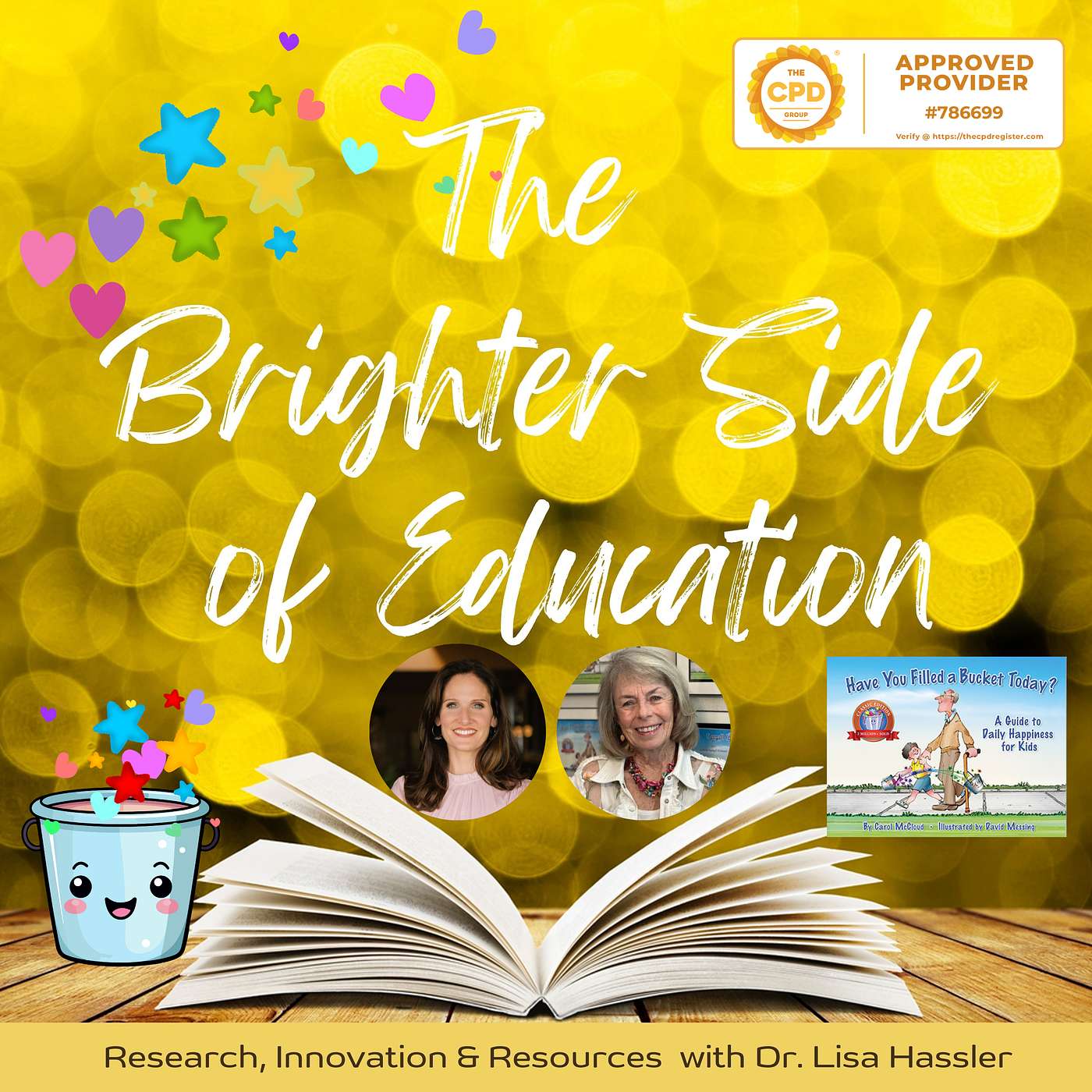
Intentional Kindness in Schools | Bucket Filling with Carol McCloud
Jan 1500:20:25Tap to summarizeSend us Fan MailWhat if a few words and a simple image could reshape how students treat each other—and how they feel about themselves? We dive into bucket filling, a plain-language framework that sparked a global kindness movement. Grounded in the CASEL competencies and early brain research, this approach replaces vague advice with three clear rules: be a bucket filler, try not to dip, and use your lid.Carol McCloud, president of Bucket Fillers Academy and author of 11 children’s books, shares how the metaphor took root in classrooms and homes, why it resonates from preschool to adults, and how “fill more, dip less, use the lid” becomes a daily rhythm. We talk through scaffolding the concepts by age, from concrete acts of kindness to the advanced skill of setting boundaries. Carol offers ready-to-use ideas: a 30-minute eye-to-eye affirmation circle that changes classroom tone, a daily pledge that keeps the habit top-of-mind, and family rituals that ask, “Whose bucket did you fill today—and what filled yours?”Expect data as well as heart. You will hear how one principal, once skeptical, watched behavior referrals fall by 68% after tracking witnessed kindness with classroom buckets and school-wide action. We also explore how the language reframes bullying as a behavior to be changed, not an identity to be assigned, helping students respond with empathy, accountability, and self-control. Along the way, Carol points to free posters, songs, and multilingual tools at bucketfillers101.com to make the practice stick across mornings, group work, and conflict resolution.If you believe culture drives learning, this episode gives you a shared vocabulary, practical routines, and the science-backed reminder that tiny acts create big ripples. Subscribe, share with a colleague, and leave a review to help more educators and families discover tools that make kindness visible. What bucket will you fill today?💡 This episode is CPD accredited! Educators can now earn Continuing Professional Development (CPD) minutes by listening. To claim your certificate:Listen to the full episodeVisit https://thecpd.group/podcastEnter code 800154 to check in and download your certificateListen. Learn. Earn.Great News! The Brighter Side of Education is now CPD Accredited! Sponsored by Dr. Gregg Hassler Jr., DMDTrusted dental care for healthy smiles and stronger communities—building brighter futures daily. Head to the show notes to find if this episode is CPD eligible and details on how to claim your CPD certification!Sponsored by Dr. Gregg Hassler Jr., DMDTrusted dental care for healthy smiles and stronger communities—building brighter futures daily.Support the showIf you have a story about what's working in your schools that you'd like to share, email me at lisa@drlisahassler.com or visit www.drlisahassler.com. Subscribe, tell a friend, and consider becoming a supporter by clicking the link: https://www.buzzsprout.com/2048018/support. The music in this podcast was written and performed by Brandon Picciolini of the Lonesome Family Band. Visit and follow him on Instagram.
Transcribe →
Tinsel, Turkeys & Trying New Things: Holiday Special with the Hasslers
Dec 500:22:20Tap to summarizeSend us Fan MailWe hit “Go Live” to close our longest season yet and lean into a simple truth: growth beats perfect. Holiday crunch time made the choice easy—pivot, try the new thing, and share what’s working for educators and parents who want less noise and more clarity. We review the milestone that mattered most this year—CPD credits for listeners—so your professional learning can count toward recertification while you collect practical strategies you’ll actually use.Across the season, AI literacy became a defining throughline. We highlight four standout conversations featuring innovators who make AI useful, ethical, and human-centered. From Endless Studios and its free pathway for students to build real portfolios, to teacher- and parent-friendly guidance on boundaries, citations, and transparency, we map a path from curiosity to confident use. You’ll hear about Notebook LM for source-grounded studying that turns dense readings into clear summaries and audio explainers, Canva AI for building interactive learning games in minutes, and InstaLesson for drafting adaptable, standards-aligned lessons that save precious time.We also talk candidly about moving to video, why showing the unpolished version matters, and how small rituals—at school and at home—keep everyone steady when routines fall apart. Parents get practical advice on setting expectations and modeling ethical AI use, while teachers get permission to start small, iterate, and invite students to use tools responsibly rather than banning them. Innovation, we argue, is about people first and tools second; relationships and good judgment turn new tech into better learning.Season four launches January 15 with more conversations, more practical resources, and more human stories from the brighter side of education. If this resonated, subscribe, share it with a colleague or parent, and leave a quick review—what tool or mindset will you try next?Great News! The Brighter Side of Education is now CPD Accredited! Sponsored by Dr. Gregg Hassler Jr., DMDTrusted dental care for healthy smiles and stronger communities—building brighter futures daily. Head to the show notes to find if this episode is CPD eligible and details on how to claim your CPD certification!Sponsored by Dr. Gregg Hassler Jr., DMDTrusted dental care for healthy smiles and stronger communities—building brighter futures daily.Support the showIf you have a story about what's working in your schools that you'd like to share, email me at lisa@drlisahassler.com or visit www.drlisahassler.com. Subscribe, tell a friend, and consider becoming a supporter by clicking the link: https://www.buzzsprout.com/2048018/support. The music in this podcast was written and performed by Brandon Picciolini of the Lonesome Family Band. Visit and follow him on Instagram.
Transcribe →
How to Prepare Students for a Changing World | Barry Garapedian on Value Creation, Mindset, and Success
Nov 2000:22:38Tap to summarizeSend us Fan MailAre we preparing young people to follow instructions or to solve real problems? We explore a better path with Barry Garapedian—financial advisor, mentor, and author of Winning the Game of Life—who makes a compelling case for teaching value creation as the antidote to uncertainty, inflation, and the AI upheaval. Together, we unpack the hidden curriculum, why compliance still shadows classrooms, and how to build graduates who contribute, not just compete.Barry maps out his Seven Fs—family, faith, friends, fitness, financial, fun, philanthropy—as a practical life blueprint. We dig into the systems that turn big ideas into daily progress: mentors over guesswork, a color-coded calendar, KPIs for sleep and routines, and 90-day goals across work, personal growth, and wellness. He shares the “impossible goal” that raises your baseline, plus a decision-board approach that keeps your aspirations visible and actionable.We go tactical with micro-leadership: “practice going first,” replace weasel words, and learn to hold “third vault” conversations that create trust and impact. Barry reframes ADHD as a superpower when paired with structure, and offers an anxiety playbook—never worry alone, get the facts, make a plan. For parents and educators, we lay out how to allow healthy struggle while opening doors to mentors and networks. For students, we emphasize AQ—adaptability—as the new edge in an AI-powered economy, backed by four reliability habits anyone can master.By the end, you’ll have a toolkit to help young adults measure ROI as return on impact, choose better books and better rooms, and codify shared values with a family constitution. Ready to shift from achievement to contribution and help the next generation become confident problem solvers? Follow the show, share with someone who needs a nudge, and leave a review to help more listeners find us.💡 This episode is CPD accredited! Educators can now earn Continuing Professional Development (CPD) minutes by listening. To claim your certificate:Listen to the full episodeVisit https://thecpd.group/podcastEnter code 800151 to check in and download your certificateListen. Learn. Earn.Great News! The Brighter Side of Education is now CPD Accredited! Sponsored by Dr. Gregg Hassler Jr., DMDTrusted dental care for healthy smiles and stronger communities—building brighter futures daily. Head to the show notes to find if this episode is CPD eligible and details on how to claim your CPD certification!Sponsored by Dr. Gregg Hassler Jr., DMDTrusted dental care for healthy smiles and stronger communities—building brighter futures daily.Support the showIf you have a story about what's working in your schools that you'd like to share, email me at lisa@drlisahassler.com or visit www.drlisahassler.com. Subscribe, tell a friend, and consider becoming a supporter by clicking the link: https://www.buzzsprout.com/2048018/support. The music in this podcast was written and performed by Brandon Picciolini of the Lonesome Family Band. Visit and follow him on Instagram.
Transcribe →