
Podcast
The Bullvine Daily Brief
Hosted by The Bullvine · EN
Every article from TheBullvine.com — read aloud so you can keep up with dairy while you're milking, hauling, or driving fence. Daily dispatches on genetics, milk economics, herd management, policy, and the stories the trade press won't touch. No fluff, no PR, no filler — just our journalism in your ears.
New articles go live in audio within hours of publication. Subscribe and the day's Bullvine comes with you.
136episodes
Episodes
Newest firstAll episodes
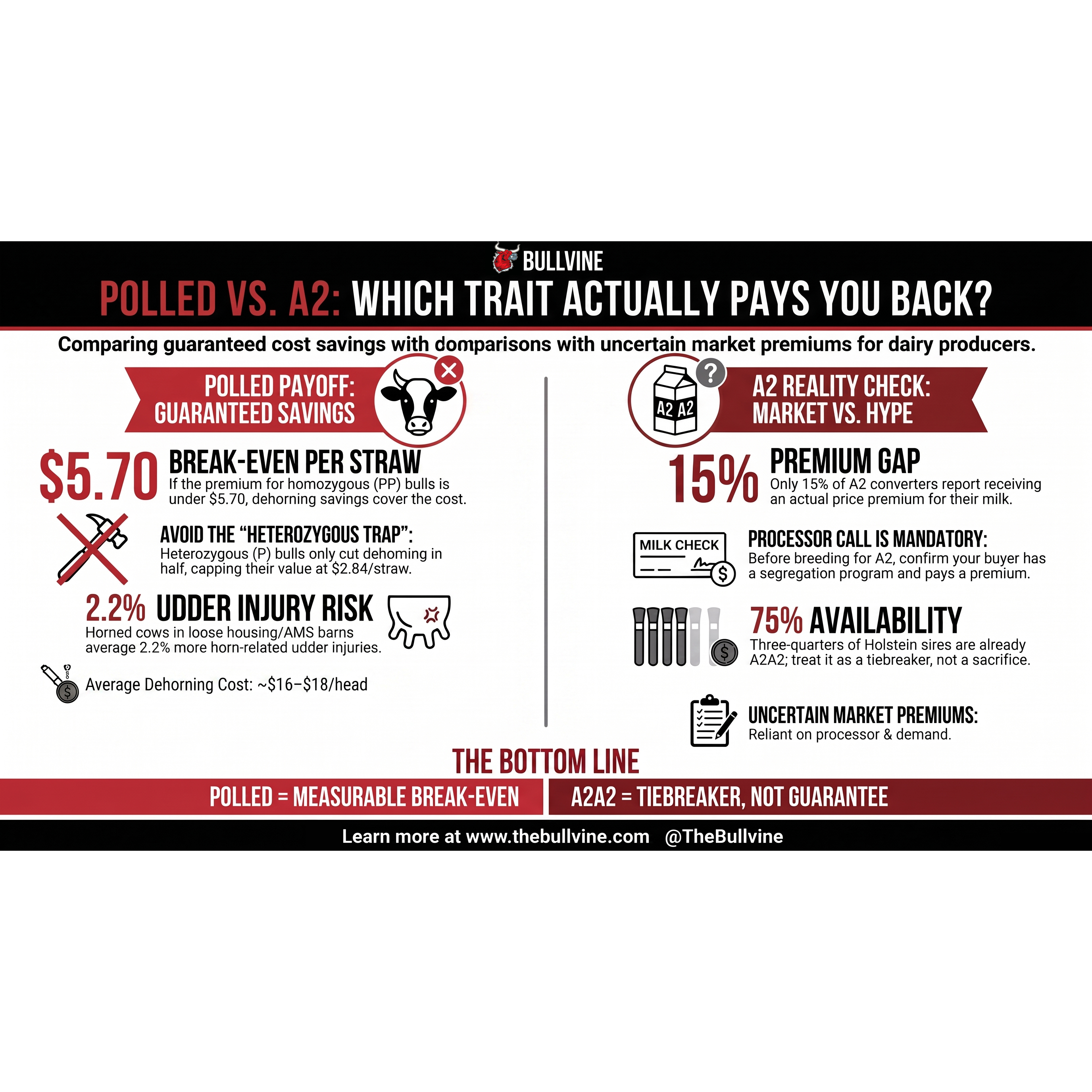
E627 $4.17 a Straw for Polled. The A2A2 Premium Isn’t Reaching You.
2d ago00:33:58Tap to summarizePurdue set the polled semen break-even at $4.17 a straw — $5.70 in 2026 dollars. Check that against tonight's semen invoice.Two traits get sold to you as the future. Only one has a testable number behind it. The Bullvine Podcast works through the Journal of Dairy Science figure on homozygous polled genetics, then the Minnesota survey where 82% of farms converted to A2 believing consumers wanted it — and only 15% said anyone was actually paying more.What You'll LearnWhy $4.17 a straw is a ceiling, not a target, and how inflation moved itWhat the Purdue authors admitted about the limits of their own modelThree questions to ask your milk buyer before you weight A2A2 in a matingWhy an 82% belief rate against 15% payment is the gap that should worry youThe polled number is peer-reviewed, dated, and verifiable against a real invoice. The A2 premium is largely belief — only 15% of converters surveyed could point to anyone paying them more. The authors noted that farm-specific semen and dehorning costs likely swamp the differences in their model, which is precisely why the instruction is check your own numbers, not accept an industry average. One decision costs a phone call. The other costs a breeding program.Full article and sources: https://www.thebullvine.com/farm-economics-management/polled-semen-break-even-4-17-straw/ Subscribe for straight-talking dairy analysis. Share this with a producer who needs it.
Transcribe →
E626 The $1,300 Gap Between the Bull You Want and the Bull You Should Buy
5d ago00:20:53Tap to summarizeA 96th-percentile LPI bull can rank 31st for Health and Welfare. Pro$ puts that gap at $1,300 a daughter in lifetime profit. Most producers never look.The Bullvine Podcast runs the barn math on Canada's 20 most-used Holstein sires against Lactanet's six new subindexes — the analysis that found bulls sitting at the 96th percentile overall and the 31st for health, behind roughly a quarter of registered calves born in 2025. Murray Hunt built Canada's first composite sire ranking index in 1970. Fifty-six years on, he says the tools finally exist and nobody's opening them.What You'll LearnWhy a composite index averages away the traits that empty your stallsHow Health and Welfare carrying just 8% of LPI hides a below-average bullThe two-minute Floor Rule that keeps hole-carrying sires off your main listWhy five of six subindexes above the 50th percentile beats a top-10 rankingWhat 60 lameness cases cost a 300-cow herd at the low end of the rangeWhere private indexes like DWP$ belong — and where they don'tTop-quartile sires retain 7.4% more daughters at six years, worth +$1,300 in lifetime profit per daughter. Bottom-quartile sires run −$1,200. US DWP$ validation across five herds put top-quartile lameness 15.9 points lower and mastitis 14.9 points lower. On a 300-cow herd at 20% lameness incidence, even the low $90-per-case figure is $5,400 walking out on bad feet every year. You buy those weaknesses by the daughter, year after year.Full article and sources: https://www.thebullvine.com/genetics-breeding/lpi-subindexes-health-gap/ Subscribe for straight-talking dairy analysis. Share this with a producer who needs it.
Transcribe →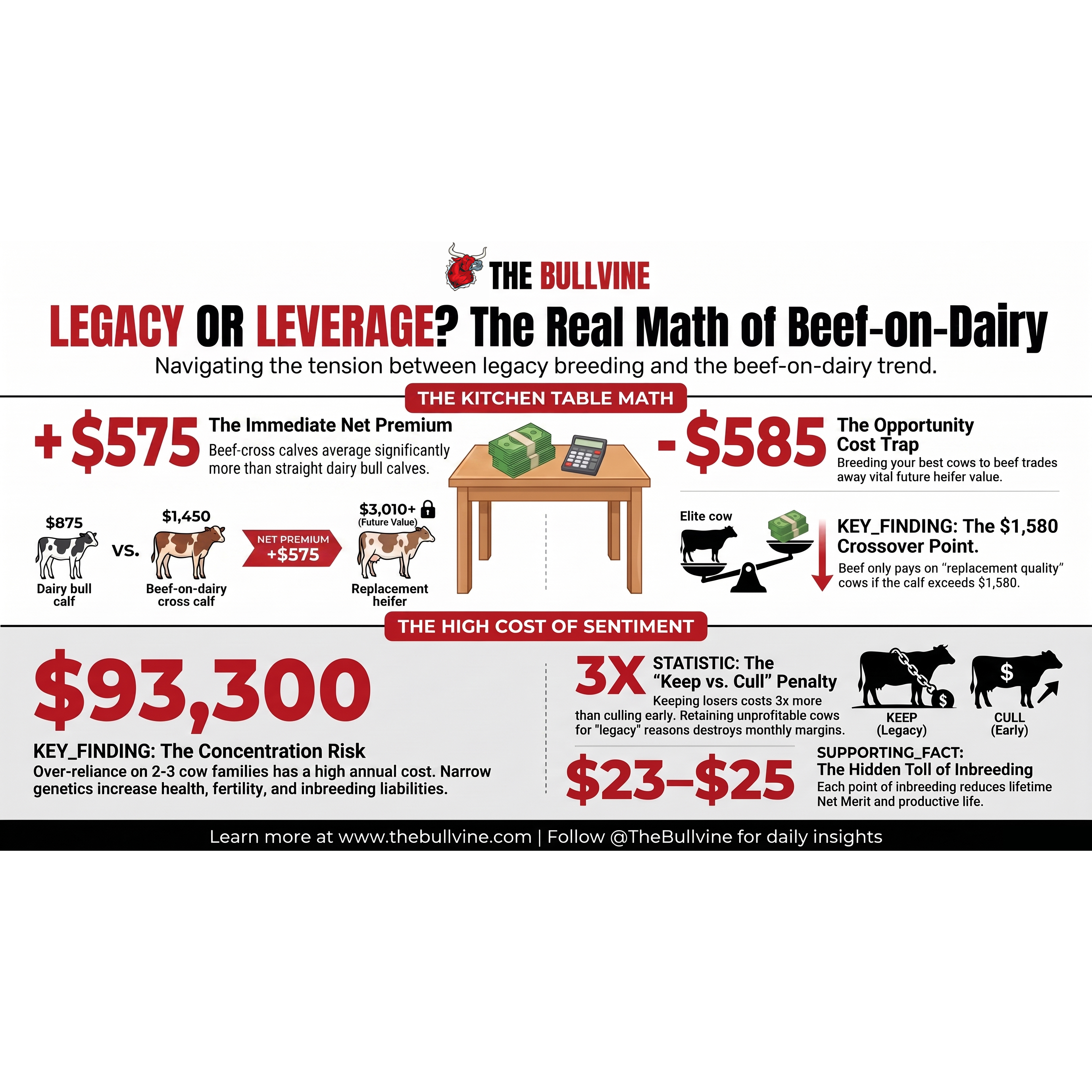
E625 The $93,300 Cow Family: Why the Breeding Fight at Your Kitchen Table Is Really a Succession War
6d ago00:17:58Tap to summarizeThat $575 beef-cross calf premium isn't free money. Every beef service on a replacement-eligible cow trades away roughly $585 in future heifer value.The math looks obvious at the calf pen and falls apart at the heifer barn. The Bullvine Podcast breaks down why the question was never how much beef semen you use — it's which cows get it. On a 300-cow family herd making just 60 of those calls against its best cows, the drag runs roughly $35,000 a year. It doesn't show up in the checkbook today.What You'll LearnWhy the $575 premium cancels out once replacement value is priced inHow 60 wrong mating calls cost a 300-cow herd $35,000 annuallyWhich cows should never see a beef straw — and how to identify themWhy replacement heifer costs climbed from $1,140 to $3,010 per headHow cow-family concentration turns a breeding shortcut into structural riskWhat a beef futures correction would do to a drained heifer pipelineThe heifer shortage wasn't an accident — it was the cumulative result of thousands of individually rational mating decisions. Replacement costs near $3,010 per head mean the cheapest heifer you'll ever own is the one you decided to breed three years ago. Bullvine modeling suggests the fastest route back to a full pipeline isn't patient rebuilding — it's a beef futures crash that drags calf premiums down and forces the correction. Either way, the operations that kept beef straws away from their best cows walk into that reset with leverage.Listen & Connect Full article and sources: https://www.thebullvine.com/genetics-breeding/beef-on-dairy-math-575-premium/ Subscribe for straight-talking dairy analysis. Share this with a producer who needs it.
Transcribe →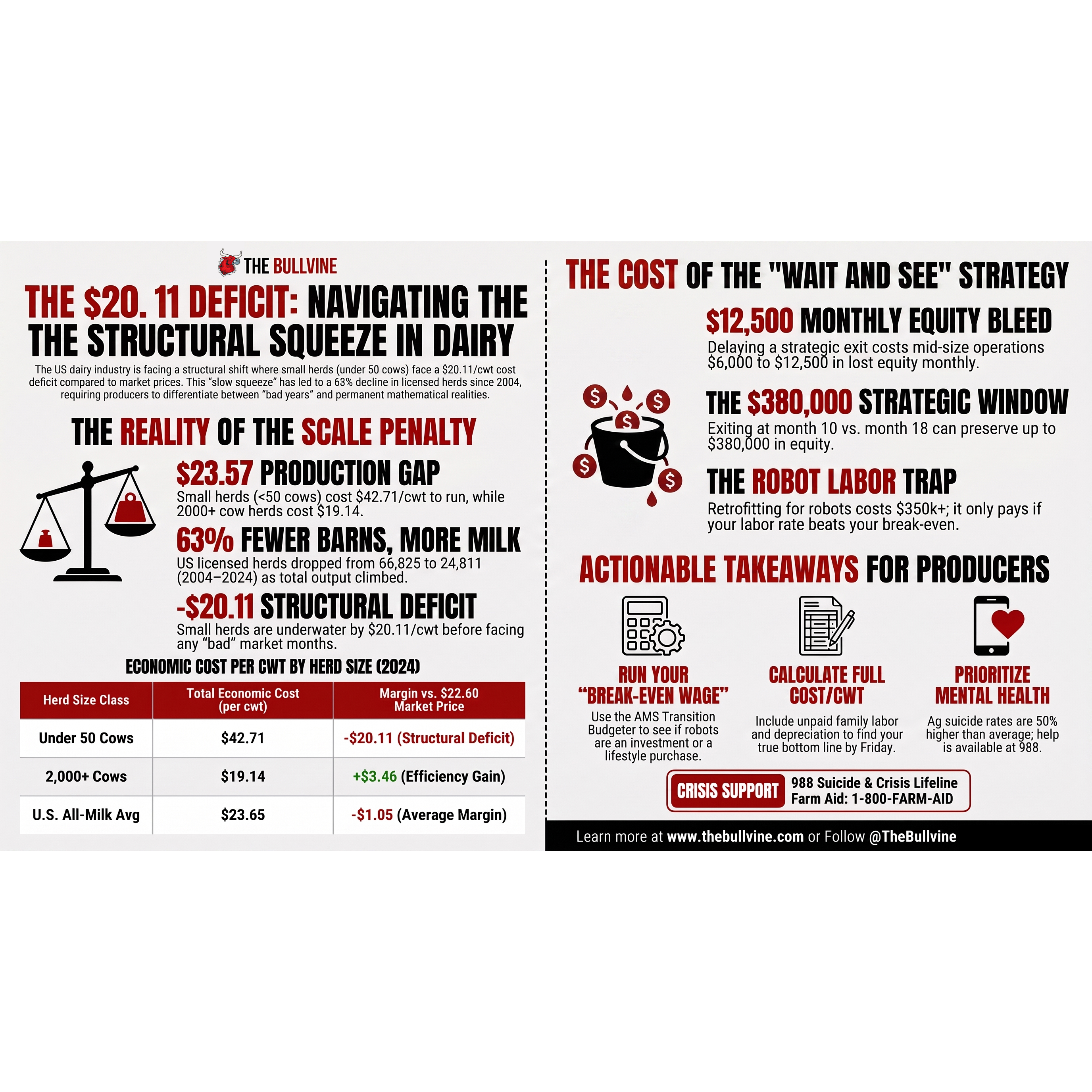
E624 $20.11 Under Water on Every Hundredweight – Before the Bad Month
1w ago00:21:56Tap to summarizeUSDA puts the cost of making milk in a sub-50-cow herd at $42.71/cwt. Milk sold for $22.60. That's $20.11 underwater before anybody has a bad month.The Bullvine Podcast breaks down why the 40-cow tie-stall isn't losing a bad year — it's losing a structural argument. ERS data shows 2,000-plus-cow herds producing at $19.14/cwt while small herds carry $42.71. The U.S. shed 63% of its licensed dairy herds between 2004 and 2024, from 66,825 to 24,811, while milk output kept climbing.What You'll LearnWhy $6,000 to $12,500 slides off your balance sheet every month you waitThe 18-month window between late bills and a forced sale — and $380,000 in swing equityWhy $27/hour and $14.77/hour are both real robot break-even wagesThe 7-year cash-flow hole behind USDA's "robots lift net returns 13%" headlineHow to tell a robot business case from a robot life raftWhy Canada's farm count fell from 12,007 to 9,256 while the national herd barely movedWhy This Episode MattersEven the average U.S. dairy ran total costs near $23.65/cwt against a $22.60 all-milk price in 2024 — a real margin around negative $1.05. Financing a $400,000 robot project can add $2.60 to $3.99/cwt in debt service while saving roughly $1.50/cwt in labor. Miss the assumed 5% production lift and a $20,000 annual gain disappears. This episode gives you the two numbers that decide it: your full cost per hundredweight, and your own break-even labor wage.If the weight of this is landing hard, call or text 988. Farm Aid: 1-800-FARM-AID.Full article and sources: thebullvine.comSubscribe for straight-talking dairy analysis. Share this with a producer who needs it.
Transcribe →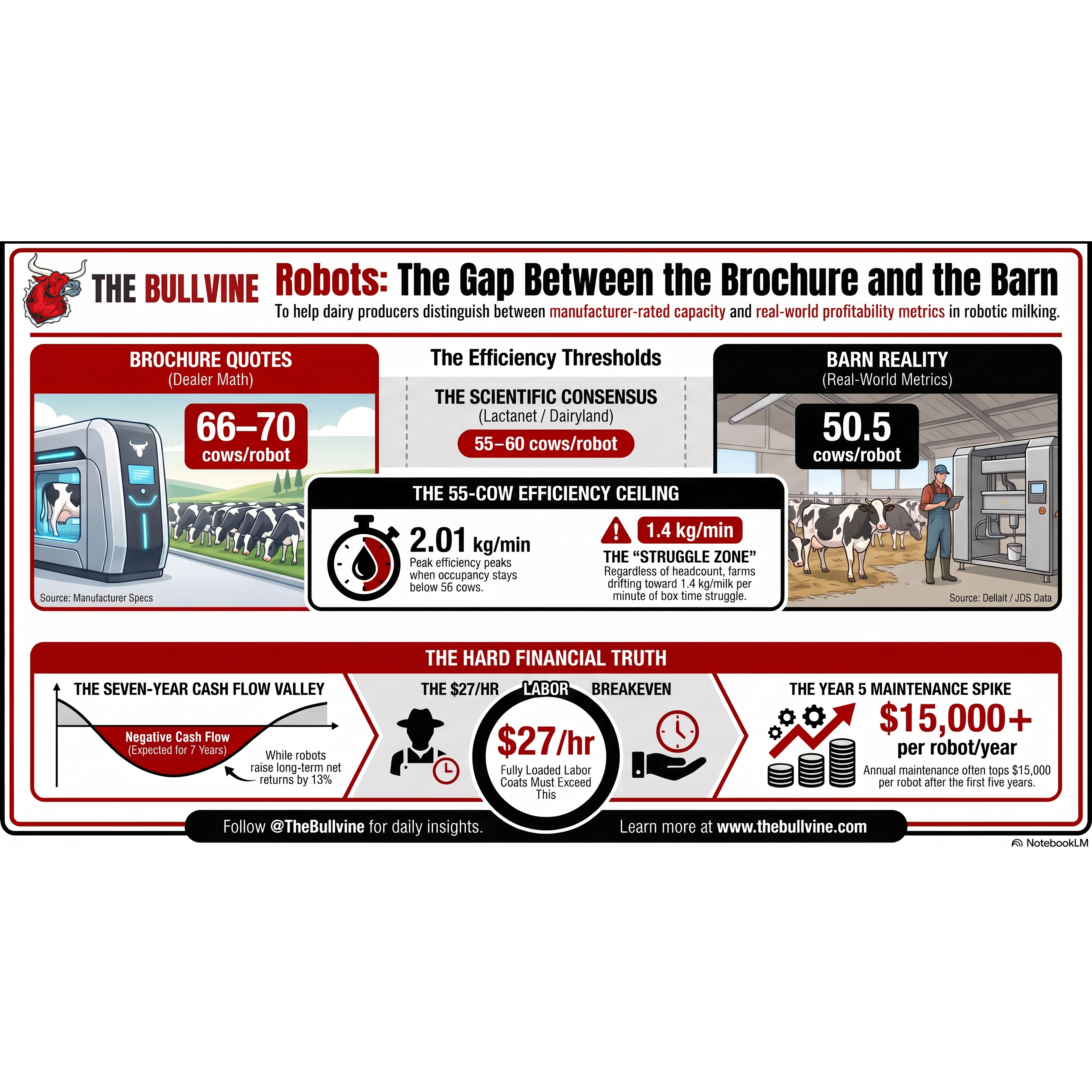
E623 Two Barns Run 60 Cows Per Robot. One’s Broke
2w ago00:24:16Tap to summarizeTwo barns run 60 cows per robot. One prints money; one's bled cash for six years. Same headcount, opposite milk cheque — and cows-per-robot never saw it coming.The dealer quotes 66 to 70 cows per box. Real North American barns average 50.5. The Bullvine Podcast breaks down why that gap decides your payback, what USDA's ERR-356 actually found on robot profitability, and the one number that separates a winning box from a broke one — kilograms of milk per minute, not headcount.What You'll LearnWhy real barns average 50.5 cows per robot, not the 66-70 dealers quoteWhat USDA's ERR-356 found: 13% higher net returns, but on a 7-year timelineWhy kg/min exposes the profit leak that cows-per-robot hides completelyHow the fetch list breaks first — from a healthy 4% toward an 8% overload flagThe maintenance bill nobody budgets: $15,000-plus per robot after year fiveWhy $27/hr labour is the line between an economic buy and a lifestyle oneWhy This Episode Matters Every AMS salesperson quotes rated capacity. Almost none quote the profitable number — and that's where payback is won or lost. This episode hands 60-to-500-cow operators the barn math to decide the real question: add cows to the box, or add a box. USDA says robots pay 13% better net returns, worth about $3.15/cwt. But you can hit the dealer's headcount and still bleed for seven years if kg/min slides toward 1.4 and the fetch list climbs.Listen & Connect Full article and sources: https://www.thebullvine.com/news/cows-per-robot-ams-payback/ Subscribe for straight-talking dairy analysis. Share this with a producer who needs it.
Transcribe →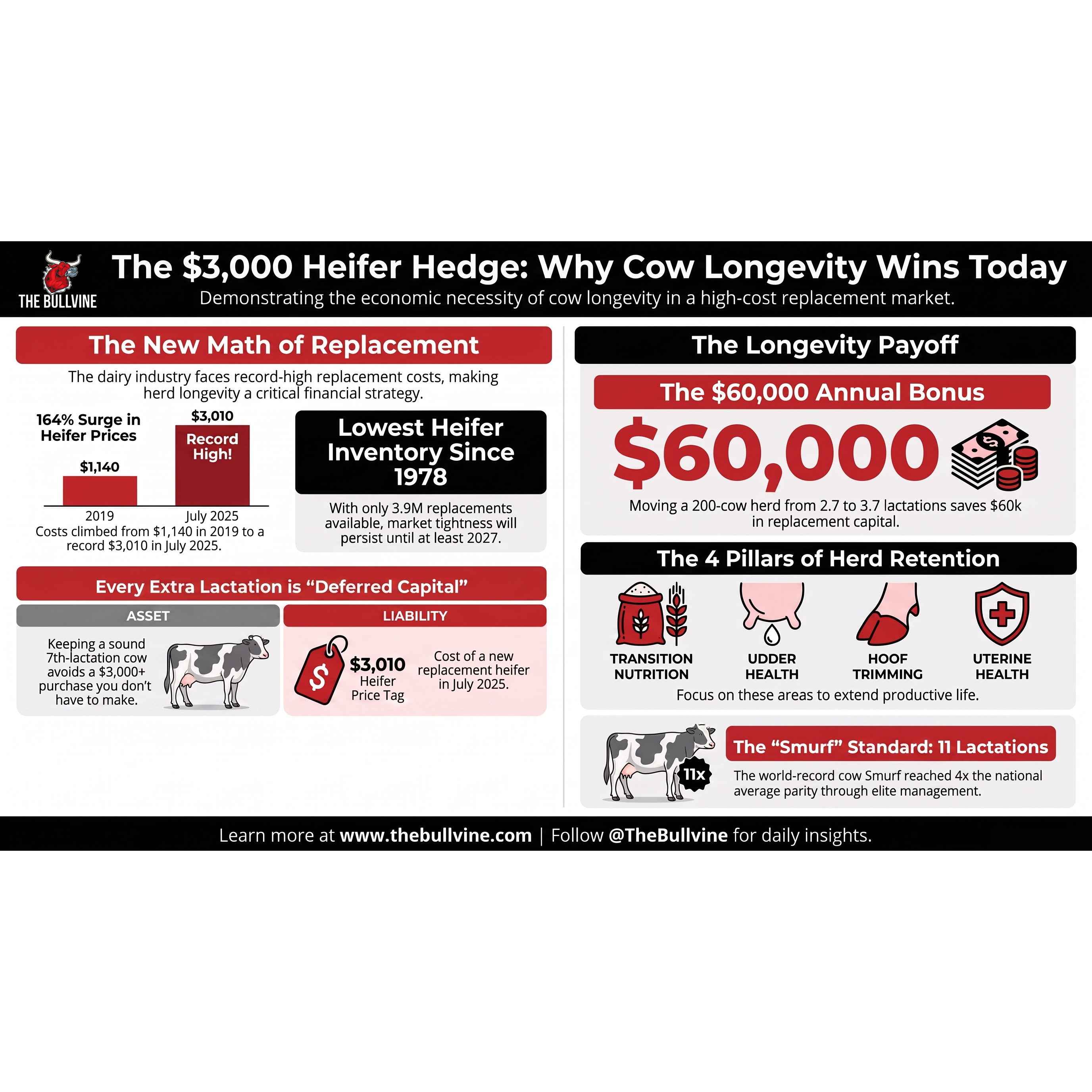
E622 Your Oldest Cow Isn’t a Cull — She’s a $3,000 Heifer You Don’t Have to Buy
2w ago00:18:37Tap to summarizeAt $3,010 a replacement heifer — a record — the cow you're about to cull might be the cheapest one in your barn. Here's the math most farms skip.Replacement heifers hit $3,010 a head in July 2025, up 164% since 2019, with US inventories at a 47-year low. This episode of The Bullvine Podcast runs the barn math through the story of Gillette Emperor Smurf — the Holstein who milked to 18, completed 11 lactations, and set a Guinness world record. On a 200-cow herd, one added lactation of productive life is worth roughly $60,000 a year in deferred replacements.What You'll LearnWhy a sound 7th-lactation cow is a $3,000 heifer you don't have to buyThe barn math: what one extra lactation saves on a 200-cow herdWhy replacement heifers hit a record $3,010 and won't ease until 2027The four things that kept Smurf sound through 11 calvingsWhere "long life equals good welfare" holds up — and where it doesn'tWith heifers at $3,010 and top genetics north of $4,000, every reflex cull is a check you didn't have to write. The episode shows how pushing herd-average productive life from 2.7 to 3.7 lactations drops turnover from 37% to 27% — about $60,000 a year back on a 200-cow operation. It also draws the honest line: high parity signals good management, but it isn't proof of a welfare formula.Listen & Connect Full article and sources: https://www.thebullvine.com/farm-economics-management/replacement-heifer-cost-cow-longevity/ Subscribe for straight-talking dairy analysis. Share this with a producer who needs it.
Transcribe →
E621 $175 Million Expansion, 48% Fewer Exhibitors: Can a Bigger Hall Fix World Dairy Expo’s Trade Floor?
2w ago00:26:22Tap to summarizeWorld Dairy Expo's trade floor lost more than 400 companies since 2017 — nearly half its exhibitors — while the cattle show set records. A bigger hall won't fix that.Dane County just cleared the first hurdle on a $175 million redevelopment package that expands the Exhibition Hall at World Dairy Expo's home. The Bullvine Podcast digs into the number nobody's connecting to the empty booths: exhibitors fell every single year the cattle show hit new highs. The problem isn't square footage. It's what a booth is worth — and that's a decision, not a construction project.What you'll learnWhy the trade floor shed 400-plus companies while cattle entries hit recordsHow the $175M covers the hall plus roads, parking, and site work — not just the buildingWhat 87 versus 112 attendees per booth really tells an exhibitorWhy 28.3 million of 45.8 million dairy semen units now ship overseasHow the 2028 contract renewal becomes Expo's real leverage pointThree plays for anyone deciding whether a fall booth still paysIf you write a five-figure booth check every fall, the math has shifted under you. With the biggest 3% of herds producing 46% of U.S. milk and two-thirds of genetics volume heading for export, a Wisconsin trade floor is doing a thinner job than your budget assumes. This episode hands you the barn math to defend your 2028 renewal — or walk.Full article and sources: https://www.thebullvine.com/show-reports/world-dairy-expo/world-dairy-expo-expansion-trade-floor/ Subscribe for straight-talking dairy analysis. Share this with a producer who needs it.
Transcribe →
E620 Agri-Mark Printed the Suicide Hotline on the Milk Cheque. The Fix Isn’t Grit — It’s 25 Hours a Week.
2w ago00:35:12Tap to summarizeA New England co-op printed a suicide hotline on farmers' milk cheques. The data says the real fix isn't tougher farmers — it's 25 fewer hours a week.In 2018, Agri-Mark mailed crisis lines to its 1,000 members alongside a milk price near $17/cwt — well under break-even. The Bullvine Podcast pulls the thread and lands somewhere harder to say: resilience isn't the lever. Workload is. An Irish study of 313 farms found the best-run quarter worked 58.6 hours a week; the worst ran 82.6. Same job, 24-hour gap — driven by how the work is built, not how tough the farmer is.What you'll learn:Why the "3.5x farmer suicide rate" was corrected down — and what CDC's 47.9 per 100,000 actually saysHow the same herd runs on 51 hours or 70, purely on system designWhat one full-time hire really costs against the hours it buys backWhich of four fixes — robots, beef-on-dairy, outsourced cropping, added labor — pencils on your placeWhy milking robots trade the 5 a.m. grind for a 2 a.m. alarmGuelph found dairy resilience runs below average, yet workload and financial pressure track straight to distress. One FTE runs $45,000–$50,000 a year before benefits — but a 70-hour solo week past 120 cows isn't free either. Someone's already absorbing that cost; it just never lands on the balance sheet. This episode turns a mental-health story into barn math you can act on before next calving.Full article and sources: https://www.thebullvine.com/farm-economics-management/dairy-farmer-workload-milk-cheque/ Subscribe for straight-talking dairy analysis. Share this with a producer who needs it.
Transcribe →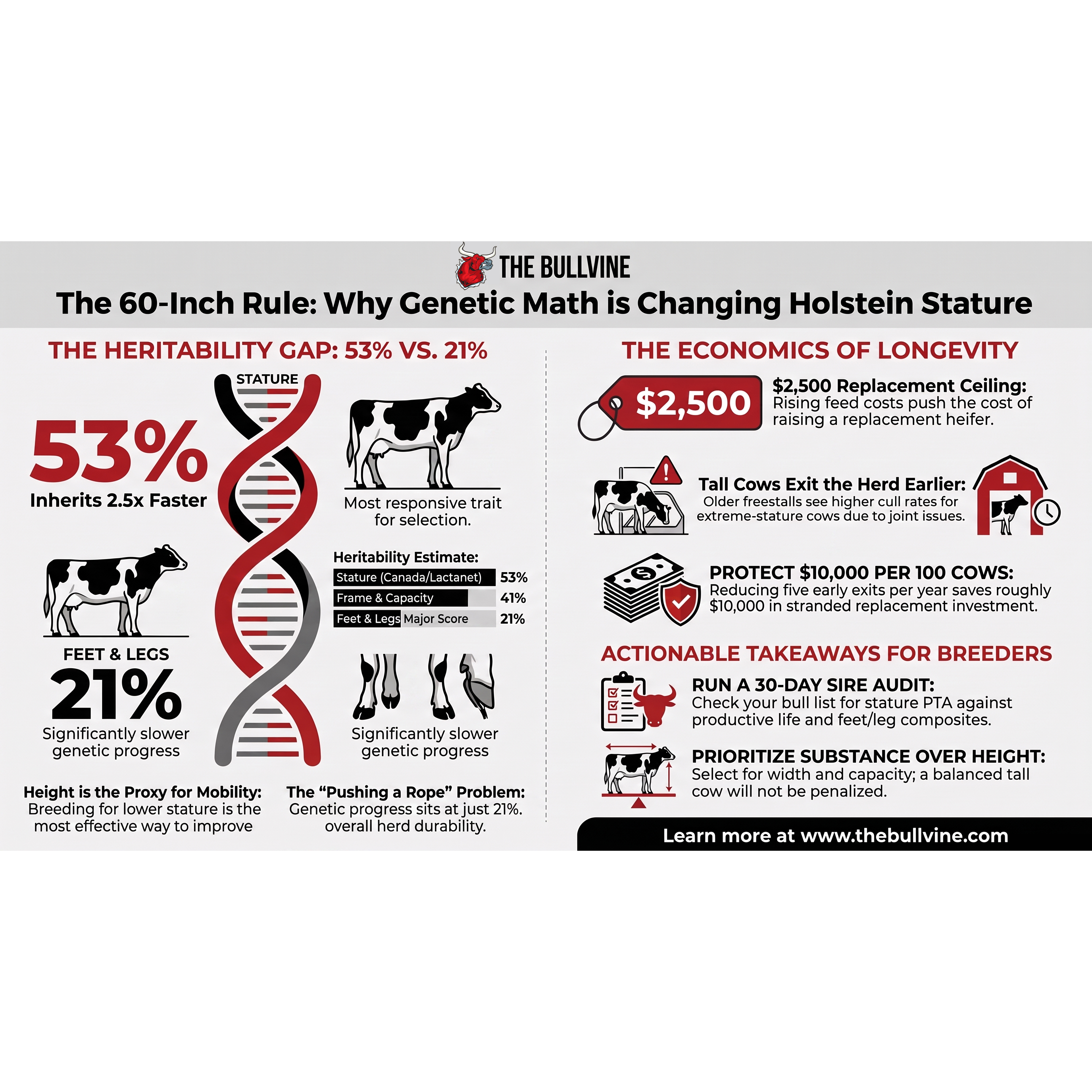
E619 Holstein’s 60-Inch Rule: Why Breeders Are Backing It With 53%-vs-21% Math
2w ago00:25:57Tap to summarizeStature is 53% heritable. Feet and legs? Just 21%. That single gap explains Holstein's entire new stature penalty — and why working breeders are backing it.Holstein USA made 60 inches the ideal in its May 2026 classification run. Go over it, you lose Final Score points. The show crowd cried foul — but on The Bullvine Podcast, we dig into the genetics math the association never spelled out. It's the reason the penalty targets height instead of the feet everyone complains about, and it changes how you should read your next sire list.What You'll LearnWhy a 53%-heritable trait moves your herd faster than a 21% one ever willHow both Holstein composites carry a −0.20 stature weight — and why that protects good tall cowsWhether the real durability killer is height, or the weak feet nobody's cullingWhy the show ring is a mirror, not the villain everyone blamesWhat early culls cost you at roughly $2,000 a replacement heiferWhy This Episode Matters The penalty isn't anti-tall — it's anti-tall-and-narrow. Breeders in older, shorter stalls are already treating a stature minus as risk management: cut five early exits on a 100-cow herd and you protect around $10,000 in replacement investment. We also tell the story of a short, 88-point Wisconsin cow, among the first in her state past 300,000 lbs lifetime, denied Excellent for one reason — too short — back when short was the sin.Listen & Connect Full article and sources: https://www.thebullvine.com/genetics-breeding/holstein-stature-penalty-heritability/ Subscribe for straight-talking dairy analysis. Share this with a producer who needs it.
Transcribe →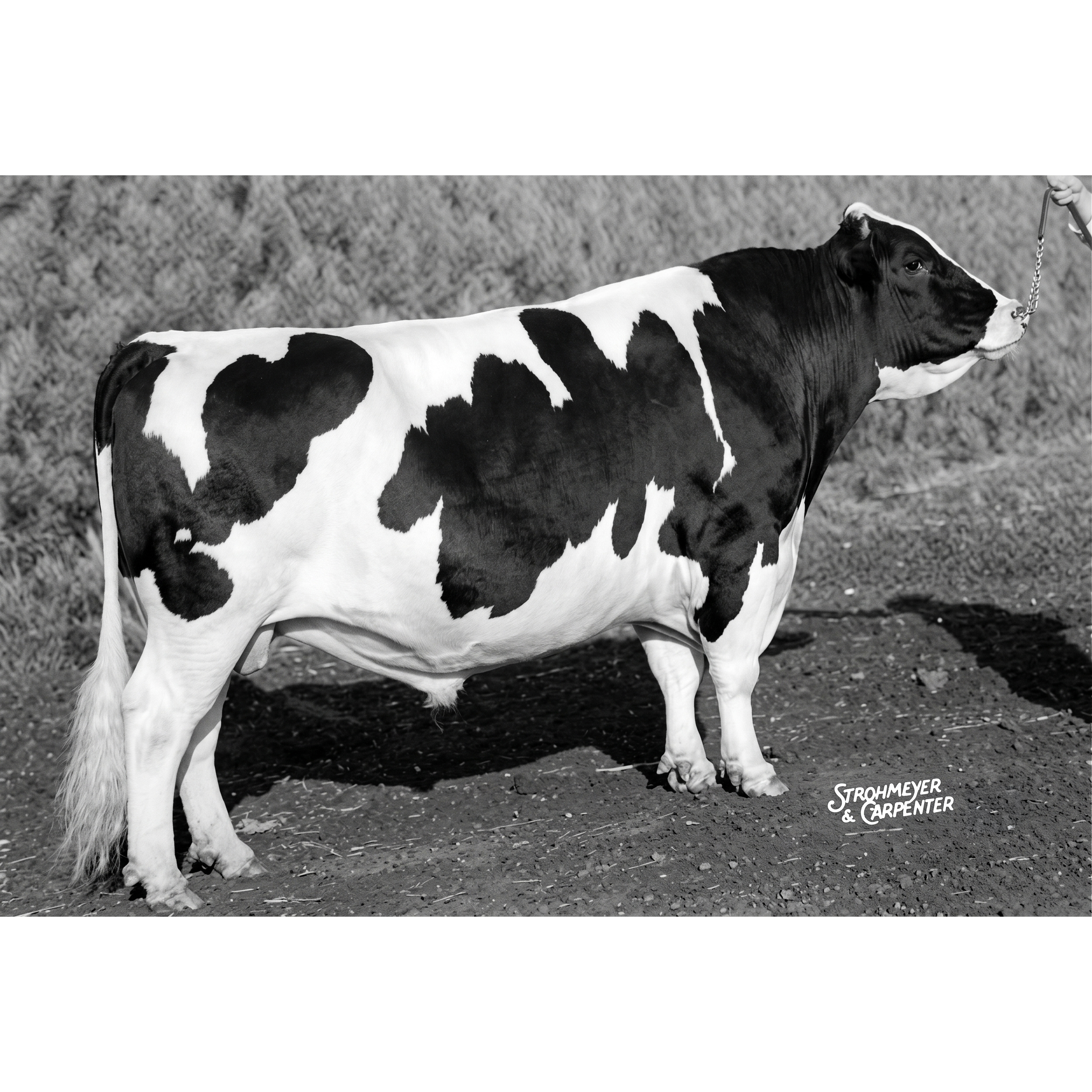
E618 Rockwood Rocket Tone: 6-Time All-Canadian, and “an Absolute Disaster” as a Sire
3w ago00:40:37Tap to summarizeRockwood Rocket Tone won All-Canadian six times — one of the most formidable bulls ever shown. Then his daughters freshened, and the truth came out. He couldn't breed. Historian E.Y. Morwick called him "an absolute disaster" as a sire. This is the story of dairy history's most humbling paradox: the glamour bull whose perfect body promised everything and passed on almost nothing — and the quieter bulls who reshaped the entire Holstein breed while the crowd looked the other way.Key MomentsThe night the ribbons came down — and why Rocket Tone's magnificent daughters told a very different story than his six All-Canadian bannersHow his near-twin, Smithcroft Snowball Rocket, won far less in the ring yet sired champion after championWhy only one champion show bull in six — across eleven of the greatest breeding houses in North America — ever became an exceptional transmitterThe costliest decision Jack Fraser ever made, and the 100-plus calves that proved him wrongThe moment beauty and blood finally agreed: Rosafe Citation R. and the perfect transmitting scoreHow a genomic heifer changing hands today is fighting the exact same battle Rocket Tone lostYou've seen these names in pedigrees without knowing what they cost — or what they built. This episode traces the record kept by E.Y. Morwick across eleven legendary programs — Carnation, Pabst, Mount Victoria, Rosafe, Spring Farm, Romandale, Glenafton and more — scoring their most decorated champions on how well they actually bred, not how well they showed. The failures are humbling. The successes are still with us.Follow Citation R. forward and you arrive at Glenridge Citation Roxy — EX-97, and the first cow in the world with ten Excellent daughters. Trace Round Oak Rag Apple Elevation's maternal line back and you find an uncampaigned Glenafton cow who never chased a single ribbon. The lesson those bulls taught the hard way — admire the phenotype, then interrogate the pedigree — hasn't aged a day. It's the same quiet question every breeder still asks of a chart-topping GTPI number or a six-figure flush donor: does she transmit?The full written history profile — with the complete eleven-farm scorecard, pedigree detail, and archival photos — is waiting at https://www.thebullvine.com/sire-spotlight/rockwood-rocket-tone-6-time-all-canadian-and-an-absolute-disaster-as-a-sire/. Subscribe so you never miss a history episode, and share this one with someone who'd recognize these names in a pedigree — or someone who should.
Transcribe →