
Podcast
The Bullvine Daily Brief
Hosted by The Bullvine · EN
Every article from TheBullvine.com — read aloud so you can keep up with dairy while you're milking, hauling, or driving fence. Daily dispatches on genetics, milk economics, herd management, policy, and the stories the trade press won't touch. No fluff, no PR, no filler — just our journalism in your ears.
New articles go live in audio within hours of publication. Subscribe and the day's Bullvine comes with you.
140episodes
Episodes
Newest firstAll episodes
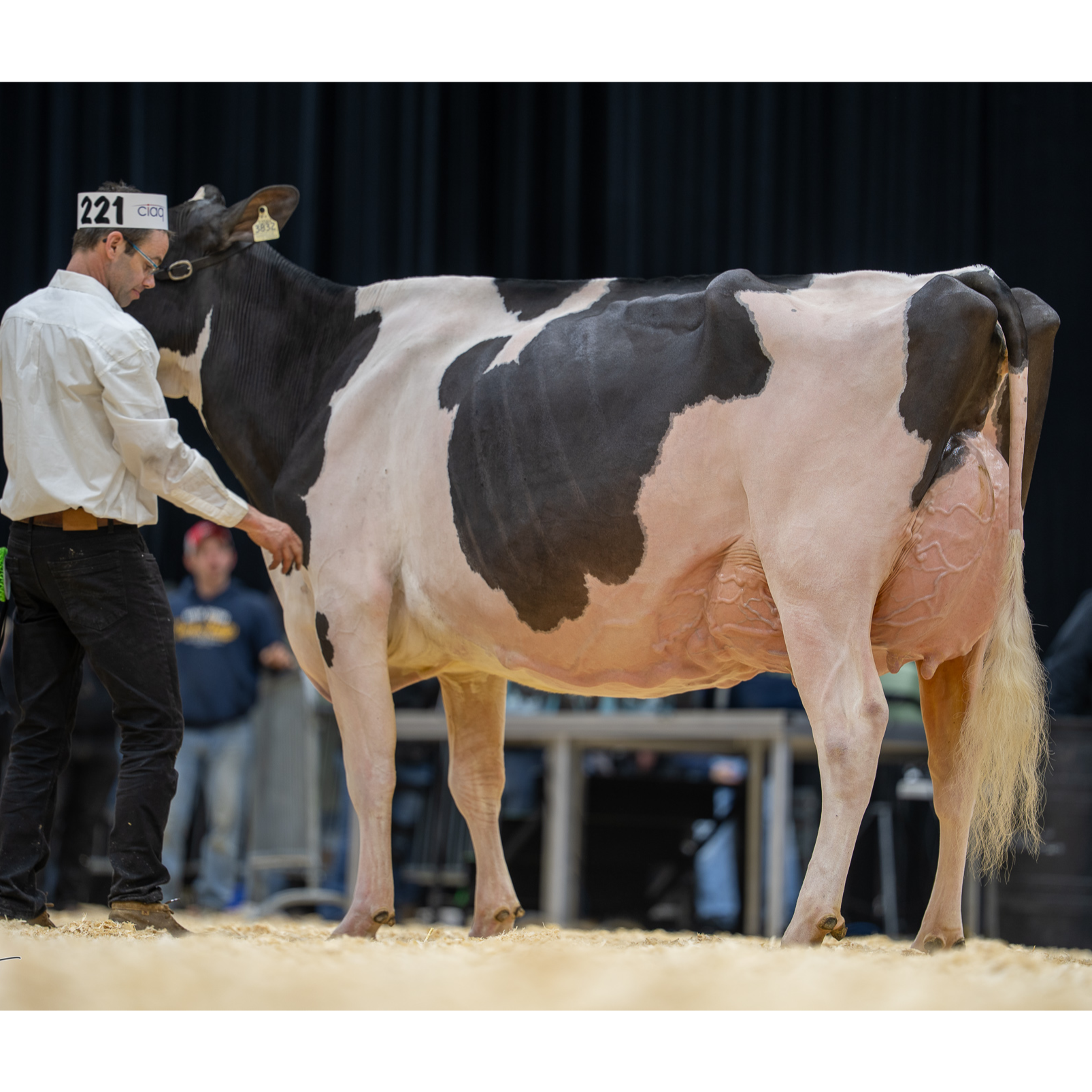
E538 Quebec Spring Holstein Show 2026
Apr 1600:40:20Tap to summarizeA Five-Year-Old cow walks into the Grand Champion callout at Quebec Spring Show 2026. Behind her: a pedigree that traces through Sidekick, Crushtime, and Cindadoor all the way back to Loyalyn Goldwyn June — one of the most influential brood cows in Canadian Holstein history. Across the ring, a single farm holds Junior Champion, Intermediate Champion, and Reserve Grand Champion — all bred and owned. A quiet showman from Montmagny stands behind the Grand Champion and the Honorable Mention Grand, running cattle through multiple partnerships with multiple sire lines, placing in every mature division. One judge. One day. Three programs colliding at the top of the deepest show Victoriaville may have ever seen. This is the episode that will change how you think about what it takes to build a cow — and a program — that wins when it matters most.The Story You'll Hear:The moment Pat Lundy pointed to the Five-Year-Olds over the mature cows — and why the Grand Champion callout wasn't even closeA cow two weeks fresh who won Best Udder in her class but couldn't beat two Junior Three-Year-Olds for Intermediate Champion — and what that tells you about what judges are really rewarding right nowHow Ferme Jacobs collected three championship banners in one day with cattle spanning Fall Two-Year-Olds to EX-92 mature cows — and why "bred and owned" is the part that mattersThe showman nobody's talking about on social media who's been in Grand Champion contention at this show for three consecutive yearsWhy Lambda daughters went 1-2-3 in the Four-Year-Old class — and what a smaller operation from Saint-Christophe-d'Arthabaska proved about competing against the powerhousesThe breeding decision made four generations ago that built the cow who won it allWhy This Story Matters:Quebec Spring 2026 wasn't a show with one dominant cow. It was a show with three dominant programs — each winning in completely different ways. Ferme Jacobs proved that depth across every age group is the product of a system, not a lucky mating. Pierre Boulet showed that consistency, partnerships, and stockmanship can place you in the Grand Champion conversation year after year without ever needing the biggest herd or the loudest social media presence. And Ferme Fortale reminded everyone that a mid-size bred-and-owned operation can take Best Udder against the biggest names in the province. The sire stories are just as revealing: Lambda's daughters hold up through multiple lactations, Sidekick's stamp dominates the mature ring, and Ambrose is starting to validate what the genomics promised. Whether you're making matings this spring, prepping for fall shows, or just trying to figure out where the breed is heading — this show gave you answers.Jacuzzi's Grand Championship traces back through four generations of deliberate mating decisions. Most of us can name the sire we're using today. How many of us are building the cow family that wins four generations from now?The complete show report — every class, every championship, judge's reasons, and the breeding analysis behind the results — is live at https://www.thebullvine.com/show-reports/quebec-spring-holstein-show-2026/ Subscribe to The Bullvine Podcast so you never miss an episode. And if your cow, your farm, or your program has a story worth telling — reach out. We're always looking for the next conversation that reminds people why they got into this industry. Find us at thebullvine.com or connect on Facebook and Instagram.
Transcribe →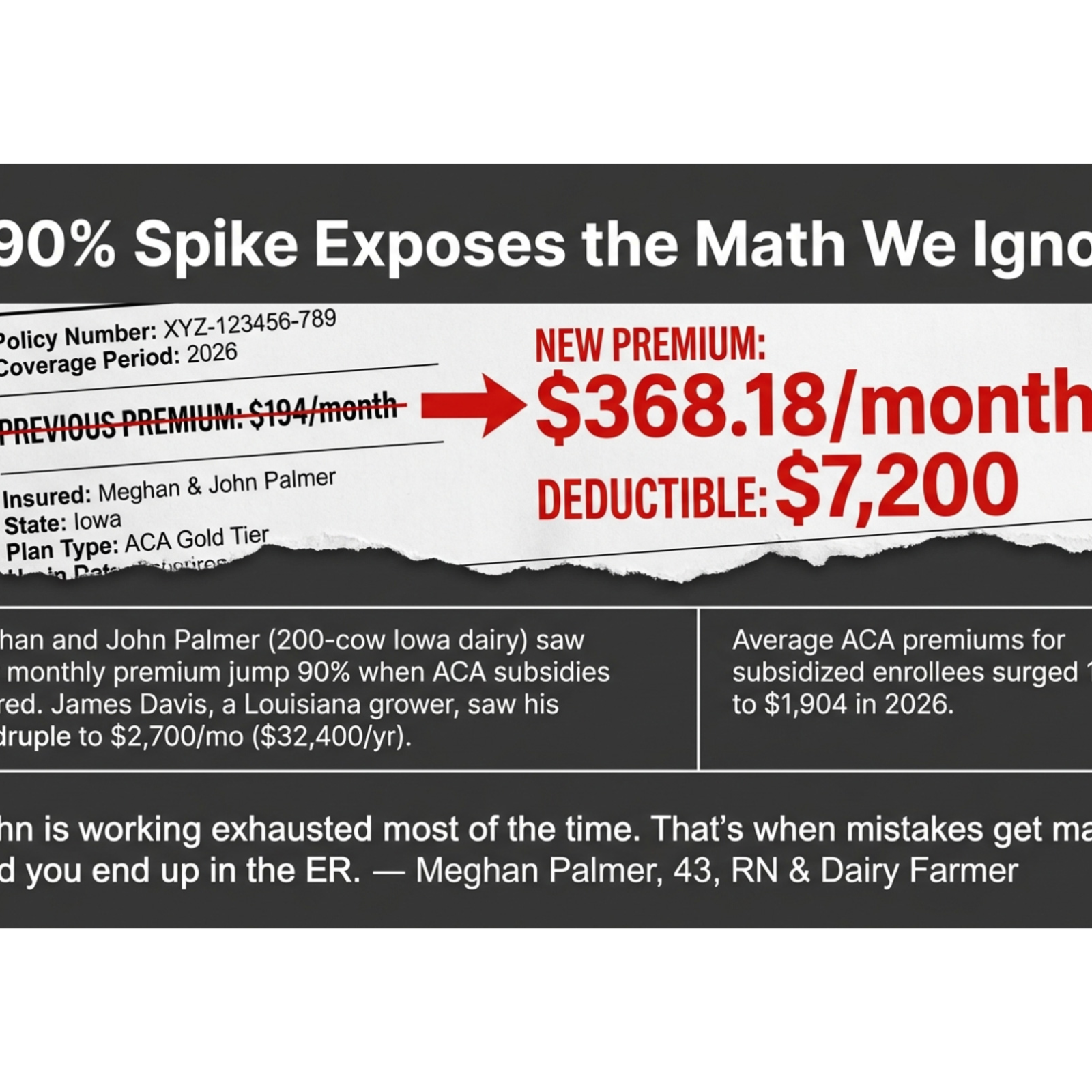
E537 $368 Insurance, −$1,830 from Farming: What Actually Keeps One Iowa Dairy Alive
Apr 1500:45:36Tap to summarizeUSDA says the median U.S. farm household lost $1,830 farming in 2024 — and earned $86,900 off the farm. When enhanced ACA subsidies expired in December 2025, families like Meghan Palmer's in northeastern Iowa watched their monthly health insurance bill nearly double, exposing a financial reality the dairy industry rarely talks about openly: on most operations, the spouse's town job isn't supplemental income. It's the operating margin. This episode breaks down the barn math, the governance gap, and four concrete decision paths every dual-income dairy household should evaluate now.KEY TAKEAWAYSWhy USDA's 2024 farm household income data ($102,748 median total — but negative $1,830 from farming) should change how you think about your farm's real financial structure.The hidden math behind a $55,000 off-farm salary: how employer health insurance, retirement matches, and benefits push total compensation to $65,000–$77,000 — and why that number often exceeds your net farm income.What a 200-cow herd shipping 75 lbs/day at $20.50/cwt actually nets after costs run $23.56/cwt — and where the off-farm paycheck fits in that equation.The governance gap: why the person funding your dairy's real margin probably isn't on your loan documents, bank accounts, or succession plan — and what that means if they get hurt, burn out, or leave.How ACA premium hikes (114% projected increase per KFF) and a 40%+ uninsured rate among dairy farmers are compounding an already razor-thin margin environment.Four decision paths — from formalizing the town job in your business plan to planning an intentional exit — with a 30-day action you can take with last year's tax return and a W-2.This episode puts real numbers behind something most dairy families live but never quantify. Using USDA Economic Research Service data, KFF Health News reporting, and Bullvine analysis, the discussion walks through what a spouse's off-farm job actually contributes — not just the paycheck, but the $7,500 to $19,300 in annual employer health insurance contributions, the retirement match, and the stability that no milk check can replicate.The conversation goes beyond economics into farm governance: if your operation depends on a single off-farm income stream, is the person generating it actually part of your business structure? For most dairy families, the answer is no — and that's a concentration risk nobody's managing.You'll hear the real story of Meghan Palmer, a registered nurse on a northeastern Iowa dairy whose $368 monthly insurance bill became the catalyst for rethinking her family's entire financial structure. Her experience, sourced from KFF Health News, mirrors what thousands of dairy households are navigating right now as ACA subsidy loss collides with production costs that averaged $23.56/cwt in 2024.Whether you're running 80 cows or 800, this episode gives you a framework to answer one question: does your farm's business plan actually account for the income that's keeping it alive?The full article — with sourced data, a side-by-side comparison table, and all four decision paths — is available at https://www.thebullvine.com/news/368-insurance-%E2%88%921830-from-farming-what-actually-keeps-one-iowa-dairy-alive/. Subscribe to The Bullvine Podcast on Apple Podcasts, Spotify, or wherever you listen — and sign up for The Bullvine Weekly newsletter at thebullvine.com for upcoming economics features on production-cost breakevens by herd size and region.
Transcribe →
E536 How a $286 Milk Replacer Shortcut Cost One 600‑Cow Herd $30,000 in Future Milk
Apr 1400:35:09Tap to summarizeOpening Summary: Every bag of milk replacer is a capital bet on your replacements—but most herds treat it like a commodity line item. This episode exposes how one 600-cow Wisconsin herd's switch to a cheaper plant-protein 20/20 replacer "saved" $286 per calf, only to lose over $30,000 in lifetime milk and delayed freshenings. Grounded in Cornell's ADG-to-milk research and Iowa State's 2024 heifer budgets, we challenge the least-cost formulation mindset and reveal the simple barn math that turns replacer decisions into profitability levers.Key Takeaways:How preweaning ADG of 0.65 vs. 0.85 kg/day translates to 456 kg more milk over three lactations—and $219 per heifer in value.Why plant proteins under week 3 drop ileal digestibility from 82% to 62%, spiking scours and capping genetic potential.The three-part ROI stack: lifetime milk + days to first calving + survival risk that makes "cheap" replacer the most expensive cut.A 30-day ADG challenge: weigh calves at birth/weaning, tie to replacer lots, and benchmark against your genomics.Cost-per-pound-of-gain vs. cost-per-bag: how higher-plane programs often lower true investment per kg of growth.Conventional wisdom says shave the replacer bill to trim heifer costs—but Iowa State's $2,258–$2,651 per-head budgets and Fodor's analysis of 35,128 Holsteins prove slow starters cost more in culling and delayed payback. We dissect Soberon & Van Amburgh's landmark 2012 JDS study (1,244 Cornell + 624 commercial heifers) showing 850–1,113 kg first-lactation milk per kg/day preweaning ADG, scaling to 2,280 kg over three lactations for survivors. UK on-farm data from 11 herds and soy digestibility trials reveal why all-milk under three weeks isn't optional. Get the barn math for your operation, including a conservative model netting near-zero before survival benefits, and practical paths to shift lenders from "cut costs" to "optimize ROI." This isn't theory—it's the data to reframe your next nutritionist or banker meeting.Run your own numbers with our Milk Replacer ROI Calculator and full breakdown at https://www.thebullvine.com/management/how-a-286-milk-replacer-shortcut-cost-one-600%e2%80%91cow-herd-30000-in-future-milk/ Subscribe for weekly genetics, economics, and management edges. Share your ADG results or lender stories on Twitter @TheBullvine—let's build better herds together.
Transcribe →
E535 The $585‑Per‑Service Beef‑on‑Dairy Trap: What a 500‑Cow Herd Reveals About Your Replacement Pipeline
Apr 1300:37:14Tap to summarizeBeef-on-dairy was a cash-flow lifeline when calves fetched $900–$1,400. But at today's $200–$500 prices, every service on a viable dairy dam is costing you $585 in replacement value—and your 2027 pipeline is running dry with just 4.29 million heifers against 9.5 million cows and $11 billion in new processing steel. This episode breaks down the barn math, exposes the $1,580 crossover point where beef stops losing money, and delivers a 30/90/365-day playbook to rebalance your breeding sheet before you're bidding $3,500+ for someone else's genetics.Key Takeaways:Why 200 beef services on a 500-cow Texas Panhandle herd equals $117,000 in lost heifer inventory—and how to run that number on your own operation.The full semen-to-milking-cow pipeline math from NAAB 2025 data, including Dr. Michael Overton's 79% completion rate that kills 21% of your calves before they lactate.When beef-on-dairy actually pencils: the expected-value formulas and $1,580 calf-price threshold that flips the economics.How 600,000+ retained older cows are masking the shortage—and what happens when culling normalizes.Bullvine Pipeline Index at 43.5 (Yellow Zone)—and the one factor that could push it Red.State-by-state heifer crunch: Critical in California and Texas, Tight everywhere else.We walk through the NAAB 2025 Year-End Report's domestic semen sales—10.6 million sexed dairy units, flat beef-on-dairy—and convert them step-by-step using Zoetis field data from 85 Holstein herds. You'll see exactly why the pipeline shrinks to 4.29 million heifers for 2027, per Corey Geiger's CoBank projections and Bullvine's weekly slaughter overlays.The heart of it: expected-value math that shows sexed dairy at $856 per straw vs. beef at $271 on a $500 calf. Plug in your local heifer price ($2,800? Still a $580 gap) and decide where beef belongs in your herd tiers. We expose behavioral traps like cash-flow timing and program inertia, then map the turn for a Panhandle 500-cow herd running 35% beef: $117,000 traded away annually.Hear how retained cows (600K+ since 2023, per Iowa State Extension) bought time but won't beat biology's 24-month lag. The Pipeline Index at 43.5 signals Yellow—but culling normalization drops it fast. Regional breakdowns hit home: California's HPAI fallout and $4,500 springers; Texas's 70% concentration on 5% of dairies.This isn't theory. It's actionable: tier your herd, audit contracts, lock heifer supply now. Producers listening will walk away with the thresholds to challenge sacred cows in their own barns and boardrooms.Grab the full article, EV calculator, Pipeline Tracker, and state maps at https://www.thebullvine.com/beef-on-dairy/the-585%E2%80%91per%E2%80%91service-beef%E2%80%91on%E2%80%91dairy-trap-what-a-500%E2%80%91cow-herd-reveals-about-your-replacement-pipeline/. Subscribe for weekly episodes on genetics, markets, and dairy decisions that pay. Share your pipeline math or beef crossover on X @TheBullvine or Facebook—tag us, we'll feature the sharpest takes.
Transcribe →
E534 The Hidden Gene Behind a Supreme Champion: Sir Inka May, Carnation, and the Rise of Red & White Holsteins
Apr 1100:36:39Tap to summarizeSir Inka May was the “Crown Prince” Minnesota breeders risked $25,000 on—a calf they could still pick up—and a century later his hidden red gene walked out of Madison as Supreme Champion of World Dairy Expo. From a 75‑cow show herd in Austin to the vast pastures of Carnation Milk Farms, this is the story of a bull who sired 33 All‑Americans and Reserves, built one of the most influential sire lines in Holstein history, and quietly carried a color factor the breed tried for decades to erase. By the time Golden‑Oaks Temptres‑Red‑ET stood Supreme in the Coliseum, the gene that once made breeders nervous had become the beating heart of Red & White Holstein pedigrees worldwide. This episode traces how that happened—and what was at stake each time someone chose to keep, cull, or double down on the blood of Sir Inka May.KEY MOMENTSHow a world‑record cow named May Walker Ollie Homestead set the stage for a son the local paper called “Crown Prince of the Inka herd.”The kitchen‑table decision where four McLeod County farmers signed a $25,000 cheque for half interest in a yearling bull.Why Carnation Milk Farms were ready to go to $30,000 at the 1925 Brentwood Sale—and what Sir Inka May did once he reached Seattle.The moment red‑and‑white calves started dropping in Carnation’s best cow families, and the Ayrshire “fence‑jumper” myth that followed.How Montvic Rag Apple Sovereign and A.B.C. Reflection Sovereign turned Sir Inka May’s blood into a highway that almost every modern Red & White traces back to.What changed when Golden‑Oaks Temptres‑Red‑ET stepped onto the colored shavings in 2025 and carried that once‑unwanted gene to Supreme Champion.Sir Inka May’s name still hides in the middle of modern pedigrees, but his influence is anything but quiet. Nearly every serious Red & White breeder works with descendants of Montvic Rag Apple Sovereign or A.B.C. Reflection Sovereign— and those bulls stand on Sir Inka May’s foundation. Understanding how one sire ended up at the heart of a boutique Minnesota show herd, a corporate production powerhouse, and the early A.I. era gives breeders essential context for the concentrated influence they see in today’s cow families.This story also captures an industry wrestling with its own standards: herdbooks that refused to register red calves, companies that printed warnings about the “red factor,” and breeders who bred on anyway because the cows were simply too good to ignore. Hearing how those choices played out over decades offers perspective for anyone balancing genomics, type, production, and recessives today. Built from archival articles, dispersal reports, and breed histories, this episode brings that era back to life so listeners can hear the footsteps behind the names in their catalogs and classification reports.For photos, pedigree charts, and the full written history profile “The Hidden Gene Behind a Supreme Champion,” visit https://www.thebullvine.com/sire-spotlight/the-hidden-gene-behind-a-supreme-champion-sir-inka-may-carnation-and-the-rise-of-red-white-holsteins/ and look under History Profiles. You’ll find related stories on Montvic Rag Apple Sovereign, A.B.C. Reflection Sovereign, and Golden‑Oaks Temptres‑Red‑ET to keep tracing the line forward. If this episode puts a familiar name in a whole new light, subscribe to The Bullvine Podcast and share it with someone who reads pedigrees the way other people read novels.
Transcribe →
533 Darigold’s $4/cwt Deduction. Idaho’s Five-Processor Bidding War. The Map That Shows Which Side You’re On.
Apr 1000:37:53Tap to summarizeA $4/cwt co-op deduction cost one Washington dairy nearly $5 million in two years. The producer didn't pick the contractor, didn't approve the overruns, and had no realistic alternative buyer for his milk. This episode maps exactly where that kind of leverage gap exists across every major U.S. dairy region — and what it's costing you even if your situation isn't that extreme.IN THIS EPISODE:Why USDA handler counts dropped 28% (from 306 to 220) in two decades — and what fewer buyers actually means for your basisHow the 2025 make-allowance increase quietly moved $337 million from producer pools to processor margins in just 90 daysThe Idaho vs. Washington paradox: how two states in the same time zone ended up with completely different farmer leverageWhy $11 billion in new U.S. processing capacity is concentrating in a handful of states instead of spreading opportunityBase-excess programs that penalize growth and lock efficient producers into capped revenueThe co-op governance question nobody wants to ask: when your cooperative also owns the processing plant, whose margin wins?A 30-day exercise you can do right now to measure your own processor dependency — and four questions to bring to your next lender meetingMost dairy coverage treats processor consolidation as a business story. This episode treats it as a margin story — your margin, specifically. Using USDA Agricultural Marketing Service data, AFBF analysis, and on-the-record producer experiences, this discussion traces the dollar-per-hundredweight path from wholesale commodity prices through FMMO formulas to the number that actually hits your account.The make-allowance math alone is worth the listen. When USDA raised the cheese make allowance from 20.03 cents to 25.19 cents per pound, processors kept the difference as operating margin before Class III component values were even calculated. That's roughly $70,000 a year on a 300-cow herd that never shows up as a line item on your milk statement.Then there's the geography problem. In Idaho's Magic Valley, at least four independent processors are actively expanding — Chobani just broke ground on a $500 million project — and producers have real negotiating power. Drive west to Washington State, and one cooperative handles roughly 85-90% of pooled milk. Same cows, same components, fundamentally different leverage. This episode puts hard numbers on what that gap costs per cow, per year.The full article with the regional power map, comparison tables, sourced data, and the lender stress-test cheat sheet is live now at https://www.thebullvine.com/dairy-markets/darigolds-4-cwt-deduction-idahos-five-processor-bidding-war-the-map-that-shows-which-side-youre-on/.
Transcribe →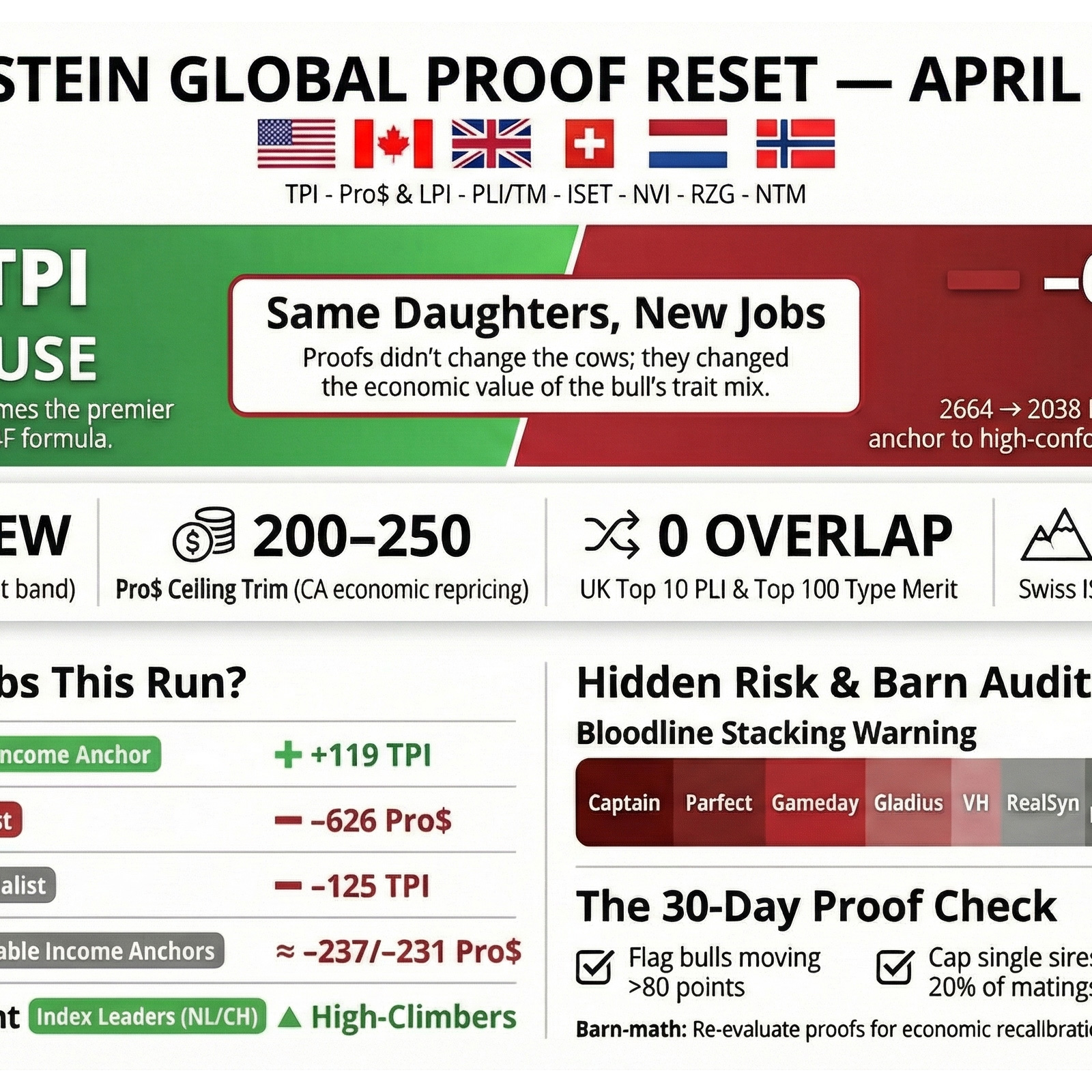
E532 Powerhouse Up 119, Rozline Down 626: The April 2026 Holstein Proof Reset on Your Sire List
Apr 900:40:29Tap to summarizeOne formula change just reshuffled every semen tank in North America. Holstein USA shifted protein to 24% of TPI and dropped fat to 14% — and the fallout hit fast. Peak Powerhouse gained 119 TPI points. Garza lost 125. The entire genomic top 10 is made up of brand-new names, all squeezed into a razor-thin 37-point band. Woodford sits at +3565 TPI and +1296 NM$. And if you're still running your December 2025 sire list without a second look, this episode is your wake-up call. The April 2026 USA Holstein proof run isn't just a scoreboard update — it's a strategic reset, and this episode breaks down exactly what it means for your breeding program.Key TakeawaysWhy moving protein to 24% of TPI and dropping fat to 14% created instant winners and losers — before a single new daughter was addedWhich proven sires gained the most ground this run, and which fat-heavy bulls you need to re-evaluate in your tank right nowWhy all 10 genomic TPI leaders are new names this run — and what a 37-point band at the top actually means for how you should be buying semenHow to read proven vs. genomic rankings as different risk profiles, not competing truthsWhich bloodlines are dangerously over-represented in the April 2026 top groups — and the outcross options that break the concentrationHow Woodford, Jitters, Sabotage, Sheepster, Captain, and Powerhouse fit differently depending on whether you run a high-input housed operation, a grazing system, or a type/show programWhat Red & White breeders need to know about Okafor-Red, Ocean-Red, and the RC/RW PTAT specialists like Crypto PPA 30-day action checklist: how to audit your sire lineup, check bloodline stacking, and re-tier your matings by herd type before the next run hitsThis episode goes well past the rankings. The conversation digs into the mechanics of the TPI 2026 formula — specifically why one pound of PTA Protein now carries 71% more leverage inside TPI than one pound of PTA Fat, and what that means in practice when you're comparing bulls with similar total component figures but different protein-to-fat ratios.The full written analysis — including movement tables for both the genomic and proven top 10, trait profiles, RC/RW PTAT bull breakdowns, and the complete 30-day action checklist — is live now at https://www.thebullvine.com/genetic-evaluation-review/powerhouse-up-119-rozline-down-626-the-april-2026-holstein-proof-reset-on-your-sire-list/. Links to all referenced data sources and official Holstein USA proof lists are available on the website.If this episode changes how you're looking at even one bull in your lineup, subscribe to The Bullvine Podcast so you don't miss the next proof run breakdown the moment it drops. We publish every major evaluation cycle — Canada, USA, international — with the same level of analysis.Find us on Facebook at The Bullvine, join the conversation, and tell us which bull in your tank this episode made you reconsider. We read every comment.Subscribe. Share. Stay sharp. The Bullvine — Genetics intelligence for the people who actually make breeding decisions.
Transcribe →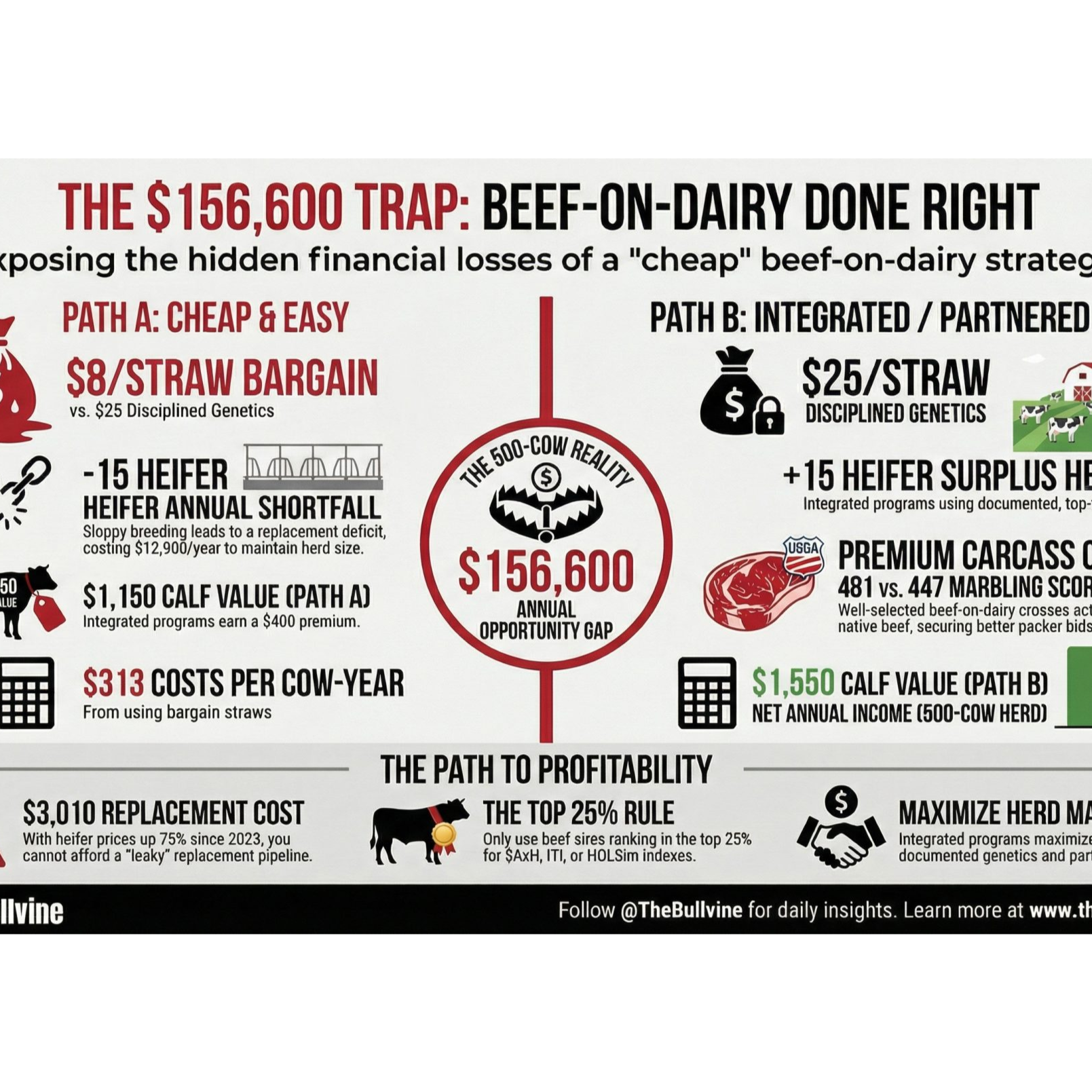
E531 $7,700 Saved, $156,600 Lost: The Beef-on-Dairy Trap CoBank Warned You About
Apr 700:06:38Tap to summarizeYou think your $8 beef straws are saving money. The spreadsheet says otherwise. In this episode of The Bullvine Podcast, we tear apart the economics of three beef-on-dairy strategies modeled on an identical 500-cow Holstein herd — same parlor, same pregnancy rate, same cull rate. The only variable: how seriously the operation treated sire selection and calf management. The annual gap between the cheapest approach and the most disciplined? $156,600. That's $313 per cow, and most of it isn't where you'd expect.Key Takeaways:Why the U.S. heifer deficit (600,000–700,000 head short per updated NAAB data) makes every straw of beef semen a bet on your replacement pipelineThe exact model inputs that turn a "good beef cheque" into a 15-heifer annual shortfall costing $12,900 just to stand stillHow well-selected beef × dairy crosses actually outmarble native beef (481 vs. 447 marbling score) — and why random-sire crosses are sliding toward Holstein bull calf pricingWhat packer selectivity means for your calves now that Tyson's Lexington plant (5,000 head/day) has gone offlineThree clear paths — stay random, structured sires, or full finisher integration — with the real cost of eachA 30/90/365-day audit checklist you can start this week with one number: your actual 21-day pregnancy rateWhy Listen:This isn't another "should you use beef semen?" conversation. You already are. The question is whether those straws are building equity or quietly draining it. We walk through CoBank's August 2025 heifer deficit analysis, peer-reviewed carcass data from Texas Tech (Foraker et al., 2022), and the trait-by-trait premium breakdown — ADG, marbling EPD, ribeye area, and documentation — that separates $1,150 calves from $1,550 calves. We also dig into replacement economics: at $3,010 per springer, the $27,900 swing between a sloppy breeding strategy and a disciplined one happens before a single beef calf crosses the sale ring. Whether you're running 200 cows or 1,000, this episode lays out the terminal index cutoffs ($AxH, ITI, HOLSim — top 25% only), the one-page calf protocol that adds $150–$200 per head, and the phone call to a finisher that will teach you more than a year of semen catalogues. If your PR is below 25% and you're breeding more than 40% to beef, the math in this episode might change your next semen order.Resources & Engagement:Read the full article with comparison tables, the trait-premium breakdown, and the complete 30/90/365-day audit checklist at https://www.thebullvine.com/news/7700-saved-156600-lost-the-beef-on-dairy-trap-cobank-warned-you-about/. Search "Beef-on-Dairy Trap" or find the direct link in our show notes.Subscribe to The Bullvine Podcast so you never miss an episode. New episodes drop weekly — covering genetics, breeding strategy, market economics, and the decisions that separate the survivors from the statistics.Got a take on this one? Tell us what path your herd is actually on. Find us on Facebook at The Bullvine or join the conversation in The Milkhouse — our private group for producers who run their numbers.The Bullvine — fearless, independent, and always on the side of the producer.
Transcribe →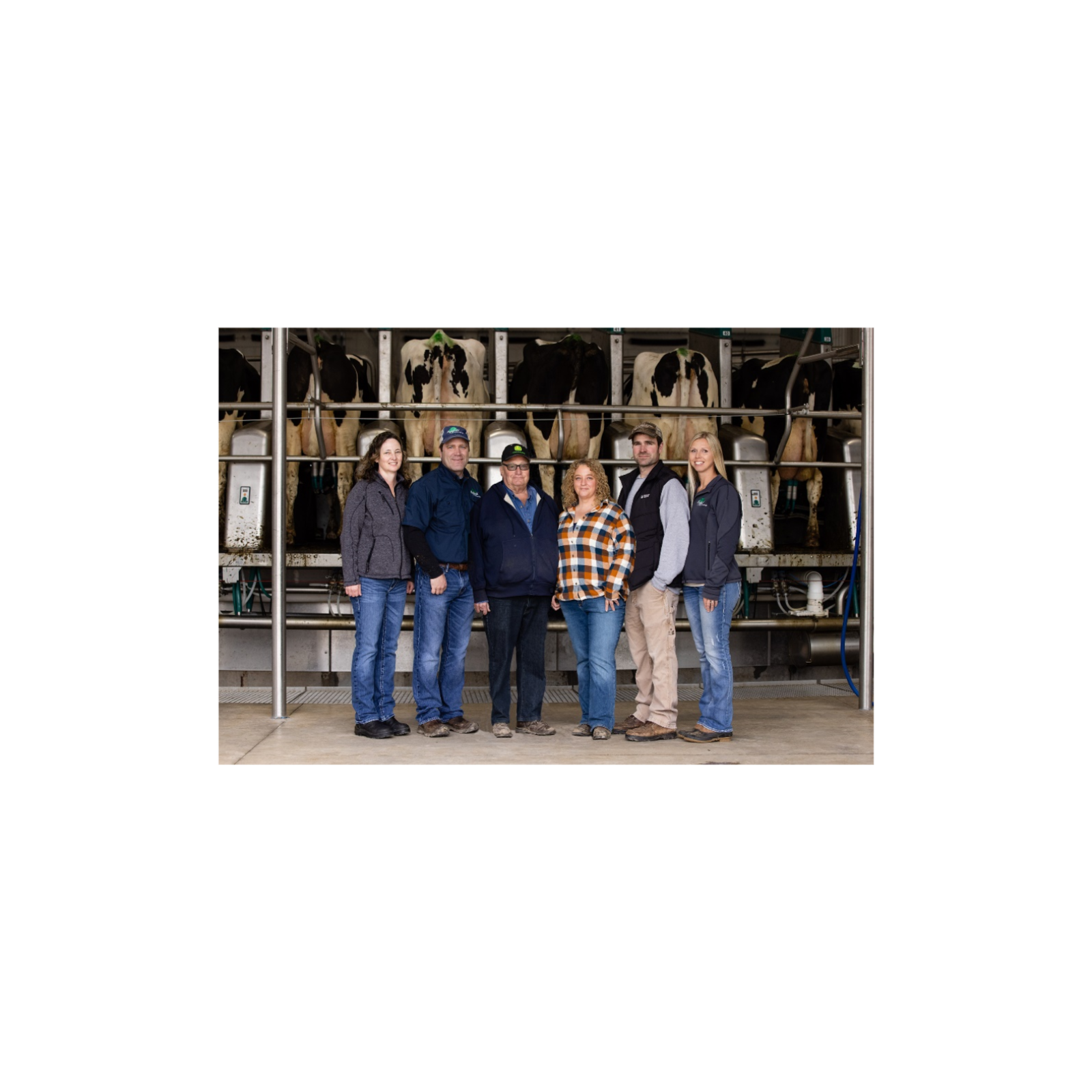
E530 From 65 Cows to 10,000, the Bull Nobody Wanted, and an Economist Who Tells It Straight: WDE Names Its 2026 Award Winners
Apr 600:33:55Tap to summarizeWorld Dairy Expo just named its 2026 class of honorees — and this year's picks tell the story of where dairy has been, where it's headed, and who's actually doing the work to get it there.A man walks into a Quebec AI center in 1966. He's 21 years old. They hand him a bull nobody wants — a young sire the industry has already written off. He doesn't flinch. He backs the bull anyway. Six decades later, Robert Chicoine's fingerprints are on the genetic evaluation systems, the progeny testing programs, and the global export infrastructure that Canadian dairy genetics runs on. His story is a masterclass in what happens when one person sees what an entire industry refuses to.A sixth-generation Wisconsin farmer trades the editor's desk at Hoard's Dairyman for the economist's chair at CoBank — without ever leaving the barn. Corey Geiger spent nearly 30 years shaping how dairy people think about their industry. Now he's shaping how lenders think about dairy's future. His analysis of the 800,000-head heifer hole and the shift from volume to components has changed how producers, co-ops, and banks make decisions.And then there's a family in upstate New York that milks 10,000 cows, breeds Supreme Champions, and makes Mexican-style cheese because their employees couldn't find it locally. Oakfield Corners Dairy took a 1966 startup with 100 cows and built it into a global genetics powerhouse with Premier Breeder banners, a generational sire in SHEEPSTER, and 4,500 embryos implanted every year.The Story You'll HearThe bull that Quebec's entire industry rejected — and the young analyst who staked his career on itHow a farm kid from Reedsville, Wisconsin became the voice dairy lenders trust mostThe 2019 mating decision at Oakfield that broke every rule in their own program — and produced a Grand ChampionWhy Geiger believes the old way of measuring milk is already obsoleteThe moment Chicoine realized Canada needed to stop importing genetic evaluation systems and build its ownHow 13 family members run a 10,000-cow dairy without destroying the partnership — or each otherWhat Oakfield's artisanal cheese project reveals about labor, culture, and keeping good peopleThree very different paths. One shared thread: these are people who saw what was coming before the rest of the industry caught up — and had the conviction to act on it.Read the full feature profiles, deep-dive genetics data, and interview transcripts at https://www.thebullvine.com/show-reports/world-dairy-expo/from-65-cows-to-10000-the-bull-nobody-wanted-and-an-economist-who-tells-it-straight-wde-names-its-2026-award-winners/ . Subscribe to The Bullvine Podcast wherever you listen, and sign up for The Bullvine Weekly newsletter so you never miss the stories that matter to your operation.Got a story about someone who changed your path in dairy? We want to hear it. Find us on Facebook or drop a comment on the article.
Transcribe →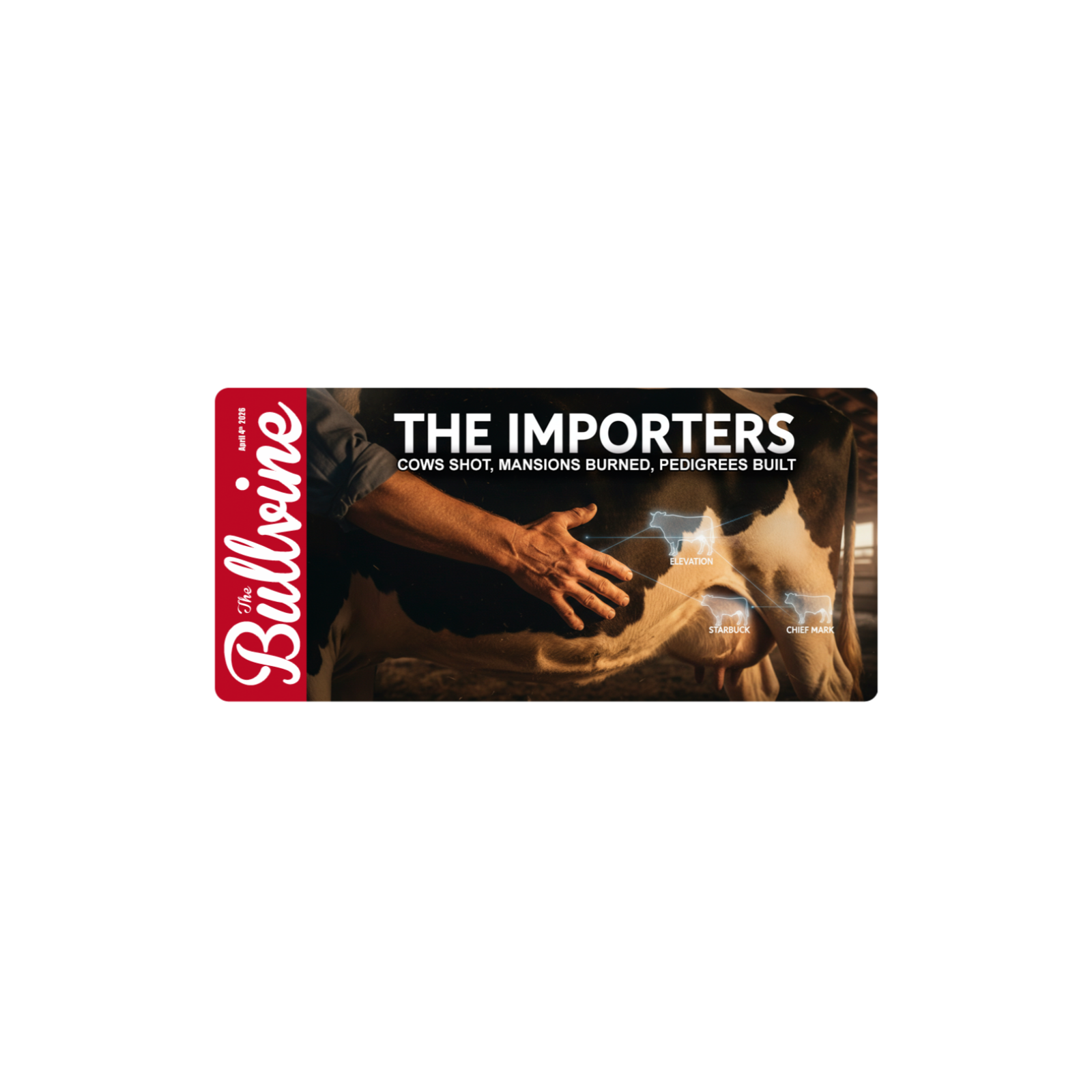
E529 The Importers: Cows Shot, Mansions Burned, Pedigrees Built
Apr 400:53:56Tap to summarizeOn a cold Massachusetts morning, state men rode up Winthrop Chenery's lane with rifles to shoot his Dutch cows. Rinderpest had come, but before the echoes faded, he ordered another shipment from Holland. This is the story of the men who imported black-and-whites in the 1850s and 1880s—not speculators, but orchardists, nurserymen, and farmers who bet big on a breed that would fill barns from Ontario to Oceania. Their barns are gone, their fortunes faded, but their cows are in every pedigree you own. (347 chars)Key Moments:The rifles cracking at Chenery's Belmont farm—and the telegram to Holland sent the same dayGerrit Miller's Triple Crown: Johanna, Empress, and Ondine, two of whom built Elevation and StarbuckHow a blind man at Brookside Farm felt his way to foundation cows whose blood is in 7.2% of today's herdSmiths & Powell importing 1,293 head—not for numbers, but for names like Aaggie and Clothilde that set world recordsB.B. Lord's Sinclairville cows seeding Canada's Posch-Abbekerk and Pauline Colantha Posch linesThe Powell brothers' Shadeland empire—1,500 head, its own railroad siding—dismantled by tractors they refused to buy (872 chars)Why This Story MattersTrace Elevation back twenty dams: Ondine, hand-picked in 1879 by Gerrit Miller. Starbuck carries her through Elevation, plus Johanna on his dam side. Walkway Chief Mark goes to Gortje 2d. O-Bee Manfred Justice to Netherland Jewel. Glenridge Citation Roxy EX-97 to Ottile and Vrouka. Plushanski Chief Faith to Pancha. These aren't footnotes; they're the maternal spine of the bulls and cows breeders chase today.The importers worked without proofs or genomics—just milk scales, butter molds, and eyes for a cow that could handle a new continent. Chenery doubled down after losing his first load to plague. Miller named his farm after a Dutch legend and bred around three cows for sixty years. Henry Stevens lost his sight and judged by feel. Smiths & Powell scoured Holland for Rooker daughters. B.B. Lord shipped foundation to Canada while drifting to horses.Their era was raw: dual-purpose Shorthorns pulling wagons, the Erie Canal shifting New York from grain to milk, $300 per head when wages were $1 a day. They built coherence from imports, turning "Dutch cattle" into a breed with traceable families. Everything after—robots, TMRs, 40,000-lb averages—rests on decisions made by lantern light.This audio overview, drawn from our full feature, brings those choices alive. You'll hear how barns burned and fortunes crumbled, but the bloodlines didn't. For anyone pulling pedigrees, it's the origin story behind the names that light up your screens. (1,456 chars)Continue the JourneyRead the full illustrated feature at https://www.thebullvine.com/breeder-profiles/the-importers-their-barns-are-gone-their-cows-are-in-every-pedigree-you-own/ art for the rinderpest morning, the blind breeder's hands, and the pedigree web from Dutch cows to robots. Dive deeper into Miller's Kriemhild, Stevens' Big Four, or the Shadeland dispersal.Subscribe so you catch every History Profile—from cow families to the breeders who built them.Share this with a fellow pedigree chaser who needs to know whose cows they're really milking.
Transcribe →