← The Business of Fashion Podcast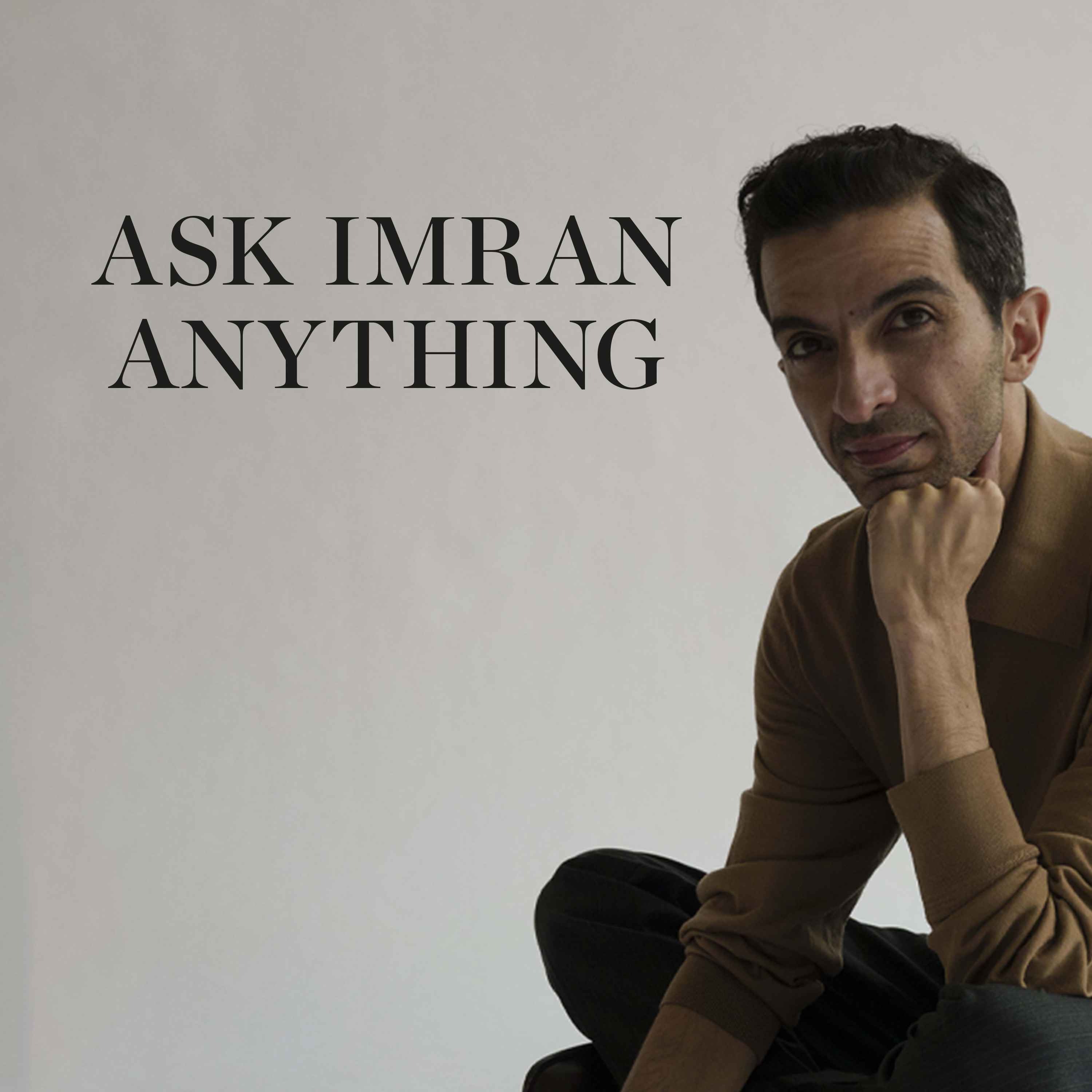
The Business of Fashion Podcast
Ask Imran Anything: Luxury’s Flop Era, Global Market Dynamics, Fashion Careers and more
00:25:52
In the BoF Podcast’s first-ever Ask Me Anything episode, Imran Amed responds to listeners’ questions.
Loading summary
Transcript29 lines
- [00:00]
Imran Ahmed
Foreign. This is Imran Ahmed, founder and CEO of the Business of Fashion. Welcome to the BoF Podcast. It's Friday, February 6th. This week we're doing something a little bit different. I have our amazing podcast producers with me, Olivia and Angel, and we've been gathering questions from all of you from all around the world that I'm going to answer in our very first Ask Me Anything episode. So, Angel, Olivia, thank you for gathering all the questions. Should we get started?
- [00:39]
Podcast Producer (Angel or Olivia)
So we've had some very insightful questions come in from the BoF community about the current state of luxury, the growth narratives happening across the globe, and also the state of emerging designers in 2026. We asked our community also to submit some questions in voice note form. And there were two questions that really stood out.
- [00:58]
Oussama Shabi / Dan / Olivia (various BoF team members)
Hi Imran, it's Oussama Shabi from Dubai. Would you say luxury is in its flop era?
- [01:03]
Imran Ahmed
That is such a good question. It's something I have been thinking about quite a bit, actually. I've been covering and kind of working in this industry for 20 years. I started back in 2007 and we hit the global financial crisis pretty quickly and that seemed like a pretty existential moment. Then of course, the next big crisis I remember was Covid, and that seemed like a big existential moment. But the moment we're in now feels different to me. And I think the biggest difference is that the crises of 2008 and 2020 were driven by exogenous events. They were really driven by big shocks to the global economic crisis system, the global financial crisis. We all thought that, you know, literally the financial markets were going to completely collapse after Lehman Brothers collapsed and Bear Stearns collapsed. You know, we didn't know where it was all going to end. It created this huge amount of uncertainty in the market, but that was completely outside the control of the luxury industry. And of course, you know, eventually the financial markets came into order and the economy bounced back. During COVID another moment of great uncertainty for the industry. You know, completely out of control of the industry. A virus began spreading in China. And then of course, everyone knows what happened from there with lockdowns that, you know, basically shut down most of the world and obviously made it really hard at first for people to shop. And then of course, the industry adapted. There were new ways to connect with customers. Online spending boomed as people were stuck at home and couldn't spend money on other things. They couldn't spend on travel, they couldn't spend on restaurants. A lot of money and stimulus money ended up getting spent on luxury goods. In a way, I think that's what led us to this current moment because there was this kind of orgy of spending, this gluttony of consumption and luxury. And I think after the lockdowns ended, we all ended up in this situation where like, people just had a lot of stuff. They'd been buying so much stuff, their closets were bursting and maybe a little bit of the value and the satisfaction that came from consuming luxury goods started to become diluted just because there was so much of it. We started seeing this kind of avalanche of imagery and of celebrity and of products all over social media. And it feels like right now it feels like we've reached a point of saturation because of something happening inside the industry, not because, you know, there's all of this economic stuff going on, which of course there is, and you know, the, the tariffs and all of that kind of stuff. They have a role to play in the kind of uncertainty that's fueling the wider industry at the moment. But there's also things that the industry itself has done. So when I think about the Flop era, yes, I think there's something going on structurally within the luxury goods industry linked to this over saturation, linked to a breakdown of trust with customers, linked to pricing that's gone out of control, linked to a lack of creativity, the kind of over merchandising of the industry. Everything became really product led. Now, the way that brands are trying to address that problem has been primarily through a kind of re. Creative reset. You know, something that we coined back in September, the great fashion reset. The industry was really focusing on creative renewal as a way of kind of reigniting interest in the industry. But I think there's a lot more that the industry is going to have to do in terms of resetting its pricing architecture, something that we're covering on BoF quite a bit these days, but also building back trust with customers around the real value that the industry offers compared to other things. And nowadays, customers aren't deciding between a Prada bag and a Gucci bag. They're deciding between a Prada bag and a health and wellness vacation or a Prada bag and a beauty treatment. So, like, I think, yes, I think there is a big existential set of questions around the fashion and luxury industry that are more than just the external factors. There's things going on in the industry right now. Thank you, Osama and Rogerio, for your questions. They're kind of opposing questions, but topics I've been thinking about a lot.
- [05:42]
Podcast Producer (Angel or Olivia)
So moving on to the next category of questions we received, which are all about retail and the business model reset. We received questions both from our BoF team members in the BOF community and here's what they had to say. Hello, this is Yossi Chatrit from New York City.
- [05:56]
Imran Ahmed
My question is, with the collapse of Saks, Essence and Matches Fashion, do you.
- [06:02]
Podcast Producer (Angel or Olivia)
Believe the traditional wholesale model is over?
- [06:05]
Imran Ahmed
Should they work on different terms, consignment things in that nature? The short answer to that question is no. I think wholesale still plays a really critical role in the overall mix of ways that independent brands or big brands can connect with customers. I think the structural change that we're seeing is really linked to this department store model and this kind of mega multi brand model. The kind of wholesale that I find really compelling right now is those like really curated boutiques and experiences where you go into a store, you get onto a website and someone's actually thinking about like the mix. The most recent experience I had like this. There's a, my family lives in Vancouver. There's a store there called Neighbor. And over the Christmas break I went to Vancouver in Gastown and walked into the store. They have multiple stores, they have, you know, a couple men's stores, they have a women's store, they have a home store. Each of those stores is so beautifully curated. The mix, it's not just the mix of brands, it's the mix of what they've picked from those brands that when you see it all together, you end up discovering things you can't find in a big department store because there's just like so much stuff or on a website with like an endless scroll of products. And I think what customers are looking for from a multi brand retail experience now is that sense of discovery, that sense of finding something that you wouldn't have discovered otherwise. And I think if we can see more of that kind of experience in some of these bigger department stores and these massive websites with lots and lots of inventory, that's really important. I think there was a long time where we were talking about the mix of content and commerce, but what was missing was this idea of curation, this real sense of taste and perspective and point of view that, you know, you get a sense of like what a specific website or store or department store stands for in terms of curation that's been lost, but customers still really look for that. Hey, this is mark from the BoF team here in London. My question to Imran is, is it easier or harder for emerging brands to gain footholds and build lasting businesses today than it was in say the 1980s and 1990s. I think this is probably one of the most challenging times for an independent brand to break through. It's a bit counterintuitive because there are direct to consumer channels. Any brand, small or large, can set up their own website, their own e commerce channels, they can reach customers through social media, they can build followings and communities. Like that's all true, but without some of these bigger platforms, you know, some of the ones that you mentioned, like you know, Essence or Farfetch or Matches, like so many brands that have really kind of scaled and kind of built a global following 10 years ago, they were able to do so because they had these multi brand partners that identified those businesses from an early stage and then help them build and grow their businesses. But now without some of those platforms, it's very challenging. On top of that, the ones that do exist are providing very, very slow payment terms. And for any emerging brand trying to build a business, managing cash is so important. You know, one of the pieces of advice I used to give to emerging designers all the time is if you're going to sell to one of these big multi brand retailers, insist on getting a deposit. Well, getting a deposit now is like even more challenging because some of these companies, they don't want to pay you for 30 or 60 or 90 days until after you've delivered the merchandise. Which means that from a cash flow standpoint, it's very hard to build a business with these retailers. So there are fewer of these retailers. The ones that exist are providing negative payment terms. And then on top of all that, the market is more competitive than ever. The good news is that I think independent brands can offer something that customers are really looking for today, which is a sense of value because they're pricing. The smart independent brands are pricing their products in a way that makes sense. Some of the big brands have gone kind of crazy out of control in terms of their pricing. And so like smaller brands, if you can offer real value for what you're offering, I think that's one way to compete effectively in this market. And the second thing is the big brands are creating products in the thousands, tens of thousands. Smaller brands are providing products in the hundreds maybe. So what you're providing is really, really special. And so that's kind of your magic opportunity right now. That's where you can really stand out in the market is to provide beautifully designed, high quality products at real sense of value. That is coming from a sense of like quality and scarcity. That's I think the trick. But you know, it's true that this is a really, really challenging time for any brand to be building a new business in fashion right now. Because damn, the market is. Market is very challenging.
- [11:35]
Podcast Producer (Angel or Olivia)
Our listeners also had a few questions about the global growth narratives that are happening across Asia and Africa currently. And here is the first question.
- [11:43]
Preciana / Flora Beyer / Isabel Cicero (various BoF team members or listeners)
Hello, this is Preciana from the BoF team. So Imran, my question is luxury brands have spent the last decade and more chasing infinite growth and massive scale, but now the market is really cooling. And do you think this mass luxury was really a fundamental business mistake? Has the industry scaled its itself so much that it has lost the very exclusivity that makes it so valuable? And I guess in the end of it, what happens after the ban has snapped, quote unquote? And will the industry reinvent itself somehow? What should we expect?
- [12:20]
Imran Ahmed
This is a really good question too. Thank you Pressy. The best perspective that I've heard on this topic is from someone named Ravi Thakron who spoke at BOF Voices a couple of years ago and will include a link to his BOF Voices talk in the episode notes. So you can listen to that and watch that talk. It's really powerful. But if I was going to summarize Ravi's conclusions, the purchasing power of the middle class in India is nowhere near where the purchasing power was for customers in China at a similar stage of development. And so I think the real opportunity is really in mass market and middle market brands, less so in luxury. When it comes to luxury, we have to remember there has been a luxury industry in India for hundreds of years. You know, India has its own native luxury sector in fine jewelry, in tailor made clothes, in beautiful fabrics and textiles. And this really goes back generations and generations. So this very strong tradition and culture in India, it remains there to this day. Compare that to China where after the Cultural Revolution, you know, the idea of wearing, you know, traditional Chinese dress, if you walk around the streets of Shanghai or Beijing, like most people are wearing western clothes nowadays. If you walk around the streets of New Delhi or Bombay or Bangalore, people wear kind of this fusion of traditional dress and western clothes. And for really special occasions, it's Indian cultural dress that really wins. And so there's so many of these amazing brands in India, Sabyasachi, Gaurav, Gupta, Manish Malhotra and countless other brands that are really catering to that luxury customer for special occasions. So maybe the real opportunity in luxury in India is still around handbags and shoes that kind of can accessorize some of these Cultural dress in India. And by the way, there's a whole host of other issues including retail, infrastructure, etc, etc, but watch Ravi's talk because it really encapsulates and kind of summarizes a lot of what I've just been discussing. And he's a real expert on that topic.
- [14:46]
Podcast Producer (Angel or Olivia)
That's a very good perspective and it actually leads us to the next question.
- [14:49]
Oussama Shabi / Dan / Olivia (various BoF team members)
Hello, this is dan from the BoF team in London. So here's my Imran. There are over 30 fashion weeks on the African continent every year. We also know that one in five people will be African by 2030. And the purchasing power of African consumers and the African diaspora is huge. And yet as we deal with the Western economic slump, all eyes are currently on India, the Middle east and Southeast Asia. So my question is, do you think the industry is still looking down on Africa?
- [15:30]
Imran Ahmed
Well, that's a very interesting question because Africa is near and dear to my heart. My family hails from East Africa, from Kenya and Tanzania, and so I feel very strong link to that part of the world. There's no doubt there's a huge creative movement happening with young people in Africa. There was a speaker at BoF Voices named Fred Swaniker who spoke a little bit about how youthful that continent is, how many young people in Africa. There's this kind of untapped potential of young people and their talent in Africa, which is a little bit counter to the narrative we sometimes see in Western media about the way the African continent is portrayed. So I certainly believe there's a huge creative potential to be tapped there. And you should check out Fred's talk on that. We also had Omoyemi Akarelli from, from Lagos, Nigeria, who spoke on a panel with a couple of young African origin fashion designers on that topic about the untapped potential. But when it comes to like big Western luxury brands and how they engage with African customers, a lot of that engagement actually is still happening here in Europe. You're seeing more and more African customers as one of the big tourist arrivals, particularly here in London. I think the Nigerian customer in particular Nigeria is the biggest, highest population country in Africa and you see a lot of opportunity with those customers coming to Europe. There's obviously other countries like Egypt and South Africa and Kenya and Tanzania. Like all of these countries, they're rising countries. And I think if you think about where they fit into the overall growth curve for the industry, there's no doubt that a huge opportunity exists in the future for engaging with these customers. But if you think about, you know, maybe China Was the first big opportunity. The next big opportunity that a lot of people are talking about, of course now is India, as we were just discussing, and then, you know, the African continent with its more than 1 billion people and the fastest growing population in the world. There's no doubt that that's a huge opportunity in the future, but it will happen. You know, maybe it's not happening right now because I think people are mostly engaging with those customers in the West.
- [17:55]
Podcast Producer (Angel or Olivia)
So our final category of questions revolves around creatives really getting their start in the industry.
- [18:00]
Preciana / Flora Beyer / Isabel Cicero (various BoF team members or listeners)
Hi, Imran. My name is Flora Beyer from Switzerland.
- [18:03]
Advertisement Voice
Is fashion school the right path to.
- [18:05]
Preciana / Flora Beyer / Isabel Cicero (various BoF team members or listeners)
Actually becoming a successful designer?
- [18:07]
Imran Ahmed
There are a lot of different paths to become a successful designer. I certainly know of designers, successful ones that don't have formal fashion school training. So it's not an absolutely essential step. However, I do think there are some interesting benefits for going to fashion school, one of which is just you're surrounded by a lot of other young creative people who are interested in the same things. And I think one of the best things about any school environment is having peers, because those peers are people you can learn from. Those peers are people who challenge you. Those peers are people who you compete with in a way. And so that lift kind of lifts everybody up. And I think there are some technical skills that can be very, very helpful as a fashion designer. You to find the schools that also provide you with technical experience, because that technical experience in pattern cutting, you know, some of the best designers in the world, like Rick Owens, for example, they're trained as pattern cutters. And that kind of ability to really understand how you take flat fabric or a flat sketch and you turn that into something that fits on a body, like understanding that and having the ability to really think about that, even if you're not the one that's doing all the pattern cutting can be really beneficial. And by the way, there are also more and more fashion schools that are really teaching business skills. And you know, 20 years ago when I first started in the fashion industry, I had the honor of teaching the first ever business course at Central St Martin's in their undergraduate program. I believe that course is still going today under another tutor. But, you know, at the time there wasn't a lot of that in the industry. There's more and more schools that are really understanding that you don't just need to be creative to be successful in fashion. You also have to understand how the business works. And similar to pattern cutting, that doesn't necessarily mean you need to run complex, excel Financial models. But you do really need to understand the concepts of cash flow, the concepts of, like, how you build a sustainable supply chain with manufacturers. All of this kind of stuff is more and more important as you build a business. And so if you can find a course at a fashion school that gives you the breadth of experience and that surrounds you with other people, other young people who are looking to do the same thing as you, I think that can be a really, really beneficial experience. Though, like I said, not everybody who's successful in fashion has gone to fashion school. Hi, Imran, My name is Isabel Cicero.
- [20:55]
Preciana / Flora Beyer / Isabel Cicero (various BoF team members or listeners)
I'm from the uk.
- [20:56]
Imran Ahmed
What would your advice be for someone.
- [20:58]
Preciana / Flora Beyer / Isabel Cicero (various BoF team members or listeners)
Looking to break into fashion journalism?
- [21:01]
Imran Ahmed
So fashion journalism is a whole different world right now. I think that's where I think going to a traditional journalistic or journalism school maybe isn't as necessary. You know, a lot of journalism is now help happening through creators. You know, people who've got this, like, encyclopedic knowledge of the industry. And, you know, they may have developed that, they may have developed that in fashion school, or they may have just been, you know, really, really voracious in terms of their appetite for learning. And so, you know, they've read a lot, they've watched lots of documentaries, they've read lots of books. You know, they, you know, follow the industry very, very closely. And they've developed a point of view. You know, it's that point of view that is the single most important thing in fashion journalism today, because anyone can get information from everywhere. What you really, really need is a perspective. You need a slant. You need something that you become known for. So back in 2007, when I was starting to write my blog and newsletter, which I called the Business of Fashion, I think what was unique at the time is the slant I had was that fashion is not just a creative industry, it's a business. And my unique perspective came from my business training. If you have something unique that you can bring to your take on fashion, and increasingly, if you're good at talking about it on these new channels like TikTok and Instagram, that's a really interesting way to break into the industry as a journalist. So there are lots of ways to break in to fashion journalism. I think the one thing that's true, whether you go to journalism school or not, is you just need to practice. You just. If you're a writer, you need to write every day. If you're a creator, you need to create every day. The more you write, the more you create, the more you'll Develop your own voice, and the more you'll feel confident in what you're doing. Like, writing is really something that takes a lot of practice. I was a terrible writer when I first started writing. Like, if you look at some of my original blog posts, you know, they're not something I would be proud of today, but I understand that those initial posts were part of my journey. You know, they're part of my getting to where I am at today. And I've developed my voice. I developed my point of view by writing a lot. I wrote all the time. So write a lot, create a lot, practice a lot. You know, it's. It takes a long time to kind of really, really, really develop your voice, but you need to do that in order to stand out, because anybody can become a creator today. So, you know, the bar is even higher to stand out now.
- [23:45]
Podcast Producer (Angel or Olivia)
And lastly, what functions do you see as essential to accelerate your career in fashion and beauty?
- [23:51]
Imran Ahmed
I guess one of the big questions that people debate is whether it's better to be a generalist or a specialist. I kind of think you need both. To be successful in the industry today, you have to have a really good, solid general foundation, but I think you should also specialize. I think you need to be known for something, especially in the age of AI, where, you know, people can get quite a lot of Generalist information from ChatGPT or Google Gemini or Perplexity, that ability to be really specialist and expertise that's really hard for a robot or a machine to replicate. So I recommend that, you know, you build a really solid generalist foundation and then you find somewhere where you can specialize something that you can become really known for. Because in the age of AI, that hyper specialization is really what makes you stand out.
- [24:51]
Podcast Producer (Angel or Olivia)
I think that's a great final note to end on. And these are all our questions for today.
- [24:55]
Imran Ahmed
Well, that was really fun. Thank you, angel and Olivia, for compiling all the questions. Thank you to everyone for sending your questions in. We've not done an episode like that before, but I found that really helpful, actually, because I get a lot of questions that come in on my Instagram and LinkedIn, and I always want to find a way of responding, but also I want to respond in a way that everyone can hear the responses. So this is quite a. An effective way of doing that. I hope we'll do another episode like this again in the future. If you all enjoyed it, please follow or subscribe to BoF wherever you listen to your podcast, whether that's Spotify or Apple or YouTube, that way you won't miss future episodes and we'll be back to regularly scheduled programming next week. Bye Bye.
- [26:01]
Advertisement Voice
The experts have been spelling it out for us for years. Drinking water helps us stay healthy and you can't spell watermelon without water. Watermelon is a nutrient dense food that contains vitamins and minerals. Watermelon is part of a year round healthy lifestyle that contributes to whole body wellness. This year, remember to rehydrate, refuel, recover with happy hydration. Buy watermelon. Just look at the rind. It leaves a smile on your mind. Make watermelon part of your winter workouts and visit watermelon.org for healthy recipes.
- [26:31]
Oussama Shabi / Dan / Olivia (various BoF team members)
Olivia loves a challenge. It's why she lifts heavy weights and likes complicated recipes. But for booking her trip to Paris, Olivia chose the easy way with Expedia. She bundled her a flight with a hotel to save more. Of course she still climbed all 674 steps to the top of the Eiffel Tower. You were made to take the easy route. We were made to easily package your trip. Expedia Made to Travel Flight inclusive packages are atoll protected.