← The Business of Fashion Podcast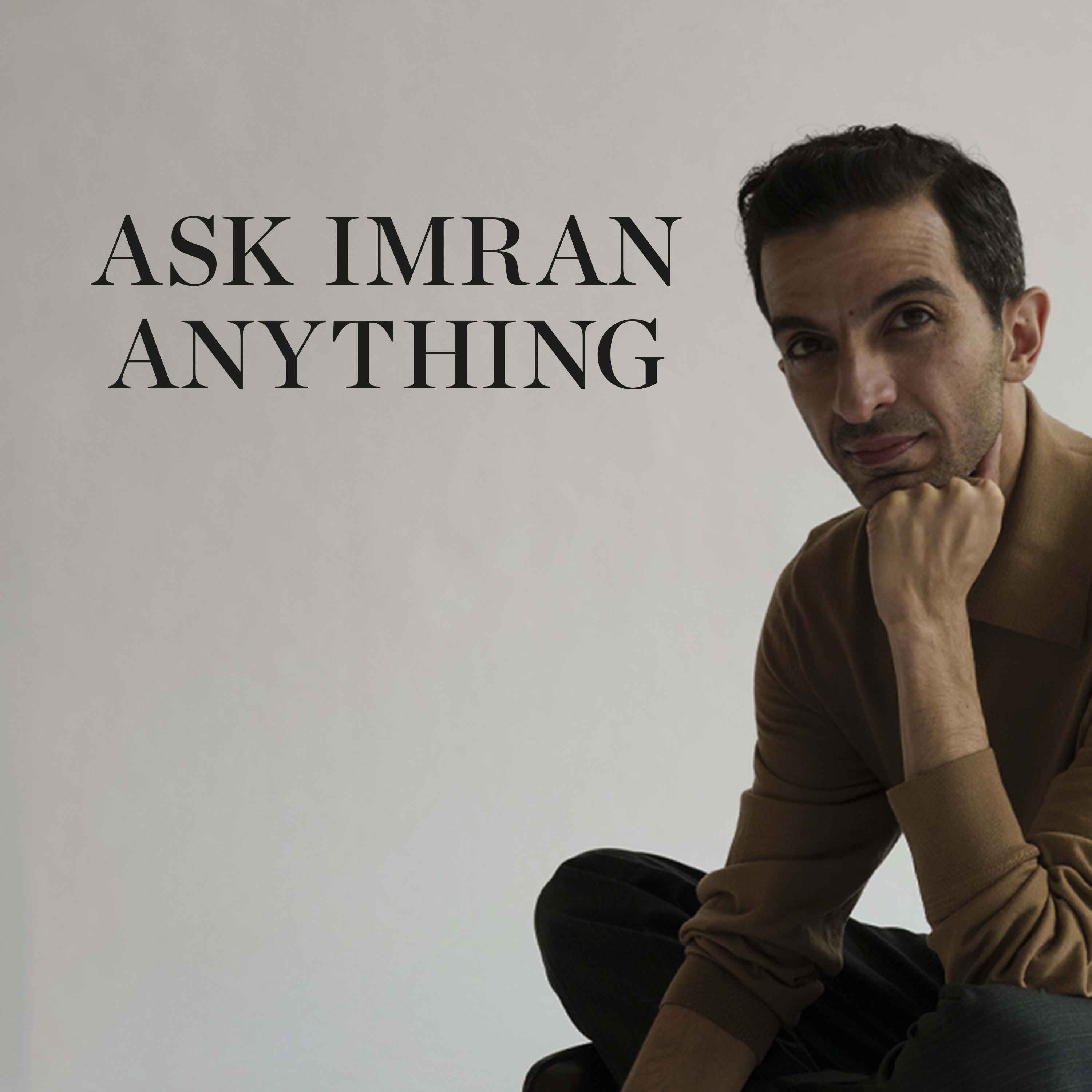
The Business of Fashion Podcast
Ask Imran Anything: On Boring Fashion, the Meaning of Luxury and Building Outside the System
00:51:27
Imran Amed takes on listener questions about creative energy returning to the industry, what luxury really feels like, why independent brands don’t need the old gatekeepers, and how to keep going when the world feels uncertain.
Loading summary
Transcript62 lines
- [00:00]
Imran Ahmed
Foreign.
- [00:05]
Hi, this is Imran Ahmed, founder and CEO of the Business of Fashion. Welcome to the BOF podcast.
- [00:11]
It's Friday, April 10th. We got such a great response to
- [00:15]
our first Ask Me Anything episode that we've decided to do it again. Listeners from around the world have been sending in their questions, and once again, I'm answering them here on the BoF podcast. This time, the conversation spans some of the biggest tensions in fashion right now, from whether the industry has become boring, to what luxury actually means in an age of commodification, to how independent brands can build meaningful businesses outside the traditional system. We also get into AI fashion education and what it means to keep creating in a world that feels increasingly uncertain. I find these episodes especially rewarding because the questions are thoughtful, wide ranging, and sometimes surprising.
- [01:00]
They push me to reflect not just
- [01:02]
on where the industry is going, but on what I've learned building BoF along the way. Thank you to everyone who submitted questions. And now, here's our second Ask Me Anything on the BOF podcast.
- [01:18]
We're back here for our second ever Ask Me Anything episode on the BoF podcast. We were so pleased with the response to the first one that we decided to do another one. I actually had someone tell me that episode was their single favorite episode ever on this podcast, which has now been going for almost 10 years. So that's good to hear. We've been gathering questions from all over the world on Instagram and elsewhere, and I have my colleagues Olivia Davies and Angel Nimov with me here today. Hi, Angel.
- [01:57]
Olivia Davies
Hello.
- [01:58]
Imran Ahmed
Hello, Olivia.
- [02:00]
Angel Nimov
Hi, Imran.
- [02:02]
Imran Ahmed
So, should we get started?
- [02:03]
Angel Nimov
Let's do it. So the first question is asking about the most interesting person you've met in fashion.
- [02:11]
Audience/Community Members
Hi, Imram. It's Valentina from New York City. I wanted to know who is the most interesting person you've met in fashion?
- [02:20]
Imran Ahmed
The most interesting person I've met in fashion. An industry filled with interesting people. That is a very tough question. You know, for me, what makes someone interesting is when they have a lasting impact on me and when they say things that keep me thinking about that conversation long after I've met them. And one of the conversations that stayed with me even till this day was the first time I sat down to interview Yoji Yamamoto. It was a really interesting conversation because when I asked him questions,
- [03:03]
unlike a
- [03:03]
lot of people who respond really quickly or feel like they need to fill empty space or silence, Yoji would take time to think, reflect, and then respond. He gave me a whole new perspective. He said, you know, in something like in an industry where there's so much referencing, there's so much inspiration, there's so much admiration of other people's work, possibly the best way to find your own voice is to copy, copy, copy, copy until you find yourself. And I just, I thought that was so interesting. You can copy somebody whom you like very much. You can copy it, copy it, copy it, copy it, copy until end of the copy, you can find yourself. And so when he said that to me, it just, it made me keep thinking. I've been thinking about it since then and that interview happened more than 10 years ago. More recently, I met an incredible founder in Seoul, Korea named Han Cook Kim. And he's the guy who founded the brand Gentle Monster. Now a lot of people in fashion have been following this brand, but they, because they create these like experiential stores with these huge installations and these like robotic animals and these like huge statues and it's very experiential and I loved all that. But when I met this guy, Han Cook, we sat down to have a cup of tea and now he's this like very secretive person. I mean, I was told he doesn't even really meet with people from the media. So I was very grateful to have an opportunity to sit down with him at their new house, Nowhere flagship in Seoul. And we had tea on one of the higher floors in the building and we sat down and just got to hear the thinking and the vision, the special spirit that's made that brand what it is. And you know, he's not one of these people, not one of these founders that goes into something or starts a business because he wants to make money. I mean, the way that whole business came about was just so organic and purpose driven. Those are two of the most interesting people I've met in fashion, but there's countless others. And the best thing about my job is that I get to meet people like Han Cook and Yeoji san, because those kinds of interactions, they stay with me for a really, really long time. So thank you.
- [06:03]
Olivia Davies
And switching gears to talking about the industry in general, we had a question from one of our community members.
- [06:12]
Audience/Community Members
Hi, Imran. My name is Gavi. I'm from New York City and I've been told by one of my fash professors that the fashion industry is now boring. Do you agree?
- [06:26]
Imran Ahmed
Wow, boring. I know where that's coming from because for those of us who've been kicking around this industry for quite a long time, there's been a period of time when it started to feel like there was a Lack of vibrancy, creativity, everything. I think I. I even wrote about this maybe a couple years ago saying everything's become productized and merchandised, corporatized. And, you know, I genuinely have felt that way. I've genuinely felt like, I don't know, there was this kind of magic in our industry, in this business that was missing. And I think inevitably that's what happens when things get big and they become these, like, big global businesses. And, you know, and those big global businesses get so much attention because they have so much money to spend on marketing and content and events and like, they just kind of. We think that that's all there is. But I have to say, more recently, I've started to have a change of heart on this. The first reason for that is clearly we went through this period last September when there was a lot of change. We had all those creative director resets. Not all of them were successful. Not all of them have had a lasting impact. Some of them ended quite abruptly, like Dario Vitale at Versace,
- [08:12]
but some of
- [08:12]
them have been quite amazing. You know, I think what Mathieu Blasi has done at Chanel, the kind of sense of joy that he's brought to that business, like, the way people are getting excited about that, is something I haven't seen in fashion for a really long time. So that's not boring to me. The way Jonathan Anderson is taking the mammoth brand that is Dior across men's, women's and couture has also been really exciting. And then there's some, like, younger upstarts. Like, I think what Maril Roga is doing at Marnie and what Doran Lantink is doing at Jean Paul Gaultier, like, that doesn't feel boring to me. It feels like we're starting to feel a little bit of creative energy again in our industry, which I'm really grateful for. So that's my first point. The second thing I'd say is the more I travel, the more I spend time and take time and make time to meet people who aren't working at the helms of these massive brands, the more I'm reminded about how much creativity there there is in independent emerging brands out there. I recently had the opportunity to meet with someone named Andreas, and Andreas worked for years at Prada. And I walked into a store recently and discovered his brand, which is called Rear R I E R. And I wrote to him on Instagram to talk to him about it a little bit, and he invited me to come into their showroom. And I spent some time with him in his showroom in January. And it was just the thoughtfulness, the level of care, the attention to detail, the quality of what Andreas is doing is really special. And you know, there are so many brands out there like that, there's so many young designers out like out there like that. And sometimes big brand fashion can feel a bit boring and corporatized and cookie cutter, but there's so many independent, young, exciting brands out there doing really, really interesting things. So I relate to the feeling that for a while, especially in that period immediately after Covid the lockdowns, I know that that time felt a bit saturated. But right now I'm starting to feel excited about fashion again.
- [11:04]
Angel Nimov
The luxury side of fashion is always a hot topic. And our next question wants to know about the meaning of luxury.
- [11:11]
Olivia Davies
Hi Imran, my name is Shwetal Patel
- [11:14]
Imran Ahmed
from London, United Kingdom.
- [11:16]
Olivia Davies
My question is, in an age of mask modification, what does luxury really mean today?
- [11:22]
Imran Ahmed
Yeah, I think maybe 10 years ago I wrote this story for BoF about the word luxury being so overused. I mean you can walk into Marks and Spencer and get something labeled luxury or you can see the word luxury plastered on just about anything. Nowadays the word luxury is so ubiquitous. But that's probably what Shwetel means when he's asking about the mass commodification of luxury. I think for a really discerning, experienced, nuanced customer, they know luxury, real luxury, when they see it or when you, you feel it and you feel it in every touch point that you have with a brand or a business. Someone has thought about how each of those touch points feels, how each of those touch points gives you a sense of and a deeper understanding of what that brand is about and why it creates the products it creates. So it's not just about the end product or the label of luxury. It's about the process of how that product comes to life and how a brand brings you along that journey. Sometimes people call it surprise and delight. Like that can be a real, that can have a real feeling of luxury. Like I recently I mentioned earlier, I was in Shanghai just last week actually and I walked into this store called Dong Liang which I had visited many, many years ago, maybe over a decade ago. And at the time it was a small, really well curated multi brand store. Some Chinese brands, some international brands. I mean in the last 10 years Dong Liang has expanded into these two incredible heritage buildings. As soon as you walked into the courtyard of those buildings, you knew you were somewhere special. Every single room had been specifically co created and co designed with the brands in those rooms. So there was a room with the row, There was a room with Phoebe Filo. There was an entire room of beautiful Chinese tea. I mean, everything was done so thoughtfully that as soon as I walked in there, I was like, wow, this feels really special. And I keep using the word feeling because I think luxury is a feeling. Luxury is a feeling. And when you have that feeling, you recognize it.
- [14:37]
Olivia Davies
Moving on to the kind of independent brand side of things, our next question is all about imagining and executing a fashion label nowadays.
- [14:47]
Audience/Community Members
Hi, Imran. My name is Jasmine and I own a brand in Hong Kong. I'm curious, if you were starting a fashion label today, how would you imagine it and bring it to life?
- [14:59]
Imran Ahmed
This is such a good question. The first properly successful series of stories I did at BoF or on BoF in 2007 was called the Business of Fashion Basics, how to Set Up a Fashion Business from Scratch. And as soon as I put that first story up, this is pre Instagram, pre Facebook, going mass. You know, super early days of Twitter. Like, all of my interaction with our community at that time happened in the comments on my blog. And as soon as I put that story up, people started asking more questions. People started saying, we want more. We want more information like this. If you go back and look at that playbook that I wrote back in 2007, not all of the things that I advise designers to do if they were starting a business back then, would hold true today. Like, so much has changed. You know, digital communication and marketing. Foremost the way brands interact with customers, the way emerging brands can reach clients. Probably the single biggest change is that back then, the only way an emerging brand could reach a customer was through kind of what we call legacy media or traditional media. You know, the way it worked was a young designer would come out of St. Martin's or Parsons or some other fashion school, and they used to have to have a fashion degree. They get plucked out of obscurity there. Like Jack and Lazaro got plucked out of obscurity from Parsons and launched their brand Proenza Schooler and got picked up by Barney's and got supported by Vogue, and the rest is history. All of their success of building a fashion business back then was based on getting through gatekeepers, big buyers, big magazines. And in order to do that, young businesses would have to hire a publicist and hire and work with a showroom,
- [17:28]
because the showroom can get you access
- [17:30]
to buyers and the public publicists could get you access to editors. All of that is now over if you're a young brand today, you don't need to work within the traditional fashion system anymore. There are ways that you can reach customers directly. Now, that doesn't mean you don't. You stay out of that traditional system altogether. There may be certain types of brands or products or designs that are better suited for that traditional system or that still require some of that traditional system in order to succeed. But the single biggest change that's happened in the last 15 or 20 years is that the routes to market, the go to market strategy where you had to rely on these big institutions like department stores or glossy magazines, that is no longer the truth. And I've seen so many examples of businesses that are forming direct connections with customers through social media channels by creating products that people get excited about and creating content that helps people get interested in what that brand is creating. They're just as creative about the content they create as they are about the products they create. So some of the things I said back in the early day with the business of fashion basics would still hold true, like you have to really worry about cash flow and you have to think about who your customer is. But some of the things have completely changed, which I think is really exciting and a big opportunity for anyone looking to build their own fashion business.
- [19:15]
Angel Nimov
The next question is also on independent brands, but this time from the Chinese perspective.
- [19:22]
Audience/Community Members
Hi, Imran, My name is Zora Ma.
- [19:24]
I'm from China.
- [19:25]
I'm currently studying in Syracuse in the United States.
- [19:29]
How do you see the influence of emerging Chinese brands on the future of the fashion industry?
- [19:35]
Imran Ahmed
I love this question because I just spent a week in Shanghai during Shanghai Fashion Week and attending some of the shows of the brands that are coming out of that city. And it was really eye opening and really inspiring to see the energy and the fandoms that some of these brands in that city have built. Now, to be fair, a lot of what I saw on the Runway there wasn't something I haven't seen before. But what I hadn't seen before was like the level of closeness that these young Chinese have with these young Chinese brands. You know, attending some of the shows, for example, like Shushu Tongue or Ow yes or Oud Wag, like these shows that were clients of these brands. So happy to be at that show wearing the full looks. It just felt really different from what you see at a young designer brand in London or New York. There was just a much bigger sense of like, connection between these brands and their customers, which I found really inspiring. And there was one designer who really stood out for me. Whose name is Samuel Guiyang. He and his partner who's from Sweden, they actually live between Shanghai and London. And to answer your question more directly around the influence that these brands can have, I think it's the brands that figure out how to have that ineffable essence of Chinese spirit, aesthetics and identity while also having global appeal. And Samuel Gui Yang has done it. That was, that was a show that could sit there alongside some of the best shows I see from emerging brands anywhere. And so congratulations to Samuel for what he's created because it's really, really special. And I think that's the kind of brand I like. These brands that are kind of, they could be from anywhere or nowhere, they're relevant in so many different contexts. They have this kind of. They bridge all of these different cultures and identities. They feel just, I don't know, that feels, really, feels really modern to me. It's like when you meet someone and you can't really figure out where their accent is from because they are from many places. I love that.
- [22:36]
Olivia Davies
Shifting gears to storytelling, we received the question which is all about how we do storytelling at BoF.
- [22:44]
Audience/Community Members
Hi, Imran, my name is Ceci. I'm from Nigeria, currently living in Paris. I'd really like to know, how do you balance telling stories from different regions while making sure that each one is represented in a well informed and meaningful way?
- [23:01]
Imran Ahmed
This is a question I think about a lot. Having a global perspective has been part of the DNA of BoF from the very beginning, by virtue of the fact that, you know, you could access BoF from anywhere in the world from day one. And most of the other publications that wrote about the fashion business or covered creativity in fashion, they were all regional publications. They were either specifically local to a country or they were the local editions of global brands. And sure, I think a lot of that has changed in the media market now, but back then that was pretty new for fashion media to be global, to be read globally right from the beginning. And I think maybe like six or seven months after I started writing, I got one of my first ever press requests and it came from Vogue in Korea. And they asked me for my expert opinion. I think it was on the impact of fashion blogs or new media on the fashion industry. And I was kind of blown away because it was like, first it was, you know, Korean Vogue and then it was the South China Morning Post. And I started to realize like, wow, we have a responsibility to be telling the stories of the fashion business, of fashion entrepreneurs, of creative people in Our industry, not just from the historically dominant Western markets. I realized that it was our responsibility to tell global stories. And it really came through the feedback I was getting. And so that was a signal for me that, wow, like, we can really talk to this global community. And also that that could be a real differentiator for BoF from all of the other media that was looking at fashion through a specific regional lens. Like, what does this mean for fashion in the US or in France or in Germany? We could tell stories that were thinking about fashion at a more global, more macro level. And that does come with a sense of responsibility. I know we have readers all over the world that expect us to be telling their stories too. And I know we can always do a better job. You know, it can be very easy to slip into the habit of only telling stories from the West. And one of the things that I try to do to make sure we don't fall into that habit is to just spend as much time as I can in other parts of the world. Because honestly, everywhere I go, it's so inspiring sitting down and meeting with people in our industry. Readers all over the world. We have BoF professional members in 125 countries. Now, I have not visited 125 countries, but I've definitely visited more than 40 countries since I set up this company. And in each of those countries, I meet young people, industry experts, educators, analysts. Everywhere I go, that's what I do. That's how I, like, learn. And it's fascinating and I love it. And I love that we have a platform now that can share those global stories with a global community. And it's interesting. It's like when you go to these different markets, you often learn just how much we all have in common. And so the struggles or challenges or questions that a designer in Brazil is facing are often similar to the struggles, questions, and challenges a designer in Dubai is facing. And you only really realize that when you start going around the world and people are asking you the same questions. So the global part of BoF is super important. We have a team that's dedicated to global markets. You know, having a global perspective is enshrined in our values as a company. We have a global team coming from more than 25 countries. I mean, we try to be global in everything we do. We are not perfect. We can always be better. I'm always open to hearing feedback, but it's something I'm really proud of that we do at BoF.
- [28:09]
Angel Nimov
So shifting gears once again, we are talking about everyone's favorite topic, which is AI. And here is our first question.
- [28:16]
Audience/Community Members
Hi Imran, My name is Kim Ben from Cologne, Germany. And my question is, does the wait and see approach to AI and fashion actually protect brands or does it just guarantee they will be playing catch up in two years? Who do you see doing it right right now?
- [28:34]
Imran Ahmed
One of the things that I learned early on was that when a new technology appears on the scene, it's better to try to get to know how to use that technology as soon as possible and build familiarity with it, understand its limitations and understand its potential. I know there is so much hand wringing about what AI is going to do to fashion, but also to the world around us. I have no idea what's going to happen. I have no idea if the predictions that are being made are going to happen and they're going to happen as quickly as what people are saying. What I do know for sure, having spent time really immersing myself into getting to know some of these tools, is that I've never seen anything like this before. It reminds me of when I first started experimenting with what was called the Internet in 1994. And I shared this story with our editorial team this week. I had my first email address, bjz4musicbe McGill CA in 1994. And the only place I could use that email address was at the terminals in the library at my alma mater, McGill University. And the other limitation was there was only like two or three other people I knew that had an email address. And of course everyone probably knows about the concept of network effects. Like the more people that join the network, the more powerful it becomes. And at the time the network was very, very small. So there wasn't a lot I could do to exchange with people using email at the time. And surfing the Internet, as people called it back then, surfing was very challenging. I mean, I used to go home and like access the school's servers from a dial up modem and it, you know, there'd be this like sound and then it would slowly connect you and then like the time it would take to get a page to load up. But even back then, then I knew I had never seen anything like this before. And the thing that struck me the most was I would find these groups, I forget what they were called, but there were these groups where people were talking about things, you know, now we'd called them online forums, but there were these groups and you could go and like a whole bunch of people would be like uploading content and it was all text back then. There Wasn't. There wasn't a lot of imagery. But I knew then that this was something really interesting. And I have that same feeling now. And I think for everyone whose reflexive response is to reject AI, I think that's a big mistake. I think that this is a transformational moment in the world. Just like when they invented the printing press or when they invented electricity, or when there was, you know, the industrial revolution or when there was the first airplane. Like, this is, like this is a game changing thing that's changing the world around us as we speak. And anyone who's just waiting and seeing to watch what's happened, yes, I think, I think you get behind now. I'm not advocating for AI to be replacing human judgment, taste, creativity, thinking, ideation, entrepreneurship. Like we still need humans to do those things. But I think those humans can do possibly bigger, better, more exciting things more quickly, more efficiently, more profitably by learning how to use AI to help them as a tool. And so for anyone that's still waiting and watching, I encourage you to dive in, experiment, try it. I mean, that's what I did back in 1994 with the Internet. That's what I did with BoF when I first started, when blogging was this past time. I mean, look at what's happened. Look what's happened in the world around us. Everyone's an influencer now. Everyone's creating their own content. You know, if I had rejected the idea of like, you know, and bloggers back then, like it was like kind of a bad word in our industry. Like it was, people use the word so dismissively and people still use the word dismissively. But all those people who were dismissing influencers or bloggers back then, those are the people who also got behind and got disrupted. I mean, BoF wouldn't exist if we hadn't, you know, been trying out all those new easy to use technologies that connected a whole community, global community of people interested in the same thing. So, like, don't wait.
- [34:37]
Olivia Davies
So our listeners are very curious about fashion education and the role it plays nowadays. Here's what they had to say.
- [34:44]
Audience/Community Members
Hi, Imran Charlotte Polling here from Nashville, Tennessee in the US My question is how can fashion educators contribute more meaningfully to the broader industry conversation? And how do we translate those insights into real curricular change?
- [35:03]
Imran Ahmed
There is this notion or expression known as the ivory tower. And when we use that expression of ivory towers, we think of academics or educators or colleges and universities that kind of live completely disconnected from reality. And that's kind of a general notion. The idea of working or living in an ivory tower, but it applies as much to the fashion education system as it does to education generally. I think in a world where we have so much change happening on the ground in real life, educators need to be even more conscious of not being stuck in this ivory tower and being disconnected from what's happening. I mean, when I first started out, one of the first. I mean, this could have been one of the most interesting people I met in fashion too. I met a woman named Louise Wilson, who at the time was the head of the MA program at Central St. Martin's possibly the top MA program in the entire world. And she was possibly the single most important educator in the entire fashion industry. Louise single handedly cultivated some of the industry's most successful, creative, impactful designers. And I had this meeting with Louise, and the reason I was meeting with her is I had met another woman named Willie Walters, who at the time was running the BA Fashion program. And Willie and I had met because I was setting up this incubator for young fashion designers, which did not last. But when Willie met me, she said, would you consider coming and teaching a course, a class at St. Martin's about the business of fashion? And I thought, sure. She's like, listen, I don't know how many people are going to sign up for it, but she said, I'd love for you to do and come and teach a class. And as I said, this was very early on in my journey. So I really had no business really getting up in front of a bunch of young people and teaching them about the business of fashion, because I didn't know that much about the business of fashion myself. But I was learning a lot. And having spent a lot of time with young designers, I could tell that there was a lot, this quite big gap between what these designers were learning in school and what the reality of the fashion business was like. And so through this process, I met with Louise and let's just say it was like one of the most intimidating meetings I've ever been in in my entire life. And she took one look at my handwriting and told me I must have psychological problems because my handwriting was far too neat and far too organized, and my notes were far too structured and bullet pointy for me to be any kind of, like, normal person. So once I kind of received the impact of that, I mean, I respected this woman so much. And, you know, the way she worked with the designers that she worked with that were so successful, you know, is, you know, it's like literally part of Fashion history. The one thing that I noticed from her though, is she just rejected this idea that fashion, young fashion designers should know anything about the business. And I just, even now, I just, I don't think that was right, you know, and if you look at the list of names of the designers that came out of that program that became bonafide stars, very, very few of them have businesses today. Because I just don't think people from that generation of design were equipped with the understanding that, you know, setting up a fashion business is like extremely challenging and very risky and requires all sorts of skills that they don't teach you in fashion school, which you know is fine. Like you don't need to run excel models in order to set up a fashion business, but you need to know that someone needs to be running those models and someone needs to be thinking about cash flow and someone needs to be thinking about how to manage a supply chain. And none of this stuff was like really embedded into the education program for young designers. And I think this is a mistake now. A lot's changed since then. I think more schools have come around to the fact that actually if we're going to educate designers, they need to understand the business of fashion, which is great. I think there's a fashion school in New York that actually created a program called the Business of Fashion, which I never called them out on from the copyright perspective, but I saw that as a good sign that people in the world of fashion education were understanding that actually in order to equip young people to operate in what is a big global industry, they need to understand how this whole industry works. They need to understand the skills they don't have so that they make sure they find those skills in other people if they're going to build those businesses or that they understand what those other people do when they encounter them in a big fashion company they work at. Because that dismissive attitude towards fashion as a business, I think is short sighted. So what does that mean for fashion education today? I really think it's that question that someone just asked on technology, which is like a fashion industry is becoming a technologically driven industry. So much of what happens right from the early stages of fabric development, sourcing to the design process, to the marketing process, to engaging with customers, everything in the fashion supply chain is now being shaped by technology and technological change and artificial intelligence. And so the most important thing that fashion educators can do today is not be in an ivory tower and ignore and stay too far away from this technological transformation that we're all living through. That needs to be embedded into the education of design. Those skills need to be part of the way designers work, because it's coming very quickly. It's happening now. And so that's my one bit of advice. After a very long winded answer, our
- [42:10]
Angel Nimov
next category of questions is focusing on fashion's place in a tumultuous world and environment.
- [42:17]
Audience/Community Members
Hi, Ambren. My name is Gerardo. I'm originally from Mexico City, but since a decade ago, I've been living in Vancouver, Canada. So I count myself as Canadian as well. My question for you is, how can a designer continue in this path, in this mad world with so much pain and sadness? How do you actually continue with that? Do you ever think in your friends and family, in your community, what is your vision?
- [42:41]
Imran Ahmed
I'm really grateful for those questions because they've been weighing on me too. And sometimes when you're working in an industry that seems like it's about what's on the surface, it can feel, honestly, a bit superficial. And you're like, what does this. What does this mean anyway? You know, we're just an industry about making clothes and making money. And I guess that's where one way of looking at it. But at a deeper level, I think fashion is so important at times like this because, I don't know, I feel like, you know, fashion is a way of expressing ourselves. And especially now when the world is so charged with emotion and division and uncertainty and when people are literally trembling with fear and not sure about where we're going to go. And I certainly feel that way a lot right now. I think creativity and beauty, you know, it's really a uniting factor. It's something that brings us closer to what makes us human. And if you are worried and you're not sure what to do with your business, and there's so much that you have to deal with. Like, I just remind people, you just have to focus on what you can control. Like, you can't control what's happening in geopolitics. You can't control what's happening between different countries, you know, at war with each other. You can't control what's happening with tariffs or the Strait of Hormuz or any other global geopolitical factor. Like, those things aren't in your control. What you can control is the work that you're doing every day, the environment that you're creating for your teams, the energy that you bring to your work. You can focus on the costs that you have to manage as a business. And I, you know, advising all Businesses to look very, very carefully at their cost base right now, because who knows what's going to happen? Focus on what you can control, and remember that sometimes beauty is the best salve at times like this, and it's what connects us with our humanity.
- [45:33]
Olivia Davies
And finishing this episode off with some advice, we had a question from Gene Campbell, who asked the what was the failure or block you overcame that transformed your business?
- [45:47]
Imran Ahmed
I mentioned earlier that I set up an incubator as my first foray into the fashion industry. And the idea was modeled on the incubators from Silicon Valley that were taking and nurturing these young businesses and equipping them with some capital and some of the skills that you don't really learn in fashion school. So the idea was you find a designer in the early stages of their development and you let them focus on the creativity, and you take care of some of the more mundane but really important functions like finance, supply chain, go to market, strategy, all that kind of stuff that, you know, still has elements of creativity in it, but is not the creative soul of the business. And by taking all of that stuff and that burden away from the designer, they're enabled to focus more time on their design and their creativity, which is what brings them joy. Which is why most designers entered the fashion industry to begin with. And in theory, it sounded like a good idea. In practice, I couldn't sign one designer up. And so after eight months, and I'm sure many of the designers that I spoke to at that time, some of you might be listening, Erdem, Giles, Roxanna, to name a few, I couldn't get any of them to sign. I don't know exactly why, but it was clearly a sign from the market that this idea was just not going to work. And so, very sadly. And I'd hired a small team of people, I had a business partner, and we had to shut it down. It was quite humiliating in some respects, because I left this quite prestigious career in management consulting and told all my friends and family that I was going to go, like, break into the fashion industry. And then eight months later, the company I set up had to shut it down. And for someone who was, at the time, really conscious about what everyone thought and how everyone was gonna react and how it was gonna make me look like, it was hard. The unblock for me was this, like, feeling I had inside. Like, I knew. I remember the day we closed the office and I was sitting there on my own. Everyone had left. I just told the team that we were closing the business, and I just Knew I was onto something. I could feel it. How was I going to bridge the gap between creativity and business in fashion? That's what I needed to figure out. And that ended up being BoF and not in a way that I could have planned. I just started writing BoF because
- [49:00]
I
- [49:00]
was so curious about this gap in the creative side and the business side and how it all fit together. And the analytical side of my brain was trying to make this whole map. And the creative side of my brain was so inspired by all these incredibly talented people, my mind was exploding with stuff and I just needed to write it all down. And in the end, it was those words and those pictures and those ideas and those. That pattern recognition. That's the bridge. That's why there's a B and an F and there's a little O in the middle. That's the bridge between business and fashion. You know, it sounds really trite. You know, you hear all this advice all the time, people, oh, you'll always learn from failure. And you always. I think, because I knew what I was, the problem I was trying to solve, which is to bridge business and fashion. When you're an entrepreneur, like, focus on the problem you're trying to solve first, not the solution, because your initial solution might not work. But if you've identified a real problem, if your first solution doesn't work, try another solution. Try another solution. Keep iterating. It's at that iteration, that experimentation, that ideation, you'll. You'll figure it out. I did.
- [50:26]
Angel Nimov
And that was our last question then. Ron.
- [50:28]
Imran Ahmed
Wow. Well, that was really nice. And it forced me to reflect quite a lot on moments and times in my life that I haven't thought about for some time. So thank you to everyone who sent in their questions. I'm sorry we couldn't answer all the questions because they were so many more good questions. But we'll keep doing these episodes because I'm finding them personally really satisfying too, because they make me think and reflect. And I used to write so many things down in my journal, but now, ever since writing became part of my work, I just don't write down as much. So maybe this is like my audio journal now. So thanks for your questions and we'll see you next week. Acast powers the world's best podcasts.
- [51:36]
Olivia Davies
Here's a show that we recommend.
- [51:40]
Podcast Advertiser (Knox and Jamie)
Do you like being educated on things that entertain but don't matter? Well, then you need to be listening to the podcast with Knox and Jamie. Every Wednesday, we put together an episode dedicated to delightful IDIOCY to give your brain a break from all the serious and important stuff.
- [51:52]
Whether we're deep diving a classic movie, dissecting the true meanings behind the newest slang, or dunking on our own listeners for their bad takes or cringy stories, we always approach our topics with humor and just a little bit of side eye. And we end every episode with recommendations on all the best new movies, books,
- [52:07]
Imran Ahmed
TV shows are music.
- [52:08]
Podcast Advertiser (Knox and Jamie)
To find out more, just search up the podcast with Knox and Jamie Wherever you listen to podcasts and prepare to make Wednesday your new favorite day of the week.
- [52:19]
Olivia Davies
ACAST helps creators launch, grow and monetize their podcast everywhere.
- [52:24]
Audience/Community Members
Acast.com think Verizon is expensive? Think again. Anyone can bring their AT&T or T mobile bill to a Verizon store today and we'll give you a better deal. So bring us your bill. Walk in running, pogo sticking, teleport. If you can ride on the the back of a rollerblading yak or flying on the wings of a majestic falcon. Any way you can bring your AT&T or T mobile bill to a Verizon store today and we'll give you a better deal. On the Best network Based on root metric's best overall mobile network performance US second half 2,025. All rights reserved. Must provide very recent postpaid consumer mobile bill in the name of the person redeeming the deal. Additional terms, conditions and restrictions apply.