← The Business of Fashion Podcast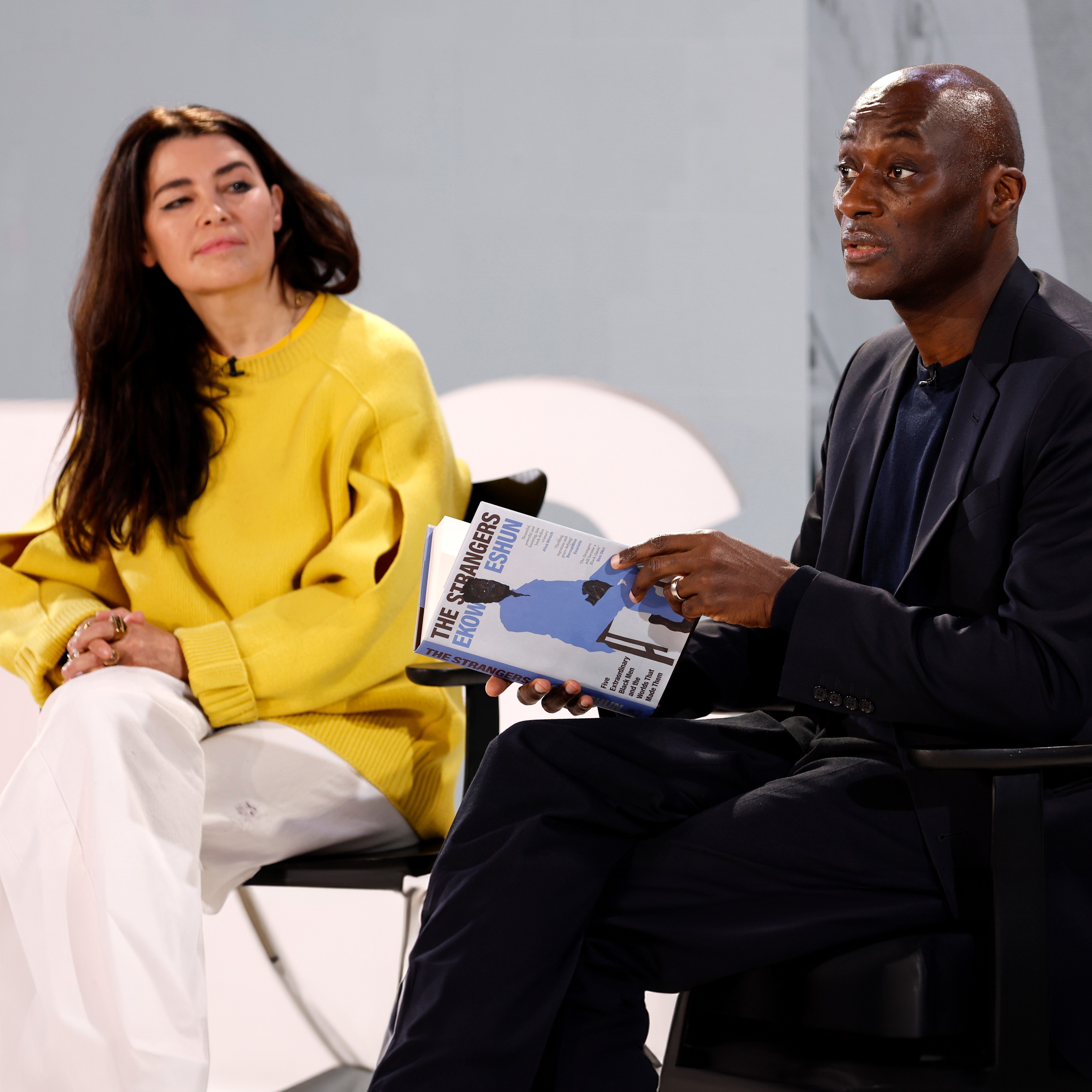
The Business of Fashion Podcast
Es Devlin and Ekow Eshun on Belonging, Otherness and Identity
00:21:58
World-renowned stage designer Es Devlin and writer Ekow Eshun explore how confronting personal biases and grappling with ‘otherness’ can fundamentally alter our understanding of self and community.
Loading summary
Transcript18 lines
- [00:00]
Imran Ahmed
Foreign.
- [00:04]
Es Devlin
Hi, this is Imran Ahmed, founder and CEO of the Business of Fashion. Welcome to the BoF Podcast. It's Friday, February 14th at BoF Voices 2024. Writer and cultural curator Echo Eshun and world renowned stage designer EZ Devlin came together for a vulnerable interrogation of identity, otherness and belonging through their latest works for a project called Congregation EZ invited 50 Londoners from immigrant backgrounds to be drawn and displayed inside St. Mary Le Strand Church in London. Echo's book the Stranger interrogates racial identity and belonging through the stories of five black men spanning centuries and continents.
- [00:50]
Echo Eshun
I wanted to encounter the layers of separation between me and others. I wanted to encounter my own racism, my own bias, my own separation.
- [01:03]
Imran Ahmed
It's easy enough to say, oh, we're all one people, or we're all one set of interconnected species, but to do that, you have to do some work along the way. That work is a self revelatory work, but it's also a work of active imagination. It's also a work of broad empathy.
- [01:21]
Es Devlin
On this week's episode of the BoF podcast, EZ and Eko investigate how otherness shapes our sense of belonging. And they argue that true understanding requires a radical willingness to open ourselves up to one another and in the process, rediscover parts of ourselves. With all of the conversation around fashion companies backtracking on diversity, equity and inclusion, given the current political climate, this is a timely episode that underscores the enduring importance of humanity, empathy and openness, regardless of how you label it. Here's Es Devlin and Echo Eshen on the BoF podcast.
- [02:10]
Echo Eshun
Thank you so much. What a pleasure to be here.
- [02:13]
Imran Ahmed
What a pleasure to be here. Thank you all for being here. First session on it we Thursday. It's been a pleasure working with you, working together on congregation. I want to just start by asking a question. This project, congregation, why did this project matter to you in the ways that it did? Why did you do this project and why did you do it the way you did?
- [02:39]
Echo Eshun
I wanted to encounter the layers of separation between me and others. I wanted to encounter my own racism, my own bias, my own separation. I was motivated because I observed that in 2022, we as a town, a city, a country, opened our arms in a way I hadn't witnessed before to Ukrainian refugees. And it was beautiful. The schools were opened, the train stations were opened. My mother and father welcomed in Ukrainians into their home. They're still living there now. And I asked myself, why now? Why this particular community? And there might be an obvious answer to that. But I wanted to find the answer in myself. I wanted to understand more. So I went to the United Nations High Commission for Refugees, and I said, just tell me the facts. Please educate me. There are 117 million refugees, displaced people around the planet. And the number of 6 million Ukrainians is also the same number of people also displaced from Sudan. There are equal numbers displaced also from Afghanistan, from Syria. So these numbers are equal in many communities. What is the separation between us and those people coming to visit from Somalia, coming to escape? So why is it that at the same time I'm reading about the welcoming of schools and libraries and train stations, I'm also reading about words being used like invasion of small boats. What is this distinction in language? And I thought, if it's at work in my community, it must be at work in me. It must be at work in my very person. Whether I think it is or not, I must encounter it. So, as you saw in that little clip, a knock would come on my door, and I'm looking at Dennis, and I would answer the door. I knew only the person's first name, and I had asked them to wear a suit. It seemed important to me that I must destabilize my own preconceptions, biases, as much as possible. So everybody came dressed for a formal occasion, dressed in a suit, and I asked them to look into my eyes for 45 minutes without talking. And we put on a piece of music. We put on the Max Richter Four Seasons, which I later found out was written at the same time as that church was being built. I only discovered that later, but I thought it would be a piece of music that would relax people. I actually started off with a piece of Brazilian music, which is very beautiful, but it was a love song. And I felt actually quite uncomfortable after a while. Look at some of my beautiful young men. I was just going. I was like, no, this can't do it. So we. I think I changed the music by the time Dennis came. So I said, please look into my eyes and let's not speak. And by the end of 45 minutes, I was longing to know this person's story, and I think they were longing to tell me their story. And I can't tell you if you've ever tried looking at someone for 45 minutes directly in their eyes. There's something about that encounter that, of course, makes both people vulnerable and open, and a sort of encounter with. I know this sounds a bit odd, but I genuinely felt like I was encountering the whole cosmos in each individual. So that was I set out to encounter who I am. Really?
- [06:11]
Imran Ahmed
Were you the same person by the end of that process?
- [06:14]
Echo Eshun
I'm not the same person at all, no. I had not sat with people from 28 countries, let alone sat and looked into their eyes for 45 minutes. And I want to just turn to your project, actually Echo, because in parallel, while I've been making these drawings that you see here, Echo's been writing a book which I really strongly advocate. I think the suitcase was already too full or else it would have been in your suitcases. I really advocate reading because it's a life changing book and I would love your Echo to read a little bit from it if you don't mind. It's called the Strangers.
- [06:52]
Imran Ahmed
So this is a book called the Strangers. It's a book about blackness and being. I'm going to read the introduction, which explains the Turns out you write a book. It's a nonfiction book. Turns out after I wrote the book, I had to write a little foreword to the book to explain what the book was about. Although it's 400 pages, but it turns out it's helpful to explain. So I'm going to just read rather than explain the But I'm going to read the forward to the book which sets out both what the book is about and but really the aims and intentions involved in that and as a consequence, potentially the parallels with congregation and with your work. Take me about three minutes or so. The Strangers is a book about the lives of five remarkable black men. Ira Aldridge, Matthew Henson, Frantz Fanon, Malcolm X and Justin Fashny. Five men of varied character and outlook who lived in different places at different times. Some of them are well known today, their legacies closely studied. Others have been largely overlooked by history. Famous or forgotten, a thread runs between them. Each was, in his own way, a pioneer, embodying and enacting striking change in his respective field and in society at large. Each was a traveler and at one point in another or another, an exile, a figure in motion through a world that regarded him as alien. Each strove to reach beyond the constraints of race, to assert himself as fully human, fully alive. In telling the stories of these men, I haven't attempted to give a complete account of their lives. Instead, I focused on a period in time when each figure stands at a crossroads, grappling with the signal anxieties and ambitions of his era alongside his own personal dilemmas. In some cases, that period runs over decades. In others, it spans no more than a handful of months or even days. The structure of my narrative has been guided by the factual details of each man's biography. But I've also given myself license to conjure what the often limited archive of cannot supply the tone and texture of their inner lives. Toni Morrison said that black people are often spoken of and written about as objects of history, not subjects within it. In the Strangers, I seek to do the opposite, to move from looking at the black male figure to seeing as him. Through storytelling that intertwines the documentary and the imaginary, I aim to reach a deeper emotional truth that fact alone cannot offer in order to create an intimate, effective portrait of each man. I realised very early in the literary process that to achieve this goal, I'd need to speak through the men's own voices. This idea of direct voicing became the second person narrative which predominates through the book and via which I've attempted to stand in my subject's shoes and to invite my reader to do the same. To do justice to these individual stories, it also felt important to evoke the dense web of black diasporic history, culture and politics within which they stand. So the book also features a second strand, a series of short but expansive essays that counterpoint the character driven main chapters. These essays range much more widely across place and era than the character chapters, introducing a broadcast of artists and writers, travelers and tricksters, and through them, tracing the development of my own thinking on blackness and masculinity. This densely constellated and more than factual approach to personal histories seems especially fitting given that the enterprise of simply being a black man moving through a white world frequently takes the individual beyond the everyday into a charged space of performance, fantasy and myth. The stories and stereotypes that frequently categorize black men as brutish or lawless are as well worn and persistent as the fantastical idea of race itself. A socially constructed fiction without any basis in scientific fact, but one which nevertheless shapes how we see the world. Each black man is the heir to this legacy of caricature which renders him simultaneously invisible and hypervisible. His existence is inextricably entangled with his representations in popular culture and the white imaginary. To live in such a state involves sustained impositions on one's personhood, from minor daily slights to heightened threats to your freedom and your life itself. It constitutes a feat of self authorship under intensely hostile conditions which remains to my mind, inherently heroic. But black men are also denizens of what the poet Elizabeth Alexander calls the black interior. Our abstract space, our space of the real, not real, far, far beyond the limited Expectations and definitions of what black is, isn't, or should be. In writing this book, I hope to speak also to that zone of possibility, approaching each of my subjects from a position of not knowing and moving freely across time and place, memory and imagination, to encounter black masculinity not as a fixed state, but as an open proposition.
- [13:04]
Echo Eshun
Beautiful. So, echo, you did let me know that this book started out as a history of hip hop. And I want to ask you, having started there, how have you changed? What have you learned? What didn't you expect when you went on this journey through the footsteps of these five men and yourself?
- [13:32]
Imran Ahmed
So I started writing a book a few years ago. It was a very different book to this. It was supposed to be a history of hip hop. And I found myself. I wanted to go at the beginning. I wanted to go deep into the roots of hip hop. So you go to the 70s and you go to the 50s. And at some point I ended up in the early 19th century. And I felt like maybe I've, you know, I've gone deep, but maybe what I'm writing about isn't hip hop itself, but is actually the experience of black people writing and creating and living. Ultimately, that led me to this book, the Strangers and the experience of writing it. In the end, look, this is a book about these five men that I described, but really, it's a book about me. And I think almost any creative exercise in the end becomes about one trying to meet what's inside you, trying to sit with what's inside you. I'm a bit more raw as a consequence of writing this because you have to open yourself up to the experience of living and being. You have to open yourself up to pain. You have to open yourself up to fraughtness. I say you. I say I have to open myself up to that process of feeling that I had to feel my way through these figures. Which means I have to be open with myself about what hurts inside me, about what motivates me, about what moves me to write. You have to write with feeling. And actually the feeling, the hopefully the honesty you get to in that process doesn't stop when you get to the last page of writing. When you get to the full stop, it turns out after that, you open your eyes and lift your eyes from the page, the world looks slightly different. Your feeling of walking through the world feels slightly more sensitive. In all the different creative projects you do, I don't know whether you encounter something similar, which is that the world feels slightly closer. A texture of the world feels slightly more Finely grained. You're grateful for the light and the sun and the rain, but it also hurts a bit.
- [15:46]
Echo Eshun
You said. Echo said something to me last night when we were just chatting about what we might talk about today. And I asked this question briefly and he said, I feel like I took off another layer of skin and I'm just going to share a few pictures of the men that Ecker writes about in the book and in parallel some of the portrait sessions, because it feels like we've been doing this parallel project of encountering the other and through the other, through an intimate encounter with the other, encountering ourselves. And I wanted to bring up this project not least because it was really in this project called Come Home Again outside the tate modern in 2022 that the origins of the current congregation project receded. And I wanted to share with this group particularly that the instigation for this project was an invitation by Cartier to make a brand activation. So a really lovely team at Cartier had been asking me for a minute and they said, will you make a work to celebrate Londoners? And it will be a five day activation with some budget. So I said, well, if you're going to spend this money, can we make a piece of art? Let's not make an activation that will end up in the landfill in five days time and let's not do it somewhere where it won't be rooted in a tradition of making art. Please can we do it at the Tate Modern and please can we make it a piece of art and can I keep it afterwards? And they said, sure. And I said, well, okay, you want me to celebrate Londoners? So I started to ask this question. Who is Londoners? Who are Londoners? Who are we? Who am I? And I went to the London Wildlife Trusts and I said, who are the Londoners? They said, well, there's 15,000 species of Londoner, of which humans is only one, and that's not counting the 10,000 species inside each human. So I thought, actually, there's a ton of stuff I know nothing about. So I sat down for a year and I drew 243 of the most endangered London species. And talking about taking off a layer of skin, it was while making those drawings that I encountered a continuity, a porosity between myself. The veins on my hand, the veins on a bat's. I drew 60 bats. Turns out there are 60 species of bats in London. The sort of shape of the knuckles on my hand, the shape of the edge of a bird's wing, the scales on my skin, the scales on a snake and a lizard, because there are some in London. And it was in that state of porosity that the Ukraine conflict began. And I felt a porosity in us and in me. And I guess coming back to the title of our talk, I wonder if you could reflect on that title a bit. Home is the Other We Carry inside Us. And what that means to you as.
- [18:40]
Imran Ahmed
A phrase, I mean, what I've been writing about, what I was so struck when you began to evolve Congregation, this experience. How do we meet otherness, how do we understand strangers, how do we move beyond our sense of a structured society into a wider sense? And kind of the point really where I began was that I've never felt part of the US potentially that sits in Britain, never felt part of a kind of secure version of a society. So I've always been interested in the space beyond this poorer space. And what I think you're right, absolutely connects this project at the Tate to Congregation is this awareness, this desire, this pushing that you've done to reach beyond the singular, into the several, into the multiple, into a sense of, well, look, if we all carry ourselves forward, what happens when we sit or stand together? What happens when we stand as we and discover an us through that process that seems to me exhilarating and important, utopian, but not without its fraughtness, not without its difficulty. Because in that process, I think there's a necessary path of self discovery that takes place, which is really, I suppose, what we're talking about as well. It's easy enough to say, oh, we're all one people, or we're all one species, or we're all one set of interconnected species. But to do that, you have to do some work along the way. That work is a self revelatory work, but it's also a work of active imagination. It's also a work of broad empathy. It's also a presumption of intimacy, that or connection, which I think is sometimes hard to get to these fraught times of ours. Elections, referendums, points of division, think, get into the proximity, get into the porousness, get into the kinship. We can't take it as a given. There's a set of work involved in that. And I think one of the things that I find interesting is that artworks and artists can be part of that process of opening up those paths to self discovery and connection with others. And I think this is what these projects say to me.
- [21:11]
Echo Eshun
I think we're running out of time. I'm going to very briefly flick through a tiny few more slides just because this work is now about to be shown at Somerset House. Please read Echo's book. Please come and see this work. And what you'll see when you come to Somerset House is that what we've put on display is the room, the studio in which all of these works were made because it felt important to me to share the process behind making them. And we'll end with a portrait of Dennis Okweira, who is a previous speaker. Thank you so much.
- [21:49]
Es Devlin
The BOF podcast is edited and produced by Olivia Davies and Eric Brea. There are some things you wouldn't mind being stuck with, like a large unexpected inheritance. An always on the verge of death phone that has to be plugged in just right so it charges is not one of those things. Switch to Verizon and we'll pay off your old phone up to $800 via prepaid MasterCard so you can get a new one. Just trade in any phone from our top brands on any unlimited plan with new line on my plan. Additional terms apply for trade in and pay off your phone offer. See verizon.com for details.
- [22:31]
Olivia Davies
Ready to elevate your skincare? Introducing Medicaite, a clinically proven dermatologist recommended British skincare brand known for age defying results. You may have heard about growth factors as the must have anti aging ingredient and that's why Medikaite is excited about their latest innovation, the Liquid Peptides Advanced MP Face Serum. This serum harnesses the power of Growth factor Mini protein, a cutting edge technology that mimics natural growth factors but goes deeper, deeper, delivering visible transformative results. Studies show immediate improvement in expression lines in just 10 minutes and a significant decrease in deep set wrinkles after eight weeks of use. The Liquid Peptides Advanced MP Face Serum not only reduces wrinkles but also gives a filler like effect, smoothing out your skin's appearance dramatically. Visit Medicaite US that's Medik and the number 8 US use code podcast20 for 20% off your purchase today.