← The Business of Fashion Podcast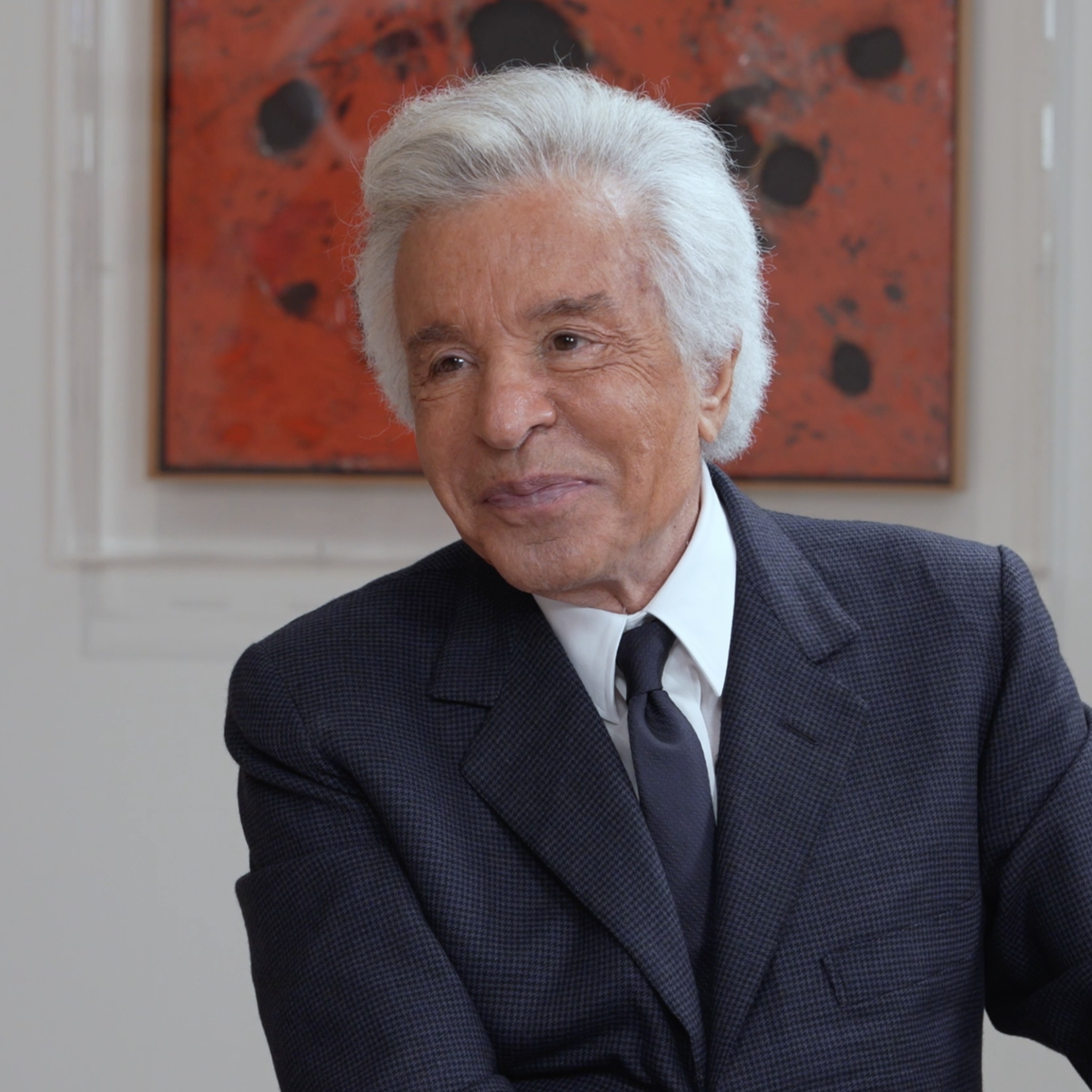
The Business of Fashion Podcast
Giancarlo Giammetti on Securing Valentino’s Legacy
00:42:43
Giancarlo Giammetti, co-founder of Valentino, joins Imran Amed in Rome to reflect on Valentino’s early days, the need to protect creativity in a commercialised industry, and why supporting young designers is more urgent than ever.
Loading summary
Transcript73 lines
- [00:00]
Giancarlo Giametti
Foreign.
- [00:05]
Imran Ahmed
This is Imran Ahmed, founder and CEO of the Business of Fashion. Welcome to the BoF podcast. It's Friday, May 30th. Giancarlo Giametti first met Valentino Garavani by chance on July 31st, 1960, setting in motion one of fashion's most enduring and most successful creative partnerships. Together, they transformed Valentino into a global fashion powerhouse celebrated for its elegance, craftsmanship and cultural influence. In 2016, Mr. Giametti Co founded the Fondazione Valentino Garavanni e Giancarlo Giametti to preserve the remarkable legacy, promote creativity, and foster charitable and educational initiatives. This week in Rome, I had the honor of Sitting down with Mr. Giametti at PM23, the newly opened home of the foundation, located right next to the Valentino headquarters where their journey together first began. In this exclusive interview, Mr. Giametti reflects on the founding days of Valentino, the importance of protecting creative integrity in a fashion market that prioritizes commercialization, and why it is critical for the industry to support future generations of designers who are increasingly overlooked by a fashion system under growing pressure.
- [01:31]
Giancarlo Giametti
This continuous change of people using people to cover jobs because the job doesn't go well. So I take another designer, put it in there, and took another CEO I put over there, makes a bit confusion and no one of them really become part of the legacy of the company. That's what is a big problem today.
- [02:01]
Imran Ahmed
During my visit, Mr. Giametti guided me through the foundation's first exhibit, Horizons Red, which showcases the enduring legacy and influence of Valentino's designs mixed in with one of a kind pieces of contemporary art. Here's Giancarlo Giametti on the BoF podcast.
- [02:22]
Interviewer
Mr. Giametti, thank you for inviting me here to the new foundation today. I have so many questions to ask you and I obviously want to ask you about this wonderful new place. But I want to start at the very beginning of your story with Valentino. You first met Mr. Valentino on July 31, 1960. Tell me, what are your most vivid memories of that first meeting with Mr. Valentino?
- [02:55]
Giancarlo Giametti
Well, you know, I was sitting in a cafe. This was La Dolce Vinita, the moment in which that street, the Avenito, was really the center of the social life of Rome. Also, don't Forget, in the 60s, Rome was called Hollywood on the type Tiber, okay? Because a lot of movies were made there. So it was fun to sit there and just to watch. Nobody had a table unless you knew somebody important in the bar, in the cafe structure. So My father was very much involved in the good life of the Avenue. I had my table, I was waiting for 11 o' clock where the nightclub called the Epistrello, the bath was open. So I was sitting there all alone and a lot of activities around me. And kind person came and said, are you alone? I said, yes. Do you mind if me and my friend, they can sit here? And Valentino sat next to me. And that's the first moment, of course, is also a moment that I remember very, very deeply. And then Valentino. And then Valentino start to talk to me in French, to speak to me in French. I say, sorry, and he say, oh, sorry. I just arrived from Paris after seven years. My mind goes French and I was hoping that you speak French. I say, yes, of course. I studied French all my life. So he said three words and didn't know what does it mean, of course. And he told me, from now on, if I see you again, we speak French. And we still do, incredibly. So this is a bit what started all of it. And then I was leaving for my holidays, I was going to Capri, and a few days later I met him there. And then in September I started to see him more and being bored more in the work and his private life, of course.
- [05:20]
Interviewer
And then, as they say, the rest is kind of history, you know, there's so much since that's happened since then you got quite involved in the business of Valentino quite quickly. I mean, when you arrived on the scene, when Mr. Valentino was just starting, how did you get involved? Why did you get involved? And what was the state of the business at that time?
- [05:45]
Giancarlo Giametti
Our business better not tell you. But anyway, I remember going to see him. He invited me to see him in his new atelier. In atelier where now I made my.
- [06:01]
Interviewer
Office, which we were at yesterday. Yeah.
- [06:05]
Giancarlo Giametti
And he was working on this dress because this is the dress that is in just present. So the dress was the piece unique of the collection. Every women want to have the dress, etc. Not every women, few women, because the business was not amazing. And then I didn't. I was not a designer, I was not a. An accountant. I didn't know anything about this, but I knew, I knew that there was some problems there because I start to see him nervous and they say, what's going on? And finally he told me, I don't have a penny. The investor that my father brought in, they left me. And so I don't know what to do. So I start to say, let me talk with you to the People to see if we can understand better what the situation. Because he didn't know what was the future. So we made the accountant to say, the only way that you can go on with your activity is that you make bankruptcy, which was not bankruptcy. It was a kind of chapter 11 in American, but you have to leave the premises immediately. So we left with the truck full of pink, green satin chairs, gold chairs. Because of that, we were able to steal from the place. And we end up around the corner to a street which was famous for designers for fashion at the time. It's called the Via Gregoriana. And we rent half of an apartment there to bring our chairs and to bring our atelier, the people working for us and the other half, the owner of the place, Mrs. Recupito and had a cat. So this male cat was impossible. But in that apartment start to arrive the very important people, from Elizabeth Taylor to Marella Agnelli to all the aristocracy.
- [08:30]
Interviewer
So basically, you started all over again. You know, you had to start the.
- [08:33]
Giancarlo Giametti
Company first, change the status of the company. His mother became the chairman of the company, of the company, because he couldn't do it anymore, him. And so we stayed there a couple of years, and then we took the top floor of the place where now the brand is. And then little by little, we took all the. All the palace.
- [09:00]
Interviewer
So over time, you know, in this creative and business partnership, you know, how did you get involved? What were you responsible for? And what did Mr. Valentino do? And how did you keep those two things kind of separate?
- [09:16]
Giancarlo Giametti
Was normal. Was. I never thought that I should be involved in the fashion part. I was very much involved in the sense that, of course, I was discussing with him. He was showing me everything. If he didn't like something, I told him, which didn't make any difference because Valentino was always, get out of here. If you don't like it, look at it. And that kind of stuff. But of course, I decided that around him was not just a business. You know, like, I look at the numbers or things like this. Of course, I had the people doing this with me. But my idea is to develop the business in a very important. Like, everybody has to know Valentino. And everybody knew Valentino very soon because I started to move the show. Instead of doing a Rome, we start to work in Florence, which was at the heart of the fashion in that moment, or the Palazzo Pitti, where the first time we went, they gave us the wrong side of the calendar. The worst last day. But people start to talk about us. So the room was super. Full of very important buyers and journalists. And then of course the decision after I got the best time, best hours, best everything. But this was my work, understand is. I don't know, create our own business and our own facade. Two young person people, ambitious, maybe very courageous. And people like that did like that. Yes.
- [11:20]
Interviewer
Was there a moment that you remember when you realized this was going to become a success that, you know, Valentino would kind of transcend just fashion and become a real cultural institution.
- [11:37]
Giancarlo Giametti
Yeah. But don't forget that Italian fashion was never recognized as important as French one until I guess 74, when the first Preta Porte in Milano with Armani, Versace, Ferreira. At the time there was other incredible name creatures start to. So in that moment also, I think there was the moment when Valentino was recognized also. Even if Jackie Kennedy already in 68 start to dress at Valentino, having seen one dresser and a friend of her. And so the collection flew to New York to be presented to the ex first lady because he died just one year earlier. In fact, the first big order she made was all in black or black and white. Those are the moments in which I start to understand that we made it. And then Valentino did the all the White Collection 68, which was also very famous. The first cover, the first Vogue, all those things.
- [12:59]
Interviewer
What were the biggest challenges you faced with Mr. Valentino at that time? Because sure, there were these moments where the brand was gaining visibility. All of these very high profile people were wearing Valentino. But it was still challenging though to build a business from scratch. No, see.
- [13:20]
Giancarlo Giametti
Was challenging until we retired.
- [13:23]
Interviewer
Yeah.
- [13:24]
Giancarlo Giametti
You know, fashion unfortunately is not just a marvelous. Of course and. And difficult business is also challenging because there is something always that make you lose sleeping well. I mean, because I always been very much around me those weight to maintain the business and then later to make him free. Which was I think one of the best challenge I had. The best, probably. Yes, I made it. Yes, to make him free to do what he wants. At the moment, it was not possible anymore. I told him, why should we here? Why should we be order what to do, when to do how many collection you are not for that. And he say, yes, I'm not for that. I'm very handy. Let's go.
- [14:26]
Interviewer
I mean, this idea of making him feel free and making him feel safe in a way, the role you played with him was not just as his business partner, but also the person who protected him and kind of shielded him from all of the pressure of the business.
- [14:47]
Giancarlo Giametti
It is. It is still. And yeah, this special relationship we had to protect each other, to be the person you call in the morning, first and last at night, because you want to share everything you feel. And, yes, this was a lot of work because, of course, life challenged all this challenge, the fact that you want to be with one person all your life. There are too many instructions, especially in the fashion world, which sometimes tend to separate people, tend to make them two different person when they begin. And so it was difficult, but still, Valentino came here a few days ago, and he was, of course, very, very pleased. Also, he says something about the show because he says something about the purity. I feel that those are pure and which is true. They are simple and pure. Forget the star inside, the red carpet, the lights, but then the dress is there, and that's what I want to show here, that the clothes are much more than what people think.
- [16:18]
Interviewer
You said just now that the fashion industry has a tendency to pull people apart or break people up. But why did you. Why has your relationship, your working relationship, your personal relationship, why has it endured so long? What are the secrets that you have to maintaining such a long, enduring relationship in the face of so many challenges?
- [16:44]
Giancarlo Giametti
Yeah, because we grew up, related so much with each other that we cannot be separated. There is nothing, you know, everything. Even when we had, I mean, in our private life, some rupture, something that changed our. After a while, we keep doing a family, and that's why we have such a big family, because all of our friends became family with us. And that's the. The strength in the meantime, really, the need of him and me to relate to each other still.
- [17:27]
Interviewer
I watched the Last Emperor documentary last night just for fun, because I hadn't seen it for a very. I watched it last night. Yeah, I wanted to remember because I remember when I first saw the documentary, it painted such an honest portrait of you and Mr. Valentin, your relationship. And it's not like you didn't have disagreements. You had many disagreements, you know, throughout that film, which I thought was, like, very, you know, as I said, honest, you know, how did you navigate those clashes with him? How did you make it through?
- [18:05]
Giancarlo Giametti
Two hours later, they were gone. So you go back to normal life, and it became part of the life. Like you shave in the morning, you know, there is so many repetitions of the same scene that you don't really suffer anymore. In fact, in the show, it's not that somebody start to cry or not at all.
- [18:30]
Interviewer
In the documentary, part of what's being documented is when you and Mr. Valentino first sold your business and then it ended up with Mr. Marzotto and then it ended up with Pair Mira. Over the course of that documentary. Talk to me about the decision to sell the business and how that felt. And you know, you were referring earlier to the moment when you and Mr. Valentino started to lose all of the control. And at one stage you, you know, you said basta. That's. It's kind of like what were the things that.
- [19:07]
Giancarlo Giametti
Because there were so many offers at a certain time, you know, and I've been always very keen to listen to those offers. I don't know. We started much earlier in the end of the 70s 60s. We sold the company to an American company called Kenton where two entrepreneur, Mr. Kenmore and other bought several brand. He bought Cartier for America, Valentino Ben Cannes, which for years very important fake jewelry, but super cool at the time. I don't remember the name now. So he tried to make like really like today's Alvin Mash or something like this. I said every money. So we bought Valentin and then I start not to pay installment. So my lawyer got me back without business. So I was always a bit tempted to listen. Also I felt very lonely sometime in my sight. I thought that having great company, great people inside would help me navigate and expand. And I was quite disappointed in that all my life. So Marzotto came and if you watch the documentary, you saw how unhappy Valentino was of that because they were coming and say, you know, the collection is great, but we need another six skirt or 12. I don't produce like this. I don't want to do it so little by little then they had their own problems financial. They had to bring inside other people. Per Mira, all that then was the time that we say why should we be here in this carousel?
- [21:11]
Interviewer
And even, you know, back then, this whole idea of private equity companies, you know, finance people coming into the industry, that was quite new. When you look at the industry today, it's changed so much, right? The business side of the fashion industry is really dictating and driving so many of the decisions. Like when you see how fashion works today, what do you think about it?
- [21:39]
Giancarlo Giametti
I think it's difficult will be much more difficult for me to be here now in business. I wouldn't know. And this continues change of people using people to cover jobs because that job doesn't go well. So I take another designer, put it in and then took another CEO and put over there makes a bit confusion. And no one of them really become part of the legacy of the company. That's what is a Big problem today, the designers become their own star, they have their own style. And they don't want to really become a witness of the work of the company where they are hired to launch the life. We have many of them. And I really understand why, because Valentino was a star maybe before many other stars in the world. Valentino, Saint Laurent, and then Holstein, all those became personal, very important here. Everybody who did two collections are already on the COVID of this. And talk like they know the business forever. And this makes a certain discrepancy between what they should do and what they are. They want to work for themselves. They don't work for the companies.
- [23:25]
Interviewer
Do you think they're disrespectful of the heritage of these great houses like Valentino, all these, like, historical houses. So you're saying that the designers are kind of transcending the history of these houses?
- [23:39]
Giancarlo Giametti
Yeah, I think sometimes not just negative is offensive.
- [23:45]
Interviewer
Offensive, yeah. Do you think creating a brand like Valentino today would be possible?
- [23:53]
Giancarlo Giametti
You tell me how many brand was created since? I don't know. The last one I remember is Valley or maybe Jackie Moose is the only one. Why? Of course, it is very difficult. Because I don't think that the big conglomerate want to put money on somebody new. They want to make strength on their own portfolio. The names they have and they saw the change designer over there. But to invest in one talent, I haven't seen anything. Don't forget that in the 70s, not just Valentino, 10 years earlier, Saint Laurent eCard, who was more a traveler between different houses, was his own big name. And then all the other money, all the Italians, I mean, all create. The last 10 years, I haven't seen any.
- [25:04]
Interviewer
Why do you think that is, I ask you? I mean, I think the business side of fashion has become so important. I think that the brands are so big that it's hard for young designers to emerge.
- [25:20]
Giancarlo Giametti
Is it?
- [25:20]
Interviewer
And I think sometimes about the cost that that's going to have on our industry for the future. You know, I think about if we don't nurture smaller creative talents and businesses today, what will fashion look like 10, 20 years from now?
- [25:42]
Giancarlo Giametti
That's exactly. That's what worries me. When they. When they ask me, I. I don't know what to answer. And this place is also to educate young designer, young artists. And we have to see how. Not just educate or just talk, go masterclass or workshop or whatever. How can we help them to acquire the strength that was not me who gave it to Valentino, but they have to conceive inside them and explore and expand. Going to talk to big conglomerate and tell this designer who really needs help, needs you have to believe in him. Difficult, difficult, difficult, difficult. And they say, oh, I would like to have a job mate in my life. What Jamie wouldn't do what he did at the time.
- [26:53]
Interviewer
We'll be right back with more on the BoF podcast.
- [27:01]
Josie Santee
Hey, this is Josie Santee from the Every Girl podcast and this episode is brought to you by Nordstrom. Summer's here and Nordstrom has everything you need for your best dressed season ever. From beach days and weddings to weekend getaways in your everyday wardrobe. Discover stylish options under a hundred dollars from tons of your favorite brands like Mango Skims, Princess Polly and Madewell. It's easy too, with free shipping and free returns in store order pickup and more. Shop today in stores online@nordstrom.com or download the Nordstrom app.
- [27:45]
Grainger Representative
If you're alignment in charge of keeping the lights on, Grainger understands that you go to great lengths and sometimes heights to ensure the power is always flowing. Which is why you can count on Grainger for professional grade products and next day delivery. So you have everything you need to get the job done. Call 1-800-GRAINGER click granger.com or just stop by Grainger for the ones who get it done.
- [28:17]
Interviewer
So it kind of brings us to the foundation you started with Mr. Valentino, the foundation in 2016.
- [28:24]
Giancarlo Giametti
17.
- [28:26]
Interviewer
Yeah. And the motto was beauty creates beauty. Right. The whole idea of, you know, preserving the heritage, the stories, the essential pieces of this wonderful house. I mean, what were your goals in creating the foundation? In part, was it to kind of leave a legacy?
- [28:50]
Giancarlo Giametti
For sure. This was the most important of the project we need in the foundation. Badria others like I told you before, there is the education part and every big show like this one, there will be a smaller show where will be dedicated to education. Next one probably will be with a very known artist who she will bring here her own studio and she will do the work that she does inside for everybody to look and learn. So this is the second part and then there is a very important part which is the charitable part. We are working very hard to help young children and older people and we are in fact building quite credible building inside the biggest hospital in Rome the where there is no large place where children and their family can wait to be visited because the first aid is very, very small. So there is this huge courtyard where sitting there in winter or summer without protection. So we are covering that with a nice pavilion and of Course, the biggest hospital in Rome is Gemelli. And Gemelli has always rooms done by us. A machine done by us. Yes. And now I have an idea about the charity because I think that at our age, older people are facing difficult to understand what they have to do because everything is digital. I have to get my retreat and I have to compose some numbers quotes and I don't know how to use a computer and my son is not here and my wife doesn't understand, like I don't understand what I do, what I do to cover my head if everything has to be a bottom. So that's what I'm thinking. I'm going to do like not a school, but a place where all the people who don't have access because their family is not there or whatever can go have the work done or the work even they can teach, like digital education. 80 years old.
- [31:49]
Interviewer
Yeah.
- [31:50]
Giancarlo Giametti
Go to school.
- [31:51]
Interviewer
Yeah.
- [31:52]
Giancarlo Giametti
Nice.
- [31:53]
Interviewer
In the time of the digital era, when everything is moving so quickly, when there's everything is so fast paced, how do you preserve the timelessness of beauty?
- [32:09]
Giancarlo Giametti
Like this is a different narrative. You don't. I hate fashion museums. I think that to see all the mannequins like Madame Tussaud look really like wax things. I don't think there is a life inside. So I think the digital work you have to work with that world to project your legacy in a different way. And this was very normal for us because we always thought about fashion and art as the main things that inspire us. Valentino never made exception any clothes inspired by a great design. But he did of course some design Hoffman, some of camouflage of Warhol, but not like many others did in an amazing way. No, but the passion was there. And the first thing that we bought was were there. And I remember that that Fontana with one cut in white and marble gallery told me, you should have it at the end of the panic. I say, okay, let me see. You should have it. And then six months from now, I sell it for double. I said, okay. So I took the place this office of Beauty of White Fontana with one cut, right? And go home. I was still living with my father mad. And they say, my father say when you open it, he thought it was the box inside that would be the painting. And this is the beginning of our passion for art.
- [34:15]
Interviewer
Let's talk a little bit about the opening exhibition, because the exhibition and the foundation opened just over the weekend. You created this permanent home. And this exhibition is called Horizons Red. I mean, clearly we can see, you know, the red Valentino red is Everywhere here you've curated it with a bunch of art pieces. But maybe the most important piece from Mr. Valentino's heritage is this fiesta dress, which I think is the birth of the whole idea of Valentino red. Can you tell us a little bit about why the story of this dress and why it's such an important part of the kind of heritage was really.
- [35:02]
Giancarlo Giametti
The beginning of Valentino? Because when I met him in July, he did show this dress at the end of 59. So it was very much there. And the few clients that we had all wanted this dress. And when I asked Valentino what is so special in this dress that became such a symbol of his work. And he told me that he learned this little bit, how can I say composition that becomes a flower from a dress that Mr. Desay Jean Desaix, where Valentino work did for Maria Felix, the famous Mexican actress. And there was a completely different proportion. But he learned there how the tool can became like a draping. And I think what is interesting, even strangely, he didn't repeat very much of this dress, even in the rose are part of course of his work. But I remember very well also because it is exactly when I met him. So I was around his dress all the time.
- [36:33]
Interviewer
And then you selected and work to curate the museum with a. Or the foundation, rather with so many different art pieces. Do you have any favorites? Like, what are the pieces here that mean the most to you personally?
- [36:52]
Giancarlo Giametti
Just behind you, maybe the little Picasso, which is the area of war describes so much not just the color red, but the attitude of the figurative expression of a woman is really incredibly strong. It's the only figurative we have with Marlene Dumas other Woman. Yes, true. Now it was. It was fun, was difficult. It was exciting to find where the most important pieces in red inspired by the red color. Great artists where they were. So we made a lot of research. Every museum, but mostly, believe it or not, are from private collection. There is very little from museums. And at the moment, then the rumor that I was looking for red start to go around. So people call me. I have a great red look. They offered me that cliff or steel, which is quite incredible. It's acting this way. I know that you're looking for red, but this. How big is this? 3 meter by 3. I say, okay, yes, yes, absolutely.
- [38:23]
Interviewer
So how does it feel? Because you've been working on this foundation for a long time. When it opened over the weekend, I'm sure it was very emotional for you to have everybody here to finally unveil this to the public. How are you feeling?
- [38:37]
Giancarlo Giametti
The most important emotion was when Valentino came to this area. Valentino doesn't work well, so he doesn't want to be seen on a wheelchair. That's all. The secret of which is not here every moment. That was the emotion. All the rest was great excitement because everybody seems to like the show, which was what I really wanted.
- [39:08]
Interviewer
So let's talk a little bit about the future. With the foundation now open, with the legacy secured, I mean, what do you hope this foundation will offer to people in the years to come, even after you and Mr. Valentino aren't here to show people around?
- [39:33]
Giancarlo Giametti
First, I have to find people who will help people. But definitely they principle of the foundation are very clear. It is based on education, protection, the legacy and charity. So this is very, very, very well understood, well explained to our successor or to the board, to the advisory board. So I hope that this is going to be always the keys to the future.
- [40:13]
Interviewer
I also wanted to ask your advice for young creative people working today who want to work in fashion. I know the industry, as we've discussed, the industry is very different. It's become a big business. But for people who want to build something special that lasts, build a partnership that lasts, what advice do you have to offer to them?
- [40:40]
Giancarlo Giametti
It's too easy to say, be yourself, don't let. Don't have people teach it, tell you what to do. Don't listen to podcasts, don't read the paper, don't look at television to see the show, somebody else, because you cannot get distracted. You have to believe in yourself and do what you want. Is this a possibility today? I'm not sure, but that's what I.
- [41:13]
Interviewer
Would like to see and to have energy, sustained energy, over a lifetime. I mean, I. Look, I've. I've been watching and observing you these past, you know, few days that we've been here. You have so much energy. Really, where does it come from that you're still so driven and so curious and so energetic? How can I be that way? No, in the future, you know, how do you keep it for so long?
- [41:48]
Giancarlo Giametti
There is no medication, unfortunately. My passion, my respect for what I have to do, I respect for the people who approach us and gratitude for so many friends and who came to see us. Like, how can you have a better stimulant, can you say that, than pride and happiness?
- [42:17]
Interviewer
So that's the secret. Just surround yourself with people who support you and who sustain you. And for Mr. Valentino, how is he today? You just said earlier he doesn't want to be seen anymore?
- [42:32]
Giancarlo Giametti
No, he's perfectly well. Health well is perfect. It's just a problem that he doesn't move the same way that he did. And for him, he preferred to stay calm and listen to me tell him at night what happened the day.
- [42:50]
Interviewer
So you still talk to him every day?
- [42:52]
Giancarlo Giametti
Yeah, a bit earlier than before, around 8 o' clock, but it is of course twice a day.
- [42:59]
Interviewer
Okay. Well, I'm really grateful for having this time with you.
- [43:05]
Giancarlo Giametti
I love talking to you.
- [43:07]
Interviewer
It's really special what you and Mr. Valentino have created, and I hope that it sets an example for people who are trying to create something that lasts. The thing that I think is still present in fashion, even if everything has changed, is we have so many talented young people, and I hope that they can look to what you and Mr. Valentino have created as an example, even if the industry has changed. Because the true test of creating legacy is something that lasts forever. And I think you've done that. So thank you from on behalf of the industry and on behalf of everybody, thank you for what you've left behind. I appreciate it.
- [43:50]
Imran Ahmed
The BoF podcast is edited and produced by Olivia Davies and Eric Brea.
- [44:03]
Josie Santee
Hey, this is Josie Santee from the Every Girl podcast and this episode is brought to you by Nordstrom. Summer's here and Nordstrom has everything you need for your best dressed season ever. From beach days and weddings to weekend getaways. In your everyday wardrobe, discover stylish options under a hundred dollars from tons of your favorite brands like Mango Skims, Princess Polly, and madewell. It's easy too, with free shipping and free returns in store order, pickup and more. Shop today in stores online@nordstrom.com or download the Nordstrom app.
- [44:45]
Paige
Hey, it's Paige from Giggly Squad. Real talk. If there's one store that I absolutely love walking around, it's Sephora. It's my total guilty pleasure. They have amazing brands that other people don't have, and I find something great every time I walk in and there's literally one down the street from me, so I do that a lot. It's so fun to shop in the store and online, and the products are just too good. No regrets ever. For example, one of my favorite beauty brands is makeup by Mario, who just launched his new lip gloss that I absolutely love. So the next time you're in the market for great beauty, shop all the hottest products and brands only at Sephora.