← The Business of Fashion Podcast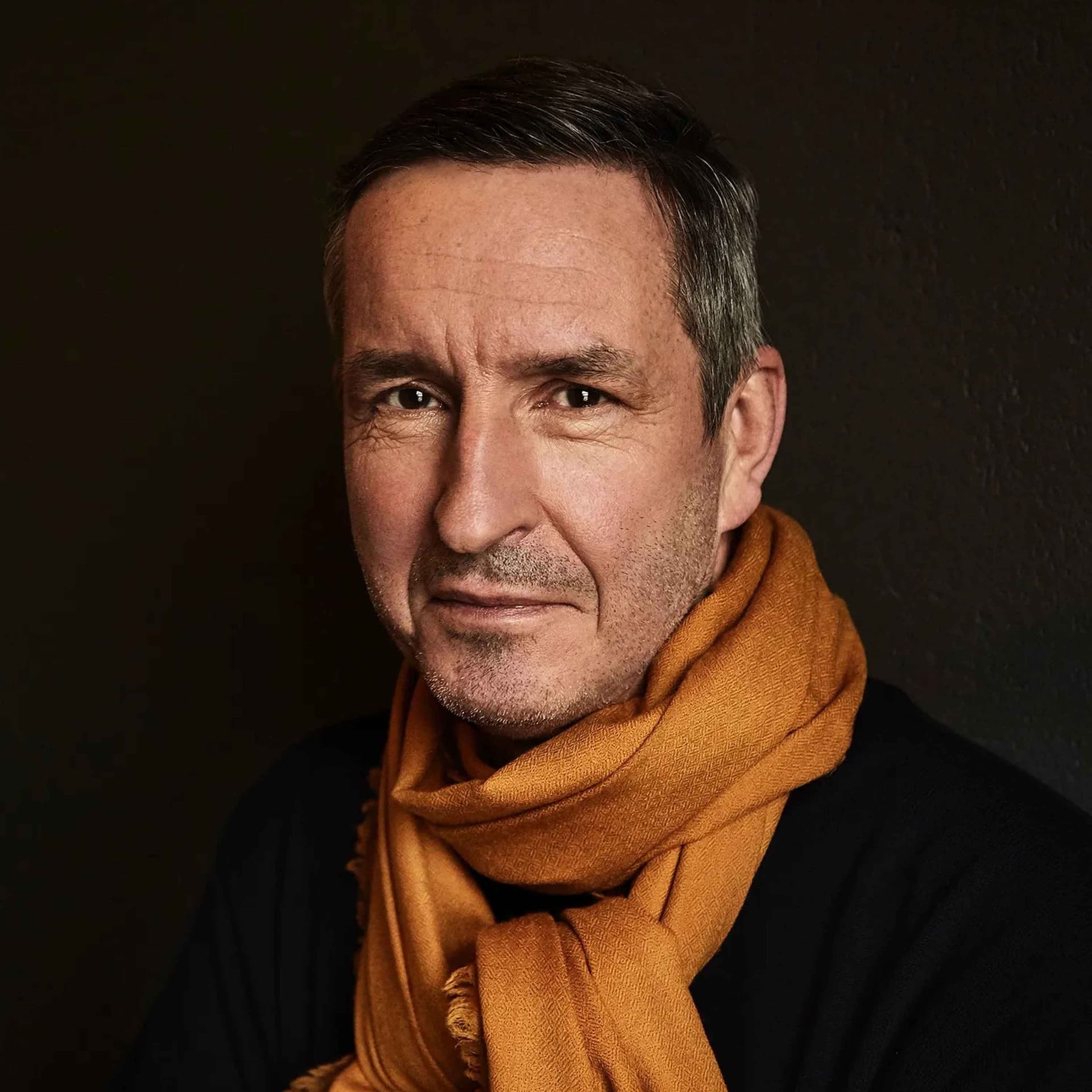
The Business of Fashion Podcast
Inside Dries Van Noten’s Venice Manifesto
00:44:52
After stepping back from his namesake brand, Dries Van Noten opens a foundation in a Venetian palazzo dedicated to craft and beauty. He tells Tim Blanks why, in ugly times, making something beautiful is its own form of protest.
Loading summary
Transcript93 lines
- [00:00]
Dries Van Noten
Foreign.
- [00:04]
Imran Ahmed
Hi, this is Imran Ahmed, founder and CEO of the Business of Fashion. Welcome to the BoF podcast. It's Friday, May 1st. For four decades, Dries Van Noten defined a singular path in global fashion, with a universe rooted in intellectual rigor, exquisite craftsmanship and independence. When he stepped back from his namesake brand last year, it wasn't a retreat into quiet retirement. Instead, Dries has embarked on a profound transition, moving from the relentless, dictated rhythm of fashion to a new life as a custodian of culture in Venice. Dries has established a new foundation at the Palazzo Pisani Moretta, a space dedicated to the beauty of craftsmanship and the belief that in a world marked by global uncertainty, the act of making something beautiful is the ultimate form of protest.
- [01:01]
Dries Van Noten
I think everybody knows that it's ugly times and when you say protest, you protest against something. So I think it's quite clear when we say the only true protest is beauty, that people know what we mean.
- [01:12]
Imran Ahmed
In this special episode of the BoF podcast, our editor at large, Tim Blanks, speaks to Dries about this remarkable transition to becoming a custodian of beauty. Here are Tim Blanks and Dries Van noten on the BoF podcast.
- [01:31]
Tim Blanks
Greece feels like it's been a long time.
- [01:34]
Dries Van Noten
It is absolutely. So it's. It's quite a while. I know.
- [01:37]
Tim Blanks
And so much has happened.
- [01:39]
Dries Van Noten
A lot of things. We are now kind of partly Venetian the majority of our time, actually. So because we are very busy here. And how is that we didn't retire, we didn't stop designing the collections to have an easy life and just relax and doing nothing. So the idea was really to do something else, which I think we succeeded in. So it's something else, but it's again very busy.
- [02:04]
Tim Blanks
How is life in Venice Changed you a lot.
- [02:09]
Dries Van Noten
Of course, fashion is very demanding and of course fashion dictates the rhythm here. Nobody dictates you with what I'm doing now. Nobody dictates in fact us what we have to do. But of course it's again very busy. So it's not. Not really. Yeah, it's. It's a different life, it's a different rhythm, but still bus. What we really wanted to do, we wanted to do something else and that's. We succeeded in.
- [02:36]
Tim Blanks
I liked what you said to me that you've become a lot more social in Venice.
- [02:40]
Dries Van Noten
Absolutely. I think, yeah. Fashion is. Is again. So you have so much things to do constantly. And one collection is finished and the next already. You're already in delay with the next one. So in Belgium we had, of course, we have friends and family and relatives. But here in Venice, it's so easy to meet people, and it's so much fun because, okay, you don't have to drive. You can drink a glass very easily with friends and hanging around. Venetians are also very social, so they invite you very easily at home just for an aperitivo. And it's really fun.
- [03:16]
Tim Blanks
So you don't have to have a designated gondolier at the end of a night out?
- [03:21]
Dries Van Noten
No, after a night out, a good walk can do miracles.
- [03:25]
Tim Blanks
Is it fun having Diane von Furstenberg as a neighbor?
- [03:28]
Dries Van Noten
It's fun. She's really fun. She presented us also to a lot of people. She really wants to help us also, which is, of course, fantastic. It's a lot of people living here, and Venice is a very layered city. You have a lot of different groups of people. You have kind of the international people. You have the real Venetians. You have also a lot of youth. So you have a lot of students here, students who continue to hang around in Venice. So it's a very diverse group of people living here in Venice. And that's nice, because I would feel, I think, quite scared when it would be only, like, the international people or all the art people. No, I think you have so many different types of people here, which is really very, very stimulating, I think.
- [04:13]
Tim Blanks
Are you surprised? I mean, have you surprised yourself by the fact that you've been able to do this? And is it a third act, would you call it? It's not a second act. It must be a third act. But it's so different from anything that you've done or known before.
- [04:31]
Dries Van Noten
Of course it's different to say, honestly, I'm surprised how easy everything went and how natural everything came to us and how fun it is and how enriching it is, how much we learned already in so little time. I think that, for me, is really the very pleasant and very surprising part, because, of course, indeed, it's something else. What we are doing now, of course, it's connected still with art, with beauty, with a lot of things, which we always were doing. But the moment that we decided to step down, Patrick and I were sitting together. I said, like, oh, we have to find something else to do. It's really important for us to stimulate, because that was all the reason why we wanted to stop designing collections. We wanted still try to do something else in our life. Because, okay, I think everybody knows that I'm an addicted gardener. I said, like, also to Patrick, oh, don't do that to me that I now the rest of my life have to talk to 70 year old colleague gardeners about pruning and what fertilizer I give to the plants. And for me that was like, no, no, impossible. We have to do something else. And of course craftsmanship has given us so much that we said, okay, maybe it's good to try to support it. And here we are.
- [05:51]
Tim Blanks
I think it's very interesting that that huge Antwerp 6 show has opened in Antwerp at Momu. And it's this interesting circularity in your life that you get to see such a sort of overview of everything you've done up to this point, just as you start the next chapter. And I wondered how it was when you went to the opening of that show, what you felt when you looked at Drees then when you're in the middle of being Dries now.
- [06:21]
Dries Van Noten
For me it was very interesting. Also confronting, of course it's 40 years of career and it's also already 40 years ago that says also something about my age. And it was, for me it was like really the perfect moment because it was really like wrapping up one section of my life. And here we are with maybe section, as you said, second part to third part. So in our life. And it was a good thing I was not nostalgic because otherwise, I think otherwise you could see, oh, this is all over. And look. And it was fantastic. And we were so much younger and so, so much more handsome and we were daring things. And now it'. Okay. Like, okay, I'm the age who I am. But still we have now a new chance, a new life, to meet new people, to work again with young people and create something else.
- [07:14]
Tim Blanks
Were you emotional when you saw it all gathered together there like that? I mean, I've only got the book as reference and it's a very emotional experience, that book, I think I can't imagine what this show is like.
- [07:28]
Dries Van Noten
It's emotional, of course, because there you see all the videos and you have the memories you have of course also Marina Ye. They're very present in the exhibition. So in that way it comes really alive and a lot of memories are coming back. I'm very happy also that this is now wrapped up. I'm happy how it goes now also with the brand. So that's that. I think Julian is doing a very good job. So this also gives me comfort and gives me kind of of okay, now I can concentrate on something else. So in a very positive way. And that's what we are doing now.
- [08:06]
Tim Blanks
So to now bring it up to date. What did you think the first time you walked into the Palazzo?
- [08:12]
Dries Van Noten
Oh, this is far too big, far too complicated, far too decorated. This is everything, what we are not looking for. That was the first idea. And then we started to fall in love with the place, with the owner, with the then owner, because he was kind of a guy of 83, 84 years old. Incredible, the love, the passion he had for the building. And then we understood that the Palazzo is really a place where craftsmanship is so visible. It's still all there, it's still the authentic 1730s decoration which is in place. So it's unique possibility to combine all that skill and all that knowledge from the past with things from now.
- [08:56]
Tim Blanks
You have a Tiepolo ceiling, do you?
- [08:58]
Dries Van Noten
We have a Tiepolo ceiling, yes.
- [09:02]
Tim Blanks
I just can't imagine what that would be, you know, a boy from Belgium who would never dream of having a Tiepolo ceiling in his place.
- [09:10]
Dries Van Noten
No. And also to say, honestly, I still realize it completely, what we have here and what responsibility, what we have, because I think, I really feel that we are custodians now of something which is so special, because it's quite unique that it's still complete, intact. It's like a woman, Chiara Pisani, who imagined it, and she was extremely wealthy and that's why she could afford really the best, best, best craftsmen of that time. It's very well documented. Also. We have really, we know every detail, who made it, how much it costed and everything, because there is a huge archive which is now in Musee Coureurs, which makes the place even more special. So it's really, it's kind of an exceptional place, which of course gives also a lot of pressure because you have to take care of it. So, as I said, we really feel custodians. But of course, on the other hand, we want also to give it a new life, because I think a palazzo like this must be used to do, to organize events, to show to people. It's not something which you have to hide. And that's exactly what you want to do.
- [10:19]
Tim Blanks
The grandeur of it, though, is so I could understand why you felt overwhelmed when you walked in. But at what, at what point did you change your mind and think, oh, this we can do something here. We, we can use this incredible place to celebrate the past, but also create a future for you and for the building.
- [10:41]
Dries Van Noten
I think the building, what was, what was also helping is that Maurizio Sammartini, the then owner, took very well care of the building. So the structure the condition of the building is really good. And that of course gives us a few years of advance, because I was nervous to find a building where you have to work five years, because then I would be more than 70 years old. So I said also to Patrick, I don't want to start my new phase in my life and still waiting for five years, because then maybe I better retire immediately. Now we said, like, this gives us a possibility immediately to start with something. And. And that's what we did. So, because the building is in fact in good condition, okay, There is on the first floor, nearly no electricity. So those things we have to bring in. But no, it's very usable. And strangely enough, even when it's like a huge building and the ceilings are 6 meters, 6 meters, 50 high and everything, there is a human scale to it. There is a warmth to it. It's not that you walk around in Versailles, of course, it's a palazzo built to impress, but there is also a very strong human factor in it. There is something really tender in it. And I think it's that balance, the grandness, but also kind of the charm, which makes it very human. And I think everybody was coming in, say, like, okay, nowadays even that the ceilings are so high. I could imagine that somebody lives in this place. Of course, we're not going to live in those rooms, but I think that gives it a different dimension.
- [12:17]
Tim Blanks
Are there no living quarters in the place that you could move into? You have no plans to live in the building?
- [12:25]
Dries Van Noten
We plan to live here. We have the third floor, where the ceilings are only 3 meters, 50 or 4 meters where I'm sitting now, which is on the top of the Palazzo, the third floor. There's still a fourth floor also, but that's more the attic and the loft, so we can live here. So we still have to make up our mind. But first, from October on, we have to do the works. Where we have then to do kind of the new elevator, which is also handicap accessible. We have to do a lot of things about electricity and techniques, in fact, heating, erco, all those things.
- [12:59]
Tim Blanks
Have you had to deal with an aqua alta yet?
- [13:03]
Dries Van Noten
We had already the aqua altar, but the Palazzo is luckily enough high enough.
- [13:08]
Tim Blanks
Oh, that's wonderful.
- [13:10]
Dries Van Noten
So we have the ground floor, which is. Then the situations like that is humid, but not really completely underwater.
- [13:18]
Tim Blanks
Now the exhibition is called the Only True Protest is Beauty. Your first exhibition and your new space. The only true protest is beauty. And that's from a song by Phil Ox, who was a contemporary of Bob Dylan's in Greenwich Village in the early 60s. How did you come across this? I mean, the preface for that line is in such ugly times, the only true protest is beauty. It's not coincidental that you've chosen that title.
- [13:48]
Dries Van Noten
Obviously it was something which I saw passing by on social media, don't ask me where or when. And it really stuck to me because it was the full sentence which I said, like, in such ugly times, the only true protest is beauty. And I think that's now nearly one year and a half because the idea of what we are doing now of this presentation is already growing for quite a while. And I said like, oh, this is really kind of the perfect working title. Because at that time I thought, like, the world by the moment that we can start our presentation is going to be already a much better place. But then where we are now with the world. I said, like, maybe we can't have a better title than this one. But on the other hand, I said also, I don't want to work now like for a full year on something which. Where the name is so negative because it's such ugly times. I think everybody knows that it's ugly times. I mean, it's say protest, you protest against something. So I think it's quite clear when we say the only true protest is beauty, that people know what we mean. And okay, sometimes in some documentation we still use a full title, but for me it was more, more exact, more exactly what I want to do because I'm a positive person. I don't want to say, oh, poor us, look where we are. The world is so bad. No, we have to look forward.
- [15:12]
Tim Blanks
Your definition of beauty in this context I think is very interesting, quite provocative because you're not talking about beauty as a resolution, you're talking about beauty as a tension. You're pitching beauty as a very proactive, provocative notion. But the beauty that it seems to me that you're talking about, you said it's a question, not an answer, you know, for I think people, especially in fashion, when people talk about beauty, it's often got an escapist angle to it. But you're definitely talking about beauty as engagement rather than escape. With this exhibition, it seems to me,
- [15:55]
Dries Van Noten
for me it can't be only escape. And I think beauty can be so much more than just pretty. For me, the beauty. A person can be beautiful and it's much more layered again than just like a beautiful person, a good looking person. No, for me, beautiful people are really people who mean something, who do something, who have a way that they Think that they. They live in the world the way that they stand in the world. Beauty before me also can be healing. And beauty is something super personal because what's beautiful for me is maybe not beautiful for you. There are so many different notions about what beauty can be and how beauty can help you as a person to live in a better life. Those are the things which I want really to work on and to investigate. And as you said, I don't want to give an answer. I think for everybody, they have to make up their mind. We show here pieces from an artist, and I had very long talks with him because he said, I really don't want that you call my work beautiful. Because he said, my work. I want to make revolting things. I want to shock people. I want to surprise people. But then for me, I said, I think when you can place them in the right way, they still have kind of a beauty, maybe not an easy beauty, not like something pleasing to the eye. And especially when we can put those in kind of dialogue with other pieces. So they're gonna ask. Make. Make people ask themselves very interesting questions. So I really hope that when people walk here to. Through the. The presentation, that they see all different types and that, okay, there are very beautiful, traditional, beaut. There are things which are quite scary. There is a lot of memento mori. There is a lot of those kind of intriguing things. And, you know, from my career in the past, when things became too pretty or too easy, I tried to give it a different twist and to change it that you think, oh, now I understand what he wants to say. You turn around the corner, you see something else, which makes it then again more kind of demanding and clear what. What the message exactly is about. So as you said, no answer yet. No answer. I think everybody has to find his own answer. Don't expect from me that I gonna say what everybody has to think.
- [18:17]
Tim Blanks
How do you see the element of protests emerging, though?
- [18:20]
Dries Van Noten
I think protest is an important thing. You have to. You can't only sit there and just live the situation we are going in. It's so. There is so much ugliness around us. Ugliness again, in the same way that beauty is not one layer, ugliness is also so deep. There's so much negativity. But negativity for me is just ugliness, which is there. So that I think you have to do something. We have to move forward again. For me, it's impossible just to sit there and to complain and say, like, oh, poor us. Look what's now happening. No, you have to. You have to move forward. And I'm not a nostalgic person. I always look to the future. And I think in the future you have to protest. You have to have hope. Protest, for me, also gives hope, and I think that's important.
- [19:12]
Tim Blanks
So it's significant that you have Ayam Hassan in the exhibition because he's a designer from the west bank. And that feels to me a very, very symbolic almost of what you're trying to do here, that he embodies hope in a particularly ugly situation, it seems to me. I mean, is that why he's in the. He's in the presentation in the exhibition.
- [19:36]
Dries Van Noten
That's exactly why he's there, because there's a lot of fashion in the exhibition. So there is 35 silhouettes of fashion, where first we have Comme des Garcons and Christian Lacroix, which are completely. Two completely different designers, completely different starting points, but sometimes growing to each other. When you compare the final result, when you see the silhouettes together or in the same space, it's surprising how close sometimes the end result is. But I wanted also to have somebody young, somebody is really working now and just starts now. Not somebody like Christian Lacroix, who stopped already so many years ago, or a very established designer like Reika Wakuro. I wanted also to have like the young one. And then I saw the things what I am did, and especially also the text, how he was writing, how what he was talking about saying that you can't only mourn, that you have to be able to dream, to think about future parties. You have to see the beauty and things like that, so to survive. And that for me was a little bit like the symbol of so many things I wanted to say with this presentation that I said, okay, we have to have some pieces of his collection
- [20:59]
Tim Blanks
here in the context, that's quite a political statement. It's creating a role for fashion in a much broader context. You know, there's been this really, I think, a debate that's become a lot more intense over the last few years about what is the relevance of fashion and how does fashion interact with the world, Especially when the world, as we've established, is becoming a much uglier and more difficult place. And having someone like Ayam in the show really seems to be a subtle or not so subtle way of reinforcing that idea that fashion can be relevant and actually needs to be relevant.
- [21:46]
Dries Van Noten
I think fashion has to be relevant to survive, because otherwise it just becomes product. And for me, fashion is too noble to Induce it only to product and kind of product and profit. That I think is really not the. The importance of fashion. I think fashion still stays a way of communication and something. A really kind of a beautiful way to express yourself first as a designer and after, it's also as person who wears clothes and fashion. And I'm not so busy so much with like what is now art and what is craftsmanship. No, it's more that it's what is really made. Because for me it's very important that things are made with your head, with your brain, with your hands, and with your soul, and not AI chat GPT and these type of things. And there for me it's much more now the difference between those two different worlds, kind of. Because when you make something with your soul, there is place for intuition, there is place for creativity, there is place for coincidence. I think the best artworks and the best creations often happen that you are making something and you stop halfway because you say you reached already what you want to say only halfway of the total process, what you wanted to create. And those for me are the interesting things. And that's also what we want to show with the videos. In the whole presentation. There are 32 videos what we show of makers. If it's now artists or an artisan or somebody who does something on his own or with a whole atelier of people helping them, I think that's what I'm so intrigued by. And then the narrative which you can create with all those different pieces.
- [23:30]
Tim Blanks
I love this idea that you have in your material, the thinking with one's hands. I mean, it's such a graphic idea. I mean, the minute I read that, I thought of Picasso for some reason, because he worked in so many different media, painting and sculpture and ceramics. And it felt very much to me like, oh, this is what you want to do in the Palazzo. You want to celebrate that kind of. What would you call it? It's not a Gesamtkunstwerk. And I only say that because I like saying Gesamtkun swerk. But, you know, the totality of what you're trying to do feels to me very elevated, quite kind of different from anything that you've done in the past.
- [24:14]
Dries Van Noten
Picasso was one of the artists who was really very much in our talks that we had with people who advised us, we helped us to create kind of the thing. Because. So of course, my question often was, Picasso is an artist. Of course, yes. Picasso made ceramics. It's still art. Are the ceramics from Picasso art? Or is it already Craftsmanship, okay, when he makes one dish, okay, it's art. When he makes 400 dishes, is it still art? When he makes 400 dishes, he paints one, and then staff from the company paints the rest looking like him. What is that? Then when it's really a vase you can put flowers in, is it art or is it craftsmanship? So it was really that whole discussion that it's absolutely unnecessary. It's an unnecessary discussion. For me. It doesn't stop because now it's more utility or it's something because you have that whole thing. Okay, Craftsmanship is everything, which is utility. Okay. But I think it's too limited. And we asked some really good writers, also a very young one, Ezra Babsky, to write about this dilemma to see, like, is it really necessary still? Is it still important where one starts and the other stops and vice versa? And my answer is, no, it's not necessary. So in that way, we show art and craftsmanship really happily together in a happy marriage, I think. And it's. Yeah, it's really discussion which is became, for me, unnecessary. And I still want to add there even more, kind of, because I want to bring music also in the palazzo, I want to do things with music, because also music is something purely personal. You put your soul in music. And even when you give the same piece of music to different musicians, everybody plays it in a different way. They add something personal. You have young winemakers who still also try to push the taste of wine to something which is not done before or a different way. So I think we're going to have a lot of fun with all those things.
- [26:22]
Tim Blanks
Do you think that's going to be a challenge for people that. I mean, I don't see the kind of art versus craftsmanship or art and craftsmanship debate as significant either. But I think there's a very interesting point to be made in culture as it is now, about the relationship between concept and collectibility and functionality, which I think has been raised in some of the writing about what you're planning to do. I don't know what you think of that, that concept, collectibility, and functionality. There are three very significant ideas that relate to what it is you were just talking about.
- [27:06]
Dries Van Noten
I think everybody has to make up for himself. And I think the last thing that I want to do is to dictate and to say, now I found the answer to all those questions. I think we want to provoke. Maybe. Yes. I think for me, it's more provoking that I want to show, like, look, those are things we put them together to create a narrative. They are also, the palazzo plays an important role in everything what we show here because it's not a neutral place. So it's kind of, it's quite bombastic and there's a lot of things to see, which adds to still an extra layer. The fact that you see it in an historical place for me makes it even more interesting. So we are in Venice, an historical city, a city which is also known for the Biennale, which is often very politically connected, especially this year and this one where you have then also isra, Russia and things like that. So it's that whole, whole idea of like, do we have to, to dictate what people have to think? No, I think for me we have to provoke. We can, we can show and I think especially here what we're going to show. Now I think, I hope people going to say like, okay, it made my me a little bit clear, but I think everybody will have a different answer or what they have seen. I hope that would be a really success when everybody comes out and say, oh, it was very interesting but for different reasons.
- [28:40]
Imran Ahmed
We'll be right back with more on the BoF podcast.
- [28:46]
Shopify Advertiser
Picture this. It's late at night and you're scrolling through your feeds when all of a sudden you see it. That one product that you've been looking for. You click on the link, add to cart, maybe even shop around a little more before finally hitting checkout. As you're filling in your address, you realize you don't have your card anywhere near you. That's when you see it. That purple pay button that has all your information saved, making checking out as simple as a simple tap of your screen. Shopify is the commerce platform behind millions of businesses around the world and 10% of all e commerce in the US from household names like Allbirds and Chubby's to brands just getting started. Best yet, Shopify is your commerce expert with world class expertise in everything from managing inventory to international shipping to processing returns and beyond. See less carts going abandoned and more sales go with Shopify and their shop pay button. Sign up for your $1 per month trial today at shopify.com bofpodcast go to shopify.com bofpodcast that's shopify.com bofpodcast.
- [29:57]
Dries Van Noten
We're lost. It feels like we're going round in circles. I'm gonna ask that man for directions. Hi there. We're trying to get to the state fairgrounds.
- [30:07]
T Mobile Advertiser
Well, you're gonna take a left at the old oak tree at this here Road.
- [30:11]
Dries Van Noten
Nah, I'm just kidding.
- [30:12]
T Mobile Advertiser
Let me get my phone out.
- [30:13]
Dries Van Noten
How is there signal out here?
- [30:15]
T Mobile Advertiser
T Mobile and US Cellular are coming together so the network out here is huge. We get the same great signal as the city, saving a boatload with benefits. And there's a five year price guarantee too. Okay, here's the turn actually can you
- [30:28]
Dries Van Noten
pull up the way to a T Mobile store?
- [30:31]
T Mobile Advertiser
America's best network just got bigger. Switch to T Mobile today and get built in benefits the other guys leave out plus our five year price guarantee. And now T Mobile is available at US Cellular stores in hermiston Best mobile network Based on analysis by Ooklo Speed test intelligence data second half of 2025 bigger network the combination of T Mobile's and US Cellular's network footprints will enhance the T Mobile network's coverage price guarantee on talk text and data exclusions like taxes and fees apply. See t mobile.com for details.
- [30:56]
Walmart Business Advertiser
This is Nick and Jack from the Best one yet and we are excited to tell you about Walmart Business. Staying ahead of business trends means moving fast and adapting quickly. Walmart business helps you simplify operations so you can focus on building the next big thing. Find exactly what your organization needs with their ever expanding business assortment and everyday low prices. Keep your momentum going fast. With reliable shipping and fulfillment. Eligible organizations can take advantage of tax free shopping both in store and online, saving you more while getting you everything you need. It's Walmart built for your business. Sign up for a free Walmart business account today@business.walmart.com.
- [31:37]
Tim Blanks
I would imagine that the curation of this exhibition was quite an exciting challenge. I'd love to know how you went about it with the artists and the galleries and I mean what were the criteria you used? I was curious. You seem to. You use one gallery in Antwerp a lot and one gallery in Barcelona a lot as well. How did all of that come to pass?
- [32:03]
Dries Van Noten
There was of course there are my. My old loves. So there were things which I always admired and things what you know and that you say okay, this is really interesting. Also a lot of coincidence. So I think social media is something you see things passing by, click, you photograph it and then after you go to your phone and in the past I always explained my brain as a. As kind of a sponge which takes drips of things, of impressions which I see and when you create something you squeeze the sponge and then what's coming out is not really is kind of a mixture of all the different elements. Now I think my phone became a little my sponge My brain is maybe not so good condition anymore. My memory became a little shorter. But the quantity of pictures, what I just take by seeing something, oh, this looks interesting. Oh, magazine, big picture. So. And when you start to go to your phone, you start to see the risk without that, you know, there is kind of a line in it. There is kind of things which are coming back, and you see things which speak. Which speak to each other. And I was surprised by cleaning up last week before we really start with installation of the presentation. I really saw that, in fact, things, what we've put together already, like what I put together like a year ago, is still now really standing here side by side in the rooms. So there is kind of clear consistency in it, and it's really creating kind of a narrative. So it's. Sometimes it has to do with the Palazzo, sometimes it has to do with. With the pieces itself. Sometimes it's something very plain, straightforward. Like the material is a room where we have a lot of wood pieces, where you have the most free thinking and the most kind of complex designer in the same room, and they make it sort of so strong. And then we still put one piece of Sotzas there, which is kind of like structure and craziness at the same time. So there is, for me, in Sotzas, you have the two worlds of the two other designers coming together. Okay. Some people gonna say, they're all wood. Okay, so. And I see kind of all the underlying thinking there. So, no, it's. We'll see.
- [34:16]
Tim Blanks
When you had that incredible show at the Musee des Arts Decorative a few years ago where you mixed your clothes and art, incredible art pieces, that show was honestly a revelation. But do you feel. Was that a sort of dress rehearsal in a way? I mean, do you feel that you've been prepping yourself, you know, in a way, all your life for something like this, in the way that you have always curated your life so well, like your. Your house, your garden, everything feels like, you know, this incredible totality, this sort of like a stream of consciousness almost.
- [34:59]
Dries Van Noten
I think I couldn't have done what we do now without the kind of what we learned in the. In Musee des Arbe de Creative with that incredible team of people that we had there, and also afterwards with the show in Antwerp. So that was really like a learning process. And there is quite a lot of what I learned now in this new adventure, what we have. So, yes, that. That, for me was. It was not like a general rehearsal, because it was also different thing, because there it was to explain my own Ideas how my. My inspiration works, how most of the designers work. That is really kind of a brain of creative person. Here I have of course, completely a free choice because the relation between the pieces is not connected to my own creativity, but it's like the creativity of the designers where I really wanted to work with very established names, but then also kind of people who just come from school and that, or people who just like very good craftsmen. Here in Venice we have people who work making things in Wood from 86, just around the corner here in St. Thomas, who makes kind of wood carving already his whole life. And unfortunately he has no assistant of, or kind of an intern who can learn all his skills. But you have then also young designers now who work also in craft with the newest tools and everything. So it's really that kind of strange layering of things which where creativity is really kind of the point in common.
- [36:41]
Tim Blanks
Did you talk to Axel Werwert at all?
- [36:44]
Dries Van Noten
He came here quite early and we discussed. And there is also one, one artist from Axel Vert Gallery, which is very present in this exhibition.
- [36:56]
Tim Blanks
He seems to me to be someone who's always been able to pull all these disparate things together and make this new. This whole new world out of all these almost random things.
- [37:07]
Dries Van Noten
I don't want to. I don't dare to compare myself with Axel. I think he's a master in what he's doing. I do it also sometimes in a slightly different way. So I'm very curious to see what he's gonna say.
- [37:20]
Tim Blanks
Me too. This show is very, very broad and there's hundreds of elements in it. What do you imagine exhibitions in the future will be like in the Palazzo?
- [37:32]
Dries Van Noten
Completely different. Because I don't think. I don't want to repeat what we do now. So also what we are doing now is really something. What we managed to do in the time frame we had, because we signed the Palazzo only in July last year. So that gave us not so much time. And also we need time as a Fondazione to create our network. And also how our funding will be used best. Because of course, a presentation like this, it's very costly, it's an expensive thing, but we did here. So we hope that there's going to be a lot of visitors coming to see. And also to help us, we have to see what would be the most interesting to continue. And definitely also this exhibition is already quite static, it's quite long, it's five months. And I want to have kind of foundation, which is very dynamic, that a lot of different things can happen. That's why also already now, during this five months, we're going to do quite a lot of different things. Also what we call the satellite projects, where we're going to have talks with more established designers, the young designers, where we're going to have evenings where we show videos from makers and people, where then people can ask questions. We're going to do things with music, where we're going to do things with food. But there is also already that is really getting kind of a dynamic and that people feel that the palace is also. The Palazzo is really kind of easy, accessible, that it's open to people of Venice.
- [39:08]
Tim Blanks
Do you imagine it becoming your foundation, becoming a way station and the Biennale situation, like the Prada foundation or the Pinot foundation, that it will become a significant a player as. As they are? Would you like that?
- [39:23]
Dries Van Noten
It's not a goal. It's absolutely not a goal. Also, I think we have different budgets, so in that way we have. We will see. But I think, let's say that, that when you compare with food that you have, then maybe the three star restaurants, and that maybe then the. This one star restaurant also can do very exciting things and speak maybe to other people.
- [39:47]
Tim Blanks
You're much too humble. The mission is inspiring. I mean, you've talked about residencies, you've talked about educational programs and the satellite projects that will swim around the Palazzo. That feels to me like an absolutely massive commitment. What kind of support system do you have to work on this to make all of this happen?
- [40:17]
Dries Van Noten
We are working, in fact, on our program now. How exactly we're going to do. If you want to work then mostly with local schools, if you want to work more with international schools, if it's necessary to do kind of residencies, because residencies are eating money, so it's expensive to have residencies, so you need spaces. You have to have kind of a whole organization to that. So I want to see, really. We are now working on our program for the next months after this presentation from October on. What is going to be our role? How can we support young people? How can we do things? How can we reach young people? Because that's always okay. You can make a beautiful presentation, can make a beautiful exhibition. But are young people gonna have something? Is there going to be somebody who says, like, look, I'm hesitating what I want to do now in my. In my life, maybe I can do something with my hands. If we can achieve that, it's already like a beautiful thing. What we can do that we can say Things which you made by your hands have an extra value. It's a little bit like the same thing as we look towards fashion that we're going to work now. But for me, it's too early to say, look, we're going to do so many residents every year, we're going to talk with so many schools, we're going to have people from all over the world flying over on our expense. No, that would be too simple. I think we just have to see. We know the budgets we have which are not huge, and then we can see how we can use the money. And I think we have to keep our eyes and ears open constantly and dare to change and to learn from our path forward. Because there is no program or a book which you can buy and say, this is perfect recipe of making a fund that's your only works around craft. And when people ask, is there another Fondazione in the world, which you think is an example, where you look at and you say, okay, that's not what you want to achieve, I say, like, no, not that I know. Okay, last weeks we have quite some people already who reached out, who say, like, oh, maybe I can help, maybe I can do some things. Maybe that could be a point. But the last weeks we have been so busy to turn a palazzo in an exhibition space, which was more complex than we imagined a few months ago, that this is a little bit on hold. And I'm looking really forward now with my small team, to continue now to explore all the things, what people have written to us and to engage there. Because we know also October when this presentation is going to be finished, it's very soon. So we have really, like a small music festival the third weekend of October, together with the Biennale of Music, we have three where we're going to do music in a palazzo, all different types of music. And from then on, okay, we move to our. To our other space, because we still have a second space we're going to move because then the palazzo closes for 14, 15 months.
- [43:27]
Tim Blanks
Has there ever been a moment where you've stepped back and said, oh, my God, what have we done?
- [43:32]
Dries Van Noten
Every day? But then, luckily enough, you go to another floor, you see something, you see the light falling in, in a way, or you see one candle burning somewhere, you say, like, oh, good that we did this.
- [43:48]
Tim Blanks
Do you think of this as your legacy? Do you think? Do you think in those terms?
- [43:55]
Dries Van Noten
That's not the goal. That's not the goal. Of course, it's nice. So at a certain moment you said, also, what shall we do now. And, okay, we have the brand. The brand is doing well. So very happy with that. That we have a house in Belgium in our garden. But it's maybe quite selfish that I still want to have fun by doing things and not just having fun sitting on the beach somewhere.
- [44:19]
Tim Blanks
Why is that selfish? Surely that's everybody's dream. No, not everybody, but a lot of people.
- [44:25]
Dries Van Noten
No, for me, it's something that. It's kind of. It's really something personal that I want to still achieve something, and then, okay, it's not really my legacy, because I think maybe in a few years I will be. I hope that I still have a few years to build up this and to see maybe it can become that. But who knows what we're still going to do in a few years?
- [44:47]
Tim Blanks
I mean, with the theme of the show, which is kind of the notion of disruption, would you like what you're doing here to be disruptive in a way? You did say it. Provocative. But. But when you say you can't think of anywhere else in the world like this, can you think of any time in history when it was, you know, something similar? Some people attempted something similar?
- [45:13]
Dries Van Noten
I don't know. I don't know enough of what happened in the world. I know a lot about fashion, and I'm learning still a lot. And I think, for me, I'm in the learning process, and I hope that I can be in the rest of my life in the learning process. I think that makes me the most, most. The most, Most happy. And so I really. I don't want to arrive. I don't want to say, oh, I arrived now somewhere. No, I just always, like, I want to. To learn more and to discover more, and that's how I am. And it's like that gives me the energy. That's also how I was as designer. And I think that's how, especially now, even more, I feel even more stimulated to first to discover a new city with new people and new friends, and also now so many new things and new artists. And again, very happy. A lot of young people.
- [46:03]
Tim Blanks
Is this world very different from the world that you've been living in for years, decades, the world that you're moving in now, it's much more open.
- [46:13]
Dries Van Noten
I meet much more different people. I meet much more different types of people. Also, of course, in fashion, it's so intense. So it's a quite narrow group of people. It's always like, the same type of people. Fashion shows, of course, you meet people who are busy with light and sound and music and musicians and all those things. But here it's the spectrum of the range of different people you meet is so fantastic. So last week I was still standing here at a person in Venice who makes books bookbinder and kind of prints covers of books and things like that. I think he's 87. It was. Oh, I had tears in my eyes. He was so happy and so proud to show me book covers. But he made completely marble and in glass and he was so happy that we could be part of our new adventure. So things like that. Sorry, but that's unique.
- [47:07]
Tim Blanks
Wonderful. I'm so jealous. I would pray that something could happen like this to me one day, but I think time's running out. So dries, thank you so much. So wonderful to see you, talk to you and I'm so excited about this
- [47:21]
Dries Van Noten
project we do and I really hope to see you here in Venice.
- [47:25]
Tim Blanks
You will.
- [47:26]
Dries Van Noten
Bye Tim.
- [47:27]
Tim Blanks
Bye drees.
- [47:29]
Imran Ahmed
The BoF podcast is edited and produced by Olivia Davies and Eric Brea.
- [47:42]
AT&T Business Advertiser
Before we had AT&T business Wireless coverage, our delivery GPS wasn't the most reliable. Once our driver had to do a 14 point turn to get back on record. A 14 point turn. An influencer even livestream the whole thing. Not good for business. Now with AT&T business wireless routes are updating on the fly and deliveries are on time. And the influencer did get us 53
- [48:05]
Tim Blanks
new followers though at&t business Wireless connecting changes everything.