← The Business of Fashion Podcast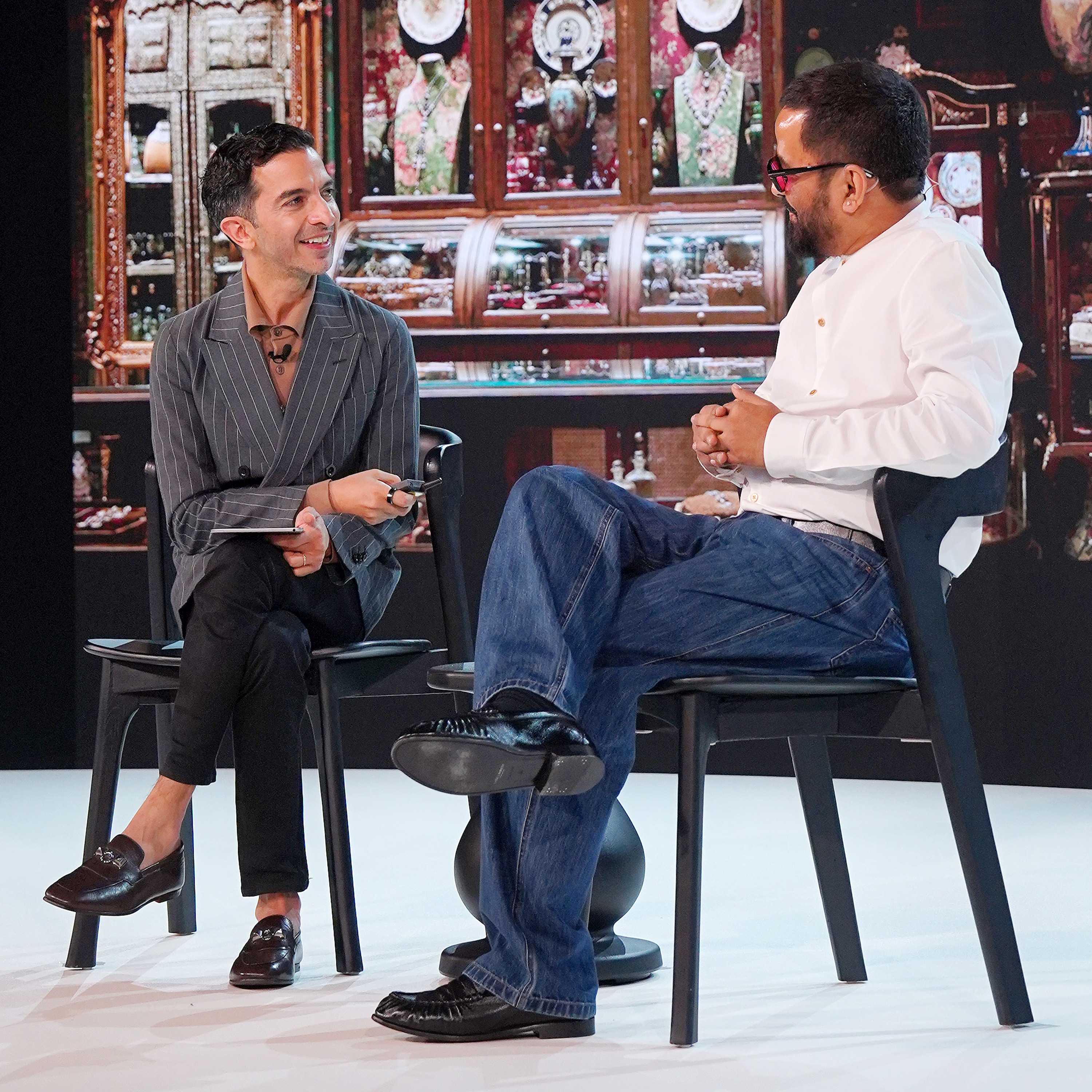
The Business of Fashion Podcast
Sabyasachi on Building a Global Brand from the Global South
00:23:14
Sabyasachi Mukherjee joins BoF founder and CEO Imran Amed at BoF CROSSROADS 2025 to explore the challenges of going global on your own terms and why he is ready to make a case for craft, culture and the rising power of the Global South.
Loading summary
Transcript39 lines
- [00:00]
Olivia Davies
Foreign.
- [00:04]
Imran Ahmed
Hi, this is Imran Ahmed, founder and CEO of the Business of Fashion. Welcome to the BOF podcast. It's Friday, April 11th. Born in the suburbs of Calcutta, India, Sabyasachi Mukherjee grew up in the rich cultural environment of the state of West Bengal. After attending fashion school, he focused on building his own brand with a small team and a big vision to create Indian fashion that honors tradition while setting a new global standard. The journey has not always been smooth. His first foray into the global market at New York fashion week in 2006 was dismissed by some critics as being too ethnic. But he remained undeterred, returning to India to build a business with power, presence and purpose. Known for his exquisite bridalwear, masterful storytelling and museum like flagship stores, Sabyasachi has built built a business that merges cultural preservation with contemporary luxury. And now he's back in New York, creating a sensation with his first store outside India. The reception has been much warmer this time, even if the core philosophy remains the same.
- [01:18]
Sabyasachi Mukherjee
The clothing hasn't changed at all, Imran. It's still the same. What's changed in people's perception? And I think nothing succeeds like success, because once you start having authority to tell people that this is the way you want things to happen, people stand up and listen to you. So I tell a lot young designers that keep holding onto your belief system because the only way you can succeed is to just stay strong. Because if you do not have a unique identity, you'll never be globally recognized.
- [01:47]
Imran Ahmed
This week on the BOF Podcast, I'm delighted to share this conversation with Sabya Sachi from BoF Crossroads 2025, which took place in Dubai this week. Bringing together top business and creative leaders to examine opportunities for fashion, beauty and luxury in the global. Sabyasachi and I explore the challenges of going global on your own terms. Why demonstrating value is key to luxury in India, and why he is ready to take his brand to the next level while making a case for craft culture and the rising power of the global South. Here's Sabyasachi Mukherjee on the BoF podcast.
- [02:27]
Olivia Davies
Welcome.
- [02:28]
Sabyasachi Mukherjee
Thank you. Good evening.
- [02:31]
Olivia Davies
I'm really excited about this one because I met Sabyasachi 19 years ago. We were both still figuring things out. BoF didn't even exist. I was trying to set up an incubator for young fashion designers and he was thinking about taking his nascent business already global in New York. And we met during New York Fashion Week with a legendary, sometimes fearsome PR named Kelly Coutrone. We looked at some of the collection. And then we went and we talked for two hours. And it's just been so remarkable and really amazing and inspiring just to see the change and development of what you've built. And I want to start at the very beginning. I want you to tell us a little bit about West Bengal and your childhood and when this idea that you might become a fashion designer first entered your mind.
- [03:37]
Sabyasachi Mukherjee
Just to give you context, I grew up in the suburbs of Calcutta. Calcutta was a very rich city. It still is. It's culturally probably the most important city in India because it was the British capital before the capital shifted to Delhi. Almost all the important Nobel laureates, policymakers, filmmakers, musicians, theater actors, revivalists, everybody came from that one city. But I grew up outside Calcutta. So to give you context, 10 years ago, I had a assistant who came to work with me from my old hometown, and I said that what's happening to our little town? He said, it's become very fashionable. We have a Levi's store now.
- [04:17]
Olivia Davies
A Levi, Yes.
- [04:19]
Sabyasachi Mukherjee
And so that's where we came from. And I had no idea that I would get this far, but there was a conviction. And when I got into doing fashion, I realized that there was such an enormous gap in the market, and I just worked very hard, and I said that, okay, I'm going to climb up the tree.
- [04:39]
Olivia Davies
So when I met you, I think you started your business in 2002. And so when I met you, it was September 2006, and you were already trying to take Sabyasachi global. And one could argue that first attempt at taking your brand global, like, it didn't click.
- [04:58]
Sabyasachi Mukherjee
No, it was a complete flop.
- [05:00]
Olivia Davies
What happened? Why did it flop?
- [05:04]
Sabyasachi Mukherjee
You know, it's the politics of fashion. Because I think sometimes talent alone doesn't help you succeed. You need a platform. You need a voice. When I first went into New York, everybody told me that my clothes would fail because they said, it's too Indian, it's too ethnic. Maybe I was way ahead of my time because there was not the kind of receptivity for this kind of clothing as it is today.
- [05:25]
Olivia Davies
When you said too ethnic, how did that make you feel? Like, what was your reaction when you hear something like that?
- [05:33]
Sabyasachi Mukherjee
You know, when I came out of West Bengal and when I moved into the national scene in India, I had pretty much the same reception because, you know, Calcutta was quite the armpit of fashion at that point of time. And so I'm used to it. So, you know, and I'm pretty resilient because, you know, people tell you that okay, this is not going to work. But you only know it's only going to work if it's your way. Because at the end of the day, people want a point of view. So I kept listening to people, but I kept doing what I wanted to do. But, you know, I was burning a lot of energy. And Susie Menkesh told me that, you know, why don't you go back to India? Why don't you start building your label? Why don't you become successful, famous, have money and power and position, and then you can come back and fight the beast. And today we have sellout exhibitions at Bertolf Goodman at Saks Fifth Avenue. The clothing hasn't changed at all, Imran. It's still the same. What's changed in people's perception? And I think nothing succeeds like success, because once you start having authority to tell people that this is the way you want things to happen, people stand up and listen to you. So I tell a lot of young designers that keep holding onto your belief system because the only way you can succeed is, is to just stay strong. Because if you do not have a unique identity, you'll never be globally recognized.
- [06:47]
Olivia Davies
You know what else I really like about that advice from Susie is that it focuses on the market that you already know and that already you already understand the customer. But also it's not about seeking validation from success in the West. And one of the key things that I find when I travel around these markets in the global south, there's still this almost post colonial wiring in people's head that I have not yet succeeded. If I don't build a business that succeeds in the west, my business isn't successful. And that advice from Susie, which I think was very good advice for all the reasons you mentioned, but also because the markets that we have available to us, whether that be in Central Asia or South Asia or Latin America, these are big markets. Earlier today, we saw the size of these markets, how quickly they're growing. And oftentimes that deeply wired colonial thing that's in people's heads prevents us from seeing the opportunity in our own backyard.
- [07:54]
Sabyasachi Mukherjee
Absolutely, I completely agree with you because I think now look at the way things have changed. Look at the way people look at India, look at the domestic market. Here, everybody's trying to make an entry. And I, I think when you're young, you're constantly looking for bigger validation from outside. But as you get older, you realize that you have to first win the battle within before you win the battle outside.
- [08:18]
Olivia Davies
Let's talk about the India market. Because as you say, maybe one of the top five questions I get asked now when I'm talking to people is what do you think of India? What's happening in India? What should my company do in India? And I think, you know, India remains somewhat of a mystery to people still. But as you, as you think about the transformation that's happened in India over the last 20 years, your business really exploded first when it came to focusing on the bridal business. I remember in 2013, I went to India and I wrote this article. It was called like, I forget, it was like the big fat, I don't know, $50 billion Indian wedding market. And when you returned to India, you focused on this market. This market has continued to grow and I know you have some additional thoughts on that market now. But tell us a little bit about how you've seen the luxury customer, the high end customer in India, change over the last 15, 20 years.
- [09:18]
Sabyasachi Mukherjee
So, you know, in my lifetime, I've done a lot of collaborations with the west. You know, whether it's in cosmetics, whether it's in footwear, fashion. And I keep telling people one thing that, you know, while you're very excited about the size of the market, please be aware of the fact that you're entering a very difficult country culturally, a very difficult country. I'll tell you the reason why I say that is because I think the Indian customer is probably one of the smartest in the world. You know, because for the Indian customer, I think they shop value. And you know, if your gross margins are going to be a combination of cost of goods and your intangibles, and if you're not going to talk about your intangible story well enough, the Indians are not going to buy you. And I think a lot of luxury brands have come into India and failed because all they did was that they advertised. But what they need to do is they need to have a stronger cultural connect with the country for people to understand why they should pay these kind of prices. Because the Indian customer has gone through a lot. You know, we've gone through the partition, we've gone through a lot of enormous loss of respect, financial respect, distress. And what it does, it makes you very resilient about who you are. And I think the Indian customer is very sharp, very smart, very savvy. And there's a misnomer about India that Indians buy cheap. That's not true at all. I think Indians buy value. So if you can come and show your value of your brand to India, Indians will open up their wallets Completely.
- [10:45]
Olivia Davies
And the other important point is that of course luxury is not new to India. Right. Luxury is part of the like, forgive the pun, but part of the fabric of Indian culture. Right. Almost everybody in India can have their own tailor made clothes. The idea of investing a lifetimes of savings into a wedding so that everyone has, is dressed well, feels good, has the right jewelry, the gift giving, the whole culture around luxury in India has been, it's centuries old. So how do international luxury brands find that cultural connect in a culture where luxury is already present?
- [11:31]
Sabyasachi Mukherjee
You know, I keep saying that you can't really sway India with marketing because we already are so evolved in our education and luxury. All I say is bring value. And if a lot of your value is about the intangibles of your brand, make sure that you tell the story well. Because at the end of the day, I think it's also a very emotional country. So if you connect through your storytelling, if you connect through the intangibles, that's the only way to win. Because there's nothing that the west can do that India can't do on its own. So if you're just going to bring big brands into the country and expect it to sell, that's not going to happen, unfortunately.
- [12:07]
Olivia Davies
Okay, well, I think you are probably India's greatest fashion storyteller. You know everything in your world. Every store, like if you look at all of the stores, the experiences you create, it's like a collection of beautiful things from everywhere. Tell us about the way you tell stories in this era when everyone is bombarded with imagery, bombarded with information. You tell stories through your shows, through your stores and through social media.
- [12:38]
Sabyasachi Mukherjee
We had the age of influence. It's totally and slowly moving away because I think the Instagram party's over now. We are moving into the age of intelligence and craft in the short term is going to suffer because we are going to be very excited about AI coming in. But I think where AI is going to last the least is the creative industry. Because we are all human beings and we are all going to go back to being human again because that's going to be the greatest luxury. After the age of intelligence, we are probably going to go into the age of wisdom. And I'm building Saby Sachi for that era where people become wise again and they understand the importance of human connections, human creativity, human evolution. And if you look at India, I was in a very important country in the Middle east and somebody there told me something that we've modernized very fast and very quickly. And what we have not been able to do is hold on or create culture. And I hear a lot of that conversation all over the world. And with India, the same thing is pretty much happening. If you go to Mumbai, all the old heritage buildings are being demolished for skyscrapers to come in. And I keep saying that, you know, culture is a part of the greatest, is going to be the greatest soft power of any country. And India has so much to offer. I preserve all of that in my store for the new generation to see. Because, you know, if you want to be selling craft, you need to sensitize people to the importance of craft, which is the reason why we build these immersive experiences to inspire, inspire people to understand that this is the India that we had destroyed and this is the India that we need to build again.
- [14:15]
Olivia Davies
I love that your international business expansion kind of took on a new inflection point recently. When you took an investment from the Aditya Birla group, you sold 51% of your company. Why did you decide to take that money? You didn't need to. Why did you decide to take that money? What are your plans to do that? I know, for example, I've got some of your jewelry collection here, which is part of the. One of the fastest growing parts of your business. But tell us about your plans for what you're going to do with this investment.
- [14:50]
Sabyasachi Mukherjee
Imran, I don't have any children and I have no one to give the business to. And I often feel that I don't own the business anymore because it belongs to the country. In terms of revenue, it might be a very small business, but in terms of its reverence and its influence, it's a very, very large business in India. Almost the entire country is extremely proud of what we've built. And I kept saying this to Kumar Mangalam that, you know, I'm giving you this business for safeguarding for the next generation. Because I told him that, you know, when I sold the business to him, I said, that doesn't belong to me, it doesn't belong to you. It belongs to the country. And I think in many ways it's doing a lot of things right that was done wrong to us in terms of culture. And often a big mistake that many entrepreneurs do is they hold onto a business for too long and they don't transition. They either transition when they're in difficult times financially or they transition when they're too old. I'm 51. I had decided by the time I was 45 to 50, I would give my business for safekeeping and spend the next 15 years transitioning, you know, because I'm finite. The business needs to be infinite. I want this business to last over the next few generations, maybe 200, 300 years. And this is all I've got. And this is what I want to give back to the country.
- [16:08]
Olivia Davies
You recently staged a pretty spectacular lavish show in Bombay earlier this this year in January. And one of the things that I noticed was there wasn't a lot of Indian silhouettes in that collection I had. It was his 25th anniversary show. I'd come to that show with expectation that it would be kind of a retrospective. But instead you created something that was looking to the future of the business and where you want to take it. So as you think about securing that legacy, is it about going after the Western market now and kind of picking up where you left off in New York all those years ago when it didn't click?
- [16:55]
Sabyasachi Mukherjee
Imran, I see a very big opportunity for India. Like I said, as we move into the world of wisdom, often a question that I ask myself is, what is the future customer of luxury going to buy? The customer is going to buy craft. The customer is going to buy authenticity. The customer is also going to buy from brands which are helping ecosystems of craft stay alive. You know, businesses need to become more and more human. And so many luxury brands have grown up disproportionately by just trading. Many of them don't even create products, but they outsource products. So brands which are going to have their own backyard of production, culture, heritage, are going to be brands of the future. And India has such a great opportunity. Where else do you go sourcing? And I think as the world starts looking for more and more geographical indication of craft, more and more provenance, I think there's a massive opportunity for Sabyasachi to leap from being a national brand to a global brand. And also people look at India in a very, very strange, cliched manner. I wanted to break that cliche because, you know, when I opened my store in New York, a lot of people looked at my store and said, wow, you built this in New York? Because most of them thought that all I deserved was a small little shack in Jersey City. And I think it's time to change that, because people often forget that some of the greatest luxury products were made for the Maharajas of India. Without their commissions, a lot of the European luxury brands would not have been able to build their legacy.
- [18:28]
Olivia Davies
Louis Vuitton, Cartier, all of these brands had these incredible relationships with that.
- [18:33]
Sabyasachi Mukherjee
Absolutely. And I think it's time to bring that back again because I think India is in a very strong position today, and I think I want to be able to push the pedal on that.
- [18:47]
Olivia Davies
Moving into international markets, as you've done, can be treacherous. When you and I spoke last week, you were in the throes of repricing your products, all of which were destined for the US because of the tariffs that were announced last Wednesday. Subsequently, yesterday, the tariffs were paused for 90 days. We're all trying to figure out how to navigate all this. I mean, I'm just curious, from your vantage point, how are you navigating this? Because this kind of makes operating as an entrepreneur, as a business person, as a designer. Making things in India right now is quite a complicated situation. How are you equipped to deal with that?
- [19:34]
Sabyasachi Mukherjee
Well, we are better off than many countries, I can only tell you that. But I have only one comment here. Products that create soft power, especially products that are made with craft. I think there should be free trade between every country in the world. I think today, globally, everybody's excited about a diverse world. We do not want to live in a monoculture. And I think sometimes we also need to think as to what are we leaving behind for the next generation. If you do not let craft thrive, if you do not let culture thrive in different parts of the world, there'll be no meaning for travel, there'll be no meaning for discovery. And I think that while there are certain things that can be put under tariff, I think businesses which are made with craft and which are made with local cultures should be exempted so that we can let them thrive, and we can make the world a more richer, diverse, and a meaningful place to live in. Thank you.
- [20:36]
Olivia Davies
Thank you. I heard an interesting statistic the other day. I think we talk about the scale of the US Economy and how overwhelmingly dominant it is. But then I forget which podcast I was listening to. They said, actually, in terms of the percent of global trade, the US only represents 13% of global trade, which means 87% of the trade that happens often between countries in these regions that we're focused on here today make up the vast majority of the trade in the world. So the other thing that I think is important is that as you think about expanding and growing your business, how can you think about other parts of this global south region that have an inherent value for craft, that understand the history and heritage of the kinds of cultures we're talking about? What plans do you have for expansion outside of the West?
- [21:36]
Sabyasachi Mukherjee
So, Imran, we are. And this didn't happen because of the crisis, but we were deeply planning on moving more eastwards. And you know, I think the Global south is such a dominating market. You know, I want to make my business very big in the Middle east as well because you know, we have a lot of royal families from different parts of Middle east who are already our customers. And I have really been reticent about expanding too fast because the craft based business, I wanted to keep my ecosystem alive first because you can't really turn off the volume because you have to train people. But having said that, only when we have a crisis do we start realizing that this is not business as usual anymore and we have to look for other things. I think this also becomes a wonderful opportunity for us to say that we can together create our own dominance. And many times what we do is we realize that the solution only lies in the west, not knowing how much stronger the solution is within our ecosystem. I think a lot of people, a lot of countries, designers, markets, finance people, influencers, everybody will come together to push up the might of the Global South. It's going to happen for sure.
- [22:48]
Olivia Davies
I hope so and I'm grateful for your time. And I think you're off to California tomorrow morning. So thank you for stopping here on the way and congratulations on your success.
- [22:59]
Sabyasachi Mukherjee
Thank you. Thank you.
- [23:05]
Imran Ahmed
The BoF podcast is edited and produced.
- [23:07]
Olivia Davies
By Olivia Davies and Eric Brea.
- [23:17]
Eric Brea
Now at Verizon, we have some big news for your peace of mind. For all our customers, existing and new. We're locking in low prices for three years guaranteed on my plan and my home. That's future. You peace of mind and everyone can save on a brand new phone on my plan when you trade in any phone from one of our top brands, that's new phone peace of mind. Because at Verizon, whether you're already a customer or you're just joining us, we got you. Visit Verizon today. Price guarantee applies to then current base monthly rate. Additional terms and conditions apply for all offers. The last thing you want to hear when you need your auto insurance most is a robot with countless irrelevant menu options. Which is why with USA auto insurance, you'll get great service that is easy and reliable all at the touch of a button. Get a quote today restrictions apply.