← The Business of Fashion Podcast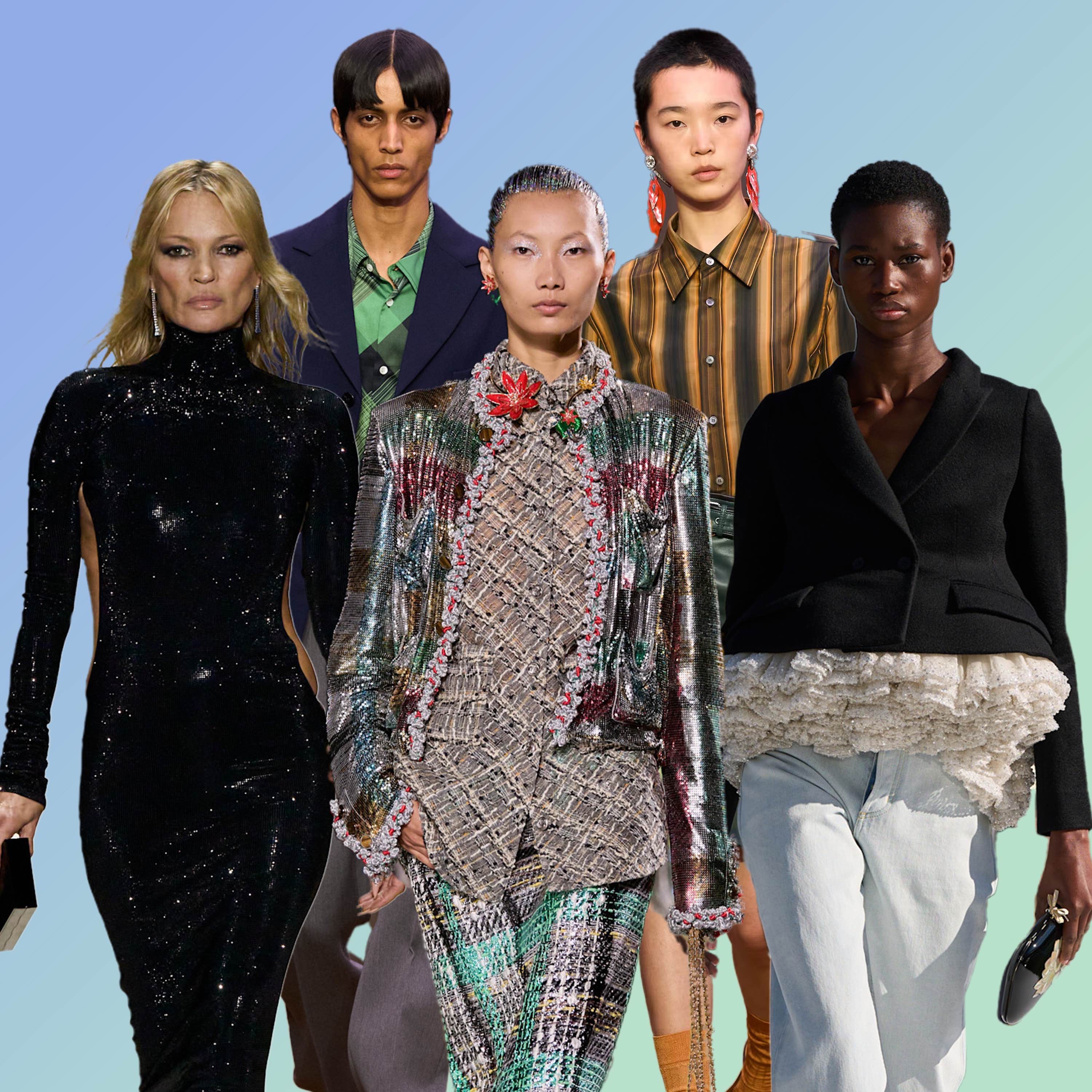
The Business of Fashion Podcast
The Designers and Brands That Defined the Season
00:54:24
In a post-fashion month debrief, BoF founder Imran Amed and editor-at-large Tim Blanks assess how the biggest houses are bedding in under new creative leadership at Chanel, Gucci, Dior and more.
Loading summary
Transcript119 lines
- [00:00]
Macy's Fashion Expert
I always think spring is the perfect excuse to dress a little softer and a little bit more romantically. And apparently Macy's fashion experts are saying that pastel dream is the trend. To know right now. What I love about it, it's not really going like full head to toe pastel. It's more about those softer details that make an outfit feel fresh and a bit elevated. Think delicate florals, lace ruffles, and sheer layers alongside flowy dresses or tailored pieces in lighter tones. It feels polished, pretty and very spring, but still easy to make your own. And you'll find it all at Macy's.
- [00:43]
Imran Ahmed
Hi, this is Imran Ahmed, founder and CEO of the Business of Fashion. Welcome to the BoF Podcast. It's Friday, March 13th. After a season shaped less by the anticipation of designer debuts and more by their second and third chapters, Tim Blanks and I sat down, as always, to take stock of the fashion month. That was.
- [01:04]
Tim Blanks
I felt that this season, it was kind of one note for me, in a funny way, there were a couple of things that, you know, in terms of being surprised. I wasn't surprised by the collection. That was my favorite collection because I expected it to be. Given everything that's happened up to this
- [01:22]
Imran Ahmed
point, I. E. Chanel.
- [01:24]
Tim Blanks
Yeah, Chanel. But there were other collections that. That one in particular that really surprised me. And it just reminded me that in that golden age that I bleat on about like an incontinent sheep, the 90s, you would go to a day which was just bang, bang, bang, bang, bang. You know, that's what I still crave. Obviously, that sense of design is just working at a peak.
- [01:49]
Imran Ahmed
But if last season was driven by anticipation, this one was more revealing. In addition to witnessing how their creative ideas are evolving, Disney new designers visions are now landing in stores, meeting customers, and beginning to show whether they can convert attention into commercial traction. Here's Tim Blanks and I on the designers and brands that define the season here on the BoF podcast. Well, hello, Tim Blanks. How are you? Have you recovered from Fashion Week?
- [02:22]
Tim Blanks
Yes, of course I have. I woke up very early this morning. I was still on some kind of different time zone situation. But no, I recovered. I whisked off my last few reviews last night, so it gave me a feeling of accomplishment.
- [02:40]
Imran Ahmed
And as a season, how did it feel to you overall? Before we go into the detail, what are your reflections? Because, of course, last season was this, like, mega season with all of those debuts.
- [02:53]
Tim Blanks
And then between that season and this season, we had an incredible couture season. Yeah, and maybe it's because couture is a little less pressured than ready to wear. I was really taken by the couture, and I was really impressed at how a sort of arena of fashion, which has often been considered to be slightly. Not as meaningful, in a funny way, as ready to wear or not, as doesn't have as much to do with people's lives, was so alive and vibrant. And I felt that this season, it was kind of one note for me, in a funny way, there were a couple of things that, you know, in terms of being surprised. I wasn't surprised by the collection. That was my favorite collection, because I expected it to be, given everything that's happened up to this point.
- [03:46]
Imran Ahmed
That is Chanel.
- [03:47]
Tim Blanks
Yeah, Chanel. But there were other collections that. There was one in particular that really surprised me, and it just reminded me that in that golden age that I bleat on about like an incontinent sheep, the 90s, you would go to a day which was just bang, bang, bang, bang, bang, you know? You know, that's what I still crave, obviously, that sense of surprise and that sense of design is just working at a peak without having to have all these other considerations in their heads, which people have to have in their heads now, which is obviously distracting and slightly numbing in a way. And, you know, it's funny. You watch shows and you like them, but you find yourself making excuses for why they weren't better than they were. And it's not necessarily a position that I'm comfortable being in, but. And it sounds a bit kind of patronizing anyway when I say it, but nevertheless, let's roll on. And.
- [04:49]
Imran Ahmed
Well, I think. I think also, you know, in my reflection, because there were a lot of new things last season, and so.
- [04:58]
Tim Blanks
But were they, well, new insofar New
- [05:03]
Imran Ahmed
insofar as they were new combinations. Right. Maybe not new insofar as what we saw. So, like, there was the anticipation of something.
- [05:10]
Tim Blanks
Yeah, well, there was a slightly sort of misguided sense that because the musical chairs had stopped at different cushions, that it was all gonna be va, va, va vumski.
- [05:20]
Imran Ahmed
Yeah, well, the music had stopped everywhere. There were all of these designers we knew in new seats, so there was an anticipation that something was gonna happen. And so for me, last season was, like, about the anticipation of something new. Cause I agree with you. Like, I didn't leave this season going, wow, that was an amazing. But I did leave with the impression that for so many of the designers that were onto their second or third shows, like, we were Starting to see how their vision is kind of setting in or bedding in. And so I was curious from that perspective and then also to have the simultaneous availability of many of these designers products in the store for the first time and to hear people talking about that. And I was doing a lot of store visits to say, well, what does Jack and Lazaro's new version of the Amazona? What does that look like in a Loewe store? What does Mathieu Blasi's universe of Chanel products? How do those fit into the Peter Marino stores? So I agree with you. It wasn't like a blockbuster season and there weren't as many debuts or, you know, the anticipation of something new. But it was still interesting just to see how it's all bedding in.
- [06:37]
Tim Blanks
And so funny you mentioned music because it was a season of incredible soundtracks. Mm. It was a season of really big soundtracks. I just. I sat there thinking, what is this stuff? It's incredible. I mean, really quite aggressive, fabulous music, you know, which you could take as a sign of confidence. You know, it's not like a designer is attempting to hornswoggle an audience with his soundtrack. But definitely it was a season I would remember the remember for its music.
- [07:12]
Imran Ahmed
What will you remember the most?
- [07:14]
Tim Blanks
Actually, Louis Vuitton. It was like. It was like a ceremony and the music was like a ceremonial. I felt it was like a ceremonial march in Babylon or something. It was so big and brassy and quite how it fitted with the set or the clothes was something that teased me. That was one I loved. And there were many more. I mean, now you put me on the spot.
- [07:44]
Imran Ahmed
Well, they'll come to you when we start discussing some of the shows. So should we go to the show that you said you had even at the beginning of the scene season Expected was going to be your favorite. And it delivered on that, you know, and that was the Chanel show, which I think, you know, as I was alluding to earlier, coincided with the availability of Matthew Blasey's first collection of Ready to Wear bags. I mean, the hysteria was. It was. I haven't seen anything like that since.
- [08:16]
Tim Blanks
It was like. It was like sort of Filene's Basement. I mean, it was incredible. It was just a. It was just a grab, you know, that. And that was great to see because. Well, I didn't see it.
- [08:30]
Imran Ahmed
I saw it.
- [08:30]
Tim Blanks
Did you?
- [08:31]
Imran Ahmed
Yeah, I went to the store. I didn't go to the store when all of the other fashion people were there. I went to the store on Avenue Montaigne. At an unannounced, unplanned, like, random time of day just to kind of get a vibe check. And Chanel stores were always quite busy, even, you know, before his arrival. But as I walked up to the first floor of the store on Avenue Montaigne, just to start having a look around, a woman was just putting on one of those beautiful black wool blazers. And it was kind of embellished with feathers at the bottom of the blazer in the most, like, beautifully random way. And she literally gasped when she put it on.
- [09:16]
Tim Blanks
Wow.
- [09:17]
Imran Ahmed
And looked in the mirror. And then she saw me looking at her and she's like, oh, I'm so sorry. And I'm like, no, it looks amazing on you. And as you looked around the store, the way customers were engaging with that product, the shoes, the bags, like, I haven't seen anything like that since Alessandro Michele at Gucci. I mean, it was.
- [09:39]
Tim Blanks
Do you think she was an old Chanel customer or was she a new Chanel customer?
- [09:42]
Imran Ahmed
She was a new customer. She was a young woman. She was like, she'd probably always admired Chanel. She probably had a 255 bag. But I don't think she was the kind of woman that would have bought Ready to Wear before the number of editors that were buying those Chanel blazers, you know, and like, I always knew the bags would sell, but it was the Ready to Wear that I was like, wow, like, people are really like, into this. You know, like young people didn't want to wear the Ready to Wear before. You know, this is. This was a big change.
- [10:13]
Tim Blanks
But there's a thing that he does that, I mean, I would respond to as a woman and probably as a man, if I kind of was into clothes as much as other people are. But, you know, there was a beautiful tweed jacket. I don't remember what the effect of the tweed was because none of the tweeds were what they seemed to be. Every single tweed was treated in some way that was kind of quite awe inspiring. But this jacket was lined in a print taken from a drawing that one of Chanel's friends, an illustrator called Sam, had made of her. And he kind of depicted her as a black swan, a little bit sort of an abstract version of her, but kind of as a black swan. Like there's a swan with Chanel's hair and stuff. And it was such an. A beautiful kind of caricature of her. And Matthieu had found this, made it into a silk scarf and used it as a lining for a jacket, which was then being Worn under one of the overshirts, which he called the new Chanel jacket. Just a very casual introduction to the Chanel vocabulary, which you could really imagine connecting with people, but you would have this jacket on, knowing that it was lined in this way. And obviously, you'd throw your jacket over a chair so people could see how it was lined. But that lining would be your secret.
- [11:35]
Imran Ahmed
Yeah.
- [11:35]
Tim Blanks
And, you know, that kind of thing. He says, we don't make fashion for Instagram.
- [11:40]
Imran Ahmed
Yeah.
- [11:41]
Tim Blanks
And I think that that kind of thing will be eliciting an incredible response from people.
- [11:49]
Imran Ahmed
Well, you hear about those kinds of gestures in fashion in smaller brands where they'll, like, you know, sew something into the lining or, you know, put your initials in the jacket or whatever it might be. But that kind of gesture at a big brand like Chanel is quite special.
- [12:07]
Tim Blanks
Right.
- [12:07]
Imran Ahmed
And so the thing is, he might not be designing for Instagram, but the way. Let's talk about the show. Because the way the show translates online, you know, unlike a lot of other shows that we see that look good in person, but the way they translate online. He also manages to get the online masses excited, too, which is interesting.
- [12:31]
Tim Blanks
Although I would say there's this real strange train of thought which says, what was that set all about? And I'm kind of amazed to read these comments, like, I didn't understand the set. What was that? I didn't get it at all from people whose opinion I kind of value.
- [12:47]
Imran Ahmed
But he told you about the set, so why don't you tell us?
- [12:50]
Tim Blanks
Yeah, I mean, the idea was a work in progress, and I felt the set was kind of like a Meccano set like kids used to make. You know, they used to build. When kids would. They would. You know, kids would build something, like, from Meccano and mature. Used Lego and Playmobil as well. I mean, he had those. He said he had a straight older brother, so his older brother introduced him to all these constructive toys. But at the same time, there was this sort of, like, Mondrian thing. I thought the set was. It was simple, it was huge. And it was very clear to me that it was cranes and things, building, you know, the idea of building something. And he's building this new world for Chanel so brilliantly, I think. I mean, yeah, I loved Chanel shows in the past. I mean, Karl's shows, that they were fun and they were kind of extravagant, and there was supermodels doing supermodel y things. But this is.
- [13:52]
Imran Ahmed
This is a different.
- [13:53]
Tim Blanks
Very different mood. This feels very much in keeping with another thing which I think is very interesting in fashion at the moment. And I think that much of Prada nailed it with the Miu Miu show. A sort of humanist streak, that fashion is kind of lowering its eyesight to a human level.
- [14:12]
Imran Ahmed
I mean, it's interesting because the way Karl used to use the Grand Palais, which is an enormous space, the way he would fill that space with a spaceship or an iceberg or a beach or a supermarket, I mean, it was huge. And he could use that whole space and really pack it together. Mathieu tends to make these much more pared back sets that still use the space, but it's not quite as overpowering. And so the focus is much more on the clothes. Whereas in Carl's shows you couldn't help but be distracted by the spaceship taking off in the center of the, the Grand Palais. And I think my one, my one wish for his shows is that given the humanist tendency you're talking about and given the like level of detail and care that every garment is made with you, it feels quite far away. You know, the clothes, the clothes feel quite distant, you know, and I know they have to use that space because that's what Chanel always shows. But like it'd be nice to be more close up to those clothes. And I guess that's maybe it's not possible given the scale of the show and the scale of the venue and the number of people. But there's so much that I think you. I mean, I didn't do the preview this time. I know you spent some time with Mathieu before, but I didn't get a chance to see things up close this time, which I kind of missed.
- [15:35]
Tim Blanks
You would never. However close you were, I don't think you would ever appreciate the depth of detail in the clothing. I mean, the tweed, where he stripped out strands and printed those strands on the lining underneath. So it was still the tweed, the density of the tweed, but it was in two levels. And one of the strands was this particular jacket. One of the strands was red and it was printed on the lining and you could see the red and it was moving under the top layer. So it had what he called this kinetic effect. The movement is exquisite. I mean, he wanted to recreate a sort of Jackson Pollock painting. Oh yeah, I remember in a Chanel jacket. You know, the depth of thought, the depth of delivery. It's really, really inspiring. I think it, you know, you can look at that and you can think of applying that sort of open mindedness to all sorts of things. I mean, the way he makes clothes is a way you could make music, or a way you could write books or a way you could make movies. And it's exciting to see where it came from so recently, you know, it's not been that long. And you think when it was so complete at the beginning, and you're thinking, how can he expand on this? How can he build? How can he grow this world? How can he evolve this train of thought without becoming repetitive or boring people? And I really think he's a really, really special designer and a really kind of. It's going to be. It's going to be absolutely fascinating following that career as it evolves. He was even talking about how he's mastering all of these elements of Chanel. He is just so immersed in her. And when he's absorbed all of that, osmosed it, so it's become part of his DNA. He's looking forward to going on, moving on from that and doing something else, you know, and whatever that something else is, is so packed with promise, you know, it's quite exciting to look forward to that.
- [17:46]
Imran Ahmed
He's incredibly thoughtful. And I think also the focus that he's able to have. If you kind of compare his role at Chanel with what Jonathan Anderson's been tasked to do at Dior, which is a much broader proposition. Cause it includes men's, and it includes, I think, a wider repositioning of Dior as a house. You can kind of see, on the one hand, Mathieu's got this incredible focus because he's just focusing on that, like, top layer of fashion at Chanel. So this was Jonathan's fifth Dior collection. How are you evaluating or making sense of his evolution at that other great storied French couture house?
- [18:31]
Tim Blanks
I think it's incredible the way he's managed to insinuate himself into Dior. His own particular idiosyncrasies. I guess you see it most clearly in the accessories. But the lily pad shoes, that almost could be, you know, some of the surrealist footwear from his Loewe days or from his own collections. I think that he has signatures already. He has signatures at Dior, and they're challenging, as they should be. And he has a very kind of broad view of the world. I mean, his particular interests and, say, craft, for example, the way that his fabrics have evolved. So, I mean, I thought the fabrics in the show were interesting. They were like couture fabrics for Ready to wear. We were lucky that it was a glorious day and he was showing. I mean, the set. Oh, my God.
- [19:33]
Imran Ahmed
Yeah.
- [19:34]
Tim Blanks
That whole incredible fountain with the lily pads and the 30 degree sunlight fricasseeing the front row.
- [19:43]
Imran Ahmed
Well, it was actually only 18 degrees, but when it was like, when it was when the light was going through the greenhouse that we were in, all of a sudden it felt like the middle of summer. But you're right that the fabrics, I mean, they were just glistening in the light. It was incredible. It was incredible.
- [20:04]
Tim Blanks
And he has a fondness for. He has a fondness for a few silhouettes that are not easy silhouettes. There's always been a fearlessness about him, and I really like that sense that's coming through in these collections of fearlessness.
- [20:20]
Imran Ahmed
He's a real risk taker. Yeah.
- [20:22]
Tim Blanks
I don't think he even knows it's risk taking. I think that's just the way he is.
- [20:26]
Imran Ahmed
Yeah. And I think what he said to me when we chatted earlier this year was like, he's more of an iterative designer. Like, he just tries a lot of stuff and it helps him refine. And even though we're five collections in, it's still only nine months into his role at Dior. I think he took over. He started the men's last March. You know, that's when he started working. Like, the amount that he's already brought to that brand in such a short period of time is pretty extraordinary, given where it was just before. And I think the ideas, like, not everything is successful, but I think that's the way he progresses is he tries lots of things. So maybe, yes, some of those silhouettes are challenging, but he's refining. He's a refiner.
- [21:18]
Tim Blanks
Well, you imagine in his early days he worked with Manuela Pavese, who was Muccia Prada's best friend. And, you know, imagine Muchia Prada doing Dior and imagine her sensibility applied to a monolith like Christian Dior. And you kind of. That's what we're kind of getting with Jonathan. I think we're getting a magpie sensibility applied to a monolith of a brand.
- [21:42]
Imran Ahmed
Yeah, that's a very interesting way of putting it, actually. I wish in that show, like, as impressive as I found the set, I always find it harder to engage with fashion shows when I think it was Nicolas Ghesquierre that did a show like that once, like a Philippe Perenno set. And like, it was all around the Coeur Carre du Louvre. And we were. You can only see a little section of it. Like everything else, you're seeing everything from really far away. I liked his other show venues better. Cause I felt more of the energy of the show because it was just tighter. I think something was a bit lost in that diffused. As impressive as it was to look at from the sky and, you know,
- [22:24]
Tim Blanks
imagine Louis XIV looking at that fashion show set. I mean, Louis XIV would have recognized a kindred spirit there. Reactivating that enormous fountain area, not with the actual fountain, but with water and fake lily pads and things. It was so.
- [22:42]
Imran Ahmed
It was very cinematic on the live stream, and it was very impressive when you looked at it when you walked in. But as a show experience, I felt like something was lost in that bit. We'll be right back with more on the BoF podcast. Okay. Well, clearly, probably the most anticipated moment of the entire season was Demna's Gucci show in Milan. We, of course, had a moment with Demna last September with the La Familia collection and the film that he made, which, you know, I think everyone was quite taken with and had quite a lot of excitement and energy around it, more than people were perhaps expecting from what had been billed to us as a first step as opposed to like a The full vision. This show in Milan this season was supposed to be Demna's first reveal of his new vision for Gucci, which, it goes without saying, is a brand that has been challenged. And, you know, as BoF has been reporting, the sales are down more than 40% from their peak a few years ago. So there is a big task for Demna and his CEO, Francesca Bellettini. You spent a lot of time with Demna before this show, and, you know, you did an incredible, extraordinary interview with him that was so revealing for me in terms of understanding that show, which it was a very polarizing show. Instantly, people were still talking about it in the final days of Paris. A lot of people did not like that show. But with the time you spent with Demna and the additional understanding you have around what he was trying to say, Tim, decode the Demna show at Gucci for us.
- [24:37]
Tim Blanks
Please don't do that to me. I'm just a medium. I'm not an interpreter. What we talked about the day before was not necessarily what we saw. And I said to him, did you change things? And he said, yes, I did make some changes, including changing the music at the end of the show, which set the end of the show at a different register. I think in his mind, he was making a show about Italian fashion and about Italians anyway. Like the beauty, for example. He described it as being like a Sort of Gina Lollobrigida beauty. And I thought about that after seeing the show and I was looking at the pictures, I thought it came across better in pictures in a way than it actually did while we were watching it because this catwalk was so long and you had so long to watch things going past. And I would say it was a shock. You know, like you were saying, the commentary, the comment, the fashion commentariat hasn't died down. People are still going to town on that show, taking it so personally. Friends again, these friends whose opinions I value. Not of. Not the same group of friends I mentioned last time, whose opinion I value. This is a different lot. They said Demna is the cleverest man in fashion and he knows exactly what he's doing. So I am really curious to see what happens when that collection hits stores.
- [26:07]
Imran Ahmed
Some of it has already hit stores, Tim. Like they did a see now buy now drop, right?
- [26:11]
Tim Blanks
Yeah.
- [26:11]
Imran Ahmed
And what happened, you know, well, we've done some analysis. There were like, you know, visits to the website were up 50%, which one would expect when a brand is putting a bunch of money behind a big, big event. There's probably a lot of discussion about Gucci online that led people to go to the website. What I don't know is how many people went from visiting the website to converting to purchasing something. And I guess we won't get a good readout of that until the next quarterly report from caring. You know, I do think it was interesting that they had thought in advance about making some of that collection available right away, because the C9 buy now formula is something that, you know, industries experimented with in the past. But I think over at Gucci, I think there's a lot of expectation that the vision that Demna's been working on is already going to be able to be translated into something that people can buy because there's no more time to wait. It is such a critical, urgent situation at Gucci at the moment that if they don't find that they're getting some traction, you know, that Neil Caring has some really, really big problems to address. So I don't know what the conversion rates were. We heard that there was a good response at the VIP Vic, you know, re see opportunity and that there was a good response there. But we don't know the conversion rate yet. But let's see.
- [27:38]
Tim Blanks
Well, one of the things we talked about the day before we were talking about Ryan Murphy's show the beauty and this notebook is Demna. You know, people were calling that the ozempic Collection because of the bodies. And he's very conscious of the fact that he. I mean, he has his whole exercise with therapy and with losing weight and so on, has been about falling in love with himself, learning to love himself after a lifetime of really not loving himself. Actually the exact opposite, and equating a sort of physical appeal with the ability to attract people for sex. Basically, this correlation between beauty and sex, which is the core of the Ryan Murphy show, when the people catch this virus called the Beauty, and transform into beautiful creatures, obviously a particular standard of beauty, it's not everybody's standard, it's a very la standard of beauty. Instantly they start having tons of. Tons of sex and spreading the virus to more people. So there's equation of beauty, sex and the sort of lethality, you know, danger. And I thought that. I don't know how much he's been watching the Beauty, but I did get that from that show that they were beautiful people. Like, maybe it's. I don't know if it's a conventional idea of beauty, but they were sort of very sexual beautiful people. And you can imagine a world in which they would be very attractive to other people. And, I mean, the day before, we talked a lot about his belief in community, which is something he's always done right from the very beginning with Vetement. He was. He always had communities in his shows. He was making communities of people. And that. That show was very clear about its communities. I thought there were. There were skaters, there were glamour pusses, there were trophy wives, There were these strange boys in glitter outfits with bare feet, like toy boys. There was. There was a. There was a sort of very cinematic quality to the show in the moment. I was a bit taken aback because it wasn't quite what we'd been talking about earlier. And I thought about it afterwards and there is so much in fashion that I can look at and say, well, it's not for me, but I appreciate that it's for someone. And I think I have to say that that collection is one of those that I feel there's a world for it. I think in particular, just as one or two looks that really stayed with me in the same way that the Beauty has these really powerful images, these really sort of quite almost toxic images, but they're super powerful and you sort of dream about them. I think it's going to be interesting to see what he does in his show in New York, because when he talked about that, he mentioned Gucci core as being the next part of the story.
- [30:37]
Imran Ahmed
Yeah, what I Understand is that if La Familia was really about revisiting the archive and this show was about setting that fashion vision for Gucci.
- [30:53]
Tim Blanks
And then there was the pre fall, which was Gucci generation, which was all about the Tom Ford years.
- [30:57]
Imran Ahmed
Exactly. And then Gucci core is more about the core proposition. So it's happening during the cruise shows, but it's. I think it's going to be the more relatable part of what he's proposing for Gucci.
- [31:12]
Tim Blanks
Well, he said Gucci core is the women and men in Milan who've been wearing Gucci for 100 years. He said it's those people who go to the shops to buy the pussy Bow blouse that they've been buying from Gucci forever. And the suits, and they're still quite eccentric in the way they dress. They're perfectly groomed, still quite eccentric. And shops have always sold this, but you have to look for it in the store. And I think he just wants to give it a little more primacy, perhaps, I guess.
- [31:44]
Imran Ahmed
Mike, I agree with your view that that is a Gucci for someone. I just wonder how many of those someones there are. And I wonder if as a fashion vision, it's a bit too narrow for a brand as big as Gucci like to go back to the scale that they have the ambition to grow that brand back to about 10 billion euros or more. I wonder at that price point, with that kind of product, how are they going to build this universe around the core proposition and the fashion proposition? Is it going to be enough? The thing that I thought was so successful under Alessandro Michele's tenure that saw that business grow to unseen heights was that anybody could walk into the Gucci store and get one of those furry loafer sliders or some of the beautiful, colorful knitwear or the embellished bags. You know, that was. There was something for everybody. And I just, I want to see more from Demna's Gucci that that's more accessible. I think when Demna was at Balenciaga and he, you know, managed to turn that into a phenomenon unlike the industry has ever seen. Like there was that moment, that first Balenciaga show when I think we all kind of stopped in our tracks. We kind of had a taste of what he did through vetements. But to see that projected through a high end luxury brand by Balenciaga, like that was a shifting point in fashion. Like you can remember what fashion was before and after that and how it was so influential in the industry. But Balenciaga was a brand doing A few hundred million euros, and he managed to scale it to, like, you know, around 2 billion euros of revenue. But, you know, Gucci's a 6 billion euro business that wants to be a 10 or 15 billion euro business. So, like, how are they going to take this somewhat narrow, specialized, and very, very appealing vision to a certain generation of people that maybe I don't fall into, so maybe doesn't resonate as much with me. How are they going to make that something for a brighter group of people? That's what I think remains to be seen. And you're right that we need to see what happens with this Gucci core collection to maybe get the full picture of the strategy they have in mind.
- [34:17]
Tim Blanks
Oh, he did bring back those first sliders you were talking about.
- [34:19]
Imran Ahmed
Yeah, I saw those. They were. They were extra long, I think, though, right?
- [34:23]
Tim Blanks
Extra long, yes.
- [34:25]
Macy's Fashion Expert
Yeah.
- [34:25]
Imran Ahmed
Well, that kind of covers the three mega brands. There were other debuts this season, Tim, that. That's worth chatting about quickly. We both attended Maril Roga's first show for Marnie, and you also had some time with her. As someone who was a follower of Consuelo Castiglioni's Marnie, the founder of Marnie. Like, how well do you think she was able to channel the original proposition that the brand was founded upon?
- [34:55]
Tim Blanks
Well, I've loved Meryl Roger's work, and I'm so happy she got this gig because she just deserves every break that fashion can give her. And I also like that she was a fan of Consuelo's for a long. I mean, the first thing she ever bought with her own money was a pair of mane shoes. It did highlight that there was a particular quality about Consuelo's work there, a kind of idiosyncratic sophistication, which I don't think Meryl has yet. Marnie was often a real head scratcher in the most fabulous way. Consuela would use, you know, the most expensive fabrics mixed up with vinyl or something. She just had this really sort of broad perspective on things that I think Meryl will grow into. One thing I liked about the collection is it did feel like it would appeal to a new audience on its own merits, not from people necessarily going into saying, oh, Mani's, you know, because, remember, there was that wonderful interregnum with Francesco Risso that was so idiosyncratic, but I think that was a cause celebre, perhaps more than a strong commercial proposition, which I feel Ameril has more of a capacity to do that, but I think she will evolve in that job. And I think she's a kindred spirit. And it's not going to be one of those transformative experiences for the brand, and nor will it be picking up where Consuelo left off or even bringing in things that Francesco did. It will be something that's true, but new.
- [36:45]
Imran Ahmed
Yeah. And I think it feels unique in the market context. Like, when I love the way she puts things together. There were pieces in there. I was quite drawn. I was just drawn to it. And when I saw the way things were put together and styled on that cast of characters in that show, I wanted to dress like that. You know, I just. There was something quite appealing to me about, you know, the way it was all crafted. I think it's an interesting start, a really good start. Fendi, Marie Grazia Curie, obviously, you know, one of the most successful designers of the last decade, having, you know, really brought commercial success to Dior, unlike anything that we've seen ever at that brand. She had her first show at Fendi and, you know, she did an interview with Robert Williams, our luxury correspondent, saying. And the first quote in the story was, I am not an entertainment designer. You know, she's quite defiant in the way, you know, she's trying to do her work. And I think she's have. She wants nothing to do with the scene and spectacle of these massive shows. Like, she's really focused on the collections she designs. You weren't there, but I'm sure you had a look at it. I mean, my view, for what it's worth, was that for all those customers that are missing what Mario Grazia did at Dior, there was a lot for them to like at Fendi. And Fendi hasn't been a ready to wear brand, really. It's, you know, it's a. It's a leather goods and I guess, you know, fur business mostly, historically. But, you know, there's, you know, there's an opportunity for Fendi. I think those customers that are looking for lace dresses and, you know, a wardrobe, they'll find plenty to like at her. At her Fendi.
- [38:37]
Tim Blanks
Well, I think Sylvia Fendi and Kim Jones did take it in a particular direction that was, I thought, quite successful, kind of cinematic. And what. What instantly comes across with Maria Grazia is how rigorous it was, how monochrome it was. Looking at the pictures, I found it very, very strict, which is an interesting proposition. I don't know if that sort of strictness is what people are looking for right now. But, you know, she. It's like, it's Interesting to watching, you know, Maria Grazia and Pierpaolo Paccioli had working together at Valentino all those years and seeing their different, their different career paths since they separated, that's been a very interesting thing over the last decade or so. And I found that Fendi was just a little strict.
- [39:35]
Imran Ahmed
Yeah, it wasn't going to get your fashion heart racing. And you know, to be, you know, honest, it never got my fashion heart racing. She never got my fashion heart racing when she was at Dior either. But I do think she's an excellent designer, notwithstanding the strictness. Like, I think there's a really clear proposition there.
- [39:58]
Tim Blanks
Oh, absolutely, absolutely. Perfectly clear. Absolute clarity.
- [40:05]
Imran Ahmed
Since you mentioned Piero Paolo, it might be a good opportunity to talk about Balenciaga and the Piero Paolo match because that's for me completely unclear what they are trying to do there. And it's, you know, I have to say, it's like a really huge challenge that Pierre Paolo has because clearly Balenciaga has built the house in the House of Demna. And you know, the brand, as so many people around, around the world know it is through the lens that Demna put onto it. And so I think the history of the brand before that, which, you know, I think you've all, you've often told me crystal ball Balenciaga is, you know, your favorite designer or one of your favorite designers ever. Like, what the House of Balenciaga represents and what Demna brought to it, they intersected in an interesting way during Demna's tenure. But I think now trying to bring someone else in to cater to that Demna customer, which is, I think, what they're trying to do, while also bringing in what Pierpaolo is known for during his time at Valentino. It's a bit confounding that I found that show, I found it all very confusing.
- [41:21]
Tim Blanks
Oh, I think a fundamental issue is incompatibility on almost every level. I mean, I guess the fundamental compatibility might be Pier Paolo with Cristobal Balenciaga, but there were so many walls between the two of them.
- [41:40]
Imran Ahmed
But do you think that if, if there wasn't this need to keep the attention of the Balenciaga customer of the last decade and he would have been able to start afresh and he didn't have to do sneakers and screen printed hoodies or coats or be cool, as in like Demna cool, and he could just create beautifully cut dresses and coats, like the, you know, the things that he's historically done. Like, do you think that that compatibility could be there?
- [42:22]
Tim Blanks
You know, with Valentino, he was always interested in this. In streetwear.
- [42:26]
Imran Ahmed
Yeah.
- [42:28]
Tim Blanks
And he was always very interested in opening couture up. Valentino's trainers were great, but I think there's just something about him at Balenciaga, in its current incarnation anyway, that just feels really inauthentic to me, even though he does have this interest in this hybridization of couture and a more sort of streety. He did it at Valentino. He did it brilliantly at Valentino. I mean, Pierre Paolo has proved how capable he is of that kind of hybrid. More than capable. There's just something that's not gelling there. I mean, I don't know how he ended up with the Euphoria team as his collaborators. That felt to me like a very, very odd reach that didn't quite connect. And it just created the whole thing. The venue, the films that were playing,
- [43:36]
Imran Ahmed
the concrete, the low ceilings, the random mix of things. It's just everything just, you know, I feel for him because I think it's kind of an impossible task to step into a house with that kind of history, both short term and long term, and try to reconcile all of it when the whole craze around streetwear and that moment has clearly passed for a large portion of fashion customers.
- [44:07]
Tim Blanks
Yeah. So in that, you know, so in that show, he has these. These evening dresses, these, you know, sequin goddess dresses, and then a kind of ruffled denim parker, like bringing the two worlds together in a way that is supposed to be. I don't know, what's it supposed to be? Supposed to be illuminating or supposed to be seductive or.
- [44:32]
Imran Ahmed
Or provocative, but it doesn't feel any provocative.
- [44:35]
Tim Blanks
But it's just not provocative. It isn't. Demna could do provocation with both arms tied behind his back, and it's not Pierpaolo's thing. It just isn't.
- [44:47]
Imran Ahmed
Well, no, and I think that's why. I think if he didn't have to worry about that Demna era and he could just do what feels right to him without that constraint.
- [44:59]
Tim Blanks
I don't even know if he's worried about the Demna era. I think maybe it just is something he wants to do, really.
- [45:05]
Imran Ahmed
I feel like I get the feeling that there is some kind of brief that he's got that he. Like, if you look at those stores, those Balenciaga stores, like, how would Pierre Paolo's beauty in the way that we know from Pierre Pollock, how does that even fit with the environment that Demna created for those stores? You know, it's Just, it's like two different planets. And so I feel like he's got some kind of brief that there's this customer that they already have that they continue to need to cater to. And why would Pierre Paolo, you know, a designer known for his couture at Valentino, his peak moment, which was those beautiful jewel colored massive gowns that, you know, how do those two things sit in the same place?
- [45:55]
Tim Blanks
Well, remember he showed those beautiful dresses, billowing dresses with tank tops and things. I mean, he did have a very, very good grasp of those two worlds coming together. The sort of sporty world and the couture world, which technically could be appropriate in this environment. It just isn't what we're seeing. That's the problem. Can we talk about Junya Watanabe?
- [46:19]
Imran Ahmed
Let's talk about the Japanese designers for sure, because Junya and Issei were amongst your favorites of the season. Tell us why.
- [46:30]
Tim Blanks
I just love the fact that they are always there doing what they do and then every so often, bang. They're the best thing. You see, Satoshi Kondo is. Every designer on his deathbed could wish for an acolyte as brilliant as Satoshi Kondo. The way that he. You sit there and you feel Issey Miyake in the room, not in a sort of nostalgic way, but just in a. You know, that man left such an insane blueprint and such an incredible. In a season where, as we said at the very beginning, humanism seemed to be on people's minds. A relationship with nature. Human nature. Nature and humanism. You know, the whole thing. I think nature becomes a kind of refuge, obviously in a world gone crazy and also a reminder of what we're about to lose. So there's a sort of poignancy that designers can tap into. I think it was very evident in Issei. And then Junior took the opposite tech and used all the wreckage of the industrial world, or the world that we have made, the modern world, to build these incredible dresses. Literally build them.
- [47:53]
Imran Ahmed
They looked incredible.
- [47:54]
Tim Blanks
I mean, if I had looked hard enough, I'm sure I would have seen a kitchen sink. I'm pretty sure that Maggie Maurer was wearing a windshield.
- [48:05]
Imran Ahmed
I was wondering how they got those dresses over from Japan, because they were like these mass.
- [48:10]
Tim Blanks
They were like.
- [48:11]
Imran Ahmed
They weren't something you could like fold up into a case.
- [48:14]
Tim Blanks
Well, speaking of Meccano sets, I mean, maybe they. You could bolt them all together. Maybe there were maps to do it, but it was such a thrilling collection. And also he staged it. There was a performance. Pat Boguslavski who did that amazing gaglia for Maison Margiela. You know, just. It was a chair. We could have been in a tango studio and there was a chair and the models kind of tangoed. I mean, they danced a little bit. They moved a lot. They were. The mascara was running. They were drama queens. It was more than you usually get in a Japanese designer show. There was more theatrics, but it was just a thrilling show in the same way that Galliano show was. And it was fabulous. And it was Junia doing it and kind of defiant. Issei was soft and sort of dune like and just beautiful, just flat out beautiful, whereas Junia was fierce and had a kind of. But getting back to that nature thing, you know, Hermes had this forest floor really, like, it really smelled like you were deep in the redwoods or something. It was incredible. Louis Vuitton had these sort of mountain ranges and valleys and things. And Miu Miu had also had a forest floor and these gigantic abstract pillars and floral walls that was supposed to suggest, again, like a forest, like a wild natural environment. And in each of those cases, the designers were talking about engaging with nature in a way. Taming nature, I suppose, which was a little less. And, you know, it's not really about unleashing the wildness in ourselves, but engaging with nature, taming it. Although Mucha Prada did say that she wanted to convey the sense of how small we are in the midst of all of that. And so the clothes were. I thought the clothes were very, very humble, almost Arte Povera style. And, you know, I thought actually, maybe in a funny way, her statement at the end of the week with Miu Miu, when she said she wanted to remind us that however small we are, it's enough. It's enough.
- [50:45]
Imran Ahmed
We're enough. Yeah, we're enough.
- [50:46]
Tim Blanks
We're enough. You know, at the end of it all, you think that what she was showing to us with those very, very plain clothes was not a way to dress, but a way to be. I thought that was a very powerful message to end the week with. I don't know how many people walked away with that, but I guess I was trying to rationalize how plain the clothes were. And then I thought afterwards, yeah, you know, she's a designer of ideas. All the time. She's a designer of ideas. The show in Milan, the Prada show in Milan was a show about ideas. You know, ideas about clothing, your relationship with clothes and so on. Anyway, that's. I thought that was quite a nice way to end the week with that thought ringing in my head. And then. And then the engagement with nature is something that, you know, we should never be tired of being reminded of because we don't do it enough, especially at
- [51:37]
Imran Ahmed
a time like this. I did want to talk about Tom Ford, which, as you know, was one of my favorites of the season, because, I don't know, it just stopped me in my tracks. Too bad I was having a massive allergic reaction during the show and could barely breathe. But even then, I was like, I'll die for fashion. Because it was just. I love that show so much. You know, I remember those shows that Heider Ackerman used to do on Saturday morning during Paris Fashion Week, and people would come out crying. You know, he was. He was able to create these moments. And I don't know if it's Heider who directs all of the choreography of, like, how they all walk out, but it seems very, very personal to him the way he does it all. Like, it. It just feels like. I don't know how to describe it, but when. When you saw those shows that he did for his own brand all those years ago and how everything. You just instantly want to be those people, like, whoever he puts on that you just want. You just want to be them. I loved it.
- [52:40]
Tim Blanks
It was incredible. I think it's also great, like, with the Junior show, that you can get models to do those things, you know, that actually just appealing to everybody's inner ham. You can really get them to do stuff on a catwalk. And in the Tom Ford show, everybody was being so dramatic.
- [53:02]
Imran Ahmed
And, well, you know, what someone told me was that because Peter Mulia Elijah was. Later that evening, he'd locked up all of the kind of known supers of the day, like the Mona 2 guards and the, you know, all of those amazing girls. So Haidar actually got a secondary casting of models, which he wasn't so happy about, but I. And so you didn't recognize a lot of those models. Like, some of them in there, of course, were, you know, Kristen McNenamy and others are like stalwarts. But even though you didn't recognize all those models and they weren't like the seasoned ones, they did such an amazing job.
- [53:44]
Tim Blanks
No, he has his repertory company. He has his little rep company. Like, Scott Barnhill is his guy. And, you know, instantly that's just a whole era of fashion is on the catwalk in front of you. And there are a few others like that in the show. It's his memories. It was his memories and Tom's memories. As well.
- [54:06]
Imran Ahmed
Obviously I loved it.
- [54:08]
Tim Blanks
And the clothes were kind of fabulous too.
- [54:11]
Imran Ahmed
I mean I really want to see those clothes up close. I probably should visit a Tom Ford store cause I'm sure Heider's first collection is in there. It's like a moving fashion editorial in real life. It's like stepping into one of those super glamorous high gloss fashion campaigns.
- [54:30]
Tim Blanks
Imran, guess what? My plumber is here. I have to go and let him.
- [54:33]
Imran Ahmed
Well, that must be our sign that we need to end this week's podcast. But Tim, thanks for your time. Thanks for our chat as always.
- [54:42]
Tim Blanks
Thank you Imran.
- [54:43]
Imran Ahmed
And thank you for everything this season. You were absolutely amazing. Your writing was inspiring as always. So bye Tim.
- [54:51]
Tim Blanks
Okay, bye.
- [54:53]
Imran Ahmed
The BoF podcast is edited and produced by Olivia Davies and Eric Brea. Dreaming of getting the all new iPhone 17 Pro designed to be the most powerful iPhone ever?
- [55:10]
Tim Blanks
Then stay in bed and let a Boost Mobile expert deliver and set it up for you.
- [55:14]
Imran Ahmed
Oh actually they will have to get up and open the door.
- [55:16]
Macy's Fashion Expert
Oh right.
- [55:17]
Imran Ahmed
Delivery available for select devices purchased@boostmobile.com terms apply.
- [55:21]
Tim Blanks
Parle tu francais? Hablas espanol? Par l'? Italiano?
- [55:25]
Babbel Advertiser
If you've used Babbel, you would Babbel's conversation based technique teaches you useful words and phrases to get you speaking quickly about the things you actually talk about in the real world. With lessons handcrafted by over 200 language experts and voiced by real native speakers, Babbel is like having a private tutor in your pocket. Start speaking with Babbel today. Get up to 50 25% off your Babbel subscription right now at babbel.com acast spelled b a b b e l.com acast rules and restrictions may apply.