← The Business of Fashion Podcast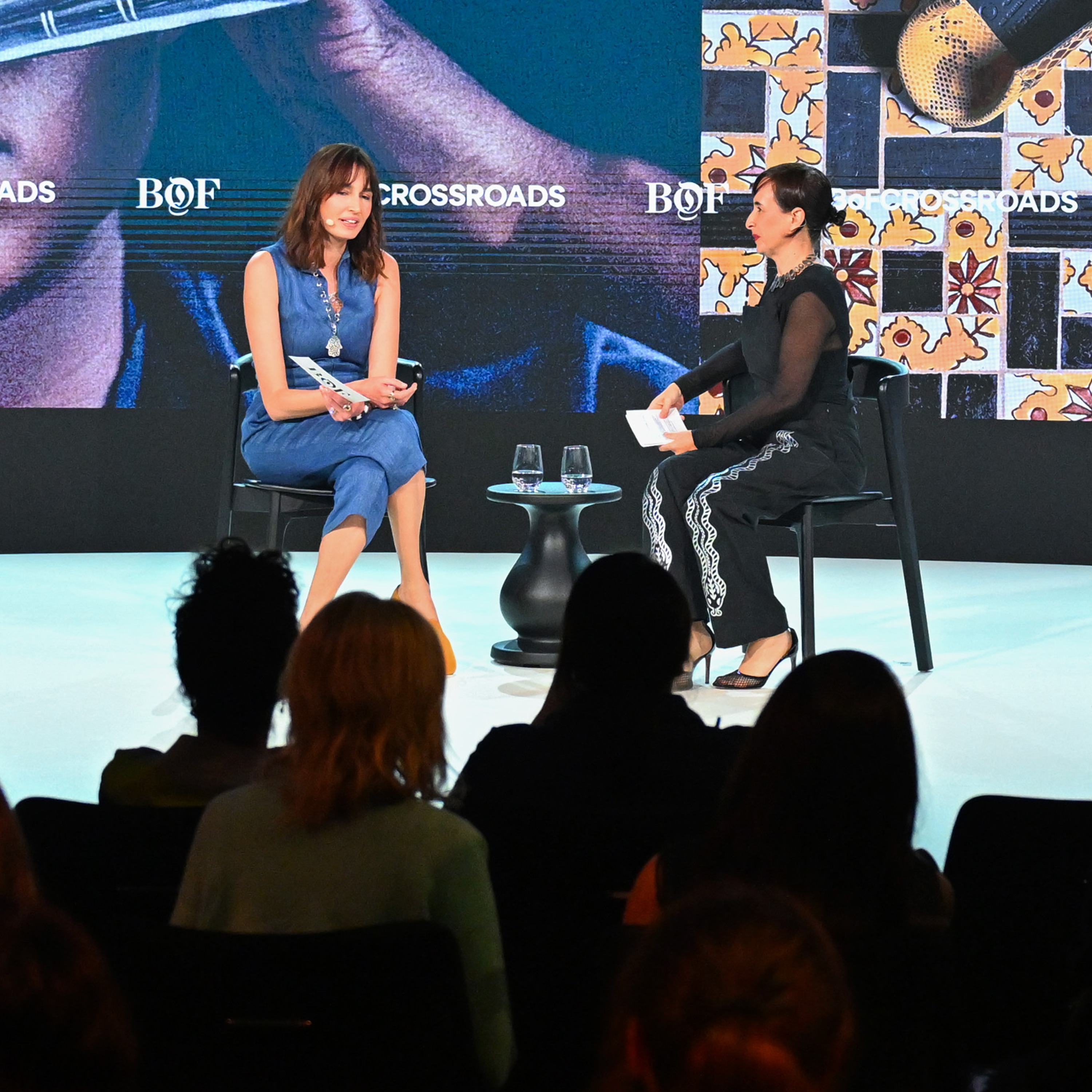
The Business of Fashion Podcast
Why Craft is the Soul of True Luxury
00:20:41
In this conversation from BoF CROSSROADS 2025, Mexican designer Carla Fernández and Tunisian entrepreneur Kenza Fourati discuss the power of craft-based fashion and how to collaborate ethically with artisans while redefining what true luxury means.
Loading summary
Transcript27 lines
- [00:00]
Kenza Ferrati
Foreign.
- [00:04]
Imran Ahmed
Hi, this is Imran Ahmed, founder and CEO of the Business of Fashion. Welcome to the BoF podcast. It's Friday, May 2nd. It's been a complicated year for luxury. The sector was already grappling with slowing growth. But now American tariffs have disrupted global supply chains, driven prices upwards and dented consumer confidence. But there's another deeper, long term challenge that the industry needs to contend with. The perceived trivialization of high end fashion. But brands that place craftsmanship at their core are able to overcome this and connect with customers in a deeper way. Mexican designer Carla Fernandez has long been at the forefront of ethical craft based fashion. Her brand collaborates closely with indigenous artisans across Mexico, promoting traditional craftsmanship and advocating for policies like collective intellectual property.
- [01:05]
Carla Fernandez
The future is handmade because the objects that are handmade, you get the inspiration of your community, of your environment. It goes through your eyes, then it goes through your heart, and it comes out from your hands. And those are objects that have a soul.
- [01:22]
Imran Ahmed
After experiencing firsthand how the fashion industry overlooks contributions from the global south, for her part, Tunisian entrepreneur Kenza Ferrati co founded Osei the Label, a brand focused on elevating artisan footwear crafted in Tunisia and using sustainable materials and traditional techniques.
- [01:44]
Kenza Ferrati
I'm still very angry with this kind of like perspective that, you know, it's designed somewhere in the global north, Paris, Milan, and then it's handmade in the global south, like whatever, you know, like Morocco, Tunisia, whatever. And it feels very fragmented.
- [01:59]
Imran Ahmed
In this riveting conversation from BoF Crossroads 2025, Carla and Kenza discuss the power of craft based fash, how to collaborate ethically with artisans and indigenous communities while redefining what true luxury means. Here are Carla Fernandez and Kenza ferrati on the BoF podcast.
- [02:25]
Kenza Ferrati
So my name is Kenza Furati. I'm from Tunisia and I started my career as a fashion model 22 years ago. And when I moved to Paris 22 years ago, you know, my agent was telling me, kenza, you speak French really well. Why don't you change your name and, you know, like pretend you're from Paris? And that stuck with me because at that time I was realizing, like, this is how the fashion industry see my part of the world, you know, irrelevant and invisible. I mean, years pass and, you know, when I travel back from New York or Paris and I bring souvenir from my home country, I like gifting babouche and I don't know if you know what it is. It's like this slipper that, you know, in my part of the world. World. You were at home when you're hosting. And if you know anything about our part of the world, hospitality is a huge thing in our culture. So I will go back with my presents to my friends in New York, and they will be like, what are you doing? This is way too pretty to be worn in my tiny studio in New York. So I went back with the artisans, and I spent a lot of time learning from them. And I was like, why don't we make it a sole to go outside? Why don't we make it more versatile? And it goes from a sleeper to a loafer? And I learned. And I learned a lot. And one of the things that I learned is the way they were getting materials. Tunisia, I don't know if you know, but it's a huge region of leather. So what artisans were doing is they will go in tanneries and buy excess leather and just kind of, like, use it. And it clicked in my head. I was like, it's actually very sustainable if you think about it, because you're using the waste and finding solution. And this is how we started the business, and we called it osei, which is the acronym of our stories are yours. Because I think, you know, like. And we talk a lot about it. Fashion is a huge part of storytelling. You know, like, it's a huge way of storytelling. Like, textile and text are very connected. And I think also if you walk in someone else's shoes, if you see the world from someone else's shoes, you connect with that person and you see the unseen and the irrelevant. And this is, you know, how we started. What about you, Carla?
- [04:41]
Carla Fernandez
Well, my story. My personal story resonates a lot with yours. I was born as a child, raised as a child in the 80s in Mexico, where we were always looking to the United States. My government wanted us to become part of the United States. They wanted to mass produce, to be very competitive. They even remember that we had these announcements in the tv. It's like, instead of eating tacos, let's eat hamburgers. No. Or instead of using the beautiful dresses, handmade dresses, let's wear jeans. And I was very fortunate that my personal story took me to the South. That is because of my dad. He was the director of the National Institute of Anthropology and History of all Mexico. And every time that a tomb was discovered, he would take us, my mom, my sister and I, to visit the archaeological sites. And they might be empty, but the surroundings were full with indigenous communities. And at the age of 12, I realized that the haute couture the high fashion of my country, that it was claimed not to be fashion. You know, that they keep saying in the 80s that Mexico didn't have a fashion. And we did. And it was made by the artisans that work in the mountains, in the deserts and the jungles. So at the age of 18, I decided, because of the strength and the power of fashion, to become a fashion designer. And I had three paths. The first one was just to follow the foreign trends out of context. The second one, because I wanted really to prove that there was a Mexican fashion, was just to have an inspiration, which I don't like at all the word of inspiration, because it's just taking the ideas and then not working with the artists. And the third one, 30 years ago was, why don't I work with the best? And the best designers are the artisans from my country.
- [06:50]
Kenza Ferrati
I think I'm going to jump on this because, you know, like, I'm still. I've been angry for many years, but I'm still very angry with this kind of like perspective that, you know, it's designed somewhere in the global North. Paris, Milan, and then it's handmade in the global south, like whatever, you know, like Morocco, Tunisia, whatever. And it feels very fragmented. And my experience have been completely different, actually. Look, you know, like, I think when I really work with the artisans, they actually, as you say, co creator, co collaborators, unseen, you know, like they feel very, again, unseen and invisible. And that's something that always like enraged. It still enraged me a lot. And something that, you know, I think it's very similar to you, right?
- [07:31]
Carla Fernandez
Yes. It's a mystery for me why in the global north they keep only focusing on one person, you know, or the individual as just the big name of the designer or the fashion house. They tend to have the supremacy of the idea instead of the manufacturing. And in the indigenous communities is totally the contrary. The creation comes like from all of us, you know, and the collaboration is the most important part. I think that has to do because you can blindfold yourself and you can see, you just focus as a consumer or a creator in the top of the creation or of the production and then everyone else is invisible. And that gives you the opportunity. You know, fashion as we know it's one of the most unethical and polluting industries. So you can just fool yourself and say it's like, oh, nothing is happening because the designer is doing a great job and et cetera. I also think as a fashion house or as a fashion business, we have to be certified by other parties. You cannot Say that you are a fashion house, an ethical fashion house, and say it yourself. That's why we have approached B Corps, Ashoka fellows, et cetera. And I truly believe that all the fashion houses and all the fashion industry should be doing the same.
- [08:58]
Kenza Ferrati
It's funny that you say fashion house because you call yourself not a fashion house, but a cultural agency. And I think, what is a cultural agency?
- [09:08]
Carla Fernandez
I always have to tell my business partner, Cristina, and to everyone that works with us that we have to be part of the solution. We cannot be. If we are a fashion house or we are designers, we have to stand up from our workshop, you know, and give not only a protest, you have to give a solution. We have to solve problems. So I'm going to give you an example again. My country was giving us more opportunities to import from Italy or from China, because I work with artisans that they change the land, the earth. So they go, they pick eight sticks in the mountain, you know, they do a loom, they grow their own cotton, or they take care of the sheep, and they produce everything, just transforming the earth. There's nothing more sustainable on earth than the practices of indigenous communities. But when I go and I work with them, what is for me the best to show that I have bought from Italy and I have the receipt, or to how can I know the lady that is in the mountains, she doesn't speak Spanish. So five little fashion houses in Mexico. We knocked on the door of the tax minister. It's like, you cannot do this because you're killing the craft, you're killing Mexico. It's a cultural superpower. So please help us and give more opportunities to business like ours and to millions of artisans that are out there, and we change it. So you have to just stand up and knock on the door and be very stubborn.
- [10:52]
Kenza Ferrati
I love that. And I think it's kind of echoing to what Sachi yesterday was saying, that craftsmanship and handmade products should be tax exempted. We have the same issue in Tunisia, unfortunately. We need you to come and fight for us because it's actually cheaper sometimes for us to import also from Italy leather than to actually get there where it's produced. And I remember last year I went and spent some time at the customs office in Tunisia, and I was like, what is going on? Help me with that. And the guy, literally, he pulled out a document and he was like, it's the law that exists since before the French left, which is before 1956, and it's still playing today. And it's kind of very hard Logistically and tax duty and everything for at least the global south to navigate this. And this is why I think I'm going to go back to the example of, I think Mexico, like the idea of the tax. And, you know, also I think Mexico is the only country from the global north, but also from the global south, to have changed the law for intellectual property, especially for the collective. So, you know, tell us about this, because I think it should be an example for all of us.
- [12:02]
Carla Fernandez
Well, yes, Mexico is the only country in the world that has a law that protects collective intellectual property from indigenous communities, mestizos and Afro Mexicans. And I'm going to tell you how it works. So you cannot take an iconography, an embroidery or a weaving or just a ritual out of the context, because then it's against the law. So if I want to do a mestizo embroidery with like, what I'm wearing now, it tells you that go and work with the artisan because it belongs to him or to her, and it belongs to the community. But it's quite interesting because listening also to Sachi yesterday, it gives you the opportunity, if you wanted to do it abroad, you can do it, but you have to go to the community and you have to ask them, okay, I want to mass produce your embroidery, but I want to do it in another country or I want to print it. Okay, so you have to sit down with the community, make decisions, and then they will say if they allow you or not, and what do they want in exchange? Or maybe they don't want anything in exchange. Of course, it's very difficult because who's the community, you know, all the time that you're going to go and spend there? So why not making it with the artisans that have been doing this amazing craft for thousands of years? The other thing that the law says is that you have to credit the region, the artisan and the technique. So it's pushing for recognition of the amazing heritage and of course, fair wages and fair payment.
- [13:47]
Kenza Ferrati
Yeah. And I think one of the things also that you explained to me, because I think right now the idea of cultural appropriation is very kind of broad and it's hard to kind of navigate. And I think you explained, I mean, the way you explained is like, from the perspective of the artisans, intellectual property and cultural appropriation is very kind of distinct. So I think it would be nice if you kind of explain it.
- [14:10]
Carla Fernandez
I can only talk about Mexican example. And if you go to a market in Mexico, to Oaxaca or to Puebla, everything that the lady, the artisan, has Done. It's for the tourist market. You know, they have made it not for the local market, not for them, but is for the tourists that come from all over the country and from abroad. So I always tell especially the North American market that they feel uncomfortable, et cetera. It's like, this is made for you. Why don't you ask the artisan how they feel if you buy what they have made for you? And I am 110% that they will say, it's like, I would love you to have this piece and please wear it. And then this is how the commercialization and the dynamics of artisans work. They are actually doing this for us.
- [15:09]
Kenza Ferrati
And I think also one of the things that I think bothered me is the idea, because it has been my experience, the idea of working with traditional ancestral ways is actually very restrictive, where I think it's actually quite the opposite. It offers new way of being very creative. So what was your experience with that?
- [15:28]
Carla Fernandez
In our manifesto, we say that tradition is not static and fashion is not ephemeral. And we depart of what we know how to do. Because at the beginning, again, the artisan is trying to please the market. So they come in and say, oh, I love your garments, but why don't you make it more tied to the body? You open it and then it's a completely other way of making clothing. In Mexico, the indigenous clothing is made with squares and rectangles. And you plead, you fold, et cetera, but you don't cut it even. We didn't have even scissors, you know, before the Spanish conquest. And when you open a hole, a buttonhole in a backstrap, loom, fabric, you can destroy a six months of work of a lady that has been doing the weaving. So what we did is like departing from tradition. We show how this DNA of Mexican pattern works from north to south, from east to west. And then you have. You have done the clothing for thousands of years, so you wear it as a design tool, you know, and it's very clever. And it can be fitted. You can do any other shape. But always departed from tradition.
- [16:46]
Kenza Ferrati
Yeah. And I think also one of the subjects that always comes back when you say, oh, you work with craftsmanship, is the idea of, like, oh, the economy of scale. Like, how can you scale it? And you said something like, very candidly, which I think, you know, should resonate with every business owner. Somehow you are like, I know I cannot give work to all the artists in Mexico, but if I build a blueprint and if, you know, like people, you know, like a young designer A young fashion house come and kind of learn from us and our mistake and everything. I would have done my job, you know, like, this is how I feel fulfilled. I think it's kind of very generous, and I think it would be nice for you to talk about it, you know.
- [17:23]
Carla Fernandez
Well, we are sure that we cannot give work to the millionaires of artisans that work in my country, mainly women. But we can share our stories, we can share our knowledge and what has worked for us and what hasn't. I think that is very valuable. And in that conversation, we need to do a movement that stops fashion as trash. We truly have to stop it. And for me, it's amazing to be here with you and have heard so many voices that we think exactly the same. And for me, it's clear that the future is handmade, because the objects that are handmade, you get the inspiration of your community, of your environment. It goes through your eyes, then it goes through your heart, and it comes out from your hands. And those are objects that have a soul.
- [18:17]
Kenza Ferrati
Yeah. And I think one of the main relationship we have is with, obviously, the customer. And, you know, like, we're a small brand, so we're very close to our customer. We know her really well. You know, she's usually like, you know, like someone on her feet, like a teacher, for us, at least a teacher, a nurse. And we love to tell her story and be close to her. But you call your customer a collector, and what is that? Tell us about it.
- [18:44]
Carla Fernandez
We never forget that we are a business. We depend on it, and we depend on our collectors. So we have to show them the complexity of the techniques. So, for example, a shawl can take more than two months to be made. Thirteen different hands. And when you show them visually through videos, through the exhibitions that we talk, through books and everything that, you know, to understand the complexity and the cultural value of the heritage of the techniques and the community, then you understand the value. And they cherish their clothing so it's not disposable, and you wear it and wear it, and they say no, as the community say no to plan of solacence. So these are garments that you love to wear, that you will continue. You inherited them. So they have been made to be passed generation after generation.
- [19:45]
Kenza Ferrati
I think these past couple of days have been extremely inspiring. I think we have learned how the Global south is awakening and how craftsmanship is so rich from, like, Brazil to Mexico to India. And I think, you know, like, it's kind of redefining the idea of what is true luxury, what does true luxury mean to each one of us? And for me, I think true luxury is being able to wear your values and wear your story. And I think that's extremely powerful. And I want you know, when we ending like, what will be the motto that you want to leave us with?
- [20:18]
Carla Fernandez
Well, I think that in true luxury there is no oppression and that also to be original, you have to go back to the origins. And thank you very much.
- [20:28]
Kenza Ferrati
Thank you.
- [20:32]
Imran Ahmed
The BoF podcast is edited and produced by Olivia Davies and Eric Brea.
- [20:45]
Olivia Davies
If you're a lineman in charge of keeping the lights on, Grainger understands that you go to great lengths and sometimes height to ensure the power is always flowing. Which is why you can count on Grainger for professional grade products and next day delivery. So you have everything you need to get the job done. Call 1-800-GRAINGER clickgrainger.com or just stop by Grainger for the ones who get it done. When you're a forward thinker, the only thing you're afraid of is business as usual. Workday is the AI platform that transforms the way you manage your people and money. Today day so you can transform tomorrow workday, moving business forever forward.