← The Clay Travis and Buck Sexton Show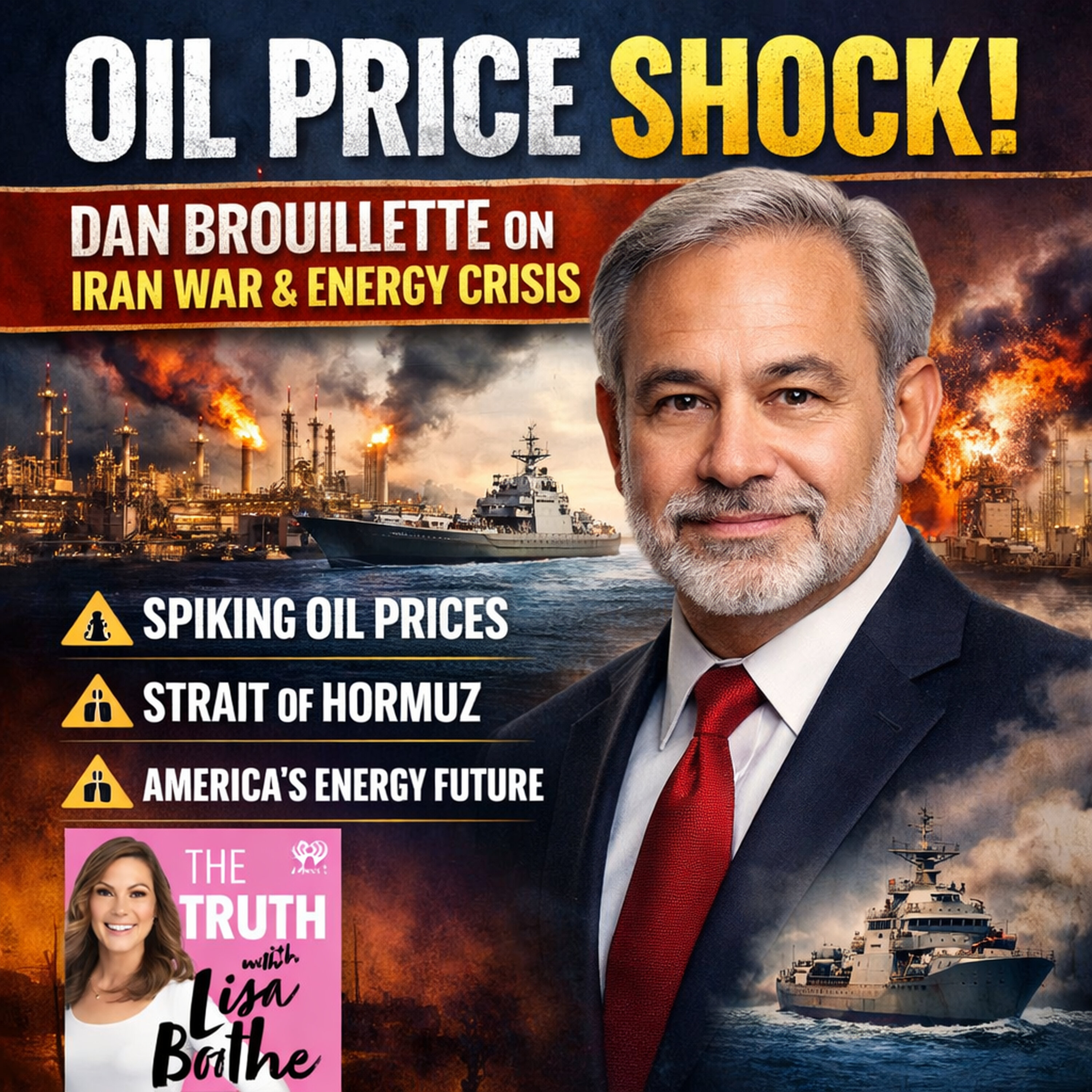
The Clay Travis and Buck Sexton Show
The Truth with Lisa Boothe: Oil Price Shock: Former Energy Secretary Dan Brouillette on Iran War, Global Oil Markets, and America’s Energy Future
00:20:08
Loading summary
Transcript58 lines
- [00:00]
Amica Insurance Representative
This is an iHeart podcast.
- [00:02]
Public Investing Platform Announcer
Guaranteed Human support for the show comes from Public, the investing platform for those who take it seriously. On Public you can build a multi asset portfolio of stocks, bonds, options, crypto and now generated assets which allow you to turn any idea into an investable index with AI. It all starts with your prompt. From renewable energy companies with high free cash flow to semiconductor suppliers growing revenue over 20% year over year, you can literally type any prompt and put the AI to work. It screens thousands of stocks, builds a one of a kind index and lets you back test it against the S&P 500. Then you can invest in a few clicks. Generated assets are like ETFs with infinite possibilities, completely customizable and based on your thesis, not someone else's. Go to public.com podcast and earn an uncapped 1% bonus when you transfer your portfolio. That's public.com podcast paid for by Public Investing Brokerage Services by Open to the Public Investing Inc. Member FINRA and SIPC Advisory Services by Public Advisors llc. SEC Registered Advisor Generated Assets is an interactive analysis tool. Output is for informational purposes only and is not an investment recommendation or advice. Complete disclosures available@public.com find home wherever you
- [01:07]
Sonesta Travel Pass Announcer
roam at Sinesta Es and Simply Suites. Stretch out and enjoy homelike amenities for however long you need. And when you're a Sonesta TravelPass member, staying at Sonesta Es and simply Suites means earning points toward free nights, upgrades and more. Go to sonesta.com to book your stay and unlock their best rates with Sonesta Travel Pass here today, Rome tomorrow. Join now@sonesta.com terms and conditions apply.
- [01:34]
HomeServe Service Announcer
It never happens at a good time. The pipe bursts at midnight. The heater quits on the coldest night. Suddenly you're overwhelmed. That's when HomeServ is here for $4.99 a month. You're never alone. Just call their 24. 7 hotline and a local pro is on the way. Trusted by millions, HomeServe delivers peace of mind when you need it most. For plans Starting at just $4.99 a month, go to homeserve.com that's homeserve.com not available everywhere. Most plans range between $4.99 to $11.99 a month. Your first year terms apply On Greenlight
- [02:05]
Greenlight Debit Card Announcer
helps kids learn about money the way most of us never did by actually using it. It's a debit card and money app that teaches kids to earn, save and spend in real life, not just swipe and hope for the best. Learning happens naturally in the moment. Parents can set limits, see spending in real time, and guide better habits along the way. All in one place without constant check ins or cash runs. Don't wait. Try Greenlight Risk free today@greenlight.com TryGreenlight@ Amica
- [02:36]
Amica Insurance Representative
Insurance, we know it's not just what's inside your home that matters, it's who you share it with. That's why we work even harder to protect it. And as a mutual insurance company, we're built for our customers. We prioritize your needs and are here for you when you need us. Amica Empathy is our best policy. Visit amica.com and get a quote today.
- [03:10]
Podcast Host (Interviewer)
Welcome to the Truth with Lisa Booth where we get to the heart of the issues that matter to you. Today we're talking about oil. Oil prices have been swinging wildly and the Strait of Hormuz effectively closed amid the war with Iran. And the global energy markets are on edge as a result. So we've got former U.S. energy Secretary Dan Barrett. He worked for President Trump during his first term and we're going to ask him to break it all down. You know why traders are panicking whether this $20 billion insurance backstop that President Trump is proposing will help. Also, Biden drained the Strategic Petroleum Reserve. So what sort of position does that put us in? Are we in a dangerous position? So we're going to talk about all of that and more oil, energy, the price of energy and what you should know moving forward. So straight talk from the man who ran the Energy Department during really interesting time, President Trump's first term. So stay tuned.
- [04:04]
Public Investing Platform Announcer
Support for the show comes from Public, the investing platform for those who take it seriously. On Public, you can build a multi asset portfolio of stocks, bonds, options, crypto and now generated assets which allow you to turn any idea into an investable index. With AI. It all starts with your prompt. From renewable energy companies with high free cash flow to semiconductor suppliers growing revenue over 20% year over year, you can literally type any prompt and put the AI to work. It screens thousands of stocks, builds a one of a kind index and lets you back test it against the S&P 500. Then you can invest in a few clicks. Generated assets are like ETFs with infinite possibilities, completely customizable and based on your thesis, not someone else's. Go to public.com podcast and earn an uncapped 1% bonus when you transfer your portfolio. That's public.com podcast paid for by Public Investing Brokerage Services by open to the Public Investing, Inc. Member FINRA and SIPC Advisory Services by Public Advisors, llc. SEC Registered Advisor Generated Assets is an interactive analysis tool. Output is for informational purposes only and is not an investment recommendation or advice. Complete Disclosures available at public.comdisclosures hi, I'm
- [05:05]
Cindy Crawford
Cindy Crawford and I'm the founder of meaningful beauty. When Dr. Sabah and I decided to do a skincare line together, he said to me, we are going to give women meaningful beauty. And I said, that's exactly right. We want to give women meaningful beauty. Which means each and every product is meaningful. It has a reason to exist. It's efficacious. You're going to get results and then you just go out and live your life. Meaningful beauty confidence is beautiful. Learn more@meaningfulbeauty.com
- [05:38]
Dan Barrett (Former U.S. Energy Secretary)
Sonesta Travel Pass is the most rewarding way to travel. Sign up@sonesta.com for instant savings, bonus points and perks like early check in, late check out, room upgrades and free stays. Choose from 1100 hotels across 13 brands and unlock the best rates when you book with Sonesta Travel Pass here today, Rome tomorrow. Join now at Sonesta.com, terms and conditions
- [06:03]
Take 5 Oil Change Announcer
apply when your schedule sounds like this.
- [06:10]
Dan Barrett (Former U.S. Energy Secretary)
Are you kidding me?
- [06:12]
Take 5 Oil Change Announcer
An oil change is the last thing you have time for. So drive into Take five and let our techs change your oil, check your tires, top off your fluids and have you back on the road pit stop fast all while you stay in your car. No putting your entire schedule on hold. No upsells, no problem. So you can get back to your to do list or not. Find your nearest shop@take5.com Take 5 the stay in your car 10 minute oil
- [06:33]
Greenlight Debit Card Announcer
change greenlight helps kids learn about money the way most of us never did by actually using it. It's a debit card and money app that teaches kids to earn, save and spend in real life, not just swipe and hope for the best. Learning happens naturally in the moment. Parents can set limits, see spending in real time, and guide better habits along the way all in one place without constant check ins or cash runs. Don't wait. Try Greenlight Risk free today@greenlight.com Try Greenlight.
- [07:06]
Podcast Host (Interviewer)
Well, great to have you on the show. We've got the former energy secretary Dan Bruyet. Thank you for making the time, sir.
- [07:13]
Dan Barrett (Former U.S. Energy Secretary)
Well, thank you Lisa. Great to be with you.
- [07:15]
Podcast Host (Interviewer)
There's a lot going on in the world right now when it comes to energy and oil. We have seen a lot of volatility in the market as well as a Result of what's happening, the war in Iran. What are traders most worried about right now, sir? What's driving sort of these huge swings in oil prices that we've seen?
- [07:34]
Dan Barrett (Former U.S. Energy Secretary)
Well, you know, it's. It's trying to price risk that that's what they're struggling, struggling with right at the moment. It's, how do you price this risk? And involves a number of different things, obviously price, but also things like duration. How long is this conflict going to last? You know, when will these shipments be able to make it through the Strait? When are we going to get the oil that we contracted for two months ago, three months ago, four months ago? It's just pricing that type of risk. And what happens in the marketplace is that when producers declare things like force majeure, like we saw in the LNG space in Qatar, you know, what that basically means is we understand we've got a contract with you, but we're not going to provide the product. So what happens is there's a mad scramble for whatever is available on the marketplace, and that means barrels on other ships. In the case of lng, it means cargoes on other ships. There's just this mad scramble for what is known is this replacement barrel or the replacement cargo. And that's what you see in the pricing today. So that's why we went from roughly mid-70s or so to literally 120 bucks in about, what, 24 hours, 36 hours, something like that, and then all the way back down to low 80s. But that's what that's all about. And it's really about, you know, it's really the psychology of the marketplace rather than the physical availability of oil or of production of oil, I should say,
- [08:56]
Podcast Host (Interviewer)
kind of reminds me after Liberation Day with the sort of volatility we saw, you know, how challenging. I mean, obviously, if you're the Trump administration, you can't exactly map out with, you know, 100 certainty how long this war is going to last. We've seen Secretary Hegseth sort of give a more undefined timeline. We've seen President Trump recently say it could be a month and kind of tighten the timeline. How much of that from the president do you think is in reaction to sort of the volatility we're seeing?
- [09:26]
Dan Barrett (Former U.S. Energy Secretary)
Oh, I think it's a factor. I mean, I don't think that it's completely dependent upon that. I mean, he's looking at this as a military exercise, not an economic exercise per se. But I do think it has an impact on his decisioning. It has to. He has to be mindful of all of the trickle down effects, if you will, or the, you know, the sort of the, the after effect of whatever activity that you're undertaking with regard to the military. So I think it's a factor, but again, I don't think it's the primary decision, I think, or the primary factor. The President as I understand it, is taking a very long term view of this, you know, the Strait of Hormuz. Everyone has known, if you've been in the energy business for a while, you've known that that's a choke point. You know that it's vulnerable and it has the ability to impact world markets. But you know, the President has said that he wants to correct the situation. We've got a regime in Iran that's on that piece of geography for 47 years and they've used it as a weapon against the rest of the world. And the President says enough's enough. So he's taking a long term view and he's going to rectify the situation.
- [10:28]
Podcast Host (Interviewer)
Well, we've seen ships rightfully concerned with trying to pass through the strait. Makes a lot of sense. Right now the administration is trying to stabilize shipping with a $20 billion insurance backstop for tankers. From your experience running the Energy Department will, is that enough to convince companies to send ships back into the region and to get the job done?
- [10:50]
Dan Barrett (Former U.S. Energy Secretary)
Yeah, I think it is. Because as I understand what they're offering, it's called reinsurance. So it's not what's called first loss coverage. Those are companies that, for instance, Lloyds of London, others who provide that first coverage in the marketplace. What I think the President is offering through the DFC here is backstop coverage reinsurance for those first loss insurers. It allows them basically to spread their risk over a bigger pool of capital so that they're not assuming all of this loss by themselves. And is the way the financial markets work that $20 billion can be stretched out to provide roughly $100 billion or $200 billion worth of coverage in the marketplace. So it is an ample amount of money in my view. Now that's coming with the understanding that I'm not in this business and I don't see what the daily risks are. But my instinct tells me after spending 12 years with USAA down in San Antonio in the insurance business, that's going to go a long way to relieving a lot of the PS fear, if you will and risk of putting your ships into that strait.
- [11:58]
Podcast Host (Interviewer)
And then you also have the security factor too. Of fear of wanting to take on that job as well, given the volatility
- [12:04]
Dan Barrett (Former U.S. Energy Secretary)
and yeah, that's true. That's true, Leese. And I mean, you know, a lot of the conversation has been focused on the commercial aspects of this. But look, if you're a ship captain, or more importantly, not more importantly, but if, you know, importantly, if you're a CEO of one of these companies, you know, you're thinking about your employees and you don't want to put them in harm's way. So sometimes it doesn't matter what the insurance coverage might be, it's just you won't put your people in harm's way, and rightfully so. That's why I think what the President is proposing, you know, this insurance regime or this insurance plan combined with a more visible presence of the US Navy in the Strait, those two things combined I think are going to go a long way to alleviating that risk that people see today.
- [12:48]
Podcast Host (Interviewer)
You know, we keep hearing about the Strategic Petroleum Reserve. And you know, or obviously, you know, as everyone knows, our emergency oil savings account, it's around 415 barrels right now, I believe. How uncomfortably low is that? I know, you know, Biden is to blame for draining it pretty significantly. What sort of position does that put us in?
- [13:10]
Dan Barrett (Former U.S. Energy Secretary)
Not a good one, to be blunt. Not a good one. Look, I think, you know, it holds roughly 700, 715 million barrels. We want to keep that as close to that number as possible because you never know what's going to happen. And what it's there for are actual emergencies. It's when you cannot physically get a barrel of oil, there's a complete stoppage in the marketplace. That's what it's there for. And it takes a lot of oil to replace that. If you ever reach that point, and we did back in 1973, which is why the reserve was created in 1974. Those were true emergencies. We're not there yet with this conflict in the Middle East. We're nowhere near it because we're supplied with, with oil today in the marketplace. I think our total production number worldwide is somewhere around 106 million barrels per day. Our demand is somewhere around 104, 105. So we clearly have enough supply in the marketplace. What we're dealing with is a logistics problem, just getting it through the Strait. It's an infrastructure problem, getting the product to market. The President's dealing with that from a military standpoint, which is the right approach. But it doesn't mean that we have to fleet the Strategic Petroleum Reserve at this point, I would suggest that we don't want to do that, given its low, relatively low status at the moment. I think it's roughly 58% full, give or take, based on what we know today.
- [14:31]
Podcast Host (Interviewer)
You know, walk us through what you did as Energy Secretary during President Trump's first term and what he's done so far in the second term, and which is energy independence at large and kind of how that has transitioned us to where we currently are.
- [14:45]
Dan Barrett (Former U.S. Energy Secretary)
Yeah, no, happy to. To, you know, to share some of the things we did in the early part of the first term. The president, when Rick Perry was the secretary in the first half of the first term, I was the secretary in the second half, but in the first half, I was the Deputy secretary. So I worked closely with Rick and the team to, you know, to work on the President's agenda. And he called us in very, very early. He said, look, here's the deal. We have too much regulation in this industry. People are hamstrung. They can't produce the way that they want to produce. Importantly, he said, you know, they can't export, and they can't. They can't move the product around as easily as they would like to. You guys need to get busy looking at these regulations and see what we can do. And then he reminded us, and you may remember this, he said, if you're going to propose new regulation, and for every one you propose, you've got to eliminate two. That was the very direct order he gave us. So that's exactly what we did. And we went to work, working on things like liquefied natural gas, which was a growing industry here in the United States and still is. But we did very simple things. I'll just give you a quick example. If you wanted to build a small LNG facility for export here in the U.S. you first have to come to the Department of Energy and get what's known as a public interest permit. And what it basically said was, yeah, you know, it would be in the public interest if you, Mr. Capitalist, put your money at risk to build this facility. As if the Department of Energy knows anything about investment or knows anything about what might be in the public interest. And then if you got that, you went over to the Federal Energy Regulatory Commission to get the actual permit to build the facility. But then it was one more step. If you wanted to export that lng, you had to come back to the Department of Energy and ask for permission to export the product. So, three big steps that are enormously expensive. It is not uncommon for this to cost tens of millions of dollars in legal fees and everything else to get these permits. So we eliminate the first step. Just as I said, Rick and I got together and we said, wait a minute, you know anything about how do you do this in terms of investment? It's not our money that we're putting at risk risk. It's. They're putting their own money at risk in the free market. If they lose their money, they lose their money. Why are we just holding them up to getting these permits? So we eliminated those kinds of things. A very common sense approach to how you approach regulation. And it really did unleash a lot of investment. We had a number of final investment decisions that went forward during our first term. We did a number of other things. But I guess to sum it all up, the President gave us a very direct order. Use common sense before you propose these things, and use common sense to see what you might be able to undo. And as a result, in 2019, we became a net energy exporter here in the United States for the very first time in my lifetime. So it became energy independent, if you
- [17:29]
Podcast Host (Interviewer)
will, in 2019, you know, which was obviously great. And, you know, I would just be doing. It's wild that, you know, that wouldn't be the goal always. There's talk about, you look at that in the developments in the United States, but you also. There's also been talk about bringing more Venezuelan oil back into the market to try to ease. When you look at what President Trump's done with Maduro, and now we sort of have a more helping hand, I guess you could say, in Venezuela, controlling hand, I don't know, whatever, you know. And then looking ahead at what is potential in Iran, depending on how everything goes down there, what does that mean for oil for the United States and just for the world moving forward, if you can kind of get Middle east under control and then we also have more control in Venezuela?
- [18:19]
Dan Barrett (Former U.S. Energy Secretary)
Well, I mean, you're eliminating that choke point that we talked about earlier in the Strait of Hormuz. So, I mean, Venezuela is on the water, obviously. So, I mean, they have an oil that they produce there. It's called heavy sour crude. And fortunately, many of the refineries here in the US Gulf coast are set up to refine exactly that type of oil, and they did for many, many years. So Pattavasa, which is a national oil company in Venezuela, was actually one of the better run oil companies in the world up until the Chavez administration took it over and literally ran it in the ground. And then Maduro, whatever was left of it, he ran, you know, he ran into the ground. But it was a very well run oil company and a lot of, again, a lot of our refineries are set up for that, for that type of oil. The larger point though is that because it's available and doesn't get stuck in these choke points, it reduces the risk around the world, not just the United States, but around the world, that that oil can become available. And I think that's the important work that President Trump is doing. The other point I'll make too is that right now Maduro and Delsey Rodriguez to some degree, but Maduro, because he was sanctioned, because Pato Vesa was sanctioned, didn't really have a market for that oil with the exception of China. So they had to sell that market at a discount, a pretty steep discount, about 10 to $15 barrel and most of it was going to China, much the same way that much of the Iranian oil today is going to China at a large discount. So it'll be important to see how bringing Venezuela back online, perhaps once this conflict is done in the Middle east, if Iran chooses to return to civilized society and their oil comes back on the market, it'll be interesting to see how stable the world markets become as a result of that. It'll also be interesting to see how China deals with the loss of discounted oil. Keep in mind they're an export country, they rely on manufacturing, they're heavily energy independent. If their energy costs go up because they don't have access to this discounted oil, it'll be interesting to see what happens to their inflation numbers and then by extension what happens to their positioning in the world economy. So there's a lot going on. It's a very, very busy, but it's also an exciting time. If these regimes go away and this energy comes back to the world market.
- [20:36]
Podcast Host (Interviewer)
Gotta take a quick commercial break. If you like what you're hearing, please share on social media or send it to your family and friends.
- [20:44]
Public Investing Platform Announcer
Support for the show comes from Public, the investing platform for those who take it seriously. On public. You can build a multi asset portfolio of stocks, bonds, options, crypto and now generated assets which allow you to turn any idea into an investing index. With AI it all starts with your prompt. From renewable energy companies with high free cash flow to semiconductor suppliers growing revenue over 20% year over year, you can literally type any prompt and put the AI to work. It screens thousands of stocks, builds a one of a kind index and lets you back test it against the S&P 500. Then you can invest in a few clicks. Generated assets are like ETFs with infinite possibilities, completely customizable and based on your thesis, not someone else. Go to public.com podcast and earn an uncapped 1% bonus when you transfer your portfolio. That's public.com podcast paid for by Public Investing Brokerage Services by Open to the Public Investing Inc. Member FINRA and SIPC Advisory Services by Public Advisors, llc. SEC Registered Advisor Generated Assets is an interactive analysis tool. Output is for informational purposes only and is not an investment recommendation or advice. Complete Disclosures available at public.comdisclosures hi, I'm
- [21:45]
Cindy Crawford
Cindy Crawford and I'm the founder of Meaningful Beauty. Well I don't know about you but like I never liked being told oh wow, you look so good for your age. Like why even bother saying that? Why don't you just say you look great at any age, every age. That's what Meaningful Beauty is all about. We create products that make you feel confident in your skin at the age you are now. Meaningful Beauty.
- [22:11]
Amica Insurance Representative
Beautiful skin at every age.
- [22:13]
Cindy Crawford
Learn more@meaningfulbeauty.com
- [22:19]
Sonesta Travel Pass Announcer
find home wherever you roam at Sinesta Es and simply sweets. Stretch out and enjoy home like amenities for however long you need. And when you're a Sonesta Travel Pass member, staying at Sonesta Es and simply Suites means earning points toward free nights, upgrades and more. Go to sonesta.com to book your stay and unlock their best rates with Sonesta Travel Pass here today, Rome tomorrow. Join now@sonesta.com terms and conditions apply when
- [22:48]
Take 5 Oil Change Announcer
your schedule sounds like this.
- [22:54]
Dan Barrett (Former U.S. Energy Secretary)
Are you kidding?
- [22:56]
Take 5 Oil Change Announcer
An oil change is the last thing you have time for. So drive into Take five and let our techs change your oil. Check your tires, top off your fluids and have you back on the road pit stop fast all while you stay in your car. No putting your entire schedule on hold. No upsells, no problem. So you can get back to your to do list or not. Find your nearest shop@take5.com take five the stay in your car 10 minute oil change.
- [23:18]
Amica Insurance Representative
They say if you want to go fast, go alone. But if you want to go far, go together. At Ameca Insurance, we know what matters most to you and we work even harder to protect it together. As a mutual insurance company, we're built for our customers and prioritize your needs. Amica Empathy is our best policy. Visit amica.com and get a quote today.
- [23:50]
Podcast Host (Interviewer)
This is a bit random, but when you look at our power grid and you look At AI and data centers, how much pressure is that putting on our power grid? Is that something to be thinking about?
- [24:00]
Dan Barrett (Former U.S. Energy Secretary)
Oh, yeah, an enormous amount of pressure. And it's not just data centers, it's the economic growth. It's a bit misleading. Some of the press coverage I've seen recently tends to infer at least that the addition of a data center actually, you know, just linear progression puts that amount of pressure on the grid. There's no question that they're energy intense. But more and more of these hyperscalers and more and more of these data center developers are putting generation behind the grid, and they're willing to pay for their own generation, and that's an important step forward. But when you just look at the growth curves, they're phenomenal. I mean, it's just amazing how much we're talking about. I was just reviewing some data for some work I'm going to do with Stanford Business School this week. And, you know, we're going to move. These are metrics that no one really understands, but I'm going to say them anyway. We're going to move from about 400 terawatt hours worldwide to over 100 terawatt hours. Just trust me. Those are big numbers. But that difference is the size of the economy of Japan. That's how much energy they use in Japan. So the growth rate in data centers over the course of the next six years is the equivalent of adding the entire country of Japan to the world energy market. That's how big these things are.
- [25:16]
Podcast Host (Interviewer)
That's. Yeah. So how are we going to sustain that?
- [25:18]
Dan Barrett (Former U.S. Energy Secretary)
Well, I think again, back to what President Trump was doing in the very first, early parts of the our term. You know, he was very interested at that time in nuclear power, and he thought that that was an answer. And he was very, very frustrated, candidly, with our inability to build nuclear here in the United States. And, you know, as one of the areas where he really pushed Rick and I and he pushed the nrc, he said, you've got to figure this out. He said, you know, it seems like France builds one every month, and we can't build one except for every 30 years, what's going on here? And he was exactly right. And he also recognized very early that we were dependent upon Russia for our nuclear fuel cycle. We were as dependent on Russia, as a matter of fact, as Germany was for natural gas. Germany was buying natural gas from Russia for years. And Mike Pompeo and I spent a lot of time over there telling them, you're too dependent on Russia. Well, it turns out that we were very dependent on Russia for nuclear fuel. So we started a program at DOE to create what's called Hya L E U H A L E U Halish. And what that is is a fuel source for these very advanced, very small modular reactors. And it's an exciting time in the nuclear business because if these things are commercialized in the next two to three to four or five years, we can actually meet that demand that I just talked about with regard to data centers and some of the other things that we're seeing on our electricity grid today.
- [26:40]
Podcast Host (Interviewer)
But, you know, as we rely more on AI as a society, we already know our power grid is susceptible to. To attack. So does that put us in a more vulnerable position?
- [26:51]
Dan Barrett (Former U.S. Energy Secretary)
Yeah, of course. Everyone's in a, in a vulnerable position when you think about cybersecurity. I mean, our lives have become so dependent upon online services of one type or another that you're almost by definition exposing yourself every time you get on your telephone. So everybody's vulnerable to some degree. What I think we've done a fairly good job with regard to the grid is cutting off the access to more sensitive types of information that Iran or North Korea, Russia, whoever it might be, would have access to. And I think today, with the adoption of AI and with some of the def, with some of the developments around things like quantum computing, we've been able to severely reduce the cyber risk that we faced 10 years ago. Quantum computing in particular is very, very interesting. And I won't get into the details, but when you're dealing with qubits and entanglement, it may, at some point in the future, make cybersecurity completely irrelevant because there's just no way to break the encrypted data that goes over a quantum computer.
- [27:55]
Podcast Host (Interviewer)
I'm realizing there's a lot I still need to learn from Spark.
- [27:58]
Dan Barrett (Former U.S. Energy Secretary)
No,
- [28:01]
Podcast Host (Interviewer)
before we go, is there anything else you'd like to leave us with?
- [28:05]
Dan Barrett (Former U.S. Energy Secretary)
Just the simple fact that I'm excited. I mean, the we all our hearts all go out to the men and women who serve in the military and have to defend us each and every day and who are fighting the conflict that we see in the Middle East. The fact of the matter is, is that once this is over and everybody comes home and the energy markets stabilize, we're all going to realize that, you know, the work that we've all done over the course of the last two decades or so to make America more energy dependent is really going to pay enormous dividends over the course of the next two decades. And that's exciting because as we think about how our economy is going to be shaped by artificial intelligence, all the technologies that are being developed, we hope that they're built here because that means jobs and it means economic security for all Americans. And I'm excited about that.
- [28:46]
Podcast Host (Interviewer)
I want to thank you as secretary, but you told me to call you Dan, so I'm going to say Dan. Very, very interesting. Learned a lot from you. I still have a lot to learn with some of the last parts of the conversation with AI. I really appreciate you making the time, sir.
- [29:02]
Dan Barrett (Former U.S. Energy Secretary)
Well, thanks for having me.
- [29:03]
Podcast Host (Interviewer)
It's been that was former Energy Secretary Dan Barrett. Appreciate him for making the time to come on the show. Appreciate you guys at home for listening every Tuesday and Thursday, but you can listen throughout the week. Also want to thank John Cassio, my producer, for putting the show together. Until next time,
- [29:19]
Sonesta Travel Pass Announcer
Sinesta Travel Pass is the most rewarding way to travel. Sign up@sonesta.com for instant savings, bonus points and perks like early check in, late checkout, room upgrades and free stays. Choose from 1100 hotels across 13 brands and unlock their best rates when you book with Sonesta TravelPass here today, roam tomorrow. Join now@sonesta.com terms and conditions apply.
- [29:45]
Greenlight Debit Card Announcer
Greenlight helps kids learn about money the way most of us never did by actually using it. It's a debit card and money app that teaches kids to earn, save and spend in real life, not just swipe and hope for the best. Learning happens naturally in the moment. Parents can set limits, see spending in real time, and guide better habits along the way, all in one place without constant check ins or cash runs. Don't wait. Try Greenlight Risk free today@greenlight.com TryGreenlight this
- [30:16]
HomeServe Service Announcer
is Jacob Goldstein from what's yous Problem? Business software is expensive and when you buy software from lots of different companies, it's not only expensive, it gets confusing. Slow to use, hard to integrate. Odoo solves that because all Odoo software is connected on a single affordable platform. Save money without missing out on the features you need. Odoo has no hidden costs and no limit on features or data. Odoo has over 60 apps available for any needs your business might have, all at no additional charge. Everything from websites to sales to inventory to accounting, all linked and talking to each other. Check out Odoo at o d o o.com that's o d o o.com this
- [31:00]
Bethenny Frankel
is Bethenny Frankel from Just Be with Bethany Frankel. Let me be blunt. Most dog food is junk. It just is. And I'm not feeding junk to Biggie and Smalls. That is why they eat just food for dogs. It's real 100% human grade food with ingredients I actually recognize, not mystery pellets pretending to be healthy. And once I switched, the difference was obvious. Better digestion, better skin, more energy. Dogs who actually feel good instead of just surviving dinner. Here's the thing. You care about quality. You make an intentional choice to be healthy. So why are you gambling with your dog's health? So let's think about our furry babies. Go to justfoodfordogs.com right now and get 50% off your first box. No code. Just try it. Because once you see the difference, you're not going back.
- [31:46]
Public Investing Platform Announcer
There's no championship league for small business owners, but if there was, you'd be at the top of the standing. Because going pro with Lenovo Pro means you've got the winning formation. One on one advice. IT solutions and customized hardware powered by Intel Core Ultra processors help you stay ahead of the competition. Business goes Pro with Lenovo Pro Sign up for free@lenovo.com pro.