Podcast
The Comedy Cellar: Live from the Table
Hosted by Comedy Cellar Network · EN
For 30 years, New York's legendary Comedy Cellar has served as the launching pad for greatest stand up comedians in the world. Colin Quinn, Dave Chappelle, Ray Romano, Dave Attell, Chris Rock, Jon Stewart, Dane Cook, Robert Kelly and Greg Giraldo are just a few of the comedians who began as Cellar regulars. But classic stage performances have never been the only show going on at the Cellar. The biggest comedians in the world come to sit at the table upstairs, where comedians come to argue and discuss the events of the day and their lives, sharpening their their comedy knives on each other. This kibitzing (an inspiration for Comedy Central's Tough Crowd), has always been a private affair... until now. Join us for a weekly peek into the happenings at the Comedy Cellar's comedian table, where the funniest people in the world debate and discuss. Subscribe now and don't miss a second of it. We would love to hear your comments. Email them to podcast@comedycellar.com
68episodes
Episodes
Newest firstAll episodes
Tucker Carlson, Daryl Cooper & the Nazi Question | Waiting for Evan Barker
2d ago00:52:36Tap to summarizeNoam Dworman and Periel Aschenbrand sit down expecting to interview Evan Barker—but when she doesn't arrive, they discuss Tucker Carlson, Daryl Cooper, antisemitism, Germany, immigration, media and why Evan Barker never made it. Chapters 00:00 Waiting for Evan Barker 02:15 Tucker Carlson, Daryl Cooper & extremism 08:35 Germany, antisemitism & lessons from Europe 19:30 Noam on ideology, immigration & prejudice 32:20 Listener emails & why the podcast matters 44:40 Evan Barker finally checks in 49:00 All is forgiven & rescheduling the interview
Transcribe →Will Guidara Ran the World's #1 Restaurant – What Can He Teach the Comedy Cellar?
3w ago01:03:32Tap to summarize0:00 "You picked the wrong guy" – the audiobook story 3:12 "You own [Comedy Cellar], one of New York's treasures" 7:28 The customer who will never tip again 15:41 Motivating a team after you've won: finite vs. infinite games 23:23 Noam doesn't like fine dining 39:55 Handling Google reviews & hunting down critics Noam sits down with Will Guidara — author of the New York Times bestseller Unreasonable Hospitality, former co-owner of Eleven Madison Park (named the best restaurant in the world under his leadership), and co-producer of The Bear — for a conversation between two obsessives who refuse to run their businesses as businesses. They compare notes on why the money has to be a byproduct, how to answer a customer who swears he'll never tip again, keeping a team motivated after you've won, why fine dining lost its way, tracking down anonymous Google reviewers, and why Will walked away from the top restaurant on earth to be a better dad.
Transcribe →I'm Terrified of Cancer. So I Called My Childhood Friend Kenan Onel, Cancer Geneticist.
3w ago01:12:42Tap to summarize0:00 The friend he hasn't seen since sixth grade 5:16 Angelina Jolie, BRCA, and the 20% nobody tells women about 18:23 What a cancer cell actually is - and why tumors evolve 26:31 How cancer actually kills you, and what a seizure is 32:14 The last cigarette: why he can't take the test every week 46:27 The best medicine in the world, and who can't get to it 1:03:23 Telling a family there's nothing left Noam hadn't seen Kenan Onel since high school in Ardsley, where Onel graduated first in the class and Noam, by his own account, drifted somewhere well below. Fifty years later Onel runs genetics and genomics at Roswell Park - the only comprehensive cancer center in all of western New York - and Noam has one thing he wants to ask him about. He's afraid of cancer. His grandfather died of it. His father died of it. He's taken the Grail blood test, it came back clean, and he wants to know why he can't just take it every week. What follows is part reunion and part interrogation. Onel explains what a cancer cell actually is, why tumors evolve like finches in the Galapagos, and what is physically happening to someone during a seizure. He explains how cancer kills - the mechanism, organ by organ. And he tells Noam that the test he's counting on just failed its biggest trial in the UK, which sets off the real argument of the hour: whether a guideline written for a population means anything at all to the one person sitting in the chair. Then, near the end, Noam asks how you tell a family there's nothing left to offer. The answer is the best thing in the episode. Also: the 20% of women who are high-risk and have never been told, the doctor who warned Noam that Pellegrino was bad for his son's bones, a scan booked by 4pm the next afternoon, and one entire podcast without mentioning Israel. Dr. Kenan Onel is Chief of the Division of Genetics and Genomics and Director of the Center for Precision Oncology and Cancer Prevention at Roswell Park Comprehensive Cancer Center. Live from the Table is the official podcast of the world-famous Comedy Cellar.
Transcribe →"An Agenda Dressed Up in Violins?" - Debating Peter Beinart on the Right of Return and Other Matters
Jul 1601:25:14Tap to summarizeCHAPTERS 0:00 Intro - four nice things about Peter Beinart 4:50 Will God punish Israel? Jeremiah, tradition, and belief 13:20 The critical-mass hypothetical: a 49% Hasidic America 22:03 Quebec, Czechoslovakia, South Africa - why not divorce? 41:35 The right of return: "You can cherry-pick anything" 54:24 1948: They were closer to the Holocaust than we are to COVID 63:40 Day one of a one-state solution: the list 79:53 "An agenda dressed up in violins" Claude Says: Peter Beinart - editor-at-large of Jewish Currents, New York Times opinion writer, and author of "Being Jewish After the Destruction of Gaza" - joins Noam Dworman and Dan Naturman for an honest, occasionally heated conversation about the questions underneath the Israel-Palestine debate. Does Jewish tradition teach that Israel's survival depends on its ethics - and does Beinart, an observant Jew, mean that literally? Is there such a thing as demographic critical mass? Why is secession the answer everywhere from Quebec to Czechoslovakia, but one shared state the answer here? Is the Palestinian right of return a sacred principle, a practical question, or - as Noam puts it - "an agenda dressed up in violins"? Plus: South Africa and Mandela, Iran, the Olmert-Abbas offers, what Benny Morris actually wrote about 1948, Robert Jackson's "suicide pact," and what day one of a one-state solution would look like for a gay couple in Tel Aviv. Two people who disagree about almost everything - except the settlements - actually talk to each other. Peter's book: Being Jewish After the Destruction of Gaza https://bit.ly/4ygbHH8 Peter's Substack: The Beinart Notebook https://peterbeinart.substack.com/
Transcribe →AI Is Self-Evolving, and Nobody Understands It - Bioweapons, China Race, Sentience | Robert Wright
Jul 1001:30:08Tap to summarizeDescription Written By Fable/Max: Robert Wright interviewed Geoffrey Hinton in 1983 and, by his own account, got the story 180 degrees wrong. Forty years later Hinton is the "Godfather of AI," two of the three godfathers are frightened of their own creation, and Wright has written The God Test to figure out what he missed and what's coming. We talk about how these machines evolved rather than being programmed - nobody fully understands them, including the people who build them - why "fancy autocomplete" was always wrong, the best case (an AI caught a radiologist's error in his cancer MRI), the worst case (a bioweapon that incubates silently for six weeks), why racing China to superintelligence may cause the war it's meant to prevent, and whether unplugging a machine could ever be murder. Plus an experiment of my own: I put a legal dispute in front of the AI and handed the laptop to the other side. 0:00 Intro - Robert Wright and The God Test 2:13 A 27-ton computer and a buried headline 4:11 Interviewing the Godfather of AI in 1983 - and missing it 10:15 Not programmed - evolved 17:27 The "fancy autocomplete" myth 24:17 Dukakis, Reagan, and how minds file words 35:49 Best case: medicine, education, and an MRI story 42:38 Worst case: bioweapons, jailbreaks, designer babies 48:51 An AI that believes what the Ayatollah believes 50:30 The China race - overdone and dangerous? 57:33 Nazis, the Hamas charter, and bombing over AI 59:46 Authoritarianism through the back door 1:03:35 Sociopaths, the ship of Theseus, and machine morality 1:14:34 Is it sentient? Should you be nice to it? 1:21:54 AI as judge: my legal experiment 1:26:20 The God Test
Transcribe →
Israel’s Gloomy Future? Occupation, Isolation, and Survival - Daniel Sobelman
Jul 301:10:30Tap to summarizeA conversation about the future of Israel and world Jewry. Can Israel protect itself without becoming a global pariah? Did Hamas gamble that even losing the war could pull Israel into isolation? Noam and Sobelman discuss occupation, unilateral withdrawal, the settler movement, Jewish vulnerability abroad, and the difficult tradeoffs now shaping Israel’s future. 00:00 Intro: Daniel Sobelman returns 03:47 Israel after October 7: a new era for Jews and Israel 08:58 Sobelman: October 7 as a nuclear-level shock 11:48 Why Israel was blamed before it responded 15:50 Hamas’s strategy: provoke a war and isolate Israel 22:35 Occupation, moral corrosion, and the West Bank dilemma 32:23 Could Israeli initiative restore its global standing? 34:03 Settlers, politics, and the failed path of unilateral withdrawal 41:29 Israel as both Jewish safety net and source of Jewish vulnerability 52:02 Resistance vs normalization: the future of the Middle East Daniel Sobelman is a professor of international relations at the Hebrew University of Jerusalem and a research fellow at the Harvard Kennedy School’s Middle East Initiative. Read his book, "Axis of Resistance" https://www.amazon.com/dp/B0D9L7QQNN?lv=shuf&channelId=500&plpRedirect=mhFallback
Transcribe →
The Truth About Iran That Nobody in the West Wants to Hear with Kian Tajbakhsh
Jun 2701:30:08Tap to summarizeWas the MOU a good idea? Noam says yes, the Professor says no. The Table is joined by Kian Tajbakhsh. They discuss his years as a political prisoner in Iran, the psychology of the Iranian regime, why he believes Iran's leaders genuinely seek Israel's destruction and what the West continues to misunderstand about the Middle East. He also weighs in on Trump, the latest U.S.-Iran developments and the future of the region. Kian Tajbakhsh is Visiting Professor of International Relations at NYU and Fellow at Columbia University’s Committee on Global Thought. An Iranian-American scholar of Middle East geopolitics and Iranian politics, he previously worked as a democracy and human rights advocate inside Iran. He spent nearly 13 months in Tehran’s Evin Prison, including 8 months in solitary confinement in a high-security IRGC wing, followed by 6 years under house arrest as a political prisoner, before being released as part of the 2015 Iran nuclear deal. He is the author of Creating Local Democracy in Iran (Cambridge University Press 2022). His essays have appeared in The Atlantic, The Wall Street Journal, Foreign Affairs, Project Syndicate, and his analysis has been featured on NBC, CNN, BBC, CBC, and NPR. He writes and comments frequently on Iranian politics, regional geopolitics, and democratic reform; author of The Iran Crisis Notebook on Substack. www.kiantajbakhsh.net kian.substack.com CHAPTERS 02:20 Arrested by Iran & Life in Solitary Confinement 16:20 House Arrest and Release 20:30 October 7 and America's Blind Spot 23:00 Why Iran Wants to Destroy Israel 35:50 Trump, Iran, and the New Middle East Strategy 49:20 Was Trump's Deal a Mistake?
Transcribe →
Epstein, Civil Liberties and the New Public Shaming with Ankush Khardori
Jun 1901:29:12Tap to summarizeNoam Dworman, Dan Naturman and Periel Aschenbrand are joined by Ankush Khardori. They discuss the Epstein files, Kathy Ruemmler, civil liberties, public shaming and whether the release of Epstein-related documents has generated more heat than facts. They also discuss cancel culture, online mobs, Anthony Weiner, anti-Semitism, and the broader consequences of judging people through leaked communications. Ankush Khardori is a legal analyst and former federal prosecutor. He has been the legal affairs columnist for Politico and New York Magazine and has contributed to The New York Times, The Washington Post, The Wall Street Journal, The Financial Times, The New York Review of Books, The Atlantic, TIME and many more. Khardori regularly provides legal commentary and analysis on television, radio, and podcasts -- including CNN, MS NOW, the BBC, and NPR. CHAPTERS 04:40 How Ankush Got the Kathy Ruemmler Story08:00 The Epstein Files and Civil Liberties Debate12:00 What the Document Releases Actually Revealed22:30 Kathy Ruemmler, Bill Gates, and Jeffrey Epstein29:00 The Human Cost of Public Accusations42:40 The Cornell Student Anti-Semitism Controversy48:40 Internet Mobs, Cancellation, and Public Shaming
Transcribe →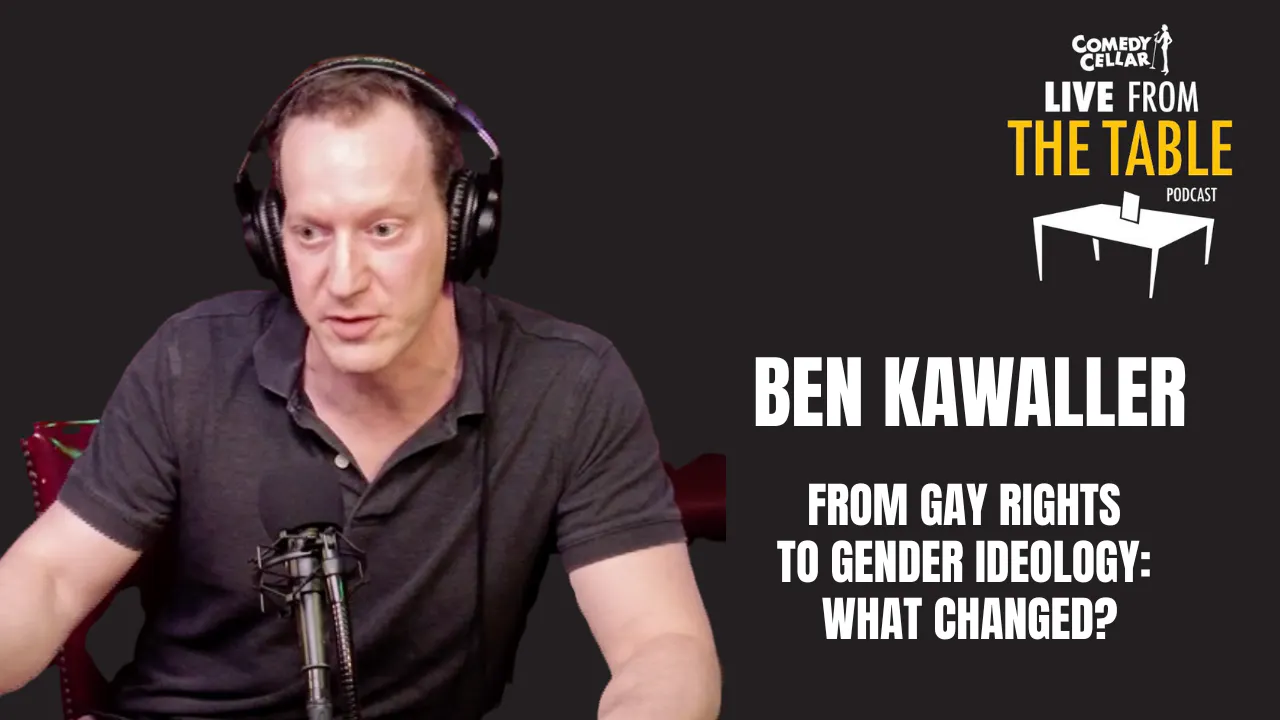
From Gay Rights to Gender Ideology: What Changed?
Jun 1201:18:25Tap to summarizeNoam Dworman, Dan Naturman and Periel Aschenbrand are joined by Ben Kawaller. They discuss his podcast Strange Bedfellows, the evolution of the LGBT movement, gay marriage, Pride culture, trans politics, free speech, Andrew Sullivan and why some gay activists believe the movement has fundamentally changed. Ben Kawaller is the lead reporter on the Reflector podcast’s three-part miniseries, “Strange Bedfellows,” about the evolution of the LGBT movement. Ben's writing and video reporting have appeared in the Times of London, the New York Post, Racket News, and The Free Press. He’s also written humor for The American Bystander, The Advocate, and Salon, among others. www.benkawaller.com https://x.com/benkawaller CHAPTERS 00:00 Introduction & Ben Kawaller 06:13 Why Ben Made Strange Bedfellows 07:17 From Gay Rights to Gender Politics 15:36 How Gay Marriage Changed America 20:19 Has the LGBTQ Movement Reached Its Goal? 26:19 Why Gay and Trans Issues Are Different 35:00 The Matt Walsh Debate 42:30 What Should Kids Be Taught About Gender? 46:04 Closeted Celebrities & Gay Culture 50:17 Judging the Past Through Today's Lens
Transcribe →
The Hamas Documents Reveal the Real October 7 Plan
Jun 801:10:54Tap to summarizeNoam Dworman, Dan Naturman and Periel Aschenbrand are joined by Professor Daniel Sobelman. They discuss his research into the strategic origins of October 7, the captured Hamas documents recovered during the war, how Israel's deterrence strategy failed and what the future of warfare means for Israel and the region. Sobelman explains why Hamas believed it could fundamentally alter the balance of power, what Israeli leaders misunderstood before October 7 and why the next generation of conflict may be driven by cheap drones, precision weapons, and asymmetric warfare. Daniel Sobelman is a professor of International Relations at the Hebrew University of Jerusalem, in Israel, and a research fellow with the Harvard Kennedy School's Middle East Initiative. His area of expertise is the conflict and deterrence dynamics between Israel and Hamas and Hezbollah. His current research focuses on the strategic foundations of Hamas's October 7th attack. His recent book is entitled "Axis of Resistance: Asymmetric Conflicts and Rules of the Game in Contemporary Middle East Conflicts." https://www.tandfonline.com/doi/full/10.1080/1057610X.2026.2613426#abstract CHAPTERS 00:00 Introduction 01:30 The article that changed the October 7 debate 06:25 How Hamas deterred Israel 15:25 Buying quiet: Qatar money and Hamas leverage 20:10 The captured Hamas documents 22:30 Hamas's plan for a regional war 26:25 How bad October 7 could have been 39:00 The documents discussing Israel's destruction 46:25 Would Hamas ever accept a two-state solution? 53:35 Israel's future after October 7 01:01:05 Can Israel reverse its global isolation?x
Transcribe →