← The Comedy Cellar: Live from the Table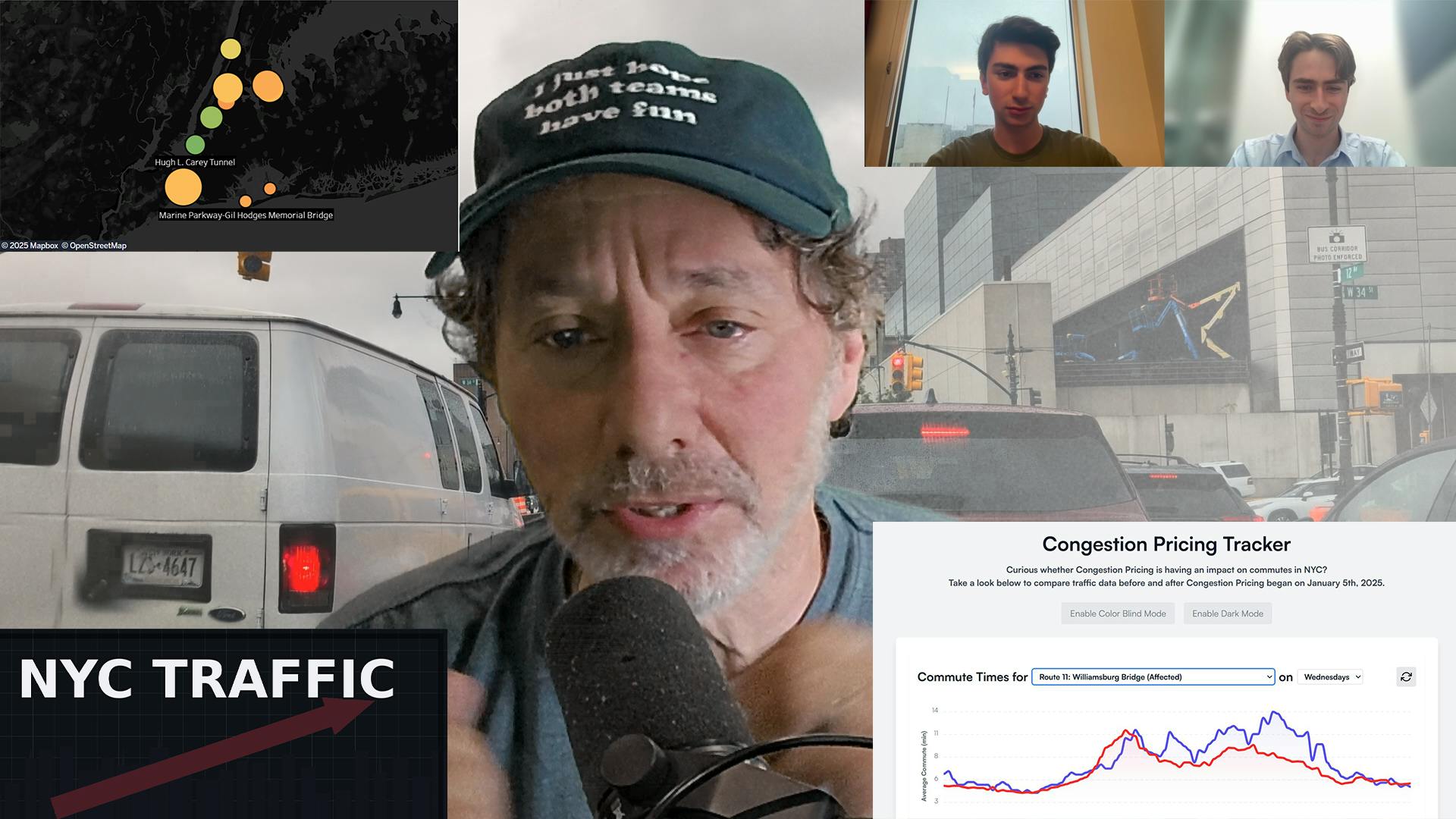
The Comedy Cellar: Live from the Table
Is NYC Traffic Back (Noam says it is)? Data Gurus on the NYC Congestion Pricing Experiment
00:58:26
Loading summary
Transcript181 lines
- [00:00]
A
Thursday, 12:39pm 34th street and West side highway in Manhattan. So I was driving home in this vicious west side highway rush hour traffic that you see behind me, and I realized I said something stupid. In this podcast I'm about to play with the Moshes brothers, Benjamin and Joshua, who are the data gurus who've been tracking congestion pricing in New York City. I realized that, I speculated that maybe the reason that the evening commutes have gotten quicker while the morning commutes have stayed the same is that people are waiting until after the 9 o' clock hour to go home when the rates drop a little bit. But I realized that can't be it because they pay on the way in. You don't pay when you go out. So now I'm thinking, and you'll, you'll, you'll, you'll have to think about it when we get to that section of the interview that maybe it's that in the morning the commutes are busy both ways, but in the evening now, people who would come into Manhattan to go to restaurants and nightlife or whatever it is, are, are staying home. I don't know. I have to get in touch with our guests to find out more. But look at that traffic. Look at that traffic. That's old school New York City traffic. There was no accident. There was no road work. That was the traffic to the west side Highway. And I should say one more thing, two more things. When I was a kid, the west side highway used to be two levels and the top level collapsed and New York City never replaced it. So that made the traffic permanently slower. Second thing is, you know, I made such a stupid mistake. When you're young, you make stupid mistakes. You don't give it a second thought. But now that I'm 60, every time I make a super mistake, I assume that's it. Early Alzheimer's, your mind's just not working anymore. So that's something's on the horizon for all of you once you get to be my age. All right, so enjoy our interview here with Benjamin and Joshua Moshes, the fantastic data gurus behind the congestion pricing tracker, who are going to tell us whether or not congestion pricing in New York City is working.
- [02:13]
B
This is Live from the Table, the official podcast of the world famous comedy seller, available wherever you get your podcasts and available on YouTube, which is the best way to enjoy the show because you get, you get audio and video.
- [02:27]
A
And sometimes I do a lot of editing and I put in a lot of video clips and, and stuff. I don't know about for this episode, but I've worked hard on some of these episodes.
- [02:34]
B
No one puts in the work we.
- [02:36]
A
Got, by the way, before these guys. We had a lot of views on our last show about the conspiracy theories. Go ahead.
- [02:46]
B
So we have with it, first of all, this is Dan Natterman. As you know, we have with us Noam Dorman.
- [02:50]
A
Yes.
- [02:50]
B
Who's the owner of the Comedy Cellar and making a bit of a name for himself as a political pundit. He's been praised by the likes of Michael Moynihan.
- [02:59]
A
My friends.
- [03:00]
B
Yeah. Coleman Hughes. Yes, they are your friends, but I think they are legitimately impressed by you. We have Perry Al Ashenbrand here.
- [03:07]
A
Let them pay their bill in the olive tree. See if they raised him.
- [03:12]
B
And with us via the miracle of telegram conferencing via Zoom, we have Wunderkins economic honor students from Brown to fine school in Providence, Rhode Island. Not a great town, but the school is good. Benjamin and Joshua Moshes or Moshes or your brothers.
- [03:39]
C
Yeah.
- [03:39]
A
Are there mics working? Let's hear you fellas.
- [03:42]
D
Yes, yes, we are. Except Joshua is from Northeast.
- [03:45]
B
Oh, correct. I'm read. Yes, that is correct. I'm reading your bio. Northeastern, but no less intelligent. He just didn't apply himself.
- [03:55]
A
Dan doesn't want to do one second more preparation than he has to if he doesn't want to read through the introduction.
- [04:00]
B
Well, you know, I went. Kat Timp was on. I read her whole book and I was the only one who did.
- [04:03]
A
So. Yeah. All right. Okay. So go ahead.
- [04:05]
B
Yes, they are. They are. They are tracking the effects of congestion pricing in New York, which Noam's always been against. My position, just, just to preface, on congestion pricing has always been the same. It hasn't changed. I was hoping for the best, rooting for it, but willing to look at the data. And I think that's the only sensible position anyway. Welcome Benjamin and Joshua Moshez to our show.
- [04:31]
A
Okay, fellas, I want to get from you what you if it's working or it's not working, but let me tell you, I commute and have commuted, you know, most days for many, many years now. And after congestion pricing went into effect on January 5th, I think it was of 2025, it was a breeze getting to work. I mean, it fell off a cliff and it was just. I mean, it scared me, but it was just astounding how fast I was getting into work. And this, this went on for few months. For the last two or three months. My commute is 100% back to where it was. My traveling cross town is completely where it was. If there is a slight difference. Cross town, it's de minimis. One of Dan's favorite words. Not that meaning diminish in a sense that I wouldn't have noticed it if you had been able to do this congestion pricing thing without me knowing about it. I wouldn't say, like, hey, why is traffic so light today? Is, did somebody die? Is it a Jewish holiday? You know, you know, it's just.
- [05:39]
C
It is a Jewish holiday.
- [05:40]
A
So. Yeah, so that's right. Today. And today my, my commute was awful.
- [05:44]
B
And a Shana Tovah to all, all who celebrate.
- [05:48]
A
And then, you know, today I've been going through the data on your website and I know I'm talking a lot. You guys haven't said anything yet, and it doesn't look good. It doesn't look like congestion pricing is doing the job. So why don't you. I don't know. Who are you, twins?
- [06:02]
D
We're not twins. I'm three years older.
- [06:04]
A
Okay, so does the older brother get the privilege of. Tell us, what is your take on congestion pricing? Is it, is it working? Is it, is it working? Partially. Is it lived up to his expectations and does it warrant the harsh tax that it actually is on middle class people who have no choice but to pay now because they don't have the option of public transportation? So go ahead. What, what are your thoughts on it?
- [06:29]
D
Yeah, of course. And Joshua, fill in as you see me missing things. But I think just to start, you know, from the very beginning looking at congestion pricing, we were always on the side of let's put the data in front of people and let people make their own judgments. So we were very, like, weary of making conclusions ourselves. We wanted people to look at the data, talk about their own anecdotal experience, and then, you know, tell us what they're seeing and then what they think of the data. But at the same time, we've like, spent a lot of time looking at our own data and analyzing what we've seen. What we've seen. I think from the very beginning there were three trends that were very visible that I think even until now are still visible in the data. Even though, like, patterns are somewhat changing now that we're, you know, like seven months into the program, the three patterns we saw were one, and this is what you were mentioning about your commute from work on the bridges and tunnels, from New Jersey, from Brooklyn into the congestion zone. We saw significant differences in traffic that I think are still Holding So a lot, you know, way fewer cars are entering the congestion zone. And after congestion pricing began and that was a big difference for people who say like commute to work from New Jersey to New York, they travel via car or like businesses trying to get goods in for them, this was a big time saver. When they were crossing the bridge in the congestion zone itself, we did, we did see small decreases and there were also, there's also a smaller volume of cars traveling throughout the zone, but that was, you know, much smaller. And the theories that we've heard about this are one, that there's a lot more commuter cars that cross from New Jersey or like Brooklyn into the island, but there's way more like lifts and taxis that circulate around the actual island. So that's why there were like Manhattan, that's why there was like way fewer like a smaller decrease of cars and thus traffic on you know, in Manhattan itself, but still a decrease. And the third trend that we noticed is that on what we called spillover routes, so routes that were sort of like around where the congestion zone was but not in the congestion zone. So like say like you know, upper Manhattan or you know, in parts of Brooklyn, we saw small increases in traffic. So the theory here was that people were sort of driving around the zone now or driving on different routes, but those decreases were very small. In some places we saw decreases.
- [09:04]
A
Let me, let me stop you there because let's just, I'm just as your. By the way, they have a website congestion pricing hyphen tracker.com which amazingly is the only thing there is really that you can look at to see this. So just to give you an example, you said I looked at Wednesday, today's Wednesday, Holland Tunnel, before January 5, which is before congestion pricing. It took 18 minutes at 7:45am I doing rush hour and 15 minutes at 6pm rush hour. Now according to this is taking 15 minutes a three minute savings and at 6pm it's a two minute savings. So traffic is three minutes faster. That can't be anybody's. And it was much. It had to be. I don't know if you have access to the data like from February. It'd be interesting to see you'd be doing a service if you'd post some of the historical data so that people can see how the trend is changing over time. Your site doesn't allow for that or just if you could just. We could download the data set for ourselves. But three minute savings is not anybody's idea of a, of a significant difference. And that's from Jersey. So if you had said we're going to charge everybody nine bucks or you know, $200 a month so that we can save three minutes. People say you can't charge people $9 a month to save three minutes. Right. Who could, who could defend that based on that result? And I'm not cherry picking. There are, there are some routes here where it's actually busier, as you say. And then I'll get to the, where I, where the hugest increase in time, you know, decrease in traffic time is and it's very bad for I think congestion pricing advocates. But anyway, first respond to what I'm saying. This is not a significant speed up as far as I can tell.
- [11:09]
D
Yeah. So I, oh yeah, Josh, Joshua, go ahead.
- [11:12]
E
I was, I was just going to say that I think my brother and I are trying not to really like excites of whether or not there should be this, whether it's the cost of the congestion policy or if there shouldn't be this cost, all of that. We just want to put the data out there for everyone to see. So we're not really going to be emphasizing whether we agree with it or not.
- [11:41]
A
Are you aware of the projections of what people expected the time savings to be at this point in time at the, at the tunnels from Jersey? Can we, can we measure it against what they were, what they, what the model said?
- [11:55]
D
Yeah. So I think because this was done for the first time in the United States, like the projections were sort of like very varied and I think people did not anticipate the big difference between the tunnel differences and then also the differences in Manhattan. I would point you to take a look at some of the other data points because.
- [12:13]
A
Well, I'll look it up. What do you want me to look at?
- [12:15]
D
I think the Holland Tunnel on a Wednesday might be a little bit of an outlier. If you look at like the Holland Tunnel on Tuesday or Thursday or if you look at the Lincoln Tunnel on some of these like peak driving days, you can see the like at peak times you, Lincoln Tunnel on a Tuesday went from a 12 minute drive to a 7 minute drive and like you know, Holland Tunnel on a Thursday, like.
- [12:37]
A
Almost Holland Tunnel on Thursday where you at 6:00am, I'm sorry, 7:00am it went from 20 minutes to 15 minutes and at 6:00pm is a big drop, 10 minute drop from 25 minutes. Now what's that's on a Thursday, let's look at a Tuesday. What's interesting and I get to it now is that the weekends Saturdays and Sundays. Okay, here's a Holland Tunnel on Tuesday because you said Tuesday. Actually in the morning commute, it's actually higher. The traffic's gone up on Tuesdays according to what you're showing here, but minuscule by one minute. And again in the ride home, it's another 10 or 12 minute, depending on where you look, 10 or 12 minute difference. So I don't know why. Maybe, maybe that's because it was this Tuesday was Jewish holiday. Maybe that's why it was much lower this Tuesday. I don't know. But okay, so. So the morning coming in was much maybe, maybe people in the evening are waiting until after the hour where the price goes down, so they have no choice when they come to work, but then they can wait before they go home. So perhaps they, they say, you know, it's only 30 minutes till the toll cuts in half or whatever it is. So maybe I'll just go a little bit later. Maybe that explains the difference in rate. But what you're seeing on the weekends now, this is, let me take a Sunday for the Holland Tunnel. This is very upsetting to me as a business owner because Saturdays and Sundays, obviously people are not really using the tunnels to come to work. They're coming for their leisure time to go to restaurants, go shopping, this and that. On a Sunday before January 5th, it took 37 minutes to get into Manhattan. And after January 5th, 15 minutes more than double. They are gutting the commercial visits to New York, gutting it, which is something they promised us wouldn't happen because those are not people who are, who are using public transportation. They're staying in Jersey.
- [15:02]
B
What are we seeing in terms of the numbers, in terms of businesses and revenue? And do you have those statistics?
- [15:08]
A
They don't.
- [15:09]
D
So I think the data that's being pulled is that. And it's really hard to say and it's hard to track what individuals, what kind of decisions individuals are making. But it seems like what the data is saying is that, you know, on the weekends we see that public transportation ridership has gone up, car ridership has gone down. And then from the data that is pullable about like, you know, how many cars are parking, like, you know, visitation of businesses. It seems like businesses have not been impacted as, as much as people maybe have thought originally. Like, people were very worried about business impacts. People were very worried about like trucking things into Manhattan. It seems like businesses are saying, like things have been okay enough. Some truckers have switched their schedules to come in after 9pm which is like when the Congestion surcharge goes down a lot. So, you know, I think like, so far the impacts to businesses have not been as bad or, you know, have not been negative at all. I think there might also be some positive impact if there's less congestion, the streets are nicer to walk around, there's less noise, people want to be in Manhattan more. I do have to say though, I was in New York about a week ago and like, I, I, I, I see what you're saying, that my commutes, like up and down Manhattan, I, I took a lift a couple of times, were very long. It felt, you know, it felt like there was no impact. And even if on average there is some kind of impact, for me as like a lived individual taking a lift and you know, at, at a peak time, it was so congested, it was so hard to get through Manhattan. So obviously it really depends.
- [16:46]
A
I don't, Business is down by many reports, but I don't want to blame it necessarily on congestion pricing because there's a Trump effect. This is, you know, tourists are not coming in, there's all kinds of moving parts, the economy, you know, it's very difficult. Although people, sophisticated people who are so, you know, so partisan, they'll do this, they'll say, business is up over last year, therefore its congestion pricing is working, which is insane because business may be up in Oklahoma also. Right. It's just, it's very, very difficult to unwind it. But I would just say, as a matter of common sense, when you have the afternoon tunnel traffic cut in, the commute times cut in half, obviously this has to be bad for business. I don't see any common sense way that that anybody in good faith could say, no, no, I'm sure that has no effect on business. You can say, well, that's the price we pay for this public good of these faster commutes. But that wasn't the way it was sold to us because we did not ever want to harm New York. New York City is a very special place. New York City survives and could die without its special place as the center of the world, as the place where everybody wants to come for restaurants and museums and shows. And if we are creating a disincentive for people to do that so that they start to form other habits and business owners start to open in other places to compete with that, we are risking all the marbles for what makes New York special. And I just, I won't, you know, ask you to respond to this, but one of the things that informs my thinking when I was a kid, there were constant TV commercials. You probably heard the song I Love New York. Da da da da da da. And then it would, they would cut in with shots of Koch or Sinatra and they'd say, it's open all night. The city that never sleeps open till 4am we sold new York on the fact that it was this raucous, congested, open, congested, open all night place where you'd come to have a ball and get drunk and stay out. And now we seem to be intent on turning that ship around for what? To save three minutes? Or people say no, it's to raise all this money to fix the subways. Well, you know what? When those subways get fixed, you let me know. I'm here to predict. Well, I'm here to predict they're never getting fixed.
- [19:32]
B
Well, it's for those things it's for. And not just that. There is also the issue of air pollution and there's the issue of the pedestrian experience.
- [19:42]
A
Then ask, then let electric cars not pay the toll like they do in England. Electric cars don't pay.
- [19:49]
B
Well, okay, I mean that's not a bad idea. I'm just saying there's other rationales besides simply saving commute times. There's traffic deaths, emergency vehicles, pollution and just a better pedestrian experience. So those are all the poss. And they are working on the 7th Avenue subway, phase two. I don't know if that has anything to do with congestion pricing or not, but I know that's underway.
- [20:15]
A
That's all on one side of the ledger and again they don't want to comment on this. The other side of the ledger is the very many stories that I know that, that I'm sure everybody knows of people, middle class people who cannot take public transportation to work either because not convenient, they have to drop off their kids, their job doesn't allow for it. They need to pick up kids at daycare, there's a million. They live in the very many transportation deserts of the five boroughs. There's all sorts of reasons they're too old. Like I have an 80 year old woman for me, she doesn't want to walk home at midnight from Riverdale to the subway that she get. So they have to pay this 200 doll dollar a month tax. In my entire. When they used to debate a 50 cent toll on the Brooklyn Bridge when I was a kid, people would freak out. You can't burden people with a 50 cent toll. And all of a sudden in one fell suit, ah, give them nine bucks a day and going up to what's it. What's the goal? Up to 15. They can afford it. It's insane. Mom. Donnie will love it. So go, Dan. Dad's making the face like I cut him off. What do you want to say, Dan?
- [21:23]
B
I didn't want to say anything. I said, you said that the rationale was a shorter commute time, and I just said that there was more rationale. There's more to it than that.
- [21:30]
A
Well, we asked Alex Matheson and that other woman, Katherine Wilde, both of these people, you know these names, These were people integral in the planning and the selling of this plan. And I asked them both in our podcast, how will you know that it's working? Or when would you admit that it was a failure? And. And they both said if traffic comes back, that's all. That's, that's what they both said. If traffic comes back, it's a failure. And now what are they going to say? They're going to say, well, the price wasn't high enough because that's always the liberal line. What? New York doubled the amount of money that it spends on school kids and the scores went down. Oh, well, of course you needed to triple the money. That will always be the thing. So, guys, I'm talking a lot. We want to hear from you. Come on. Say what? Whatever's on your mind about this.
- [22:23]
D
Yeah, I think, I think what you're saying makes a lot of sense and the argument you're making is great. I think, like to play devil's advocate, what people would say about the weekend traffic, for example, is that, you know, if now Instead of taking 25 minutes to cross the bridge, it takes 12 or 15, then it's all about demand. And so, you know, the people who were on the margin who probably could have taken public transportation, but because it was free to drive or they didn't pay the toll, they were driving and they were creating traffic. It was making it harder for everyone to get into the city. So people don't want to wait in traffic. They check waves, they check Google Maps. It's going to take me like 50 minutes in total to get to my destination. I'm not going to go. So if, if those people are now taking public transportation, which there is good data that they are taking public transportation on weekends, ridership has, has gone up on. On public transportation.
- [23:18]
A
You have that data for the weekends from Jersey? Do you have that data from the weekends from Jersey, public transportation?
- [23:23]
D
Yeah. Well, I don't know if I've specifically like weekends from Jersey on public translation. We know that like, in general, you know, usage of public transportation has gone up.
- [23:33]
A
But it was, it was, it was on a trend line up already since COVID So it's important to say it may be up. I mean, it has to be up somewhat from congestion pricing, of course, but also it was on the way up. I still don't think it's where it was prior to Covid. So you would, you know, you can put it however you want, but I don't doubt that it's up. But go ahead, go ahead.
- [23:54]
D
Oh, yeah, I think, I think there's a lot of validating to do with all of this data and making sure that like, congestion pricing is whatever's caught, whatever effect we're talking about, whether it's air pollution or public transportation or like number of cars in Manhattan or we always want to be checking that this is something that is congestion pricing caused and not caused by like the hundreds of different factors that could be causing it. That's actually why on our website we had a second graph where we were comparing traffic in New York to traffic in Boston and Chicago and seeing if like, there was a big, there was a difference in the difference between the traffic in New York and Boston and New York and Chicago. And we did see that, like, traffic went down a little bit more than it did in Boston and Chicago over the same period, which again was, you know, pointing to some sort of effect, even if it wasn't very large. But again, like, what the thought can be is that the people who don't really need to be taking a car, they, they start to, started taking public transportation on the weekends. And the people who actually really need to drive for whatever reason, they're elderly or, you know, public transportation is really inconvenient now. It's much, much faster for them to get into the, to get into Manhattan. And so they're more likely to go in the first place because they see that it's faster to get in. You know, that could be a story. There's lots of different stories and lots of different anecdotal situations. So my very argue with one or. Joshua, I don't know if you, what you were thinking on, on the subject.
- [25:20]
E
Yeah, I think I, I agree with everything that you said and there could be like many factors to all of this. One thing I was going to add is that so we know that the majority of where the traffic went down was tunnels and bridges leading into Manhattan. And so there wasn't as much of a, of a decrease inside like the first five routes on our website if you look at them, some of them have decreased on certain days, but a lot of them are also kind of like the same. And so that would mean that like, okay, again, many factors, like many reasons for this to happen, but it could mean that people get in there with public transportation, they use public transportation and then. And then they like, like they, they take taxis or whatever within the zone, and that also causes the traffic to stay similar to the way that it was before.
- [26:23]
A
So let me say two things. The first thing I. Of course, it's very important. Of course there's some of everything. So what you're saying, I'm sure describes some number of people, but since taxis cost almost always more than the extra $9 all I guess then you have to figure out where they were parking. I don't know. I can do the math.
- [26:47]
D
But parking can be so pricey to be fair. Like, you know, per hour can. Can totally make up the difference between taking a taxi and driving.
- [26:55]
A
Yeah. So I can't do that math in my head quickly enough to think. All of the earlier thing you said, I have the very strong gut feeling that families in Jersey are not getting on a bus with their kids to come in to have brunch in New York City on a Sunday afternoon. I just, I don't buy that. To me, that's something. You get in the car, you go into the city and I. Well, let me ask you guys a question because I know you take donations on there. There is all sorts of data which we'd all like to know. One is, as I said, the historical data has. Has it, you know, how is it track it since January 5th, week by week, the percentage change. Another thing would be what you referred to before. The public transportation from Jersey on the weekends is all sorts of things like that. You guys are working for free now, basically, what would it take to commission you guys in such a way, like to maybe do a deeper dive into the data. I might be willing to put some money towards that as a public service as long as you come out the way I want you to. No, no, obviously I'm kidding. But is with donations help for that? No one's doing it. There's no. I mean, nobody's doing this. We don't know and we can't trust Hochul to tell us.
- [28:30]
D
Hey, hey, for the right amount of money, we can, I think we can uncover anything you'd like in the data so we can find any answer.
- [28:38]
A
Find any answer. But obviously you mean with integrity, right?
- [28:41]
D
No, I'm joking. I'm Joking? No, I think honestly, looking into the data that we've collected, we can do that donation or not, if there were specific questions you were curious about, we can just try to look into it and see what we had before. The story here is that we started collecting this data back in May of 2024, and then we collected it for an entire summer. We paused for a little while after the plan was caused was paused by Governor Hochul, and then we started collecting the data again in late November of 2024 and then continued collecting the data. So we have a large amount of data that tells different stories. Obviously at the time, in the first couple of weeks of January, we were looking at every single data day of data and reading into things very closely. And then it was particularly clear, like, you know, from the days of, you know, the week of January 5th compared to the week prior, which again, there were questions about like, holidays and whatnot. But like, even then it was very clear that, you know, there was a huge difference. But of course, like, you know, the bigger picture was what was most important. But it was a big question.
- [29:58]
A
It was before. It was huge. I was joking in like February. It's like, this is like I am legend. Like, it was like, it was like the apocalypse. The streets were so empty. And then I would take a taxi and a taxi driver, like, they're going to bankrupt New York. They're going to put New York out of business. It was so obvious that traffic was gone. And now it's just as obvious that traffic is right back. And you guys, you know, you should crunch the numbers and issue a press release. Either way, either say New York traffic is back to where it was or traffic has sustained its low pace. But since you're the only guys doing this, and there's tremendous national interest in this, not just in New York City, but other cities that are contemplating the same thing, I would strongly encourage you guys to crunch that data. I can even connect you with a pretty well known statistical guy who knows how to do these things for news shows and stuff like that. Very, very. Again, a lot of integrity. Nobody's trying to, to be corrupt here in any way, but maybe you guys don't even need that. You're very smart kids. What do you want to say about young men? Men, I would caution you. No one say something.
- [31:16]
C
No, I was just curious as whose idea this was that like, are you guys from New York? Like, this is such a niche thing and it's so interesting that like, one of you, let alone two brothers, were like, let's dive into this, like, insane thing. And the other one was like, oh, yeah, I want to do that too.
- [31:35]
B
I don't think they're from New York, judging by their accents, but you'll correct me.
- [31:41]
D
Do we really give Boston that much?
- [31:43]
B
Well, you don't give New York.
- [31:46]
D
I think here I'll tell the first half of the story and then. Josh, will you tell the second half, like, the building part? I think the way that this began is I, as an economics student, was introduced to a data set very early on. It was like two years ago where we were looking at taxis and it was a big data set on, like, you know, how taxis were, like, basically, like, you know, ride by ride data on taxis. And I noticed that, like, back in 2019, New York City instituted this congestion surcharge to a much smaller scale. And it was specifically on taxis and for hire vehicles like Ubers and Lyfts to try to, you know, curb the number of those vehicles a little bit, make it a little bit easier for people to commute inside the congestion zone. And I got really curious about this. And by, you know, April, May of 2024, I was thinking about writing an honors thesis my senior year about this congestion surcharge that was done in 2019 and seeing if there were any impacts if people were taking fewer taxis or not. I spoke to my thesis advisor, who's a wonderful professor, Emily Oster. She's just absolutely brilliant. She works at Brown. I was telling her about this and she was like, this is great, but New York City is about to implement this much larger congestion pricing plan in July of 2024. You should think about how can you collect this data or maybe scrape collect this data online and try to see what are the effects of this new plan. This sounds great, but I don't know how to code. I need someone to help me with this. I enlisted my brother, who's a brilliant coder and brilliant with data. We started working and trying to collect the data in advance so we could see, like, what are the trends with traffic now and then after July, whenever it was supposed to start, like, what are they going to be? Then about three weeks in advance, Governor Hochul indefinitely postponed the program. We were disappointed, but we still kept collecting the data just in case. And then November rolls around and the program is back on. So we sort of hop back on this. And again, by that point, I switched my thesis topic. I wrote my thesis about something completely different or similar, but very different. But I talked to the professor and she says, you know what? It Would be great if you made a website to showcase the data you have and you know, maybe some people would take interest, you know, and I again, I'm like, this is great, but a website is not something I can build. So, you know, back to my brother and then Joshua, do you want to talk about like, what the, you know, what the process was like?
- [34:34]
B
And like, who's the older one again? Benjamin or Joshua?
- [34:37]
D
I'm older.
- [34:39]
A
30.
- [34:40]
B
You're 30?
- [34:41]
A
No, no, no, no, no.
- [34:43]
B
Three years. Okay. 22. Yeah, I was going to say. Sorry about that. Yeah, Joshua hit it.
- [34:50]
E
Yeah. So. Okay. So then basically what happened was my brother said that we, we scraped it over the summer. Then we started again late November. We had some problems with the. And we ended up collecting data more like from early December. So then when my Oster gave my brother the idea that we should make this into a website, shouldn't be too hard. So then like I made the website connected to the data. We came up with the, the two graphs and the website and then publish that. And then like, yes, it got a lot of attention because no one else.
- [35:34]
A
Made one else did it.
- [35:35]
E
Like a visualization of the data.
- [35:37]
A
By the way, there is.
- [35:37]
D
The attention was pretty crazy. Like not something we could have anticipated at all. We, you know, we were wondering if, like, you know, if there's going to be 10 people who see it or 100 people. And then, you know, we got I think like 100,000 impressions on the first day.
- [35:52]
C
Wow.
- [35:53]
D
Like, and there were like news outlet. The New York Times reached out to us like the, you know, the, I think the first evening. Because again, like no one knew the data. No one was knew what was going on. All these different news sites that we have listed on our site started reaching out. It was.
- [36:08]
A
Did you.
- [36:09]
D
And then, and then running the site became so expensive because there were so many people who were trying to see the data and then like, you know, create graphs. So we were losing a lot of money. That's why we started the donations so that we wouldn't, you know, become indebted because of this project.
- [36:24]
A
That's question.
- [36:25]
D
We're kidding. It was, it was very.
- [36:27]
A
Did you have, did you have the following experience? You're lying in bed and say to yourself, oh, shit, I hope. Did I get it wrong? Like, like, there's so much, there's so much writing on your data. You're the only ones presenting the data. Did you have this panic that maybe our data is not accurate? Maybe we didn't think of this, maybe we didn't Think of that.
- [36:47]
E
I think we were thinking about everything. The first 24 hours especially was crazy because we started getting first it was 100 views and we were like, whoa, who are those people? And then it was more and more people. And then we got the email from the New York Times and we were like, whoa, this is crazy. Then basically, I think that day, the first day we stayed up like 4 or 5am Just like making, checking everything over and I was optimizing the website and my brother was checking that all the data was act.
- [37:21]
A
Yeah, so, so by the way, just.
- [37:24]
D
And there were like, and we had like, I, I, hundreds of people emailing us. And these were just like, I mean across the board, different people but asking us questions and like curious about the data. And there were obviously some people who were like, you know, questioning the data and how's it working? And that was great because that made us go back and like, you know, honestly become more confident in the process. We had, we were very concerned about our data being correct and like making sure that what we were putting out there is accurate. I think what was great is because, is that we had spent at that point more than six months working with this data and we'd spent a lot of time building the site and checking the graphs. And then obviously as we started we were, we were so like, you know, by the point that the site was out there, there have been so many checks that had gone through. And, and then as like anecdotally and like from other sources, people were like confirming what we're seeing. We became more and more and more confident that what we were showing was, was, was very accurate. But that was kind of, that was, that was very important to us to make sure that what we were showing was. Because a lot of people were seeing it and news sources were citing it.
- [38:28]
A
And yeah, I would be panicked if I, by the way, just as I was talking, there's another website, C2Smarter. See number two. Smarterengineering, NYU EDU. And they have some data, but it's spotty. It stops in July. But it shows that all the crossings from the, where I live, Westchester county, are up. They have, they're all orange, which means up. It shows that the Hugh Cary Tunnel is down. So again, I don't see any evidence of a, of a significant success here whatsoever. But this Henry Hudson data, that's, that's where I travel from. There's like a little bridge. You don't realize there's a bridge, the Henry Hudson.
- [39:10]
C
So can you walk this back? Like if, if it's not working or they'll never walk. Kill this $9.
- [39:16]
A
They'll never walk.
- [39:16]
B
Well, I would never say never.
- [39:18]
A
Never.
- [39:18]
B
I would never say never.
- [39:19]
A
Well, give me how many. Give me a list of the other. Other times government has. Has instituted a tax prohibition.
- [39:25]
B
I mean, that's not a tax, but.
- [39:26]
A
And then they. And then they started spending the money. They started depending their budgets on it, and then they canceled it and blew a hole in their budget. As my father used to say, expenses always rise to meet income. And, and that's what, that's what always happens. And as soon as. As soon as there's a stream of money, they start spending it. They get dependent on it, and doesn't matter whether traffic is attenuated or not, they will never give it up. But what they can do, perhaps, is keep it at $9 and, and inflate their way out of the. The burden of it. But I don't think they'll ever.
- [40:01]
D
So bad news on that front.
- [40:03]
A
Okay, it's going up.
- [40:04]
D
You're hoping that things were going to stay at $9. They're not, because there's a clause in the law that I think after three years, the price will rise to 12, and after another years, I think it's going to rise to 15. I might be getting the details of the time and the like, the amounts wrong, but I'm pretty sure that's, like, fairly accurate. So it is like, there's a. There's already a planned rise, but that.
- [40:27]
A
Could, that could potentially be changed by a future governor or, you know. But yes, it took me an hour.
- [40:33]
C
And a half to get from 33rd and Lex to the Upper west side last night.
- [40:40]
A
Yeah, it's just. I mean, I am shocked. And by the way, the people that I spoke to, like, I don't name names, but I. People who were all for it, I tell them and I even, I take, you know, like, screenshots of my ways, which tells me exactly how long it's going to take for my. And I say it's an hour and five, hour and 10. Said it's right back where it was. It never took me an hour and 20. It always took me like an hour and five, an hour or 10. If I would leave in the middle of the day.
- [41:06]
C
It's actually outrageous.
- [41:07]
A
And it's exactly right back where it was. And I was like, the only silver lining to me was as someone who makes a good living was, well, at least I'll get into work quick. You know, I don't. I think it's terrible what it's done to my employees and everything, but at least I'll get into work quick and not even getting to work any quicker, it's just terrible.
- [41:26]
D
And I have to say, congestion pricing or not, which again, very, you know, clearly a big difference or not difference in what it's doing to traffic. But, you know, commuting around Manhattan, there's so. There's so many other factors that are making traffic so much slower than I think it should be. Especially, especially when you're going east to west. The roads are so narrow and there's a lot of, like, parked vehicles where it probably shouldn't be. There's these, like, truck drivers that will stop in the minute, and I know they need to unload there, but that, like, you know, slows down traffic very heavily. There's people who honestly, like, don't follow the rules as much and like, don't turn when they're in the, like, turn lane or they go in the wrong lane. And that makes traffic so much worse. No, years ago, when you combine all these factors, there's. There's also some, like, I forget which avenue, but like, it used to be three lanes and now it's like two.
- [42:19]
A
Or one ton of them. A lot of them.
- [42:22]
B
Years ago, I read an article, I don't know how true it is, suggesting that bad elevators were problematic because it just takes longer to get things loaded and unloaded and delivered and that. And so that leads to double parking and leads to more traffic. So I don't know if there's any truth to that, but linking bad, bad.
- [42:44]
A
Elevators, that sounds like a freak Freakonomics theory, you know? You know what I would do? I mean, this is probably dumb, but like, my, my inclination was Instead of charging $9, set up a few crosstown streets and charge $30, $40. You know, let, let the people. There's plenty of millionaires in New York. Let them pay much more money to get crosstown if they want to. And really, like, that's the progressive way to do it. Let all the rich people pay a lot of money to get around fast.
- [43:19]
B
Well, either either rich people or poor people that really need to get home to go to the bathroom. There have been situations where I need fast transportation and I can't get it. And I would like that option even if it costs a lot of money. I mean, within reason, of course, but not just to go to the bathroom, but for various reasons if I have another spot to do. I'm a comedian, sometimes I have a spot here and then I have to go to Dangerfields, which is another club, more upscale club. I'm kidding. And I have to get there fast. I just don't have that option. I'd like to be able to pay an extra 30 bucks.
- [43:53]
C
You'd pay 50 bucks?
- [43:55]
B
Maybe not 50 bucks. But the point is, I would like the option to pay more money to get somewhere faster, and I just don't have that option.
- [44:01]
A
Yeah. Wasn't there a way that they could charge and, and you know, the price could vary by demand. The way like Uber, what do they call that? Peak demand?
- [44:10]
D
What's pricing?
- [44:12]
A
Surge pricing. And, and, and you know, as I said, put it on certain, certain streets, certain avenues, certain lanes even. They can, you know, the technology allows for so many things now and allow the people who can't afford it to avoid it. Well, that's. That seems to me at least try it. I mean, it couldn't be any less effective than what we're seeing now with people saving three or four minutes.
- [44:37]
C
It's outrageous.
- [44:38]
B
It's just like a total failure.
- [44:40]
C
Huh?
- [44:40]
B
It's an interesting idea that I haven't heard proposed.
- [44:43]
A
Yeah. Why don't they do it then? Because it's never been about actually congestion. It's about New York running out of money.
- [44:50]
B
Well, but they would make money out of your scheme as well.
- [44:52]
A
Yeah, but maybe not as much. Maybe not as much.
- [44:54]
C
So you guys are from Boston?
- [44:56]
D
Yes, yes.
- [44:58]
C
They don't have like heavy Boston.
- [45:00]
B
They don't have heavy boxes. Like, where were you guys born?
- [45:04]
D
Boston. Like Framingham, Massachusetts. At least I would. We were born in the same hospital. Right.
- [45:09]
B
Oh, interesting.
- [45:09]
A
Dan's fishing for Israel.
- [45:11]
B
No, no, I, I thought I. Well, I thought I sensed like a. Almost Eastern European accent, but very subtly.
- [45:19]
A
Were you raised by immigrants?
- [45:22]
D
Yeah, yeah, Our parents are from. From Russia originally, but they, they immigrated 30 years ago.
- [45:28]
B
You know, I think you might have caught a. Caught it. Caught a. Caught some of that. Yeah, I do think that. Yeah.
- [45:34]
A
Well, listen, fellas, that, that's, that's. I wish you guys were a little bit more, you know, do you speak disagreeable, but. And a little bit more, you know, ornery and. Do you speak Russian? Dan wants to know.
- [45:47]
D
Yeah, we, we both speak Russian.
- [45:49]
B
I think something's leaking over in your English.
- [45:52]
D
You think so?
- [45:53]
B
Yeah, I do. Especially Joshua when he speaks.
- [45:57]
D
Joshua, say something.
- [46:01]
B
I don't want to. I don't want to make you self conscious because I don't think there's anything wrong with it.
- [46:07]
A
I will break you. You guys know what that is?
- [46:10]
B
By the way, can I ask, Joshua, you're the coding guy. What's the sense among young people in coding? Like, they tell us that coding is going to be. AI can do all the coding. The coding is no longer a lucrative career path. Is that, is that what the sense among young people is?
- [46:28]
E
Well, it's funny because. So I do a lot of projects outside Gestion Tracker and every time I do something with AI and the AI can't do it, or I'm annoyed at that and do something for me at the same time, I am just so happy that, like, ooh, my job is saved for now. But I do think that a lot of jobs potentially going to be taken by AI because AI do many, many things, but I think there's still a lot of stuff that can't do and it's just not good enough.
- [47:04]
B
Well, I feel the same way about comedy. If I try to get AI to write a joke, he can do a reasonable job, but not at the level of a good human being comedian. So at least for now, as you.
- [47:18]
A
Said, what I find. And Tyler Cowan, you guys know Tyler Cowan is obviously the economist. He refers to AI as witchcraft. And I agree. It's. Sometimes I will ask it to compare and contrast two logical arguments. And I am just astounded, just astounded at the high level of analysis that this computer program is able to do. If, if it had taken. I said this before, if I had had to put it in as a question, I had to come back six hours later to get the response, I would still find it impossible to believe, but it spits it out in seconds. I don't understand how it's working. At first. People are telling us, no, don't worry about AI. It's just a. It's just a glorified, you know, predict Google predictive tax. It's really. It is not a glorified predictive text. This is not predictive text. It is analyzing. Go ahead. You want to say something, Josh?
- [48:14]
E
Well, okay. To that point, I also have another example of what I've been working on. There is this project I'm currently working on and there is this. I was facing just something wasn't like in an editor, I was making the format wasn't formatting correctly. And so visually in my app, and so I'm telling like, and it seems like a very simple, simple fix. And I told like, AI chatgpt, like, please fix this. No. And so, but it can't. It's just, it's like every time I give different prompts and very, very detailed, very specific. And it doesn't, it doesn't fix it correctly. It doesn't fix it at all. Sometimes it makes it even worse. And the reason for that is because originally was trying to find code for the thing that I was doing. I was trying to find it online, like an example, like something that I can use and then build off of. I couldn't find anything. It just doesn't exist. And all I'm building is an editor, like a text editor, like a WYSIWYG kind of thing.
- [49:20]
A
A WYSIWYG text.
- [49:21]
B
What you see is what you get.
- [49:22]
E
Yeah, yeah, yeah, exactly. And so like I'm trying to build this, this text editor, but there's nothing online for me to, for me to use. And so, and AI can't do anything because it doesn't already exist. And because it doesn't already exist, it doesn't have anything that it can like build off of. It can, of course it can still code in a certain way and based off my instructions, it can figure out what I'm looking for. But, and there, there is some code out there that resembles what you see is what you get. And so, and then like another thing I've recently read about was that did this artificial intelligence study where they gave an AI, I'm not sure if it was ChatGPT or something else. They gave it like a very, very difficult math problem and step by step instructions of how to do the math problem. And it wasn't able to do it because it was like it never saw it before, so it couldn't follow those steps. So I guess that's another thing with AI.
- [50:33]
A
Early on, a year ago, I had given it a relatively simple algebra problem and it could not get it right. And I would tell it, maybe it's gotten better. I know it's a language model LLM, so maybe that's, you know, math is not what it was built to do, but it certainly seems to reason. Well, I'll tell you guys a story before we go, but I used to do coding. As a matter of fact, we were the first place to take, I think, in the world, the first place to take online reservations. At first I would enter it in, I would have comma, delineated emails that I would import into a Microsoft Access database. And then I like to say I invented cloud computing because I had the idea because computers used to crash all the time in those days, like Windows 95. I said, you know what, I don't know how to take care of a computer. Why Don't I put it all online. And that way I figure whoever's in charge of like servers, they're going to do a better job backing up the data and all that stuff than I could ever do. So I decided to put it all online and I hired a guy and I did some myself and PHP mysql. So actually if you go to the Commissella website now and make a reservation, much of that is I coded. But. But much of it now is coded by a guy named Steve Zyransky who's a fantastic coder. So I, I can, but I can go and correct today. But that's not the story. The story is this. Years ago in the 90s, there was a site kind of like Yelp is before Yelp was called City Search. And City Search would have these once a year. It was a very popular site. Would have these once a year polls like Best Lounge, Best Bar, Best Happy Hour. And they were very, very popular. And the winner of the City Search poll. This was a highly marketable thing to be able to tell. Put a sign out, whatever it is. So I was just opening a new bar and all the bars had happy hours and I wanted to have a happy hour. But you know, when you have a happy hour you have to charge half price drinks and it's already tough enough to make money. And when you cut your drinks in half, unless you have volume, the happy hour is a killer. So I said, what am I going to do? And I said, well, I'd like to win citysearch Best Happy Hour not even open yet. So I said, let me vote for myself. City Search Best. Quickly I realized that it took a snapshot of your IP address. So you can only vote once a day from a particular IP address. So what I did was the following. I got three computers and I got three modems, dial up modems because every time you disconnect from a dial up modem, it dials in, you get a new IP address. And I download a program which is still out there called Macro Express, which is a Windows macro program. And I program and I program these three computers to dial in, wait a random amount of time between 30 seconds and 10 minutes or something and vote for the fat. Like Pussycat is best Happy Hour. And I had these three computers going 24 hours a day and we won best Happy hour. And then I started my happy hour. Have you already won Best Happy Hour? Then I started my happy hour and we had a line up the block to get in to the. And that, that is How I hacked and, and, and bootstrapped my bar into relevancy from then. And then after that, I actually did win legitimately. Best music club at the Cafe wall.
- [54:06]
B
He also plays the oud. A man of many talents. But that's pretty cool.
- [54:11]
A
I, I, I mean, if there's one story to be told. My f. I had such satisfaction. I was so satisfied.
- [54:18]
B
Well, I would tell it, but you've already told everybody five times.
- [54:20]
A
Yeah. Yeah.
- [54:21]
D
That is so cool. This is so cool.
- [54:24]
A
You guys like that, do you?
- [54:26]
B
Are you? Are you? So you're looking to get.
- [54:28]
A
Might even be legal. I don't even know if it's legal or not.
- [54:30]
B
Joshua, you're looking at a career in computers, I guess, and Benjamin in economics.
- [54:37]
D
Something like that, I guess.
- [54:38]
B
I predict great success for both of you. You've passed. You see, the only thing can stop you now is mental illness. But you've already passed that hurdle. You know, at your age, if you were gonna be schizophrenic, you'd be schizophrenic by now. There's a guy, lived in my neighborhood. Brilliant. He never went to school. The only time he went to school, he went in, he walked in one day, decided to take the PSATs. Does that still exist? And he became a National Merit Scholar. And he never went back to school. And his life spiraled and he died at a young age. But that's not you guys. You guys have the brains and the mental, you know, health to, to go, to do great things. And we look forward to.
- [55:19]
A
And they're bilingual.
- [55:21]
B
Yes, they're bilingual. And I don't know that Russia. I don't know how, how useful a language that is, but it may become useful.
- [55:30]
A
All right, before you go, fellas, what do you think? What do you think about Gaza? Kidding.
- [55:36]
C
Come visit us. Come visit us when you come to New York.
- [55:39]
A
Absolutely.
- [55:41]
D
We would love to. We would love to. This hour flew by. I don't want to speak for Joshua, but I had a wonderful time talking to you guys. I think we covered a lot in a short period of time, and you guys are all funny and such a pleasure to talk to. So thank you so much for having us.
- [55:56]
A
That's very nice, guys. Beyond my, beyond my wildest dreams. You guys are terrific. I would love to have you guys come in person. You can tell me off the record what you really think about all these political issues and see a show at the Comedy Cellar. I'll introduce you to some interesting people.
- [56:11]
B
Well, you've already met the most interesting person, but so it's all downhill after me. But we did have Trevor Noah just. Just before the podcast was. Was hanging out, done a show here.
- [56:23]
A
So one more time. It is congestion-pricing-tracker.com and this is very good work you guys did. And, yeah, I hope you will. I know how much work it'll take. But it would be really interesting to be able to put the historical data up there or just allow people to download the data set, as some sites do. Thank you very much, fellas. See you later.
- [56:46]
D
Thank you all.
- [56:46]
A
Thank you. I assume you're Jewish, right?
- [56:49]
D
Yes, yes, yes.
- [56:58]
A
Okay, thanks, guys. Could you stand for a second until I close the. Are we on Riverside? No, I just want to make sure. Okay. Yeah.
- [57:06]
D
Thank you all. This was wonderful. This was wonderful.
- [57:09]
A
Yeah, it was great. Thanks.
- [57:10]
E
Yeah, this was very.
- [57:11]
A
Absolutely. Make sure you get my email address and my phone number so they come to New York. Okay. All right.
- [57:17]
B
All right, let us. So is that it, or are we going to do a slight debrief? We have John Spencer coming.
- [57:22]
A
That's it. As my father would say, nice young men.
- [57:25]
C
Oh, they're so great.
- [57:27]
A
Yeah, yeah.
- [57:28]
B
Look, I'm mad. I. Look, I was rooting for congestion pricing, hoping for the best. Doesn't seem like it's. If it's. It doesn't seem like a raging success. I. You know, if it's a success at all.
- [57:39]
A
Well, I think. I think the data experts basically.