Podcast
The CTO Compass
Hosted by Mark Wormgoor · EN
The CTO Compass is a podcast for CTOs, CIOs, IT directors, and everyone leading technology teams.
The hardest part of leading in tech was never the technology. It's leading people, growing into the job while everyone assumes you already know how to do it. That's what this show is about.
Every guest brings one lesson: the one thing they'd teach every tech leader, backed by their real stories. The growth, the setbacks, and the decisions that made them the leader they are today. Alongside the interviews, there are solo episodes where Mark shares the leadership lessons from his own career and his executive coaching. This is not a hype show, and it's not theoretical leadership content. Real stories, real mistakes, and lessons you can use.
Your host: Mark Wormgoor. He spent 30 years in technology, six of them running global IT teams at JDE, and today he works as an executive coach for IT leaders.
If you lead in tech, or you want to, The CTO Compass is built for you.
23episodes
Episodes
Newest firstAll episodes
How User Psychology Grew a Dating App to 17 Million Users With Almost No Marketing Budget ft. Colin Hodge
Apr 1700:36:40Tap to summarizeColin shares the raw, behind-the-scenes reality of moving from a cushy engineering role at Microsoft to the high-stakes environment of a Silicon Valley accelerator. He discusses the pivotal "moment of liberation" when he admitted his initial startup idea was failing, a realization that cleared the path for him to co-found a viral sensation overnight.The conversation dives deep into the intersection of technology and user psychology. Colin explains how understanding human behavior allowed him to scale a product to 17 million users and later lead growth for a live-streaming giant in Asia with over 100 million users. He breaks down why technical leaders must look beyond the code to understand the "psychological levers" of their customers, whether they are building B2C dating apps or complex B2B platforms.Mark and Colin also explore the evolving role of the CTO in the age of AI. Colin argues that as AI makes the digital landscape noisier and more automated, the competitive advantage shifts to leaders who can empathize and connect with people. This episode is a masterclass in growth strategy, the psychology of negotiation, and why "judgment" is the most valuable asset a tech leader can bring to the boardroom.Key TakeawaysThe Power of Admitting Failure: Admitting a product is failing is often the necessary liberation to clear the path for a high-growth idea.Psychology Over Code: Growth is driven by understanding the psychological levers of acquisition and retention rather than just adding features.The AI Human Advantage: As AI automates digital noise, the primary competitive edge for leaders shifts toward human empathy and judgment.Strategic Friction: Real growth involves framing user choices and occasionally adding "good friction" to nudge people toward higher-value actions.Team Empathy as a Lever: Success requires framing technical decisions with the team's emotions in mind to ensure smooth execution.Pricing Strategy as Growth: Behavioral triggers, like the "second cheapest bottle" effect, can be applied to tech products to increase revenue.Chapters00:00 The 14 Year-old Company Owner05:47 Launching DOWN12:54 Ad13:26 The Controversial "Bang With Friends"17:42 "Outrageous Startup Growth"24:18 Ad24:29 Psychology as a Foundation!28:14 Standing Out Through The AI Noise30:10 Past Advice and Future Plans!33:22 Behavioral Improvement and Empathetic ApproachAbout ColinColin Hodge is a seasoned entrepreneur and growth expert with over 17 years of experience scaling businesses to over 100 million users. His expertise lies in organic growth, user psychology, and disruptive marketing. Colin co-founded and grew 'Bang with Friends' (later DOWN) to over 6 million users organically before selling it, and later re-acquired and grew it into a top 5 US dating app. He has also served on the board of a Silicon Valley social media company, contributing to over $200 million in annual revenue, and acted as Chief Growth Officer for 17Live, Asia's leading live-streaming app, where he led its US launch. Colin's approach is rooted in understanding user psychology to drive authentic, sustainable growth, and he is passionate about sharing his lessons with fellow founders and marketers.Where to find ColinWebsite: https://colinhodge.com/LinkedIn: https://linkedin.com/in/ckbhodgeInstagram: https://instagram.com/ckbhodgeColin's Book: Outrageous Startup Growth: Uncovering the Secrets of User Psychology to Scale Your Success: https://www.amazon.com/Outrageous-Startup-Growth-Uncovering-Psychology/dp/1394387334
Transcribe →
Why 95% of AI Pilots Deliver Zero Business Impact and How to Fix Your Foundation ft. Matt Soltau
Apr 1000:53:29Tap to summarizeMost AI projects don’t fail because of bad models. They fail because the data underneath is broken.Matt Soltau breaks down why “AI readiness” is really a data problem and why most organizations are building on fragile, disconnected systems that can’t survive outside a demo. From hidden data silos to untraceable pipelines and compliance risks, this conversation exposes the real reason AI initiatives stall and what CTOs must fix before scaling anything to production.You’ll learn how to move from spaghetti architecture to controlled, traceable data flows, why integration strategy matters more than the latest AI tool, and how to build a foundation that actually supports long-term AI value. If your board is pushing for AI but your systems feel messy underneath, this episode will show you where to start and what to avoid.Key TakeawaysWhy most AI pilots fail to deliver business impact despite working in sandbox environmentsThe hidden risk of disconnected data pipelines and how they break AI in productionEarly warning signs your data foundation is not ready for AIWhy point-to-point integrations create long-term complexity and technical debtHow to design scalable data architecture using integration layers instead of “spaghetti systems”A practical starting point: how to move from one controlled use case to enterprise-wide AI adoptionAbout MattMatt Soltau is a Global Director of Strategy & Operations at IntelliPaaS, an AI‑ready data integration and workflow automation platform for enterprises and regulated organizations. With nearly a decade spent connecting siloed systems, automating complex processes and making data trustworthy for AI. He helps leaders turn fragile tech stacks into secure, compliant workflows that actually scale and drive real business results.Chapters00:00 Dangerous AI Assumption09:37 Why Pragmatic Solutions aren't Enough15:08 Ad15:40 How Important is Compliance?22:29 When Does the Problem Start?28:59 Working with Enterprise Organizations34:17 Dealing with Compliance Complexity39:07 Ad39:19 Expensive Integration Mistakes46:26 Controlling Your Data Foundation!Where to find MattWebsite: https://www.intellipaas.io/LinkedIn: https://www.linkedin.com/in/soltaumatt/YouTube: https://www.youtube.com/@IntelliPaaS
Transcribe →
The Software That Can’t Be Wrong: Building Fintech for Millions in Africa ft. Erioluwa Asiru
Apr 300:33:25Tap to summarizeWhat happens when you take a trust-based, offline financial system and turn it into software that people depend on with their money? In this episode, Erioluwa shares the real pressure behind building a fintech startup in Nigeria, where every product decision, line of code, and feature trade-off directly impacts user trust and financial safety.For startup founders, this conversation goes beyond fintech. It reveals what it actually takes to move users from familiar, manual systems into digital products, how to balance growth with risk, and why sometimes the best product decision is not building a feature at all. From early traction challenges to scaling a lean engineering team, this episode breaks down the realities of building something people rely on financially, not just functionally.You’ll also hear how trust becomes the real product, why simplifying solutions often beats complex engineering, and what changes when your users’ money, not just their attention, is on the line.Key TakeawaysWhy fintech changes engineering standards completely and why “good enough” code is never acceptableHow to balance product growth with fraud prevention and system riskA practical approach to deciding which features to build or reject based on risk vs returnHow to scale a lean engineering team without introducing unnecessary process overheadWhy raising the bar for users can be more effective than building complex safeguardsThe shift from writing code to leading people, making trade-offs, and owning outcomesAbout ErioluwaErioluwa Asiru is a software engineer, technology leader, and mentor, serving as CTO and Cofounder of Circle Funds. She leads the company’s technical vision, building scalable financial infrastructure and products that expand access to funding and wealth-building opportunities. Her work combines hands-on engineering with strategic leadership, ensuring reliable systems and strong product execution.Alongside her role as a founder, Erioluwa is a lead mentor at Data Epic, where she guides cohorts through intensive six-month programs in data and software engineering. She is passionate about developing practical skills, fostering confidence, and helping aspiring professionals transition into successful tech careers.Erioluwa has delivered a wide range of impactful solutions, including digital savings platforms, creator financing systems, admin portals, and automated data analysis tools. Driven by innovation, education, and economic empowerment, she is committed to building technology that creates real opportunities while mentoring the next generation of tech talent.Chapters00:00 What is Ajo?06:56 Ad07:28 Working in Nigerian Financial Technology13:35 Fraud, Features, and Leadership22:51 Ad23:03 Complicated Solutions and Inspiration26:38 The Future of Circle Funds29:46 Mentorship Experience31:05 You Need a Community!Where to find ErioluwaWebsite: https://circlefunds.ioLinkedIn: https://www.linkedin.com/in/asiru-erioluwa/
Transcribe →
3 Ways to Build AI Systems That Survive the Real World ft. Sairam Sundaresan
Mar 2700:42:43Tap to summarizeMost AI initiatives don’t fail because of weak models. They fail because they collapse under real-world complexity. This episode breaks down how CTOs and business leaders can design AI systems that survive messy data, unpredictable users, and production reality.You’ll learn how to shift from “build a model” thinking to system-level strategy, manage AI as a high-risk investment, and align business expectations with technical uncertainty.Key Takeaways• Why AI success depends more on system design than model performance• How to build guardrails, monitoring, and rollback into AI from day one• The “VC mindset” for AI investments and why most initiatives will fail before one works• How to align CEOs and boards around uncertainty, cost, and probabilistic outcomes• The real reason AI breaks in production and how to anticipate failure modes early• What skills modern AI teams need as roles shift from building models to orchestrating systemsAbout SairamSairam Sundaresan is an AI Engineering Leader with over 15 years of R&D experience. Currently leading autonomous driving research at Valeo, he has a history of innovation at Intel Labs and Qualcomm, backed by a portfolio of patents and publications.Beyond his technical roles, Sairam is deeply invested in the growth of the AI ecosystem. He has mentored countless engineers, served as a Lead at the Frontier Development Lab (FDL) applying AI to space science, and actively advises business leaders on AI adoption.He is also the author of the book 'AI for the Rest of Us' (Bloomsbury) and writes Gradient Ascent, an illustrated newsletter read by over 25,000 subscribers. Through these channels and his LinkedIn following of over 100,000, he is one of the industry's most trusted voices for making AI accessible.Chapters00:00 Industry Real World Failures05:26 Reliability of AI Models11:24 Ad11:57 "AI for the Rest of Us"16:28 Starting With AI24:54 Explaining AI to the Board27:37 Ad27:48 AI Unrealistic Expectations32:42 What kind of People does AI Demand?36:49 Keeping Up with AI39:15 AI PredictionsWhere to find Sairam• Website: https://newsletter.artofsaience.com• LinkedIn: https://www.linkedin.com/in/sairam-sundaresan/• Instagram: https://www.instagram.com/artofsaience/• YouTube: https://www.youtube.com/@artofsaience• His Book: https://www.amazon.com/AI-Rest-Us-Illustrated-Introduction/dp/B0F29THNLT/
Transcribe →
AI Risk Is a Design Problem: 3 Questions Every CTO Should Ask Before Their Next AI Release ft. Jill Stover Heinze
Mar 2000:41:43Tap to summarizeMost AI strategies fail before anything ships, not because of the tech, but because leaders never test assumptions against reality. In this episode, CTOs will learn how to ground AI strategy in real user behavior, reduce risk early, and avoid costly AI failures before they scale.Jill Stover-Heinze breaks down how generative AI changes the risk model, why non-deterministic systems demand new leadership thinking, and how CTOs can turn governance, user research, and risk into a competitive advantage instead of a bottleneck.Key TakeawaysWhy most AI strategies fail before build and how to validate ideas against real user behaviorHow generative AI changes risk and why non-deterministic systems require new leadership thinkingHow to use risk and governance as a design tool instead of a compliance exerciseWhy product-market fit still kills AI initiatives and how to avoid building the wrong thingWhat to ask your board and teams to move fast without falling into AI hype and costly mistakesAbout JillJill Heinze helps product leaders make smarter AI decisions through strategic intelligence and ground truth research. As founder of Saddle-Stitch Consulting, she brings 20 years of user research and competitive intelligence experience to help organizations navigate AI uncertainty, revealing what competitors miss and avoiding expensive mistakes before they happen. She serves as Responsible AI Program Director for The American College of Financial Services and hosts Responsible Tech Talks on LinkedIn Live.Chapters00:00 The Ground Truth04:38 AI's Hidden Consequences (NIST)12:47 Ad13:19 Approaching AI as a CTO18:45 FOMO in the Corporate World22:57 Keeping Up with AI28:42 Ad28:53 Effectively Using AI37:27 Talk to Your People!Where to find JillWebsite: https://www.saddlestitchconsulting.comLinkedIn: https://www.linkedin.com/in/jill-stover-heinze/Instagram: https://www.instagram.com/jill_saddlestitchconsult/YouTube: https://www.youtube.com/@JillHeinze-SaddleStitchConsultFacebook: https://www.facebook.com/profile.php?id=61581363390571TikTok: https://www.tiktok.com/@jill_saddlestitchconsult
Transcribe →
AGENTS.md Won’t Save You: Design AI Systems You Can Actually Control ft. Craig Kaplan
Mar 1300:52:27Tap to summarizeAI is moving from copilots to autonomous agents, and most tech leaders are not prepared for what that shift means. Craig walks through the real risks behind superintelligence, why AI checking AI is becoming inevitable, and how CTOs and CIOs can design safer, more resilient systems before autonomy outpaces human oversightRather than focusing on hype, this episode dives into the alignment problem, the limits of guardrails, and why monolithic black box models may be the wrong long term architecture.You will hear a practical path forward for tech leaders who are already overwhelmed by AI generated code, agent frameworks, and rapidly evolving modelsIf you are leading engineering, AI, or technology strategy, this episode will challenge how you think about safety, governance, autonomy, and the future role of the CTO in an AI driven world.Key TakeawaysWhy AI checking AI is not optional as code generation and autonomy scaleWhat the alignment problem really means for enterprise technology leadersThe limits of guardrails and why prevention at design stage beats patching at deploymentHow democratic architectures of multiple agents can reduce systemic riskWhy vendor agnostic, multi model strategies increase resilience and strategic controlHow to embed company values into AI systems through training, memory, and architectureWhat P(doom) represents and why many leading researchers assign it far higher risk than most executives assumeAbout CraigDr. Craig A. Kaplan is a renowned expert in artificial intelligence, artificial general intelligence, and superintelligence, with a focus on collective intelligence and quantitative modeling. He is the Founder of Superintellligence.com and CEO and founder of iQ Company, a consulting firm dedicated to advanced AGI and SI systems. Previously, he founded PredictWallStreet, a financial services firm that powered top hedge fund performance by leveraging the collective intelligence of retail investors. Dr. Kaplan has authored a book, published extensively in scientific journals, and holds numerous patents on AI-related technologies.Chapters00:00 How far is AGI?06:55 What is P(doom)?16:43 AI Reviewing AI Output20:54 Dealing with Bad Actors (Human or AI)25:36 Approaching AI as a Small Scale CTO30:43 Democracy of AI Agents35:15 AI Safety Conferences40:03 AI Models, Open-Source or Big Company?45:05 Is AI Adoption Keeping Up?Where to find CraigLinkedIn: https://www.linkedin.com/in/craigakaplanWebsite: https://www.superintelligence.comWebsite: https://iqco.comYouTube: https://www.youtube.com/@iqstudios1
Transcribe →
Why Treating AI Like Software will cause Most AI Initiatives to Fail ft. Stephanie Sylvestre
Mar 600:47:23Tap to summarizeAI is not just another tool. It is reshaping leadership, strategy, and the future of work.Stephanie Sylvester explains why most AI initiatives fail, why middle management is most at risk, and how CTOs and CIOs can use AI to create faster strategy clarity, stronger teams, and real business impact. If you are leading AI inside your organization, this conversation will challenge how you think about automation, culture, and staying relevant in an AI-driven economy.Key Takeaways• Why AI initiatives fail when treated like software instead of a leadership and culture shift• How C-level leaders can use AI to create faster strategy clarity and execution• Why middle management roles are most exposed and how to reposition them around coaching and people development• How AI can improve team performance and reduce internal friction• Why clean data and context determine whether AI creates value or chaos• How tech leaders should think about personal employability and continuous learning in an AI-driven economyAbout StephanieStephanie is a technology leader who helps organizations turn complex AI and software problems into clear, actionable strategies. With a track record of partnering closely with CTOs and engineering teams, she specializes in scaling systems, improving developer velocity, and aligning technical roadmaps to business outcomes. On CTO Compass, she’ll share practical insights from the field on building resilient architectures, navigating AI adoption, and leading teams through rapid change.Chapters00:00 Managing AI with a Human Perspective06:06 Avatar Buddy14:04 Automation using AI24:47 Getting People Into AI31:05 Working with Smaller Systems35:16 C-level People and Personal Growth43:42 What Does the Future Look Like?Where to find Stephanie• Website: https://avatarbuddy.ai• LinkedIn: https://www.linkedin.com/in/stephanie-a-sylvestre• Instagram: https://instagram.com/avatar_buddyai• YouTube: https://www.youtube.com/channel/UC7WJI0FupsR6CTMmI6-MEeQMy Socials• Website: https://tairi.co• LinkedIn: https://www.linkedin.com/in/mwormgoor• Instagram: https://www.instagram.com/markwormgoorContact Us• Business Email: team@tairi.co
Transcribe →
Why CTOs Burn Out when the Pressure to Deliver Keeps Rising ft. Andrew Hinkelman
Feb 2700:45:47Tap to summarizeCTOs and CIOs are facing relentless delivery pressure as teams shrink, AI accelerates expectations, and urgency becomes the default operating mode. In this episode, you will learn how constant exhaustion and apathy signal deeper leadership risk, why staying hands-on quietly destroys strategic capacity, and how small changes in delegation, prioritization, and ownership can help tech leaders move from reactive sprinting to sustainable executive leadership.Key Takeaways• Why rising delivery pressure is burning out even highly capable CTOs and CIOs• How the hands-on fixer mindset breaks down at scale and increases risk• The early warning signs of burnout most tech leaders ignore until it is too late• How to delegate real ownership without losing control or accountability• What sustainable, long-term tech leadership looks like in high-velocity environmentsAbout AndrewAndrew Hinkelman is a certified Executive Coach and recent CTO and COO. He has more than 25 years of experience in the Technology and Financial Services industries across roles in IT, Product Management, and Business Intelligence along with consulting and fractional roles.Andrew helps high-achieving executives—CEOs, CTOs, and their teams—master the balance between operational demands and strategic growth. He uses an "inside-out" framework with his clients, meaning that we must understand self-leadership and self-improvement before we can effectively lead others.Andrew has worked with global brands and high-growth companies like AWS, Sony, AirBnB, LinkedIn, Stripe, Coinbase, Reddit, Twitch, Tripadvisor, Hello Fresh, and Gilead, helping their leaders overcome challenges, foster collaboration, and elevate their impact.Andrew lives in the Seattle area with his family where he spends an enormous amount of time on a bike or paddleboard and sneaking out to the mountains.Chapters00:00 What makes a Successful CTO05:48 "I need to fix everything"10:56 Delivery Expectations and Overwork21:54 What Burnout Looks Like26:40 When Standard Training Isn't Working33:05 Bringing People into the Culture37:54 TAKE CARE OF YOURSELF!Podcast mentions• Website: https://ctolunches.com/Where to find Andrew• Website: https://www.pri-1.com/• LinkedIn: https://www.linkedin.com/in/andrewhinkelman/My Socials• Website: https://tairi.co• LinkedIn: https://www.linkedin.com/in/mwormgoor• Instagram: https://www.instagram.com/markwormgoorContact Us• Business Email: team@tairi.co
Transcribe →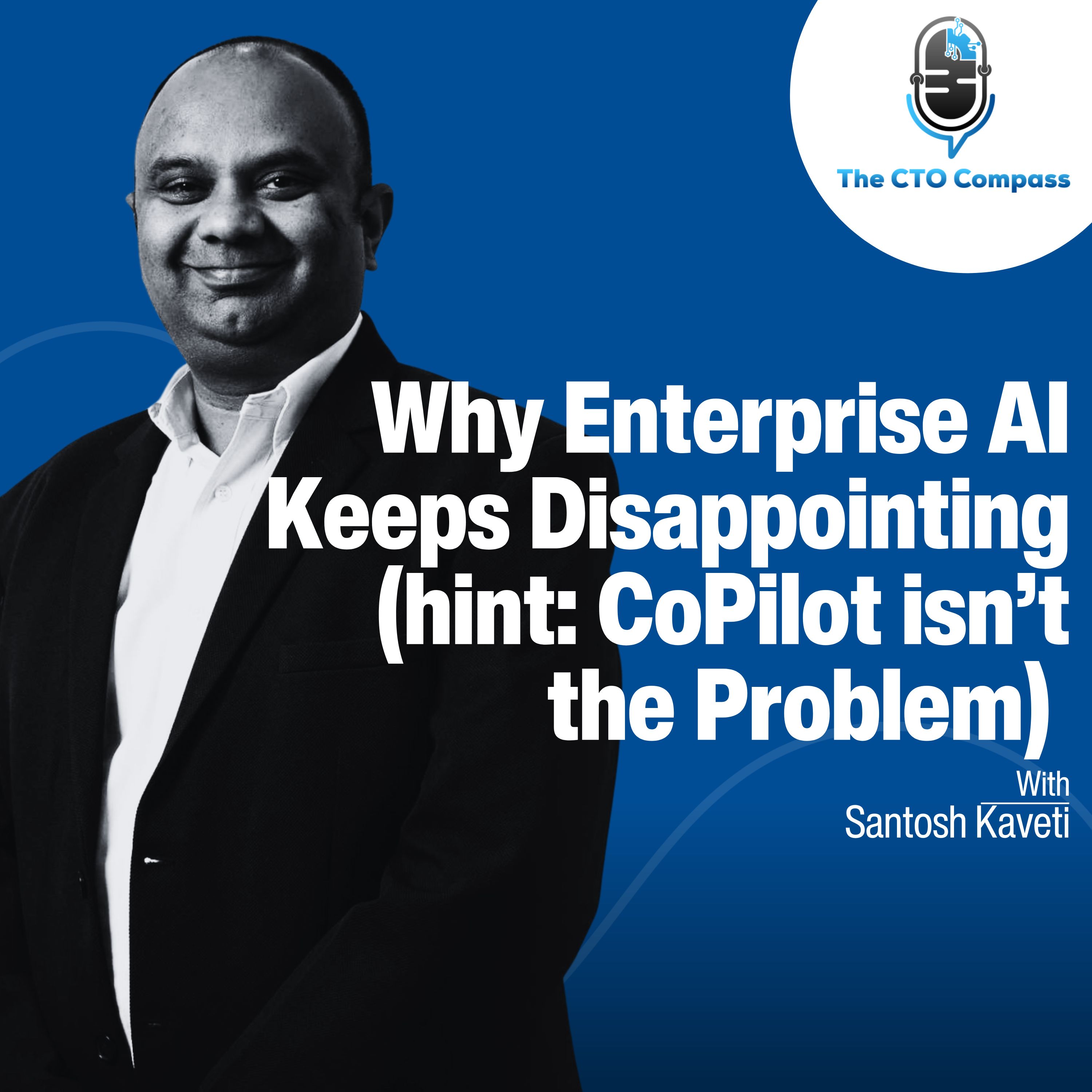
Why Enterprise AI Keeps Disappointing (hint: CoPilot isn’t the Problem) ft. Santosh Kaveti
Feb 2000:46:09Tap to summarizeMost CTOs and CIOs are not behind on AI because they chose the wrong model. They are behind because their data, culture, and workflows are not ready.In this episode of The CTO Compass, Mark Wormgoor speaks with Santosh Kaveti, CEO of ProArch, about what it really takes to scale AI in large enterprises. They break down why AI pilots stall, why data lakes did not solve data readiness, and how tech leaders can move from experimentation to real business impact in 90 days or less.The conversation also covers Microsoft Copilot, enterprise data governance, AI security and compliance, and how CIOs and CTOs should respond when boards demand AI results.If you are a CTO or CIO under pressure to deliver AI outcomes instead of demos, this episode offers a practical, no-hype playbook.Key Takeaways for CTOs and CIOsWhy AI adoption fails without strong data readiness and ownershipWhat “data as a product” looks like in practiceHow to move from AI pilots to production in four to six weeksWhy Copilot often struggles and how to unlock real productivity gainsHow to measure AI ROI beyond licenses and usage metricsWhy model-agnostic architecture matters for enterprise AIAbout SantoshWith over 18 years of experience as a technologist, entrepreneur, investor, and advisor, Santosh Kaveti is the CEO and Founder of ProArch, a purpose-driven enterprise that accelerates value and increases resilience for its clients with consulting and technology services, enabled by cloud, guided by data, fueled by apps, and secured by design.Santosh’s vision and leadership have propelled ProArch to become a dominant force in key industry verticals, such as Energy, Healthcare & Lifesciences, and Manufacturing, where he leverages his expertise in manufacturing process improvement, mentoring, and consulting.Chapters00:00 Knowing When You're in the Wrong Direction07:44 What is Data Readiness in AI?12:49 Where Do You Start with AI Data?17:43 AI Implementation in Your Business26:11 Microsoft Copilot is Overtaking!37:04 AI Enterprise Adoption43:53 Leveraging AI for Big ChangesWhere to find SantoshWebsite: https://www.proarch.com/LinkedIn: https://www.linkedin.com/in/santoshkaveti/My Socials• Website: https://tairi.co• LinkedIn: https://www.linkedin.com/in/mwormgoor• Instagram: https://www.instagram.com/markwormgoorContact Us• Business Email: team@tairi.co
Transcribe →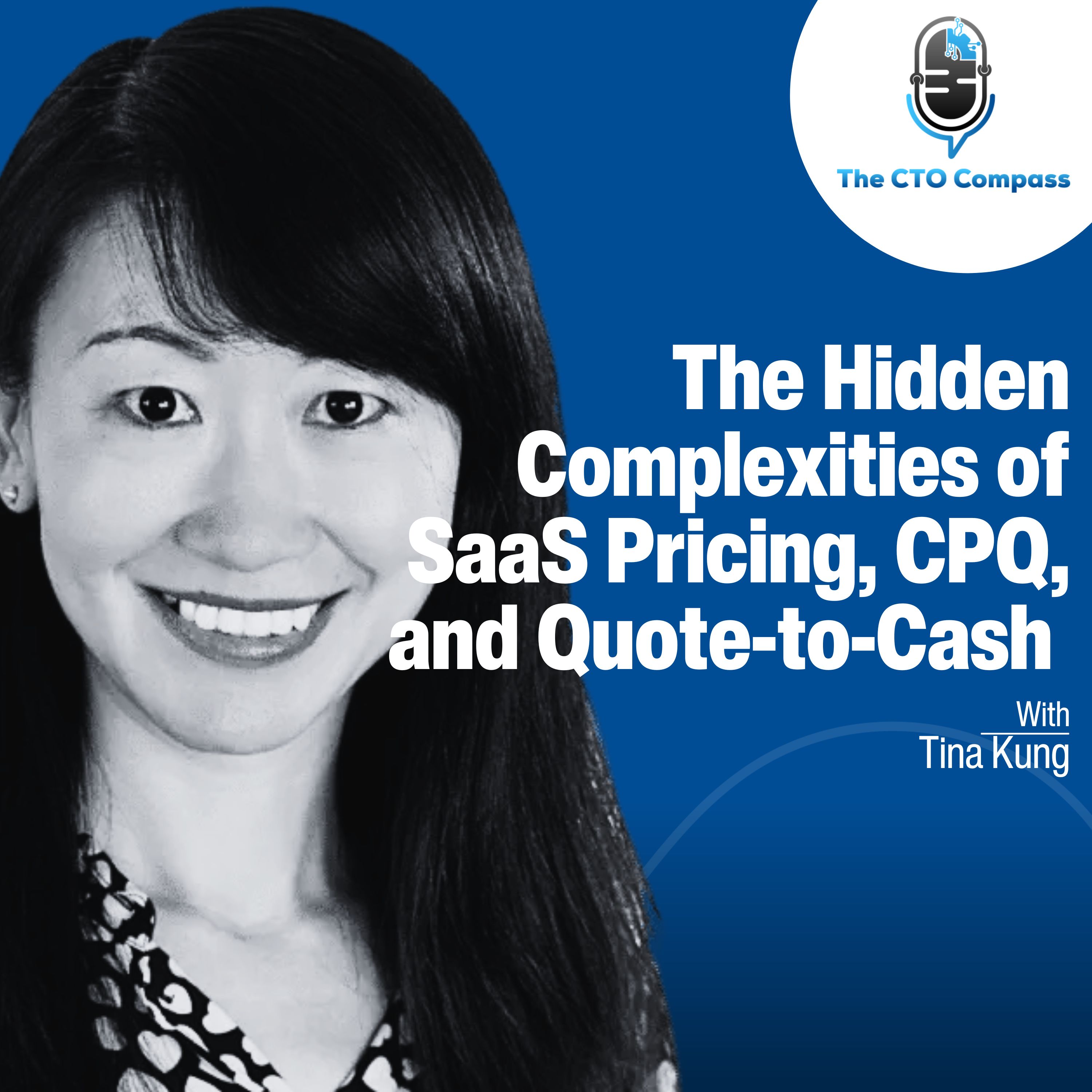
The Hidden Complexities of SaaS Pricing, CPQ, and Quote-to-Cash ft. Tina Kung
Feb 1300:42:17Tap to summarizeRevenue systems are becoming a major source of complexity in modern SaaS and AI companies. As CPQ, pricing, quoting, and billing evolve, they often slow decisions and execution instead of enabling growth.In this episode of The CTO Compass, Tina Kung, Founder and CTO of Nue, shares lessons from building revenue systems at Salesforce, Zuora, and Neocrm. The conversation explores why revenue infrastructure shapes strategic clarity and boardroom impact, why most enterprise AI stops at summaries, and how CTOs can design systems that scale without slowing the business down.You'll learn:Why CPQ and quote-to revenue systems often slow decisions as SaaS and AI companies scaleHow pricing flexibility and personalization create hidden complexity that impacts execution and strategyWhy revenue systems should be treated as core technical infrastructure with direct boardroom impactWhat most enterprise AI gets wrong by stopping at summaries instead of removing operational workHow CTOs can simplify revenue workflows to improve clarity without triggering a large transformation projectChapters00:00 Handling Business Overload07:09 Simplifying the Process14:47 The Hurdles of Implementation18:31 Problems with Old Contracts23:11 OpenAI's Strict Timeline25:54 Complexity under Simplicity31:26 Implementing AI35:40 What's Next?About TinaTina Kung has over 20 years of experience in the opportunity-to-cash space.Before co-founding Nue.io, she served as VP of Products and Engineering at Neocrm — the largest CRM in China — and held engineering leadership roles at Salesforce CPQ, Zuora, and Oracle CPQ.As Nue’s CTO, Tina is reimagining how modern businesses run revenue. She founded Nue to solve the painful complexity she witnessed firsthand at companies like Salesforce and Zuora.Her vision is clear: to build a unified, AI-powered platform that makes revenue operations elegant, intelligent, and beautifully simple.Under her technical leadership, Nue is powering the next generation of SaaS and AI companies with a Salesforce-native quote-to-revenue platform that unifies pricing, quoting, billing, and analytics in real time.Where to find TinaLinkedIn: https://www.linkedin.com/in/tinakung/Website: https://nue.io
Transcribe →