← The Curbsiders Internal Medicine Podcast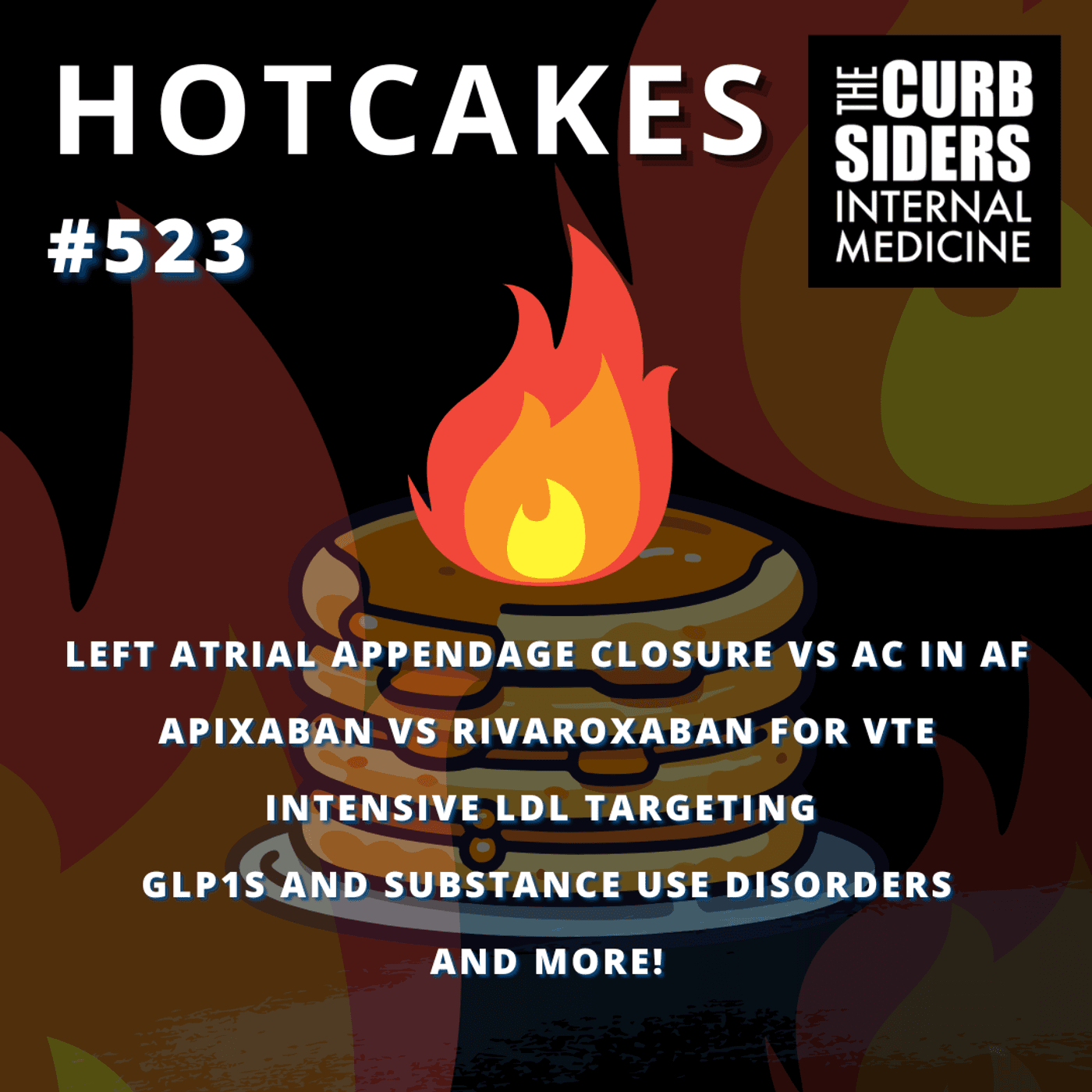
The Curbsiders Internal Medicine Podcast
#523 Hotcakes: Left Atrial Appendage Closure vs AC for Afib, Apixaban vs Rivaroxaban for VTE, Intensive LDL Targeting, GLP1s and Substance Use Disorders, and more
01:06:21
Loading summary
Transcript158 lines
- [00:00]
A
It's 2026 and we're about to have our three year anniversary of our patreon@patreon.com curbsiders. So to celebrate, we're offering the first 1000 members who sign up free house officer privileges for one month. That lets you get access to 70 plus bonus episodes where Paul and I recap high yield Pearls, answer listener questions and give our picks of the week. It's a lot of fun, so check us out at Patreon or you can click the link in the episode description to sign up. Paul Watto, the guy who stole my diary has gone missing.
- [00:43]
B
Yeah, I can't get there.
- [00:45]
A
My thoughts are with his family.
- [00:46]
B
Paul, that's a great one.
- [00:50]
A
Thank you.
- [00:51]
B
That might be why I hear what you've done.
- [00:52]
A
That's what I getliving.com under the dark dad jokes section.
- [00:57]
B
I loved. The Curbsiders podcast is for entertainment, education and information purposes only and the topics discussed should not be used solely to diagnose, treat, cure or prevent any diseases or conditions. Furthermore, the views and statements expressed on this podcast are solely those of those and should not be interpreted for the official policy or position of any entity aside from possibly cash like Moral hospital and affiliate outreach programs, if indeed there are any. In fact, there are none. Pretty much, we aren't responsible if you screw up. You should always do your own homework and let us know when we're working.
- [01:26]
A
Welcome back to the curbsiders. I'm Dr. Matthew Frank Watto. Here, my great friend and America's primary care physician, Dr. Paul Nelson Williams. Hey Paul.
- [01:36]
B
Hey Matt. How are you?
- [01:38]
A
I'm doing well, Paul. Tonight is a Hotcakes episode. We have a great guest, Dr. Shani Herzig. And of course Dr. Rahul Ganatra is with us as always. Paul, would you remind people what is it that we do on Curbsiders and why are we here tonight?
- [01:51]
B
Sure, Matt. As a reminder, we are the internal medicine podcast. We use expert interviews to bring you clinical pearls and practice changing knowledge. Except, as you mentioned, this is one of our Hotcakes episodes. So this time the experts are not really us, me and you, Matt, but we actually do have some bona fide experts with us, including the great Dr. Rahul Garnacha, our resident epidemiologist. We go through some articles that we thought were especially interesting or perhaps relevant to practice or just things that we wanted to talk about. And then we get to listen to smart people talk about how they think about those articles, which is always super educational. So as I mentioned, we are joined by Dr. Hoult. Ghonacha. Rahul, how are you?
- [02:25]
C
I'm doing great, Paul.
- [02:26]
B
How are you? I'm good. Thank you for asking.
- [02:29]
A
Paul, I want to mention to the audience that I was in Boston this month and I got to see Rahul in person. Actually, I brought my whole family to his house, which I apologize to you, Rahul, for my kids running all over the place.
- [02:43]
C
But I got.
- [02:44]
A
He got to meet my family. I got to meet his wife. It was great. We got to talk for a while. Rahul, you're the. My kids are like, rahul is so nice. I'm like, yeah, why wouldn't he be?
- [02:54]
C
No, I had just cut up a honeydew melon and so I had like a bowl of fruit to offer. I think that really went over well.
- [03:01]
B
This is maybe the most wholesome thing I've ever heard. Yeah, no, I would love to hang out with Rahul, but yeah, I also not going to Boston anytime soon.
- [03:08]
A
Well, Paul, that's your loss. But if you're ever in town, I would just go to his house with your family and just say, hi, come on over.
- [03:16]
C
I'll bring Ollie.
- [03:17]
B
It'll be a good time.
- [03:18]
A
All right, so that I derailed us. But Rahul, tell us about our wonderful guest.
- [03:23]
C
All right. It is my privilege to introduce Dr. Shani Herzig. Shani is a practicing hospitalist and the associate chief of hospital medicine for academic affairs and also the chair of the pharmacy therapeutics committee at Beth Israel Deaconess Medical center in Boston, where I did my training. She's an associate professor of medicine at Harvard Medical School. And though she wouldn't admit to this, she is a national, internationally renowned expert in the field of pharmacoepidemiology. She really knows what she's talking about in this space. And she's one of the few people for me who has transitioned from being a mentor to a colleague and friend. And so I'm so privileged and overjoyed to be recording with her tonight.
- [04:06]
A
And a reminder that this and most episodes will be available for CME credit for all health professionals through VCU Health at curbsiders.vcuhealth.org foreign let's get started. And the first article that I'm going to present is the Champion AF trial. This is by Doshi et al. It was in the New England Journal in 2026. And this is about left atrial appendage occlusion or closure. They abbreviated LAAO or laac if you're reading the literature. And they wanted to look at this One of these occlusion devices versus a novel oral anticoagulant which aren't really so novel anymore. Paul, They've been around since we were in training, which was a long time ago.
- [04:54]
B
Yeah, I thought we were doing direct now. I thought we're doacs, not noacs.
- [04:58]
A
I know, you know, some of the reading for this, they were. That's how they were abbreviating it.
- [05:03]
B
And there's something like new and tortured right now too. Like non vitamin K antiques. Like there's like a. Yeah. Is that where the NOAC is? Back to everything new again?
- [05:11]
A
Yes. So that's why I wrote this up as noac. But I want the audience to know what we're talking about. But basically they wanted to know and look at does this work for patients who don't have a contraindication to anticoagulation but just don't want to take anticoagulation for the rest of their life? Which I understand why this article made headlines and why it's such a sexy idea that hey, instead of having to take a blood thinner for the rest of my life I can get one of these devices. Most of these patients still need to take aspirin anyway, but I guess it's better than taking a blood thinner. So that's why this study is important and these devices are controversial. John Mandrola wrote about this in his substack and that's what kind of put me onto this one. So the top line results of this study, that this was a positive trial that left atrial appendage occlusion was non inferior to NOACS for major adverse cardiac events. And that when you look at bleeding outcomes, it was superior. The primary outcome for preventing major adverse cardiac events at three years there was a difference of about 0.9%. There was more events in the left atrial appendage occlusion, there was about 5.7% of patients had events versus in the oral anticoagulant about 4.8% of people had had events. And so they're touting this as this is non inferior, it's superior for bleeding. And you can imagine how those headlines are written. So Shani Rahul, I'm going to go to you. Shani, let's start with you as our esteemed guest. What do you think about this and anything that jumps out to you about the setup here that might have kind of biased the results of the study?
- [06:58]
D
I mean I think anytime that I look at non inferiority trials, the first thing that I think about is how did they set their non inferiority margin? Non inferiority trials, it's all about the non inferiority margin and that's something that's chosen by the study investigators. So there is incentive to choose a large one, especially if the device manufacturer is sponsoring and designing the study. So our question is whether we agree with the one they chose. And I would say that a non inferior margin of 4.8%, which is what they chose, seems a bit high. It means that they would still call device closure non inferior to NOACs, even if they cause up to a 4.8% absolute increase in the rate of stroke. And so I would say that in and of itself seems like a bias towards concluding non inferiority. And then when you account for the fact that they also had much lower event rates than expected, and this is an interim analysis, it does make you really wonder about whether we should actually draw practice changing conclusions from the study.
- [08:07]
A
Rahul?
- [08:08]
C
Yeah, I had a similar worry. I mean, thinking about the size of the non inferiority margin as being a possible source of bias towards non inferiority is really important. And then also looking at the components of the primary outcome and the safety outcome and what is and isn't included. One thing John Mandrola identified is the inclusion of death from cardiovascular causes. You have to really think that there's biologic plausibility that that's going to be affected by the interventions. If you don't have that, then it just runs the risk of kind of diluting the difference between the two groups, which itself could be a bias towards non inferiority and the bleeding outcome. I mean, they didn't include periprocedural bleeding here, which they then go on to describe in the text. You know, there were a lot of cases of patients, you know, with pericardial effusions who needed repeat procedures. So, you know, it's just worth kind of us calling out that the procedure itself is not benign and we have to consider that cost to the patient in the calculus of whether this is beneficial or not.
- [09:15]
A
Yeah. And the group in general they chose, people with a low has bled score, it was about 1.3 on a scale of 0 to 9, with 9 being like the highest risk of bleeding. And then the Chads VASC score, the Chads 2 VASC score was about 3.5 on average. So these were not like our highest risk for patients for stroke. And if you look at the absolute numbers of stroke, there were more strokes in the left atrial appendage occlusion group. And there was as far as bleeding. There was more bleeding in the novel oral anticoagulant group, but if you add back in procedural bleeding, it was pretty similar. Like both groups had around 80 bleeding events. So the question is, if it wasn't much better for bleeding and you still have and you had more strokes, then what are you gaining from this? And the patients do for these devices, they do need some upfront. Like the first 45 days they're either gonna be on dual antiplatelet or they might be on an anticoagulant and aspirin. And then most patients are recommended to be on lifelong aspirin for this. So it's not like they're completely antiplatelet anticoagulant free, even if they have a device. So that's what I would just point out to patients practically. And I think it's easy to write a headline for this study, which is why I wanted to cover it, so that people are just wary that this is a much more complicated decision than just recommending everyone get these now and we just stop anticoagulation.
- [10:50]
C
Yeah, I have a question for Shani about this. We talked a little bit before recording about how to interpret the fact that there's a lot of crossover in this study. And in like the case of a superiority trial, that could actually be a strength. If you're kind of diluting the effect size that you're looking for. Do you want to talk a little bit about like, what that could mean in this study where the question is not one of superiority, but one of non inferiority?
- [11:15]
D
That's an excellent point, Rahul. Absolutely. In a superiority trial, crossover is going to bias you towards the null.
- [11:25]
B
Right.
- [11:25]
D
When you're doing your intention to treat analysis, it's going to just kind of wash out any effects. If you're looking for non inferiority, washing out of effects is not good. Right. Because it's going to make your two groups look closer together, which is exactly what you're trying to prove, or I guess disprove, depending on what you're rooting for. But in this case, with a huge amount of crossover, you're going to bias towards concluding that your treatments are more similar and therefore more likely to say that one is non inferior to the other. So not good to see when you see more. It's never good when you see that more than 10% of your sample in one group crosses over to the other.
- [12:09]
C
Yeah, this is a really good example of how like, you know, sometimes it can be hard to figure out the direction of bias from, you know, Lack of protocol adherence in a non inferiority trial. And so that's why I think it's convention to report both the intention to treat and per protocol analysis. But like, this is a great, nice, clear example of how you had like 200 patients in the NOAC group crossing over to get the device. In this case. This is going to obscure any potential differences between the two and bias towards non inferiority.
- [12:38]
A
So I would say that. And maybe I was biased by reading the substack before I read the article, but I would say I'm giving this two and a half out of five hotcakes. And I would say to the audience, just if your patients are on oral anticoagulants and they're asking you if they and they don't have a contraindication to an oral anticoagulant and they're asking should they get a Watchman device? I think at this point the oral anticoagulant is the better treatment and they're going to avoid more strokes, which is what we're trying to do if they have that, as far as we know. Now, Rahul, let's talk a little bit more about anticoagulants and let's switch over to venous thromboembolism. So what article did you do?
- [13:21]
C
All right, my friends. Yeah, let's take it on over to thromboembolism land. So this paper that we're going to
- [13:28]
B
talk about the worst theme park in human history,
- [13:32]
C
I wondered if that was going to go uncontested and it did not. Okay, well, we're going to talk about the COBRA trial. Paul, do you have any reactions to the name where.
- [13:45]
B
And that's from what now?
- [13:47]
C
You know, I actually didn't prepare. Oh, man, I feel like a intern on Rally.
- [13:51]
A
Well, the title of the article is Bleeding risk with apixaban versus rivaroxaban an acute VTE. So, Paul, I'm not sure it has
- [13:59]
B
to be something tortured. I'd like to give credit, but yeah, it's gotta be something awful. And apologies to the authors.
- [14:07]
C
All right, well, this was a trial by Castellucci and colleagues and this was published in a March 2026 issue of the New England Journal of Medicine. And the research question that these authors were asking was, does rivaroxaban carry a higher bleeding risk than apixaban when used to treat VTE for three months? And this is an important question because prior studies comparing apixaban and rivaroxaban to vitamin K antagonists from the bad old days for VTE treatment, those suggested a higher bleeding risk with rivaroxaban. But no head to head direct comparison was really available until this study. And it's also worth pointing out that current professional society guidelines recommend DOACs for VTE, but with really no preference given or priority given as of yet. So the bottom line for this trial, this was a positive trial, okay. At three months, clinically relevant bleeding, which we'll define in just a second, occurred in 3.3% of patients who took apixaban, compared with 7.1% of patients who got rivaroxaban. And for ease of comparison, this is an absolute risk reduction of about 4%. Number needed to treat of about 25 and a relative risk reduction of about 50%. Okay. VTE recurrence was uncommon. It happened in about 1% of both groups, despite adherence being about 10% lower with apixaban being a bid medication. So I'm curious, before we get into the details here, are there any, you know, questions that kind of float to the top of your minds? Are you ready to accept these results? Whole hog. Any concerns people have?
- [15:48]
B
Can I say, before we get into that, it pains me to say this. Cobra not bad. So comparison of bleeding risk between Rivaroxaband and the Pixaban. So other than the errand between kind of floating in there, I've seen far, far worse. So apologies to the authors for assuming they didn't try. That's not terrible.
- [16:05]
A
So I apologize as well. I apologize.
- [16:08]
C
You guys are so cynical.
- [16:09]
B
Yeah, we've been doing this for a while.
- [16:11]
A
With good reason. Rahul.
- [16:13]
B
Come on.
- [16:15]
D
Foreign
- [16:18]
B
this episode is brought to you by Masterclass. There's always something you want to get better at. So why not go to Masterclass and find a class that's taught by someone who's actually the best in the world at it and it fits into your life. There's audio mode, short lessons. It can be on your phone or your tv. You don't have to carve out hours, you just have to start. I'm thinking about Mother's Day coming up, and I feel like Masterclass would be a great gift for my mom, who has tons of interests that I'm sure she would love to explore. And where better than Masterclass? Because Masterclass has the world's best instructors. Unlike other learning platforms, Masterclass puts you in the room with the people who define their fields. Not just experts, but the best in the world. There are more than 200 classes across 13 categories. Things like business, writing, cooking, wellness and more, with plans Starting at just $10 a month, billed annually, Masterclass fits into any schedule. Audio mode turns your commute or workout into a classroom. You can download lessons for offline access and learn on your own terms. And it actually works. Three in four members feel inspired every time they watch, and 83% have applied something they've learned to their real lives. Every new membership comes with a 30 day money back guarantee. Masterclass keeps adding new classes, so there's never been a better time to get in. Right now, as a listener of the show, you get at least 15% off any annual membership@masterclass.com curb that's 15% off@masterclass.com curb. Head to masterclass.com curb to see the latest offers. This episode is brought to you by Panacea Financial. You matched. You did it. After four years of medical school, hundreds of hours of studying, and one of the most stressful application cycles of your life, you finally have a program. And then almost immediately the texts start coming in. Where are you moving? When do you start? Have you gotten your license yet? And suddenly the celebration is over and the spreadsheet begins. Moving truck, security deposit, first and last month's rent, New city, maybe a new car, and a start date that doesn't care whether your bank account is ready. When I matched into residency, it was probably one of the most exciting days of my entire life. But then almost immediately, I started thinking. I had this mountain of student loan debt behind me. I had a bunch of new expenses laying ahead of me, and, and you have to ask yourself, where is this money supposed to come from? And that's exactly the gap that Panacea Financial's PRN personal loans are designed to fill. They're built specifically for residents, fellows, medical students and doctors. People whose financial lives are anything but typical. You're not a generic borrower. You're someone who just completed one of the hardest academic journeys in existence and is about to start one of the most demanding jobs there is. Your loan should reflect that. PRN personal loans give residents access to up to $20,000 to cover moving expenses, licensing fees, board costs, deposits, or anything else that comes up in that chaotic pre res residency window. During residency, you can take advantage of reduced payments that are built around what you're actually earning, not your future attending salary. There are no prepayment penalties. So when you're finally making attending money and want to pay it off early, you just do that for qualified applicants. No co signers required. Panacea Financial understands the path you took to get here. And with 247365 live support. There's always a real person available, even on your overnight call shifts. Applying is fast online and takes just a few minutes. If you're about to make the leap into residency and feeling the financial pressure of that transition, visit panaceafinancial.com curbsiders today Panacea Financial is Division of Premise Bank Member FDIC. Not all applicants qualify for the maximum loan amount subject to credit approval.
- [19:53]
A
Shawnie, I think you should start though. What do you think? What jumped out to you about this one?
- [19:59]
D
Yeah, I mean, overall it was a really nicely done study, Straightforward, sponsored by national health organizations rather than people with lots of conflicts of interest. I think the biggest thing that jumped out was just there was a really big drop between eligible and who actually made it into the trial based on exclusion criteria. So there were a lot of patients excluded for good reasons. But it does make you wonder about how this would generalized to real world practice. I think it was like ROHO probably has the actual numbers, but it was
- [20:35]
C
30% of people screened were ultimately included. This is one of my favorite things to do, by the way, what you've just done, which is consort diagrams. Yeah. Talk about the CONSORT diagram. Ooh. I mean, just taking a rough measurement of the ratio of the number of people who were randomized to those who were screened.
- [20:56]
D
Yeah.
- [20:57]
C
And you know, we've talked about this before on other episodes. It's kind of up to us to look at the exclusions and decide do they make sense? But you know, this is one way to gauge how vulnerable are the results of any positive trial to explanation by selection bias. If this is a very highly selected population, is this a sort of Goldilocks phenomenon? So I love it. Yeah. I mean, it's, as Shani's pointing out, this was a sort of somewhat highly selected group. Patients couldn't be very obese, they couldn't have active cancer, they couldn't have child pew B or C cirrhosis. So the comorbidities are not listed in the paper or the supplement. But I did kind of get the sense from reading this that this was a relatively well population despite having vt.
- [21:38]
A
I remember Paul, like maybe a year ago there was an article I covered where they, they didn't, they put the CONSORT diagram, but they didn't put in like how many patients they initially screened. And Rahul like flagged it right away. Like I can't remember what study it was. And then there's of course some that just don't even include that at all, which is, you Know, that's got to be a red.
- [22:00]
C
It's in the word document template. You have to make a deliberate decision to take it out. So it's like. Yeah, yeah, very sensitive to that. Okay.
- [22:08]
A
The other thing that I wanted to just mention about this is the rivaroxaban has this 21 day lead in twice a day, this higher dose. And then. And apixaban has a higher dose for just seven days. So Shani, what do you, what do you make of that?
- [22:25]
D
Yeah, Rahul was noting the excellent point that when you look at the actual outcomes, it does seem like those outcomes, the bleeding tends to happen early on and those curves separate early on, which, which could be a reflection of the fact that most of the problematic outcomes associated with rivaroxaban are when you're on the higher dose in that first 21 day loading period. So I don't know if Rahul, I think, has some thoughts about maybe whether that should spark ideas for other.
- [23:06]
A
You mean, is this a function of pharmacology? It's not a problem with the drug, it's a problem with the way we're dosing and administering it.
- [23:15]
B
Yeah.
- [23:15]
D
It made me want to go and look back and see the initial studies that determined that that was the right dose for the loading period for rivaroxaban. You know, why did they choose that dose in particular? But I, I'm not good enough at remembering all the literature to be able to say why they chose that.
- [23:32]
C
Yeah, I mean, I don't use rivaroxaban for VTE that much and so I had to kind of remind myself of this. But yes, there is a three week period of high intensity bid dosing in comparison to the period of, of bid or of higher intensity dosing for a Pixaban. That's much shorter. I think it's like seven days for a Pixaban. So, yeah, I mean, for those of you playing along at home, you can take a look at figure 2 in the paper and you can see that the slope of the Kaplan Meier curve is much steeper during the first 21 days for river oxyband. So this is telling us that most of the bleeding events are accruing early in people's treatment course. And, you know, there's what looks to be a relatively more similar rate of bleeding between the two after that. So it kind of makes me wonder if, you know, down the road maybe if we could come up with a different, you know, high intensity initial strategy for rivaroxaban to get people through that. You Know, first period of thrombus absorption or, you know, whatever's happening during the early period, and then switch over to the once daily, you know, medication to kind of get the benefit of that. It just makes me like you, Shani. I was wondering, like, why do we do that again with the. The three weeks of. Of bid dosing? This kind of suggests that that's where all the harm is. So it also makes me wonder if maybe these results wouldn't generalize to say, you know, atrial fibrillation, where we don't have any kind of initial high intensity period. So the same group is conducting another trial, creatively named the COBRA AF trial, which should answer that question.
- [25:12]
A
Paul, you okay?
- [25:13]
B
Yeah, I mean, it's fine.
- [25:17]
A
So, Raul, how would you rate this on a. On our hotcakes scale of 0 to 5?
- [25:23]
C
Yeah, I mean, this is a nice, clean trial. It was well done. There were not, you know, glaring sources of chance or bias that really threaten the author's conclusions. And we talked a little bit about the potential for this being a highly selected population and whether these results would generalize. So, you know, I'm on the lookout for COBRA AF and for other dosing strategies, you know, that might allow using rivaroxaban sort of safely in this population. But I think this is pretty good. This is food for thought. I'm going to give this four out of five.
- [25:51]
A
All right, good score. So let's move on to the great Dr. Paul Williams, who. He's a great primary care doctor. He loves talking about cholesterol. He loves cholesterol targets and just kind of combing through patients labs. So, Paul, what do you got for us?
- [26:08]
B
I do actually love all those things.
- [26:10]
A
I know you do, Paul.
- [26:12]
B
It sounded like you're being sarcastic, but. No, genuinely, those are some of my favorite things. So I bring to you the intensive LDL cholesterol targeting an atherosclerotic cardiovascular disease, A hot off the presses New England Journal of Medicine paper that was looking at LDL cholesterol targets for secondary prevention. And part of my motivation for doing this paper was to so A, to choose something that was not going to torture me statistically because I did that to myself too often. But then also B, was to hopefully bully myself in actually reading the new cholesterol guidelines because I just haven't done the deep dive yet. And holy smokes, they are dense. That is, God bless the 27 authors or however many, but that is a rocky read. But we can talk about that some other episode. So for this paper, this is the EasyPave trial, a wretched name, it is the effective Ezetimibe combination therapy for patients with vascular cardiovascular disease. So deal with that when you shall. But the question they were asking is treating to an LDL target of 55 milligrams per deciliter superior to targeting 70 milligrams per deciliter in patients with already known atherosclerotic cardiovascular disease. So we've moved more and more towards actually choosing lipid targets, but there have not been studies actually looking at those lipid targets. Some of that has been sort of extrapolating. So the authors are looking at this number 55 very specifically compared to a more traditional target of 70. And the new guidelines, if you've had a chance to pour through them, recommend this. 55 milligrams per deciliter in patients who are very high risk. And when we're talking about secondary prevention, and that's going to be all of the patients who already have known ASCVD, so over the age of 65, if they have a CABG or PCI, if they have current tobacco use, diabetes, a history of heart failure, hypertension are just some of the things. But basically it's not going to take much to get you to those two risk factors to kind of get you into the very high risk category. So most of our patients, their goal is going to be 55 milligrams per deciliter according to the new guidelines, when we're targeting secondary prevention. So I'm going to give you the top line results and then pause to see if there are any initial thoughts. But basically, when they divided two groups in either 55 milligrams per deciliter or 70, the group at the 55 milligrams per decilliter had a significantly lower risk of cardiovascular events at three years than the group that was targeted to the more conventional. And that I'll give you the primary endpoint because that is probably good to know. This was a composite endpoint that was deaths from any cardiovascular cause, non fatal mi, non fatal stroke, any revascularization or hospitalization for unstable angina by year three. So I'll pause there to see if there are any initial thoughts, questions or concerns before I get into the nitty gritty of how they did the study.
- [28:42]
C
I mean, as a mostly inpatient doc, I'm maybe the worst person to have any opinion on lipids. But one question I had about these results was what did they achieve? How many people in each group were able to actually achieve these targets? And what was required to get there? We talked a little bit before recording about the absolute difference between the groups. I don't know. Do you want to say anything about how easy or hard these targets were to attain?
- [29:12]
B
So, Rahul, they achieved good separation, like I said. But I will say that a good chunk of patients, the intensive group, did not reach the target of the 55 milligrams per deciliter. The median LDL in that group was actually 56, so not quite there. And it was actually 66 milligrams per deciliter in the conventional group. And the way I can get into a little bit about how this study was actually designed. But again, I thought I chose something relatively straightforward. And then how they randomized in terms of the treatment was also wild. I started reading this and then my eyes went crossed and my pupils went black and then I lost a fair chunk of time. But basically, once they randomized the intensive versus the standard group within those groups, they were then stratified. They were randomized to either statin monotherapy and within statin monotherapy, they were randomized to either rosuvastatin or atorvastatin, or it was rosuvastatin plus ezetimibe or what the patients are randomized into within the groups, whether this is the intensive or the standard target. Does that make sense? Did I say that in a way that was actually comprehensible?
- [30:10]
A
Yeah.
- [30:10]
B
And what they were trying to do is sort of evenly distribute the various statins. I think just to prove it is in fact the cholesterol lowering and sort of class effect stuff, and not one statin versus the other is my understanding of why they chose to do that. And then after patients were randomized after that, at follow up the adjustments, the investigators, the clinicians who treated the patients were given instructions as to sort of where to go. But they were not hard and fast. They could use their clinical judgment, but in general they were recommended to increase the dose of the statin, then add on ezetimibe if that hadn't already been done. And then they could sort of move on to things like PCSK9 inhibitors and other sort of more intensive measures.
- [30:44]
A
So Paul, what I thought was surprising was there was just this 10 point difference. Like first of all, patients were starting with like an average cholesterol LDL of around like 77, which is quite low already. Right. And then, and most, I think a lot of them were already on statins. And then at the end of the trial, there was only this 10 point difference. But they had this pretty large 30% or so reduction in events, which just seemed high to me. And you know, that was one of the things, the editorialist pointed out that in another trial that was done, even a much larger, like 30, almost 40 point reduction in LDL led to like a smaller relative reduction in adverse cardiac events. So that, that part I have a little bit of like, I just don't know how to explain that. But it is, it was quite surprising at how much because they were starting from a low level and then even just incrementally going down by that much. I wouldn't have expected such an effect.
- [31:47]
B
They excluded patients who had an LDL cholesterol less than 70 without medications. But. Yeah, that's exactly right. And then also really only explored out to three years. So you had this whopping difference between the groups with a relatively minimal difference in the actual LDL cholesterol over a relatively short period of time. So I could not find fault with the way the study was actually performed, but I really was surprised by just how striking the outcomes actually were. So I think it's a good study, but I was surprised by that. And I don't have a great way to explain just a 10 point difference causing that big a change for our pharmacoepidemiologist. Yeah, help here. Is there anything that you noticed that sort of jumped out at you that should have been done differently or that felt kind of hinky to you?
- [32:30]
D
I think that's, I can't say there was. I don't think I'm going to be much helpful in this instance. I think it's an interesting thing to note and it makes me wonder if there was just something different about these patients. Remind me, Paul, the study took place outside of the U.S. yes.
- [32:49]
B
This was a South Korean study, I believe.
- [32:51]
D
Yeah, I don't know how to explain it.
- [32:55]
C
Yeah, I mean, looking at the, I mean, thinking about importing results from one population to another is always, you know, we have to ask, like, could there be biological differences in people or populations that matter? I mean, the, you know, looking at Table 1 looks like randomization was effective. These were people in their mid-60s, mostly men, mostly normal weight. And as you mentioned, you know, they excluded people with low LDL at baseline. The, the median LDL at enrollment was in the 70s.
- [33:22]
B
Yeah, pretty good.
- [33:23]
C
Yeah. So I don't know. I mean, 20 to 25% of people were smokers, so. And you know, half of them had prior ACs. So, you know, these are people who seemed like they had risk factors but, yeah, I don't know, it seems like if you shoot for the moon and land among the stars, that's like, still good, is how I'm interpreting the results of this.
- [33:42]
B
Yeah, I mean, it's in keeping with lots and lots of data that we have where there's the improve it trial, where I think the added ezetimibe dosynvastatin. And really the takeaway is not that ezetimibe is magic, but that lower LDL seems to improve outcomes. And then we had the same types of data with the PCSK9 trials, too, that just showed the further down you push them, the better off patients seem to do. So this. This seems in keeping with that. But to have an actual number to shoot for to kind of validate some of the targets that we've established is a nice thing overall, I think.
- [34:07]
A
Yeah.
- [34:08]
D
Adds further credence to the question of should statins be in the water?
- [34:15]
A
Paul, if you would answer that for us and give your hotcakes rating.
- [34:18]
B
Yeah, sure. Why not?
- [34:19]
A
Take homes.
- [34:22]
B
Yeah. Along with the microplastics. Maybe they'll counterbalance each other out, and I do. So I think it's an impressive study. I think it was well done. I don't have a whole lot to find fault with. I'm going to be ruminating on the outcome for a while, but I'm going to give this a 4 out of 5 only because it won't change my management all that much because I follow whatever guidelines are thrown at me. So I'll still be shooting for 55 regardless. But overall, a fun study to read.
- [34:44]
A
Okay, Paul. Well, Paul, we'll need your help in a minute because at your day job, I know you treat a lot of substance use disorder. Shani has an article that is interesting because GLP1 agonists are just always in the headlines these days. And you could argue substance use disorder gets a lot of headlines as well. So, Shani, tell us about your article and how these things are related.
- [35:07]
C
Yeah.
- [35:08]
D
So this article brought together those two hot topics. It's an article that was published in the BMJ in March of 2026 and it's entitled Glucagon, like peptide 1 receptor agonist and risk of substance use disorders among US veterans with type 2 diabetes. A cohort study. And this is a paper by Kai and colleagues. And they asked the question, is new initiation of GLP1 receptor agonists associated with two different things. First was reduced risk of incident alcohol, cannabis, cocaine, nicotine, opioid and other substance use disorders in people without a history of substance use disorders. The second question they asked was does initiation of GLP1s reduce the risk of substance use disorder related adverse outcomes among people who already have a pre existing substance use disorder? And the outcomes they looked at were SUD substance use disorder related ED visits, hospital admissions, SUD related mortality, as well as SUD related drug overdose and suicidal ideation or suicide attempts. So a pretty broad array of outcomes. This is a study on two hot topics and I'll jump to what they found before telling you a little bit more about why I think it's an important study. One important thing I will note about the study design is they compared GLP1 receptors to an active comparator, and that active comparator was SGLT2 inhibitors. And the reason they did that is to basically have patients who had similar indications for starting a medication. And comparing these two different medications allows you to kind of overcome some selection bias that could otherwise have been seen. And what they found is that compared to SGLT2 inhibitors, GLP1 receptor agonists were associated with lower risks of all of the different substance use disorders that they measured, which suggests a potential preventive effect across a broad array of substances. The numbers, if you translate them out based on their estimates that they found, they find that over three years the findings translate to roughly 6, 7 fewer new diagnoses of substance use disorders per thousand users of GLP1s. Then their second finding related to the people with pre existing substance use disorders was similar. GLP1 receptor agonists as compared to SGLT2 inhibitors were associated with reduced risks of each of those serious adverse clinical outcomes associated with the substance use disorders. And those findings translated into roughly 12 fewer serious adverse events per thousand users over three years, including two fewer deaths. So pretty cool results. And I think a lot of people are probably wondering what the heck, what is the connection here? Why, why would people be looking at a diabetes medication and it's or a weight loss medication and its impact on substance use disorders? And what I kind of found the most interesting when I was reading this article was just learning more about how these medications are hypothesized to work in this respect. And it turns out there have been a lot of studies done in animal models looking at GLP1 receptor agonists and their effects on drug reinforcement and this mesolimbic reward pathway that's a big part of addiction. And those studies have demonstrated that in animal models these drugs do seem to reduce drug reinforcement across a wide array of drugs. Alcohol, nicotine, cocaine, opioid use disorders. And then there have been observational studies in humans that have linked GLP1s to lower risk of alcohol, tobacco and cannabis use disorders. And then some limited studies looking at opioids. But this is really the first study that looked at the association between these drugs and a wide array of different substance use disorders within a single study. And I see Rahul is like chomping at the bit and I know he's got something really insightful to say. Go for it, Rahul.
- [39:45]
C
I didn't know I was that obvious as I'm just sitting here like, like twiddling my, my short beard. I mean, okay, I read the abstract of this paper and I was immediately suspicious. Like I went in thinking, okay, this, there has to be a problem here. And just to say out loud for everybody, you know, the whole problem with retrospective cohort studies and why, you know, there's such a loud chorus of people clamoring for randomized trials is you need to be really sure that the investigators have taken every measure possible to ensure that patients who are not randomized to a GLP1 or an SGLT2 are as similar as possible so that any difference in outcomes between them is attributable to the thing you think it is. So just to name that for everybody. So I read the abstract and you know, they did like seven studies in one and so I was immediately suspicious. But then I have to say I read the paper and they did a lot of really impressive things to kind of address, you know, some of the threats to causal inference that arise in this situation. The active comparator new user design is a really good way, as Shani mentioned, to try and identify patients who are, you know, thought to be similar. These were all patients with diabetes who were thought to need another medication for diabetes control. And they just, you know, looked at people who got GLP1s and people who got SGLT2s. So that's a strength. They took steps to mitigate immortal time bias by starting the durate, the time of follow up at the first active pharmacy fill, which is, you know, a strength. And then they did these great falsification endpoints, which, Shani, I don't want to steal your thunder by talking about that, even though I also think it's really cool. Do you want to tell everyone what they did with falsification and why that's such a strength?
- [41:34]
D
You're too kind, Rahul. Yeah, some people call these negative controls, other people call them pre specified falsification endpoints. But basically what it is is you can imagine that if there is residual confounding, so differences between your two groups that you're not measuring that is causing a spurious reduction or asperious association, that then you should see that same association with other things that you don't hypothesize to be associated with the drug that you're. The drugs that you're studying. And so in this study, they actually said, all right, so we're seeing reductions in the things that we hypothesized we would see reductions in. Let's test and see if we see associations with things that we wouldn't expect that GLP1s would have any association with. And they had a number of those, one of which was bph, benign prostatic hypertrophy. And what they found is that they did not see an association with these different negative control conditions that they hypothesized they would not see an association with that tells you, like, if there were a lot of residual confounding, you would have expected that you'd see additional spurious associations. And in fact, they did not see that. In all the things that they expected to not see in association, they did not see one. And in all the things they expected to see in association, they did. So that's a pretty nice way to kind of try to just assuage the concern that there are these residual differences that you're not measuring in your study.
- [43:16]
A
Did they throw in the signs like Virgo Leo, that sort of thing? Isn't that what they did in the aspirin trial?
- [43:24]
C
The ISIS 2 trial?
- [43:26]
A
Yes.
- [43:27]
C
Yeah. Tony Brew taught me that. Shauna, you know about this?
- [43:30]
D
I did not know that they did that.
- [43:32]
C
Yeah, well, that was all about the arbitrariness of subgroup analyses if you're not careful about doing multiple comparisons.
- [43:41]
A
So that's different than what we just talked about with the negative.
- [43:44]
C
Yeah, but it makes a cool point, though, that, like, you know, if you do a bunch of comparisons and a bunch of tests, you know, eventually, just by chance alone, you run a high likelihood of finding a spurious association, which is, you know, something we do have to think about in this paper, because there were a bunch of tests done. But, yeah, just a kind of another cool story in medicine we can link in the show notes.
- [44:04]
D
That was a big part of a negative falsification endpoint. Pre specified falsification endpoint was one of the big ways that people started realizing that the story on hormone replacement therapy may not actually be what it is. Someone did a study that showed that hormone replacement therapy Reduced the risk of death from car accidents and all kinds of things that basically helped to elucidate that this was really a healthy user bias that we were seeing.
- [44:31]
B
Oh, I never knew about that.
- [44:33]
D
Yeah, the Walnut Creek study is one of the big examples of that. But it's a very cool methodology that you see more and more of lately. I've seen it more and more in pharmacopy studies over the last maybe five years or so. And it's just another cool way to really be rigorous about making sure that what you're seeing is not affected by the things that Rohool loves to wax poetic on. By a chance, and they did a ton of those things. This negative control is one of many things that they did. I think they did like eight different sensitivity analyses, varying everything. You name it, they varied it, and the results were all consistent, no matter how they cut it.
- [45:23]
B
This episode is brought to you by figs. If you work in healthcare, you might already know this, but just in case you don't, it's Nurses Week. This is a time to shout out the incredible people who help keep us healthy and also happen to be some of the best humans you and I know. And to celebrate, FIGS just dropped new limited edition colors and styles you can't not love. The best news of all, everything is 20% off during nurses Week. From scrubs to outerwear to footwear and beyond, FIGS truly gets what healthcare professionals need to look sharp, feel good, and take on just about anything. So if you're in healthcare, don't miss out on 20% off for Nurses Week, happening May 6 through May 12. Go to wherefigs.com that's 20% off during Nurses Week at wearfigs.com.
- [46:13]
A
Doctor Williams, you practice as an addiction medicine doctor. What do you think about this? And then any limitations?
- [46:22]
B
Yeah, I mean, it's. I appreciate you bringing up a lot of the basic science stuff that has been done. There's observational like it is. I mean, there's. There's all kinds of biological plausibility. So I'm not surprised by this. I do anticipate seeing these agents used as at least adjunctive therapy for substance use disorders. None of this is terribly surprising to me. So, like the X Files, I wanted to believe I was ready for this paper. I will say just the patient population. And I don't know what to do with this information because I'm not a smart epidemiologist or researcher like you all are, but I think the mean age of the patients was in their 60s. And I will say looking at incidence, substance use disorder diagnoses in someone who's in their 60s is a little bit of a sticky wicket since that tends to happen in the 20s. And I'm not quite sure how that sort of alters the data that we're actually seeing here. I guess the other question I would have for you all, and again, this being a VA patient population, it might be different than what I'm used to. But I will say I think GLP1 agonists are more likely to be prescribed in patients who are able to engage in the healthcare system in a consistent way. So it's for me at least it's someone who has insurance where I can actually get the medication approved. I will be doing dose titration, I'll be doing follow up visits. Whereas an SGLT2 inhibitor, and I realize there's specific clinical indications for these too, is a medication I might give someone if I worry about their capacity to sort of manage all the complexities that come with the GLP1s, which are not complicated medications, but still a pill's a pill and titrating injections is kind of a different animal. So I don't know with all the propensity matching and sort of all the statistical finagling that they managed to account for that kind of thing or not. But I do think of patients on these injectable medications as needing to be a little bit more engaged with the healthcare system. I don't know if that would impact the results or not.
- [47:59]
D
Paul, that's like a perfect segue into where do you go from here? And kind of what I think the bottom line is for this study. I think ultimately as impressive as this study was from a pharmacopy study standpoint, really robust methodology, it's about as good as it gets for an observational study of drug effect. I think that RCTs are still needed and I think one of the big areas that those RCTs need to look at is whether GLP1 receptor agonists actually add benefit beyond standard addiction therapy. And do patients, can patients actually handle the follow up that's required with these medications? I think we also need to probably see whether or not these actually achieve this in people without diabetes. Because then that's kind of the group you're talking about, right? Because a lot of these patients, patients don't have diabetes and do these drugs. Is the mechanism really irrespective of the improvement in weight and glycemic control? So should I give my.
- [49:04]
A
Yeah, how many Hotcakes. Do you give it five? Five is the highest.
- [49:09]
D
So I mean, if we're, if, if the pool was all pharmacoepi studies, I'd give this like 100. But but for overall, I would probably say this is like a 3.5 to 4ish. Because at the end of the day it still is an observational study that, where these patients were prescribed these medications for clinical reasons and not randomized to these treatments. And so until we have RCTs, I don't think we can make too much of this. But it is, I would say that this is a really exciting study and I'm really curious and excited to see what RCTs demonstrate.
- [49:48]
A
Yes. And there will be some, there are some forthcoming with semaglutide if you look on clinicaltrials.gov because a lot of the studies that have been completed were with exenatide, liraglutide, some of these older agents. But there is a new GLP1 agonist on the market now or for Glipron. And the brand name is much easier to say, but we won't say it. Paul thought it was fondue, fondue, something. But that's not. It's not. It doesn't have fondue in the name. Paul, did you hear about this one?
- [50:23]
B
I am aware of its existence, but I'm excited to hear more from you.
- [50:26]
A
Yeah, so this was this. There's some commissioners national priority voucher program, the cnpv. And this program basically got this, an accelerated approval. It's A. Or forgloprawn is a small molecule non peptide oral GLP1 partial agonist. It binds to a different spot on the receptor than the peptide GLP1s and it's like 10 times smaller if you look at the size of it. So it comes in 0.8, 2.5, 5.59, 14.5 and 17.2 milligrams. And you jump the dose each month. Most patients for maintenance in the trials were needing like five and a half to 17.2 milligrams. So there's four doses in that range and the average weight loss was something like 10% compared to like 2% weight loss with placebo. And just a reminder, if people are taking injectable GLP1s, they're getting around 15% weight loss with semaglutide and 20% or more with the highest dose of tirzepatide. So this is a little bit less potent than what we have out there, but it is. I'm sure you'll be asked about it and I'm sure it's going to be coming down the market right now. Curiously, it's approved for weight management in people with comorbidities, but it doesn't have a specific approval for diabetes the way that semaglutide does, so we'll see. But it did reduce the A1C by like 1.7% on average. So I think it's going to be effective for diabetes management as well. If there's no questions or comments. Paul. E cigarettes. I heard they cause cancer.
- [52:23]
B
I mean, probably, yeah. So, yeah, I've been thinking a lot about this. I'm going to put you on the spot, Matt, because I think you actually seem to enjoy it. But. But you're taking a history. You ask a patient, do they smoke cigarettes? They say no, because you're such a great doctor. You're like, well, do you vape? And they say yes. What history do you take from here?
- [52:41]
A
What history do I take? If I ask them if they smoke cigarettes, they say they vape and then they vape. I ask them how many puffs, because I know and what sort of cartridges are you using and that sort of thing. Because the nicotine content of these things can be high and some people are like maybe getting more nicotine through those than they were through actual cigarettes because they can just puff all day.
- [53:05]
B
Yeah, it's something I've been thinking about a lot just because I think all of our HRS are built to ask about tobacco use. And actually more people are vaping now and are using electronic cigarettes than are actually smoking. And I think we still don't have a great sense in terms of counseling about safety. Is the other thing that I've been thinking about. I have a lot of patients who maybe even transition from smoking cigarettes to vaping. And they will say to me, listen, I know it's worse than smoking. I'm like, I don't think that's right. But also. But we don't really know for sure. And then I, you know. So I think about this a lot. It's kind of. It's always on my mind a little bit. Then I saw in the lay press, I think it was in the Guardian is the first study paper or article that I saw about this is like vaping linked to oral and lung cancer. I'm like, well, that's not great. And then I looked at the article that they were referencing and it's this article. The Carcinogenicity of E Cigarettes. A Qualitative Risk Assessment. And this is in carcinogenesis from this year with, with Bernard Stewart et al. And so I went to the paper to see what the lay media were sort of reporting on. And it is, as they say, a qualitative risk assessment. And I don't know what to do with that information. I almost presented this as sort of my main article. And the more I read about it, the more I was like, oh, I'll get myself in trouble if I do this. This is a review of reviews and it talks about sort of biological plausibility, it talks about animal models and exposure, it talks about about certain potential mechanisms and cell damage and all that kind of stuff. But there is still, and as much as I could see, kind of going through the review of the reviews and then also even looking at some of the papers in this study, I could not see any studies that actually demonstrated definitively that electronic cigarettes or vaping actually led to oral cancers or lung cancer. There's a lot of plausibility. There's a lot of sort of thinking that probably they do. I would be shocked if they don't. It's probably bad to heat up chemicals to inhale them into your lungs. And I don't doubt that that will more than likely increase your risk of cancer. But I will say that there's nothing, at least in this review that I saw that definitively demonstrated that. It just said that it makes a lot of sense that it would. And I don't know, I think, Rahul, I think you read through it and actually sent me a nice article or a nice kind of editorial on this as well. What were your thoughts looking through this paper?
- [55:06]
C
Yeah, I mean, when you mentioned this paper to me, my first question was, what is the design? What are we talking about here? And it became clear upon reading it that this is what I would call a narrative review. You sometimes see the word scoping review thrown around, but that's in contrast to a systematic review, which is meant to be like an overview of all the information in a particular area. So I mean, there's definitely a role for narrative reviews. They can be really useful for kind of generating hypotheses that should be tested and evidence sought to confirm or disprove. But the part of this paper that floated to the top for me was just having some healthy skepticism about news media coverage of papers. Just go look at the paper because you can decide right away, is there evidence of an association or are well meaning people misinterpreting the kind of weight of evidence presented in a paper, which is, I think, what happened here. These are important hypotheses that I think patients and consumers definitely deserve evidence and answers to. And I definitely want to know the answers to these questions as well. But after reading a narrative review that is expert opinion, it's kind of hard to say with any certainty that that means that e cigarettes are associated with cancer. We just don't know.
- [56:33]
A
Yeah, it's basically looking at a bunch of biomarkers, animal studies and kind of jumping to the conclusion that this is definitely gonna cause cancer in humans, but we just don't have the evidence. That was kind of my takeaway.
- [56:45]
B
Yeah, I feel like there's even like one throwaway line in the paper about electronic cigarettes being as likely to cause cancer as cigarettes. I looked at the reference and the reference that I looked at did not show that at all. So I don't think again, I sort of stand by my original premise. Yeah, it's probably not healthy for you, but I still think until I hear more, it probably still has to be healthier than smoking. And I'll report back if I'm.
- [57:04]
A
Yeah, don't throw away. Based on this one article, don't throw away your vape and then like go back to smoking combustion.
- [57:10]
B
That's right, exactly.
- [57:12]
C
This is studyable. We should be able to like get some data to.
- [57:16]
A
And Cochrane has like a live review of all this and like right now it looks like there's net benefit to vape, you know, replacing combustible tobacco with vapes. The last I looked at it. But Shani, any before we move on to the last hot take, any other. Any comments on this at all?
- [57:33]
D
I'd be curious about also just the effects of nicotine. And I wonder like nicotine replacement therapy must have been. Must be studied. I haven't looked up the studies but because they have a lot of purported mechanisms of the damage, one of which is nicotine itself. And I'd be curious if there's different effects if you see some of the same things with just nicotine replacement therapy or if it's all related to the heating of the.
- [58:01]
A
We'll find out because the nicotine is just being. I feel like the nicotine amount of nicotine people are consuming has gone up, if anything since cigarettes went because now they have these nicotine pouches that are like 8 milligrams. Like we give nicotine gum, it's 2 milligrams or 4 milligrams. And I don't think patients like, love the nicotine gum, so most people aren't doing much with it. But these I don't want to say the brand name, but there are some of these pouches that I know several people who are addicted to them, and they think that they're, like, healthy. They're like, oh, yeah, you know, it's just. It's healthier than coffee. I'm like, I don't know about that. We have a lot of evidence about coffee.
- [58:41]
B
I think the nicotine market has sort of outpaced our study of it because, you know, I've had patients that actually, you know, if you extrapolate the use disorder criteria, like, they feel like a loss of control, it causes distress, they can't stop, they're using more, they build up tolerance, they have withdrawal symptoms. Like, if you apply that to any other substance, it's a substance use disorder for nicotine pouches. So we are. Yeah, I just think we haven't quite caught up to what patients are doing yet. So even taking the vaping history, my original point is something that we do poorly, even though I think your vaping history, that was actually shockingly thorough compared to what I typically hear done. But I just think we don't ask about these things. We don't think about them enough. And I think to your point, Shani, I think there was just a recent review article, hopefully I'm not lying about this, that actually looked at the cardiovascular effects just of nicotine alone because we view it as a basically benign substance that just tends to addiction predict. And it turns out it does actually increase the risk for things like heart disease and stroke. I'll see if I can't find that. So don't quote me on that.
- [59:32]
D
Yeah, makes sense.
- [59:33]
A
I just assume anybody under like 40 is vaping if they're coming into my office and I do ask about it, and then, you know, at some point,
- [59:42]
B
it's on the rope around the neck. I feel like that's. That way. You don't even have to take the history. You can just jump right to the counseling.
- [59:47]
A
Well, when I found out some of these cartridges have like 5,000 puffs in them, and people are like, oh, yeah, I've run through it in a couple days. I'm like, you're taking 5,000 puffs in a couple days? You know, like, that's. How much nicotine is that? It's enough to kill a man. It sounds.
- [60:01]
B
Yeah, I know this is. We didn't want to spend too much time on this, but that's. It's one of the reasons why they're so popular. Like, you could do it indoors. Like, it doesn't bother people like they, I think smoking there's some actual stigma associated with now. And people like, you know, it's, you're kind of limited where you can do it and vaping is just much more prevalent because you can get away with it or do it in locations that, that you can't do it with tobacco use. So it's out there. We should be thinking about it. I'm glad people are looking at this, but I don't think we don't have quite enough data to speak definitively yet.
- [60:26]
A
Well, something that is tolerated but shouldn't be is waking people up at 4am in the hospital for blood draws. Rahul. So what can we do about that?
- [60:37]
C
Great segue master, tell you a little bit about a study that addresses this very question. So I have a little hot take on a very nice little quasi experimental study that was published in a February issue of the Journal of Hospital Medicine. And now this study was done at a single hospital in Indiana, okay. And it was done on two similar medical units. The only thing that differed between them was what time they did morning blood draws on their patients. And so this study enrolled 130 medical inpatients who had to be admitted for at least three days to be included in the study. And one unit that patients could be basically randomly assigned to based on bed availability at the time of admission. That's why that's quasi experimental. One unit did blood draws at 6am and the other unit did blood draws at 4am and the investigators then compared self reported sleep quality and quantity between the two groups. Okay, they excluded patients with dementia and severe delirium. And they actually didn't really tell patients anything about their group assignment above and beyond the routine hospital consent because that's just how things were done on the ward. And to the extent that the assignment was as close to random as possible, that's what enabled them to call this a quasi experimental study. So anyway, maybe not that surprisingly, patients in the 6am group reported higher subjective sleep quality on something called the Richards Campbell Sleep Questionnaire, which is like a 0 to 100 scale. And people who were allowed to sleep two extra hours felt like they slept better. And they reported an additional one hour of sleep, six versus seven hours. So this isn't really anything earth shattering or surprising. But as you pointed out, Matt, it does point out this behavior that we tolerate of waking people up in the middle of the night to draw labs on them. And it's just worth discussion, I think, because now people who want to lead the charge to sort of, of stop doing this, particularly on the day of discharge. Now we have some evidence to kind of show that this really affects patients experience of things that are important to them, important to us from a delirium perspective. This is a small study. A lot of unmeasured confounders. They didn't look at impacts on things that the hospital might care about, things like throughput or discharges by noon or bed turnover, what have you. But that said, I'm kind of inclined to believe these results. And they suggest an easy way to improve sleep quality for inpatients.
- [63:14]
A
Let people sleep through the night and don't draw their blood until 6am or later. Come on, what are we doing?
- [63:20]
D
I feel like any, any offset that, you know, later discharge or whatever, I, I think any of that would be potentially offset by patients who get better sleep, have less delirium, probably, you know, like all these hard clinical outcomes I would guess would improve. But we need to see, someone needs to study that.
- [63:38]
A
Yeah, it would be a whole culture change that would have to happen for this to happen on a large scale. But it's possible. I think it's worth trying, I think.
- [63:50]
C
Yeah.
- [63:50]
B
I mean, it's also worth, I think,
- [63:51]
C
empowering patients to the extent that they can. I mean, they can refuse labs. It happens routinely at my branch of Cash, like, because labs happen too early in the morning sometimes times. And it just got me thinking. And then I, I saw this, this paper addressing exactly that question.
- [64:08]
D
So don't they have to be woken up in order to refuse though? Like, the cat's already out of the bag.
- [64:13]
C
Cat's already out of the bag.
- [64:15]
D
Just get them done at that.
- [64:16]
A
Maybe they can fall back asleep. They could just kind of go away and fall back asleep. That's what my teenagers do. So, you know, maybe. Yeah. All right, Shani, thank you so much for joining. This was great. And, and welcome back. Anytime you want to come on and hang out with Paul Rahul and just, you know, go through some articles.
- [64:37]
D
I had a blast. Thanks for inviting me.
- [64:43]
B
This has been another episode of the Curbsiders that we're bringing you. A little knowledge food for your brain hole.
- [64:52]
D
Yummy.
- [64:53]
B
There we go. Strong work. Still hungry for more. Join our Patreon and get all of our episodes ad free plus twice monthly bonus episodes at patreon.com curbsiders you can find our show notes@thecurbsiders.com and sign up for our mailing list to get our weekly show notes in your inbox. This includes our Curbsiders Digest, which recaps the latest practice, changing articles, guidelines and
- [65:10]
A
news, conventional medicine and we're committed to high value practice changing knowledge and to do that we need your feedback. So email us@askcurbsidersmail.com reminder that this and most episodes are available for CME for all health professionals through VCU healthurbsiders.vcuhealth.org you can also get CME credit but as part of our Patreon now as well. And I wanted to give a special thanks to our whole team, our whole recording team tonight, the great doctors Rahul Ganatra and Shani Herzig and of course DePaul as well. Our technical production is done by Pod Face. Elizabeth Frodo does our social media, Jen Watto runs our Patreon, Chris the Chuman Chu moderates our discord. Stuart Brigham composed our theme music and with all that, until next time, I've been Dr. Matthew Frank Waddo Johnny Music.
- [65:58]
B
I've been Dr. Rahul Ganatra and as always remain Dr. Paul Nelson Williams. Thank you and good. Save on family essentials at Safeway and Albertsons. This week at Safeway and Albertsons, fresh cut cantaloupe, watermelon, pineapple or melon medley bowls 24 ounces are $5 each and wild caught lobster tails are $4.99 each. Limited eight member price plus selected sizes and varieties of Doritos, Lays, Cheetos, sun chips and kettle cook chips are 199 each. Limit for member price.
- [66:45]
A
Hurry in.
- [66:46]
B
These deals won't last. Visit safewayoralbertsons.com for more deals and ways to save.