← The Big Impression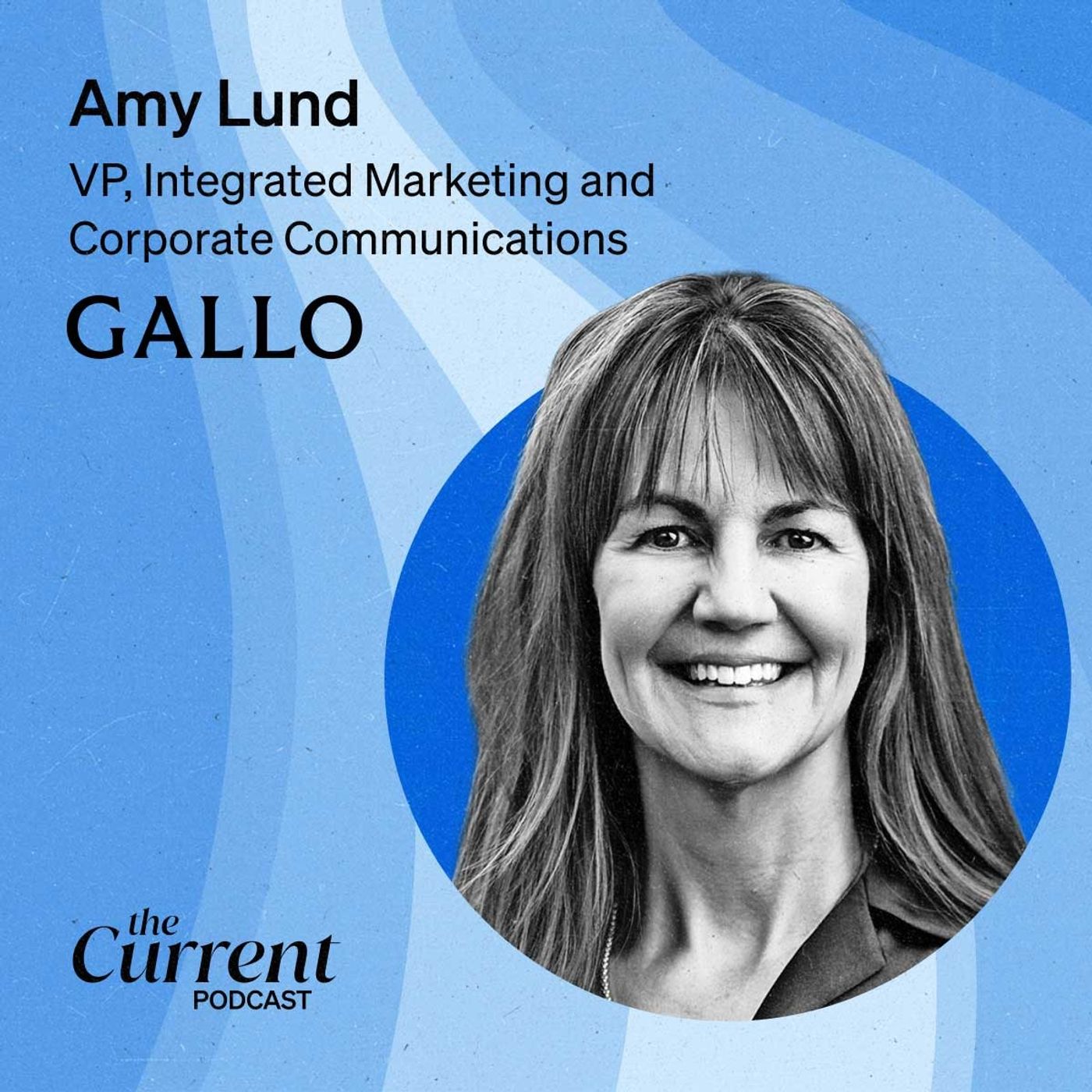
The Big Impression
Gallo Winery’s Amy Lund on bringing wine to the NFL
00:30:56
In this episode of The Current Podcast, hosts Damian Fowler and Ilyse Liffreing sit down with Amy Lund, VP of integrated marketing and corporate communications at E. & J. Gallo Winery, to talk about Barefoot’s bold move to become the official wine sponsor of the NFL.
Loading summary
Transcript76 lines
- [00:00]
A
I'm Damien Fowler.
- [00:01]
B
And I'm Ilise Lefring.
- [00:02]
A
And welcome to this edition of the current podcast.
- [00:09]
B
This week we're joined by Amy Lund, the senior vice president of marketing and media investment at EJ Gallo Winery and the architect behind the company's boldest brand moves.
- [00:20]
A
Most notably, Amy led the charge to make Barefoot the nation's top selling wine, the official wine sponsor of the NFL.
- [00:28]
B
And that partnership isn't just a logo on a screen. Working with icons like Simone Biles and Donna Kelsey Gallo is helping wine find its place at tailgates and halftime party.
- [00:39]
A
Well, it's a smart play, elevating wine culture in a space long dominated by beer. And it seems to be resonating with a younger, more diverse fan base.
- [00:48]
B
Amy's approach also redefines how a 90 year old wine company shows up in modern moments.
- [00:54]
A
So in this episode, we're going to talk about that evolution and how Pinot, Grigio and disruption can go hand in hand.
- [01:00]
B
Let's get into it.
- [01:03]
C
When. So Anheuser Busch moved out of the, out of the lead spot and gave up the wine sponsorship. We saw it as an opportunity to reach a new fan base and specifically the NFL fan base. So how do we recruit new consumers in a category? We've all heard wines facing massive headwinds. So how do you continue to recruit new consumers into a category and more importantly, create a new occasion for them that beer is typically dominated? So how do we create a new occasion for them and make wine more approachable and the most approachable and love sport there is?
- [01:41]
A
I mean, that is just to keep going on that. I mean, that's a massive challenge right there.
- [01:46]
C
Massive challenge. And it's going to take years because we have built a category and norms within a category that are fairly pretentious and we need to, you know, still keep some of those norms around. There's a right time and a right place for those. But also make sure that people know that wine can be done at a tailgate. Wine can be paired with pizza, and wine can be done in different occasions that are less formal. So you can drink it over ice, you can drink it with a straw, you can drink it in a solo cup and do it in all of the occasions where, you know, you could join a, a soda or a beer.
- [02:26]
A
Why did you think Barefoot, though, was the, the right brand to lead this, this charge into sports culture?
- [02:33]
C
Great question. So when we secured the sponsorship, it includes over 30 brands. So we own the whole wine category. So we were very pragmatic about what brand do we want to put in this position and do we want to just focus one brand or do we want to put a portfolio of brands in? And we decided that barefoot was the best to not only focus our synergies across our organization and with our distributors, but taking America's most loved and most awarded wine is completely natural to team up with America's favorite sport. So making it very simple for the consumer as well as our sales and distributors teams. And barefoot brings more wine into the category than any other wine brand, thanks to its kind of long standing. Just easily accessible, easily to drink, sationable palette. You know, it doesn't. It isn't over presumptuous for the consumer.
- [03:27]
A
How would you sort of describe it? Barefoot brand? The barefoot wine brand.
- [03:32]
C
It's a no fuss, no fuss brand. Just really a nod to joy and fun, not being pretentious or pompous in any way and easily accessible and affordable. So for all points, Points, I think of it new consumers coming into the category and exploring wine for their first time. Barefoot happens to be their first choice.
- [03:55]
B
I must say, it tastes pretty good too.
- [03:57]
A
You like it?
- [03:58]
B
I like it. I'm a fan.
- [03:59]
A
Yeah.
- [03:59]
C
What.
- [03:59]
A
What kind of. I mean, just what kind of do you be? Is it Pinot Grigio something you're blanc?
- [04:04]
B
Yeah, yeah. Pinot Grigio. I would say it's very like fresh, if I had to pick one word to describe it, but like very light and fruity.
- [04:12]
C
Very light, very fruity. I think of it as you can and I think this is where football matched up so well with it, with tailgating and, you know, you can pair barefoot with chicken wings pizza. You could serve it in a solo cup over ice. It is not your $50 bottle of wine that you're going to want to make sure you pair with the best red meat around. It is. You can eat it with any occasion and it goes down fairly easy, I would say.
- [04:39]
B
So, yes. Speaking of which, this must have been a fun, like, creative brief to. For pairing wine with football. Can you walk us through what the creative brief was for the campaign? And how did you want fans to really feel about barefoot on game day?
- [05:00]
C
This was a really simple brief, to be honest with you. So we wanted to create a new occasion for wine and we wanted to do that with the largest fan base around, but focus on a targeted audience of it. So it was really about how do you introduce wine into the football space and do it in a relatively simple way that shows people that wine isn't pretentious? So it was very, very simple. But then what we had to do is think about what are the right partnerships and how do you bring that to life? So the brief was actually fairly simple. But then we took our time to think about how do you pick the right personalities that are approachable? It's not the experience fan, but approachable. And so that's what the brief was about. How do you find the approachability in the partnerships that we were going to do that went around the halo of the NFL?
- [05:55]
B
Yeah. And I know Simone Biles and Donna Kelsey were some of those personalities that you brought into the mix. How did their star power really help bring the brief to life? And were there any channels that the campaign really fit well into? What was that mixed?
- [06:14]
C
That was really the first one with Donna Kelsey was serendipitous. I'm not going to lie. The timing of it could not have been better. So Donna Kelsey is absolutely. What you see is what you get. She's probably one of the most approachable personalities that I've ever worked with. And then having two sons in the NFL was, you know, perfect. At the same time, the Taylor Swift hype was coming at, and so we were able to get on top of that as well. So what we wanted to do is we partner Donna with our winemaker, and they together pick what her favorite wines were. We tasted her through it. We literally did it over a Mac in her kitchen. So very, you know, she's very low tech. She wanted to do it. She was asked all of the right questions. And then we had the Bandwagon box event, which allowed consumers or fans to really enter a sweepstakes to get into the box to go to one of the games. And it was the Eagles versus the Chiefs. So with Donna Kelsey in the box with our winemaker to talk about how do you learn about football as well as wine throughout the whole game. And so it really took off on social. So Instagram was huge for us as well. It got picked up some on YouTube as well. But really, Instagram was probably the biggest channel for us.
- [07:34]
B
Amazing. You know, I feel like the timing was perfect with us and with the partnership as well. But I feel like I'd be remiss if I didn't mention probably the amount of more female viewership watching NFL games and how they might pair that with their favorite wine at the same time. Maybe you can talk a little bit about how, I don't know, that newfound spirit with women and the game has helped booster and maybe inspired this campaign.
- [08:08]
C
So there's a Tremendous amount of female fans in football. And, you know, that was. That alluded us to the next partnership with Simone. So I'm going to kind of tie the two together. So there is, you know, on TikTok and all the social channels, there's this whole movement behind weg, so the women and girlfriends of NFL players. So it's quite the cultural phenomenon. So as women start to pick up into this, what are they wearing at the games, what are they drinking? What are they eating? Who are they sitting with? We wanted to get into that culturally relevant moment and put Barefoot in there. Put it in there, naturally. So Simone was a great choice for us there because she's an awarded athlete. Her husband's also in the NFL. So we were able to take that same campaign with the Barefoot bandwagon and do the same thing with her, but really appealing to. She appealed to both a lot of females as well, and female empowerment, but as well as men from an athletic standpoint within other sports as well. So I think she's recognized and certainly. What's the word that I'm looking for. Respected as an athlete among both male and females as well. So it was a nice crossover for us to also start to bring in other consumers. So not only women, but we want to make sure that we're getting some of the more diverse groups. So the Hispanic groups as well as the black community. And Barefoot's been able to demonstrate that it resonates with those consumers as well.
- [09:37]
A
That's great. I mean, we're actually going to move on right now to ask you about the takeaways and what you saw after the campaign, and that's fascinating. I guess we should start there. What were the KPIs that you were looking for going into the campaign? And was there anything that surprised you from the results?
- [09:57]
C
The obvious metrics, such as in store sales. Right. In store sales and displays, increased displays in the stores. So those were the obvious. And we saw great results there. I wouldn't say that we were surprised, but certainly optimistic. So Barefoot saw an increase in brand public opinion and purchase intent, which was very positive. So this is an older brand, a brand that's been around for a long time. It's the largest wine brand around, so people do nova, but we wanted to recruit new consumers into this. So to increase your purchase intent and sentiment is really a positive metric. Also, the association with the NFL increased by 7%. So that was something. I don't think we were expecting to have it. So when we knew that the power of the partnership and certainly the NFL. But to see it related to the NFL and an occasion was exactly what we were hoping for. So that was a positive. We got tremendous earned media placements, more than I expected. I knew we would get some, some pickups, but we got an inspiration, you know, a lot, A lot. And my team was working feverishly on there. We got double digit, year over year growth on our voice. So another sentiment, but most importantly, and you guys alluded to this earlier, is recruiting new consumers in the category. So bringing in over 4.5 million new consumers into the brand, such a large brand and a category that's facing head headwinds was certainly a tailwind for us.
- [11:31]
A
One of the things I found interesting about this whole campaign is that traditionally NFL has been beer culture associated with beer culture, and you're introducing wine culture into it. That, that must have been a bit of an eye opener for you in terms of like, who reached for the, for the glass of wine, as it were.
- [11:50]
C
It's a, it's still difficult. So teaching different behaviors to consumers is very difficult. And also breaking kind of all the wine norms, like it doesn't have to be served in a, in a, you know, a wine glass. You can put it in a cup, you can put it in a solo cup, you can pair it with different things. So, you know, this is something our, you know, we've created a monster within the category ourselves. We really have. So how do you break down some of those things that you work so hard to develop to make it more accessible and approachable to people, you know, so if that is something that we're going to continue to battle with, and that's why these partnerships are so important.
- [12:31]
B
I know you talked about social. Were there any other channels that you guys leaned into for the campaign?
- [12:36]
C
Certainly we did linear. We did quite a bit of linear. So in game linear, and then we're also dabbling in streaming as well.
- [12:45]
A
Do you find that this sort of go to. Do you find that marketing strategy now has to be a lot more nimble in terms of reacting, you know, any of that pressure. Once you, once you associate yourself with live sports, there's a lot going on. And from a marketer's perspective, that must mean you've got to be like, you know, if not watching the game, ready to react to these moments that come up.
- [13:11]
C
You do. And more importantly, I think you have to do a tremendous amount of social listening to understand what your consumers or the consumers that you're hoping to garner, what's important to them, because you don't want to be so massive in such a large scale that you don't actually resonate with anybody. So we are doing it. We do a lot of social listening and a lot of quick turn A, B testing within social, especially within organic, with some of our partners to understand and mine insights on how they're speaking. So we can make the creative and put it in the right time at the right place. So we can't just always just do NFL. We have to make it bigger. So NFL works great. And the longer you do it, I think your retailers and your distributors start to expect it, which is great. So it has some consistency. But most importantly, we're not able to be nimble unless we have really strong brand positioning and strong brand strategy that's going to stand the test of time. So you can get nimble underneath it as the consumer reacts.
- [14:13]
A
So.
- [14:14]
C
So you have that overarching consistency. And that is something when you're in the moment of those nimble moments or the culturally relevant moments that you could jump on or start to plan for that are gonna last a few months, everybody wants to go back and redo their brand positioning to fit that moment. You cannot, sometimes you shouldn't participate, and that's okay. So that's okay. So making sure you're participating in the moments that truly matter for your brand.
- [14:44]
A
Yeah. This campaign launched a while back, but obviously it's ongoing. Are you going to continue to look at live sports as opportunities?
- [14:58]
C
Sports is the only true unifier we have left these days. I'm sure you guys have heard this a million times, but from a marketing perspective, it is really a true unifiner. With everything that's going on in the world, it has a positivity to it. It has a great emotional connection. So there is a huge power behind sports, and I think that's why so many companies are drawn to it, because it's low risk and it's fairly positive and it unifies people, and that's hard to find today. And also I think it allows people an escape as well from what's going on. So I think sports is here to stay, and I think it's probably more important than it's ever been.
- [15:42]
A
Could we kind of pull back a little bit? Look at the big picture about brand building today. And I guess we would love to talk a little bit about your background. We know that you've worn every hat at Galo and just wondered, you know, with all your experience, how do you think about marketing in this moment today, with everything, you know, with all that experience, what's your kind of like take on where we are right now.
- [16:11]
C
You know, I think with my personality and I've been at Galo and I've been at Galo a long time. I've been in six different functions. I've rotated 13 times. I've been in marketing the past. I guess I'm coming on nine years. And the one thing that I've appreciated about Gallo is they are always picking and pulling me to find an opportunity to go build, build a new capability for the organization as well as is there a way to optimize something? They have really appealed to my curiosity. I am one that I cannot stand to be complacent and curiosity gets the best of me. So now that I've touched so many different facets of the business, I think it's been instrumental in shaping my marketing leadership because I can have a holistic perspective and be fluent in languages across all of the different departments, understanding what some of their concerns or barriers will be. So I can make sure that we're putting the consumer first. So in Albev, it is very easy to lose sight of the consumer because you're in a three tier distribution. So first we have to sell to the distributor and then the distributor sells to the retailer and then the retailer sells to the consumer. So you have to make sure your marketing campaigns and your consumer brand proposition appeals to all of those three or that you can explain the benefit and making sure that your consumer leads. So it's very complex and it's very regulated. So being able to peg up and down the system very quickly and have the same language allows me sometimes to be a little bit dangerous. Sometimes I take it for granted. And what may seem obvious to me may not be obvious to others. So you know, things from, you know, production, supply chain, the operation realities when we're creating a new brand and you know, what are the bottle limitations and things like that, you know, those come, they help you move faster than you normally would in an organization. I think my financial acumen helped me understand what's important to make sure it's feasible for the consumer at the right price point as well as it's going to provide, you know, the right healthy economics for the family and the business. Right. So always aligning to those kind of fundamentals. So I always am anchoring my team into the brilliant basics. So no matter what function, I'm what are your brilliant basics and those fundamentals to make sure we have the right proposition for the consumer?
- [18:42]
B
It's so complex the field, it must be also Difficult to be as agile. And I know data plays a big role with what you do as well. Maybe you can talk a little bit about how agility comes into play even with all those multiple layers that you have to work through.
- [19:06]
C
So data is a lifeblood. And when you're in a three tiered distribution, except for our tasting rooms, we have several tasting rooms with our luxury portfolio up in Napa and Sonoma and on the coast of California. So there we have the opportunity to sell directly to the consumer and capture first party data. Otherwise for most of our other hundred brands, we don't have the opportunity to sell directly. So we go through third party marketplaces like Instacart or Doordash or we're selling through a retailer of some sort. So that is really hard to get the first party data. So it's something that partnerships help provide an opportunity to gather that and get you closer to your consumer so you can build better audience segments so you can target them and localize it. So as we get smarter and get more nimble again that brilliant basic I have to have the right brand strategy and proposition that stands the test of time. And once we hold that constant over time, it allows us to be very nimble. I think agile is an abused word these days. It's like the buzzword of the day. Allows us to be flexible and nimble in a smart way and allows us to plug and play when we need to and then get down to the right local levels when it's important.
- [20:23]
B
You know, these days tariffs are throwing all brands through a loop and especially in the wine category where a lot of it comes from international, across seas and everything. With those pressures rising, how do you think about maintaining your brand equity while still remaining accessible to consumers?
- [20:43]
C
I think that you have to be very diligent and very patient in this climate. Anybody who's running a business agnostic of what party you're involved in knows that when we're introducing new tariffs like that, it takes months if not years to transform a supply chain to react to it. That is not a consumer, that is not something you can pass on to the consumer. So we are trying to be very patient to understand where things are going to land long term. So we make sure we keep our equity stable within our brands, not react as well as not passing on costs to our consumers in these unstable times. So we talk a lot about it and then also it just creates a nervousness throughout your entire company. Right on. You know, what are you going to wake up today? What is the new so In Canada, for instance, they pulled all alcohol brands, American alcohol brands off the shelves and have not put them back. So it obviously has an economic impact. So you know, we're just marching forward. We have import brands and like I said, we're just not reacting and not passing those costs off to the consumers. But I think every company is looking at each one of their brands differently and the supply chain that goes along with those and the production capabilities that goes along with those. But it's so uncertain that you really find out who leads under stress. Well, very quickly and I happen to own corporate crisis communications and corporate communications for the company as well. So a lot of like let's take a step back, let's not react. Tomorrow may look different.
- [22:35]
B
I know brands are going about their messaging around tariffs. Completely different too. How is Galo approaching that? Is it changing any of its marketing messaging? I know like pre tariff pricing is a thing, but you're saying you're not going to pass along those costs.
- [22:54]
C
We're not going to pass, pass that on to the consumer or change our messaging. We're going to stay the course. We believe in our brands and if you have a strong brand proposition and positioning, you should be able to ride this out. And you know, if anything, I think consumers know myself and even how I shop and get up, you know, I, I would like to see some stability. So it would be nice to know that if I go in it's going to look the same, feel the same and taste the same.
- [23:23]
B
We have some rapid fire questions for you now. So let's have a little fun, see what's on your mind here. What are you obsessed with figuring out right now?
- [23:35]
C
This is such a great question. I am, I, I don't know if it's I'm obsessed or it keeps me up at night. So the workforce has not been the same since COVID It just has not been. And it's. I really think a lot about how do I balance individual talent and getting the right talent Because I can, I can source talent across the whole United States now. Right. You have the ability to have a hybrid workforce and at the same time building high performing teams. And what is that sweet spot where you can build a high performing team and get the right individual talent and how do you get them, get them together or have the right start to build the right future facing culture going forward? Because it's not going to be the same. And we're swinging the pendulum so far and so quick that how do you again provide your workforce and your talent that Stability as well. So I think a lot about it, I read a lot about it. I'm trying different things with my teams. So that, that's very top of mind for me. And some things I read are just like, no way.
- [24:43]
B
What would you say needs to change in the ad marketplace?
- [24:49]
C
This answer will not surprise you because I think you've probably heard it a ton of times. But is how do you build confidence with companies and consumers really around kind of increased data privacy, especially with AI mitigating AI algorithmic bias? I think cross platform integration. These channels are so walled garden that it's really hard to develop the right ecosystem and measure your marketing campaigns holistically. And then programmatic continues to be a black hole. Transparency, transparency, transparency. So things you probably have heard before, of course.
- [25:28]
A
Red wine or white wine?
- [25:30]
C
Well, I'm gonna be different than everybody else, probably. Most people probably prefer red, but I'm a white. I love Sauvignon Blanc. My favorite, my favorite go to is Sauvignon Blanc. I love it. Whitehaven's my favorite. If you have not tried it, pick it up. Whitehaven, yes. White Havens from New Zealand. It's, it's light. I love it.
- [25:56]
A
So, you know, at the upfronts this year, obviously all the global streamers talked sports. What was your upfront experience like in linear?
- [26:06]
C
It was what to be expected. We've done it for several years, so no surprises there. Streaming was a bit difficult and we are gaining our sea legs and our media partner was also learning alongside of us. So I think there's just a tremendous amount of learning that needs to go there. Sports are clearly the prevalent place. You know, moving into streaming. Streaming is going to continue to grow linear, shrinking and it's, you know, different channels for different streaming. So it's very complex and we're learning as we go. So linear, same as to be expected. I would say the, um, fronts and streaming were rocky.
- [26:47]
B
Amy, why would you say wine consumption is on the decline right now?
- [26:52]
C
Yes, I think, you know, beer's obviously facing headwinds as well. All of Albev is, I think spirits and RTDs, what we call seltzers, are performing quite well. So it's really that sessionability and access to different formats and occasions where wine used to own the dinner occasion and people don't sit down for dinner anymore, not like they used to. So you have an occasion, your primary occasion that is somewhat disintegrating. So you have to create new occasions around that experience. I also think health and wellness is alive and well and it's great, right? So how do you create maybe different lower alk alternatives or non alk alternatives to do it? I think GLP1s are going to be here to stay. They obviously, you know, people don't takes out all the food, noise and the noise that you have. So that's another. And then I think cannabis is a true competitor. So you see a lot of it, cannabis infused drinks now in convenience stores, it's not regulated. There's a lot of interstate traffic happening between the states. It's showing up in convenience shelves. And it's a, you know, it's another option for consumers today.
- [28:08]
A
So, Alice, as a fellow wine drinker, what did you make of that? What was your big impression?
- [28:16]
B
So my big impression really is that Gallo found the opportune moments for their push into the NFL when Taylor Swift came on, brought all these female viewers and now they're drinking wine too at the game, which is really, you know, a perfect blend of those two cultures in some ways.
- [28:40]
A
Yeah. I think what you say is really interesting because in a way it's counterintuitive. It may seem like the perfect moment, but, you know, it's a marketer's opportunity. But the market has to make it happen because typically the category, I mean, sports, the NFL has been dominated by beer culture. I think it's not, it's fair to say that. But, you know, it's counterintuitive to think, well, wine, you know, wine goes in a stemmed glass with dinner. But what Amy was saying is this is a different time and a different place and she's trying to market into this opportunity. I thought that was a really interesting point that she made. And the other point, you know, off the back of that was that we need to create new occasions that maybe people aren't sitting down for dinner as much and drinking wine. So this seemed like a great vehicle for Galo to kind of like get in there.
- [29:35]
B
Football fans and they're continuing to find more ways to blend themselves into live sports, including really figuring out streaming more and new opportunities there with like teams like the Valkyries, which a bunch of brands are trying to reach that female audience too.
- [29:53]
A
A lot of people seem to want to get in on the Valkyries, right? As we saw in our video a couple of weeks back.
- [29:59]
B
Yes, totally. So it definitely makes sense. And the timing is ripe for. Not to make it pun or anything, but it's.
- [30:07]
A
And the timing is ripe.
- [30:09]
B
The timing is ripe for some wine, for some gala wines in live sports.
- [30:15]
A
Well, on that note, we should say cheers.
- [30:17]
C
Cheers.
- [30:22]
A
And that's it for this edition of the current podcast.
- [30:25]
B
This series is produced by Molten Heart. The current podcast theme is by Love and Kel. The current team includes Kat Fessy and Sydney Cairns.
- [30:34]
C
And remember, we're not able to be nimble unless we have really strong brand positioning and strong brand strategy that's going to stand the test of time, so you can get nimble underneath it as the consumer reacts.
- [30:46]
A
I'm Damian.
- [30:47]
B
And I'm Ilece. And we'll see you next time.