← The Big Impression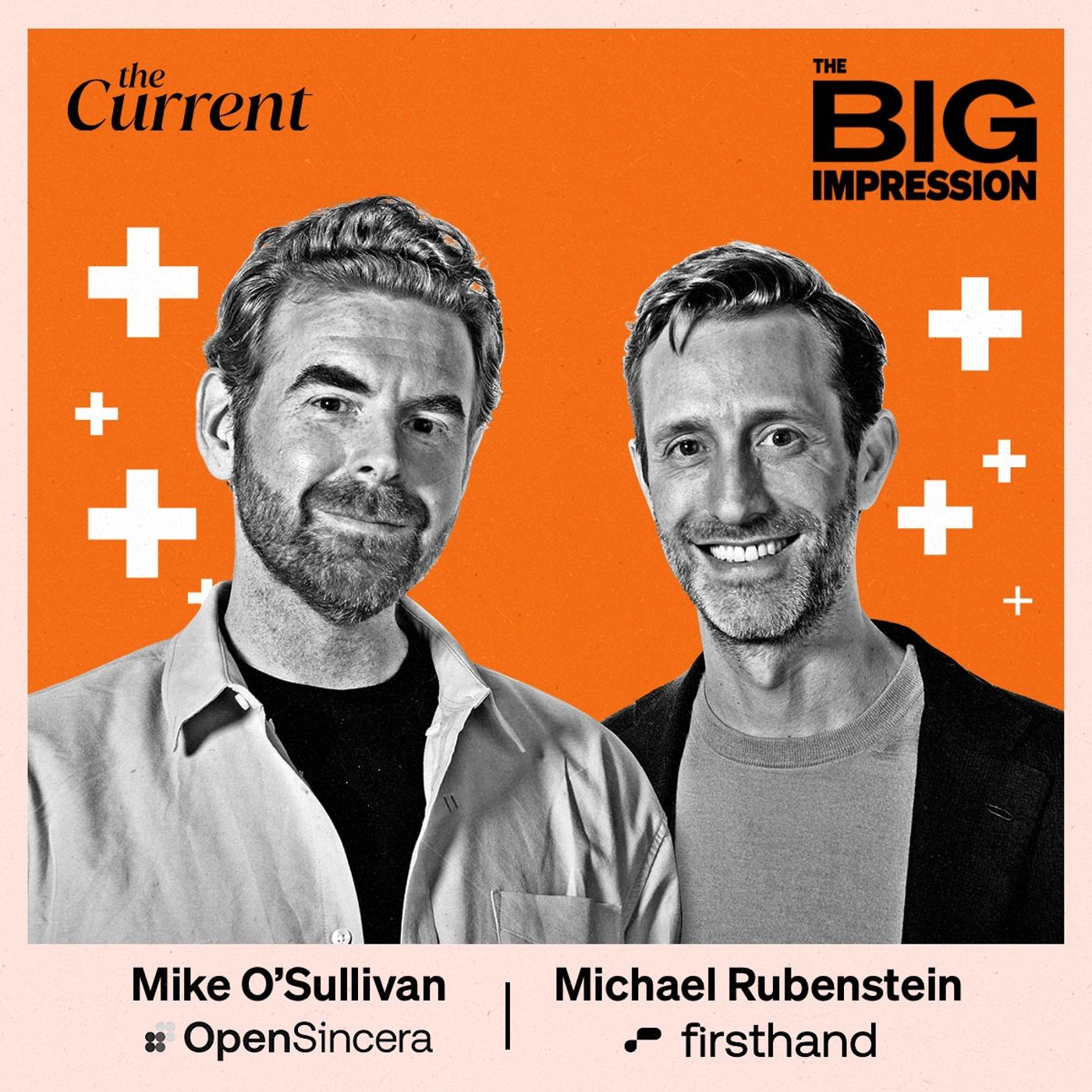
The Big Impression
Michael Rubenstein on Founding Firsthand, AI, and the Future of Ad Tech
00:38:38
Mike O’Sullivan (Co-Founder of Sincera and GM of Product at The Trade Desk) sits down with Michael Rubenstein, Co-Founder and Co-CEO of Firsthand, for a candid founder-to-founder conversation about innovation, risk, and leadership in the age of AI.
Loading summary
Transcript55 lines
- [00:07]
A
Hello, everyone.
- [00:08]
B
Damien here and ailease and welcome to this special edition of the Big Impression.
- [00:13]
A
We're coming to you from Advertising Week New York, where we brought two powerhouse founders together for a conversation.
- [00:19]
B
Mike o', Sullivan, co founder of Sincera and Diema product at the trade desk. It's also a preview of Mike's new podcast, the Build, where founders get real about what it takes to create something meaningful.
- [00:33]
A
If you've ever wondered what it's like to build breakthrough tech, this is the podcast for you.
- [00:37]
B
Take a listen, you know, a little.
- [00:39]
A
Bit more about, like, the podcast. Like, I really wanted to have conversations that were not focused on hot take issues. It just feels like that's a space that's well covered. And I just think there's so many interesting stories about how things were built, what people are working on now, what are the challenges. And I'm super excited to talk with you, Mr. Because I was thinking about it. I don't know if anyone has your sort of kaleidoscope of founder experiences. You were the Intrapreneur at Google with DoubleClick with the exchange. You know, you were sort of early founder. Like, I think a lot of startup companies, tech companies are like, we bring in the commercial leader at, you know, like person 30 or 50 or whatever it was, and then you have the whole new founder from ground floor on firsthand. So I can't think of a better person to have to sort of kick this off with our stealth launch. So first of all, thank you. Second question. That wasn't a question, it was a statement. First question. Second statement is, did you always know that you wanted to be a founder and that was sort of the trajectory from intrapreneur to early to core founder? Or was that a conscious choice? Or was it just like that's the opportunities that presented themselves?
- [01:57]
B
Well, first of all, thanks for having me, Mike. I'm honored to be the first guest on your new show. And I love the concept, so I'll definitely be a listener. I have always loved building and loved entrepreneurship. My parents are entrepreneurs. I started my first company in University at McGill when I was young. I have been in entrepreneurial companies in the martech and ad tech space my entire career, as you mentioned. I think that I view myself more as a builder and an innovator and a value creator more than an entrepreneur per se. To me, entrepreneurship is amazing. I love it. I love what we're building and love what we're doing at Firsthand right now. I also love being an intrapreneur at Doubleclick I loved having a combination of both experiences at Appnexus and so forth. And I love working with entrepreneurs and intrapreneurs and helping and paying it forward as well. So, yeah, I think I've always known in some way, shape or form that this is what I love to do, that the dynamism of business and innovation in business was where I wanted to spend my career. And the Internet and developing this as a commercial space has been an incredible thrill.
- [03:13]
A
Yeah. So makes total sense. It's funny because I never thought that I would do. And I mentioned this to you before, I never saw myself as a founder. I always saw myself as more of like, you know, I can be a really good lieutenant, and I sort of fell into it by accident. And I think something that was very illuminating for me is, like, when I was at Appnexus, you know, which Michael was the one who brought me to Appnexus. So we've known each other a long time. You know, I sort of had this very naive view of, well, I'm not Brian. I'm not gonna dent the universe. I'm not gonna. I don't have this idea to beat Google. So I get. I don't know, why would I. Why would anyone give me. Why would anyone invest in me? And then as I learned and what we did with Sincera was just like, there's so many ways to build something. There's just like, you know, you don't have to go to Sandhill Road and get capital that way. And. And I think what was really exciting for Ian and I at Sincera was just like, we started with problems that were so small and annoying that nobody wanted to do them. And we're like, we think these are fun and, like, we can solve these. And we just sort of, instead of big idea that dented the universe, it's like, let's start with something really small and cumulatively build and see where it goes. So I think that, to me, was such an eye opener. When I think about building something, it's like, there's no path. You can bootstrap. Like, you know, index exchange has. You can do big funding, and you can do all those different areas in between. So I think it's. The variation is so interesting to me. And I'm curious, like, now that you are the sort of independent founder, you have the intrapreneur experience, and now I'm the intrapreneur side of things, what were some of the big differences that you experienced? Like, if you were to just. Just suppose, sort of your firsthand experience now and the doubleclick experience. Yeah.
- [05:11]
B
Well, first of all, I agree with you. I mean, there are extraordinary entrepreneurs out there like Brian, but there is no one way to build an entrepreneurial venture or no one way to create value. And that's. I think one of the things that's so exciting is you could bring your passion, your expertise, your insight, and build a company or build a business around it, whether it's, to your point, independently or inside another entity. And I just think that's incredibly exciting about what we do. I think that intrapreneurship and entrepreneurship have commonalities. I mean, in both cases, you're trying to solve a problem and leverage your unique expertise. And, you know, you have to be incredibly passionate and focused on developing and delivering a solution and so forth. But, you know, they're very different as well. Obviously, in an entrepreneurial context, you are starting from scratch. You don't have assets really to help you along, but that's very liberating as well. And I think it gives you an incredible sense of freedom and creativity. And I think one of the things you find as an entrepreneur, also, as I know you did it since Sara, is that if you put yourself out there, people will be inspired by that, whether that's venture capitalists or customers or employees. And they will come to support you.
- [06:32]
A
Yeah.
- [06:32]
B
And they will show up for you. And I think that in some respects, entrepreneurship is less risky than some people typically perceive. With intrapreneurship, you have to do all that, but you also have to leverage the assets around you, or you're not really capitalizing on the benefit of doing something inside a larger organization. So it's a very tricky balance you need to find between. You need to be independent and drive things forward, but you also need to bring the organization along and leverage the assets of the organization. Otherwise you may as well just be an independent company.
- [07:08]
A
Yeah. Yeah. I think one of the things that I thought was so interesting when you start a company and you're the CEO and co founder, is that you can be the tiniest company, you can be a grain of sand, and you can have a company like the trade desk or Google or whatever, and you know, they are the size of the world, the globe in comparison. But the conversation is still founder to founder, CEO to CEO. Like there is a. Like you have unlimited agency to say, you know, I'll take a meeting with whomever and maybe we'll build a whole new product based on this feedback. And to me, that is one of the differences like, you get the scale with entrepreneurship. Like many of the assets, like, look, Sincera could never have put this together, like this amazing experience. But the piece that I think is super maximal on doing your own thing is this maximum agency. And so it's a funny balance. There's pros and cons. I would say to my wife, she's like, well, hey, it's Saturday. What are we going to do? And I'm like, I don't think you understand. If we're not working on Sincera, nothing is happening. So it's scary in that way too. But I think, yeah, it's been really interesting and really novel and it keeps my gears turning just like seeing these different, like how many experiences are out there under the guise of starting something and building something is like super, super fascinating.
- [08:40]
B
Yeah. I think one of the things you're hitting on is that, you know, this force in business of driving growth through innovation, whether you're an early stage startup like Sincera was, or, you know, firsthand, or whether you're a company like the Trade Desk or even a giant company, like, for example, those that the Trade Desk works with, let's say a unilever. Driving growth through innovation is the most important thing that you could be working on. And so to your point, if you really are on the leading edge of that, you can really access some very interesting opportunities and very interesting conversations because it is so important. It's existential. It is the very frontier of capitalism and competitive advantage. And so it's a thrilling thing to be.
- [09:32]
A
It's also just more fun. Like it's more fun to go out and grow than to constantly defend. Right. And be like, oh, you know, I have a lot. It might sound crazy, like I have a lot of sympathy for people at Google right now because it just must be miserable, like trying. You have this huge, you know, amount of revenue that you have to protect and defend and fend off. Like, it's just exhausting versus how do we innovate and find new ways to drive actual outcomes for our customers to solve problems that they have that would solve before. Like, it's just more fun. Like, I think, which is like, I have, I don't know how anyone can be like CEO of these huge companies that are like super mature and are on that defensive side, especially in the software space. Just seems really, really tough.
- [10:18]
B
Very tough. Especially in today's economy. I mean, this is a very dynamic innovation economy. You have AI coming in. It's very difficult for companies, I think, to be in a play it safe defense oriented mentality and expect to win. I think playing it safe will not keep you safe as a company. Playing it safe actually will cause you to fail. It's actually paradoxically the willingness to fail and the willingness to take risks that will lead companies to succeed. And I think that's where innovation and trying new things via entrepreneurship or intrapreneurship really comes in.
- [11:00]
A
You know, for those who don't know, both Michael and I are Canadian. And so there is a Canadian expression that's very apt here which is like, you know, gripping your stick too tightly. You have to play freely, you have to be willing to fail and that's what gets you to win. It's, you know, it's funny because like I've had people at the trade desk come up and say like, hey Mike, you know, can you, can you take this idea or that idea to Jeff? Because like, he listens to you. And I'm like, first of all, you're super mistaken if that is your interpretation. Like, you know, that's definitely not the case. But let's just presume it's true that occasionally and he does is like, it didn't start that way. You know, it's not like Jeff's like, oh, this I, I'm going to pick someone out of a hat. And here's a name. It's more just like you have to have, you just, you just go. I'm partial to the phrase like, you know, which comes from like F1 racing, which is full push. You just have to, you have, you can't take that edge off. And that was so exciting on the, on both sides, right? Inside a company or outside is like, there's no safety net. So you have to play at like, you have to move right up to the red line of what you're doing and that's how these companies win. So it's super exciting. Now, one question I had for you or an additional question I have for you is something you do really well is something I do very poorly, which is know how to hire well. And I would argue, I think the biggest legacy from Your time at AppNexus is the people that came out of it. So like, can you explain a bit about like, what was the mindset and like, like, was it a conscious strategy and like how, how did you achieve that, like hiring such great talent?
- [12:38]
B
Absolutely. Conscious strategy. I think it's always been a core part of how I like to build businesses and it was a core part of how other companies I worked for. I mean, Doubleclick, I Think did a great job of this as well. An extraordinary job of this. You hire people who are hungry and who are high potential and who are passionate and have high integrity and you teach them, you train them, you create mechanisms to be able to train them and bring them up to speed. Our industry changes so fast that it's normally not really worth it to hire people who have been trained in other companies because again, things move so quickly. So you create mechanisms like we did at AppNexus, AppNexus University, things of that nature and, and you think very intentionally about your company's values and culture as well. At Appnexus, for example, we had this value that we treasured called learn and Teach. People still talk about it today. So not only were we hiring people who were really predisposed to growing with the business, but we also taught them and trained them and then created a culture where they were essentially at every moment either transmitting knowledge to other people or absorbing knowledge. And so you kind of create this flywheel where you bring in these incredible high potential people and then you help to unlock their potential and to create a situation where they are helping other people unlock their potential as well. We had that at DoubleClick. We had that at AppNexus. We're building that now at Firsthand as well. It's really powerful.
- [14:16]
A
Yeah, so that was my question. Like, how has that, what have you learned since the Appnexus days in terms of building and growing a team that you're applying at Firsthand now? And, and.
- [14:30]
B
I think it's really the same things, which is like, we're looking for people who want to build the next platform and the next wave as well. So, you know, I think with AI this is a, like fundamental technology shift. This is a major once in a. You know, this is an incredible opportunity and we're bringing on people who are passionate about that, who are high potential, who want to be sponges and who want to teach others, whether it's their colleagues or their clients, and help to educate the marketplace about what it means to. What AI means to the future of marketing and advertising.
- [15:07]
A
Speaking of AI and Firsthand, I'm curious, like, you know, you were. I'm going to get this word wrong. It's indefatigable. When you were at AppNexus, I used to joke that, you know, I'm like, I'm like, I'm moderately sure that Michael Rubenstein gets plugged in at night to recharge his battery. But, you know, I remember seeing you in those and it was just in those days like Programmatic was, was exploding, but there was more of an understanding of what it is versus AI. I'm curious, like, as you talk to customers at firsthand, how, how is the, I mean the product is obviously different, but I'm curious, is the education different? You're obviously talking to a lot more brands now. Like, how is that, how has the technology shift in AI and LLMs and all these pieces affected, like how you talk and educate and sell to customers.
- [16:03]
B
This moment is a little bit different, I would say, than where AppNexus was with programmatic, where, you know, we had already built DoubleClick, Ad Exchange, right? Media Exchange, Jeff had built ADCN. Those businesses had already been sold to Microsoft and Google and Yahoo. So I think the marketplace knew that Programmatic was going to be a. There were a lot of signals that Programmatic was going to be important.
- [16:27]
A
Right.
- [16:28]
B
It was a race in many respects to scale up and determine who would be the platforms that would be, you know, foundational to the space. And I think that this moment in AI reminds me a little bit more of those early days of the exchanges, you know, when we were building those initial ad exchanges and evangelizing Programmatic for the first time. It reminds me a little bit also of the beginning of the Internet when at DoubleClick we were talking to people for the very first time about concepts like online advertising and permission based email marketing. So this is an education and evangelism moment. That said, AI has captured the attention and the imagination of every cmo, every CEO, every board member. So there's an incredible tailwind and things are moving unbelievably fast in that space. So there are similarities, but I would say it's moving faster than ever before.
- [17:22]
A
I think that makes total sense in that the market was more mature in terms of Programmatic. Like there was obviously, you know, like there was proof points that are, that just aren't as common. But the interest level is sort of so much broader than our little sector of the marketing space. So I think like that is such a fundamental difference. I can't remember who it was. Ben Horowitz had that, that saying, it's like, we're fucked, it's over. Like we foe. Like, I'm not saying it's that, but I'm like, what are the things that keep you up at night where it's like, you know, I'm worried that like this is, this is a risk for us and it's like. And like how do you think about, you know, potential challenges on the horizon or outcomes that you would find challenging for firsthand.
- [18:05]
B
So, as you know, I've always been drawn to a big fight, whether it was at DoubleClick, competing against Google. Adapt Next is taking on the world, including Google, obviously. I think the fight that I'm really inspired by now is the fight for the future of brands. I really think that this is a moment of great opportunity for brands with AI.
- [18:28]
A
Yeah.
- [18:28]
B
But I think it's a moment of great peril as well. There's a scenario where this plays out in a way that's very bad for brands, where the consumer experience of the Internet and of technology is fully intermediated by these AI companies that essentially really dilute the value of brands, where brands become almost like brands on the Amazon marketplace, like totally interchangeable. And I think that if brands disappear, then companies struggle to sustain themselves. And over time you end up in a situation where the intermediary, the AI company gets more and more and more powerful and the brands weaken and weaken and weaken and the services to consumers dilute and weaken as well. And I just think that's a bad outcome for the Internet and I think it's a bad outcome for consumers and for brands. And so that's why at firsthand, we're building something we call the brand agent platform. And that's why we called the company Firsthand. We believe that it is existentially important for brands to be masters of AI, for brands to use AI to engage directly with consumers and build direct relationships and engage with consumers using AI and not be just disintermediated by AI. So to me, this is the big fight for the future of business and technology and it's one that we're on the front lines of at firsthand and something I'm incredibly inspired to be working on.
- [20:03]
A
Yeah, it's, it's, it's so interesting. Like you would think that this was a planted question. I actually haven't looked at any of these questions, but just because there's so much I would say like synergy or like fellow traveler element with, with Trade Desk as well, where Trade Desk and Ian, who runs marketing is going to get mad at me for like getting this wrong. But it's like brands should be in charge of their own marketing. Right. And I think it's like it is such a sibling strategy and concern to what you just articulated on the AI side. Right. Where it's like. And something that I also like am very concerned about is I thought it was like super fascinating that the Google remedies ad Tech trial comes out and there's some charts that say, hey, like in the last six or seven years, Google's investments in the open Internet have been flat, but their investment and spend on YouTube has 8x and it's like, and so like the, you know, is it better, is it eight, you know, X better in the last five years for a brand to advertise on YouTube? I don't think so, like, I don't think YouTube has changed that much. And but you know, again, it's these like these intermediaries with competing interests that dilute and you know, that inter, like that intercede basically between a brand and their marketing objectives, whether that's through brand agents at Firsthand or their marketing in general. I think it is a very big perilous concern for these types of brands. So I'm always excited to see another company join the rebel alliance. And you know, I think people say sometimes with, with, with trade desk strategies like, oh, this is, you know, you guys are gonna go and do this. It's like, what's a more disruptive strategy than just focusing on the brand and the buyer, right? And like, and I think that's, that's super exciting. So let me, let me ask you this. You have such a history, I would say as I mentioned, with like, with, with talent and finding the right people. How did you choose your co founder at Firsthand?
- [22:17]
B
Well, I co founded the company with John Heller, who I have worked with for 25 years. So John and I were both early doubleclick and got to know each other incredibly well. And I love John and John is someone who, I mean, John kind of famously built Freewheel as well, obviously another well known company in our space. And John is someone I've always really admired for his ability to see around corners, which is not easy to do and not many people in our space can do. And I think he really did that with Freewheel. He envisioned the way the television and CTV market would evolve way before it did. And you know, I knew that I wanted to build something new in the AI space. John and I were one of, one of our investors and one of my mentors, David Rosenblatt, who is the CEO of DoubleClick, I was chatting with, this was two and a half years ago, and he said, have you talked to John recently? I said no. And he said, you guys should sit down because he's got a concept. And we sat down and sort of compared notes and he shared some pretty foundational insights. I think that became, as I mentioned, very foundational to what Firsthand would become. And so I would say it was very organic. We have a co founder, Wei Wei as well, who is a star engineer at Freewheel, who is our cto, extraordinary talent. So it's very organic the way that it happened. But in terms of what I look for generally in co founders, I think shared values is really important. Shared vision, which I think in this particular case was absolutely true. And complementarity, the ability to say we don't do the same thing and we don't view things the same way, but we respect and appreciate the way the other person is and we recognize that it's a one plus one equals three or one plus one plus one equals five, you know, whatever type situation. And I think we really have that here at Firsthand, which is really wonderful going back for just a second. Also, you know, the thing that John expressed to me when we sat down and started and had coffee two and a half years ago was, you know, for me, with AI, I mean, AI kind of reminded me of mobile, where for like 10 years, people said, it's the year of mobile, it's your mobile, it's your mode. No one really cracked it. And then the iPhone happened and it just like the floodgates open. And I felt the same personally about ChatGPT with AI. It wasn't like AI was a secret or it wasn't being talked about at every conference. But to me, I think ChatGPT made it so, so crystal clear that this was a revolutionary technology that was ready.
- [25:00]
A
Yeah.
- [25:01]
B
And, you know, the thing that I had been seeing and sensing in the market was that 99% of the use cases, when I'd attend these like marketing and advertising conferences, all revolved around efficiency. Here's how AI can be applied to do exactly what we're doing today, but do it more efficiently so more, more creatives or fewer people involved. It was all variations on the efficiency use case. And that is a legitimate use case for any technology. But it's not the one that really inspires me most. The use case that really inspires me most is about value creation, new value creation. And John, to me, really saw it very clearly. He said, AI is not just a technology, it is a new medium, it's a new communications medium. And, and the killer application is it will be used by brands of all kinds to engage consumers in new, wholly new and different ways using AI. And I think that that vision really inspired me. And we've built firsthand around it, as I mentioned, and today with our brand agent platform, we allow brands to engage with consumers in ways that would have been impossible prior to the advent of AI and really deliver on the promise of digital advertising and marketing in, in just profound ways that create orders of magnitude better experiences for the brand and for the consumer.
- [26:32]
A
So can you make an example concrete of one of these new experiences? Like I, I don't know, maybe this is a difficult one or not. But like I, you know, we just bought a Rivian SUV and you know, both me and my wife love it. Like, how would a brand like that use some like technology like firsthand for some of these new experiences?
- [26:52]
B
Sure. So you could think of brand agents as almost virtual brand representatives. So instead of sending out an ad or a message to encounter a consumer somewhere, you're sending out your brand agent to engage with a consumer. It's almost like sending out a sales rep more than sending out a marketing message. And the thing is, these brand agents, they are really smart. They have the full context of where they're engaging with this consumer and why they're engaging with this consumer. They also know everything about the brand's products and services. And so when a consumer engages this Rivian brand agent, let's say maybe it's in a third party publishing environment, maybe it's on Rivian's owned and operated properties, maybe it's in this wholly new dynamically created environment, the bottom line is in.
- [27:43]
A
The car itself because the cars are all smart cars.
- [27:46]
B
Right. Maybe not yet, but we'll put that on the roadmap. But the bottom line is that these agents engage with the consumer and can dynamically adapt on the fly and guide the consumer through an entire consumer journey. That's so much different than the way advertising and marketing works today. And it really, as I mentioned before, just delivers on so many of the terms that we've been using in this industry for so many years. Customer journeys and engagement and personalization and so forth. It actually delivers it. And we've seen the results. I mean the companies, we've been live with customers for a year and a half.
- [28:28]
A
Yeah.
- [28:28]
B
And the case studies, the results are bananas.
- [28:32]
A
It's so interesting to me because like again, like I put firsthand in, like you said it, you like, you like big problems and you like big fights. Like I put that in the category of like, big idea, like seeing around corners and like I can't help but you know, sort of compare and contrast to like our experience. And it's like, it's so inspirational to hear what you guys are doing. And it's so big and yet I'M also so excited about the way we do things, which is like, where, like you said, like, finding shared values with your co founder. And for us it was just like, we don't think anything we do, like a first principle is like, we don't think anything we do can't be done by anyone else, but we're going to do it faster and better. And we also have the theory. It's like, look, I think a lot of like this is mostly gone away in the last couple years, but like, if you think about like five, six years ago, there was sort of this like weird faux machismo that existed in startups. It's like 80 hour weeks. You got to crush it, sleep at the office, bring a sleeping bag. And it's just like, I think you can build a great company without having to do that. And so I think, like, even though our companies are very different, you guys have that big vision approach and you're sort of denting the universe with what you guys are doing on the AI side. And we're like much smaller and nimble and more like, you know, you guys are a Star Destroyer and we're an X Wing, to put it in Star wars terms. I think it's just so exciting that it's like they're equally so interesting and novel to me that I just like. It makes me so excited to do the podcast and to talk with builders like you who have these, like, amazingly different experiences. So with that, I wanted to turn it over to see if there's any questions in the audience. So I'm going to hope. Oh, okay. Yep.
- [30:30]
B
So I'm very curious, how has your experience as a founder changed as your company grew, as it got bigger?
- [30:40]
A
Well, I think you should answer this one first because you have much more experience with like, growth than I do, at least in terms of, well, in terms of revenue and people.
- [30:49]
B
I think, you know, we had a coach at one point at AppNexus early on when we were trying to make a pivotal transition in the business, a transition from going from a startup to a real business. And he said something really wise to us, which is it was actually a question. He said, do you know what the job of a founder is? And we said, no. And he said, it's to found a company. And once the company is founded, the founder doesn't really have a job anymore. The job of the founder is to find a role on the executive team, basically, and to do that job better than anyone else could possibly do that job. And so I think that was really Insightful and something I think about a lot. You do have to found a company and founding a company is really, it's a challenging thing. It's also a delightful experience. It's an incredible experience. But you also have to transition in a not too short period of time in a business like firsthand into being an extraordinary executive and leader of the business as well. Because ultimately that's what helps you to scale the business and helps you to really maximize the impact of this idea that you have out there in the world.
- [32:15]
A
One thing I would add is when I left Microsoft and went to AppNexus, in my mind I'm like, oh, I'm going to work at a startup now. But from AppNexus perspective it's like, no, we're a serious, like we're a full business. Like this is not a startup. And one of the things that I learned is that there are. Nexus was around 250 people ish around when I joined. And there are probably, you know, 80 different checkpoints on like a startup journey. It's like, okay, you were doing this, but now that you're at this stage, you gotta start doing that more or this more or that more. And so it's like I look back on my experience and I was like, God, I was so naive. Like I thought that was a startup like that, like Mnex has really had its shit together and it was like a real company, like that's not a startup like. And so to me I think your question is super interesting and insightful, but in a way I would also ask like, how often do you hit that interval change point? And I think you hit it like, I think there were maybe like literally like probably eight to ten stages of sincera and when we sold we were 17 people, right? And it's like. And so you have to do that reinvention and every time.
- [33:33]
B
What part of being a founder did you totally underestimate?
- [33:38]
A
I can go first on this one. I underestimated how hard it is to hire good people because I was spoiled by my app Nexus experience because I was like, well there's all these great people and if you just ask the right questions, you can find them. And the difference is kind of like my previous question. People who are super successful and great at a company of 200 or 100 people does not mean they're, they're, they're necessarily the right person to be employee 4 or 5 or 6. So like getting people and people are really excited about your company and the momentum and there is still Like a glamour that exists with startup, which isn't necessarily like in the day to day a reality. So I would say one is people and then two is honestly like spending money. Like, Ian and I were always like so focused on optionality. Like, we barely use the money that we raised. And you know, Dave Vessels, who's at next year, who is our lead vc, was like, he's like, what? Why are you struggling to do the books? Just pay someone to do these books for you. It's like. And I was just like, oh, yeah, I guess we have all this money. Like, why am I like, you should be building and selling. Stop worrying about a p and l just pay someone to do this. So that would be my answer is getting the right people and knowing when to spend. Because I think we probably considered the money too much that we raised too much like our own and that probably slowed us down.
- [35:12]
B
I think it's a great question. The one thing that comes to mind is, you know, these markets can move and develop really fast and it really pays to think big and to have people around you who can push you to do that. I'm really fortunate in my career. I've had fantastic business mentors and partners who, as I mentioned before, have complimented me, I've pushed them, they've pushed me. And I think one thing that's really important is as a founder is don't underestimate how significant your vision can be and how big the opportunity can be, either for yourself and for your customers. It's really important. It's really meaningful. And, you know, it's helpful to have great people around you as well. As I mentioned before, I think it's the hack that I found that's really helped me to be constantly sort of top of my game is just have amazing, visionary, ambitious people around you who can really push you and who you could push as well. It's, you know, you can accomplish so much more as an organization or as a team than you can as an individual.
- [36:19]
A
I completely agree. I'm a big fan of like, you know, they say socially you're the average of like your five closest friends when you have two kids under three. I wish I had five close friends. But I think it's also true with like, founders and, you know, the people that you work with, which is like, you know, surrounding yourself with great people and great talent keeps you sharp. So last question, Michael. What do you think a founder needs to know about building a product or a business today? Like, what if you could impart one piece of wisdom? What would that be?
- [36:53]
B
I mean, I think every business today, whether it's an existing business like the trade desk or your customers or a young upstart, like, Firsthand, is either an AI startup or an AI transformation. And so I am personally, obviously very bullish on AI. I've bet my career on it. I'm all in on it. And I think that there are moments I don't think this is like blockchain or some of the. Maybe more, you know, virtual worlds. Some of the things we like you.
- [37:30]
A
As a user can see the value. Right. Like that's. That's the seminal moment where I think it passed, all of that stuff.
- [37:36]
B
Yeah. I think you need to be a. I think your business needs to be fundamentally about unlocking the value of AI and leveraging AI. And I think if you do that, you'll be well positioned to compete in this new era.
- [37:55]
A
Yeah, I completely agree. And I think a great question for brands and others to ask is, what is AI marketing? Which is like, you know, our space loves to just be like, oh, AI is a thing. Everyone update your websites. But the product didn't change. And I think you just, you know, having smart people and smart companies and like, with a startup, you have none of that baggage and being like, what's real AI and what is the value it's creating in terms of marketing outcomes for me.
- [38:26]
B
Yeah. Cool.
- [38:26]
A
Michael Rubenstein, thank you so much for episode 0 of the Build podcast.
- [38:31]
B
Awesome. Thanks for having me, Mike.
- [38:32]
A
Appreciate it. Thank you.