← The Big Impression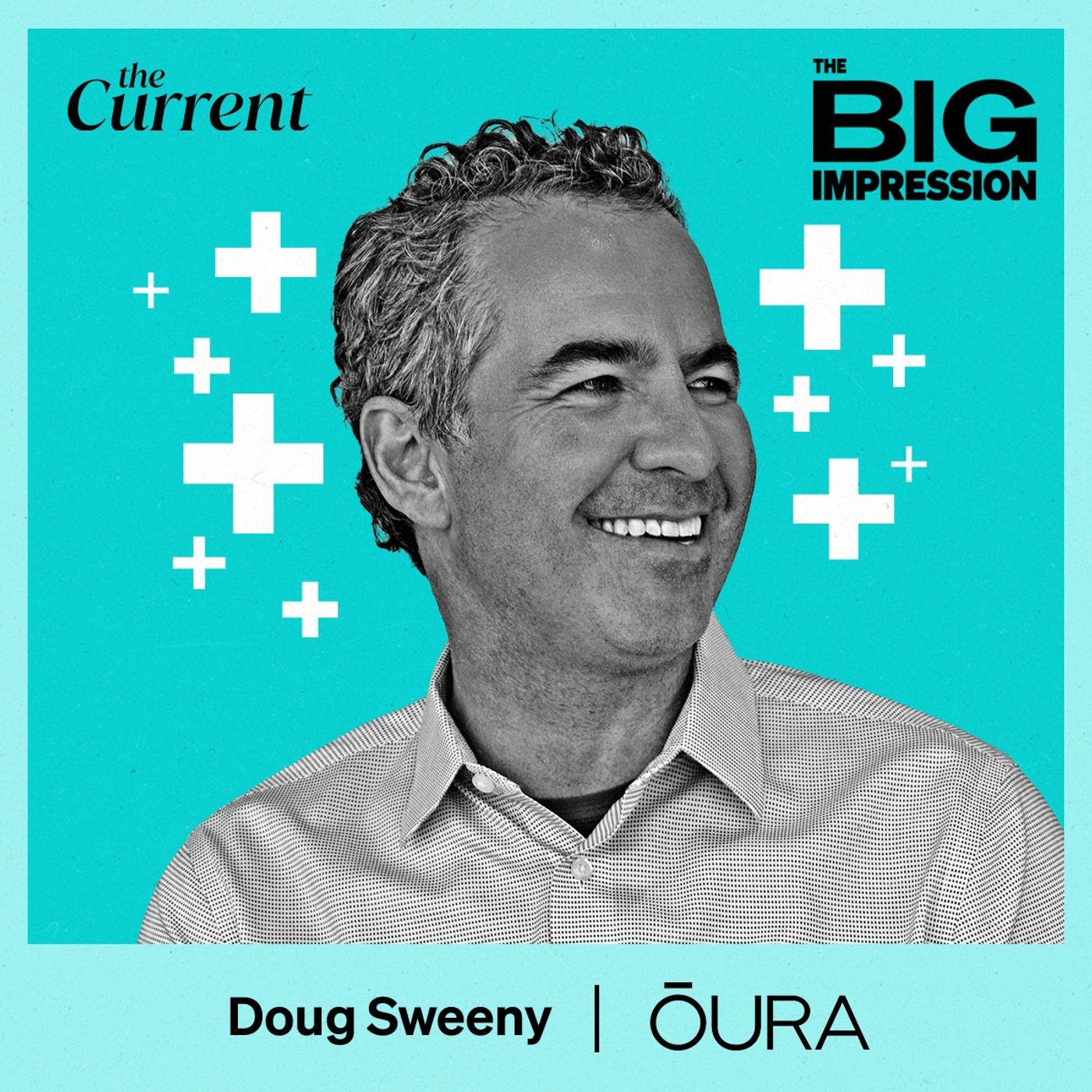
The Big Impression
Oura’s Doug Sweeny on turning data into daily wellness
00:28:56
Oura CMO Doug Sweeny on how the brand uses data, storytelling and its Olympic partnership to make wellness more personal — turning health insights into everyday behavior change.
Loading summary
Transcript55 lines
- [00:00]
A
I'm damien fowler.
- [00:01]
B
And I'm a. Lee sliffering.
- [00:03]
A
Welcome to the big impression.
- [00:09]
B
This week we're joined by Doug Sweeney, Chief Marketing Officer at Aura.
- [00:14]
A
Now, Aura has become one of the most talked about brands in health tech. In fact, the producer of this very podcast is wearing one. It's known for its sleek rings, but more importantly for how it's informing the way people think about wellness.
- [00:28]
B
Less about peak performance, more about everyday awareness, sleep rich recovery and the small habits that add up over time.
- [00:35]
A
And as the official wearable of the Winter Olympics, Aura stepped into a global moment with a very different message.
- [00:42]
B
Not chasing those extremes, but using data and storytelling to make wellness feel more personal and more attainable. It's all about that behavior change.
- [00:52]
A
Aura is a brand that lives where science, design and culture overlap. It takes complicated data and makes it into something that's actually useful for people. So let's get into it. Let's talk about the Olympics. Aura was the official wearable and you launched the campaign for this past Winter Olympics. Why was the Olympics the perfect moment for Aura to tell its health story?
- [01:22]
C
Great question. So we actually, so this, it started out very authentically years ago, actually. Aura has been a supporter of both a variety of summer and winter Olympians, US Team and other teams across the world. And we've been supporting them through commercial deals where we actually sell rings to the trainer of the U.S. snowboard team or the speed skating team. And they use the product for training for performance within these elite athletes. Sleep, recovery, cardiovascular health, et cetera, the variety of different metrics as they're training for the Olympics. And our Chief Medical Officer, Dr. Ricky reached out and said, hey, by the way, the chief medical officer on Team USA is a very good friend. Would you guys like an introduction to him? We already are working across the teams. Is there a way to create a partnership here where we support the athletes for the winter game? So we started that process and started negotiating and discussing that with the team and trying to figure out ways to get product into the hands of these athletes. We actually signed the deal with a Team USA for both the winter and the summer games and LA 28, the night of the opening ceremonies in Milan. So it was like that. It went right up until the very end and we announced it. But it's really exciting. I think the other comment I would make is we are also going to be conducting a study. Both our chief medical officers are going to work together on what does a study look like? What exactly what part of health, wellness and elite performance within The Olympic team should we be focused on. So that's going to happen over the course of the coming months.
- [02:59]
A
Did you have a sense at that point how you wanted the campaign to shape up? Obviously alignment with athletes is a huge plus.
- [03:07]
C
Each of the. I think the partnership and the stories we've been telling in social media. Breezy Johnson's a good example or any of the other athletes, we wanted to tell authentic stories. So it's really how are they using the product in their performance, in their daily lives? Performance within whatever sport they're participating in may only be 5 minutes, 2 minutes, 20 minutes. It's the lead up, it's the years and years prior to and that training that you don't see and aura has been in integrated part of their ritual and really that, that. So I think coming out of the Winter Games, given how the way we signed this deal and the way it's played itself out, we were able to announce it and tell stories during the games and then after we've been working with a number of the athletes to tell their stories about how they've been using it pre and post the Olympics for the summer athletes. That'll happen over the course of the next year or two in terms of the stories we're going to be telling there.
- [04:00]
B
Very cool. Curious what other channels you're looking into too, even beyond broadcast for the Olympics specifically. Overall. Yeah, but also specifically for our Olympics.
- [04:11]
C
Yeah, but so for the Olympics, it's interesting the as a core partner the athletes do have an onboarding experience. They had it in Milan which I got to experience and it's gonna be similar in la. So there's a product onboarding and there's actually an event we have coming up in D.C. with the athletes as they return and celebrate the finishing of the Milan game. So there's actually an experience there where ORA will be a part of that and they'll be s. If they don't have the product and they're not an athlete who uses it. So there's, there's actually organic event elements to this. The general question of where do we show up on the marketing side, we, we do, we do. We use broadcast streaming. We're very global. So the way we're looking at the world, we, we do show up locally in an out of home standpoint in London, in Sydney, in, in Berlin, in Munich, all over Western Europe. We've launched and we have been launching over the course of the last two years in, in countries all over the world and showing up of meeting from top of Funnel advertising down to lower performance.
- [05:11]
A
What kind of insights do you have? You're launching globally, I guess. The Olympics obviously is that global event, so that's perfect positioning in lots of ways. Do you get different insights from different global marketplaces?
- [05:26]
C
Yeah, great question, Damon. The sort of state of the brand around the world is very different. The US is our most mature market. If I'd say we have probably between 35 and 38% awareness in the US market, followed by the UK. Those are sort of two most, most mature markets. We've been investing in those markets the longest. And those consumers know about the product and the benefits and what aura is a market. Like I was in Mumbai and in India just a week or two ago and in Sydney we're further back on the journey. So the stories that we're going to be telling about what our product does and its benefits to you as a consumer are going to be very different in the of use. Australia or even Germany. Germany we're going to be telling a more of an engineering oriented story. In Japan we're going to be telling more of a sleep oriented story. Back at our foundation level, the roots of the company, because there's a real sleep deficit. In Japan, the UK and the US we're telling a variety of different stories that may be more about holistic health and wellness because the consumers have been along with us on that journey over the last couple of years. So it really does. It differs by state of the brand culturally within wellness. What is really important to those consumers in the market and then we activate and deploy our strategies accordingly.
- [06:48]
A
There, that's fascinating.
- [06:49]
B
It is. And then within that larger audience, that larger global audience, what is your core consumer? Who do they look like? Are they on the younger side, older side, demographic?
- [07:04]
C
It's a good question. They're really all shapes and sizes now and ages. We have 21 and 22 year old females and guys and we've got 75 and 80 year olds. It's age. Doesn't matter what part of the age spectrum we're on because we all care about our bodies. So we do find people who lean in into health and wellness who really want to know what's going on inside their body. It's core what this product does. The company pioneered this idea of a wearable that could, you could wear on your finger, which is 10, 12 years ago was a really radical idea. But at its core what we do is we give your body a voice, we give everybody a voice, we translate these complex signals within your body. Circulatory Heart, respiratory, stress, sleep signals. And we make them really simple for people to understand and they're so simple that it doesn't matter where you are on the spectrum in terms of your tech affinity, it's really easy to optimize and figure out what's going on and how you can live the happiest, healthiest life possible. While Mikaela Shiffrin may wear the product in a ski race for the Olympics, it's also the every man or woman who wants to just be healthier and sleep better and understand what's going on with their stress or their heart health.
- [08:24]
B
Has that audience changed over time or how are you envisioning that audience changing in the future?
- [08:32]
C
It has, it's really changed. So I've been in the company three and a half years and about four or five years ago we were a very male dominated audience. They tended to be biohacking guys. They were so early adopters. And if you fast forward today to 2026, we are a more female skewed product and it's fundamentally changed, I would say our age range also, while Noelle's not only male, it was a little older and it is actually skewed more younger. We're seeing our fastest growth in the 22 to 35 year old female demographic in terms of our overall growth. We've built out a set of Women's Health, a suite of products, services, software there that women love and they're talking about it so that it's been on, it's been really on as a result of those, those efforts there.
- [09:22]
A
I think what's interesting about this as well, from a marketing point of view is that you have a combination of, you have a product story, right? You have a data store and you have, and then you have the layer in the storytelling campaign around it. And as the cmo, how do you integrate those three different elements into, into the way you go to market?
- [09:41]
C
Yeah, we sit at this really interesting cross section because where if you open the hood of the company and looked at the structure of our company, it looks like a health care brand. We have 35 plus PhDs in medical. I mentioned Dr. Ricky, we have a medical staff. We're working on algorithms across these and doing studies over the world to make sure it's accurate. So the company looks less like a tech company and more like a healthcare company. So it's a healthcare company, but it also sits on your finger and has a jewelry and a pop culture component to it. So it sits within this sort of creative healthcare efficacy zone. And we're combining those two things. So we're constantly pivoting between data rich stories and telling emotional human stories. And it's the combination thereof. I think it's interesting when we look at the funnel though very strategically we may be at an emotional at a top of funnel level telling more human story. As that consumer goes on the journey with us and is thinking about buying an OURA ring mid funnel and even lower funnel, we're going to get a little more specific on the product, the data, the accuracy, the different products and services that are available. So the messaging. The messaging definitely changes as we move through and we very deliberately are creating content in that way that hits both
- [10:58]
B
those audiences curious when it comes to using the data for marketing purposes, do you feel like you have almost too much data to work with now these days or do you feel like you would rather have less data?
- [11:15]
C
It's a good question. I think because we're one. Because we're a healthcare brand. I know this coming out of I spent time at four plus years at one medical. It's like healthcare data is very personal and very private. So we want to be very careful about how we do that and want to make sure the consumer is very much in control of their data. So example of that would be if you want to opt into a partnering with a third party that would be important to you. You as the consumer member actually are driving that and can share that. Strava Natural Cycles as an example. Dexcom is another example where we've got a third party. We do on the data side for our members. Our members are our best advocates. The product is beloved. So we do find when we look at the overall member data and growth of our business overall, the members themselves are sharing it and talking about it frequently. It sits on the hand, sits on the finger. And we see this populate. When we grow a membership in a geography or an area, we tend to see more inherent growth. Even today at Aura scale, the number one source of awareness is still the members. And our numbers are between 40 and 50% roughly. When you ask them how did you find out about Aura? It's from a family member, friend or a coworker. Yes, there's advertising content, but the product in a lot of ways does help sell itself because people ask about it, what's that on your finger? Is that an OURA ring or. Or they tell about their own experience and they're explaining why it's impacting their overall health, which is really powerful. I do think you can get to your question about is the Data confusing or I think more data is better. You just have to be a really good editor on the data and make sure you're looking at the right and most impactful things that can help move the product. We want to be listening to our consumers and members about what do they want to see next on aura, what are the areas that they're looking for? More information about their body and what's going on that we can actually react to. I think is really key.
- [13:16]
A
As you look now at the campaign since, let's say the Winter Olympics rollout, is there anything there that surprised you that you learned in terms of response to the campaign?
- [13:29]
C
Yeah, I think we are so. I think in a football game, we're in the first quarter, we're probably five minutes in. I think we, we have been organically working with these athletes and trainers all over the world. We have roughly 120 collegiate and professional teams around the world that we work with, that we are NFL, NBA, professional athletes in the Olympics, tennis, F1 drivers, you name it, that we're working with organically. This was an element to create a formal partnership. I think the surprise, Damian, was the, oh, wow, that makes a lot of sense. Like right out of the gate from a social pr when we were going to the media and talking about this, the answer that we got from everybody was totally logically makes sense. This is exactly where I'd expect you guys to be. I think we're a global brand working within global teams competing at the highest level in sport and people know and are cognizant of the fact that these elite athletes are using the product. There was awareness of that. Even though it's subtle, the product is very discreet. But when Mikayla takes off her glove, she has, and she just completed her slalom gold and she's holding her gold medal ring. She has, she is in a gold aura ring right next to it, which is really powerful and people pick up on those things. So I think that would be the thing I would say would be the most is people were everyone was leaning into. Like this makes a ton of sense. It's really about where does it go from here? What do we do with it over the course of the next two years leading up to, to la.
- [15:02]
A
Yeah, I think you have a huge advantage, of course, because proximity to live sport is everything in marketing. And we talk about that a lot. And we talk about it in terms of how streaming channels are all, you know, vying for sports rights, but you have that access and that's huge.
- [15:19]
C
It's huge. It's authentic. I think that the other thing about the partnership, and we heard this from the US Olympic leaders and team, this was the easiest program to say yes to because it was already endorsed and used by the athletes and trainers that you're not having to explain through borrowed interest why this makes sense with a partnership. They're already using this and we're already integrated within their regimes across these teams. So it became a very easy. Of course. And those leaders within the USOP are also wearing the product too, mind you. So it's again, you've got elite athletes and you have business leaders, you have these sort of these athletes in life wearing the product and seeing the benefits. That was really made it really simple and easy.
- [16:05]
B
That's awesome. I kind of want to zoom out a little bit, look at the bigger picture here. You talked a lot about the science that is behind this product. For those marketers who are listening right now, how do you translate something so technical into something that's more like story led? Is it more the creator that you lead with or is there something even deeper that you're trying to relay to the viewer?
- [16:36]
C
I had the fortune to work with Tony Fadell, who created the ipod and the iPhone under Steve at Nest. And I learned a lot of lessons working for him. And that was about solving real problems for consumers and breaking things down into really simple, easy to understand. Just sort of what has made Apple and Nest really strong brands. And so I do believe in this idea of simplification and what is the thing you're really ultimately trying to solve with consumers. I think that's really important. You can get lost in the technical engineering whiz bang of something but. And that may really excite the product team or the engineering team or the science team, but it's got to be. It has to be benefit led and really helping consumers at the highest level within this product. People want to know what's going on in your body. We 24 to 36 hours before you get sick, we give you a heads up. You are having mild or major symptoms. We think you're coming down with something because your body temperature rose. That is a superpower. And that is amazing because now you can move into rest mode and you can maybe not get on that flight or maybe not go to the gym and chill out. And it is an unbelievable feature that's solving a real consumer problem, being able to have that understanding. I think another thing about our product that makes it powerful is it's discreet and consumers don't want another screen on their hand. There is no screen on an OURA ring. It's one of the reasons the battery life is so long. You drive it, you're in control. The technology moves into the background and is really discreet and you drive it on your phone when you want to learn those insights. So I think that's listening to consumers. We hear that loud and clear in all the data that we see from our members. They don't want the constant pinging you, nudging you all the time and pining for your attention. That's another example. But again, we want to, we really focus on our team of telling those stories in clear, benefit oriented ways that are really simple, that any part of the population can understand. I think that's really, really key.
- [18:43]
B
Do you think more brands should act as you guys are in a way, as more guides to everyday living? And are there any brands that you would say are doing a good job at that besides you?
- [19:00]
C
I think it depends on the product offering. Right. I think oura, at its core we're a mission driven company. We are here all to make health a daily practice. We believe that there's little teeny steps that you can do. You don't have to go in hard every single day and work out in the gym for two and three hours to live a healthy life. We believe in balance and structure and everybody in this company is very focused on that mission. We all believe it and that's what we do every day and that's why everybody is here. But a lot of it stems from the mission vision and the product offering. So I think if you're, you know, working at a, at a social app company or something that is more about pop culture or something that is in a completely different category. I think it, it can be a challenge based on what the product is offering. I think at its core that's what Aura does, which makes it, you know, it's easy from a recruiting standpoint about making sure that people feel and are living and breathing these things. But we see that in all our employees, I would say generally is that they're in because they believe in what we're building and creating every day and the benefit we're giving people around the world.
- [20:07]
A
On that point, Doug, do you think that a brand like Aura can genuinely change long term health outcomes in any given demographic?
- [20:17]
C
Do you? I absolutely do. I think the US healthcare or healthcare around the world has historically been reactive. You go to the doctor when something's not right and a lot of times that's usually too far down the road. You really want to get in front of these things. And Aura does believe in proactive small things that can make a direct impact on your life. Aura is one of the first brands to actively promote this idea of sleep. And that is a. Now that is like everybody realizes the impact of sleep, but it used to be about this idea of I'll sleep when I'm dead. I'm gonna, it doesn't matter. I'm gonna work hard, play hard. And if I get four or five hours of sleep, if you're not getting seven hours of sleep, of good quality sleep, it has a direct impact on your metabolic health, your cardiac health, your stress, and a variety of other things that are going to be long term problems. That's just within one of our product pillars. Not to mention stress, activity, resilience, on and on. So I do think I've changed the way I live in the three and a half years since I've been at Aura. I've definitely altered the way I live my life. Absolutely. And we hear this all the time from consumers all the time. And it doesn't have to be, Damien, a big fundamental thing. Right. It could really be some relatively small tweaks to the way you're living that can impact your overall health.
- [21:47]
A
Yeah, that's, that's amazing to hear that you've actually changed the way based on the information you're getting from the ring.
- [21:54]
C
Yeah, I'll give you, I'll give you like one is the, the glass of wine late at night at 9:30 or 10, when then you're out with friends and it's late and you're going to go to bed at 11 is. Or the late meal, your body is metabolizing that food or that, that wine. And it takes a while for your resting heart rate to go down, which is why you usually don't get a good night's sleep. Dr. Robbins, who's on our medical advisory board from Harvard, said, she said this is. I'll quote her because she said it. I promote day drinking because it's during the day and then you metabolize that beer or that wine over the course of the day before you go to bed. That was a thing. I didn't really know that until I worked at Aura and I've adjusted. It's like I'm gonna not have that late snack or that late night food because it does impact my, it does impact my stuff.
- [22:41]
A
That's funny. I was gonna say let's split the difference and talk about cocktail hour at 6.
- [22:46]
C
We could do that happy hour Is fine. Happy hour is good too. Okay.
- [22:49]
A
Happy hours, fine.
- [22:50]
C
Shall we move on to.
- [22:51]
A
We've got a few kind of fun quick questions here to close this out.
- [22:55]
C
Absolutely.
- [22:56]
A
One of them is, the first one is this. Are there other brands out there that you think are doing a great job in the health and wellness sphere right now?
- [23:07]
C
I've always been a big fan of Headspace and what they've done. I think their content creation and digital storytelling, I think has always been some of the best.
- [23:16]
B
What's one thing in marketing that might sound good on paper but just isn't delivering in reality?
- [23:26]
C
I think there's this feeling that there are platforms now with social influencers around the world, that the social influencer space, which is now moving into sort of maturity, early maturity, that you can actually, you can engage with those, those influencers through a variety of different platforms. I still think it's early in that it's a challenging thing to wrap your head around in the US Alone within different segments and communities, health, wellness, yoga instructors, elite athletes, moms, dads, you name it, all these different communities. But when you add into it as well a global lens and you're thinking about Germany or Australia, New Zealand or Japan or India, the complexity of that is more challenging. So that's just one area that I feel like there's a lot of solutions out there right now being talked about in the early stage startup space that are trying to solve these challenges. YouTube creators too. YouTube creators, influencers, bloggers in that space, micro macro across a variety. It's still very much early days and I think that's a. It's an ongoing challenge for brands to manage because it's yet another. We figured it out on the social side through the traditional platforms which do keep growing too. Think about the rise of Reddit over the last five to 10 years. But yeah, that's what I would say there.
- [24:56]
A
What's a trend in wellness or tech that you think is overhyped?
- [25:03]
C
Overhyped within. Here's one. I think the idea that only using elite athletes to market sports products, which has been an overused thing, is in some ways jump the shark. I think it's important to be able to talk to a variety of segments. I think those athletes and using have that are actually using your product authentically is really powerful and telling those stories. I think just a linear strategy and approach like that I think can be a little overhyped. It's a strategy Nike and Red Bull used for decades to great effect. But it's, it's just changed the complexity has changed. I would say the use of and this is not overhyped but maybe underhyped or I mean this thing we talk about all the time. But within AI, I think the impact of AI and tools. We have an AI advisor tool on the app that is really powerful that allows you to do a deep dive that is actually under hyped. It's a real game changer within the product. It allows you to go deeper into your own data and analytics about what's happening in your body. If you're not seeing at a surface level the information you need, our AI advisor allows you to go even deeper and try to understand what's happening and provide you thoughts on that. That's really powerful as well. Just on the other side.
- [26:19]
B
Very cool. Last one. Do you have a dream collab? Which athlete, creator or cultural figure would you most want to build a campaign?
- [26:35]
C
Most like to create a. I'll go down a different. We've been talking a lot about Olympics and athletes and partnerships there. We have a lot of organics through business leaders and celebrities and actors and actresses and folks and entertainers. We did do a. When I first started, we did a Gucci collaboration years ago and I think a fashion collab would be interesting to be really open and honest. We haven't. It's not something we've talked about as a brand much but I do think within some of the elite fashion houses it could be interesting. I don't know if I'd pick one but I think there is a surprise and delight. There's a stacking thing going on with jewelry and culture. We see this a lot with women who are wearing the oura ring and stacking it front and side. There could be a collab there or within one of the the big fashion houses that I think could be really interesting. I think the surprise and delight with those can be interesting. I think with the case of Gucci we just surprise people. The product was bigger and a little clunkier at that stage given the scale as the technology has shrunk on our ring four. Yeah, that would be one that I would say.
- [27:51]
A
And that's it for this edition of the Big Impression.
- [27:53]
B
This show is produced by Molten Heart. Our theme is by Love and Caliber and our associate producer is Sydney Cairns.
- [28:00]
C
And remember, we're constantly pivoting between data rich stories and telling emotional human stories.
- [28:10]
A
I'm Damian. And I'm Ayelece and we'll see you next time.