← The Big Impression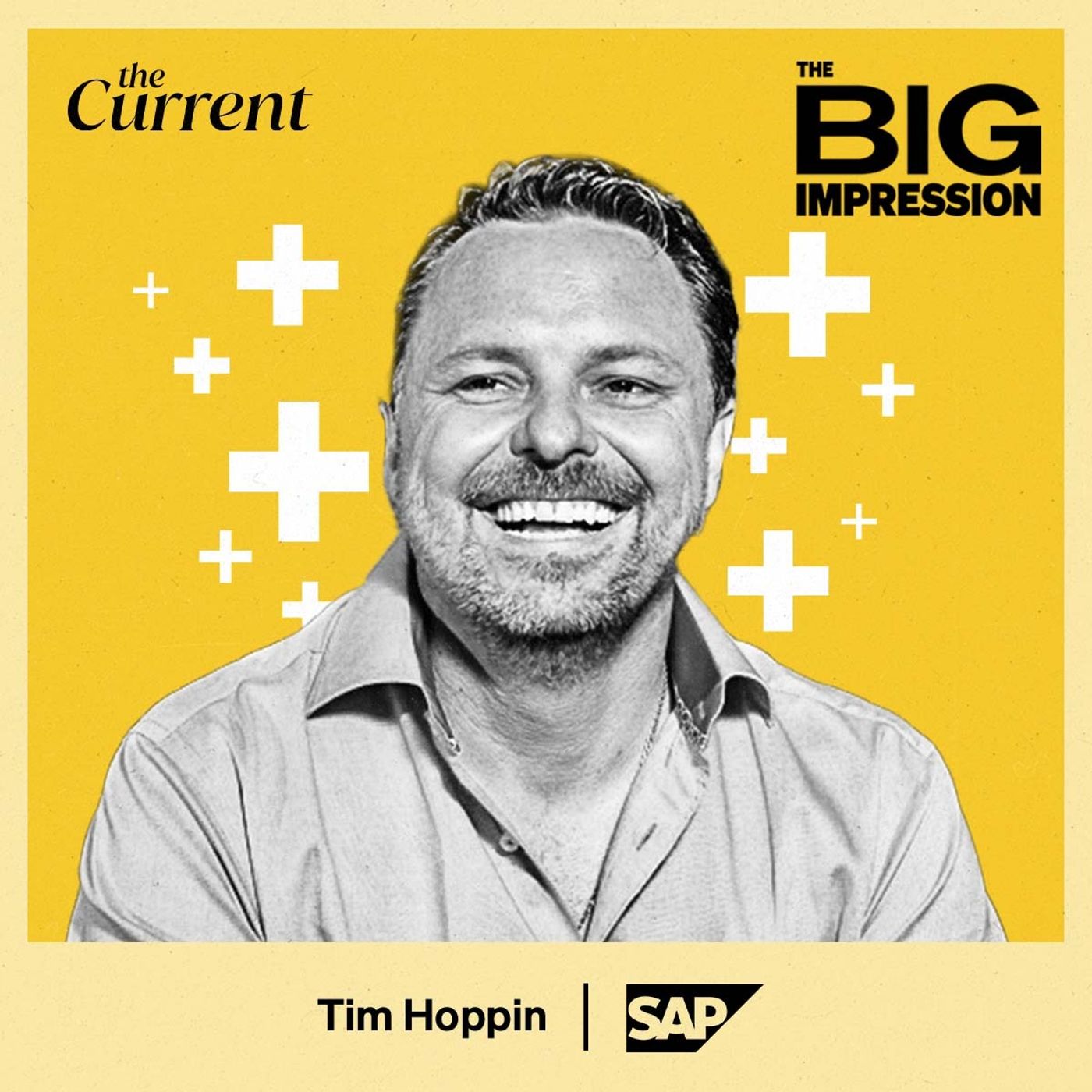
The Big Impression
SAP’s Tim Hoppin on why emotional storytelling belongs in B2B
00:17:05
B2B marketing has long been stuck with a somewhat boring reputation: rational, buttoned-up and forgettable. Tim Hoppin is on a mission to change that. As chief brand and creative officer at SAP, he’s helping one of the world’s largest software companies embrace big creative swings — and prove that business buyers are humans too.
Loading summary
Transcript57 lines
- [00:00]
A
Damien.
- [00:00]
B
I'm Damien Fowler.
- [00:02]
C
And I'm Ilise Loefring.
- [00:03]
B
And welcome to this edition of the Big Impression.
- [00:10]
C
You might be wondering. Wait, what? Isn't this the current podcast? I'm here to listen to brand marketers talk about the highs and lows of their brand campaign.
- [00:19]
B
I know I am.
- [00:20]
C
Well, rest assured, we've just had a little bit of a brand refresh for now. The Big Impression, that's official.
- [00:29]
B
Shout out to our creative team for the new name, which I really love, actually.
- [00:33]
C
So do I. So, without further ado, let's kick off this new season with a great guest.
- [00:39]
B
And today we're delighted to be joined by Tim Hoppin, the Chief Brand and Creative Officer at SAP.
- [00:46]
C
Now, SAP makes software that helps big companies run everything from payroll to supply chains, all in one integrated system. It was recently hailed by Brandz as the 23rd most valuable brand on the planet.
- [01:00]
B
And no doubt some of that's thanks to Tim. He's a brand builder who spearheaded the tech company's recent B2B campaign, Unstoppable, which was shortlisted at this year's Cannes Lions. And that's where we sat down with him. So we're going to start out with this sort of, like, philosophical frame. Ryan, you have said that a brand must influence everything a company makes, says and does. Could you explain that philosophy a little bit?
- [01:30]
A
Yeah, sure. I think a lot of people even just kind of reduce it down to, like, branding, like the colors and things like that and maybe the expression a little bit. But the way I think about a brand transmits meaning to people and it does that through lots of different formats. So when I say what a brand is, what you make, you're actually affecting the service or the product that you're actually delivering to the world. So my classic example is Harley Davidson. Those motorcycles don't use plastic and they. They do that very specifically because they want the brand to be expressed a certain way in products. And then when I say a brand is what a company says, that's your marketing, your pr, your communication, and then what you do is your activations, your choices on what kind of companies you're going to invest in and. And so on and so forth. But. So it's all three.
- [02:26]
B
Yeah. Can you walk us through your recent SAP campaign, which I believe is called Unstoppable?
- [02:32]
A
The campaign was built to communicate a new way we're going to market with our products, which is kind of bringing together all the different parts of the software that we make. We tie it together. We call it the SAP business suite. And we're dramatizing it with sort of metaphors that bring it to life. For instance, sometimes if you're in business and you're in charge of a something like being head of hr, it can feel like you're literally underwater. So we recreated what literally happens when the entire office goes underwater. So we, we filmed the entire office submerged underwater and people are trying to go about their business. And of course, at the end we introduce our product, which kind of drains it and gets things back to normal. And another example, sometimes when you're trying to innovate, it's like an uphill battle. So you start off and the entire building tilts on its side and we kind of go in this metaphoric world where the CEO is like trying to march up a hill and things are coming at her and she's trying to dodge it. So they're all metaphors that we can kind of associate, but they're also very real stories. Every one of them is based on an actual customer story.
- [03:48]
C
Very fun. What would you say are the key consumer business insights behind this campaign?
- [03:54]
A
Yes, because we're purely B2B. Our research is a little bit. You have to be more precise in getting those insights. So a lot of it has to do with doing interviews because there's not like a survey you're going to send out to a bunch of CFOs or CEOs and they're going to respond. They're pretty busy people. But we can do other things like get some individual interviews. We do quant studies as well, but it's easier to get real insights when you actually talk to real people. So more like anthropology research, I'd say, than sort of traditional marketing broad surveys.
- [04:35]
C
Some people might say that emotional storytelling and B2B business campaigns are almost like a oxymoron of sorts. Is that at a conundrum, would you say?
- [04:51]
A
How many times have you seen a piece of content that's using just stock imagery, talking about functional stuff, and you just ignore it? And so there's this perception that that's what everybody wants and does. We are seeing a renaissance in B2B where emotional, strong, insight driven work is what works. And so I, I think you're going to see more and more of that as people realize that it actually is more effective.
- [05:22]
B
It's interesting to me that the B2B is being put out on what you might consider consumer channels. I'm just curious to hear your take on, you know, why that was important and how do you basically, how did you activate this campaign and where did you want to put it?
- [05:38]
A
Yeah, so our media team and working with their agency took the brief that we're trying to do two things. We're trying to both lead people that are maybe in market ready to buy, kind of lead them into our ecosystem and get in touch with our salespeople. But we also recognize that SAP, you know, as a 50 plus year old company has some perceptions out there and we need to constantly re educate the marketplace about who we are, what we stand for, and then also present ourselves to the next generation. 71% of all B2B buyers are either millennials or Gen Z. 71%.
- [06:20]
B
Wow.
- [06:21]
C
It's a large amount.
- [06:22]
A
Yeah, it's a lot. So like to, to become and stay relevant even as the world's largest sort of enterprise software company, you have to, you can't rest on your laurels. So some of those media tactics like being in airports or some television buys in very targeted ways is designed to get broad enough reach so that we can get people familiar with us and start to understand what we stand for so that when they're ready to buy, they're not just hearing about us for the first time. And then of course we're looking at the real data, what's happening out there. Happy to say that all of our creative work has got five stars. Our hybrid is the highest you can get. System one, we're beating every industry benchmark and then in market, the performance that we're seeing in the market is also way above all of our benchmarks. So we're excited because as we like to say, if creative doesn't work, it's not working.
- [07:15]
C
Was there an insight that you say you took away?
- [07:18]
A
I had a strong hypothesis that there would be some disruption just from visually the way the campaign is presented, especially the films. I think the thing that's really surprised me as we did our research how what a chord, it's striking with people. There's one comment that came through just from the qual study that we did where people were saying like you finally get me. Not only is the, is the content visually arresting but emotionally resonant like people really feel seen. And to your comment earlier about like, hey, B2B is seen as traditional and there's such a, I'd say a traditional and sort of safe approach to just use business people doing businessy things and boats and cars moving fast and satellites flying by the camera and putting a logo at the end. That one, yeah, yeah, I've made that one unfortunately. But like to really take this risk and like tell interesting stories that are based on real human insights and have emotion and are disruptive and, and have the very people that we're trying to reach go. Thank you, thank you for seeing us telling us a story that's like different. Like I have this saying if you want to be disruptive, you actually have to disrupt. And so there's also sort of a hundred SAP like we have to reinvent ourselves. We are in our product and our go to market and so like the, the brand platform that we created over the last three years now this is sort of the next level is like taking the campaign higher. So it, I think we're on this momentum of transformation and so it just felt natural to do it. And the way we're investing the does parts also coming to you frankly like the way we're investing in AI and kind of transforming what's possible from a 50 plus year old company. It's, it's exciting.
- [09:13]
C
Let's talk a little bit about AI.
- [09:15]
A
Yeah, sure.
- [09:16]
C
On that note, how are you guys investing in AI and what do you foresee as a creation, as a creative.
- [09:25]
B
Person, do you feel threatened by it?
- [09:27]
A
Not at all. I Sorry, I didn't mean to jump on your question.
- [09:30]
C
That is the question.
- [09:31]
A
Yeah, it's the question of the week and it's come up so much actually.
- [09:34]
C
I was talking people talking about it.
- [09:38]
A
No, I actually think what's been really refreshing is two things. Always the first part of your question, which is as a company we are basically transforming into a data and AI company. I think pretty much anybody who's going to survive has to do that. So we've made software for 50 years. But what all the companies that run on our platforms, it's the data that's the most valuable part of course. And so the AI that we've developed is allowing people to like run their businesses completely different ways. So we're investing in that as a creative person. We're also starting to experiment with AI for instance, trying to understand how people might react to our messages. I don't think that AI is going to replace creatives, but I think creatives are going to have to change. So you're going to have to act more like a director than a executor. I remember when I started in the business a few years ago, 25ish. I remember the people who would were still laying down typography by hand and like everything, you know, every piece of printed material was proofed. Like the proofs would come into the agency and people were like looking at it, you know, and so all those people's jobs changed and it's. This is, that's all this is. Human creativity will not and cannot be replicated, but it will require us to get better at being creative and know how to use these new tools.
- [11:10]
C
Yeah, that's a great answer. We've transformed so much in 25 years. It's. It's kind of baffling completely.
- [11:19]
B
Yeah.
- [11:20]
C
So you're an agency guy. It does seem that B2B is getting better. Is it because of all these agency folks moving in house?
- [11:30]
A
Yeah, I think so. We're seeing a look, the agency world has changed and is contracting in some ways and it's really tough. But also it's creating opportunities for those same creative talents to move in house. And so it becomes a, I'd say rebalancing. I remember early in my career if you worked in a in house agency, it was sort of looked down on like you're just not good enough for a real creative job, which was totally mean and not nice. But that was the perception and now it's completely not that. Some of the best work that's being produced is coming from in house agencies. So you're seeing a migration from. And frankly it's caused by clients. So clients are reducing what they're willing to pay agencies, which puts economic pressure on the agencies and they have to downsize and then those great talented people need to pay their mortgage and put their kids through college and they're coming in house. And so my team is almost exclusively on my creative group are ex agency people. And that's what I am too. And so that actually makes us better clients so we can work with our agencies and we know how to work with them and who they are and we, and sometimes we even know them from past lives. So like it just makes the work better all around.
- [12:53]
C
Is there anything in the creative realm that you're looking at or data back creativity that you think brands should co op for B2B campaigns?
- [13:06]
A
Yeah, I, absolutely. Interestingly, as we've seen this sort of spike in the AI chatter and everybody talking about it and sort of wringing their hands about what it's going to do for our job jobs, there's been sort of a pushback in a really healthy way where people are saying actually no humanity and really putting AI in its place, which is, it's just another tool. Yes, it's going to disrupt jobs. That, that is a true statement, 100%. But it's not going to replace human creativity and so as I said before, that reality is getting people back to what's important, which is storytelling, human storytelling, creativity, finding those interesting combinations that only humans can do. And that's where you're starting to see that come to life in B2B marketing, is that it's a, It's a. I said it earlier, I think it's a. It's a bit of a renaissance in a not cheesy way where we have.
- [14:06]
C
Some last minute record fire and this.
- [14:08]
A
Is your home's trick.
- [14:11]
B
So is, is there anything, is there anything, Tim, that you're obsessed with figuring out right now?
- [14:17]
A
Yeah. How to, how to keep getting better. It's like I love seeing what people can do and I want to use new tools and new solutions. And so I'm, I'm trying to figure out where is all this AI stuff going to go and where is it going to be helpful and how do you avoid the pit of generic communications that is a real threat as from AI.
- [14:44]
C
Did you have a favorite can moment that made you stop and say wow?
- [14:50]
A
Yeah. I was in line for a session and there was a young creative, a group of young lions. And this one kid, he had to be maybe 18, maybe 19, he still has his braces on and he was so excited, so excited to be there and to go in. And I've been really worried that like our industry doesn't have the next generation coming up. And I saw this kid and I was just so relieved that this kid was as excited about the start of his career as I was when I started. I mean, I would fall asleep with award annuals to learn how to do this stuff better and that you could feel the energy from this kid. It was awesome.
- [15:40]
C
I'm so happy that like a lot of students come to Cannes.
- [15:44]
B
It's great. It's just fills your heart. Yeah, it does, it does.
- [15:49]
C
Last one.
- [15:50]
B
So who beyond SAP, who else is doing B2B brand work very well, in your view?
- [15:56]
A
Well, GoDaddy won the Grand Prix for, I thought, a really fun piece of work. And you know, it's, it's targeted to small business. So it's. You can be a little, I think you can be a little bit more courageous than sometimes we get to, but I just loved it for its, its wackiness and just audaciousness. And then also the, the way that they really just kind of carried across different mediums. The thing that was the best about it was they're trying to make the case for starting a small business and they literally did that with a celebrity. It was brilliant.
- [16:42]
B
And that's it for this edition of the Big Impression.
- [16:44]
C
This show is produced by Molten Heart. Our theme is by Love and Caliber, and our associate producer is Sydney cairns.
- [16:51]
A
And remember, 71% of all B2B buyers are either millennials or Gen Z. I'm.
- [16:58]
C
Damian and I'm a lease, and we'll.
- [17:00]
B
See you next time.