← The Big Impression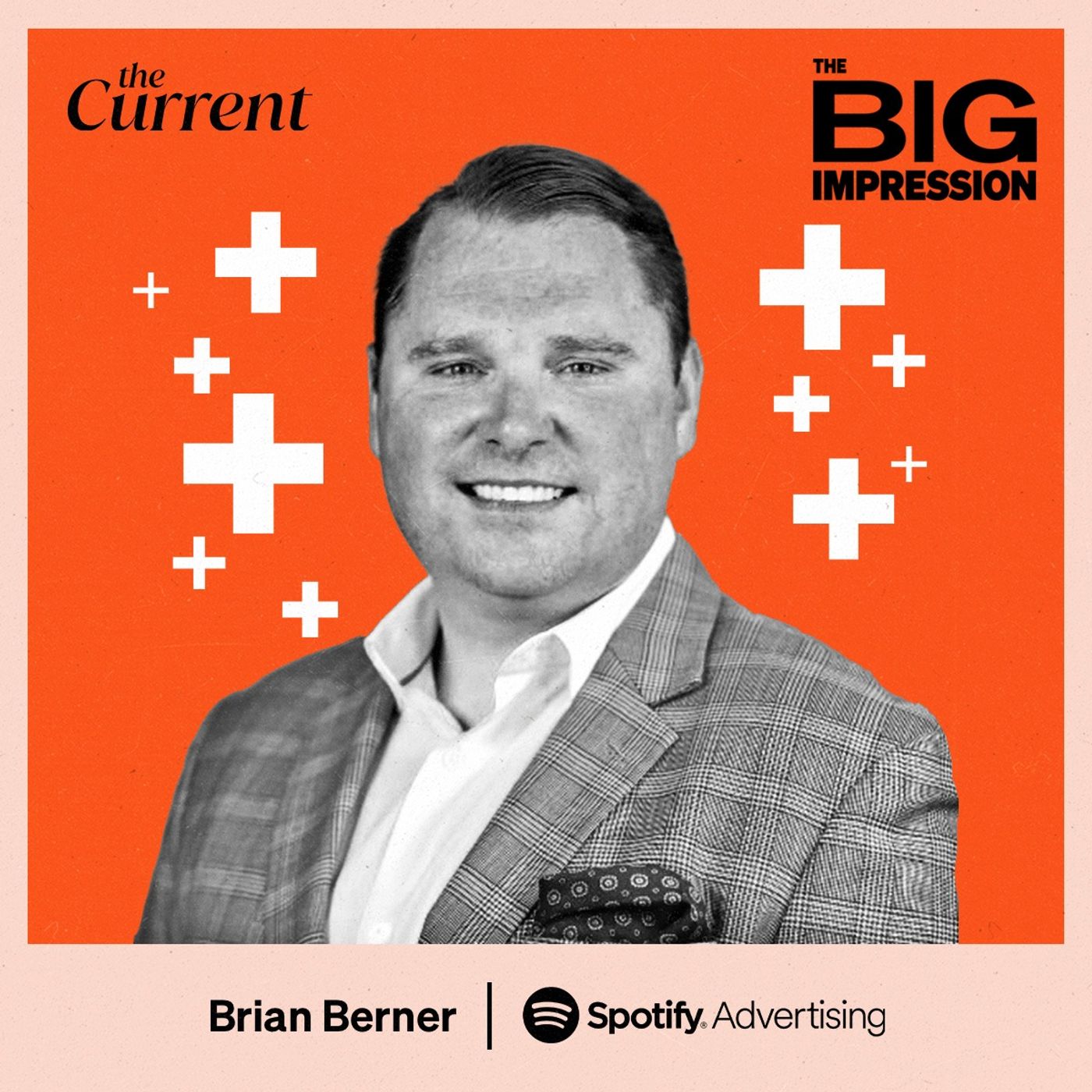
The Big Impression
Spotify’s Brian Berner on the ‘untapped’ potential of audio
00:24:14
On this episode of The Big Impression, Brian Berner, Spotify’s head of global ad sales, talks about the benefits of its ad exchange and AI-generated audio spots.
Loading summary
Transcript53 lines
- [00:00]
A
I'm Damian Fowler and welcome to this edition of the Big Impression. Today we're talking about Spotify and how it's quietly becoming way more than just your favorite playlist app. Yeah, it's not just about streaming music or podcasts anymore. Spotify's ad business has leveled up in a big way. We're talking audio, video, display and AI powered creative. All of it. My guest is Brian Berner, global head of ad sales at Spotify. He's here to broadcast break down how the platform is turning cultural moments into performance engines and why brands are leaning into Spotify's programmatic tools to do it faster and smarter. From auto generated ads to cross format buys to first party audience targeting, it's a whole new world inside Spotify right now. So let's get into it. Graham, let's start with a moment that shows off Spotify's latest offering, which is the launch of Sax, Spotify's ad exchange change. You know, it feels like a really big shift for Spotify. Spotify's ad business. Why was it the right moment, you know, to make this leap into real time Programmatic?
- [01:13]
B
Yeah, yeah, absolutely. So, you know, look, what I would say is the moment itself was, you know, the announcement was in April. Right. But it's also been a couple years in the making and development. So to answer your core question, what I would say is as we continue to partner with brands, we're always trying to build what's best for them. Right. What does the customer want? And what I would say, especially in a post Covid economy, you continue to see accelerated focus on brands wanting agility and flexibility when they're activating campaigns. Right. So not only do they want to avoid being locked into something for a full year where possible, but they also want to, you know, think through how they're aligning their own data and targeting and custom audiences. They want to have flexibility with creative optimizations and ab testing creative and then equally measurement. They want to be able to bring in, you know, in house or third party measurement, you know, verification to just confirm and get insights on the work they're doing. So when you start from that lens, you know, the moment or Sax in particular, it was really just, you know, because of customer feedback, we, you know, wanted to just make it easier for clients to ultimately create, buy and measure on Spotify. And building out the Spotify ad exchange, initially partnering with the trade desk and DV360 and most recently Magnite has unlocked about now 39 +DSPs that we're partnering with Globally, that's really the moment or the why that as brands are partnering with us, we want to be able to just make it easier for them to create, buy and measure.
- [03:01]
A
On Spotify, Sax is different because it opens up all inventory and all signals in one one place. What are you getting? What kind of feedback are you getting from buyers at this time about that availability?
- [03:13]
B
Yeah, I'd say, look, definite feedback or initial feedback is, you know, with the massive increased advertiser count, I think we've already seen over 5,000 advertisers year to date lean into sack. So I think just the sheer adoption alone is, you know, confirmation that this is the right thing in the market's looking for it. But I'd also say the feedback is, you know, if you think about what they might be doing with like Trade Desk and some of their uid, you know, audience builds or in other instances, just open path for ease of buying, I think the feedback has just been like how quickly they can, you know, activate and scale on our, on our network. The other thing that, you know, I'd also plug in there though is given that Spotify is a logged in, authenticated user, the real power of Sax is us being able to bring our first party data and matching it with theirs. So, you know, even something as simple as leveraging, leveraging our age and gender, you know, data mirrored with your, you know, whatever data you're bringing to the table. And then to your point, you hit the nail on the head. All signals, all formats, you know, all, all inventory, just really allows advertisers to maximize, you know, reach and performance to the Spotify users.
- [04:22]
A
I want to say that you've just closed your most profitable year in company history. Right. With ad revenue up 114% since 2020, if that's 2020.
- [04:30]
B
Yep, yep.
- [04:30]
A
And how much of that growth is tied to the programmatic, this programmatic expansion that you're talking about right now versus, you know, advertisers getting in on the action and creative access? I mean, what is, what's the balance there?
- [04:44]
B
Well, look, I mean, if you think about it, we only just announced and opened up these tools in April of this year, right? So our core, you know, where our growth has been coming from, our core products that have been around for, you know, the past five plus years, that's still where, you know, the majority of that revenue is going to exist in that number that you discuss. But back to my point where I look at the majority of growth moving forward with the new advertisers coming to the Platform and the different ways we're seeing them activate, I think you'll definitely, this year and moving forward see the growth coming from automation.
- [05:19]
A
Brian, are there any great use cases where you talk where brands have activated across the platform that are seeing really good results?
- [05:26]
B
Yeah. Yeah. Well, the way I would think about answering that question is probably like some of the work we've done with brands like Iviza, Kona, even a Budweiser. And what they've done is, is not just leveraging, you know, automation, but also our AUX part of the company. So AUX is an announcement we made, I think, two years ago, specifically around how we can partner with brands for music consulting, you know, talent and artist alignment, how to activate within music. You give an example, such as Kona, for that matter, what they'll do is they'll come to us and obviously all these different brands have a target audience they're trying to reach. Right. So first, just brilliant at the basics is making sure that we're leveraging, you know, scalable media to engage with those consumers. So that's where they're going to be, you know, using like a sax to just activate their media and have all the flexibility I've been talking about. But with that said, even as the world is digital, consumers, you know, still love experiences. And Kona understands that. They have this incredible program they're doing with different music activations. And one of them is, you know, coming soon, there's the Lollapalooza Festival and in Chicago, and we're going to be doing, you know, an offset session during that where we bring in, you know, people. But what we do in that instance, and some of the great work is we look at the brand attributes. What does it stand for? And what's interesting because of our streaming intelligence is if you, if you look at, like, what are consumers listening to, it's probably always going to be, who knows, like Taylor Swift, you know, Travis Scott, Zach, Brian. But what's fascinating about Spotify is we can really start layering in, like the different, you know, cities, zips or areas, age and gender, and then you can really break down even to sub genres that align with brand attributes.
- [07:21]
A
So it goes beyond, like Gen Z, hip hop fans in la, you can.
- [07:24]
B
Yes, you definitely have to go deeper than that.
- [07:26]
A
Yeah.
- [07:26]
B
And that's how you make, you know, these just amazing connections. And I think, back to your point, like, great examples or like, why. What's so powerful and unique about Spotify is having all of that intelligence allows us to really bring the true fans, you know, of the band. But it gives the brand a moment to like be contextually aligned with Spotify, with that band, with that moment. And that's like how you make magic. One plus one equals three.
- [07:56]
A
What's interesting I'm hearing is, you know, this contextual alignment for the data. But you know, you're finding cultural moments at events, but then I'm being able to spin those kind of those audiences out across.
- [08:08]
B
Yeah. You know, to amplify them. So it was a question like, how are we doing that? Yeah, well, I mean again, so why do people. Events are such like intangible incredible experiences because you can get your product in the hands of consumers in real time. But to your point, the challenge with events is that they're not scalable. So what we're going to do at that event is, you know, one, if you can, you know, create this amazing memorable experience for these fans, they're going to share it with their friends. Right. You know, like even if I was going to plug a Spotify program, like one of the coolest programs I've seen Spotify do was called Fans First. And it was under the premise of like, you know, true fans are never really like sitting front row at a concert because you know, the corporations, whoever come in and buy those tickets. So we started doing pop up events and we would literally go to cities all around the world and we'd find the top like maybe 75 or 100 listeners of the, the band or you know, singer, whoever we were partnering with, send a personalized email for a plus one invite to this experience. But why I'm plugging that back to your example is because then if you think about how amazing that is, the social amplification that, you know, those consumers will then help with the brand is one touch point. That's why, you know, virality is still and social, big topic of, you know, brand pillar discussions. But then two, like you know, it goes back to audiences. So we're trying to also create custom audio assets or videos that will help amplify that experience in that event. And that's where you need scalable media, you know, because if I, if I'm doing an event in New York or Chicago, great. But there's still a whole plethora of others, you know, cities and states that I need to amplify that message to.
- [09:53]
A
Do you think media buyers at the moment fully understand the nuances that are available to them in the platform? Is there still kind of like a gap between what they know and what they can buy?
- [10:07]
B
So that's a Great question. I'm going to answer that differently. So I'd say two things. Like one, no matter what how the platforms evolves and we might roll out like a division like AUX or Spotify Ad Exchange. Our unique value proposition has never changed where it's all about attention. So we have a platform, you know, I say this is objectively and modestly as possible. We have a platform where consumers are on over two hours per day and this is a platform where it's a one to one experience with that person. They're maybe their earbuds in or they're plugged in, listening. They're not doom scrolling, you know, they're, they're engaged in content that makes them happy or motivated, inspired. I've never gotten off of Spotify and, and felt worse about myself.
- [10:53]
A
Right.
- [10:54]
B
So, so from that perspective, back to your core question of like, you know, do buyers understand the value? I think the value they need to understand is, you know, brands look for moments to capture user attention and that's happening on Spotify or even other audio platforms. You know, I would speak on behalf of audio. The challenge where I'd want to be a contrarian and the things I challenge brands on is, you know, we, you know, at any given moment, I think a consumer's entire like media day. You know, I'm sure you can split this data in 100 different ways and you know, have to cite the source. But let's say, you know, over one third of consumers days are spent engaging with audio. Right. Yet audio as an entire vertical is 1% of, you know, budget. So of course I would, you know, tell you that, you know, the pendulum doesn't have to immediately swing the other way but like there is a massive disconnect between, you know, how marketers are thinking about audio versus where, you know, they're investing.
- [11:58]
A
Yeah, it's interesting that I don't want to get to this but you know, Spotify is not. You've gone beyond audio now, right? In many ways. But let's you mention something about the kind of the value of this media buzz. Can we talk a little bit about the performance? You know, are there results that you're seeing since launching these tools that you're seeing good results from advertisers, you're getting that feedback. What kind of results are you seeing?
- [12:26]
B
Yeah, I mean that runs the gamut, right? I mean that's going to, you know, I can answer that a thousand different ways by country, vertical, etc. But like what I would say is, you know, it, it's you know, whether it's some of the marketers. Mmm. We're definitely, you know, getting results. Some marketers are simply traffic tracking, foot traffic, purchase intent, you know, brand awareness, all the usual suspects. We're definitely, you know, seeing positive results there. And the other thing I would say is the adoption of the Spotify pixel and some of our first party, you know, solutions for like closed loop attribution. You're going to see some, you know, furthered investment and announcements over the course of this year around, you know, our first party solution. So generally speaking, like, yes, the proof is in the pudding. And back to my earlier, you know, comment. We're seeing increased adoption from share advertiser accounts. So all signs are pointing to, you know, this was the right thing to do and continue to do more of it.
- [13:20]
A
Just as a sort of digression, that was recently at an event, an audio event and Spotify was there and other big audio networks. I won't necessarily mention them. Yeah, big audio networks there. What was interesting is the solidarity that everyone had to say, you know, invest in audio. Yeah, yeah, I thought that was really striking and I like to see that. It's, I mean, it's great to see that, you know, people are seeing the value across the entire kind of industry.
- [13:47]
B
Yeah, I mean, like, I'd love to. Yeah. Maybe after I'll ask you what event that was. But I love that there's solidarity there. But like, look, like, I guarantee you, like even at can here, you can walk into any crowd and ask them if they're using a streaming audio platform and I guarantee you're going to get 100% of the hands. And even if you talk about podcasts nowadays, you know, you know, maybe five years ago one person in that crowd or a couple were listening to podcasts. Now I'm guaranteeing you, it's 75% to 100. So the point is, I think you're seeing that solidarity because again, from both, you know, personal consumption, from, you know, marketers and brands to like everyone, it's very clear that like audio is a dominant media platform. And I think there's a lot of underinvestment and therefore still a lot of untapped opportunity and innovation that you're going to see happen in audio.
- [14:35]
A
And speaking of innovation, you have some innovative products inside to help AI creative.
- [14:40]
B
Yep.
- [14:41]
A
Generate, you know, brands coming in. Are they using that?
- [14:44]
B
Yeah, yeah. So what you're talking about is our generative AI audio ads. We've been beta testing them in the US and Canada and then literally this Past week we just launched them in the UK. So in under four months, we've seen over 1500 advertisers test them and they've created over 7000 different audio spots.
- [15:07]
A
Wow.
- [15:08]
B
So the premise here to explain what the tool is, is like you could go into this tool and you could just simply put in, you know, keywords or, you know, different descriptions about your brand or brand attributes. Right. So you put some descriptions, keywords in, etc. Then you can select, you know, the gender of your V. You know, we're working through accents, still background music and then even tone like, you know, excited or calm or low, you know, and then literally first time users on average can create an audio spot in under 17 minutes. And then really when people get going, you can do it in under nine minutes. But most importantly, why this tool is getting so much adoption. One, it's saving time versus like this massive, you know, creative process. And again, this is also creatives in there doing it. Let's be clear that like, creatives are core to building this tool. It's like not us doing it, but then two, so they're saving time, you know, therefore probably saving some costs and expenses. But now they're able to leverage, you know, the power of our data or their data with personalization and think about even, you know, the power of localization where you can have a consistent message but change it, you know, based on, you know, you know, maybe not zip code, but maybe zip code or city or state. So that's where you're seeing a lot of great fun, you know, testing on, you know, what does great audio creative look like? And then how do you optimize towards your best creative?
- [16:35]
A
Sure. More to come on that pretty, pretty soon, I guess. I don't know if it's too early to say, but are you saying any performance differential between, say, the human produced spots and the AI generated spots?
- [16:46]
B
I just think the only thing is like just, you know, speed and control. Right. You know, there's like, like I told you, like, no matter what you need, you know, people involved in that process, you're always going to need creative input and creative strategy put into that process. So I just think it's creating a lot of operational efficiencies for our partners.
- [17:08]
A
Okay, let's zoom back a little bit and look at the big picture here. One of the things we mentioned at the beginning was that we talked about audio, but you're not just an audio partner anymore. You're making a serious play to look at the full funnel, right? Everything from video to display and performance. Why is that important?
- [17:28]
B
So to answer that question, it's important to, you know, first talk about our core product. You know, the thing about Spotify is we are always, you know, tapping into our users for, you know, feedback. So even if you think about podcasts, you know, people would make the assumption, oh, we got into podcasts because we're audio platform. That's not true. We actually saw some very interesting user behavior out of Germany where they were uploading their podcast using our music file. And it was a horrible, you know, experience because the formats weren't there. So, you know, did some further testing, Insights saw that this was something that consumers were looking for. So therefore we, you know, stood up and created a whole new podcast format, file innovation, etc. So now we're seeing the same exact thing happening in video that the user signals we're seeing, you know, primarily coming from the younger generation. Like, like most trends, it starts with the younger generation, then, you know, hits mainstream adoption. But we're seeing that our younger consumers are seeking more visual or video content on Spotify. It started in podcast, interestingly enough too. So now as a company, we're really working as best as possible with our creators to incentivize them to upload their, you know, video podcasts alongside their audio podcast. We have music videos that are hitting all countries over the course of the year. And really then the goals is to create a user experience that, you know, based on the different moment. You know, if I want to watch Spotify, I can watch and then guess what, if I just want to then pivot to an audio, I'll click audio. So there are moments when I'm commuting on the train into Manhattan and I'm watching my video podcast and then I jump off and I'm about to walk and jump on the subway, I click a button and it switches to audio. So back to your point. So like, let me start there, you know, that that like it all starts with the consumer experience. So now how we're working with brands is a keen focus on multi format, not just audio. To your point. So to that point, like, I think, you know, people see Spotify as an audio platform, but that's just, you know, evolving now. And, and so now I think brands really need to think through what is your audio, you know, video and, and even display, you know, look like. And then what we're working on is again giving those signals to the brand and making sure we're serving the right message to the right user in the right moment. You know, in the right environment. And is that environment, you know, video or audio or display?
- [19:50]
A
I've got a stat here that says you've had video podcasts have had 500,000 episodes uploaded this year.
- [19:56]
B
Yeah.
- [19:56]
A
You know, with video podcasts growing, 500,000 episodes uploaded this year, why is that important as brands look at activating on Spotify?
- [20:06]
B
Yeah, definitely. So I think again, it's important because it just goes back to what we talked about, you know, brand storytelling, showing up in the right moment, right message, you know, etc. So as brands are looking to figure out how to best optimize creative and brand performance in Spotify, they have to start thinking about, again, what are those moments or creative assets. So if consumers are going to be spending more time watching Spotify, brands really need to be ready to, you know, have just like I said, the Spotify experience, the brand experiences. In that moment, you can watch my brand or in other moments, you're just going to listen to my brand.
- [20:47]
A
Yeah. All right, we're going to close out. I've got a few quick fire questions here. What are you most obsessed with when it comes to cracking what happens next in Spotify's ad business? Maybe that's not a quick fire question. It sounds like a future prediction. But is there anything that's really obsessing you right now in the, in the, the marketplace?
- [21:07]
B
Yes, I, again, I've already kind of commented on, but I'm, I'm definitely becoming obsessed with, you know, time spent and engagement on audio platforms versus, like, you know, share of investment. And again, that's not even from just like a pure investment standpoint. It's. There is a lot of untapped opportunity that is still out there for us to innovate with brands together. So that's, you're going to hear that message for me a lot this year about the discrepancy, see, between where consumers are spending their time versus where, you know, marketers are investing.
- [21:36]
A
I'm hearing that what's still missing from Programmatic that you, you wish the industry could understand or wish the industry could solve.
- [21:45]
B
I don't think there's necessarily anything missing per se. Right. Like, I think the next evolution of Programmatic and a keen focus for us is just going to be continued evolution of measurement. You know, I think, I think I commented on this earlier, but Even in my 20 plus years of advertising, I have never had so many consistent discussions around measurement. And it's not just like the, the Fortune 350. It's everyone from SMBs to mid marketers you know, measurements key. So back to your question. I think in programmatic, you know, continued evolution of measurement, maybe even omnichannel, is becoming a real big discussion on looking at the whole media mix, you know, as well as, you know, partners, I guess.
- [22:28]
A
Finally, let's I want to ask you, you know, is there a podcast that you're listening to that you really like on Spotify?
- [22:35]
B
I would say, you know, I'm an avid, I think maybe like most people in advertising, you know, and me, you know, I'm an avid Prof. G. Markets listener, equally a pivot listener. So those two would be favorites. But I'd also, you know, we just launched good hang with Amy Poehler, and it's awesome. She's doing a phenomenal job. Her format is really groundbreaking from what I've seen with other podcasts. So that, that's another fun one, I would say.
- [23:02]
A
So another, another way of asking that question, I guess, is on your commute, is it music or podcasts?
- [23:08]
B
Oh, I'd say I want to. Can I answer that? More than commute, I would tell you my workouts music.
- [23:13]
A
Okay.
- [23:14]
B
No, I'll tell you like this. What's interesting is like my cardio is music, my weightlifting is podcasts. My commute over indexes on podcasts. But it depends on what kind of mood I am and if I need a little mood boost. And then I'd say during the office hours, it over indexes on music. And then at night, podcast.
- [23:35]
A
Wow. Yeah. Mix and match.
- [23:37]
B
Yeah. Yeah. I'm a little all over, I guess.
- [23:43]
A
And that's it for this edition of the Big Impression. This show is produced by Moltres and Heart. Our theme is by Loving Caliber, and our associate producer is Sydney Cairns.
- [23:51]
B
And remember, it's very clear that, like, audio is a dominant media platform. And I think there is a lot of underinvestment and therefore still a lot of untapped opportunity and innovation that you're going to see happen in audio.
- [24:06]
A
I'm Damian and we'll see you next time.