← The Big Impression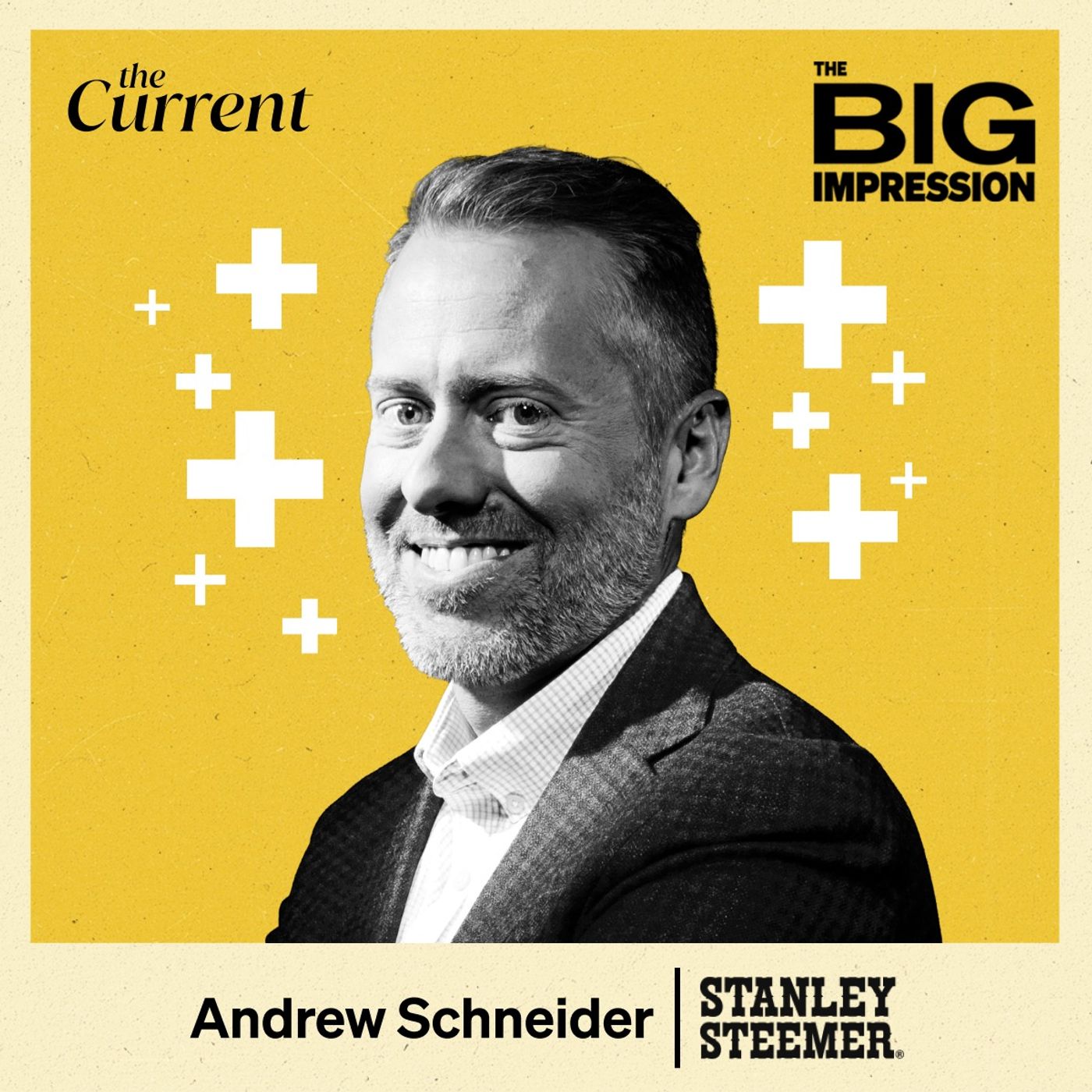
The Big Impression
Stanley Steemer’s Andrew Schneider on owning the spring clean
00:25:46
In this episode of The Big Impression, hosts Damian Fowler and Ilyse Liffreing talk with Stanley Steemer's CMO Andrew Schneider about how a legacy brand earns its place again, starting with a moment everyone knows: spring cleaning.
Loading summary
Transcript67 lines
- [00:00]
A
I'm damian fowler.
- [00:01]
B
And I'm ilyce lafern.
- [00:03]
A
And welcome to the big impression.
- [00:09]
B
This week we're joined by Andrew Schneider, chief marketing officer at Stanley Steamer.
- [00:15]
A
Stanley Steamer is a brand that's been in American homes for decades. It's synonymous with carpet cleaning, but it's now navigating what it means to stay relevant in a very different media landscape.
- [00:25]
B
Andrew is leading that evolution, bringing a more modern, integrated approach to how the brand shows up, especially with younger consumers.
- [00:34]
A
His latest push leans into a moment. Everyone knows spring cleaning. I'm going to get my kids on the job. But he's rethinking how a legacy service brand can make that moment feel, well, fresh again.
- [00:46]
B
We'll get into how this campaign came together, what success looks like and what it says about marketing in so called everyday categories. Let's get into it. So, Andrew, spring cleaning is one of those things everybody talks about, but few brands really make it feel fresh or culturally relevant. When you were thinking about launching this campaign, what was that opportunity like to do something different?
- [01:17]
C
Yeah, that's a great question. As we took a look at spring cleaning, the consumer mindset and intent around that time of year, and then where we should be positioned as a brand in general from a Stanley Steam and the fact that our brand promise for consumers is providing a cleaner and healthier home, there was no better intersection for us to say we should own this time frame of year. And as you think about the idea of spring cleaning, there's a lot of brands that try to chase it. And with this campaign, we're trying to reframe it, to say there are things that normal consumers you might turn a blind eye to or you might not understand or know that your home isn't getting clean enough. And so the things we're doing with this campaign is really trying to shine a light on the things that consumers might not see every day that Stanley Steamer can provide the benefit for.
- [02:05]
A
And speaking of the campaign, obviously you're building on a great legacy. As you think about the campaign, to what extent do you look to the past and what extent do you look to the future? How do you think about that balance?
- [02:17]
C
It's a balance that is a tightrope to walk as a legacy brand. Right. You think about the history and the legacy of what Stanley Steamer has built over almost 80 years. We're at this crux point or, you know, a crucial moment. As I think about the future of Stanley Steamer, it's one where I've used it internally as we've talked about the importance of this campaign is we're in that point right now as a legacy brand. Do we want to be Blockbuster, or do we want to be Netflix? And I think the aspirations that I have for this campaign and what we're going to start to do is we obviously want to be Netflix, right? So it's like, how do we position Stanley Steamer not just for the next six months or next three years, but, like, for the next three decades? And we're really at that point, all legacy brands hit it. And it's a decision that you have to make. Do you want to ride off into the sunset, or do we want to build our next rocket ship?
- [03:05]
B
Awesome. Can you take me inside how this campaign really came together? Was there, like, a specific insight about how people live clean or even reset in the spring these days?
- [03:17]
C
Yeah, absolutely. So with this campaign and with the tension around, the cultural tension is real around this idea that we're living in a world of good enough, right? Consumers are settling for things day in and day out. And so when you think about good enough cleaning and there's robot vacuums and DIY hacks and quick fixes, you're not getting everything in your home clean. Just going through that approach, right? So underneath that, there's this growing tension and anxiety that we're starting to play into from a brand standpoint to say what is actually still there. And then with this new campaign, when clean enough is not enough, we're not ignoring that tension. We're leaning into it and truly trying to position Stanley Steemer as the hero that our benefits and our services can provide a consumer that they might not have seen otherwise.
- [04:07]
A
One of the things that you mentioned about this campaign was that you're trying to reach a younger consumer today. Could you talk a little bit about that, where you're trying to reach that younger consumer?
- [04:19]
C
Yeah. It's interesting. In my previous life at the Wendy's company, we were all about Gen Z, right? And getting younger. When I say getting younger, from a Stanley Steamer standpoint, it's actually more focused on the millennials and the Gen Xers of the world, Right. And with such a legacy brand, this might be a surprise, or not, but a lot of our consumers and our consumer base are on the older end, right? So baby boomers make up more than 60% of our current consumer base. So as we look at getting younger, it's really. I'm trying to target the homeowners out there that are in their prime years of spending and making sure that, like, they're in that 40 to 50 range that have the ability to understand what it means to have a clean home and look at our services as more of a necessity than a luxury.
- [05:04]
A
I want to ask you a little bit more about that. You mentioned homeowners. That would suggest a certain demographic, a certain income level, maybe even a certain geographical sort of location. Do you have a sense of, like, where the audience is as you look across the United States?
- [05:21]
C
Yeah, that's a great question. So as I think about what we need to achieve from a brand standpoint and where Stanley Steemer needs to be, there is a sweet spot. But it's not necessarily demographically. It's more of if you own or even rent a home and you want to take pride in your living space, we're the brand for you. And so when you think about this shift from cleaning as a transaction to cleaning as peace of mind, it's not necessarily about income level or whether you own or rent a home, but it's this idea that we want our brand and where the consumer meet to be focused on the pride that people feel in their home. Right. And that what we can unlock that through what we do in a home with our cleaning and the health benefits, giving consumers confidence in their space and really, like, truly knowing that it's clean for their family, friends, or whomever.
- [06:13]
A
That's super interesting.
- [06:15]
B
On that note. Yeah, it's a very, like, emotional connection, really, that you're trying to make with consumers. How do you strike that note in the creative itself, especially in one of these categories where it can easily get reduced to, like, price and, like, promotion?
- [06:34]
C
That's a great question. So two things. One is I believe in. When you're looking at how you're telling your brand story to consumers, you've got to figure out a way to be authentic, because if not, consumers these days can see right through it. Right. So with this campaign, we're tapping into a real emotional truth and insight of this idea that clean enough is a question for most homeowners. Right. Is my home truly clean? Is my air quality truly where it needs to be for my family to live in? And so, as people are constantly managing their homes, there's that lingering doubt that's underneath. Our message is we're connecting to that tension and really trying to resolve it in a way that's reassuring and empowering based off of the services that we provide. The other thing is we're elevating the brand by making our process the proof. And so in order to get away from, like, this shouting price or a Race to the bottom on discounting, I believe that by showing the depth of what we do, you think about, we remove 95% of allergens, bacteria buildup, dirt, dust. That builds trust with consumers. And so that trust is what we, what creates that emotional connection that will last beyond just like a single transaction.
- [07:48]
A
One of the things I wanted to ask you about, we talk about Sunny Sema being a legacy brand and when it launched there were probably few media channels. Now we've got a sort of plethora of options, not only ctv, Social. How are you thinking about the channels and reaching all of these people? That opens, clearly that opens up a lot of opportunity for you for the campaign.
- [08:10]
C
It does, it does. It's, it's been very interesting as I've taken this role with Stanley Steamer to look at. Traditionally we've been very heavy in linear tv both on a national and local level. And so one of the first things that I did, as we took a look at, okay, how do we need to evolve the brand and really start to position us for a modern day consumer is, is looking at our media mix, right? And so when you think about all those channels, how we show up all the way from again, national television in our social channels, on TikTok, on Meta, in Google search, we've revised it top to bottom to say how does the consumer use those channels? How does the consumer use those channels in relation to brands like ours? And then how do we want consumers to see and understand our brand in those channels? And when you look at it through those three different lenses and you start to calibrate, you can get a really clear picture on how Stanley Steamer should be showing up authentically for consumers to get an understanding of kind of where that's at. And so we're using channels that we've never turned on before in the history of this brand. When you think about Meta, TikTok and even CTV, addressable TV is still a very big part of that mix.
- [09:25]
A
And it's really interesting now that because of the D2C brands that are out there, if somebody has just bought a house, you know they're going to be immediately found as somebody who needs various services, whether it be furniture, a new dining table, new bed, Stanley Steamer, there's just this much more direct route to get to that person now, thanks to, you know, what's out there. The media.
- [09:49]
C
Yes, yeah, absolutely. And it's a space that, as I look at brands like ours, not necessarily competitors, but you think, like you said, buying furniture for a home, the things you would do when you're moving. Stanley Steamer hasn't necessarily been positioned in those conversations or even in the peripheral of the consumer in those moments. So just by showing up and starting to integrate ourselves into that moment unlocks a whole new audience for us that I'm very bullish about tapping into.
- [10:15]
B
And I know you're still fairly new to the role, but how have you been finding these other channels performing for you thus far?
- [10:27]
C
Yeah, so far so good. We just started firing up these channels as we start to launch this campaign this year and it took me about nine to 10 months to make sure that I adjusted the right foundation for what marketing should be here, brought on a new media partner, an infinite roar under the publicis umbrella. And really as we're firing off all these channels, I'm very excited and bullish about the, the results we're seeing so far.
- [10:49]
B
Very cool. Are there any specific KPIs that you're looking for or that you're hoping to meet, especially with this new campaign?
- [10:57]
C
Yeah, it's interesting when you think about it from a marketing standpoint. I am not one of those marketers that will sit here and say I want a certain number of impressions or I want the roas on this or whatnot. For me, and this is what makes great marketers really good, in my opinion, is that is the business moving. So for me, with all of these channels, what I'm measuring our success by, we're going to live and die by the amount of jobs that we bring in from consumers. Right. Are consumers telling us that the messages we're putting out there are relevant and action oriented enough that they're actually using the service? And if not channel by channel, we're going to go in and start to dial that up or down, depending on what we see and what we hear.
- [11:38]
A
Speaking of brand lift, do you think there's an opportunity here for some people perhaps who may not know the brand that well, to acquaint themselves with Stanley Steamer brand and the campaign as a longer arc, as a sort of longer brand build?
- [11:52]
C
Yes, absolutely. So the dual fold goal for this campaign really is to reintroduce Stanley Steamer to even our current consumers and that current age range that we over index on and also to get the younger audiences to start to see and understand what our brand can provide. It's really interesting. Like before I took this role, I was asking around in my social circles and my marketing circles, have people, have you heard of Stanley Steamer? And a lot of the response was oh yeah, you guys have that jingle.
- [12:23]
B
I was Gonna ask about the jingle.
- [12:26]
C
But often followed by, I didn't know you guys were still around, or I thought you guys only cleaned carpet. And we still see that in some of our social commentary. Like we talk about firing up in some of these new channels every once in a while. Probably more like once a week in our meta comments, we get people saying, I didn't even know Stanley Steemer was still around. So when you think about this, the opportunity with that is we've been around for 80 years, and it's fundamentally a problem that people don't understand that we're still here. So we have to re educate and reignite that passion for this brand by showing people what we can do for them and their homes.
- [13:05]
B
You brought up the jingle and I do need to ask, are you guys keeping the jingle? Is that still alive?
- [13:11]
C
Yes, absolutely. So one of the things in my core beliefs as a marketer is you don't mess with success. And I think that oftentimes there's this. There's marketers fall into the trap of, oh, if I just change the branding on something, or if a campaign is just based around changing the branding of a brand, which would include a jingle or something like that, that's gonna fix everything. It'll turn us around. The reality is that you gotta take what has worked for a brand, figure out how to make it authentically true to the message you're trying to talk to consumers about today and just fire away from there. So, no, won't be, won't be changing the jingle. Now we might, I should say, not gonna change the jingle. Maybe we bring it into a more modern era and look at maybe a different type of recording with it down the line. But that are yellow trucks and the 1,800steamer number. Those are sacred, sacred brand assets.
- [14:04]
A
Yeah. Pop opportunity there for someone, right?
- [14:07]
B
Yep.
- [14:07]
C
Yes. I have a short list. I don't know if I can afford them yet, but I've got a short list of who I would love.
- [14:12]
A
Oh, yeah, Come on. Can you share some?
- [14:15]
C
Well, it depends on. It depends on who our target is. Right. I think the 90s in nostalgia right now is a very interesting place to be. And you could take some artists from that genre or that decade and have a lot of fun with it. And when you think about the intersection of the consumers that I'm trying to talk to right now with Gen X and those later millennials, it could be interesting. I'm not going to throw any names out just yet.
- [14:39]
A
You know, your background, you were the director of integrated media At Wendy's, that's obviously a huge national brand. How did your experience there shape what you're doing now at Stanley Steamer?
- [14:53]
C
Yeah, my time at Wendy's was just an absolutely fantastic run. And I had some amazing mentors over my almost seven years there. I think what I learned the most, that is I've taken on from Wendy's to here, is there's this difference between the idea of a brand and branding when you look at marketing. And what I mean by that is the brand is the promise that you make to consumers. Right. So what does your brand stand for? And if you anchor everything you do from a branding standpoint in the brand, then you can't go wrong. Even if an idea might seem like it's very far out there, if it's rooted in what your brand promises for consumers. And in this case for Steemer, our promise is a cleaner and healthier home. Right. I think you can't go wrong as long as you're being authentic to who you are as a brand. And again, positioning yourself with the consumer at the center of everything you do. I think that's the biggest thing that I learned in my time at Wendy's is if you put the consumer in the center of your decision making on everything, they won't steer you wrong.
- [16:02]
A
That's good advice. Yeah, it's like your kind of North Star.
- [16:07]
B
Now I want to zoom out a little bit and look at the big picture, what this really means for marketing going forward. So there's a lot of talk about like owning moments in consumers lives these days. Do you see spring cleaning as one of those ownable cultural moments for the brand and then how do you go about defending that space?
- [16:28]
C
Yeah, I absolutely believe that spring cleaning is an ownable moment that really only at least in our category, Stanley Steamer should have the right to own. Right. When you think about the fact that we built the category as a brand that we're in over the last 80 years. So when I think about this idea of spring cleaning and deep cleaning your home, there really is no other brand that should be able to own that in the minds of consumers the way we do. How do you defend that space? It's interesting because when you talk about defending that space, I think the best way you can defend what you're trying to do as a brand is make sure that you're just listening to what your consumers are telling you and make sure that you're putting your, again, your consumers at the center of every decision you make. Because if you get too distracted by what a competitor might be doing or what deal they might be offering, then you start to fracture how authentic you want to show up for customers and for the people that you're trying to talk to. So I believe like less is more in that idea. We'll defend our space by just being who we are, showing up and doing the best job that we can. Because if you think about the home and that space, we're one of the only brands that it's such a sacred space, I should say, from a home standpoint and to enter into one's home these days, you have to be trusted. And so my thing is, let's just lean into that, do the best job that we can do, and that will continue to build on itself for us for years to come.
- [17:57]
B
Do you think that brands today are under investing in storytelling in favor of perhaps short term performance, especially with media channels as they are and the options out there today?
- [18:14]
C
Yeah, if you would have asked me this before I had a full P and L responsibility, I would have answered it much differently. No, I do think that brands are under investing in storytelling because again, when it comes back to this idea of getting a consumer to trust your brand, like you're not going to do that necessarily through chasing short term performance. You've got to be true to who you are, what the values you stand for as a brand. And if you communicate that in the right way, you should see momentum in the near term. That should also build and compound itself for the future. Right. It's probably not a question of under investing. It's more of a question of what's the right investment level for the brand that you know and what that brand needs.
- [19:01]
B
So really you're saying a Stanley Steamer should have like its own Netflix show?
- [19:06]
C
Hey, maybe We've been around for 80 years. There are stories that are. I hear new stories every day that our texts tell. I'm sure we could do a Netflix series on behind the Steamer or something like that. That'd be pretty fun.
- [19:16]
A
Stanley Steamer meets Grey Gardens. All right, that's for another time. All right, for marketers listening to this who are in the similar categories or everyday categories, should we say services, homes, utilities? How would you advise them? I guess when it comes to finding
- [19:34]
C
a story that resonates, that's a very interesting question. Here's the advice that I would say when I think about everyday categories. And again, I don't want to sound like I'm repeating myself, but it is one of those things where consumers are so in tune and have so many different Options to go watch content, absorb media, make decisions about the brands they interact with and they allow into their ecosystem. I think my advice would be you've got to find a story that is true to what you're trying to position yourself as a brand. And when I say true to the brand, it also means that, like, you know, how is a consumer going to understand and perceive the message you're trying to put in front of them and will they act on it? That's probably different for every, every brand out there right now because consumers have so many different choices and they're inundated with advertising on every platform and almost every moment of their life.
- [20:33]
A
Do you think when you look at consumer expectations around cleanliness and keeping their house clean, do you think perceptions around that and comfort have evolved in the past few years? Or is it thus has it ever been?
- [20:48]
C
I think it's, I think it's constantly changing. So one of the things is we've looked at the strategy behind this campaign, right? We looked at the, what our agency calls the death spiral of the deep clean. So when you think about, I talk about our tech stories, but there's a lot that have been with a company for over 50 years and they use this analogy, like back in the day, we would go into homes and people would clean alongside us. So we were there to clean their carpets or their floors and people would be cleaning the rest of their house alongside Stanley Steamer. That is in no way, shape or form the current reality of how consumers do things. And so I think when you look at the consumer expectations around home and cleanliness, I think they're still there. But how consumers are achieving that cleanliness has changed. And that's where like you think about, we're looking at different ways to build some different loyalty or rewards into what we do. But getting into homes more often and making sure that consumers, we're providing them a convenience and what we do too, is almost equally as important as just getting there and providing them a clean home.
- [21:51]
B
Well, let's go into some rapid fire quick questions for you now. Are there any brands you think are doing a good job in your category or elsewhere?
- [22:02]
C
I'll tell you what, here's one of the brands that I admire right now from a marketing standpoint, and this is more from a consumer standpoint, is Liquid Death. And I know that is nowhere near our category. But when I look at brands that are out there doing different things, challenging the norm on how to be creative, how to talk to your consumer, how to show up and get noticed, I really admire the work they've been doing. And I think whomever is on the helm of that team, I would love to pick their brain on quite a few things.
- [22:30]
A
All right, what's a fact you wish the marketing community would wake up to?
- [22:34]
C
This is going to be very specific, but I think it's been very
- [22:39]
B
top
- [22:39]
C
of mind for me as I've come into here. Performance marketing is not a growth strategy. And I think a lot of people talk about performance marketing being a strategic growth lever, and if you really think about it, it's a tool. But I think as I've looked at what Steemer was doing and where we're going, too many brands tend to over optimize the bottom of the funnel. And then they wonder why growth stalls, right? So if you're not investing in the brand, you're just recycling that same demand over and over. And I see a lot out there from the marketing community, from my peers that like, oh, performance marketing is king. And I'm like, it is very much an important part of the ecosystem of what we need to do, but it is not a growth strategy.
- [23:19]
B
What is one trend you're hearing a lot about that you think is overhyped?
- [23:23]
C
Also a good question. There's a lot out there right now with this idea of shortcuts. How to crack the code of the algorithms, different brands talking about how they hacked algorithms, shortcut their way around how they're buying media. For me, there's no shortcut. The brands that win will still do the fundamentals better. Do you have a clear brand position? Do you have distinctive creative storytelling? And are you consistent with that storytelling and how you show up in all these channels? And I think what I've seen is the algorithm rewards what people actually care about, right? What consumers actually care about, not necessarily the other way around. So I think that's where, like, for me, and maybe I'm a little bit old school when it comes to that thinking, but there's no shortcuts in marketing. There's no silver bullets. And anybody that will tell you otherwise probably needs to go recheck.
- [24:21]
A
Okay, here's a final question. What's one campaign, past or present, that you wish you'd have worked on?
- [24:28]
C
There have been a lot of great campaigns over the years. And this is. This goes back. This goes back a ways. And I might be cheating and answering this question, but I'll give you a reason why beef with Wendy's. And having worked at Wendy's and seen and heard and how the understanding of how that campaign has reverberated through the halls and through that brand over four decades. I would have loved to have been a fly on the wall or a part of that process when Dave was developing that with the ad agency at the time, because I think that brand or that campaign had such an impact on the trajectory of where Wendy's is at today. That's always been fascinating to me.
- [25:17]
A
And that's it for this edition of the Big Impression.
- [25:19]
B
This show is produced by Molten Heart. Our theme is by Love and Caliber, and our associate producer is Sydney Cairns.
- [25:26]
C
And remember, I think the best way you can defend what you're trying to do as a brand is make sure that you're just listening to what your consumers are telling you and make sure that you're putting your, again, your consumers at the center of every decision you make.
- [25:39]
A
I'm Damian.
- [25:40]
B
And I'm Aylase, and we'll see you next time.