← The Daily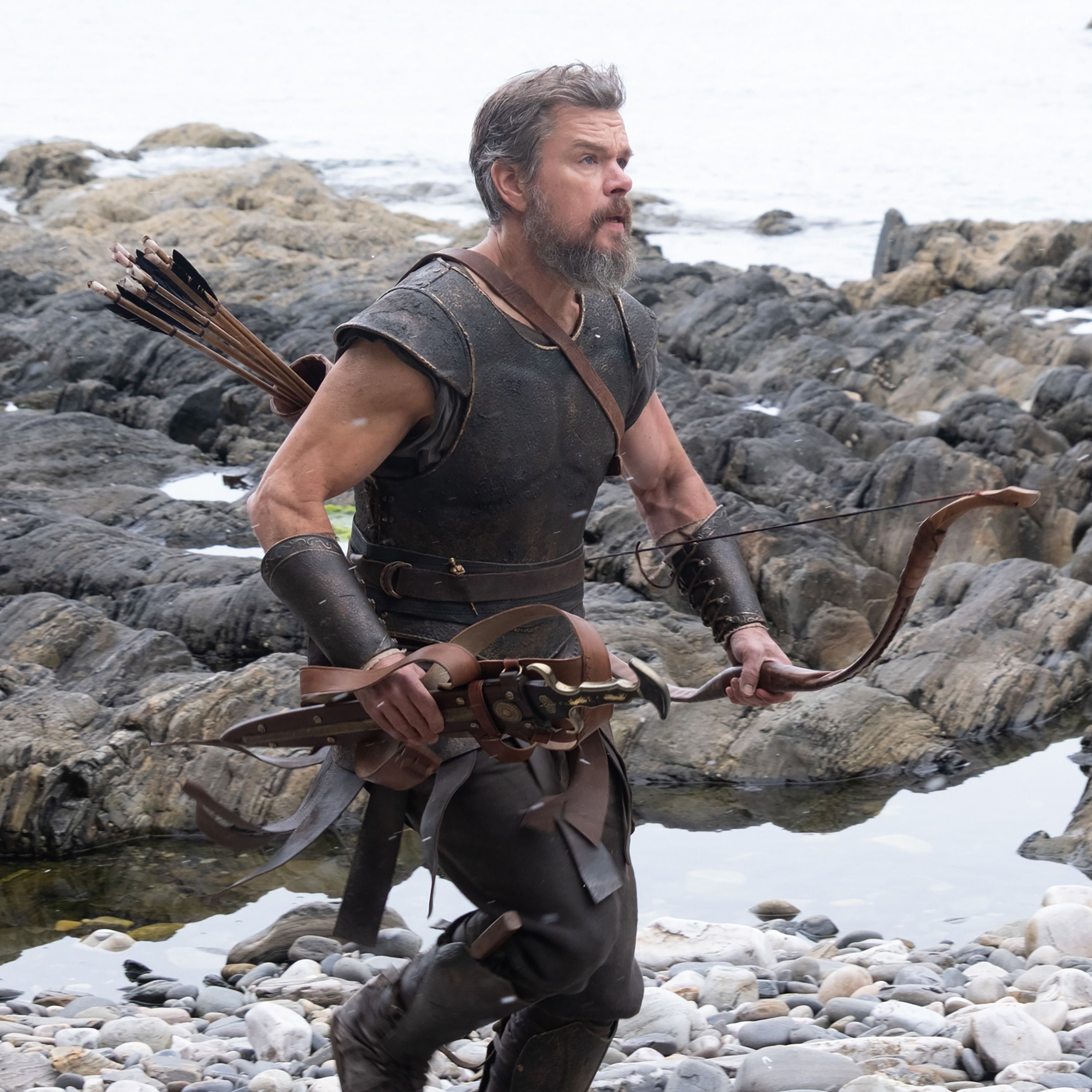
The Daily
What’s Epic About the ‘Odyssey’? Everything.
00:50:40
This Friday, “The Odyssey,” directed by Christopher Nolan, hits theaters. Even before the movie’s release, though, it’s proving to be a cultural event. Spirited discussions of Nolan’s cinematic interpretation of the epic poem already abound online, and they are likely to intensify after the public sees the film. Why does a 12,000-line poem that is nearly 3,000 years old still feel resonant today? In this episode of “The Sunday Daily,” Natalie Kitroeff talks about the “Odyssey” with two writers who have produced some critically acclaimed and widely read modern interpretations of Greek classics: Emily Wilson, the first woman to translate the “Odyssey” from ancient Greek, and Madeline Miller, the author of the best-selling novels “Circe” and “Song of Achilles.”
Loading summary
Transcript170 lines
- [00:00]
A
Say hello to a new kind of AI Assistant. With Alexa, staying informed is just the start. It tracks shopping deals before they end, manages your schedule, books reservations, and remembers what matters to you. So you're always a step ahead. Free with prime. Learn more@Amazon.com Alexaplus so what I'm hearing
- [00:20]
B
is we're going to get an ancient Greek translation of from the New York Times. This is the Daily on Sunday, and we're going to read it.
- [00:29]
C
Natalie, do you want to say cherete with us?
- [00:31]
B
Okay.
- [00:32]
D
All right.
- [00:33]
C
One, two, three. Cherete. Should we do it again?
- [00:38]
B
Yeah.
- [00:38]
D
Okay. You did more of like a cherete. So should I get. Okay, I'm going to do that.
- [00:42]
C
Okay. I will say hello and then you say you're like Madeleine.
- [00:45]
D
All right, I willete.
- [00:48]
B
Greetings.
- [00:49]
D
Hauto sestin homuthos ephemerios tes polias gunaikos.
- [00:53]
B
This is the daily speech of the Gray Lady. I'm Natalie Kitroweff.
- [00:58]
C
Hegelia apotes poleos ton pentademun te hemere tu haeli oyo the news from the
- [01:06]
B
city of five boroughs on the day of Helios, the sun God.
- [01:10]
D
I was trying to sound like a news like, you know, I like that. To match Natalie's. Yes.
- [01:21]
B
Christopher Nolan's new movie, the Odyssey, is coming out in theaters this Friday. We're. And it's going to be a big cinematic event. In fact, it already is a big event. Nolan's version of Homer's 3,000-year-old epic tale is generating a ton of excitement, much spirited discussion, and somehow, before it's even been released, backlash. So today, to prepare us all for this upcoming spectacle, I talk with two people who've produced critically acclaimed and widely read interpretations of the Odyssey. Emily Wilson, who translated the Odyssey and is the very first woman to do so, and Madeline Miller, author of Circe and song of Achilles, two best selling novels inspired by Homer's poems. It's Sunday, July 12th. Emily, Madeline. Hello.
- [02:17]
D
Hello.
- [02:17]
C
Hello.
- [02:17]
B
I am so happy to have you both here.
- [02:20]
C
Happy to be here.
- [02:21]
D
Yes, definitely.
- [02:22]
B
This is gonna be like the most exciting thing I do for a very long time. It is really making me love my job that we get to do this together. So we have you both gathered here in order to talk about something that really fascinates me, has fascinated me for a long time, which is the Odyssey. And we wanna prepare people for this movie in a way that I think only the two of you can. But first, for people who may not remember the plot of the Odyssey, I Am gonna attempt a quick recap. The the very, very short version is that it's the story of a man, Odysseus, who is trying to get home. He fought in the trojan war for 10 years and then he spends 10 years working his way across the beautiful but also very scary Mediterranean Sea in order to get to the island of Ithaca, which he is the king of, and where his wife Penelope and son Telemachus are waiting for him. It is all very dramatic because there are a bunch of suitors trying to get Penelope to betray Odysseus and marry one of and it is famously extremely difficult for him to actually get there. To get to Ithaca. There is sex and murder along the way. There are fantastical creatures, vengeful gods, helpful gods, awesome gods. The whole point of it is that he is really smart and really resourceful and he gets home eventually, not because he's the strongest dude in the world and really good at war, but because he essentially outsmarts his enemies. Emily, I hope I did an okay job with that. That was great doing it in front of you. What was it about that story that first got you that hooked you?
- [04:05]
C
So going back to childhood, I mean, my first exposure to a version of that story was when, as for many people, was when I was a little kid and I got to be in a school play. I got to play Athena. I thought this is such an exciting story about goddesses. And there were these kick ass goddesses. Who doesn't love stories with giants with the possibility of being eaten alive? That's exciting. And these questions about whether forces that are more powerful than you might be plotting and you're in the midst of these mysterious plots and you don't know where you are in the world. That to me very much resonates with the experience of childhood. And then once I was older, I got to learn Greek and Homer in Greek sounds fantastic. And that also hooked me in a whole new way to how it sounds on the level of the line, the passage, the voice, the speech rhythms of the language. And also I was hooked on just how fascinatingly complex the storytelling techniques of this ostensibly very simple story are and how psychologically deep and subtle it is. It's not just a kids adventure story. It also has so much to say about these really deep questions about grief and rage and loss and whether full recovery or going back in time is ever possible.
- [05:19]
B
What about you, Madeline? What is your Odyssey origin story? How did you get sucked into this weird, amazing world?
- [05:28]
D
Well, my mother, who was an English major and a librarian and Also loved mythology. Started reading me little pieces of the Iliad and the Odyssey as bedtime stories when I was pretty young and I fell in love with it. I wanted more and more. In particular, the thing that really grabbed me was actually Penelope's trick. That was one of the pieces of the story that, as a kid, I remember loving. Because her trick is that the suitor are trying to kind of force her to choose one of them to marry. She's waiting for Odysseus to come home. And so she tells them, okay, I'll choose after I finish weaving this shroud. And then, you know, she weaves it, and then at night, she goes and unravels it, and then she weaves it and unravels it. And it's such a great trick on so many levels. It's so smart. But also, she knows that they have no idea how long it takes to weave a shroud. And so it's like a great trick that, like, really reveals sort of the gender roles of the time as well.
- [06:19]
B
Right. These men have absolutely no idea what shroud making entails.
- [06:25]
D
So I love that. Not only is this about a very clever and ingenious man, it's also about a very clever and ingenious woman who's his match in every way.
- [06:33]
B
Okay, Emily, I want to ask about the project of translating the Odyssey, because obviously we credit Homer with this story, but we know that this is something that was told over many generations. It was an oral tradition refined and shaped by different tellers, these bards. Homer kind of did the original interpretation in a way. And since then, in the modern era, there have been many translations into English. So why did you decide to translate it again? And what was the opportunity that you saw here to do something that hadn't been done before?
- [07:11]
C
I felt so grateful to get to spend, you know, these many, many years working on the Odyssey. It was just so fun. The opportunity I saw was partly about trying to activate elements of the original in contemporary English that I felt were not fully activated in the many translations that I tried using with my students. And one of the big elements that I felt wasn't fully activated was the meter. The fact that the original isn't just a story, it's a poem. It has rhythm. It's designed for oral performance. And so it seemed to me that I needed to use traditional poetic form, the meter of Shakespeare and Milton, in order to activate for an English listener or English reader some elements of what did Homer sound like to a fluent listener of the original?
- [07:58]
B
Just to be clear, when you're talking about the meter. What you did with this is write it in iambic pentameter. And it sounds like you're saying that that rhythm, that pace, was crucial to the original text and you didn't read it represented in these other translations. And I just. It's so bananas that you did that. It sounds so hard. You also kept it the same number of lines as the original Homer. It just sounds very, very difficult, like extremely hard. Did it take you as long as Odysseus to like get back?
- [08:31]
C
I could easily have used 20 years. If the publishers had let me have 20 years, I would have used every second of it. Yes, absolutely. So the original is composed in the meter that was common, traditional for epic verse in archaic Greece, which is dactylic hexameter.
- [08:47]
B
Doesn't exactly roll the tongue, by the way.
- [08:56]
C
It has that rhythm all the way through. So it has this traditional meter. I'm not the first translator to use iambic pentameter in English, but I'm very rare in doing that in the modern era. It's something that earlier translators, early modern translators assumed that of course meter needs to be translated into meter. Whereas in the modern era there's been this assumption that modern readers can't tolerate rhythm, which I think is false. I think modern readers can totally tolerate rhythm and in fact love it.
- [09:24]
B
Can you just read a little from your translation to give us a sense of that?
- [09:28]
C
Sure. So I can read from the episode in which Odysseus and his men have to pass through the strait between two terrible goddesses, one of whom is a whirlpool who threatens to swallow their whole ship. And the other is a six dog headed deity who will eat up six of the men from every ship that passes by, depending on which which side the ship veers towards. So we rode through the narrow strait in tears. On one side, Scylla, on the other, shining Charybdis, with a dreadful gurgling noise, sucked down the water. When she spewed it out, she seethed, all churning like a boiling cauldron on a huge fire. The froth flew high to spatter the topmost rocks on either side. But when she swallowed back the, she seemed all stirred from inside. And the rock around was roaring dreadfully. And the dark blue sand below was visible. The men were seized by fear.
- [10:29]
B
That is amazing. I truly felt it in my heart. Madeline, I assume you did too. Listening to that, I'm wondering what you thought when you first read this translation by Emily. Did it feel different to you?
- [10:44]
D
Absolutely. I Mean, I loved it. The moment that I really knew what an extraordinary piece of text this was is Charybdis and Scylla. And I remember being like, is he gonna make it? And, you know, here's like, I've spent years, decades of my life studying this poem. I know he makes it, but, you know, I was so in the scene because of what Emily Wilson had done with the text and with the excitement of the story that I, you know, I felt like I saw it again with new eyes. So that is such a gift, and I love that.
- [11:14]
B
I feel the same way. Madeline, let's talk about your work. You are a classics teacher turned novelist. You've written a number of brilliant books and short stories, including Circe, my personal favorite, which is about one of the goddesses that Odysseus encounters on his way home. She is the goddess of sorcery. And again, quick recap here. Forgive me. Basically, she turns all of his men into pigs. He spends a year with her as her lover, and eventually everything gets resolved and Odysseus moves on. Overall, Cersei is a relatively minor character in the Odyssey, but clearly she's someone that you felt strongly enough about to base an entire book on. Why is that? Like, what was it about her that you were so drawn to?
- [12:00]
D
Yes, so one of the things that is so interesting is sort of the later versions of Cersei have really tended in a very negative direction. They've seen her as sort of the man hater and the femme fatale and, you know, the spider at the center of her web. But in the Odyssey, if you actually go back to the Odyssey, yes, she does turn Odysseus men into pigs, but she also, after she and Odysseus come to an understanding, invites them to stay on her island as long as they need to stay. She, you know, helps them recover from the trauma that they've been going through. She offers them a place of peace and a haven. And then when they do decide to go, she doesn't hold them at all. She says, fine. And she gives them incredibly valuable advice for the journey ahead. So in the epic story, she represents an obstacle that he has to kind of tame or overcome. And then she offers him her help. It kind of unlocks her help for him, which then she offers freely. But we get nothing about, like, why is she turning men into pigs? Odysseus, the most curious man in ancient literature, doesn't ask her. And so part of what really drew me to that is that all we get is Odysseus's version. It's literally him telling the story to some other people to make himself look good.
- [13:12]
B
Classic.
- [13:12]
D
And so I really wanted to know, who is Circe? Why is she doing these things? How did she come to have this witchy power? You know, I wanted to understand from her perspective, not from his perspective, why all that was happening.
- [13:25]
B
Okay, this is making me think of a question that is actually for both of you. But Emily, I want to ask you first, when you set about doing this translation of the Odyssey, what were the things that were in the DNA of the story that you felt you absolutely had to maintain? These are kind of immovable parts. And what were the things that you, you found to be movable or interpretable? How did you go about thinking about that? Those questions?
- [13:56]
C
Yeah, that's a really difficult question, I think for any translation project is just because it's never gonna be possible to replicate in totally different words for a totally different culture, every single element, every single syllable, every single sound of the original text. Yeah, I mean, I felt that, as I already said, the meter of the poem seemed essential to me. And also the multivocality seemed essential to me. Then there were other things where I thought I can convey some quality of this without being 100% one for one about it. And that included things like the fact that the original poem, because it's based on a centuries long or pre existing oral tradition, has a huge amount of repetition. And so I thought I need to include some repetition. Everyone needs to have the iconic wine, dark sea. Wine, dark sea. Wine, dark sea. Some more wine, dark sea. We need to have bright eyed Athena keep on being bright eyed. We need to have Nestor being a horse lord over and over. But it may be possible that you can get the idea that this is a repetitive formulaic text without it being absolutely 100% of the time when there's a repetition in the original, does there need to be a repetition every single time in the translation? Maybe I can convey that quality actually more vividly by repeating some amount of times, but maybe not 100% of the amount of times.
- [15:16]
B
How did you choose what to vary? Obviously, part of the reason why there was so much repetition, one of you told me this at some point in all of the things you've written or said, part of the reason was that bards, it helped them remember the story. Right? It was like a device where they could just kind of remember that Athena has bright eyes. Athena has bright eyes. How did you make the decision about what to sub in if there was a new way of Describing her or one of these other characters.
- [15:44]
C
I mean, so I thought in some ways, if I'm going to vary sometimes, then that's an opportunity to lean into the fact that some of these epithets, which is the standard formulaic describing words for these characters or the nouns in the poem, some of these have multiple different meanings. So if possible, I want to be able to convey, for instance, that when Odysseus is described as he repeatedly is as polu class, which means much enduring or resilient, or he's gone through a lot, or this guy is capable of going through a lot, he's got grit, he's stubborn. If I can change how I translate that to fit a different context, then I'm going to give the reader or the listener more of the all around characterization of the character because the original word connotes all of those things. And so I can lean into maybe in this scene where Odysseus is weeping as he remembers the Trojan War, maybe then he's pollute las, as in he's a veteran of wars. But maybe that maybe he's stubborn if he's pollute las when he's plotting the murder of his wife's suitors. So there might be ways they can shape the epithets to fit the context of a particular scene.
- [16:56]
B
Madeleine, how did you think about this question, about what you wanted to be loyal to and what you would diverge from? In other words, what was the guiding principle there as you thought about how off script you might go?
- [17:14]
D
The guiding principle for me was Circe's agency and the fact that this was her story. And the idea that the story of a woman's life and growth into sort of her vocation and her role as an artist, which is how witchcraft functions for me, is enough that is story. When you are adapting, there really are no rules. You can write very close to the text and not be successful and very far from the text and be completely successful. I feel like what makes for a successful retreat telling is how true and sort of fully fleshed the vision that the writer has is. I love writing close to the text personally, but I also like overturning it and arguing with it. And so I love sort of pushing back on. Okay, that was Odysseus's version of the story that he's been able to dine out on for, you know, 3,000 years. Let's have someone else's perspective on these scenes. So there were moments where I really enjoyed contradicting, but there were also so many moments where I loved going right into the text and picking something up and, you know, transforming it or allowing it to really inform. Circe, one of the most important descriptions of her that really informed the whole novel was the description of her as speaking like a human. And I was like, what does it mean to be a God who speaks like a human? And so, you know, then as a novelist, my imagination and my invention could work upon that incredibly rich term that Homer gave.
- [18:41]
B
What did it mean for you to speak like a human?
- [18:43]
D
Well, for me, I started thinking about first what it meant to speak like a God, which is that in the ancient stories, when gods speak to humans, oftentimes humans will fall to their knees and their blood runs cold and their hair stands on end. There's like, this very physical response to being in the presence of a God who is, you know, commanding your attention and showing you their power. And so if you are speaking like a mortal, it means you sound weak compared to them. And so that immediately, in my imagination, put Circe kind of at the bottom of the hierarchy. And it made her, in a sense, an outcast to, you know, these incredibly powerful gods that she's surrounded by.
- [19:22]
B
That's so fascinating. And it makes me think of the reaction that all this interpretation of the text gets. And I guess I wonder. Emily, your translation got this huge response, including some criticism from some Odyssey obsessives on your website. You have these three buttons. One is for media requests, another is for general inquiries, and a third is for misogynistic trolling. So it does seem as though you're getting quite a fair bit of that.
- [19:56]
C
Yes, I gotta get rid of that.
- [19:58]
B
I wonder how you engage with people who, in good faith, say and feel that you strayed too far from the words and the meaning of the text in Homer.
- [20:12]
C
Honestly, I would dispute the idea that the misogynistic trolls or the trolls of various kinds are actually obsessed with the Odyssey. I mean, I would love to have an actual conversation with any one of them about. What do you make of line 52 in book 13? I mean, I'm really interested in the interpretation of that Greek phrase.
- [20:29]
B
We would all love to watch that, by the way.
- [20:31]
C
It's never what happens, right? It's all just online performativity about modern notions about masculinity and greatness and actually whiteness and Westernness as well. None of that is about the Odyssey. The Odyssey is this really complex portrayal of a heros, which in the archaic context means this outsized character who performs outsized deeds. And he wins chaos, he wins eternal glory through this Ability to do extraordinary things which no other mortal could do. He has a homecoming journey which is impossibly long and he spends eight years with two different goddesses. Most mortals don't get to do that. Most mortals don't fight in a war that lasts 10 years and devise a wooden horse and manage to outwit everybody and slaughter huge numbers of people despite being completely outmatched in his own house. So he's both a warrior hero and a trickster hero and a strategy hero. Within the archaic context, is there the kind of judgment about, oh, we don't like dishonesty that there is in later cultures? I don't think there is. I think there's much more open mindedness about. Yes. One of his skills is he can tell any story and he can talk out of many different sides of his mouth. He's really good at that. That's an important skill.
- [21:49]
B
Okay, if we set aside the not obsessives, what about the people? Like, what do you say to the people who do read the text, who do care about it and take issue with some, some of the words you chose or the way you went about the text? Like, where do you think it comes from, that feeling of preciousness, of protectiveness over what people view to be the quote unquote correct version of a translation of this thing?
- [22:20]
C
I think it's quite odd. I mean, even with the less trolley kind of people, I think it's quite odd to think that one book or one translation erases the others. I mean, if people prefer some other translation or want to read the Greek, I would love for them to do that. I think it's great. I have no desire to legislate about which versions of the Odyssey or of any ancient text people want to engage with. So I think there's something quite strange about the idea that the canon doesn't have room for many, many different interpretations, translations, engagements, reinventions.
- [22:54]
D
In a way, it's like wanting there to be only one production of King Lear ever. And that's it.
- [23:00]
C
It's a substantial.
- [23:01]
D
No other productions, no other ideas. You know, you want as many productions and fabulous productions out there as possible.
- [23:08]
B
Yes.
- [23:09]
D
So it just, I always find it very confusing when people get so agitated and I think what, maybe what they're really saying is I had a important experience emotionally with one version of this text and that's great.
- [23:20]
C
Which is great. Yes. Don't need to get angry about it. Glad. I'm happy for you that you had that.
- [23:28]
B
So from the outside, I think something that joins Your work for me is that both of you share this idea that this ancient text needed to matter to people. Not necessarily in like a highfalutin academic way. It needed to matter to people viscerally. And you both dedicated years of your life making that happen, making this story more popularly understood. And so my question is, why, like, what have you each come to understand about the transcendence of the Odyssey, about its universality?
- [24:09]
C
I mean, I hesitate about universality because, of course, the Odyssey has meant different things in different moments of history, right to different people. But I think the other section of your question, I absolutely. I think the original poem for me, but I'm also so much not alone in this, is deeply moving. There's so many big emotions in Homer. There are so many characters feeling enormous amounts of both rage and grief and joy and excitement. And those qualities seem to me not always legible in all translations that I've looked at or read. So I want to convey that in English however I can.
- [24:45]
B
And Madeline.
- [24:47]
D
Yes. And I think it's incredibly exciting to read. And I always find it a magical moment when I read an ancient text and I see a piece of of myself that just, you know, speaks right through the millennia, right to me and my situation, even if I'm, you know, not understanding it 100% the way an ancient audience would have understood it. Still feeling that resonance of things that humans have struggled with from time immemorial, you know, and knowing that. That the grief I might carry is resonating down through the centuries with all the other people who have resonated with that, that that's. And then at the same time, to get lost in the things that are very different. It's such an endlessly interesting, and I would say, generous world that Homer has created, that any one of these characters, not just Odysseus who stands at the center, but any one of these characters could be their own novel, they could be their own epic. You know, all of these characters are interesting and valuable, and the world feels so big and inviting and open, and it's just such a pleasure to spend time at this. And so I love to sort of help facilitate other people to have that experience, because I love it so much.
- [26:01]
B
Okay, we're going to take a quick break, and when we come back, we are going to spend time talking about all of those characters that made us all fall in love with this book. We'll be right back.
- [26:27]
A
Say hello to a new kind of AI Assistant. With Alexa, staying informed is just the start. It tracks prices and alerts you when they drop, helps you plan around your actual schedule and budget, and remembers what you've told it. So every conversation picks up where the last one left off, no matter where you're chatting. For people who like to stay ahead, it's the assistant that keeps up free with prime. Learn more@Amazon.com Alexaplus
- [26:54]
E
hi there. I'm Chris Wood, audio engineer on the Daily that means that I put the finishing touches on the show, make everything sound a little bit better, and hit Publish on my computer. That sends the day's episode out into the world so it's ready before most of our listeners wake up. So the Daily team makes a show every weekday that can mean late nights, and that's when they pass it off to me. Part of the reason that I'm able to do the work with a clear head is that it's not the middle of the night for me. You might have already guessed from my accent I live in London and we're five hours ahead of New York. The Daily is only possible because it involves people all over the world, and that includes the whole fleet of New York Times journalists who give us their expert analysis and in depth reporting five days a week. So if you're a loyal listener and want to support what we do do, as well as explore everything that the New York Times has to offer, you can subscribe@nytimes.com subscribe Cheers.
- [27:52]
B
To the point about the eternal resonance of these characters and how they reach through the millennia, we want to do a who's who of the Odyssey and we're going to focus on the main characters, the ones that appear in the movie. Let's start with our hero, Odysseus. Emily, your translation of the Odyssey famously starts with a line that Christopher Nolan himself has cited as part of his inspiration for making this movie. Christopher Nolan is famously drawn to obsessive, flawed protagonists. So I think it's apartment and that starting line is Tell me about a complicated man. So so why is Odysseus complicated?
- [28:36]
C
He's complicated because he's multiple in ways that no other Homeric hero is. Odysseus is always going to take the roundabout way. He's going to be constantly disguising himself as someone else. One of his great skills is code switching. He can survive those multiple years of being lost, being in multiple different environments, facing threats that no other Homeric hero manages to survive, surviving goddesses and man eating giants, surviving all of the threats that face him once he's back on his home island of Ithaca of the Men who are besieging his house or who are already inside his house. He has this capacity for self reinvention and for having multiple identities, which is very different from anyone else in the universe, in the Homeric universe.
- [29:24]
B
Madeleine, what about the. The complexity of his duality? You know, he's the smartest guy in the room, but he's also the most ruthless. He's murderous, and he's also devoted to his family. He spends this whole book trying to get home to them. How do you think about those things?
- [29:42]
D
Well, the piece that really resonated with me is the psychological aspect of, you know, kind of looking at what it means to have survived, what he survived and how that would shape him. You know, the ancients didn't have a word for ptsd, but I feel that he clearly shows it. And there are other ancient texts where we can see it as well. People who have suffered through war and are still suffering. And when he does finally come home completely alone and what it means to then face the families of all the people that he's lost, and all of that is sort of in there in his portrait. And yet here he is, this very proud person who is carrying the title now of Best of the Greeks and wanting that pride, wanting that reputation, seeking it out very clearly throughout, but also wanting to be with his wife and with his child and sort of fit into this family role again. The contradictions and the friction around his character are so fascinating.
- [30:41]
B
You know, your depiction of Odysseus in this story and Circe really leans into the idea that he's a shifty, shady guy. He comes across in that novel as almost a villain. And so I'm wondering how you thought about Odysseus as you were adapting him for the story you were writing.
- [30:59]
D
I think he's very complicated, and I think that, you know, the Odyssey is just one view of him, and it's sort of his epic, so he gets to take center stage and we get to appreciate so many parts of him. But if you look at him in other ancient texts, like, for example, Sophocles, Philoctetes, he is much more villainous in that text. Even in the Iliad, I would say he's much more of a schemer and not as honorable. And there's this great. Like, he and Achilles make wonderful fo for each other. Achilles in the Iliad and Odysseus in the Odyssey. There's a great line in the Iliad when Achilles says, I hate, like the gates of death. The man who says one thing and hides Another in his heart, which.
- [31:41]
B
And you're like, we know what you're talking about.
- [31:43]
D
Right.
- [31:44]
C
But you're talking too, as well.
- [31:45]
D
Right.
- [31:45]
C
Because he's saying it right to his face.
- [31:47]
D
Exactly.
- [31:48]
C
You're kind of guy.
- [31:51]
D
And so I love that tension where, you know, it can be really. You can be. Get out of some really tough situations if you're, you know, a liar and a good speaker and, you know, can spin the situation to your advantage. But does that make you a good person? You know, question mark.
- [32:10]
C
But none of the heroes are good people. That's not the point of being a hero, Right?
- [32:14]
D
Absolutely. Absolutely. Yes. The ancient idea of hero and modern idea are very different.
- [32:18]
C
Very different, yes.
- [32:19]
D
But he's so much fun to write as a character. And I got to write him both ways. I got to write him from the perspective of Patroclus in Song of Achilles and then from the perspective of Circe in Circe. And so it was also fun to play with the chameleonic aspect of him where he changes himself depending on who he's talking to. Right. He shapes the way, the kind of affect he's gonna give off, depending on who he's speaking to, he's able to modulate how he comes off. And so it was a delight to write his scenes. He's the most juicy character for a writer.
- [32:52]
C
Super fun. Yes.
- [32:54]
B
Okay, so now I wanna move on to his wife Penelope, who's gonna be played by Anne Hathaway in the movie. Madeleine, you've said that Penelope is every bit Odysseus's equal. What do you mean by that? And is that a feminist spin on Homer or is that plainly in the text?
- [33:18]
D
I mean, I would even say maybe she. She's the one who puts sets the final test. I don't. Is it okay to do spoilers? I don't know.
- [33:24]
B
Yes, you can do spoilers. We're allowing spoilers for testing texts that are 3,000 years old.
- [33:30]
D
Okay, great. Awesome. So at the very end, she is sort of making extra sure that this is really Odysseus and she's not getting conned. There's this wonderful moment where he has built their bed out of a living tree so it can't be moved. And that's kind of a secret that they hold. And so she's like, okay, great, you can come into my bed. We'll just get the bed made up and we'll put it out here. And he's like, what do you mean we can't move the bed? You know, we can't Move the bed. Like, oh, it is you. You know, and it's this incredible moment where even then, even though there's been all this proof and all these moments that she still is, you know, she's like him, she's testing, she's cagey, she's gonna wait and see and watch and observe and feel it out. And so I think that's absolutely. In the text. And there's a great moment also where he watches her when he's in disguise talking to the suitors and she is sort of asking them for more presence if they're gonna woo her. And you kind of would imagine, you might imagine that Odysseus watching this in disguise is like, jealous, right? Here she is, you know, kind of. But instead he's like, this is great. She's conning them. She's going to get stuff from them. I love her. And it's a fabulous moment where he looks at her, he knows exactly what she's doing. So I think it's in the text that she is absolutely meant to be brilliant. But like him, I think she's a complicated figure. We also, as I think, Emily, you've pointed out, the text also recedes from us ever really knowing Penelope, that it's hard to get inside her head and really hear her perspective. I don't know, there's like a little bit of mist, like, quality to her. I feel like she remains a mystery a little bit.
- [35:17]
B
Talk about that, Emily.
- [35:19]
C
Yeah. So, I mean, I think Madeleine's absolutely right, though. I think we do get some insight into what does it feel like to be Penelope. For instance, in the amazing sequence where she tells her dreams to the disguised stranger, she's a wonderful. In which she describes her dream in which there are geese in her yard and then an eagle swoops down and kills all the geese. And in the dream she weeps and the eagle turns out to be able to speak in human language and can say, actually, it's me, I'm Odysseus came back, killed all the suitors. Yay. It's great. You're welcome, you're welcome. No problem. Did it all for you, baby. But then what's not explained is why is she crying inside the dream? And when Odysseus Said says, it's easy to understand this dream. Odysseus is going to come back soon. She says in that famous second speech, there are two gates of dreams, not all of them come true. So there's a kind of ambivalence about Penelope's attitude in that sequence. And I think her attitude is defined by this sense of she's stuck between two different narratives. She doesn't know what's going to happen, and she doesn't have the kind of control over what's going to happen that she might if. If she were a goddess or even a mortal man.
- [36:28]
D
And that was part of what it was really fun to get to do. And this is, you know, what a novel can do, because Penelope shows up in my novel. And to get to have her have a story where it's not about what man she is under the protection of, you know, I wanted her to find something that was just about herself and not related to some man that, you know, she's triangulating with.
- [36:47]
B
Mm. Okay, let's do a quicker 101 on their son Telemachus. I have to confess, he is not my favorite character in. In this book. He's played by Tom Holland in the movie. Why should we care about him?
- [37:01]
D
I also, Natalie, struggled to connect with Telemachus in the poem.
- [37:06]
B
The first time I was worried I was alone.
- [37:08]
C
And you're definitely alone. I see that in students all the time. Yes.
- [37:12]
B
Yeah.
- [37:12]
D
And I think, you know, now I have. But I think that what helped me connect with him was sort of two things, one of which is me bringing my novelist brain. But one of which is that he's incredibly, incredibly young and that we are seeing him at a moment of extreme anxiety where the expectations on him are very, very intense. And, you know, the danger he's in is very real, and he doesn't know what his role is. He know he's. He knows he's supposed to do something, but he doesn't seem to have a ton of support. So seeing him kind of struggle with this moment of youth and that the Telemachus we see in that moment in the Odyssey may not be the Telemachus he is his whole life. It's who he is at this moment of anxiety and immaturity, honestly. And then the piece that sort of maybe I added was the fact that he was raised by his mother and Eumaeus, the enslaved swineherd, who's kind of a stand in parental figure or fatherly figure and very different perspectives than Odysseus. And so I really connected with him as. As wanting this deep connection with his father. But the parent who shaped him, if we're thinking from a psychological perspective, is Penelope.
- [38:23]
B
Okay, that helps me with the fact that the thing that bothers me about him is how mean he is to her and kind of asserting himself over her, you know, because that's part of
- [38:32]
C
what it is to grow up as a man in this world. I mean, the first four books are really devoted to how difficult his experience is in being this very, very isolated young person who doesn't have any brothers, doesn't have any friends. Instead, he's surrounded by.
- [38:46]
B
He's an only child.
- [38:47]
E
Right.
- [38:47]
C
He's an only child. And as somebody with both no brothers and no father, all he has is the suitors of his mom who are bullying him all the time. He has no sense of, how can I grow up to be a man? How can I attain glory for myself? The poem is both about the journey of his father back home to reclaim his glory, but also of the son's journey to manhood, which is arguably an not fully complete journey because Odysseus comes back and then Odysseus is the man.
- [39:14]
B
Right, Right. Okay, let's do a lightning round on Athena and other gods that we need to know about. What do we need to know about Athena, played by Zendaya in the movie, and Calypso, played by Charlize Theron? These are two big ones. And any other God you feel like we absolutely need to know, baseball card style, who are these heavies?
- [39:37]
C
Athena is a warrior goddess who's also associated with strategy and craft, and she's the daughter of Zeus, born straight from his head. So she favors the patriarchy and does not favor women characters.
- [39:49]
D
Right. And of course, Die Hard, you know, pro Greek, anti Trojan. She's been on the Greek side the whole way. And so this is, you know, her favorite. Coming home is really important for her agenda.
- [40:01]
C
Another God that we should cite is Pizarro Poseidon, who's in the Odyssey. It's Athena versus Poseidon. It's the goddess who builds ships versus the God who makes the storms at sea. Poseidon is furious because Odysseus blinds his son Polyphemus the Cyclops, and curses the journey home.
- [40:20]
B
And that curse is a big part of why everything is so terrible for him all the time.
- [40:24]
C
Exactly.
- [40:29]
B
All right, with that, that, let's take a quick break, and when we come back, we're going to talk about how you both feel about this movie. We'll be right back.
- [40:48]
A
Say hello to a new kind of AI Assistant. With Alexa, staying informed is just the start. It tracks shopping deals before they end, manages your schedule, books, reservations, and remembers what matters to you. So you're always a step ahead. Free with prime. Learn more@Amazon.com Alexaplus this is Maurice Sharma,
- [41:06]
D
the host of a new podcast from serial productions, the Marshall Project and the New York Times. Last year, I spent three months embedded with a capital defense team. Their client had been on death row for more than 30 years and now his execution date had been set. I followed along as the lawyers tried to prove something nobody had successfully done in three decades, that one of Texas most notorious serial killers was actually innocent. The last 12 weeks. Listen wherever you get your podcasts.
- [41:37]
B
So this movie comes out Friday, meaning you both will very soon be able to see this text that you have treasured for so long, get probably its biggest treatment by Hollywood ever. Lots and lots of people are gonna experience this story. How do you feel about that? Is this like your Super Bowl? Are you pumped? Like, where are you right now?
- [42:05]
C
I'm pumped. I think it's gonna be exciting. I mean, it's gonna be exciting that so many people who may have thought, oh, ancient literature is boring. Oh, it's not for me. Oh, it's too inaccessible. Are then gonna realize, actually this is a really compelling story and some proportion of the people who go to the movie will then, then turn back to the original poem, which I think is great. I love that.
- [42:26]
D
Right. You know, as a teacher, I love the idea that people are gonna be hotly debating whether or not Odysseus should have been this way or that way. Like, that's great.
- [42:36]
C
Yes.
- [42:37]
B
I wanna do a quick poll from the experts here. How did you guys feel about the casting that we know about in this movie? Like, you have to have had some imagination of who would play Odysseus in this big Hollywood production. Was it in fact Matt Damon of Boston?
- [42:59]
C
I mean, I don't think he was Christopher Nolan's first pick. He wouldn't have been my first pick, but I think he'll do a great job. If he can do talented Mr. Ripley, then he could do Odysseus.
- [43:11]
B
There you go. And Madeline, what do you think of.
- [43:14]
D
I'm just excited. I mean, these are all incredibly talented actors that have been gathered here. So I, I just, you know, I'm excited to see what they bring, the spark that they bring to these, to these roles.
- [43:26]
B
Okay. Amidst all the anticipation of this movie, there has also been some criticism already of the casting choices that's already happened. The costumes, the extent to which they're using modern language in the trailer, the word daddy, for example. How are you two thinking about this kind of criticism, which undoubtedly was. Will also happen after it comes out? The kind of purists critiques of the movie's choices?
- [43:59]
C
I Mean, I think it's pretty muddle headed, really. Already in antiquity, the Homeric poems were adapted for performance. All of that was already happening in the 5th century and probably much earlier. So it doesn't seem to me that the idea that adapting this poem for performance is something. There's a right way to do it. There are many ways to do it. And Nolan obviously has his own vision. And it's easy to see how the Odyssey story already resonates with classic Nolan tropes about time and memory. I think it's totally fine and valid for a director to explore his own vision.
- [44:36]
B
And you're saying he's part of a long lineage of hugely long lineage creators who have done.
- [44:41]
C
Yes, exactly.
- [44:41]
B
Yeah.
- [44:42]
C
Yes.
- [44:42]
D
And starting with the ancients, I mean, there were. As soon as these poems existed, they really coalesced from multiple different versions, likely or different performers performing them and adapting them for audiences who were listening, possibly on the fly. I mean, they came out of oral tradition, so there's already a flexibility to them because of that. Then they do get written down, but as soon as they existed, they were being told and retold and people were, you know, correcting them and writing back to them and performing and reacting to them.
- [45:12]
B
Right, absolutely.
- [45:13]
D
And lampooning them. Right.
- [45:14]
C
And making them ridiculous gods look bad in this poem. We shouldn't be performing that one.
- [45:20]
B
Maybe the critics are also part of a long lineage.
- [45:22]
C
Maybe they're part of a long lineage. Exactly.
- [45:24]
D
Of course. Of course. Part of the tradition of retelling and adaptation is that you are trying to make the story stand on its own in a new way. And so, you know, the question is not is it faithful in X way and Y way? It's that, does it. Does it sit as a whole and move you? You know, does it. Does it mean something?
- [45:46]
B
Okay, I want to ask a sensitive question here. Do you two have any worries about this Hollywood version of the story? As two people who know it so well, are there nuances you feel worried may not be captured? Are you kind of. Of anxious that Nolan might mess it up?
- [46:09]
D
You can't hurt Homer.
- [46:11]
C
You can't hurt. Totally. Yes. Homer's invulnerable.
- [46:16]
D
Yeah, exactly.
- [46:18]
C
It's fine. I mean, whatever things Nolan does that might be different from what either of us would do if we had the IMAX camera, that's fine. That's his right to do that. I mean, I have questions about how is Nolan going to. To center the story in ways that might be very different from what the poem is doing, But I Also in some ways look forward to that because I think that's going to be so generative to think about and discuss with students.
- [46:44]
B
But say what you mean by that specifically.
- [46:46]
C
So, for instance, I mean, I think it's very likely that this is going to be presented as the story of a husband who's very much in love and is returning to his soulmate, as opposed to, here's a hero who's generating glory for himself through this quest. I also think it's from the casting that we've seen so far, we haven't been told anything about a actor playing Eurycleia, the enslaved elderly nursemaid who famously washes Odysseus leg and recognizes the scar on his leg. Because, of course, the enslaved women in the household know the bodies of their enslavers in ways that even his wife doesn't know his body on that level. Euryclea has been taken care of of him ever since he was a little baby.
- [47:32]
B
So when he comes home, she recognizes him.
- [47:34]
C
She recognizes him when. When she's washing his feet as a gesture of hospitality, she's washing the feet and reaches up the leg and recognizes the scar that he got when he was hunting on his first trip. I think that's an amazing sequence and she's an amazing character. I think it would be a shame if the norms of Hollywood meant an older woman actor isn't going to get a part in that, you know, to. To play Eurekla. I also wonder about the degree to which the. The whole apparatus of the enslaved members of the household. Will that be fully fleshed out in the Nolan version, or will it just be maybe one enslaved character? I think Eumaeus has been announced, but maybe there won't be as much richness in terms of the social world of the enslaved members of the household as there is in the original place.
- [48:21]
B
What would be lost for you if that wasn't explored in depth? The role of all of the people that are enslaved and serve these elite members of society.
- [48:34]
C
I think it's crucial in the original in terms of what does the poem say about nostos, about homecoming and about the fact that it's such an exclusive privilege to get to have a homecoming journey and to have a house at all. Eumaeus the swineherd, says if only my owner would come back because he might one day give me a house of my own. And that we have this really clear sense that the enslaved members of the household don't actually want to belong to someone else's house. They want A house of their own. But they don't get a homecoming journey because they belong to someone else's homecoming journey. And of course, his journey is not glorious and his house is not glorious unless it's full of people who. Who haven't chosen to be there.
- [49:17]
B
And, Madeline, what about your beloved Cersei? Are you gonna be watching those scenes with great apprehension?
- [49:25]
D
No. I mean, anytime I'm watching an adaptation of the Odyssey, I want more of the women. Calypso gets to have her monologue, and, you know, she kind of gets to put a little bit more of her perspective out there. But so many of the women are just kept as these sort of mysterious figures who come in and help or obstruct, and that's just how they function in the Odyssey. So I'm just gonna yearning for more of their stories, as I always do.
- [49:51]
B
You know that. You already know it.
- [49:53]
D
I'm at peace. I'm at peace.
- [49:55]
B
You're resigned to it. Okay. I want to end by asking what you're hoping that people take away from experiencing this movie. Like, is there a moment or a line or a lesson in it that you think applies uniquely to the world that we're living in now, and that if you could do it yourself, you would leave people with if this was your movie.
- [50:25]
C
I mean, I think one of the big themes of the Odyssey that very much resonates with our time is the importance of welcoming the stranger into your house.
- [50:33]
D
Right.
- [50:33]
C
I mean, that the whole poem is about hospitality and about the fact that the suitors of Odysseus have abused his hospitality by going into his house and hitting on his wife without being invited to do so. It's all about the violations of hospitality and then the dangers of what happens when hospitality is violated and when people don't recognize that the poor and strangers are blessed by Zeus.
- [51:00]
B
I loved that part of your translation. And I also got that, honestly, Madeleine, from reading your work, just this idea that. That you have to be a good host. I say this not just as a podcast host, but as a human being. This idea that when somebody shows up at your door, you should offer them what you have and listen to them. That just felt like a kind of wonderful thing to keep in mind always.
- [51:31]
C
Yes.
- [51:31]
D
Yes. And the other half of that is because you don't know when it's going to be you that we all need to do this. This is sort of this great exchange that we all have to take part in.
- [51:44]
C
Yes. No one belongs everywhere. Right. And the poem really teaches you that.
- [51:48]
D
Yeah.
- [51:53]
B
Well, I want to thank you both for coming on the show. Emily and Madeline, it has been a true pleasure.
- [51:59]
C
It was a great pleasure for me. Thank you so much. It's always so lovely to talk to you. Madeline.
- [52:04]
D
Yes, it's always great to speak with you you and thank you so much for having us.
- [52:08]
C
You're a great host. Thank you. I hope we were okay being guests
- [52:12]
B
cuz in fact you were wonderful guests. You were not suitors. You were wonderful guests.
- [52:17]
C
Okay, good.
- [52:28]
B
Today's episode was produced by Luke Van der Pluke with help from Tina Antolina. It was edited by Wendy Dore with help from Paige Cowett and engineered by Sophia Landman production assistants and fact checking by Dalia Haddad. It contains music by Dan Powell, Marion Lozano, Rowan Niemisto and Elisheba Itup. Special thanks to Amy Pearl. That's it for the Daily Haidite. I'm Natalie Kitroweff. See you tomorrow. Foreign.
- [53:09]
A
Say hello to a new kind of AI Assistant With Alexa, staying informed is just the start. It tracks prices and alerts you when they drop, helps you plan around your actual schedule and budget, and remembers what you've told it. So every conversation picks up where the last one left off. No matter where you're chat chatting. For people who like to stay ahead, it's the assistant that keeps up free with prime. Learn more@Amazon.com Alexa plus.