← The Daily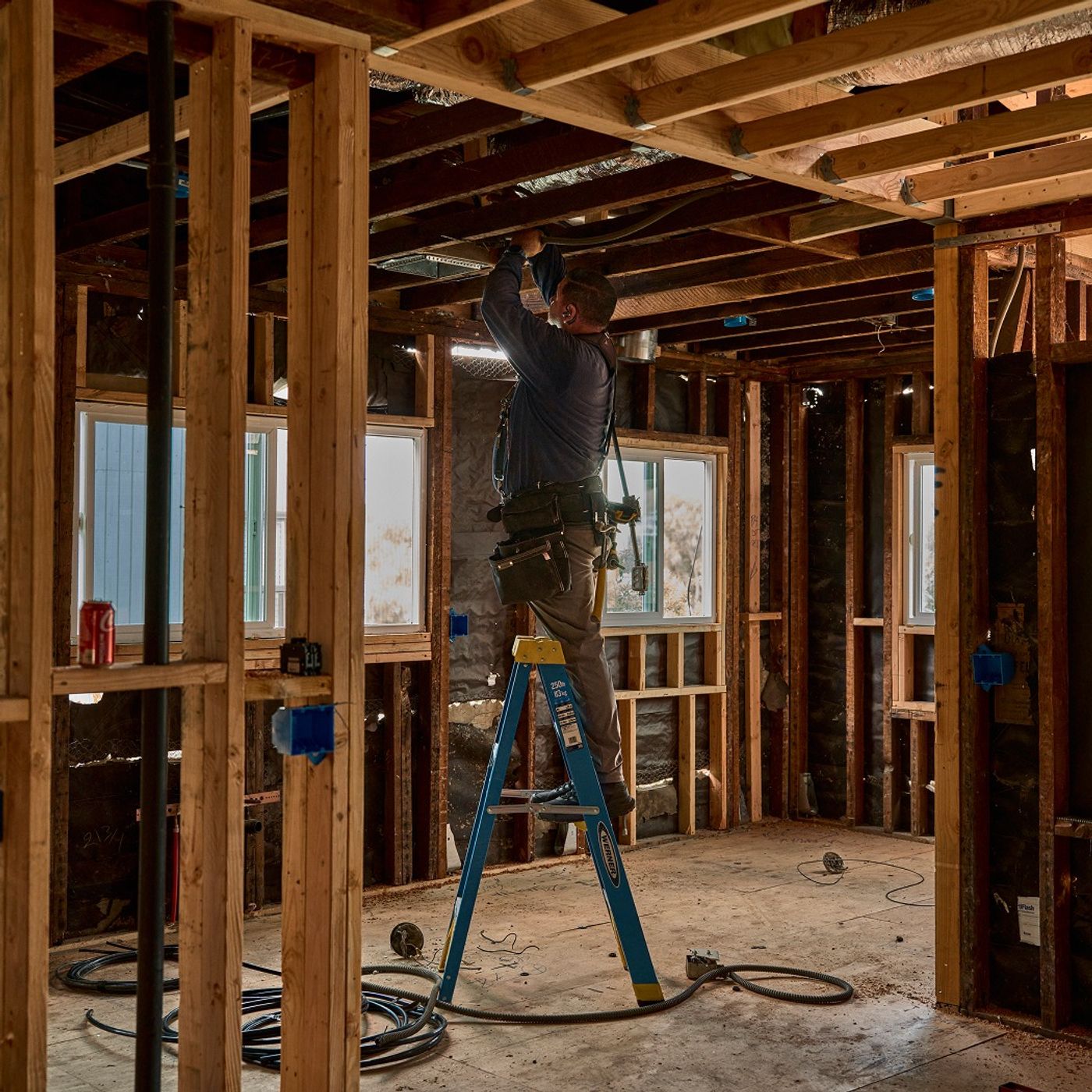
The Daily
Trump’s Clashing Goals: More Housing, Fewer Immigrants
00:36:04
A new law aims to speed up building housing around the country. At the same time, the construction sector is reliant on foreign-born workers.
Loading summary
Transcript196 lines
- [00:00]
Capital One Bank Guy
With no fees or minimums on checking accounts, it's no wonder the Capital One bank guy is so passionate about banking. With Capital One, if he were here, he wouldn't just tell you about no fees or minimums. He'd also talk about how Capital One cafes are open seven days a week to assist with your banking needs. Yup. Even on weekends, it's pretty much all he talks about in a good way. What's in your wallet? Terms apply. See capitalone.com BankGuy Capital One NA Member FDIC
- [00:30]
Michael Barbaro
from the New York Times, I'm Michael Balvaro. This is the Daily. To confront America's acute shortage of housing, Congress just passed a historic piece of legislation designed to encourage the construction of new homes. The problem is, is that President Trump's crackdown on immigrants is taking direct aim at the workforce required to build those homes. Today, my colleague Rhonda Cason explains how the US Housing industry became so dependent on immigrant labor and how that reliance could end up undermining a once in a generation housing law. It's Wednesday, july 22nd. Rhonda, welcome to the Daily.
- [01:37]
Rhonda Cason
Thank you. Thank you for having me.
- [01:39]
Interviewer (possibly Michael Barbaro or a co-host)
So let me just set the stage. By the time that Congress decided to pass this landmark housing bill, which has now become law and is supposed to make it a lot easier and faster to construct new homes in this country, you had finished a line of reporting into the workers who actually build those houses. And that reporting allowed you to see more clearly than most of us that there was a little bit of a problem here. And that problem was a gap between intention and kind of reality. Just explain that.
- [02:15]
Rhonda Cason
So if we look at the law specifically, this new law that was passed has all sorts of tools in it to get housing built, all sorts of different ways that you can encourage developers to make it easier for them to build, encourage them to want to build, but somebody has to actually build those homes.
- [02:33]
Interviewer (possibly Michael Barbaro or a co-host)
Right.
- [02:33]
Rhonda Cason
And we already had this labor shortage. We've been short 300,000 workers for a long time. And Trump has another policy which is separate of this industry, which is to have a mass deportation policy. And no industry is more reliant on immigrant labor than construction.
- [02:53]
Interviewer (possibly Michael Barbaro or a co-host)
Right. The two goals that the president has and has articulated at various points, a cheaper housing market and a major crackdown on illegal immigration. You're saying those are profoundly intention.
- [03:05]
Rhonda Cason
Right. The core of the housing crisis is that we haven't built enough housing. We really haven't built enough housing in decades. And one of the reasons is that we don't have enough workers to Build the housing. And so labor costs are high, which makes it expensive. And construction relies on labor and relies on immigrant labor. And Trump has been actively deporting that population. And so Congress passed this landmark legislation that's the first time in more than 30 years that the federal government has said we want to build housing. At the same time, the federal government's also saying we want to deport the immigrant workforce.
- [03:43]
Michael Barbaro
Who builds the houses?
- [03:44]
Rhonda Cason
Who builds the houses? And so you could end up with a situation where there's all sorts of builders ready to go and, and they don't have the workers to do the work. So I wanted to know, how did the construction industry become so reliant on an immigrant workforce so that it's now so vulnerable to losing its workers? Because the country wasn't always this way. This was not always an immigrant job.
- [04:09]
Interviewer (possibly Michael Barbaro or a co-host)
Well, just explain what you found in your reporting about how it came to be that the US Housing industry has become so dependent on immigrant labor and as you just said, so vulnerable to losing those workers to a crackdown.
- [04:26]
Rhonda Cason
So construction employs the highest share of foreign born workers of any industry in America.
- [04:32]
Interviewer (possibly Michael Barbaro or a co-host)
Huh.
- [04:32]
Rhonda Cason
And to explain how we got to this point, we usually hear one of these two stories. We either hear that immigrants stole Americans jobs or we hear that Americans were too lazy to do these jobs. But these two narratives put together don't make a lot of sense. They can't both be true.
- [04:52]
Interviewer (possibly Michael Barbaro or a co-host)
Why not?
- [04:53]
Rhonda Cason
Well, because there's a tension in that. Like, so one is, I don't want the job, and the other one is I'm stealing a job you want. So which one is that?
- [04:59]
Interviewer (possibly Michael Barbaro or a co-host)
Doesn't quite add up.
- [05:00]
Rhonda Cason
So it doesn't add up to me. And so my colleague Rob Gebeloff and I really wanted to know, why did American workers leave this industry and why did the immigrant workers come into it?
- [05:13]
Interviewer (possibly Michael Barbaro or a co-host)
And what did you actually find?
- [05:16]
Rhonda Cason
So what we found is the story starts in the 1970s. And back then homes were built almost exclusively by American workers. There was about maybe 5% of the industry was foreign born. And union membership at this time was at an all time high. It was like 40% of all construction workers were unionized, which was like higher than other industries.
- [05:41]
Interviewer (possibly Michael Barbaro or a co-host)
So if you were getting a house built in the US in the 1970s, it was almost assuredly going to be built by American born unionized workers, certainly
- [05:49]
Rhonda Cason
for new construction and for the larger projects. Yeah, these were union jobs and they were good jobs. So union construction workers earned $1.71 for every dollar the average American worker earned.
- [06:04]
Interviewer (possibly Michael Barbaro or a co-host)
Wow.
- [06:04]
Rhonda Cason
You had health insurance, you had a pension, you had vacations, and it was a job you didn't have to have a college degree for. And one of the construction workers I met from that era was Matt Moore. So are you from Orange county originally?
- [06:23]
Matt Moore
No, I was actually born in Elliott, born in Linwood.
- [06:26]
Rhonda Cason
And he was really emblematic of the type of workers who were working in the industry at that time.
- [06:31]
Michael Barbaro
How so?
- [06:33]
Rhonda Cason
Well, he graduated from high school in Southern California in 1975. He doesn't really know what to do with his life.
- [06:41]
Matt Moore
My father told me one thing when I was growing up, because after I graduated high school, I wanted to go to college. And he looked at me and he said, there's two kinds of humans. He goes, there's two kinds of man. There's man with a strong mind, man with a strong back. God blessed you with a strong back. Go to work.
- [07:00]
Rhonda Cason
He decides to work at a parts department at a Volkswagen dealership. And one afternoon his high school buddy comes in and says, hey.
- [07:08]
Matt Moore
He goes, I just started roofing. He goes, and it's great. He goes, you can get $2 more an hour. I was making $2 an hour. I doubled my money. Starting roofing. We went to the union shop, went to the hall, signed the paperworks, and that was it.
- [07:24]
Rhonda Cason
And he goes to the union hall. He fills out his union card. He gets a pair of hot boots, which are the boots you wear on a roof. And he's up on a roof.
- [07:32]
Interviewer (possibly Michael Barbaro or a co-host)
I so want to know what a pair of hot boots looks like.
- [07:35]
Rhonda Cason
I saw them. They're just like boots, but I guess they don't melt. So suddenly he's an apprentice, and he absolutely loves it. He's out in the Southern California sunshine. He's throwing up roost from the ocean to the mountains in Orange County. He's building tracks of homes in California.
- [07:53]
Matt Moore
If we were working by the coast, we brought our surfboards and everybody went surfing afterwards. Surf the glass off at night, and
- [08:01]
Rhonda Cason
he's going surfing in the afternoon.
- [08:03]
Interviewer (possibly Michael Barbaro or a co-host)
What a life.
- [08:04]
Rhonda Cason
Yeah. And he is happy as a clam.
- [08:06]
Matt Moore
Work would dry up okay, but it wasn't a big deal. You just go to the hall, and he'd say, hey, who wants to go here? And they would pull you off the list and give you a slip and you'd go to the next shop.
- [08:16]
Rhonda Cason
So he's getting paid. Well, he's 19 years old and he meets a girl, as one does.
- [08:22]
Matt Moore
The girl I was dating, which became my wife. She looked at my bank account and said, what are you going to do with this money. And I said, I'm going to go buy me a Dodge truck.
- [08:31]
Rhonda Cason
So he's got $10,000 in the bank and he wants to buy a car. $10,000 in the bank in 1976.
- [08:36]
Interviewer (possibly Michael Barbaro or a co-host)
By now that's real money, right?
- [08:38]
Rhonda Cason
So he's got real money.
- [08:39]
Matt Moore
And she said, no, you're going to go buy a house.
- [08:41]
Rhonda Cason
His parents never owned a house.
- [08:43]
Matt Moore
So I said, okay, I'll go buy a house then.
- [08:45]
Rhonda Cason
That's. How much was it?
- [08:47]
Matt Moore
48,000.
- [08:49]
Rhonda Cason
He buys a house and he's 20 years old. All from making money as a roofer.
- [08:53]
Interviewer (possibly Michael Barbaro or a co-host)
Right. Not old enough to drink, but old enough to buy a home.
- [08:56]
Rhonda Cason
And he's only been putting on roofs for two years.
- [08:58]
Interviewer (possibly Michael Barbaro or a co-host)
So this is quite lucrative. And it sounds like things are going pretty swimmingly for Matt.
- [09:04]
Rhonda Cason
Right? For Matt, this is a gravy train he's on. And in the 1970s, the unions had locked in really, really strong contracts, partly because the Vietnam War. There was less workers. Like, they had gotten these great contract contracts. But then you've got this period where there's high inflation, high interest rates, right?
- [09:21]
Interviewer (possibly Michael Barbaro or a co-host)
This is the 70s.
- [09:22]
Rhonda Cason
So the late 70s, and the home builders and corporate America decides it's time to start fighting back against unions that have been incredibly powerful for decades. And they form a lobbying group. And one of their goals was to weaken labor laws and to sort of break the stranglehold that unions had on industry. And construction was in the center of this. So they start introducing non union crews into unionized job sites.
- [09:56]
Matt Moore
It happened very slowly. What happened was a lot of non unions started coming up.
- [10:02]
Rhonda Cason
So the way this plays out in Southern California, where Matt is, is that in 1983, the Carpenters Union goes on strike. And the real heart of the strike is not about wages, but it's about whether or not non union shops can come into any job where there's a carpenter union.
- [10:19]
Interviewer (possibly Michael Barbaro or a co-host)
Got it.
- [10:20]
Rhonda Cason
They think they're going to win on this. But instead the strike drags on for four months.
- [10:25]
Interviewer (possibly Michael Barbaro or a co-host)
Wow. And they're not working during this period.
- [10:27]
Rhonda Cason
They're not working during this period. They're losing money. They've basically underestimated how determined the home builders would be. Meanwhile, other local unions have gotten involved
- [10:37]
Matt Moore
because we were fighting other trades at that period and not fighting fighting and not fighting where we should have been fighting.
- [10:45]
Rhonda Cason
There's a lot of infighting and the coalition starts to break down and they have to make a deal. And in the end, the unions concede to the home builders and let non union crews on residential sites where there's a unionized carpenter, basically they lose on
- [11:04]
Interviewer (possibly Michael Barbaro or a co-host)
the marquee issue of the strike itself.
- [11:07]
Rhonda Cason
Exactly. But at the time, it doesn't seem like that big of a deal.
- [11:13]
Michael Barbaro
Why not?
- [11:14]
Rhonda Cason
Because while they were letting non union workers come into unionized residential projects, the union still had a lock on the commercialized work in the construction industry.
- [11:24]
Matt Moore
We had so much, what they called commercial work. We had so much of it.
- [11:29]
Rhonda Cason
California is building a lot and they're building a lot of commercial. They're building hotels, they're building hospitals, they're building strip malls.
- [11:37]
Matt Moore
It was just flowing out of the cracks.
- [11:41]
Rhonda Cason
So the unions say it's fine, we'll just go do commercial.
- [11:45]
Matt Moore
I brought it up more than once. They said, oh, we had too much, don't worry about it. There's too much commercial go to work.
- [11:52]
Rhonda Cason
So if they cede some of their work in the residential sector, they'll be okay? They'll be okay.
- [11:58]
Interviewer (possibly Michael Barbaro or a co-host)
The commercial will make up for the residential. Right.
- [12:00]
Rhonda Cason
No big deal.
- [12:01]
Interviewer (possibly Michael Barbaro or a co-host)
Okay.
- [12:01]
Rhonda Cason
Do you think it was a mistake? Things like turned away, didn't worry about residential?
- [12:05]
Matt Moore
I do.
- [12:06]
Interviewer (possibly Michael Barbaro or a co-host)
Why?
- [12:07]
Matt Moore
Because it eliminated a whole section of our industry. I honestly think when we lost residential, it changed my trajectory in the industry. Tell me.
- [12:19]
Rhonda Cason
So Matt immediately notices a change. The first thing he sees is he goes into the union hall where he's supposed to see his jobs. And there's far fewer residential jobs available. They're just less of them. And the ones that are available are a lot smaller. There's just like they're not building 60, 80 tracks of homes. Maybe it's 10.
- [12:37]
Matt Moore
That's when two gates started coming up. We had a union gate and a non union gate.
- [12:42]
Rhonda Cason
And when he goes to the job sites, he starts seeing two gates, one for union crews and one for non union crews. And they're keeping those workers separate. So remember though, at this time in the early 1980s, both the unionized and non unionized workers were still American born workers.
- [13:00]
Michael Barbaro
Hmm.
- [13:00]
Interviewer (possibly Michael Barbaro or a co-host)
That's just the demographics of this workforce.
- [13:02]
Rhonda Cason
That's the demographics of America at the time.
- [13:04]
Expert or Scientist (discussing Cyclospora outbreak)
But
- [13:07]
Rhonda Cason
in the early 1980s was the beginning of Reaganism and he was very pro business, but he was also very pro immigrant. He had a huge amnesty program. And his successor, George H.W. bush, saw an even bigger wave of immigrants. And he expanded Reagan's amnesty programs. And he ends up signing the Immigration act of 1990, which is this major piece of legislation that created the TPS program, H1B visas, a visa lottery program. He does, you know, also add in some border protections and try to reduce illegal immigration. But overall, this is a time where the borders are porous and it was not the hard border that we think of today. So all these immigrants are looking for work, and many of them are coming in without documentation. And many of them also are coming in either already knowing how to build homes, or they come and join family members who've already gotten jobs in construction. And so construction becomes a natural place for immigrants to find work. And for the American worker, these home construction jobs are becoming less appealing as non union work grows in the sector. And these non union jobs don't have those good benefits. And so Matt starts seeing the labor force changing. Suddenly there's more Spanish being spoken on the job sites. A few years later, the the foremen are often Spanish speaking.
- [14:34]
Matt Moore
I literally was working one day and I turned around on the roof and I happened to be the oldest guy and the whitest guy on the roof. But I wonder what happened to all the white guys. I really did. They all went different places. Nobody wanted to do it anymore.
- [14:49]
Interviewer (possibly Michael Barbaro or a co-host)
So just to be clear about the sequence of events here, home builders decide to challenge the union's hold over the construction of housing. They say, we want non union workers. They fight the unionized workers to get that to happen. And as that's happening, these waves of immigrants are coming to the US and they are being introduced especially to this non union world of home construction, which it sounds like is very open to hiring them.
- [15:24]
Rhonda Cason
Exactly. It's almost like a parallel experience is happening because, you know, while Matt is noticing that the folks who look like him on the job site are disappearing, I spoke with a lot of immigrants who arrived during that time period, and they tell almost a similar story to what Matt's youth was like. So one guy I spoke with was named Mariano Martinez. So where are you? Where were you born?
- [15:48]
Interviewer (possibly Michael Barbaro or a co-host)
Oaxaca, Mexico.
- [15:50]
Rhonda Cason
And he's also a roofer. And he arrived in the United states. He was 19. He came in the late 1980s from Oaxaca, Mexico. So he walked across the border and it was easy then back in the day, yes.
- [16:01]
Interviewer (possibly Michael Barbaro or a co-host)
It was like not even half hour.
- [16:04]
Rhonda Cason
Okay, did it cost a lot of money or no?
- [16:07]
Interviewer (possibly Michael Barbaro or a co-host)
It was like $110, I think.
- [16:09]
Rhonda Cason
Okay. He crosses the border with the help of a coyote. He's initially working at a gardening center, and he's not making very much money. He got laid off. And like Matt, a friend tells him about roofing.
- [16:22]
Interviewer (possibly Michael Barbaro or a co-host)
Oh, my God. Quite literally, it is a parallel story.
- [16:24]
Rhonda Cason
It is a parallel story. And so what did your friend say about roofing?
- [16:27]
Interviewer (possibly Michael Barbaro or a co-host)
Well, he said it was a hard work, but if you like it, it's a good job.
- [16:31]
Rhonda Cason
So what? So when you. So he doesn't speak any English, he shows up on a job site, they put him on a roof. He's got a rip off an old roof. It's horrible work. He absolutely hates it. He thinks he's never going to do this again.
- [16:43]
Interviewer (possibly Michael Barbaro or a co-host)
But I really need the job. So I act like really know what
- [16:49]
Matt Moore
I'm doing, but definitely then the money's
- [16:52]
Rhonda Cason
a lot better and he comes back the next day anyway and in a few months he's making $100 a day in cash. So the money's good, but there's no benefits. And then did you ever have health insurance?
- [17:05]
Interviewer (possibly Michael Barbaro or a co-host)
No, not on that time, no.
- [17:06]
Rhonda Cason
There's no retirement, there's no paid vacation, but it's more money than he's ever seen. And his friends actually tell him, you know, there is union work you can get, but it's not worth it because it's not steady. There's all this work in the non union work. There's so much to be had where the union work. There's all these rules and you may be out of work sometimes. So he never even bothers to consider union work and he doesn't have to
- [17:33]
Interviewer (possibly Michael Barbaro or a co-host)
because the contracts no longer require it.
- [17:36]
Rhonda Cason
Right. And for Mariano, the money is so good that by the late 90s, he's also married and he has enough money to buy a house also in Southern California.
- [17:45]
Expert or Scientist (discussing Cyclospora outbreak)
Mm.
- [17:46]
Interviewer (possibly Michael Barbaro or a co-host)
I'm really curious. As immigrants like Mariano are starting to take these non union home construction jobs, what is happening to people like Matt? Clearly he's looking around and the world is changing, but I presume that he's still getting plenty of union construction work.
- [18:05]
Rhonda Cason
Right. He's, he's not even looking at the jobs that Mariano's looking at. So remember, he's still looking at the jobs on the union hall. So he's not seeing Mariano' jobs. Unionized workers have just shift increasingly into commercial work.
- [18:17]
Bank of America Advertiser
Right.
- [18:17]
Interviewer (possibly Michael Barbaro or a co-host)
As they kind of predicted.
- [18:19]
Rhonda Cason
As they predicted. Which sounds like, well, what's the difference? I mean, a job is a job, a roof is a roof. Commercial work. Did you go up and do high rises?
- [18:25]
Matt Moore
Yes.
- [18:26]
Dan Tabursky
Wow.
- [18:26]
Rhonda Cason
How was that?
- [18:27]
Dan Tabursky
Was that hard?
- [18:28]
Matt Moore
Yeah, it was hard.
- [18:29]
Rhonda Cason
Was it harder than residential roofing?
- [18:30]
Matt Moore
Oh, yes. Oh, yeah. Yeah.
- [18:33]
Rhonda Cason
But putting a roof on a two story house in the Orange county suburbs is a lot different than putting a roof on a 30 story tower. These are multimillion dollar projects. There's a lot of pressure to get them Built very fast. You're up on steel beams. You can get seriously injured. It's very hard, hard work. The hours are much longer like that.
- [18:56]
Matt Moore
Trying to get the trash off. We put these big giant tubes up and you would throw the trash in the tube from the roof and if it got stuck, well, you had to send the smallest guy down on a rope inside the tube. No. Yeah.
- [19:09]
Rhonda Cason
And you know, Matt tells stories of just intense physical labor and real danger with real injuries.
- [19:17]
Matt Moore
I've broken my back twice. I ripped off this arm, ripped off this wrist, ripped off this elbow.
- [19:24]
Rhonda Cason
He fell off a roof and ripped his arm off his body and had it reattached. Showed me the scars.
- [19:29]
Matt Moore
My knee is completely wiped out. I've broken both my ankles several times, broken my pelvis, fractured ribs.
- [19:36]
Rhonda Cason
How'd you break it back?
- [19:37]
Matt Moore
Falling.
- [19:39]
Rhonda Cason
But even despite how difficult the job was, Matt and other commercial roofers still had enough work and had decent salary and benefits to hang on and to build a good, solid life. But then something happens that no one anticipated that makes American born, unionized workers like Matt feel even more left behind.
- [20:15]
Interviewer (possibly Michael Barbaro or a co-host)
We'll be right back. This podcast is supported by the American Petroleum Institute.
- [20:25]
Michael Barbaro
Energy security affects how Americans live, work,
- [20:28]
Interviewer (possibly Michael Barbaro or a co-host)
travel and stay connected. America has abundant oil and natural gas, but resources alone are not enough. The country needs modern infrastructure like pipelines and transmission lines that can affordably and safely bring energy to families, communities and businesses. That's how to build a stronger, more reliable energy system for the future. Learn more@energysecurityframework.org this podcast is supported by Bayer.
- [20:55]
Capital One Bank Guy
Science is a rigorous process that requires questions, testing, transparency and results that can be proven again and again. It's the approach that mapped the human genome, advancing therapies for chronic diseases. It transformed farming to help feed billions of people. It produces countless innovations that improve lives worldwide. This approach is integral to every breakthrough. Bayer brings forward innovations that save lives and feed the world because the future depends on it. Learn more@sciencedelivers.com this podcast is supported by
- [21:29]
Rhonda Cason
bank of America Private Bank.
- [21:31]
Bank of America Advertiser
You're cut from a different cloth. And with bank of America Private bank, you have an entire team tailored to your needs, with wealth and business strategies built for the biggest ambitions like yours. Whatever your passion, unlock more powerful possibilities@privatebank.bankofamerica.com what would you like the power to do? Bank of America Official bank of the FIFA World Cup 2026 bank of America Private bank as an official of bank of America, NA member FDIC and a wholly owned subsidiary of bank of America Corporation.
- [22:03]
Interviewer (possibly Michael Barbaro or a co-host)
So Rhonda, what happens that makes life and work even worse for folks like Matt?
- [22:11]
Rhonda Cason
The housing boom.
- [22:13]
Interviewer (possibly Michael Barbaro or a co-host)
Not intuitive, but I know you're going to explain, right?
- [22:15]
Rhonda Cason
If you all remember, in the early 2000s there was this huge housing boom fueled by subprime mortgages. And Americans start building millions of new homes. And also they're not just building anywhere, they're building in the sun belt states like Arizona, Nevada and Texas and California, where there's a lot of immigrants, because these are border states and many of these states are right to work states. So they have very, very weak union representation. And so where the construction industry is growing is increasingly non union. And they have this enormous workforce that is moving across the border, eager and willing to take these jobs that are not particularly attractive to a worker who's born in the United States.
- [23:02]
Interviewer (possibly Michael Barbaro or a co-host)
Got it. So I'm intuiting from what you're saying that this is boom time for non union foreign born construction workers.
- [23:13]
Rhonda Cason
It is. And if you look at the share of foreign born workers in the construction industry, it is just skill skyrocketing during this period. But what's also happening simultaneously is union membership for both foreign born workers and American born workers is falling from this peak of 40%. It's just falling off a cliff. And while that's happening, wages for both union workers and non union workers aren't keeping up with everyone else's wages.
- [23:40]
Michael Barbaro
Why?
- [23:41]
Rhonda Cason
Well, because if you think of union workers as like the standard of what you're supposed to be paid, then even if you're hiring for a non union job, you're kind of matching that a bit. So as there's fewer workers in unions, there's fewer jobs to be had, wages start to shrink, and then the non union wages sort of fall in concert.
- [24:00]
Interviewer (possibly Michael Barbaro or a co-host)
Because if the standard starts to go away, then the non standard pay can start to go faster.
- [24:05]
Rhonda Cason
Exactly. So in some ways union work, even if you're not unionized, keeps your standard of living a little bit higher for everyone. And that standard is now falling. And at the same time we're seeing this huge wave of immigration that is really transforming the construction industry. Remember in 1973, about 5% of construction workers were foreign born, right?
- [24:27]
Interviewer (possibly Michael Barbaro or a co-host)
Tiny percent.
- [24:27]
Rhonda Cason
Tiny percent. But so during the housing boom, the percent continues to just soar. And now in California, they make up half of all construction workers. In some parts of the construction industry, like drywall roofing, they're like 80, 90% of the workers are now foreign born. And also the union provided huge apprenticeship programs. Matt came in and was trained on day one. He went through a long apprenticeship program where he got trained to do a union roof. When Mariano came, there was no apprenticeship program. He was just trained by his friends. So you don't have that apprenticeship program that was a pipeline to train a new workforce. Cause the unions don't exist. And so young people graduating from high school are no longer putting on their hot boots and getting on a roof.
- [25:14]
Interviewer (possibly Michael Barbaro or a co-host)
So even before the housing boom inevitably yields to a housing crash that we all remember, the entire infrastructure that encourages American born workers to go into construction is eroding on top of the fact that the wage advantages of entering this industry are starting to evaporate as well.
- [25:43]
Rhonda Cason
Right. And all these things are happening together. So the pathways to get into construction for an American born worker are rapidly disappearing. Because the unions are disappearing. Because the construction that's happening is happening in places where there's no unions and they're building residential homes. And instead what's happening is a pathway for immigrants. So Mariano arrives, his friend tells him about this job, he brings cousins and got them jobs in construction in Southern California as immigrants. And that becomes the new pathway into construction.
- [26:14]
Interviewer (possibly Michael Barbaro or a co-host)
So what happens when this housing boom inevitably becomes a housing bust in 2007,
- [26:22]
Rhonda Cason
2008, 2009, it's a complete disaster for the construction industry. No industry faced more job losses than construction. Almost 2 million workers lost their jobs. That's 1 in 4 construction workers lost their jobs. For workers like Matt, they were staring down the barrel of a very bleak future. It had already become a pretty hostile environment for them. So Matt is 51 and he walks away.
- [26:50]
Interviewer (possibly Michael Barbaro or a co-host)
He quits the construction industry in the middle of the housing crisis.
- [26:53]
Rhonda Cason
He retires, he gets his pension and he walks away. And he is one of millions of workers who did the same thing. And so as the industry starts to churn again and starts to rebuild, it never reaches the levels it did in 2000s. Which is what is sort of setting us up for where we are today. Home builders are not building at scale. They're not building the number of houses Americans need. And there's a labor force that was just never recovered. We're short 300,000 workers because they left and they retired and they didn't come back. And we don't have the pipeline of new young American born workers to fill those jobs. So now we have a workforce that is incredibly dependent on the immigrant workers who have been here and have been working and building homes for years in this country. And they're being deported. They're being deported from job sites and they're being deported from Home Depots and they're being deported from their homes. And if they aren't being deported, they're afraid to come to work.
- [27:53]
Interviewer (possibly Michael Barbaro or a co-host)
It can't have escaped the awareness of the President and those around him that at this moment, when America desperately needs a lot more housing and faces a shortage of workers to build it, that this deportation campaign is at odds with the goal of getting more housing and more affordable housing. And I wonder if the Trump administration assumed, believed that if it was deporting all these foreign born workers who were building these houses that it might bring the American born workforce back somehow.
- [28:31]
Rhonda Cason
Yeah, I think that is the vision is that wages will rise because now you'll have to pay them again the good wages that you once had. I think that's J.D. vance's argument for sure. Homebuilders will have to pay more and American workers will come and take these jobs. And that the problem is again that immigrants have taken their jobs. And if you remove the immigrants from the equation, the Americans will fill the void.
- [28:52]
Interviewer (possibly Michael Barbaro or a co-host)
Is there any evidence that that's starting to happen?
- [28:57]
Rhonda Cason
There's actually evidence that it's not. So researchers found that in communities where there was a high level of deportation, employment dropped for immigrant workers.
- [29:05]
Interviewer (possibly Michael Barbaro or a co-host)
Right.
- [29:06]
Rhonda Cason
But here's what's kind of surprising. Employment also fell for American born workers.
- [29:11]
Interviewer (possibly Michael Barbaro or a co-host)
Huh. And what does the study say is the causality there?
- [29:15]
Dan Tabursky
Why?
- [29:16]
Rhonda Cason
Well, you would think that contractors would raise wages because they're short on workers, but that's not really the way the industry, American born workers and foreign born workers aren't evenly split across the industry. You have a concentration of foreign born workers who maybe build the foundations. So let's say your crew that builds a foundation doesn't show up because they've all been deported or they're afraid to go to work. So you don't build the foundation. So then when you call in the
- [29:41]
Interviewer (possibly Michael Barbaro or a co-host)
carpenter, they're like, what am I supposed to build on? There's no foundation.
- [29:44]
Rhonda Cason
So you don't need the carpenter, so you just don't hire him. You know, in my reporting I spoke with a number of contractors who said jobs that were taking three months to build now take five months to build because there's just fewer workers to get each stage of the project done. And they're not paying their workers any more money, they're just taking longer to get the job done. And this housing bill doesn't address the labor force, it doesn't provide a pathway to a trade school or any requirements to hire unionized labor. So it provides no avenues to expand an American born workforce. There is one place in the bill that does speak to a potential future and that is the factory built housing. So the bill makes the first major changes to manufactured housing, which means that now we can build lots of different types of factory built housing. That kind of housing requires less labor. You don't need as many workers. I'm not sure if that's an upside,
- [30:40]
Interviewer (possibly Michael Barbaro or a co-host)
but it's an upside for housing, but not for construction workers.
- [30:44]
Rhonda Cason
Exactly.
- [30:45]
Interviewer (possibly Michael Barbaro or a co-host)
So, Rhonda, I want to end by returning to where we began this conversation, which is with these prevailing narratives around why the US home construction industry became so reliant on foreign born workers. One of those myths is that foreign workers took those jobs from Americans. The other myth is that the American workers decided they didn't want to do those jobs anymore. But obviously it's much more complicated than those simple stories.
- [31:12]
Rhonda Cason
Yes, and I think it's a provocative thing to say. But what we learned through the reporting is that there's sort of elements of truth in both these threads. Yes, immigrants replaced Americans in the jobs they used to hold. Right. But it was because they had an opportunity to do so where they couldn't before the government allowed them in and the unions no longer had a lock on the jobs and businesses wanted to hire them and they made a choice to do that.
- [31:41]
Bank of America Advertiser
Right.
- [31:42]
Interviewer (possibly Michael Barbaro or a co-host)
They wanted this cheaper labor that was non union. They pushed for it and the immigrants presented themselves as that cheaper laborer.
- [31:50]
Rhonda Cason
Exactly. So you had this partnership between government and business to really decide together to erode what was a really solid American job. And as young American born workers entered the workforce during this period, they looked at this backbreaking manual labor that maybe their fathers had done and it didn't feel worth it to them. There were other opportunities where the wages were higher, where the protections were safer, where there were health benefits, where maybe there was air conditioning in an office. And the industry no longer appealed to a new generation of American born workers. And in its place it opened an opportunity for a generation of people coming to this country looking for work. But they didn't exactly take jobs from people who wanted them anymore.
- [32:44]
Interviewer (possibly Michael Barbaro or a co-host)
I mean, one of the things that strikes me is that almost everyone in the story you have told here did act in a pretty economically rational way. Right. Us born workers started to walk away from an industry when the work became less lucrative. Immigrant workers still flocked to it because it was lucrative enough for them. And builders sought cheaper and cheaper labor in a system that didn't require them to work with just unionized workers. So in a system where everyone's acting rationally and we end up in a place where there's more and more foreign born workers at the center of the industry and then the government decides that a lot of those workers need to leave the country and we have a huge housing shortage and not enough workers to build. In that scenario where lots of people have been acting naturally and it's not working, it feels like the only solution is for something unnatural to happen. And I wonder what you, as someone quite expert in this area, think that perhaps unnatural thing now needs to be. What is going to fix the American housing crisis if there aren't enough American born workers who want to do the work? And increasingly there are foreign born workers who are being asked to leave.
- [34:09]
Rhonda Cason
I mean, one option obviously is to rethink the deportation policy. Another option is to really have meaningful training programs. If it is a priority for this administration to have a domestic workforce, then there needs to be quality training programs and quality wages for workers across the board. You need to sort of decide to have a policy that would actually rebuild the ranks of the workforce. And absent that, you're just sort of haphazardly removing an already fragile workforce. That just makes it harder to get the job done.
- [34:59]
Interviewer (possibly Michael Barbaro or a co-host)
Well, Rhonda, thank you very much.
- [35:01]
Rhonda Cason
You're welcome.
- [35:09]
Interviewer (possibly Michael Barbaro or a co-host)
We'll be right back. This podcast is supported by Audible.
- [35:13]
Dan Tabursky
Hey, Dan Tabursky here. I'm a podcast host, a journalist, and now with my newest project, the author of my own manifesto. Well, it's a manifesto about manifestos, my search for inspiration in a world that feels more infuriating, more out of its freaking mind with each passing hour. Manifestos are a call to action, an artful scream. They capture our anger and they try to do something with it. This is my attempt to take the manifesto back from mass shooters and nihilists and return it to its rightful place with the warriors, the visionaries, the regular folks with the just the right amount of crazy. I compare notes with radicals, secessionists, Internet trolls out for a laugh, and punk singers screaming their guts out, all trying to turn their anger into the world they want to see. Listen to Manifesto wherever you get your podcasts. Audible subscribers can binge all episodes of Manifesto early and ad free right now. Join Audible in the Audible app or by subscribing on Apple podcasts.
- [36:11]
Rhonda Cason
Startup founders around the world are using Anthropic's Claude to solve problems, build faster, and create things that have never existed before.
- [36:19]
Interviewer (possibly Michael Barbaro or a co-host)
By getting to work with Anthropic, we've been able to help bring folks to a new era of software engineering. We are a very small startup, so
- [36:25]
Rhonda Cason
Anthropic Model actually changed everything about how
- [36:28]
Interviewer (possibly Michael Barbaro or a co-host)
we work together as a team.
- [36:29]
Rhonda Cason
The very cool thing for us is that with each new model, new capabilities are unlocked. To watch the full series, go to claude.com problemsolvers that's claude.com problemsolvers.
- [36:46]
Michael Barbaro
Here's what else you need to know today. The governor of New Jersey, Democrat Mikey Sherrill, said that about 400 non citizens voted in the state after they were improperly registered in 2023 and 2024. The voting was the result of a software error at the New Jersey Department of Motor Vehicles, which put more than than 6,000 noncitizens on the voter rolls even after they had disclosed their immigration status. New Jersey said that the voting had no impact on any elections and that all of the non citizens have been removed from the state's voter rolls.
- [37:30]
Expert or Scientist (discussing Cyclospora outbreak)
And we've never seen an outbreak this large for this parasite in as cases
- [37:37]
Michael Barbaro
of Cyclospora surge across the United States, inflicting diarrhea on thousands of people, my colleague Alice Callahan has been looking into the central question raised by the outbreak for Cyclospora.
- [37:52]
Expert or Scientist (discussing Cyclospora outbreak)
The parasite only survives in humans, so as far as we know, it has to come from human feces.
- [37:58]
Michael Barbaro
How did a parasite that only grows in the human gut somehow get into our food system on such a large scale?
- [38:07]
Expert or Scientist (discussing Cyclospora outbreak)
So usually what that means is there's a situation on farms where their septic system maybe has a leak in it, or they have outhouses next to the field and somehow the waste gets into the water supply that's then used to irrigate the crop.
- [38:29]
Michael Barbaro
So far, government agencies have linked the current outbreak to iceberg lettuce grown in Mexico that a company called Taylor Farms supplied to Taco Bell locations in multiple states. Taylor Farms has now recalled ICEBERG Lettuce from 27 states and the US government is stepping up its screening of lettuce coming from Mexico.
- [38:52]
Expert or Scientist (discussing Cyclospora outbreak)
That's another thing about this bug is that alcohol based hand sanitizers don't work to kill it, so you really need soap and water and full hand washing to get rid of it.
- [39:03]
Michael Barbaro
Today's episode was produced by Nina Feldman and Chris Benderev, with help from Stella Tan and Shannon Lynn. It was edited by Lisa Chow and contains music by Marion Lozano, Diane Wong and Dan Powell. Our theme music is by Wonderly. This episode was engineered by Chris Wood. Special thanks to Robert Gebeloff. That's it for the Daily I'm Michael Barbaro. See you tomorrow.
- [39:45]
Rhonda Cason
This podcast is supported by bank of America Private Bank.
- [39:49]
Bank of America Advertiser
You're cut from a different cloth, and with bank of America Private bank, you have an entire team tailored to your needs, with wealth and business strategies built for the biggest ambitions like yours. Whatever your passion, unlock more powerful possibilities@privatebank.bankofamerica.com what would you like the power to do? Bank of America Official bank of the FIFA World Cup 2026 bank of America Private bank is a division of bank of America, NA Member, FDIC and a wholly owned subsidiary of bank of America Corporation.