← The Daily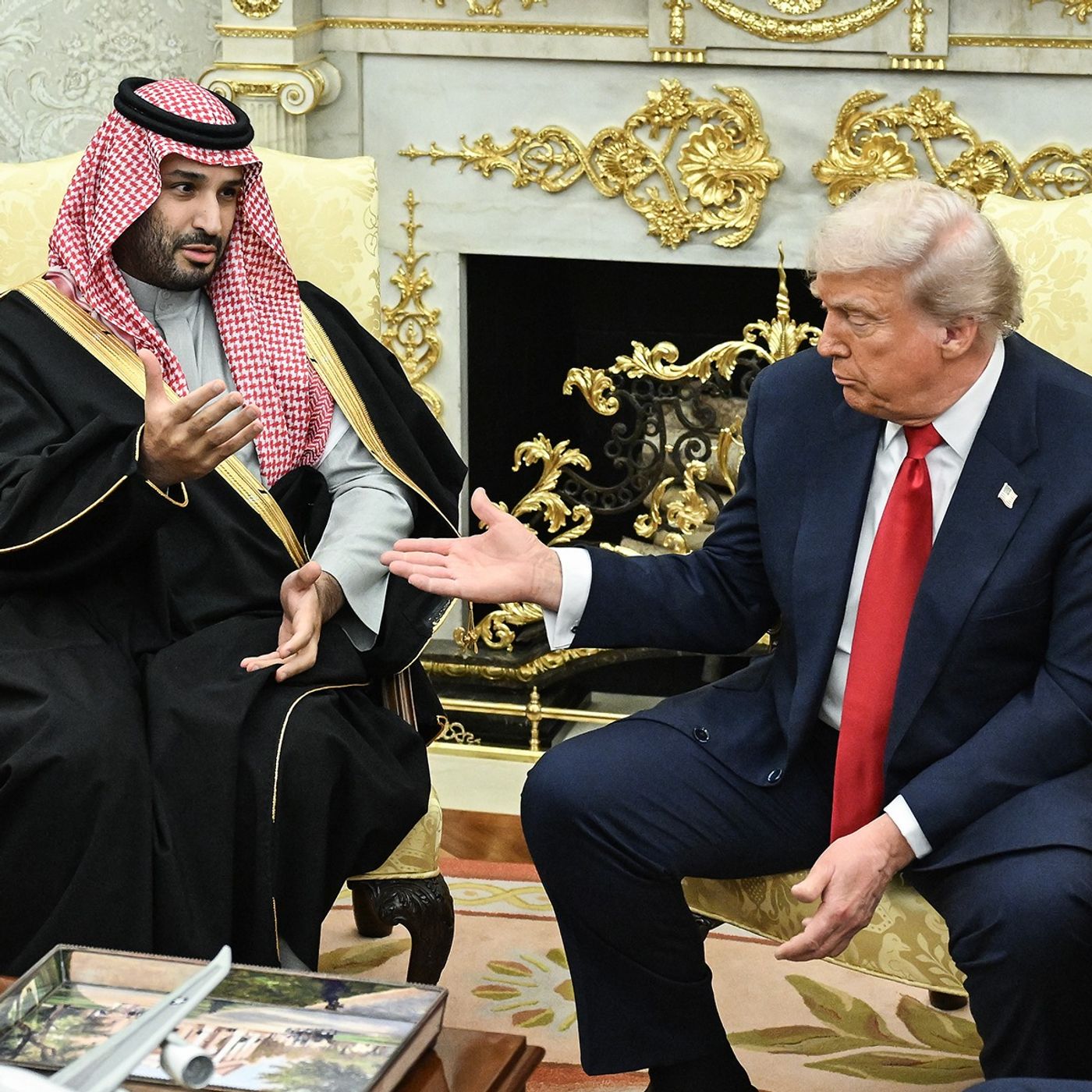
The Daily
Why Is the U.S. Building the Saudi Nuclear Program While Destroying Iran’s?
00:25:01
Our reporter explains what both countries are getting out of the deal.
Loading summary
Transcript66 lines
- [00:00]
Sponsor/Ad Voice
This podcast is supported by bank of America Private Bank.
- [00:04]
Your ambition leaves an impression. What you do next can leave a legacy at bank of America Private Bank. Our wealth and business strategies can help take your ambition to the next level. Whatever your passion, unlock more powerful possibilities@privatebank.bankofamerica.com what would you like the power to do? Bank of America Official bank of the FIFA World Cup 2026 bank of America Private bank is a division of bank of America, NA member FDIC and a wholly owned subsidiary of bank of America Corporation.
- [00:35]
Rachel Abrams
From the New York Times, I'm Rachel Abrams, and this is the Daily. On Wednesday, the United States signed a historic deal that allows Saudi Arabia to develop a nuclear program even as the Trump administration escalates a war against Iran. The the White House says is about destroying its nuclear capabilities. Today, David Sanger explains what Saudi Arabia and the US Are each getting out of the deal and why it's prompted worries about nuclear proliferation across a region that is already engulfed in an escalating war. It's Thursday, july 23rd. So, David, when I saw this news about this Saudi nuclear deal, I will confess I was surprised. I had a bunch of questions, but I assume that you, longtime Washington correspondent nuclear expert, were probably not quite as
- [01:42]
David Sanger
surprised as I was not surprised because this has been brewing for a long time, more than 10 years actually, but it has taken many different forms. For a while, the Biden administration wanted to make this part of a much broader deal with Saudi Arabia about recognizing Israel. The Trump administration has dealt with it more as a business deal, but we knew it was coming. The question is what were the terms?
- [02:09]
Rachel Abrams
So let's actually talk about that next. What do we know so far about what is included in this deal?
- [02:15]
David Sanger
Well, the core of it is that Saudi Arabia gets to build at least two nuclear reactors, probably more, that this will last for three decades, and that the business will largely go to American companies, which is to say Westinghouse, which even though it has significant Canadian ownership these days, is still a big jobs provider in the US So what the United States gets out of it is an extension of the president's determination to to export American goods and to make sure that American allies are tied to American energy systems. But there's a catch, as there always is with things nuclear. And that has to do with the question of who makes Saudi Arabia's fuel and what kind of inspections the Saudis agreed to.
- [03:10]
Rachel Abrams
And just to be clear, David, it sounds like from what you're describing that this is a civilian energy program, right?
- [03:17]
David Sanger
It's Entirely a civilian energy program, which means that its intent is to help Saudi Arabia build nuclear power plants the way many other advanced economies have, including many countries that don't have nuclear weapons. Think about Japan or Germany or South Korea. But the critical problem comes in the supply of nuclear fuel. If you are making your own nuclear fuel and enriching uranium up to, say, 3%, well, that's fine. That's the level at which you can use that uranium as a source for your nuclear electricity generation. But if you keep enriching up to 90%, suddenly you have the makings of an atomic bomb. And so the whole effort from the 1950s forward, from Eisenhower's Atoms for Peace program, to spread nuclear technology around the world and make cheap nuclear energy available to all has been to find a way to let countries produce nuclear energy without getting the stuff they need to divert to a nuclear weapons program.
- [04:33]
Rachel Abrams
Just so I'm clear, David, this deal is about providing Saudi Arabia with fuel, right? Not letting them enrich their own fuel, which would avoid the threat that you just explained.
- [04:43]
David Sanger
Well, Rachel, that's where this deal gets very vague. It allows the Saudis to purchase the nuclear reactors, which will take years to build, but it doesn't resolve the question of whether they are making their own fuel or whether they are buying it from someone else, including the United States. Instead, it refers that to a committee to go study the question of whether or not it even makes economic sense for Saudi Arabia to make its own fuel.
- [05:14]
Rachel Abrams
It sort of kicks that can down the road. It sounds like on this important question, it does. Okay, I want to back up just for a second, though, David, because you had said just a couple minutes ago that this deal had been in the works for a really long time. So I want to talk about the origin of all of this. Like when and why did these talks begin in the first place?
- [05:32]
David Sanger
Well, Saudi Arabia wanted a deal for the same reason all of its Arab neighbors want deals. They all want nuclear power. They're thinking about a future in which their economies are driven as much by data centers as petroleum. They want to build modern societies. They're conscious to some degree of the environmental effects. And so you've seen many countries in the region turn to nuclear energy. One of Saudi Arabia's most prosperous neighbors, the United Arab emirates, decided back 20 years ago they wanted nuclear power plants. And they struck a deal with the United States in 2009. And today they have four nuclear power plants that are up and running. But to do that, they had to go reach a deal with the US That Every country that's using nuclear technology of American origin has to go strike. And that is what's called a 1, 2, 3 agreement. Sounds strange. It comes out of the Atomic Energy act of 1954. What it means, essentially, is if you are going to buy US technology, you have to agree to some US restrictions. When the UAE negotiated its deal in 2009, it was considered probably the gold standard of these kinds of arrangements because the UAE agreed that it would not produce its own nuclear fuel and that it would allow international inspectors for the most intrusive kind of inspections. And so the thought was, okay, we set this standard. Let's apply this to other countries. And when the Saudis began discussing this with some of President Trump's closest allies during the first term, it was clear that they were more reluctant than the UAE to give up their right to produce nuclear fuel and to allow those intrusive inspections.
- [07:42]
Rachel Abrams
So if those talks started in the first Trump administration, what has happened since then? Why did this deal only come about now?
- [07:49]
David Sanger
Well, the Biden administration picked it up, and President Biden wanted to make a nuclear deal part of a larger political arrangement with Saudi Arabia that would include Saudi diplomatic recognition of Israel. And so the nuclear deal was the sweetener for that, and they were all linked together. The Saudis also were demanding that Israel allow a Palestinian state to exist. So there were these negotiations that were all wrapped into one big ball, and they were getting very close to completion when the terror attacks of October 7, 2023, happened. And that blew up the entire thing.
- [08:32]
Rachel Abrams
Right. And I think a lot of people will remember that when Israel started retaliating for that October 7th attack by bombing Gaza, the idea that Saudi Arabia would normalize diplomatic relations with Israel, that was a total nonstarter at that moment.
- [08:47]
David Sanger
That's absolutely right, Rachel. And beyond that, we now have some evidence that Hamas timed their attack on Israel in part to blow up the deal with the Saudis.
- [08:59]
Sponsor/Ad Voice
Right.
- [09:00]
David Sanger
So when President Trump came in, he recognized he was gonna have to decouple the nuclear deal from the diplomatic arrangement because the Saudis aren't gonna recognize Israel diplomatically for years if they can ever pull that off. And Mohammed bin Salman, known as MBS in the region, the Saudi leader, made clear to President Trump last fall that diplomatic recognition of Israel was pretty low on his priority list, but the nuclear deal was high on his priority list. And because it has the promise of bringing billions of dollars of revenue to the United States, it's high on President Trump's list as well.
- [09:46]
Rachel Abrams
Right. Basically, the United States is thinking Israel normalization not as high on the list as all the money we could get from this deal, hence why we might cut a deal with Saudi Arabia that has these kind of favorable, looser restrictions.
- [09:59]
David Sanger
That's right. And the question was, how loose would those restrictions be? Now, to be fair to President Trump, when the Biden administration was negotiating before October 7, they were moving towards some pretty loose restrictions themselves. So it's not clear to me that the terms would have been any tougher under President Biden.
- [10:24]
Rachel Abrams
Right. But the Biden administration was going to get something very different and very significant in return, which was a Palestinian state and diplomatic relations with Israel being established by Saudi Arabia.
- [10:35]
David Sanger
That's right. For President Biden, the idea of getting such a huge diplomatic breakthrough was worth taking a bit more nuclear risk. For President Trump, the idea of getting a big business deal is worth taking a little more nuclear risk.
- [10:54]
Rachel Abrams
I want to talk a little bit more about the timing of all of this, David, because obviously this deal is coming in the middle of the United States war with Iran. Right. And we know that there has been tension between Saudi Arabia and the United States over the war to the point where I think at one point, Saudi Arabia closed its airspace to the United States for the military for a period of time. So can you just talk a little bit about whether the war has anything to do with why we're seeing this happen now?
- [11:22]
David Sanger
Well, certainly, as we've discussed, this was long brewing. So there was some thinking, in fact, that the deal would be signed back, back in February. But then the war broke out with Iran, and the Saudis were angry at Washington for several reasons. I remember having dinner with a very senior Saudi official just hours before President Trump ordered the first bombs dropped on Tehran in February. And that official did not have much notice, if any, that the war was about to break out. Then the Iranians took everybody by surprise by actually expanding the war to the Gulf allies and particularly hitting American bases. And again, there was a lot of tension about whether the United States was putting enough effort into protecting Saudi airspace from these incoming missiles and drones. So they. There have been a lot of points where the war in Iran has surfaced, a lot of tensions between MBS and President Trump, even in the midst of a pretty solid alliance.
- [12:35]
Rachel Abrams
So, David, should we see this deal as a way of smoothing things over with Saudi Arabia? Like you mentioned, all these tensions, and it seems like Saudi Arabia is getting a lot of what they want here, a nuclear program and relatively loose restrictions on the fuel economy.
- [12:50]
David Sanger
Certainly, Rachel, you could say that this is a way of helping solidify what's been a rocky alliance in recent times between the US and Saudi Arabia. It establishes for 30 years a relationship that'll be very profitable for the United States, presumably, and will get Saudi Arabia into the nuclear power game with some of the world's best equipment. But the big question that's out there right now is could Saudi Arabia exploit that technology for other purposes at some point in the future? And that's what has so many in the region concerned.
- [13:41]
Sponsor/Ad Voice
Foreign
- [13:44]
we'll be right back.
- [13:50]
This podcast is supported by Vanguard. To all the financial advisors listening, let's talk bonds for a minute. Capturing value in fixed income is not easy. Bond markets are massive, murky. And let's be real, lots of firms throw a couple of flashy funds your way and call it a day. But not Vanguard. Vanguard bonds are institutional quality. Institutional quality isn't a tagline, it's a commitment to your clients. It means top grade products across the board. The Lineup includes over 80 bond funds. They're actively managed by a 200 person global squad of sector specialists, analysts and traders. The bond market is complex and it's not something one person or a small team can realistically keep up with. Vanguard's been in the game a long time and their scale gives them a serious edge. They're able to invest across all kinds of sectors, maturities and geographies. So if you're looking to give your clients consistent results year in and year out, go see the record for yourself@vanguard.com audio that's vanguard.com audio all investing is subject to risk. Vanguard Marketing Corporation Distributor with no fees
- [14:51]
or minimums on checking accounts, it's no wonder the Capital One bank guy is so passionate about banking with Capital One. If he were here, he wouldn't just tell you about no fees or minimums. He'd also talk about how Capital One cafes are open seven days a week to assist with your banking needs. Yup. Even on weekends. It's pretty much all he talks about in a good way. What's in your wallet? Terms apply. See capital1.com Bank Guy Capital One NA Member FDIC
- [15:20]
Rachel Abrams
so David, if this deal is theoretically at least a plan for Saudi Arabia to develop nuclear power for civilian purposes, as you explained, walk us through the concerns that that has raised.
- [15:34]
David Sanger
Well, the first concern people are worried about is has to do with Saudi Arabia itself. It's made pretty clear that if Iran ever gets a nuclear weapon at some point in the future it's going to build one too. But right now it doesn't have the fuel to go do that. If at the end of the day, the Saudis get what's called the nuclear fuel cycle, that they are allowed to go produce and enrich their own uranium. The concern is that the same engineers who are enriching the 3% to go feed Saudi Arabia's new nuclear reactors could, on their night job, go over to some secret laboratory and enrich up to 90% and be able to go build
- [16:20]
Rachel Abrams
a bomb in the secret bunker in the hills somewhere.
- [16:23]
David Sanger
That's right. And we've seen it happen before. North Korea said it was just producing nuclear fuel for its reactors before it built the bomb. Iran has always maintained that its nuclear program is completely civilian in nature. We don't believe them. And so in the Saudi case, if in fact they ultimately end up being able to produce their own nuclear fuel, the world is going to want to know that that's not being diverted to
- [16:56]
Rachel Abrams
a bomb project, because that's, as you explained, that is how a civilian nuclear program becomes a military nuclear program.
- [17:02]
David Sanger
That's right. But there are other concerns. So remember that United Arab Emirates deal that I mentioned to you?
- [17:08]
Sponsor/Ad Voice
Right. Yep.
- [17:09]
David Sanger
It's got a little codicil in it that says if any country in the region gets a better deal than we got, we have the opportunity to go back and have consultations with the United States about whether we should get that deal as well.
- [17:22]
Rachel Abrams
Oh, so they can go back and be like, we want what Saudi wants?
- [17:25]
David Sanger
Absolutely. It's like the most favored nation treaty for nuclear power. Right. So they may well demand that they get similar rights. And imagine other countries that we want to go sign nuclear deals with in the future. They're going to say, well, you did this for the Saudis, so of course you'll do this for us.
- [17:47]
Sponsor/Ad Voice
Right.
- [17:47]
Rachel Abrams
And so what that could mean, if I'm just following the logic through here, is that the number of countries in this region or nearby that could potentially have nuclear weapons goes from Israel to Israel, Saudi Arabia, uae, then presumably whoever else wants them and is willing to pay for it.
- [18:04]
David Sanger
Egypt would love to have nuclear power. Many other countries would. But the question is, do you make them sign on to the kind of standards that the Bush and Obama administrations insisted on for the uae, or do they get the same deal that the Saudis just got?
- [18:24]
Rachel Abrams
Whoever's actually worried about this new Saudi Arabia deal, David, can those people actually do anything to stop this agreement?
- [18:32]
David Sanger
Well, these agreements have to go in front of Congress, not just the Senate, but both houses. And Congress has 90 days to vote a resolution of disapproval of the agreement. Now, it's conceivable that such a disapproval vote might pass, particularly if there's a new Congress that's voting on it. We'll have to see after the elections. But even then, the president could veto the resolution and override the veto. You'd need two thirds, and it's not clear that those votes would be there. So if you had to ask me to guess today, I would guess that President Trump is going to get this through.
- [19:17]
Rachel Abrams
If I were Iran right now, I can imagine thinking to myself, why would we ever agree to very strict monitoring and enrichment rules if everybody else in the region effectively does not have to abide by them? Like, in other words, I presume that this deal with Saudi Arabia makes the negotiation that the United States is trying to have with Iran right now on this very issue that much harder.
- [19:40]
David Sanger
I think you're exactly right, Rachel. And the other argument that the Iranians may make is that this deal shows how discriminatory the nuclear rules of the road are. And the fact of the matter is, we have different rules for our friends and for our adversaries. And while it doesn't look that way on paper, no one in the United States complains to Israel about the fact that it never signed the Nuclear Non Proliferation Treaty and is widely known to have a arsenal of 100 weapons. Pakistan and India didn't sign. Right. But we complain much more about North Korea, a clear adversary. Well, you're seeing a little bit of that here. But in the nuclear world, there have always been these built in contradictions. You know, the rules are different for the five original nuclear weapons states. Right. The United States, Russia, China, Britain, France. When the first nuclear treaties were written in, it was understood that they were going to get to hold onto their weapons. And the idea was to keep other countries from getting them. That's a fundamental unfairness. And it's why the Nuclear Non Proliferation Treaty requires all countries, even nuclear weapons states, to begin moving down towards zero. Not that we really do that. And in this case, you're just seeing very different treatment for a close ally like Saudi Arabia and an adversary like Iran. And that comes down to a fundamental question of trust.
- [21:17]
Rachel Abrams
But, okay, if we're talking about trust, we have got to talk about the fact that Saudi Arabia is not a longtime ally of the United States in some very key ways. They obviously harbored the 911 terrorists. There was the killing of the Washington Post journalist Jamal Khashoggi. They might have been rehabilitated in the eyes of the Trump administration under mbs but it seems fair to question how far the trust will actually get us in this particular relationship, given that this history of being friendly does not go back super far.
- [21:48]
David Sanger
It's an excellent point because nuclear programs last for decades and your close alliances may not. Think back to Iran, who gave Iran their first test nuclear reactor? The United States did, back in the days of the Shah. And then the Shah was overthrown and suddenly this nuclear program is in the hands of revolutionaries who shout death to America. And that's the risk, of course, that you run at any time that you ship out nuclear technology. Now, the US has decided over the years that that risk is pretty small when you're dealing with Japan or Germany or Singapore or any number of other fairly stable allies. But in the case of Saudi Arabia, there's no question that there's a roll of the dice happening here about what Saudi society will look like 30 years from now.
- [22:49]
Rachel Abrams
That is so interesting, David, because I'm sure that there are a lot of people who did not know or perhaps forgot that the United States had built Iran's nuclear infrastructure under the Shah. I wonder how much you think the Trump administration is thinking about that as sort of a cautionary tale, right, as they're finalizing this deal with Saudi Arabia.
- [23:07]
David Sanger
Well, I certainly hope they are. And they argue that while they have loosened some restrictions, there are other restrictions built in here and that the United States will be so enmeshed in the Saudi nuclear program that if anything was going awry, they would know about it. And they also make the point, think about the Saudi alternatives. Yeah, it would be great if they bought from the United States, but if they can't strike their deal with the US they're going to do it with China or with Russia, and neither of them are going to require any significant non proliferation agreements.
- [23:46]
Rachel Abrams
The thinking, if I understand you correctly, is that it's better to have a say here from the United States perspective, because otherwise Saudi Arabia could just go to somebody else and that somebody else might not be friendly to the US So it might as well be us.
- [23:59]
David Sanger
This is the classic debate about how you wrap countries into your network, not just of defense suppliers and so forth, but into all of their networks, whether you wrap them into building nuclear equipment with you so you can keep an eye on them, or building telecommunications networks because you'd rather they be in the American tech stack than in the Chinese tech stack. It's the question that's come up over artificial intelligence, that if we don't open up our best products to other countries, particularly allies they'll go elsewhere, to the Chinese. And so one way of thinking about this nuclear deal is is that we have taken a big step back from 15 years ago when we struck that gold standard arrangement with the uae. Another way to think about it is we're in an era when power has to do with your networks. And keeping Saudi Arabia in the electric grid and building nuclear power with the US Is a better alternative than letting them do it with someone else.
- [25:14]
Rachel Abrams
David Sanger, thank you so much.
- [25:17]
David Sanger
Thank you, Rachel.
- [25:27]
Rachel Abrams
We'll be right back.
- [25:30]
Sponsor/Ad Voice
In the US there's a break in every 26 seconds. But when intruders step near Simplisafe, home security steps up. Using the outdoor camera Series 2 and advanced AI alerts, SimpliSafe's US based live agents identify threats on your property and help deter them, stopping the crime before it starts. SimpliSafe no long term contracts, monitoring and deterrence plans start around a dollar a day. And right now you can save 50% on your new SimpliSafe system at SimpliSafe.com thedaily that's half off at SimpliSafe.com theDaily There's no safe like SimpliSafe.
- [26:06]
FIGS is on a mission to make healthcare professionals feel valued, supported and empowered. Starting with a uniform that works as hard as they do. Figs scrubs are stylish, comfortable, and have pockets in all the right places. They're built to last shift after shift, and they come in great colors and styles to keep you looking, feeling and performing your best. If you're in healthcare or know someone who is, get 15% off your first order at wearfigs.com with the code FIGS RX. That's wherefigs.com code FIGS RX I'm Anna
- [26:41]
Martin, the host of the Modern Love podcast. In every episode, we peek into an intimate corner of someone's life and learn
- [26:49]
Rachel Abrams
about what love means to them.
- [26:52]
David Sanger
You know, I can tell you 35 years with another person, I've never spent that much time with anyone else either.
- [26:58]
Rachel Abrams
So we both kind of said I love you pretty fast.
- [27:00]
Sponsor/Ad Voice
My advice is that it's okay if it's hard.
- [27:03]
You can listen to Modern Love wherever you get your podcasts.
- [27:12]
Rachel Abrams
Here's what else you need to know today. In a tit for tat. On Wednesday, President Trump said that if Tehran continues to strike ships in the Strait of Hormuz, the US Will destroy bridges and power plants in retaliation. Iranian leaders then dug in against President Trump's threats, with the foreign minister warning that his country would fight, quote, an eye for an eye. Hours after that declaration, an Iranian ally in Yemen claimed to have attacked two Saudi oil tankers in the Red Sea, and an investment firm run by Donald Trump Jr. Posted returns of 200%, according to a person familiar with the matter. The the firm made investments in AI and defense technology that have tripled in just months, fueled in large part by policies enacted during the second Trump administration. The revelation comes amid growing concerns over how the president and his family are profiting from business ventures that directly intersect with the priorities of the federal government. Today's episode was produced by Rochelle Banja, Asta Chaturbaidi and Eric Krupke. It was edited by M.J. davis, Lynn and Paige Cowett and contains music by Alicia Btube and Mary Lozano. Our theme music is by Wonderly and this episode was engineered by Chris Wood. That's it for the Daily I'm Rachel Abrams. See you tomorrow.
- [28:44]
Sponsor/Ad Voice
This podcast is supported by the American Petroleum Institute. Energy security affects how Americans live, work, travel and stay connected. America has abundant oil and natural gas, but resources alone are not enough. The country needs modern infrastructure like pipelines and transmission lines that can affordably and safely bring energy to families, communities and businesses. That's how to build a stronger, more reliable energy system for the future. Learn more@energysecurityframework.org.