← The Daily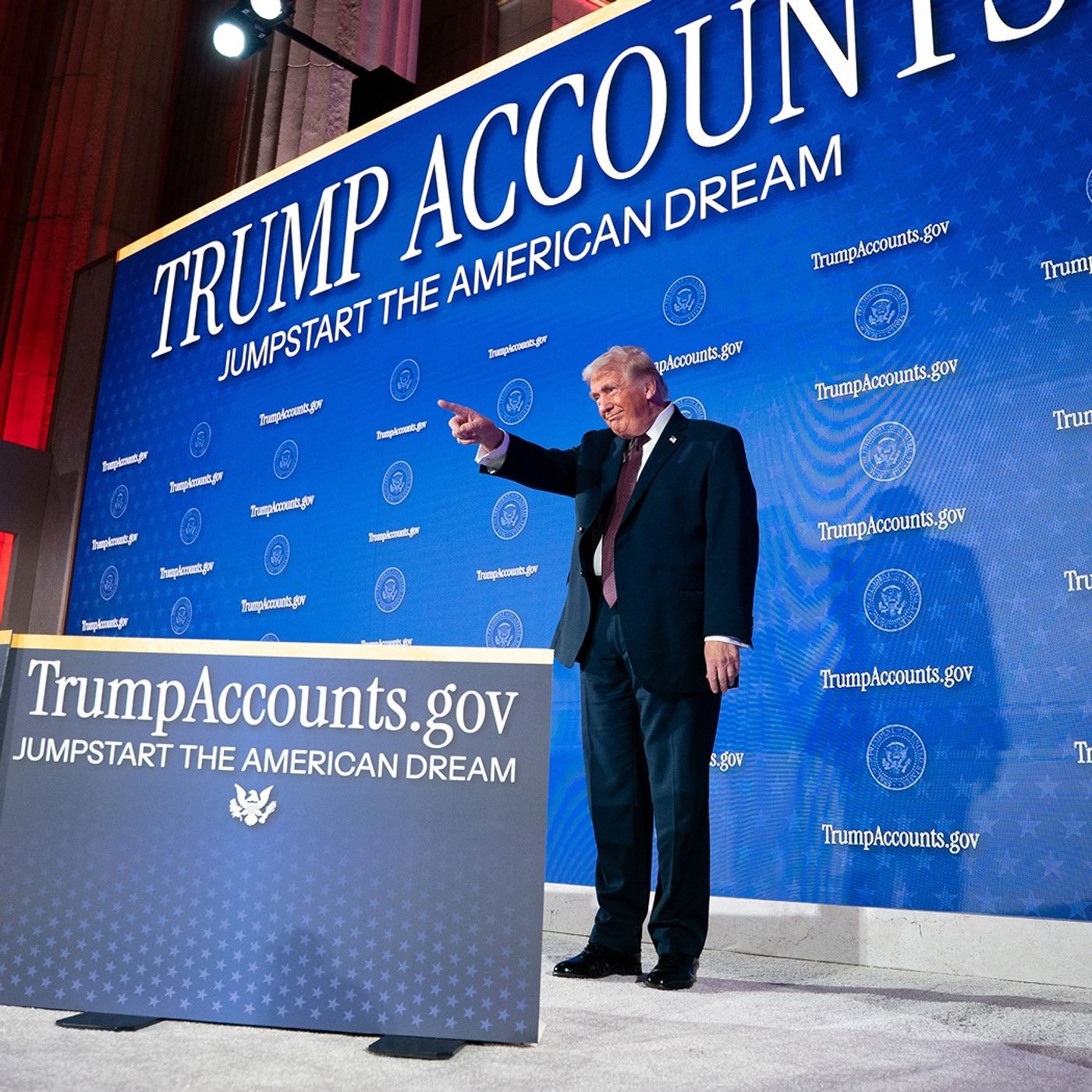
The Daily
Could ‘Trump Accounts’ Actually Close the Wealth Gap?
00:31:19
The investment accounts created in last year’s tax bill allow babies to receive a $1,000 deposit from the federal government.
Loading summary
Transcript142 lines
- [00:00]
Apple Card Advertiser
This message is brought to you by Apple Card. Apple Card puts the power of titanium in the palm of your hand. What does that mean? It means the power to earn unlimited daily cash back on your purchases every day. It means a materially different credit card accepted anywhere in the world. MasterCard is accepted. Ditch the plastic upgrade to titanium. Apply in the wallet app on iPhone. Today, subject to credit approval, Apple Card is issued by Goldman Sachs Bank USA Salt Lake City Branch terms and more at applecard.com
- [00:31]
Zolan Kano Youngs
from the new York Times, I'm Zolinkano Youngs filling in as host. And this is the Daily I want
- [00:38]
Claire Kane Miller
to stand next to these soon to be very rich people.
- [00:43]
Zolan Kano Youngs
Earlier this month in the Oval Office, surrounded by kids, President Trump rang a ceremonial bell to open the stock market. So today, with the ringing of the opening bell for the stock market, those accounts will now begin to grow right
- [00:59]
Claire Kane Miller
along with our booming economy.
- [01:01]
Zolan Kano Youngs
He announced the start of so called Trump Accounts, a new investment device that could eventually address the nation's wealth gap. We're giving this money to children so
- [01:11]
Claire Kane Miller
they can have a good life very early on. They can have a good life.
- [01:17]
Zolan Kano Youngs
Today. My colleague, Claire Kane Miller on how these accounts actually work, why they have bipartisan support, and why even weeks after their launch, so many Americans have yet to sign up for free Money. It's Friday, July 24th. Hello, Claire.
- [01:41]
Claire Kane Miller
Hi.
- [01:42]
Zolan Kano Youngs
I'm so glad that you could join us today because when we talk about Trump's signature piece of legislation of this second term, what he calls the big beautiful bill, we typically talk about tax cuts, we talk about IC funding, hiring border patrol agents. But tucked into this enormous piece of legislation is an initiative that I know you have been focusing on, and that's Trump accounts. Clara, as someone who covers families and the public policy that affects them, can you tell me where this idea came from? This idea of Trump branded investment accounts for children? Where do we start? Here?
- [02:19]
Claire Kane Miller
Sure. So the general idea is that babies and children can start investing in the stock market. And babies born during Trump's second term get $1,000 from the federal government to do so. The idea is actually decades old. It's trying to address the fact that many Americans aren't in the stock market at all. And so they're missing out on that wealth building. And it contributes to a wealth gap between, you know, kids from poor and rich families, kids from black and Latino families and white families. And so the general idea is try to shrink that, to give a chance to invest starting when they're really young so that they have more Time for that investment to compound and grow.
- [03:06]
Zolan Kano Youngs
And this is essentially free money. People don't need to pay for this. This is just money that's out there that they can take advantage of.
- [03:12]
Claire Kane Miller
That's right. All they need to do is open a Trump account.
- [03:14]
Zolan Kano Youngs
You mentioned that there was also a history behind this kind of idea, even before Trump announced it as well. Can you take me through a little bit of that history?
- [03:23]
Claire Kane Miller
Sure. So this idea started several decades ago, and there are a few states that have experimented with. Two examples are Oklahoma, where some kids, as part of an experiment, have received money to invest in the stock market, and Maine, where a philanthropist has pledged to give every baby born a certain amount of money to invest in the stock market. Some cities have also done this, and they're mostly going into college savings accounts like 529s. And the idea, interestingly to me, has bipartisan support. Both Democrats and Republicans have supported the general idea. They might disagree on some of the specifics of how the policy works, but the idea of allowing children to start investing in the stock market when they're young appeals to both parties. And it's one that people have been trying to get in to the mainstream for decades now.
- [04:19]
Zolan Kano Youngs
That's interesting.
- [04:20]
Claire Kane Miller
More recently, there were two bills, one from the right and one from the left, trying to start these accounts.
- [04:26]
Dan Tabersky
One.
- [04:26]
Claire Kane Miller
One was from Cory Booker, a Democrat, who proposed the idea of baby bonds, where all babies would get a certain amount and then babies born in low income families would get even more to try to close that wealth gap. And then another idea came from someone on the opposite side of the aisle, Ted Cruz, who proposed an idea that looks very much like the version of Trump accounts that we now have in this bill.
- [04:53]
Zolan Kano Youngs
Ted Cruz and Cory Booker, two people not exactly always meeting and agreeing on the same policy. But here we have this rare case of bipartisanship, Right.
- [05:02]
Claire Kane Miller
And I think it reflects something that I've been observing covering family policy, which is that politicians in general talk about the importance of family. They talk a lot about family values. But in general, Democrats have been more willing to invest government resources in family policies, things like paid family leave or universal childcare or an expanded child tax credit. More recently, though, Republicans have been more willing to do that, realizing that if they want to address some of their priorities, like banning abortions and increasing fertility, that working families might need some help. And this policy is one way that they thought they could do that.
- [05:44]
Zolan Kano Youngs
It seems like what you're saying is both parties have stated this focus on helping working families to different ways of actually doing that. But recently we are seeing both parties coalesce around one similar idea. These Trump accounts.
- [06:00]
Claire Kane Miller
Exactly.
- [06:02]
Zolan Kano Youngs
Now, how did this idea then get on the President's radar?
- [06:06]
Claire Kane Miller
So there are people on the right who have been loudly advocating for accounts like these. And they got the Trump administration's ear during the writing of the tax bill. There's a group called Invest America that had this idea. And from what I understand, it appealed to people in the administration for two main reasons.
- [06:28]
Zolan Kano Youngs
Okay.
- [06:29]
Claire Kane Miller
One is that it relies on the free markets to grow money for Americans instead of just government handouts. Though babies born in his second term do get the $1,000, it's mostly about the compounding returns from the stock market instead of using taxpayer money to support families and children. A second reason is that it gives people choice on how they spend the money. Republicans have generally been opposed to family policies that only provide for one way of caring for children. For example, subsidized child care, which some worry encourages parents to work outside the home. Instead, they prefer policies that provide choice, basically giving families money so that they can choose for themselves and their children how they spend it.
- [07:15]
Zolan Kano Youngs
Okay, Claire, you started to get into this, but what is the idea exactly? What are these accounts? What's the process for it?
- [07:22]
Claire Kane Miller
So anyone under 18 can have an account opened in their name. The law says that the money must be invested in low cost index funds, which basically means that for minimal fees, they're accessing the broad stock market. If children are born since January 1, 2025, and they have an account open in their name, they'll automatically get the $1,000 from the federal and families friends. Employers can donate also, philanthropists can. So the Dells behind the Dell computer Fortune have donated $250 to most children who aren't eligible for that $1,000 from the federal government to try to seed these accounts.
- [08:05]
Zolan Kano Youngs
Wow.
- [08:06]
Claire Kane Miller
And parents could have checked a box on their tax forms in April to open these accounts. Or they can go to IRS.gov and get a tax form. And a new thing is that when parents of newborns register Social Security number at the hospital, they will also get a chance to open a Trump account for their baby.
- [08:24]
Zolan Kano Youngs
Okay.
- [08:25]
Claire Kane Miller
When the child is 18, they then become an IRA, which is essentially an account that can only be used for certain purposes. Retirement, college, buying a first home, things like that. If someone tries to withdraw money from the account for a different purpose, they're assessed a penalty.
- [08:44]
Zolan Kano Youngs
Fascinating. Okay, so Claire, you mentioned that in part one goal of this is to address the wealth gap, right?
- [08:50]
Claire Kane Miller
Right.
- [08:50]
Zolan Kano Youngs
I Just want to take a step back here. What exactly is the difference between the wealth gap and the income gap?
- [08:57]
Claire Kane Miller
So we've heard a lot about income inequality in the United States, which is the vast difference between what the lowest paid workers earn each year and what the highest paid workers, like CEOs and billionaires earn. That's about how much you earn from your job. But wealth refers to savings and assets. These are like retirement accounts, a brokerage account with your savings in it, the house that you own. So the gap between the least wealthy Americans and the most wealthy Americans is even larger than the gap in how much they earn.
- [09:34]
Zolan Kano Youngs
Right, Right. Your wealth is basically your net worth, which would cover your long term savings, rather than just what you would earn in a given year.
- [09:41]
Claire Kane Miller
That's right. And this matters for things like eventually retiring or, or paying for college. But it also matters in an important day to day way because having these kind of savings provides a buffer. If your car breaks down, if you have an unexpected health care expense and you have no savings, that's an incredible stress for your family that can plunge you into poverty. And research has found that even just knowing that a family has some savings like that can decrease the stress in the family even when there's not a financial emergency.
- [10:14]
Zolan Kano Youngs
I hear you on that. We're talking about this being a buffer. Right. But I can't help but think now that also this piece of legislation was criticized for also cutting the social safety net, cutting programs that many of the needy relied on, like food stamps. So I can imagine some folks looking at the cost of this program and asking, well, wait, why not get immediate cashier? Like what good is sort of an investment in a long term plan to address the wealth gap when I've got bills to pay right now? So is this, which is more long term, a solution? What's the argument for that?
- [10:55]
Claire Kane Miller
It's a good question. And the people who I talk to who advocate on behalf of families and addressing child poverty would say both are needed. They really serve different purposes. And giving families cash now, which happens in the form of the child tax credit, which the Trump administration did expand slightly.
- [11:14]
Zolan Kano Youngs
Right.
- [11:14]
Claire Kane Miller
This helps with day to day needs, like getting food on the table, filling up your car with gas, making sure your children have winter coats. These kind of things are very important. And it could be frustrating to have your child get an account that the Trump administration puts $1,000 in, but you can't access it, even though you can't afford to feed your children right now.
- [11:36]
Zolan Kano Youngs
Right, right, right.
- [11:37]
Claire Kane Miller
And so the, the long term savings accounts is that if you get $1,000 as a newborn now, it could be worth $6,000 if no more money was put in by the time they're 18. And so taking advantage of the compounding returns of the stock market could really serve people well. But it doesn't mean that families don't also need help in the form of day to day assistance now. And people who study this field and craft these policies mostly say that both are necessary.
- [12:08]
Zolan Kano Youngs
But you're talking about, when it comes to the Trump accounts, you're talking about the idea of money that's building. Right. Like that's what you're talking about when it comes to compound interest. You may put this money away and it may be frustrating to not use it in the near term, but also that money's gonna grow over the long term.
- [12:22]
Claire Kane Miller
Right. It's helping your child when they're an adult versus helping your child right now. And so it's just serving a very different purpose. And there's another real benefit of these kinds of savings accounts, researchers told me, which is that a lot of families use them to save for college. A lot of the states and localities that already have them, they go into college savings accounts specifically for that purpose. And even small amounts of money can really change children's attitudes towards education.
- [12:50]
Zolan Kano Youngs
You're saying, look, even if you initially put away $250, that isn't enough to pay for college, as we know. But maybe it starts to change the mindset a little bit.
- [13:02]
Claire Kane Miller
That's right. What the researchers have found is that even having a few hundred dollars in a college savings account makes parents talk about education differently. It gives middle schoolers and high schoolers a college going mindset just to know that this exists because it makes people more optimistic about the future and it gives kids literacy in the idea of what the stock market is. I think a lot of people, you know, even when they're 18, are overwhelmed by the stock market, perhaps scared of it, don't really know what to do if they're offered their first chance.
- [13:34]
Zolan Kano Youngs
They got a lot going on at that age as well.
- [13:36]
Claire Kane Miller
Right.
- [13:36]
Zolan Kano Youngs
You're overwhelmed, you're figuring it out. You're growing up.
- [13:39]
Claire Kane Miller
Yeah. And you've never invested in stocks. You don't know what a retirement account is. And a big piece of this that the Trump administration is pretty proud of is financial literacy education. They're trying to get a lot of states. Oklahoma is the first one to put financial literacy into the public school curriculum related to Trump accounts have some stuff online that's aimed at teaching kids what stocks are and what investing is and why to invest. And the hope is because the earlier you invest, the more money you'll make, that this will get more people, more Americans comfortable with it and able to do it and take advantage of it.
- [14:18]
Zolan Kano Youngs
Okay, so the benefits of this actually seem pretty clear. You have money that could be growing over time. You have people that are thinking about long term plans like, like college from a young age. You're almost changing the vibe. The atmospher at a home, there's bipartisan support for it. Are we seeing that reflected in how the public is responding to it?
- [14:40]
Claire Kane Miller
Right. So these accounts are potentially a political win for the Trump administration and beneficial for many families in the United States. The concern is whether the families that are opening them are necessarily the families who would benefit most. And right now, it doesn't seem so. And the question is why?
- [15:15]
Zolan Kano Youngs
We'll be right back. This podcast is supported by the American Petroleum Institute. Energy security affects how Americans live, work, travel, and stay connected. America has abundant oil and natural gas, but resources alone are not enough. The country needs modern infrastructure like pipelines and transmission lines that can affordably and safely bring energy to families, communities and businesses. That's how to build a stronger, more reliable energy system for the future. Learn more@energysecurityframework.org this podcast is supported by Audible.
- [16:03]
Dan Tabersky
Hey, Dan Tabersky here. I'm a podcast host, a journalist, and now with my newest project, the author of my own manifesto. Well, it's a manifesto about manifestos, my search for inspiration in a world that feels more infuriating, more out of its freaking mind with each passing hour. Manifestos are a call to action, an artful scream. They capture our anger and they try to do something with it. This is my attempt to take the manifesto back from mass shooters and nihilists and return it to its rightful place with the warriors, the visionaries, the regular folks with just the right amount of crazy. I compare notes with radicals, secessionists, Internet trolls out for a laugh, and punk singers screaming their guts out, all trying to turn their anger into the world they want to see. Listen to Manifesto wherever you get your podcasts. Audible subscribers can binge all episodes of Manifesto early and ad free right now. Join Audible in the Audible app or by subscribing on Apple podcasts.
- [17:02]
Zolan Kano Youngs
Okay, so there's money on the table, but people aren't enrolling. What do you mean when you say that people who would benefit from this program the most aren't signing up?
- [17:11]
Claire Kane Miller
Yeah. So so far, the government has said that about six and a half million children have had Trump accounts opened in their name, which is a lot of kids, but it's less than 10% of eligible kids.
- [17:23]
Zolan Kano Youngs
Wow. So that's not as much as I would expect.
- [17:26]
Claire Kane Miller
Right. And of those who can receive the $1,000, only about a quarter of them have open Trump accounts.
- [17:35]
Zolan Kano Youngs
Okay, just a quarter. That's striking. And are there any numbers that get at the most needy people as well, and just how much they know about this?
- [17:45]
Claire Kane Miller
So the administration has said that because of privacy concerns, it's not able to tell the demographics of who have opened accounts. But the data that is out there from a variety of sources does suggest that the poorest families have not done so.
- [18:01]
Zolan Kano Youngs
I mean, just hearing that, those would seem to be the people that this program would maybe benefit the most. The people least likely to invest in the past.
- [18:11]
Claire Kane Miller
No, that's right. So there are a few challenges there. The Trump administration does emphasize that families across the income spectrum have opened accounts, but the way that many families did it, first of all, was by checking a box on their tax returns in April. And there are families, many families in America, who don't earn enough to pay income taxes.
- [18:32]
Zolan Kano Youngs
Okay, so that's one hurdle.
- [18:33]
Claire Kane Miller
That's one hurdle. Another is the awareness. We had a survey by Public first that looked at who has heard about these accounts and then who really knows what they are. And it found that just 10% of the poorest families were even aware that these accounts existed.
- [18:51]
Zolan Kano Youngs
Money out there that would be available for families, but people actually don't know about it yet.
- [18:56]
Claire Kane Miller
That's right.
- [18:58]
Zolan Kano Youngs
What's going on here?
- [19:00]
Claire Kane Miller
Well, to start, these accounts are new. And while parents have been able to sign up for them for a while, they only opened for investments on the 4th of July. So earlier this month.
- [19:11]
Apple Card Advertiser
Okay.
- [19:11]
Claire Kane Miller
And the Trump administration has been really focused on just standing up the accounts, which happened in a very short period of time. They told me that they're now turning to outreach. There was a Super bowl ad. They're putting up billboards in areas of the country that are underrepresented in signups. They're trying to incorporate some of this into public school curriculum, into hospitals where babies are born to tell parents about them. And so they have said that it's really a priority to reach more American families, but the rollout has been a little bit scattered.
- [19:44]
Zolan Kano Youngs
Scattered? Scattered how?
- [19:46]
Claire Kane Miller
Well, there are some disagreements on the right. About the goal of these accounts and how to talk about them.
- [19:52]
Dan Tabersky
We're making people part of the system. We are Increasing financial literacy.
- [19:57]
Claire Kane Miller
For example, the treasury secretary, Scott Besant, who's been a huge proponent of these
- [20:01]
Dan Tabersky
accounts, I think it's a great thing,
- [20:04]
Claire Kane Miller
at one point on stage at a Breitbart news event, said that they were a backdoor to eventually privatizing Social Security.
- [20:11]
Dan Tabersky
Social Security. If all of a sudden these accounts
- [20:14]
Zolan Kano Youngs
grow and you have in the hundreds of thousands of dollars for your retirement, then that's a game changer.
- [20:22]
Claire Kane Miller
And then immediately had to walk that back.
- [20:24]
Dan Tabersky
It is a complement to Social Security, not a replacement.
- [20:30]
Claire Kane Miller
But there's another split on the right, too, which is that the populist wing of the party has become much more in favor of the the government using its money to help families. But the more traditional Republicans, who are hesitant to spend government money are not thrilled about the idea of a government handout in the form of these $1,000 contributions to babies born during his second term. Another goal, as we've been talking about, is to reduce the wealth gap. Yet the way the law is written, unlike the policies that Democrats have proposed, actually restricts donors from choosing who gets money based on income. They cannot give money specifically to kids whose parents are below a certain income.
- [21:14]
Zolan Kano Youngs
Okay.
- [21:14]
Claire Kane Miller
And then there's also the goal of reducing the racial wealth gap. And what we know is that about 60% of Americans own stock, and they are more likely to be white, to have college degrees, and to earn high incomes. And so the stock market has now become the biggest driver of the racial wealth gap, which is the amount of savings and other wealth that black and Hispanic people have versus white people. This is something that the Trump administration has talked about almost. Not at all. As we know, it has worked very hard to end diversity, equity, and inclusion measures.
- [21:51]
Zolan Kano Youngs
Right. This is an administration that has almost made just the term equity a stigma in a way, you know, and has tried to remove that term from grant applications. It strikes me as surprising that they would go out and sell a policy that has Trump's name on it as an equity policy, even if that might be part of the impact of it. Addressing the racial wealth gap.
- [22:13]
Claire Kane Miller
That's exactly right. So instead, they focused on something else, which is just the incredible success of the US Stock market. The idea that the US Stock market is a really powerful way to build wealth, and the idea that every American child should be a shareholder. Instead of talking about children who are poor, who are black and Latino, who may not be able to access that wealth, they're just talking about how every American child should. Should be able to get into the stock market.
- [22:39]
Zolan Kano Youngs
It seems like they're still trying to figure out the right way to talk about this, but I guess the person at the center of this is the messenger is President Trump. How consistent has he been when it comes to getting the message out here?
- [22:54]
Claire Kane Miller
From what I've heard, people on the right think that addressing the struggles of working families and the affordability crisis is really, really key for the president because working families are having such a tough time right now. But them say that the president is not paying enough attention to those issues. And even the things that he has done, like these Trump accounts, like expanding the child tax credit, he's not talking much about them.
- [23:19]
Zolan Kano Youngs
I'll say this. This is a little bit of Groundhog Day for me, in a way. I do usually cover the White House, and I feel like, you know, we've heard him get blowback from his America first supporters, that they want him to focus more on the daily needs of Americans. And often it's Trump aides themselves who will say, you know, this is gonna be the speech where he focuses economic policies, and he ends up launching into a list of grievances or sort of the more red meat issues. And look, we saw this just this week.
- [23:49]
Dan Tabersky
It is an honor for me to
- [23:51]
Claire Kane Miller
welcome you to the Cobb County School District.
- [23:54]
Zolan Kano Youngs
President Trump traveled to Georgia. The White House had been billing this event as a speech that was going to be focused on Trump accounts. You're going to hear a lot more
- [24:02]
Claire Kane Miller
because it's so important.
- [24:04]
Zolan Kano Youngs
Trump account.
- [24:06]
Dan Tabersky
Thank you.
- [24:07]
Claire Kane Miller
That does deserve an applause.
- [24:08]
Zolan Kano Youngs
It did seem like Republicans want to talk about it, especially local Republicans who spoke before him, who had a very focused message, but President Trump took the stage.
- [24:18]
Claire Kane Miller
Well, thank you very much, everybody. It's a special place.
- [24:21]
Zolan Kano Youngs
And spoke for more than an hour and 20 minutes, and only 10 minutes of that was actually focused on this policy.
- [24:28]
Claire Kane Miller
It's called the Trump accounts, and it's hot as a pistol.
- [24:31]
Zolan Kano Youngs
It didn't take long for him to start talking about Iran, to start talking about Joe Biden, Sleepy Joe Biden and
- [24:37]
Claire Kane Miller
the radical left Democrats.
- [24:39]
Zolan Kano Youngs
They're Democrats. D U m. It does seem like there's opportunities to get out there and talk about this policy, but President Trump has never really been known as having a consistent message, particularly on economic issues. So then I guess I'm wondering, is the president himself a hurdle to this policy?
- [25:00]
Claire Kane Miller
He is, in the sense that we're seeing from reporting that the Trump branding on these accounts is. Is very polarizing. These accounts went by various names during the drafting of the bill, and the official name is a530A account. But right before the Republican tax bill was passed, the name was changed to Trump Accounts. And this, it turns out, has been a turnoff for some of the parents who could be opening them for their children.
- [25:30]
Zolan Kano Youngs
Trump's name is a turnoff to some families, you're saying?
- [25:33]
Claire Kane Miller
That's right. We've heard from many people that it actually is preventing them from wanting to sign up. And this is showing up in surveys, too. There are also some trust issues that we've heard. Will these actually be funded? Trump has a history of defaulting on his debts, so there are other hurdles as well.
- [25:51]
Zolan Kano Youngs
I do realize that the President has low approval numbers right now, that he's incredibly polarizing. But when we're talking about essentially free money being out there, I mean, that is. That is pretty striking.
- [26:04]
Claire Kane Miller
Yeah. And he's really branding these. Another funny thing is that the tax form from the IRS used to sign up for these is number 4547, which all signs point to being named after his presidencies.
- [26:16]
Zolan Kano Youngs
I think that's a fair assumption there. Okay, so we've talked about the hurdles to enrollment here.
- [26:22]
Claire Kane Miller
Yeah.
- [26:23]
Zolan Kano Youngs
What could the government do to get over some of these hurdles and actually increase enrollment?
- [26:29]
Claire Kane Miller
The biggest thing they could do, and this is according to researchers who have studied the way that these kinds of accounts work in other places, is auto enroll children.
- [26:38]
Zolan Kano Youngs
Okay.
- [26:39]
Claire Kane Miller
Right now, parents have to sign up, and when they have to do that in other places, a minority do, just like we're seeing with Trump accounts. But in those other places, like Maine and Oklahoma, when babies were automatically enrolled in accounts, giving parents the chance to opt out instead of forcing them to opt in, almost none of them did. There was 99% or 100% participation.
- [27:01]
Zolan Kano Youngs
Wow. Seems like they should be doing auto enrollment. Why aren't they doing it?
- [27:05]
Claire Kane Miller
There are a few reasons. It's a huge task to take on for all the children in the United States. There is a small fee associated that the government has to pay with opening these accounts. There are also some privacy issues. There are laws about sharing information, identifying information across government agencies, which would need to be done between the IRS and the Social Security Administration. And another reason seems to be that despite these accounts being available to anyone under 18, they are most beneficial if you invest early.
- [27:38]
Zolan Kano Youngs
Right.
- [27:39]
Claire Kane Miller
If you are a baby or a toddler when you start investing. And so there is some concern in the Trump administration about opening accounts that some families might never invest in or which the children are older and they might not have as much time to
- [27:51]
Zolan Kano Youngs
see, compounding returns okay, so I'm hearing a couple different reasons. It seems like we've got some privacy laws, also some costs for auto enrollment that the administration would have to pay. But what's the cost of not doing these things and maintaining sort of the course as we've seen it thus far?
- [28:09]
Claire Kane Miller
The risk is that it could do the reverse of what these are aimed at and actually widen the wealth gap. Because the parents who are financially sophisticated, who are already investing in the stock market on behalf of their children, who are hiring tax accountants to help them with their income taxes, those are the people who are going to sign up, the people who can afford to contribute to these, who maybe work for big white collar employers who are also going to contribute. And if the poorer families, the ones who are not already in the stock market are the ones who aren't signing up, these could end up widening the wealth gap instead of shrinking it.
- [28:47]
Zolan Kano Youngs
I just want to pause you here because we started this conversation by talking about how this could be a means to address that wealth gap, address a disparity, help those that were not prone to invest. That person at the dinner table who might not be talking about this with their family because they don't actually have an account like this, they don't have money in the bank. But what you're saying is there is a risk here of actually undermining the whole goal of this thing.
- [29:17]
Claire Kane Miller
That's the concern. And I will reiterate that the Trump administration has told me in several ways that reaching low income families who would benefit most is a top priority. I don't think the goal here is to leave them out.
- [29:32]
Zolan Kano Youngs
Right.
- [29:32]
Claire Kane Miller
But as of now, those are the families with the least awareness and perhaps the least comfort with opening these accounts.
- [29:39]
Zolan Kano Youngs
The goal might not be to leave them out, but the design of this program is what's going to determine who actually takes advantage of it.
- [29:47]
Claire Kane Miller
Right. That's the big concern here.
- [29:48]
Zolan Kano Youngs
It kind of seems like a double whammy in a way. Right. We talked about how this bill, this legislation, had a cost. Right?
- [29:56]
Claire Kane Miller
Right.
- [29:56]
Zolan Kano Youngs
There were major cuts to the social safety net to actually pass this legislation, which has this program that seems to have all of this bipartisan support. And now we're describing a scenario where the people who relied on that social safety net and saw it cut, they might not be able to reap the rewards.
- [30:17]
Claire Kane Miller
So worst case scenario, this program just becomes another way for wealthy families to invest in the stock market on behalf of their children, or if it is successful in the way that many policymakers imagined, could become a way that the next generation of adults, those babies being born right now, enter adulthood in a more secure spot, more able to pursue higher education or buy a home or do many of the things that young people are saying today that they can't do. And it could be something that doesn't just define this presidency, but changes the way that we think about wealth building and working families for generations to come.
- [31:01]
Zolan Kano Youngs
And.
- [31:01]
Claire Kane Miller
And all of that is likely to be shaped over the next few months and years.
- [31:08]
Zolan Kano Youngs
Well, Claire, thank you so much for breaking this down.
- [31:12]
Claire Kane Miller
Thanks for having me.
- [31:26]
Zolan Kano Youngs
We'll be right back. This podcast is supported by Audible.
- [31:32]
Dan Tabersky
Hey, Dan Tabursky here. I'm a podcast host, a journalist, and now with my newest project, the author of my own manifesto. Well, it's a manifesto about manifestos, my search for inspiration in a world that feels more infuriating, more out of its freaking mind with each passing hour. Manifestos are a call to action, an artful scream. They capture our anger and they try to do something with it.
- [31:55]
Claire Kane Miller
It.
- [31:56]
Dan Tabersky
This is my attempt to take the manifesto back from mass shooters and nihilists and return it to its rightful place with the warriors, the visionaries, the regular folks with just the right amount of crazy. I compare notes with radicals, secessionists, Internet trolls out for a laugh, and punk singers screaming their guts out, all trying to turn their anger into the world they want to see. Listen to Manifesto wherever you get your podcasts. Audible subscribers can binge all episodes of Manifesto early and ad free right now. Join Audible in the Audible app or by subscribing on Apple Podcasts.
- [32:30]
Apple Card Advertiser
This podcast is supported by Memorial Sloan Kettering Cancer Center. What if cancer could be treated without surgery, radiation, or chemotherapy? At MSK, it's already happening. In a small, groundbreaking clinical trial, 100% of participants saw their cancer completely vanish using immunotherapy alone. This MSK giving day, your gift will be triple matched to make the seemingly impossible breakthrough possible. Bring hope to people impacted by cancer. Give now@msk.org thedaily
- [33:06]
Zolan Kano Youngs
here's what else you need to know. Today, the Trump administration said it would impose tariffs of around 10% on goods for more than 80 countries starting Friday. It was the president's latest effort to replace tariffs that were struck down by the courts. And the president added a major new condition to his nuclear agreement with Saudi Arabia, one that threw its future into doubt. The president demanded that Saudi Arabia establish diplomatic ties with Israel, a condition that will be difficult to meet. Saudi Arabia has said it would only work with Israel once Israel created a pathway for a Palestinian state, something Israel has firmly opposed since the October 7th attacks. And finally, the Justice Department has withdrawn subpoenas that sought phone records and grand jury testimony from New York Times journalists who reported on the security capabilities of President Trump's new Air Force One. The decision came after a federal judge grilled Trump administration lawyers in court on Thursday over their handling of the subpoenas, which the Times has sought to quash. Today's episode was produced by Adrian Hurst and Eric Krupke, with help from Diana Wynne. It was edited by Chris Haxel with help from Michael Benoit, and contains music by Marian Lozano. Our theme music is by Wonderly. This episode was engineered by Chris Wood. That's it for the daily I'm zolan kano youngs. See you on Sunday. This podcast is supported by bank of America Private Bank. Your ambition leaves an impression what you do next can leave a legacy. At bank of America Private bank, our wealth and business strategies can help take your ambition to the next level. Whatever your passion, unlock more powerful possibilities@privatebank.bankofamerica.com what would you like the power to do? Bank of America Official bank of the FIFA World Cup 2026 bank of America Private bank is a division of bank of America, NA Member, FDIC and a wholly owned subsidiary of bank of America Corporation.