← The Daily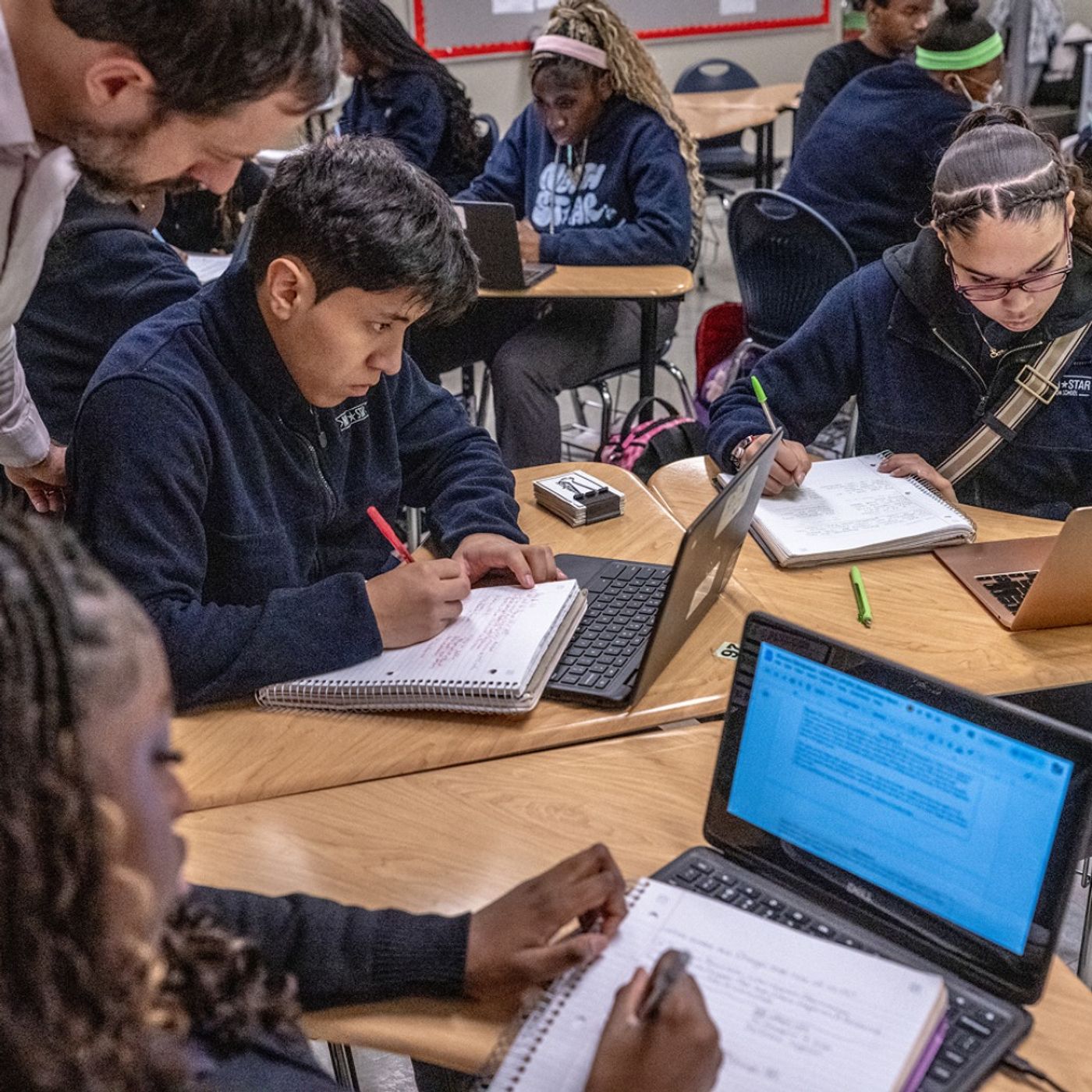
The Daily
The Battle Over A.I. in the Classroom
00:31:51
With the school year ending, all over the country educators and parents are taking stock of the drastic shift caused by artificial intelligence in the classroom. Today, Natasha Singer, a technology reporter, discusses the year that reshaped American classrooms and how one dedicated teacher helped his students chart their own path into an uncertain future.
Loading summary
Transcript168 lines
- [00:00]
Everpure Sponsor
This podcast is supported by Everpure. When your data is scattered across different systems, your AI initiatives can't deliver results. Why? Because your AI is only as good as the data behind it. Everpeer unifies your data into a single secure platform. Less hunting, more delivering. With all your data together, it's AI ready in minutes, not days. Welcome to a new era of data management@everpuredata.com
- [00:28]
Rachel Abrams
from the new York Times, I'm Rachel Abrams, and this is the Daily. With the school year ending, educators and parents all over the country are taking stock of the earthquake that is AI in the classroom today. My colleague Natasha Singer talks about the year that reshaped American classrooms and how one dedicated teacher helped his students chart their own path into an uncertain Future. It's Wednesday, June 17th.
- [01:10]
Host (likely Michael Barbaro or similar)
Natasha Singer, welcome back to the Daily.
- [01:12]
Natasha Singer
Thanks for having me, Rachel.
- [01:14]
Host (likely Michael Barbaro or similar)
So the school year is done for most students across the country, and it's been a really contentious year when it comes to one topic in particular, which is AI in the classroom, something that you have been covering. Can you summarize for us what the fight is over specifically, and when did it really get started?
- [01:32]
Natasha Singer
You know, Rachel, I've been covering tech in schools and Tech Industry Influence in schools for the New York Times for more than a decade, and I've never seen the kind of parent backlash about school tech that we're seeing. And particularly, as you pointed out, AI is becoming the new flashpoint. And I think that it's partly because of the context. First of all, there are massive concerns about cheating. Students tell me they're sitting in the front row of class, and the kids in the back row have got their Chromebooks open. And whenever a teacher asks a question, the kids in the back are looking up the answers on Gemini or ChatGPT. And if they get called on, they're just reading the AI answers.
- [02:08]
Anna Foley
Wow.
- [02:08]
Natasha Singer
And so there are all these concerns that these AI tools could pose serious risk to kids learning to kids critical thinking. And so that's part of what the fight is about. And at the same time, you're getting this massive push from tech companies like Google and Microsoft and OpenAI to get their check chatbots into schools. And you're also seeing the White House pushing for AI education. This next executive order relates to artificial intelligence education.
- [02:37]
Listener Andy
Sir.
- [02:37]
Natasha Singer
The White House issued this executive order on AI education toward the end of the last school year, and it was called Advancing AI Education for American Youth.
- [02:49]
Unidentified Commentator
That's a big deal because AI is where it seems to be at. We have literally trillions of dollars being invested in AI.
- [02:58]
Natasha Singer
The Trump White House was saying, if America wants to remain on the cutting edge, then we need kids to learn how to use these AI tools.
- [03:06]
Unidentified Commentator
AI is the way to the future. I don't know if that's right or not, but certainly very smart people are investing in it heavily.
- [03:13]
Natasha Singer
It was a call to action, but it didn't have a lot of direction on what to do. And so that left a great opportunity for tech companies to come in and shape what was happening. At Microsoft, we believe delivering. At Google, we see AI as the most profound way. It's called the AWS education. And so the next thing that happens is you have dozens of companies signing up. Today we are making new commitments by providing K12 students, teachers and staff with broader access than ever before. And those companies are like Anthropic and Amazon and Nvidia and Meta and Microsoft and Oracle and OpenAI. Like all the companies who are invested in tech, step up and say we have the technology and the expertise and the funds to drive AI education. And the goal really is to give away up to $100 million in technology. $150 million will go towards grants to support AI education. There's nothing more important than education. Focusing on education is the center of,
- [04:16]
Host (likely Michael Barbaro or similar)
of where we need to go, because
- [04:19]
Natasha Singer
it is all of these young people,
- [04:22]
Host (likely Michael Barbaro or similar)
they literally have to embrace it.
- [04:26]
Natasha Singer
But AI education is so new, nobody really knows what it is, and everybody has different definitions.
- [04:32]
Host (likely Michael Barbaro or similar)
So basically, in the absence of very specific guidance from the White House, that leaves a vacuum for all these other stakeholders, if you will, to come in and try to shape how AI is being used in the classroom.
- [04:44]
Natasha Singer
100%.
- [04:45]
Host (likely Michael Barbaro or similar)
Okay? So these big tech companies want to get their technology into schools, which we know they have done before. I am probably one of many people who remembers being a kid and suddenly seeing these big colorful imacs that just appeared in classrooms. So on some level, this is not a totally new phenomena.
- [05:04]
Natasha Singer
This is a really important point because we see these tech hype cycles in school driven by companies who have products and they want to get their products in front of kids, because kids are the next generation of consumers. If you can train a second grade generator on your tool, you have them for life as a customer. And we should look at these, because when schools got laptops, in the beginning, there was a big push for what they called computer literacy, like learn how to use a computer. And then as social media was taking off, we got social media literacy in schools. And then there was this brief moment after Meta changed its name where there was a campaign for metaverse literacy. And now we have this huge push for AI literacy when we have sparse evidence that many of these past tech literacies had educational benefits for kids.
- [05:49]
Host (likely Michael Barbaro or similar)
Can you talk about what that rollout of AI in schools actually looks like? What are we actually seeing happening with students?
- [05:57]
Natasha Singer
So that's a really important question. It's also difficult to answer because each school district is doing its own thing. The most prominent example is Miami Dade County Public Schools, which is the third largest US school district. And they were very careful. They spent months having their own technology experts test tech tools to see what they thought had the best guardrails for students. And then they spent months training teachers how to use these tools. And I sat in on some of those trainings. And so you have a district that basically geared up for a year before they decided to introduce Gemini, Google's chatbot for more than 100,000 high school students. So that was a very careful rollout. They started very, very slowly. And then I think, in contrast, you have the Los Angeles Unified District, which is the second largest school district. They in 2024 announced with huge fanfare, Los Angeles Unified will never waver from putting our students needs first. That they had signed a deal with a startup to make an AI chatbot for students. A new day is dawning in technology and public education. As Los Angeles LA had said, we're going to be a model for the nation in AI use and was going to be called ed. It was really friendly.
- [07:12]
Unidentified Commentator
Hi, everybody, I'm Ed. Hola.
- [07:14]
Scott Kern
Todoes soyed bare of bolorin that would
- [07:17]
Natasha Singer
talk to students and students could ask for help if they were struggling with a math problem, it could give them emotional support. They could check their grades, they could check their test scores. Their parents would be able to use this AI tool.
- [07:29]
Host (likely Michael Barbaro or similar)
We have one of the brightest entities
- [07:31]
Natasha Singer
in the universe, Ed. And so it was billed as this magical thing. Right. And the superintendent said it would democratize access to information.
- [07:39]
Host (likely Michael Barbaro or similar)
A panacea, it sounds like.
- [07:41]
Natasha Singer
Right. But very quickly, within a few months, federal prosecutors came in and charged the founders of this startup that was making the AI tool for Los Angeles schools with defrauding investors.
- [07:53]
Host (likely Michael Barbaro or similar)
Defrauding investors.
- [07:55]
Natasha Singer
Right. And then the startup went bankrupt. And so, you know, that's the end of this tool that LA had chosen as its kind of demonstration product.
- [08:05]
Rachel Abrams
Sure.
- [08:05]
Natasha Singer
And so you have this contrast between Miami, which went methodically and tested many AI tools before settling on one, and la, that went with a small startup that had never made anything of this scale.
- [08:17]
Host (likely Michael Barbaro or similar)
So obviously this rollout of AI in schools has been chaotic. Los Angeles shows the risks of rushing into something quickly. This chaos, though, does seem a bit predictable, right? Because we're talking about technology, that we are only beginning to understand what it is, how to use it, what the risks are. How have parents reacted to all of this?
- [08:37]
Natasha Singer
Well, I have to go back to Los Angeles because soon after this whole fiasco with the chatbot, the Los Angeles parents started a petition called Get Big Tech off Students Desks. Big Tech is the big tobacco of our time.
- [08:53]
Scott Kern
Is it safe, is it legal, and is it effective?
- [08:56]
Natasha Singer
I trusted the school and the district with my child and that you had his best interest at heart. And it wasn't long before he started to come home from kindergarten singing the first songs he learned Grammarly.
- [09:10]
Host (likely Michael Barbaro or similar)
Adds make cursive and typing educational standards and remove all generative AI and AI chatbots immediately.
- [09:19]
Natasha Singer
And more than a thousand people signed this petition. And one of the things that the parents were asking for in their petition is to get the school district to audit all its recent tech contracts. LAUSD must undertake a review of all
- [09:32]
Everpure Sponsor
existing technology products and policies to ensure
- [09:35]
Natasha Singer
they are safe, effective, and legal. So this concern over AI is part of this wave that we're seeing around the country of parents pushing back on school tech.
- [09:49]
Host (likely Michael Barbaro or similar)
So, okay, the AI backlash kind of gets rolled into a broader backlash with AI though. What is a specific complaint about AI?
- [09:57]
Natasha Singer
So I think the concerns about these generative AI tools, right, which can produce texts and images, are Multiple. You've used ChatGPT and other tools. They regularly make stuff up.
- [10:10]
Everpure Sponsor
Right?
- [10:11]
Natasha Singer
And so one of the things is, are they going to misinform students and are students not going to know? The second thing is that you're basically offloading human tasks to a bot. And if you are a child or a student who doesn't know how to think critically yet, or who doesn't know how to use research or doesn't know how to analyze a text passage, then it's like both hindering the development of your own human skills and also creating this result that seems human ish. It's human esque. And we've seen a series of reports and studies cautioning against using AI in education and the problems it could cause. And one of the biggest was a report from Brookings earlier this year in which, you know, they looked at hundreds of studies and they spoke with hundreds of students and teachers and researchers and parents and technologists across the world. And the Brookings report said that, at least for now, the risk of using generative AI in kids education far overshadows the benefits.
- [11:19]
Host (likely Michael Barbaro or similar)
I want to pause briefly here and talk a little bit more about some of those risks that you articulated, because what you are describing as the concern is fundamentally about critical thinking.
- [11:30]
Listener Andy
Right.
- [11:31]
Host (likely Michael Barbaro or similar)
If the assignment is to read Othello and explain what it means, or look at a piece of civil rights law and try to explain how it might apply in a different situation, theoretically what students are being offered is a machine that can do all of that for you. And just to use an imperfect metaphor, if you think of the brain as a muscle that you exercise by learning to think critically in schools, this is a tool that basically takes away that exercise.
- [11:54]
Natasha Singer
Absolutely. It's completely different to read a play like Othello or study primary source documents on the history of the civil rights movement or even listen to a podcast versus getting an AI to synthesize that for you, to summarize that for you, to explain it to you. And parents are saying they want to see more research and more studies about the impact of these tools in schools. And so one of the things we saw right after the LA Chatbot fiasco was the Los Angeles school board just voted to put in restrictions on tech in schools, including, like, no laptops or tablets for kids in kindergarten and first grade. But in New York, we've seen a groundswell of concerns specifically around AI and a huge push to get the school district to put a moratorium on using student facing AI tools and asking for an immediate pause on AI in schools. And one of the things that's remarkable about this polarizing debate is that the folks that are actually in the middle of this, the teachers and the students, are largely left out of the discussion. And so this year, I spent a lot of time going to schools and asking teachers and students what they think.
- [13:14]
Host (likely Michael Barbaro or similar)
We'll be right back.
- [13:17]
Everpure Sponsor
This podcast is supported by Everpure. When your data is scattered across different systems, your AI initiatives can't deliver results. Why? Because your AI is only as good as the data behind it. Everpeer unifies your data into a single secure platform. Less hunting, more delivering. With all your data together, it's AI ready in minutes, not days. Welcome to a new era of Data Management. @everpuredata.com I'm Paul Tanorio.
- [13:45]
Soccer Reporter (The Athletic)
I cover soccer for the Athletic.
- [13:46]
Amy Lawrence
And I'm Amy Lawrence. I cover football for the Athletic.
- [13:49]
Soccer Reporter (The Athletic)
Whatever you call it, the biggest competition in the sport is happening right now, and the athletics World cup coverage has everything you need to follow the tournament.
- [13:58]
Amy Lawrence
There's 48 countries taking part from the tiny island of Curacao to the five time champions, Brazil. Even if you don't know your offside from your onside, if you're eager to know more about the teams, the matches, all the stories on and off the pitch, we've got you sorted.
- [14:12]
Soccer Reporter (The Athletic)
Maybe you're the kind of person who's already up early every weekend waking the neighbors when your favorite club scores. We'll make sure you get equipped with more information, more insight than anyone you know.
- [14:23]
Amy Lawrence
We've got more than 70 obsessive reporters on the ground covering the ins and outs from every game.
- [14:28]
Soccer Reporter (The Athletic)
I almost forgot to mention the best part, Amy. Free access to the Athletics World cup coverage in our app.
- [14:34]
Amy Lawrence
Download the athletic app and see you there.
- [14:41]
Host (likely Michael Barbaro or similar)
Okay, so, Natasha, what have you learned from talking to the people that we have not been hearing from in all of this? Teachers and students?
- [14:48]
Natasha Singer
You know, I spent a lot of time in schools this year and it's absolutely fascinating. I found that more and more teachers and students aren't buying the popular, polarizing narratives that, like, AI is magically going to transform education or AI is going to tragically doom education. You see some students who have deep concerns about AI and you have teachers who are trying to stake out a middle ground and chart a new path for what AI education could look like for their students.
- [15:18]
Host (likely Michael Barbaro or similar)
And what does that path mean? What does it look like?
- [15:21]
Natasha Singer
Well, a great example is a teacher that I started talking with earlier this year. Okay, can you just tell me a little bit about your class and the school you're in? Newark?
- [15:31]
Scott Kern
Yeah, I'm in Newark, New Jersey, at Northstar Academy, which is a charter school. I've been there for a long time.
- [15:38]
Natasha Singer
So his name is Scott Kern. He teaches advanced placement U.S. history.
- [15:43]
Scott Kern
It's passion, for sure. It's hard for me to imagine doing anything else.
- [15:47]
Natasha Singer
You just see he's the kind of dedicated, engaging teacher that you wish you had or that you would want for
- [15:52]
Scott Kern
your kids, helping them become good writers, good thinkers, good people.
- [15:58]
Natasha Singer
And, you know, like many of us, Scott started experimenting with AI chatbots.
- [16:03]
Scott Kern
My kids and I were using it to make silly stories.
- [16:06]
Natasha Singer
And then he signed on and did this fellowship program for teachers where he learned to build his own customized AI tools tailored to the history courses that he was teaching.
- [16:16]
Anna Foley
Teaching.
- [16:17]
Natasha Singer
And he's the head of the history department.
- [16:19]
Scott Kern
I thought, wow, this could be so helpful for me as a curriculum planner.
- [16:23]
Natasha Singer
And so he's using it for his own work to develop and update course materials. And he can see that that's really useful. But as he's using these AI bots more and more.
- [16:34]
Scott Kern
I thought. I think there's opportunity here.
- [16:36]
Natasha Singer
It occurs to him that the AI might also be able to help engage his students in learning AP US History,
- [16:43]
Scott Kern
to hopefully deepen their thinking and to make for, like, a richer discussion, but
- [16:48]
Natasha Singer
in very limited doses.
- [16:50]
Scott Kern
When teachers know when the moments of academic friction and critical thinking are happening, they can choose that AI will not enter the picture at those moments. And if we do that, then AI, I think, can augment learning in some really powerful ways.
- [17:07]
Natasha Singer
And so educators know that the thing that makes students learn is friction. Right? The fancy term for it is productive struggle. If something is easy, you might not retain it. But if you think through something yourself and you ask questions and maybe you make mistakes or maybe you correct it, or maybe you have this epiphany about how to synthesize information from different time periods or whatever, it's going to stick in your head. And so Scott decides to develop some AI tools to see if he can help that productive struggle, that friction with students. And one of the things he does remember, he's a AP US History teacher, is he creates a debate bot. And in the middle of class, students stop for 10 minutes, and they start talking with the AI tool that Scott made. And it's saying to them, what do you think was the primary cause of the Chicago race riots? And students say, here's what I think the reason is. And you've got the bot saying, okay, what evidence do you have for that? What's the primary source for your argument? And what about what else is happening around the rest of the country? Maybe it's not isolated to Chicago. The bot is designed to try to push their thinking further and help them hone a deeper argument.
- [18:16]
Host (likely Michael Barbaro or similar)
Right. It's not trying to think for them.
- [18:18]
Natasha Singer
But Also, after about 10 minutes, Scott's like, okay, close your computers, and now we're going to talk about this ourselves.
- [18:23]
Host (likely Michael Barbaro or similar)
He wants to make sure that his kids are still exercising their brain muscles, so to speak.
- [18:27]
Nicholas Wertham
Right.
- [18:28]
Natasha Singer
And it's working inside the classroom, outside the classroom. Scott and one of his teacher colleagues, Mike Taubman, are getting worried because they're noticing that a lot of students are turning to AI tools more frequently. And I have been seeing this a lot in my reporting this year. Like, yeah, there are plenty of kids using AI to cheat or to take shortcuts. But I'm also talking to teens around the country who are using chatbots to, like, create fitness routines or look up recipes or envision their prom dresses or make animated selfie videos?
- [19:03]
Host (likely Michael Barbaro or similar)
No, it's. It's every time you do a Google search. It is integrated into dating apps. It's everywhere.
- [19:08]
Natasha Singer
Right. And at the same time, we're seeing kids, like adults, get into these very risky, intimate relationships with AI chatbots. And sometimes they're really tragic outcomes. I recently spoke with a 12th grader in San Francisco, and he told me, like, he'd accidentally stabbed himself in the middle of the night with a samurai sword.
- [19:29]
Listener Andy
Wow.
- [19:29]
Natasha Singer
And instead of waking up his mom in the middle of the night to tell her that he had this deep bleeding gash in his leg, instead, he asked a chatbot about what to do about it.
- [19:37]
Host (likely Michael Barbaro or similar)
He asked the chatbot what to do about a samurai sword injury to his leg?
- [19:41]
Natasha Singer
Yes, he did. And eventually he woke up his mom and she took him to the emergency room.
- [19:45]
Host (likely Michael Barbaro or similar)
That seems like the right call.
- [19:46]
Natasha Singer
Right? But the first line for many teens is chat, tell me what to do about this. Right, right. And so Scott and his teacher Mike were, like, just growing concerned about their students.
- [19:55]
Scott Kern
Who knows what's going to be out there in six or seven years? Imagine that they get there and we have done nothing to prepare them to think critically about AI. If we're helping kids to figure out the world and their futures, then we have to help them figure this out too.
- [20:17]
Natasha Singer
So the teachers decide that generative AI is actually a crucial new subject that teens need to be fluent in. And the way they're going to deal with this is they're going to create a new course, and they're going to call it driver's education for AI.
- [20:33]
Scott Kern
So our goal in all of this, by the end of the class that we're having, is for you all to think of yourselves as drivers of the technology.
- [20:43]
Natasha Singer
So I actually went to the first class of the semester earlier this year in February, 16 students had signed up. It's an elective class, and most of them were seniors preparing to graduate.
- [20:55]
Host (likely Michael Barbaro or similar)
Okay, so what do they talk about in the first class?
- [20:57]
Scott Kern
You control the wheel. You control where things are going. You are not a passenger who's just sitting there letting AI happen to you. You're in control.
- [21:06]
Natasha Singer
They focused on having students think about agency.
- [21:12]
Scott Kern
So to kind of think about this in your own lives. We're going to do what we're calling a 24 hour audit to look at this.
- [21:18]
Natasha Singer
The teachers ask the kids to think about when were the times that they actively asked a chatbot to do something for them. Specific. And the cases in which you're like, on Instagram and there's an algorithm and it's just feeding you content and you're like, just scrolling through.
- [21:34]
Host (likely Michael Barbaro or similar)
They're being asked to think critically about whether they're thinking critically.
- [21:37]
Natasha Singer
Right. Which may seem obvious, but of course, most of us just mindlessly are using these AI tools all day long.
- [21:45]
Listener Andy
Sure.
- [21:46]
Natasha Singer
You know. And in addition to this exercise where they thought about whether they were AI passengers or AI drivers, the students had this fascinating conversation about creativity.
- [21:57]
Mike Taubman
Right there. That clip of the building falling was an AI generated clip. Now you would think, like, what's the big deal? It was less than a second, but it caused.
- [22:05]
Natasha Singer
They looked at a scene from a movie where a director had used AI to generate an explosion. And they talked about, like, is that film director still the creative force behind this part of the movie, or should the AI also get a co directing credit? And when we talk to students from the class, they weren't naive about the potential impacts of the technology. And you hear their really sophisticated thinking when we ask them about it.
- [22:35]
Anna Foley
Okay. So I'm Anna, by the way. I work on the daily, which is, you know, like.
- [22:40]
Natasha Singer
So our daily producer, Anna Foley spoke with a few students.
- [22:45]
Brianna Perez
I'll start. My name is Brianna Perez and I'm currently a Senior and I'm 18.
- [22:50]
Nicholas Wertham
My name is Nicholas Wertham. I'm currently a Senior and I'm 18.
- [22:54]
Adrian Ferrell
My name is Adrian Ferrell. I'm a Senior and I'm 18.
- [22:57]
Anna Foley
Okay.
- [22:57]
Natasha Singer
And Anna asked them broadly about what they had hoped to get out of the AI literacy class and how they thought about AI.
- [23:03]
Brianna Perez
Now, I decided to sign up for this class because I actually did an internship last year and I saw how there was a lot of AI co pilots that helped in, like, business databases. So I feel like AI isn't going to go nowhere. So it's better for me to learn it now so I will be more, like, aware and know how to work AI in my future.
- [23:24]
Adrian Ferrell
So I just want a better understanding of how AI can help me in my thinking. Like going throughout this class, it kind of made me realize that I have to approach AI with a certain purpose in mind instead of just mindlessly asking a general question, because then AI will kind of drive me and I won't drive it.
- [23:42]
Anna Foley
Yeah, yeah. What did you think about AI before you started this class?
- [23:47]
Brianna Perez
To me, I think the misconception that I had is AI kind of has the answers to everything because I had some very specific tasks that I was working on. And if I wasn't specific, giving the AI context or like being straightforward with what I needed it for, it wasn't as accurate or efficient as I hoped it was going to be. And it just showed me that I had to put a lot more effort into my own personal thinking and taking the initiative on my own versus solely relying on AI in places that I probably shouldn't have solely been relying on it for.
- [24:18]
Anna Foley
When you look back on this course, do you have favorite lessons? Any memories that, you know, you had a light bulb moment or, like, were funny or silly?
- [24:27]
Brianna Perez
I would say probably the first class. We had an example chart of, like, how are you a driver? And how are you a passenger? And I was like. I really sat back and realized I was like, Spotify has an AI like dj, And I'm always listening to the AI dj. It plays all of my favorite music. And I was like, that's. That's AI unconsciously driving me because I'm not picking the music. I'm just listening to whatever it generates. And I was. It was funny because I was just like, I feel like I have a good understanding of AI, but this idea of, like, being a driver wasn't really something I ever thought of.
- [24:58]
Anna Foley
Did you change how you listen to music? Like, do you still use AI dj?
- [25:01]
Brianna Perez
Yes.
- [25:02]
Nicholas Wertham
Okay.
- [25:04]
Brianna Perez
I try to, like, be more specific. Like, if I don't like the song, I'll skip it. Now. Before, I just let it used to
- [25:09]
Natasha Singer
go on and on and on.
- [25:10]
Brianna Perez
But, you know, I'm trying to get better.
- [25:11]
Anna Foley
Yeah, you're trying to say, like, if it's gonna pick music for me, it should be straight hits. Yes. Yeah, yeah. I'm kind of curious, like, before this class, like, I feel like I see a lot of people in my life using AI, including my parents. Have your parents used AI and, like, what is that?
- [25:26]
Brianna Perez
Like, yes. So recently I went on vacation with my mom, and our whole itinerary when we were in Puerto Rico was completely chatgpt generated. But my mom was like, this saved her so much time. And most of the places we went to were actually pretty good. But I would say the issue with both of my parents is they cannot tell when some things AI generated. And even they'll say at the bottom, like, may contain AI generated media. And they're just like, well, how can you tell? And I'm just like, yeah, this is gonna be a problem. I feel like in the future.
- [25:55]
Anna Foley
Yeah, like, it's here to stay, so you might as well start learning it. Kind of like what you were saying, you2, anything with your parents.
- [26:02]
Adrian Ferrell
So my dad is mostly a call type of person. Like, he'll call me instead of Text me. But recently he's been texting me and using ChatGPT.
- [26:09]
Anna Foley
How can you, how can you tell?
- [26:11]
Adrian Ferrell
I can tell because that is not the way he talks at all. The times he does text me, it's only like one word, short answers. And all of a sudden I'm getting this long paragraph of like advanced words. Not to say he doesn't know them, but that's not him.
- [26:25]
Anna Foley
He just doesn't typically write.
- [26:26]
Adrian Ferrell
Yeah, he does not write like that at all. And it really caught me off guard and I asked him about it and he said, yeah, Chad GP really helps me formulate my grammar. And I was telling him that I want to hear what you have to say, not chatgpt. So we talked about it for a bit and he kind of understood where I was coming from.
- [26:44]
Anna Foley
That's a big task as your family ambassador for AI.
- [26:48]
Adrian Ferrell
Well, they say it themselves like, I'm growing up in this time of AI, so I feel like it's kind of up to me.
- [26:55]
Natasha Singer
So these students have taken on the roles of teachers. They're teaching their parents about AI and how to use AI responsibly.
- [27:02]
Anna Foley
Well, thank you guys so much. I really appreciate it. And thank you for letting me sit in on class. I. I enjoyed it.
- [27:07]
Natasha Singer
Yeah, yeah.
- [27:08]
Host (likely Michael Barbaro or similar)
But Natasha, given just how fast all this AI technology is evolving, I mean, they're coming out with like new versions of ChatGPT. It feels like every few weeks at this point. What are the chances that whatever these kids learn this semester would be outdated by the next school year?
- [27:23]
Natasha Singer
That's a really good question. But I think what's fascinating about these teachers is they're trying to get students to think deeply about its implications for society, not just how to use it. And the questioning skills that they're learning can be applied to any technology, whether it's social media or like upcoming quantum technology. And so I think of this not so much as AI literacy as AI civics. It's a civics class. And so as a final project, the students got up and they presented a kind of declaration of independence about this technology.
- [27:57]
Brianna Perez
I hold these self evident that artificial intelligence is a tool created to expand human potential.
- [28:04]
Adrian Ferrell
AI is meant to be a tool to help people. Instead of replacing human thinking, it is
- [28:09]
Nicholas Wertham
only to foster personal harmony. We seek a personal connection with technology that serves to enhance the human experience without replacing it.
- [28:15]
Brianna Perez
That creativity is lost whenever convenience becomes more important than growth. And that true learning still demands struggle with reflection and creativity.
- [28:24]
Adrian Ferrell
And that AI should be viewed as a extension for humanity, designed to unlock Solutions for critical challenges.
- [28:32]
Brianna Perez
Whenever AI begins to diminish honesty or human connection, we have the responsibility to limit its use and to question its influence.
- [28:39]
Nicholas Wertham
Because educational institutions may authorize the usage of artificial intelligence, provided it remains a tool of support and never a surrogate for the education. In conclusion, we stand firm against the surrender of our autonomy. We assert our role as the architects of the future.
- [28:57]
Mike Taubman
Thank you for a great semester. We had never taught this class before. It never existed before at the school. And thanks to you, I think it's become a part of the future here and elsewhere maybe. Thank you.
- [29:12]
Natasha Singer
When you think of what parents are concerned about, that there's so much tech in schools that it is rotting kids brains and bamboozling them, be able to think critically. Like here you have 12th graders who arrived at a place where they're excited about AI. They want to use the tools in ways that will benefit them. They have specific ideas about what uses that might be. But they also know that they are dealing with a product and they don't want to have a product driven future. They want to have a human driven future. And I think that that's like an amazing outcome for parents who are concerned about the overuse of tech in schools.
- [29:48]
Host (likely Michael Barbaro or similar)
Well, to your point Natasha, what people are worried about with technology is so existential, right? Like it's really important how we educate kids, but what is the world that we are educating them for? Because what this one teacher is doing, even if it does work and it gets students to think critically and use these tools better, that feels very out of scale with the advances this technology is making in basically every other sector of our lives. Like this feels a little bit like a David and Goliath.
- [30:19]
Natasha Singer
So I think you're picking up something that's really important. We all know there's a massive, massive power imbalance between trillion dollar tech giants pushing schools to train kids on their AI tools and the durable critical thinking skills that teachers like Scott and Mike believe are in the best interests of kids. But I think it's part of a much bigger thing that's happening where we're questioning what we want the world to look like. I'm visiting schools all the time and I think this grassroots teacher movement for AI civics is much bigger than the one classroom and the one school we visited. The fact that teachers around the country want to help students learn to ask deep questions about whether they want a technology driven future, how they want AI tools to fit into their lives, or maybe they don't want to use AI at all is a reflection of this broader questioning of the role of big tech power in society. Students are not buying the idea that an AI driven future is inevitable.
- [31:27]
Host (likely Michael Barbaro or similar)
Natasha Singer thank you so much Rachel.
- [31:30]
Natasha Singer
Thank you for having me.
- [31:34]
Host (likely Michael Barbaro or similar)
We'll be right back.
- [31:44]
Everpure Sponsor
This podcast is supported by Everpure. When your data is scattered across different systems, your AI initiatives can't deliver results. Why? Because your AI is only as good as the data behind it. Everpeer unifies your data into a single secure platform. Less hunting, more delivering. With all your data together, it's AI ready in minutes, not days. Welcome to a new era of data management@everpuredata.com hi, this is Andy.
- [32:11]
Listener Andy
I've been a New York Times subscriber for years and years and I'm trying to get my teenagers interested in reading it. If they were to have their own logins and we could share articles, I think that would help get them interested. It would also then allow us to discuss over the dinner table or wherever. Thank you very much Andy.
- [32:29]
Natasha Singer
We heard you. It's why we created the New York
- [32:32]
Scott Kern
Times Family Subscription One subscription, up to four separate logins for anyone in your life.
- [32:37]
Natasha Singer
Find out more@nytimes.com family.
- [32:44]
Rachel Abrams
Here's what else you need to know. Today, the Trump administration announced plans to move two major functions of the Education Department to other parts of the government. The White House's most aggressive moves yet to dismantle an agency that it has pledged to dissolve. The changes move programs for disabled students into the Department of Health and Human Services and the enforcement of civil rights laws in schools to the Justice Department. The moves are expected to be immediately challenged in court, and federal prosecutors on Tuesday unsealed conspiracy, assault and other charges against 15 people accused of violently impeding immigration enforcement officers in Minneapolis during an immigration crackdown this year. Minnesota's top five federal prosecutor Daniel Rosen said the defendants were members of two Minneapolis based groups connected with the far left movement Antifa. Since the immigration crackdown began late last year, prosecutors have struggled to sustain similar criminal charges against ICE protesters, with judges often questioning the government's underlying evidence.
- [33:56]
Host (likely Michael Barbaro or similar)
Today's episode was produced by Diana Wynne,
- [33:58]
Rachel Abrams
Lexi Dio, Adrienne Hurst and Anna Foley. It was edited by Michael Benoit with help from Liz o', Ballin and contains music by Marian Lozano, Dan Powell and Chelsea Daniel. Our theme music is by Wonderly. Special thanks to Juan Arredondo. That's it for the Daily I'm Rachel Abrams. See you tomorrow.
- [34:38]
Everpure Sponsor
This podcast is supported by Everpure. When your data is scattered across different systems, your AI initiatives can't deliver results. Why? Because your AI is only as good as the data behind it. Everpeer unifies your data into a single, secure platform. Less hunting, more delivering. With all your data together, it's AI ready in minutes, not days. Welcome to a new era of data management@everpuredata.com.