Podcast
The Daily Aftershock (Writing Prompt)
Hosted by Max Wallis' Daily Aftershock Writing Prompts (The Aftershock Review) · EN
Daily writing prompts from the raw edges of memory, survival, and creative reinvention. Each one designed to crack something open. For poets, memoirists, and anyone writing through the wreckage.
aftershockpoetry.substack.com
aftershockpoetry.substack.com
12episodes
Episodes
Newest firstAll episodes
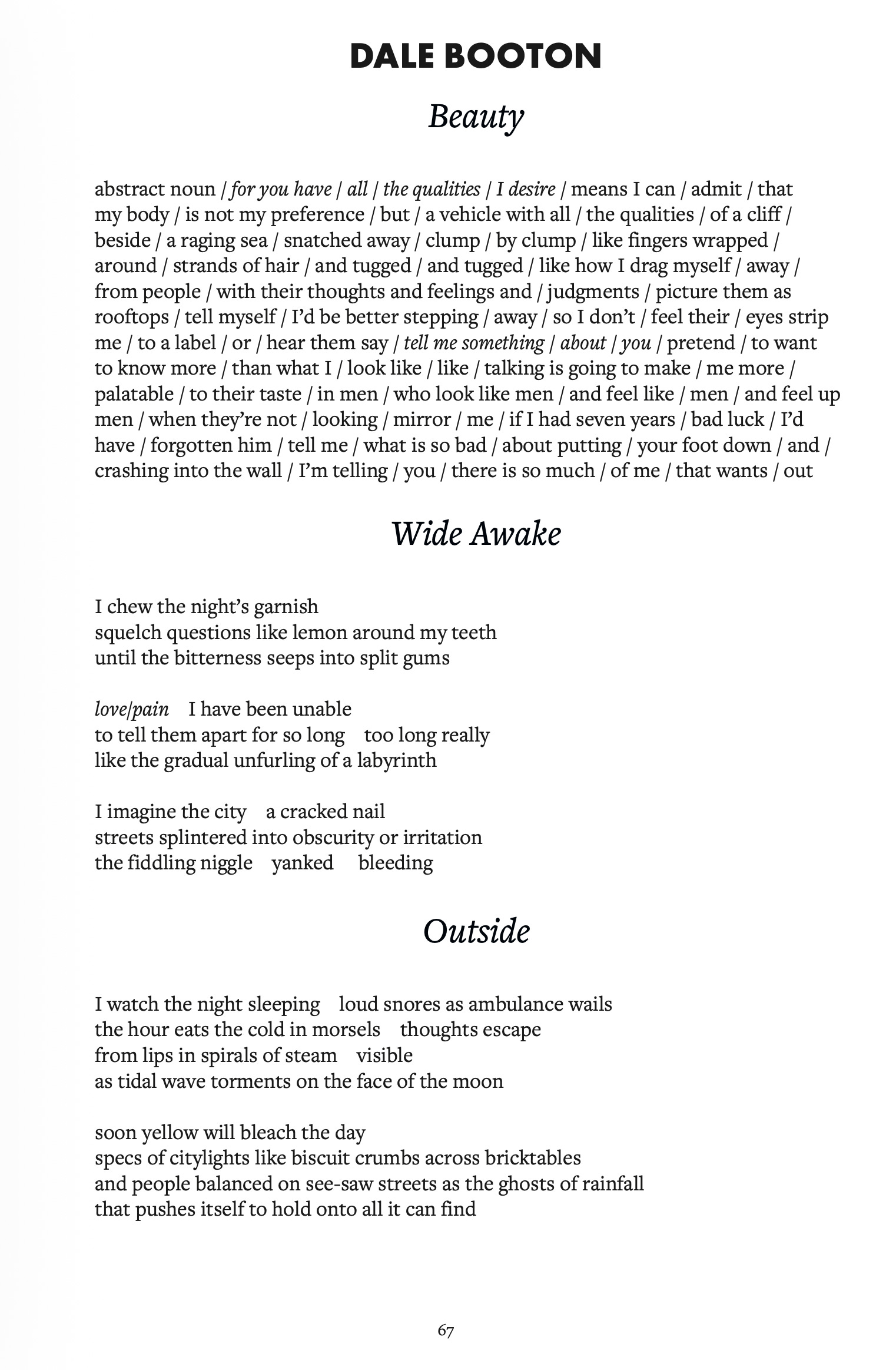
Three poems by Dale Booton from Issue One
Feb 2400:01:26Tap to summarizeEditorial Note by Max WallisWhat I love most about Dale Booton’s poems is the unpalatability of them — and I mean that as praise!There is a quiet defiance in the way these poems refuse to make themselves agreeable. “Beauty” announces itself as an abstract noun and then immediately dismantles the idea that beauty can be stable, desirable, or even coherent. The slashes aren’t decorative; they feel like thinking under pressure, like a body trying to speak before it has fully decided what it is allowed to say. The poem moves in clumps, in tugs. It drags itself forward. It refuses the clean line, the polished turn. Even the word palatable appears like something caught in the throat — a recognition of how often bodies are asked to soften themselves for the comfort of others.The poem understands what it is to be looked at, to be translated by someone else’s appetite. It doesn’t ask to be admired. It insists on being felt in its resistance.Wide Awake:“Wide Awake” carries that resistance into the mouth. Lemon, split gums, bitterness seeping; the imagery is intimate and slightly uncomfortable. Love and pain sit beside one another without explanation, without hierarchy. The poem doesn’t attempt to separate them or resolve them into clarity. Instead, it lingers in the slow unfurling of a labyrinth, in the irritation that won’t quite subside. The city becomes a cracked nail, something picked at until it bleeds. It’s such a small, bodily metaphor, and yet it opens into something larger: the way restlessness becomes its own landscape.Outside:By the time we reach “Outside”, the interior has spilled into the world. Ambulance wails thread through sleep. Breath becomes visible in the cold air. The coming of morning doesn’t promise redemption; it bleaches. It exposes. The city lights are biscuit crumbs across brick tables — tender, almost domestic — but there’s still that sense of imbalance, of see-saw streets and rainfall pushing itself against whatever it can hold.What holds these poems together is not a single theme but a shared refusal to resolve. They do not rush toward epiphany. They do not perform neat catharsis. They stay with the abrasion… of being watched, of wanting, of not being able to untangle love from harm, of lying awake while the world insists on continuing.There is a line in “Beauty” that lingers long after reading: there is so much / of me / that wants / out. It doesn’t arrive as a declaration of freedom. It arrives as a fact. And that feels honest.In a moment where so much writing feels pressured to be easily consumed, easily shared, easily praised, these poems hold onto their roughness. They leave an aftertaste. They resist being smoothed down.That resistance is where their beauty lies. This is a public episode. If you'd like to discuss this with other subscribers or get access to bonus episodes, visit aftershockpoetry.substack.com/subscribe
Transcribe →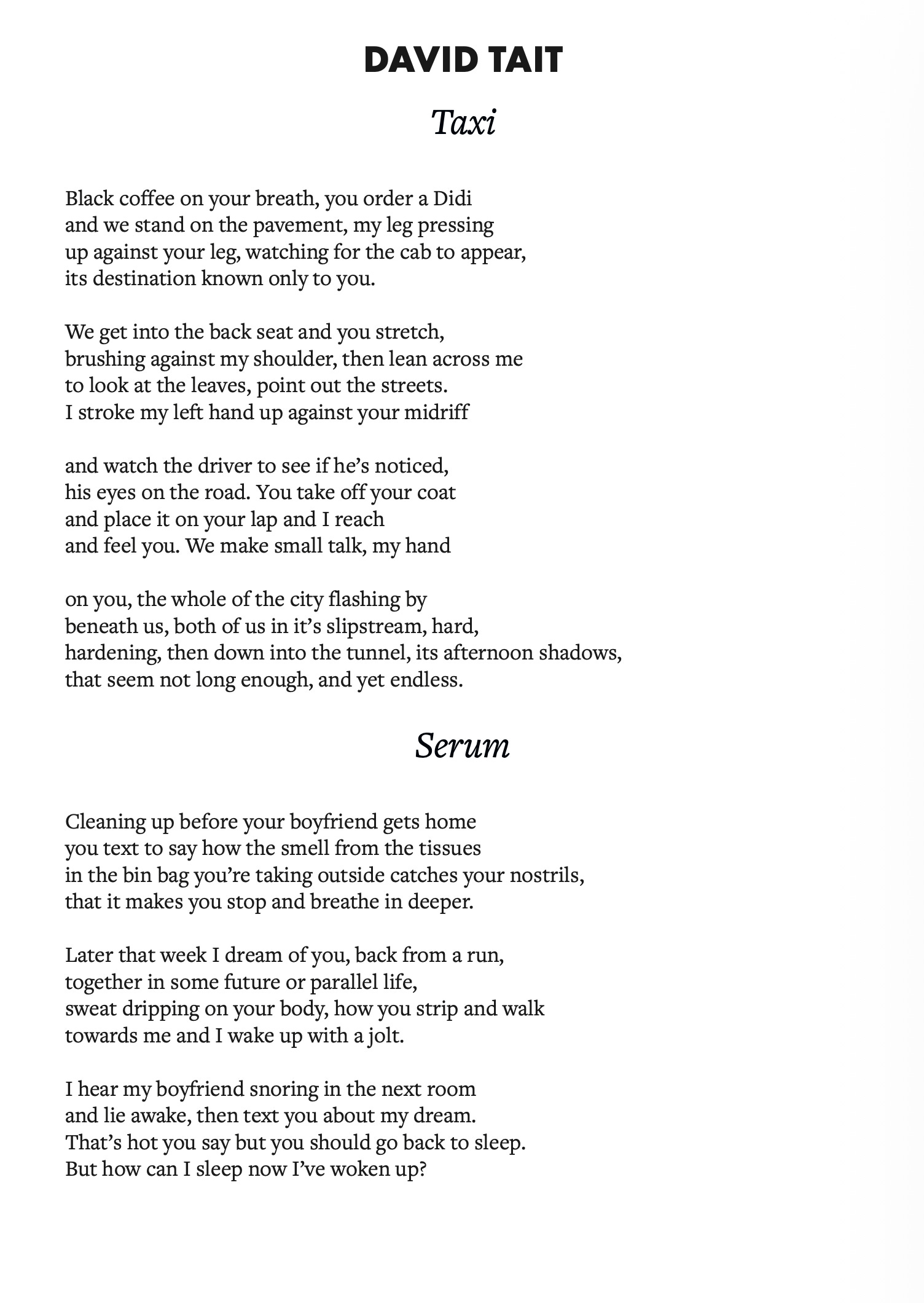
Two poems by David Tait from Issue One
Feb 1300:01:02Tap to summarizeSerum VO below:Editorial Note by Max WallisDavid Tait’s Taxi and Serum sit inside that charged space where queer life is both ordinary and illicit; tender and edged with risk. These are not grand declarations. They are moments: a hand resting too long in the back of a cab, the smell of tissues in a bin bag, a text sent at 3am when sleep isn’t happening.What I love about these poems is their restraint. The city flashes by; a boyfriend snores in the next room. Nothing explodes. And yet everything is happening. Desire here is threaded through secrecy, through glances at the driver’s eyes, through the knowledge that intimacy is both hidden and loud.This section of Issue One gathers poems that ask what we carry forward from queer histories — the codes, the caution, the thrill — and what we refuse. Tait’s work reminds us that sometimes the inheritance is not a manifesto but a touch, a tunnel, a text message we shouldn’t send and send anyway.In other news submissions are about to close for Issue Three: This is a public episode. If you'd like to discuss this with other subscribers or get access to bonus episodes, visit aftershockpoetry.substack.com/subscribe
Transcribe →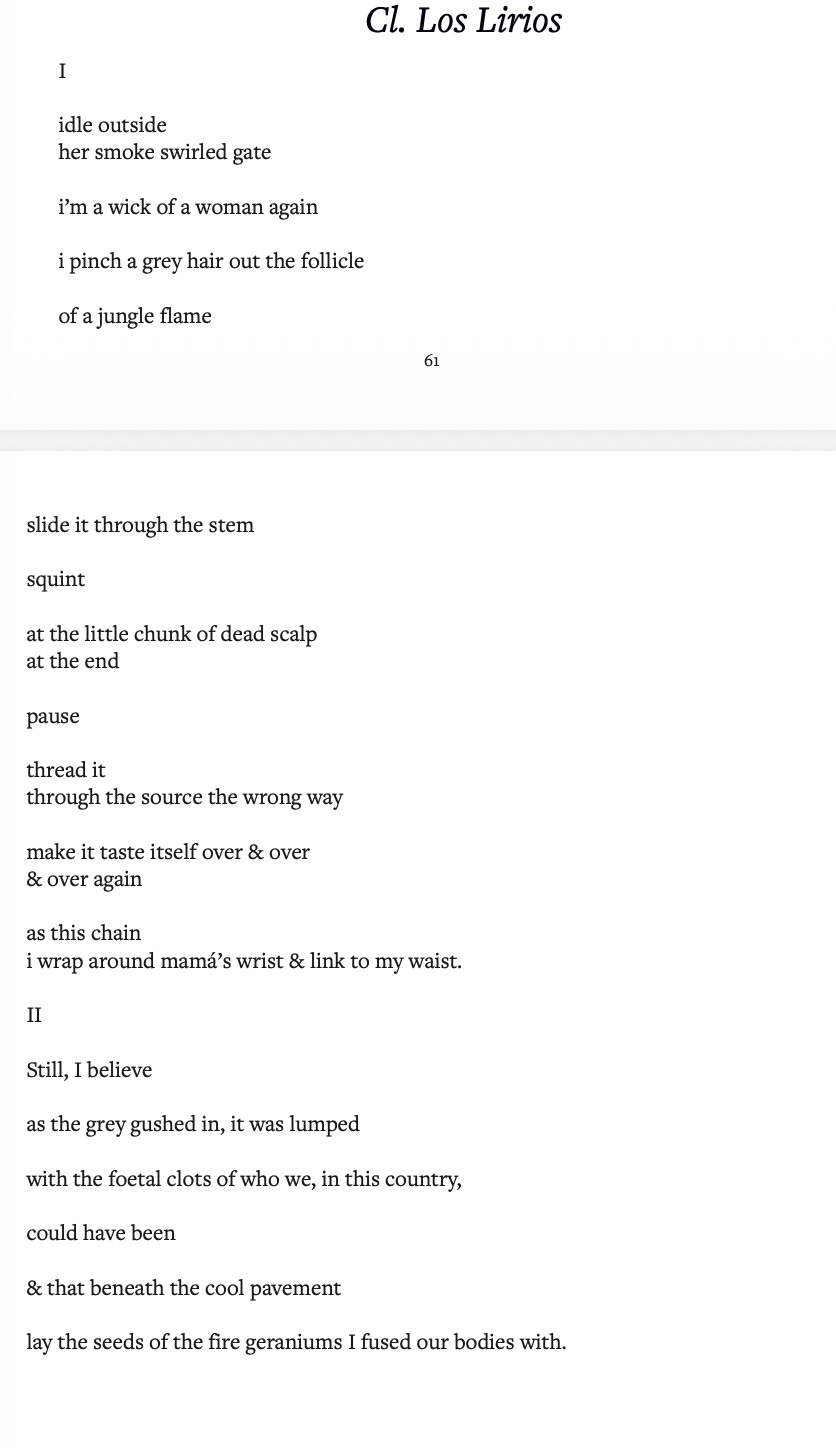
Cl. Los Lirios by Soledad Santana
Feb 200:01:05Tap to summarizeEditorial Note by Max WallisIn Soledad Santana’s third and final poem from Issue One the body is not a metaphor, it’s the mechanism. A grey hair becomes thread, becomes fuse, becomes something passed hand to hand, wrist to waist, mother to child. The poem never explains this. It just does it, again and again, until repetition itself becomes the point. What we inherit is not always chosen, but it is always felt.There’s also a quiet political pressure running underneath. The language of foetal clots, pavement, country. What is discarded, paved over, and lumped together. The poem refuses sentimentality, but it doesn’t let go of belief either. I love how the ending turns downwards, into the ground. Not redemption exactly. More a stubborn insistence that something survives, even if it’s buried, even if it takes time to burn its way back up.Perhaps, really, it’s about how love can be a chain and still be a way through.Soledad Santana is a Venezuelan, London-based poet, feminist community organiser, and human rights researcher. She’s a current member of the Barbican Young Poets programme. She has co-created various zines, including Tangled Tongues / Lenguas Enredadas, which examines the politics of monolingual publications and self-translation, and collates Spanglish poetry and short fiction.Recently, she’s interested in the new Latin American gothic. Instagram: @Lasoledadsantana This is a public episode. If you'd like to discuss this with other subscribers or get access to bonus episodes, visit aftershockpoetry.substack.com/subscribe
Transcribe →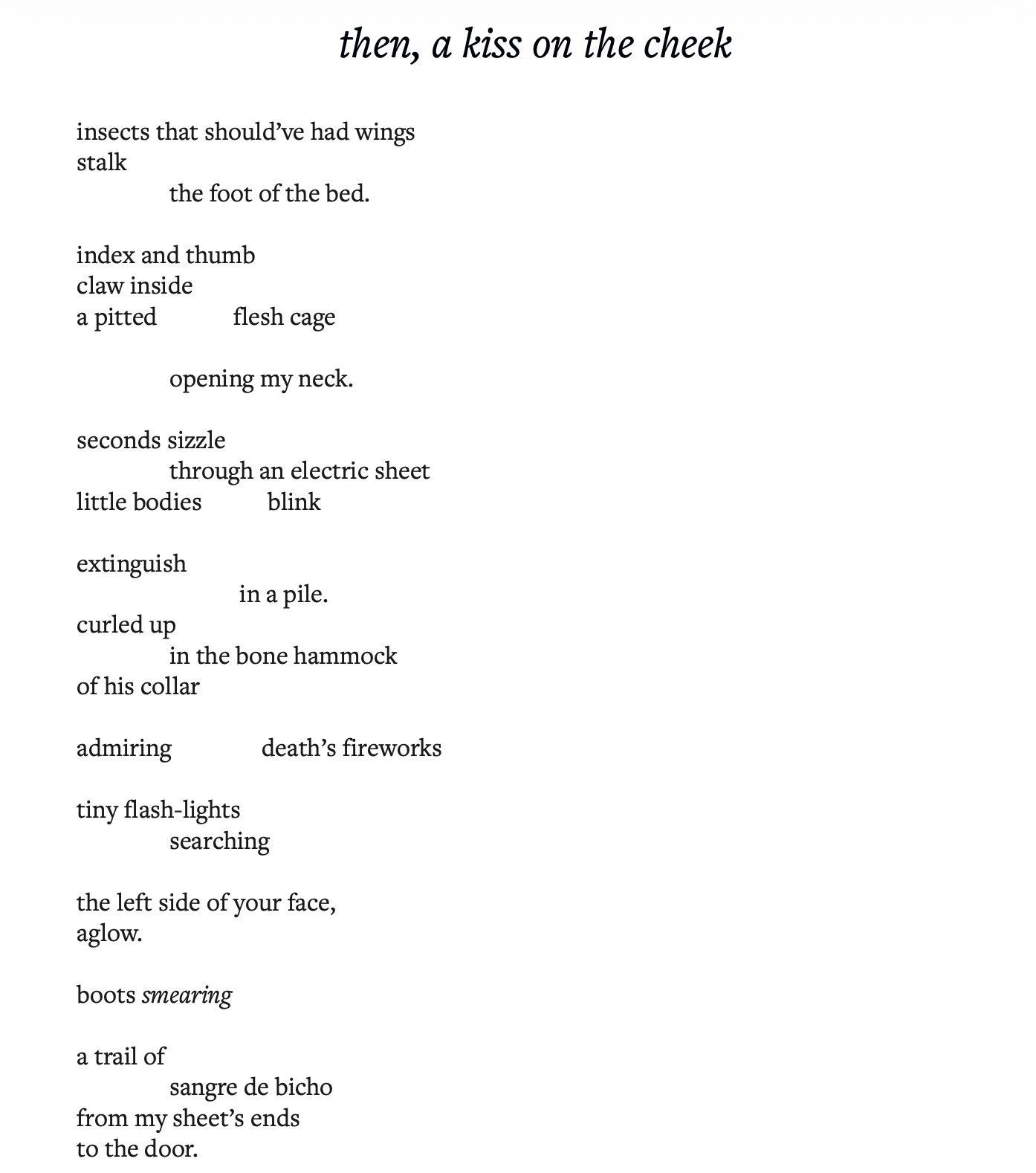
then, a kiss on the cheek by Soledad Santana
Jan 2600:00:51Tap to summarizeSoledad Santana’s second poem from Issue One is unsettling in its calm. It takes place in a room we recognise, with objects we think we understand, and lets them slip out of register. What should be small and incidental begins to feel deliberate. What should be affectionate begins to bruise.The poem pays close attention to sequence and consequence. Each action leaves something behind, whether that’s heat, light, or trace. The insects are not symbols to be decoded but lives interrupted, noticed just long enough for their erasure to matter. By the end, the poem offers no commentary, only a trail. The reader is left with evidence rather than explanation, and the uncomfortable knowledge that nothing here was accidental. This is a public episode. If you'd like to discuss this with other subscribers or get access to bonus episodes, visit aftershockpoetry.substack.com/subscribe
Transcribe →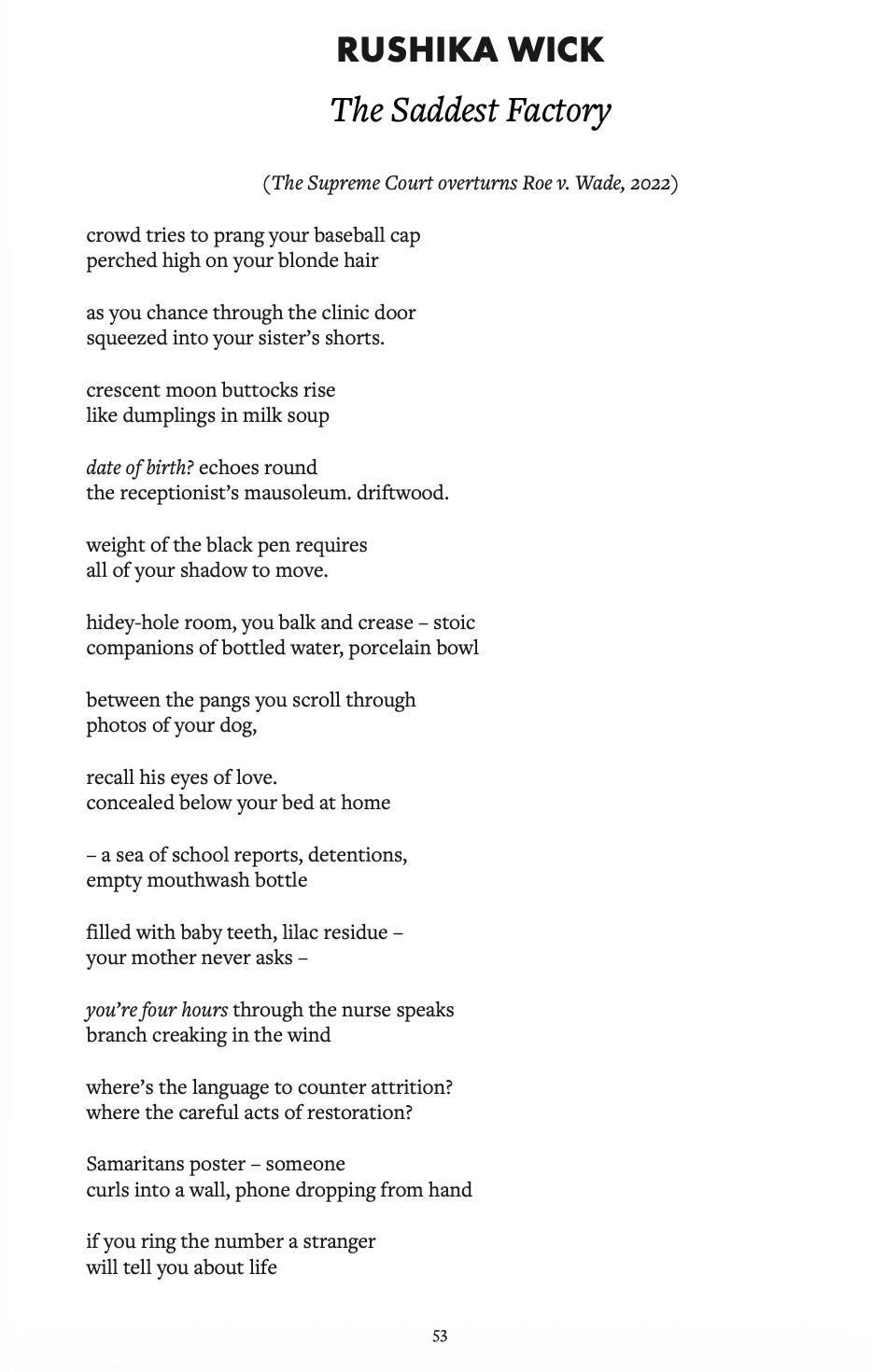
The Saddest Factory by Rushika Wick
Jan 1200:01:30Tap to summarizeSome poems don’t so much argue but stand their ground.Rushika Wick’s The Saddest Factory enters Issue One’s Section VI - A Furious and Tender Reckoning at the point where fury turns inward, where political catastrophe is no longer abstract but lived in the body, minute by minute. Written in the aftermath of the US Supreme Court’s overturning of Roe v. Wade, the poem refuses spectacle. What I love most is that it embodies the events. It attends to the logistics of harm: the waiting room, the pen, the form, the phone in the hand. What is stripped away here is not only rights, but language itself.The power of this poem lies in its refusal to reduce grief to slogan or symbol. Wick understands that damage often arrives quietly, through clipboards and posters, through polite questions that echo like mausoleums. The speaker moves through a system designed to be neutral and efficient while everything inside them is unravelling. Even tenderness, the remembered eyes of a dog, the domestic relics hidden under a bed, feels fragile, smuggled in against the steady pressure of attrition.The Aftershock Review is a reader-supported publication. To receive new posts and support my work, consider becoming a free or paid subscriber.Section VI gathers poems that reckon with harm without abandoning care. Wick’s poem is furious not because it shouts, but because it notices. It asks the hardest question in the room: where is the language for restoration? The poem leaves us with the knowledge that too often there is none. Only the number on the wall, and a stranger on the other end of the line, trying to explain how to go on.This is a poem that understands survival as something procedural, bodily, unfinished, and insists that attention itself is a form of resistance.You can buy Issue One here: Here’s Rushika reading it below, too:The Aftershock Review is a reader-supported publication. To receive new posts and support my work, consider becoming a free or paid subscriber. This is a public episode. If you'd like to discuss this with other subscribers or get access to bonus episodes, visit aftershockpoetry.substack.com/subscribe
Transcribe →
Day 95 - Back to bed and poems from illness
Dec 400:04:31Tap to summarizeI’ve been in bed for days — which, historically, has not been a promising sign for me. My body tends to associate “back to bed” with “things are about to go very wrong” or, rather: “Hell is here, and you’re going to have to buckle-up.” PTSD taught it that. My brief stint in hospital taught it that. Those long months of recovery where the ceiling felt more like a lid hammered shut on life, and one that would never be lifted.And yet this time, the culprit wasn’t psychological collapse but something far less dramatic: honest-to-God manflu. Snot, coughing fits, a temperature. For once, my body handed me symptoms I could trust — visible evidence instead of dread, instead of night terrors, instead of the what-ifs and whys of a life relived over and over again when you do not want to be reliving it. It was something that for once didn’t require a trauma glossary or a risk assessment or psych evaluation to understand. Instead it was the damp inevitabilty of manflu.There were small mercies in the evidence around me: the phlegm, the phlegm, the curling, ripped, red-green-yellow Lemsip sachets piling like confetti by the kettle.Snot, for once, wasn’t because my sinuses were shredded by cocaine.My chest didn’t rattle because I’d smoked twenty cigarettes the night before.And my immune system wasn’t a casualty of litres of vodka.This was simply a cold.A democratic, boring, biological cold.But I spent a long time in bed for different reasons. Addiction is one of the most full-on commitments a person can make — a devotional practice of self-erasure. And my whole post-addiction identity is built on the opposite: work, community, writing, reading, publishing, showing up, holding the centre when for so long that centre fell.So lying in bed again carries an ache. Not fear of relapse but the phantom memory of the life where bed was the only geography I had. A place that blurred the days into each other until they stopped being days at all.And yet: this time is different. This is not collapse. This is convalescence.It reminds me of what Issue One taught us… that illness is never just illness; it is metaphor, history, a weather system inside the body. When Claire Snook writes “touch grounds me… a cup, a foot on the floor” in Seizure 1, she names exactly what I feel today: how the smallest, realest objects become proof you’re still here. Or Di Slaney, in Lay my head on fleeces, longing for the warm bodies of sheep during a seizure because the animal world carries a steadiness we can’t always muster. ‘If I have another seizure, put me with / the sheep. They won’t stand on me’And in Issue Two, Lydia Unsworth’s transient ischaemic attack when she references “Mr Jelly on stilts” — lets humour lean into terror without breaking it. Or Stef Pixner’s woman “fantastic in a red dress… blazing” before diagnosis dims her glow. These poems understand how illness tilts the room, how the body becomes an unreliable narrator, in fact, but they also understand endurance, the clarity that arrives after the fright.So here I am, in my grey silk bedding, noticing the same small proofs Aftershock poets also notice: the hum of the radiator, the cat shifting twice before committing to my hip. Ginger on my tongue. Lemsip gold. The benign boredom of being unwell.Once, this would have undone me. I used to confuse tiredness with danger. Fatigue with relapse. Stillness with a return of the dark.Recovery has taught me to distinguish them.A cold is just a cold. A bed is just a bed. Not a disappearance. Not the preamble to catastrophe.There is a poetry to this kind of illness — the safe kind — and it’s one that Aftershock has been writing across two issues: the body whispering, not screaming. The body inconveniencing you, not endangering you. The body asking for rest, not rescue.Sometimes recovery isn’t heroic. Sometimes it’s simply this: the radical act of lying down without fear. This is a public episode. If you'd like to discuss this with other subscribers or get access to bonus episodes, visit aftershockpoetry.substack.com/subscribe
Transcribe →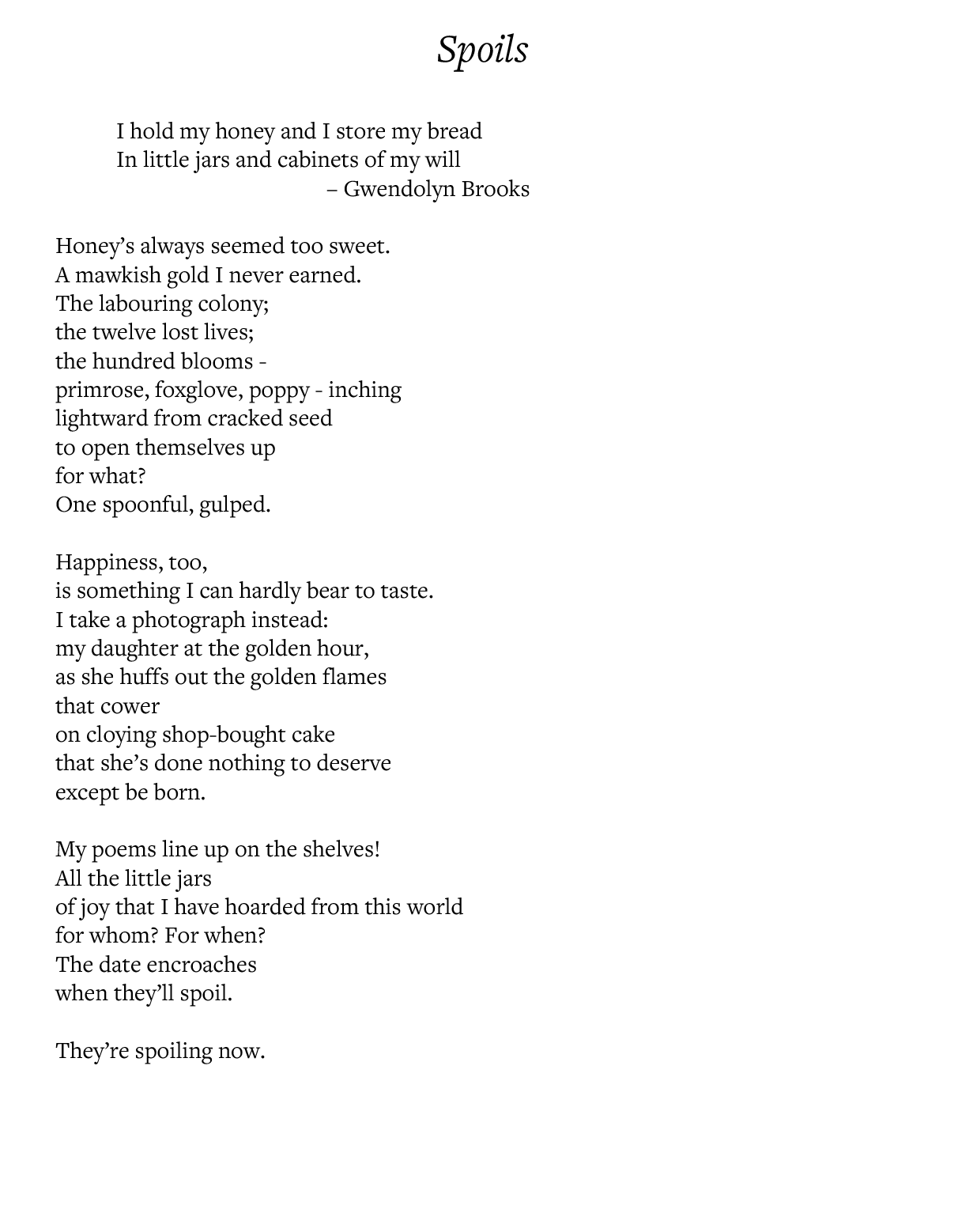
Spoils by Clare Pollard & ruminations on poetry
Nov 1300:01:17Tap to summarizeEditorial Note by Max WallisIn Pollard’s second poem in Issue One, Spoils, she returns to one of her most quietly devastating territories: the sweetness we’re taught to accept but can’t quite swallow. The poem begins in honey, golden, excessive, a substance that feels both earned and unearned at once, and moves quickly into the wider question of what we inherit, materially and emotionally, without ever having asked for it.Here, sweetness is labour: the hive, the blooms, the careful work of other lives. And yet it is also something the speaker can hardly bear. Pollard threads that ambivalence through the maternal moment at the poem’s centre, where a child in late-afternoon light extinguishes her candles with the kind of effortless grace adults forget how to believe in. It’s a scene suffused with tenderness, but shadowed by the knowledge that joy doesn’t always arrive in a form we know how to keep.By the time we reach the shelves lined with “little jars,” the poem has become an inquiry into the very act of making—poems as stores of sweetness, poems as perishables, poems as offerings whose future readers aren’t guaranteed. Pollard writes into that anxiety with unusual frankness: that preservation is not the same as permanence, and even our most careful hoardings have a date by which they must be opened or lost.Spoils sits exactly where Issue One wanted to begin… at the point where beauty and unease hold one another upright, where joy threatens to turn, and where the poem becomes a vessel for what we are afraid to taste in real time.I’ve been thinking a lot today about what writing poetry is. Based on this Bluesky by Rishi Dastiday (also in Issue One): It made me think and respond:What is it to write poetry? It is soft hope, breath made paper, part unpeeling, part armour, part wish, part prayer. A mosaic that appears only when the pieces of us settle. Sometimes the poem asks; sometimes the reader answers; often the answer is simply the act of making.I think Clare’s poem does likewise.Max WallisPS These orders went to singapore, arran, southampton and more today!The Aftershock Review is a reader-supported publication. To receive new posts and support my work, consider becoming a free or paid subscriber. This is a public episode. If you'd like to discuss this with other subscribers or get access to bonus episodes, visit aftershockpoetry.substack.com/subscribe
Transcribe →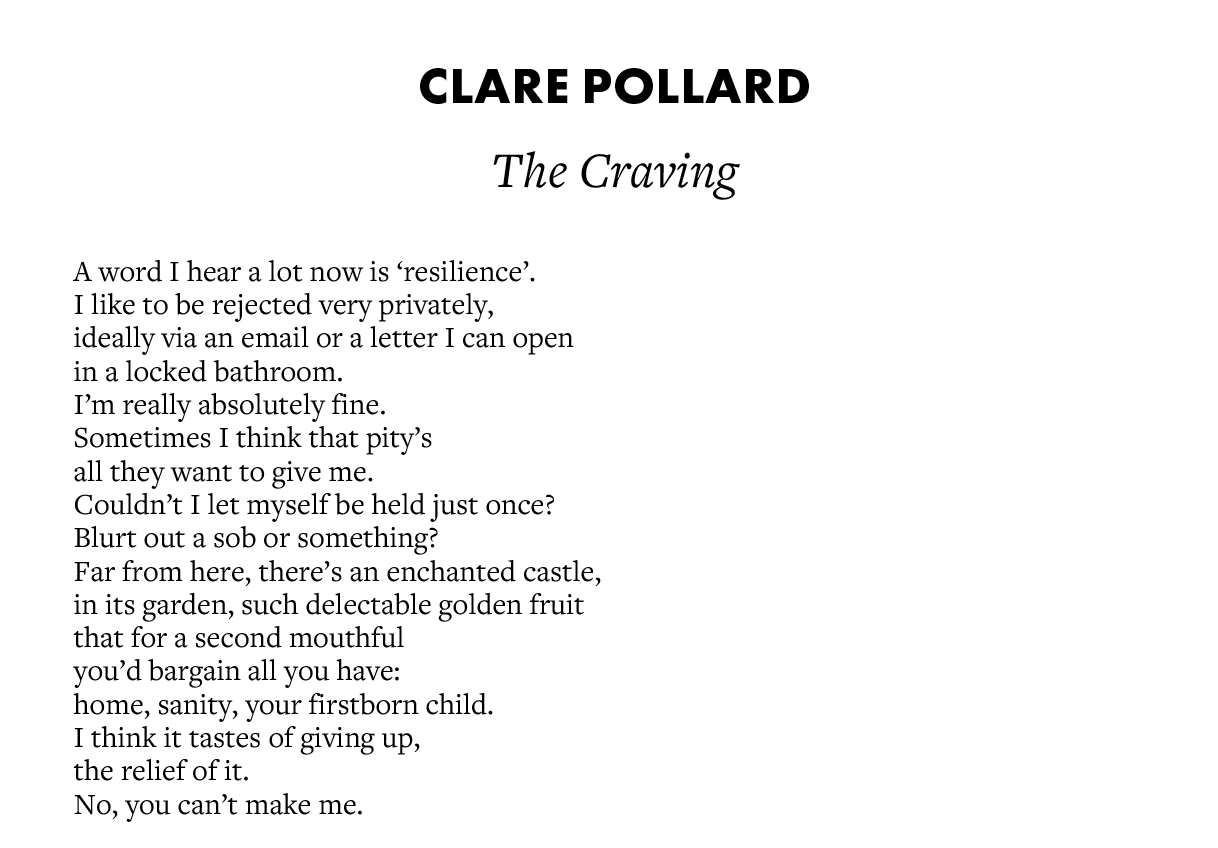
The Craving by Clare Pollard
Nov 700:00:59Tap to summarizeEditorial Note by Max WallisWhat does it mean to be resilient when what you crave most is permission to stop pretending? In The Craving, Clare Pollard writes from the quiet exhaustion of motherhood: the need to hold everything together, the refusal to be seen breaking. Her humour is wry and deliberate: rejection emails, locked bathrooms, the polished insistence of I’m fine.Then the poem tilts from the domestic to the mythical. Toward “an enchanted castle” and its golden fruit, shimmering with the forbidden relief of letting go. That fruit becomes the impossible bargain between care and collapse, self-preservation and surrender. It’s here that Pollard lays bare the hunger beneath endurance and the tenderness caught in the very act of suppression.The poem’s closing defiance of No, you can’t make me rings with both fury and fatigue: a mother’s protest against the expectation to be endlessly strong, and the faint mercy of still standing, because, as Pollard says earlier: I’m really absolutely fine.Clare Pollard’s most recent books are the children’s novel The Untameables and the adult novel The Modern Fairies. She has published five collections of poetry with Bloodaxe, with her sixth, Lives of the Female Poets, forthcoming in 2025. Her poem ‘Pollen’ was nominated for the Forward Prize for Best Single Poem.www.aftershockreview.com This is a public episode. If you'd like to discuss this with other subscribers or get access to bonus episodes, visit aftershockpoetry.substack.com/subscribe
Transcribe →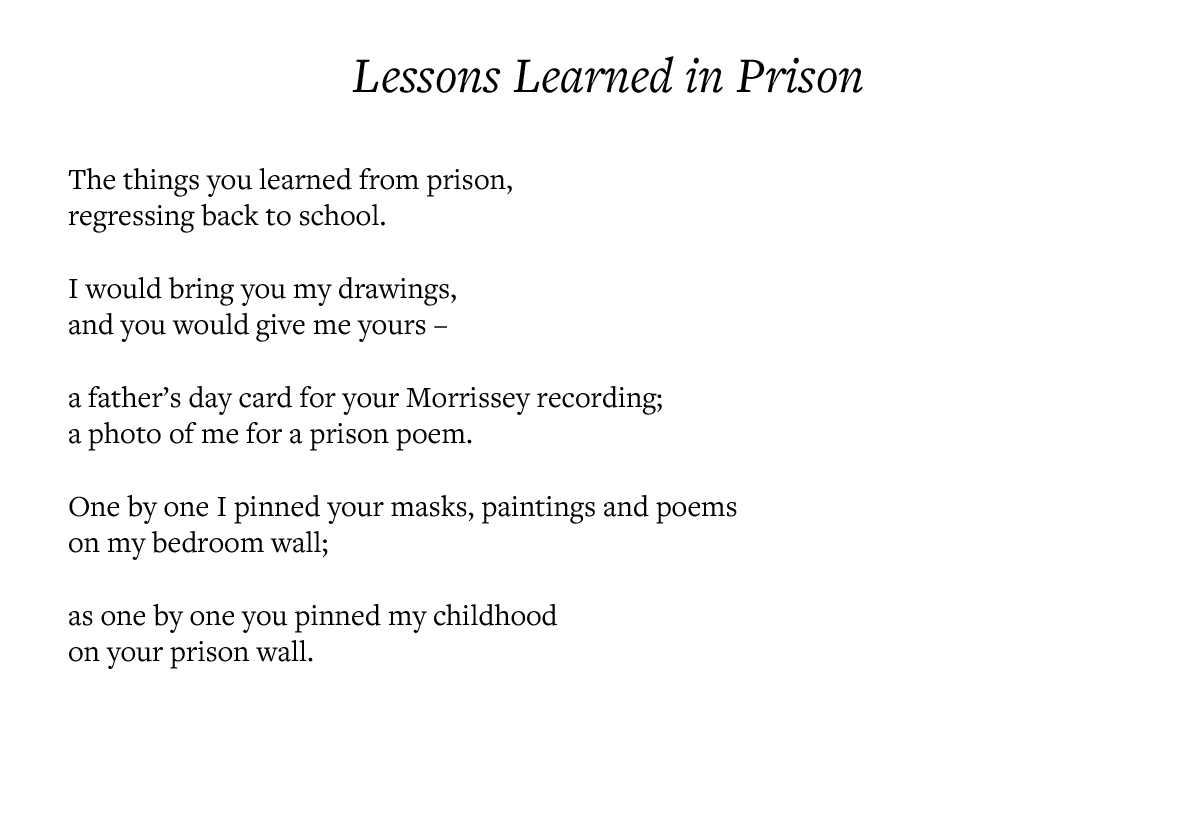
Lessons Learned in Prison by Dominique Dunne
Nov 100:00:29Tap to summarizeEditorial Note by Max WallisThis final poem closes Dunne’s sequence with quiet devastation. Where Mother exposed injustice and Father held distance, Lessons Learned in Prison becomes an act of paternal and perhaps therapeutic exchange: a daughter and father trading art across walls, both remaking what connection remains.Dunne writes the unbearable with calm precision. The imagery is domestic, almost gentle — drawings, masks, Morrissey tapes — yet beneath it runs the ache of role reversal. The father becomes the student; the child, the keeper of his work. Each gift between them is both tenderness and evidence, an attempt to bridge the distance that punishment insists upon.The final lines turn the mirror: “as one by one you pinned my childhood / on your prison wall.”It’s an ending that collapses time, in fact: love preserved as memory, art, guilt, and survival. Dunne’s restraint allows what’s unsaid to ring louder than any declaration. Across these four poems, she builds a portrait not of crime, but of care endured: the fragile un-eraseable bond between parent and child, even when the world has taken everything else.Dominique Dunne is a former Barbican poet and poetry producer for the Shake the Dust Festival at Southbank Centre. She has supported Kae Tempest, performed at Ronnie Scott’s, and delivered a TEDx talk on original writing. Dominique holds a BA in Creative Writing from Bath Spa University and has taught poetry to both children and adults. Writing from personal experience on heartache and joy, she believes that ‘Poetry can bridge the gap between the personal and the universal.’ Currently, she works as a creative career coach, helping young people break into the arts. This is a public episode. If you'd like to discuss this with other subscribers or get access to bonus episodes, visit aftershockpoetry.substack.com/subscribe
Transcribe →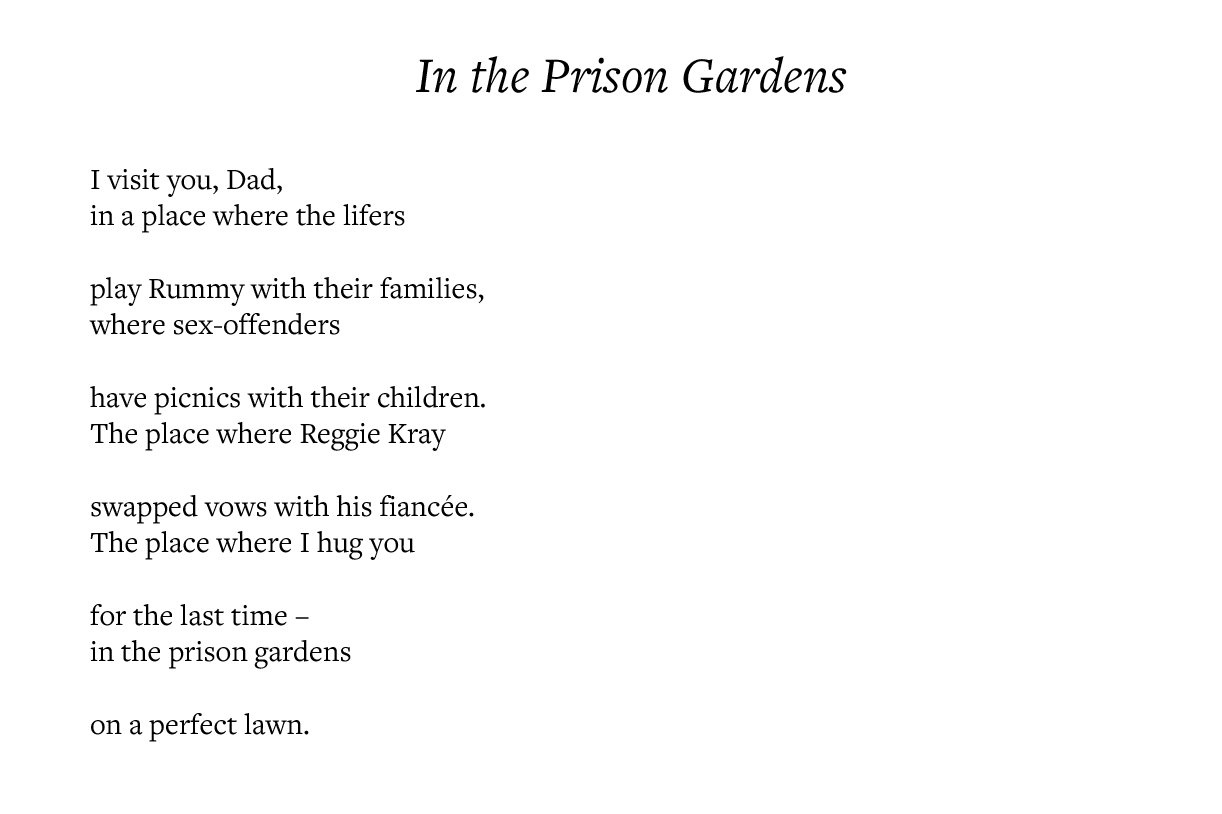
In the Prison Gardens by Dominique Dunne
Nov 100:00:24Tap to summarizeEditorial Note by Max WallisAcross Dunne’s sequence, we move from the mother’s humiliation to the child’s car journey toward the father’s absence. By the time we reach In the Prison Gardens, love exists only within visitation hours… a ritual of limited touch, a tenderness fenced by rules.The poem is devastating in its restraint. Dunne frames the setting with almost documentary calm: “lifers play Rummy with their families,” “offenders have picnics with their children.” The world she enters is both ordinary and impossible: a place where the worst people are allowed moments of grace, and where she must find her own.The final image — “on a perfect lawn” — carries all the ache of what’s unsaid. Perfection here means control, containment, an unnatural order imposed upon grief. Yet within that manicured space, a daughter’s love reaches through the system, however briefly.Dunne writes the unwriteable: how love survives its own disfigurement, how memory keeps touching what the body can’t.Dominique Dunne is a former Barbican poet and poetry producer for the Shake the Dust Festival at Southbank Centre. She has supported Kae Tempest, performed at Ronnie Scott’s, and delivered a TEDx talk on original writing. Dominique holds a BA in Creative Writing from Bath Spa University and has taught poetry to both children and adults. Writing from personal experience on heartache and joy, she believes that ‘Poetry can bridge the gap between the personal and the universal.’ Currently, she works as a creative career coach, helping young people break into the arts. This is a public episode. If you'd like to discuss this with other subscribers or get access to bonus episodes, visit aftershockpoetry.substack.com/subscribe
Transcribe →